Wednesday, April 02, 2025

APRIL 2, 1948 
FR. ACHAD 
(CHARLES STANSFIELD JONES) 
DECLARED THE AEON OF MAAT\ OR MA-ION


Wisdom in the Aeon of Maat 

I have recently been getting excited about the release of this forthcoming book published by those wonderful people at Starfire  and thought I’d share a piece of writing that appeared in my book The Heretic’s Journey that sought to explore the key role of Nema’s work in manifesting the aeon of Maat:

In reflecting upon the Aeon of Maat and how Nema’s own work developed the initial articulation by Frater Achad, I feel one of her wisest insights relates to the importance of “the double current” in seeking to develop a more balanced magical path. In contrast to simply seeing our current age as needing the mono-message of Thelema or Will, Nema’s own journey has been towards a place where the overlapping Aeons of Horus and Maat dialogue with each other.

maat.png

Horus; “Welcome!” Ma’at; “In peace.”

The issue of how Magicians in the West quantify progress has always been a tricky one. Yes, we may choose to rely on the grade system mapped out by a given Order that we participate in, but this is no guarantee of personal evolution. Grades and titles are not without value, but they seem to function primarily as markers of progress within the given sub-culture of that Order. I think a more interesting and potentially demanding question is how we translate any claimed maturation into social or cultural change.

Such dilemmas are not unique to overtly Gnostic or Magical religious paths, with most religions having to grapple with the more collective or political dimensions of their original spiritual message. Certainly in the Buddhist tradition the historical development of the Mahayana tradition (from the earlier Theravarda) reflects an attempt to explore the more collective implications of that philosophy.

The pursuit of true will as a project for the contemporary Mage certainly resonates with the existential and individualistic concerns of the 20th century that birthed Thelema, but is it enough? The icon of Horus as the conquering child certainly seems to capture the type of surging technological change of the last century, but to my mind this energy needs some counter-balance.

The primary symbolism in ancient Egypt regarding the goddess Maat reflect her position as the neter (divine principle) of justice and balance. The hieroglyph of the feather is seen as representing the breath of life, as well as the standard against which the human heart will be weighed at the judgement. Her other symbol of the ruler is in keeping with these ideas of accuracy, assessment and truth.

For Nema (and Achad) the importance of the Horus/Maat “double current” is that it at once acknowledges the need for a prophetic cleansing of a corrupt Piscean/Osirian age, while at the same time recognizing that such change needs balance and stabilization in order to prevent “Will” becoming egoic megalomania. I see great parallels between Maat and the Gnostic Sophia as the embodiment of wisdom. The punk rock energy of Horus may get the revolution started, but in the longer term we need our Aeons to overlap and to allow a multiplicity of perspectives to support us in the cultivation of a fairer society.

maat2

This idea of the Aeons being sequential and dominated by mono-mythologies is frequently promoted in esoteric lore, and while it may have been helpful and even accurate in times past, I believe that the value of such an approach is now limited. What Nema seems to be pointing towards (and which Maat herself embodies) is the importance of allowing these differing Aeonic currents to dance with and inform each other, and create what she describes as a “PanAeonic Magick”.

In my view Pete Carroll highlights something similar in his seminal “Mass of Chaos B”:

“In the first aeon, I was the Great Spirit
In the second aeon, Men knew me as the Horned God, Pangenitor Panphage. 
In the third aeon, I was the dark one, the Devil. 
In the fourth aeon, Men knew me not, for I am the Hidden One
. In this new aeon, I appear before you as Baphomet The God before all gods who shall endure to the end Of the Earth.”

Liber Null and Psychonaut

In contrast to those ages ruled by a singular narrative or dominant discourse, now is the time of Baphomet, a deity more overtly borne of humanity’s creative imagination. Baphomet embodies duality itself and transcends it, within their being they hold the ongoing process of dissolving and coming together.

I believe the Aeon of Maat with its core message of balance holds within it the possibility of the multiple, and the aspiration of being able to recognize numerous perspectives and approaches. Nema’s artistic depiction of N’Aton captures much of this as the half of their face that is visible contains a multitude of individuals dwelling in a futuristic city scape. N’Aton represents the potentiality of a future in which dualities are played with by the Magician: transcended, discarded, redefined and embraced in accordance with a true will that balances both individual freedom and collective responsibility.

The icon of N’Aton provides a potential map for the Magician’s project of self-sovereignty. N’Aton seeks to balance the needs for individual self-definition and collective connection. Rather than getting overly focused the type of brittle, self-obsession that can tip into solipsism or megalomania, for me N’Aton asks that any claims to insight are pressure tested in the realm of wider society. In many ways the Aeon of Maat closely parallels the description of the Aquarian age as described one of Nema’s magical colleagues Louise Martinie of the New Orleans Voodoo Spiritual Temple:

The Aeon in which we are presently incarnate has been called by various names. “Aquarian” seems to be the designation which is most widely used in the New World cultures. The Aquarian mode emphasizes profound searching, a reliance on experiential knowledge, and a uniting of diverse occult systems. Aeonic Voodoo seeks to incorporate these dispositions in its structure. 

Waters of Return: The Aeonic Flow of Voudoo

He then goes on to describe this Aeon’s defining features:

Anarchism; the state of being without a “frozen” hierarchy. Postdrogeny; the abrogation of all existent gender roles so that new perceptions may manifest. Feminism; as it is in the forefront in its stand against restriction and for human liberation. Equalitarianism; the belief that all people have equal political and social rights, and Nonviolence; a refusal to subject the self or others to physical coercion. 

Whether we define this Aeon as being Aquarian, of Maat, or holding a multiplicity of overlapping words, we seem to be moving towards a place where language and definitions are being asked to become more plastic and amorphous in trying to stay alive to the diversity of human experience.

Steve Dee

 November 22, 2019


visibility

889 Views

description

6 Pages

2008, Silver Star: A Journal of New Magick, Issue 9 (Spring Equinox, 2008)

Page numbers: 76-81
Publication date: 2008
Publication name: Silver Star: A Journal of New Magick, Issue 9 (Spring Equinox, 2008)

The brief ritual Nexus of Horus/Maat, composed by Aion 131 (= Denny Sargent) in 1995, is here given in full with commentary from various online sources. Many of the webpages and sites from which material was drawn in 2006-2007 are now defunct.


Methods of Maat (2024) excerpts: Introduction and The Distractions of Liber Salomonis

By Don Karr
visibility

3669 Views

description

26 Pages

2024, Methods of Maat

Methods of Maat shows the inner workings of two Maat-centered entities, the OAI and 416, offering full transcripts of their most revealing texts.


SEE

https://ia8SEE00601.us.archive.org/35/items/KennethGrant/Nightside-of-Eden-KennethGrant_text.pdf

Fellowship of Ma-Ion. Secret magic order founded by "Frater Achad" (Charles Stansfeld Jones ), a close associate and magical child of magician Aleister Crowley.
35 See Chapter 8 for Frater Achad's interpretation of the Aeon of Maat. Page 14. 18. Cults of the Shadow. Immediately after this critical stage in the rite the ...

Charles Robert Stansfeld Jones aka Frater Achad, was a Canadian occultist and ceremonial magician. An early aspirant to the A∴A∴ (the 20th to be admitted as ...
The Frater Achad Library: 31 Hymns to the Star Goddess, Anatomy of the Body of God, Chalice of Ecstasy, Crystal Vision Through Crystal Gazing, Freedom an Essay.

METHODS OF MAAT. (excerpts). INTRODUCTION. THE DISTRACTIONS OF LIBER SALOMONIS. METHODS OF MAAT. Don Karr. © 2024. ####### © 2019/2024 Don Karr.

The 42 ideals of Ma'at · The following translation is by E. A. Wallis Budge from his original work of the Egyptian Book of the Dead. Each confession is preceded ...


Web Results

Jul 12, 2020 ... The Seven Principles of Ma'at. An error occurred. Try watching this video on www.youtube.com, or enable JavaScript if it is disabled in your ...

The seven principles are Truth, Justice, Harmony, Balance, Order, Propriety, and Reciprocity. What is Maat known for? Ma'at was an Ancient Egyptian Goddess who ...

Maat or Maʽat comprised the ancient Egyptian concepts of truth, balance, order, harmony, law, morality, and justice. Maat was also the goddess who ...


Tuesday, April 01, 2025

CAPITAL STRIKE

UK Tax Reforms Prompt Billionaire Mittal to Consider UAE Move

  • Steel billionaire Lakshmi Mittal is set to leave the UK after nearly 30 years due to the government's crackdown on non-domiciled residents and changes to tax rules.\

  • Mittal, the executive chair of ArcelorMittal, is considering relocating to more tax-friendly destinations such as the United Arab Emirates, Italy, or Switzerland.

  • The UK's changes to non-domicile tax rules, including the removal of offshore trusts for inheritance tax, have led to concerns about an exodus of wealthy individuals from the country.Steel billionaire Lakshmi Mittal is set to leave the UK, as a direct result of a government crackdown on non-domiciled residents, in favour of more tax-friendly destinations such as the United Arab Emirates, Italy and Switzerland, the FT has reported.

The businessman, a former Blair-era Labour donor and Sunday Times Rich List number seven, is set to leave the UK after nearly 30 years.

The Indian entrepreneur owns a number of properties in the UK, including a mansion in Kensington Palace Gardens which he bought from Bernie Eccleston in 2004 for £67m – then the world’s most expensive home. 

Mittal was chief executive of ArcelorMittal until four years ago, when he stepped down in favour of his son Aditya Mittal. 

He remains executive chair of the group – a 2006 merger of Mittal Steel and European steel giant Arcelor – and his family retain a 40 per cent stake in the firm. 

ArcelorMittal’s business lines span from steel production to wire products, logistics and shipping. 

Ahead of the October Budget, the firm threatened to leave the UK, warning the new government’s industrial strategy must do more to protect the steel industry’s supply chain.

Non-doms were previously able to avoid paying UK taxes on income from overseas.

Rule changes were first introduced by former Chancellor Jeremy Hunt back at the March 2024 Budget – in part, as a political manoeuvre to outflank an existing Labour policy commitment – and will take effect on 6 April. 

Rachel Reeves has since recommitted to the plans, and has pulled the plug on offshore trusts as a workaround for inheritance tax. 

Rachel Reeves has since made some concessions back in January in an attempt to stem the exodus of the super rich from the UK, introducing a new residence-based scheme to offer some tax incentives for international investors. 

The Temporary Repatriation Facility – the new scheme – is by its nature limited by a transition period, and has a significantly shorter sunset period than the outgoing non-dom tax arrangement.

By City AM

Confidence Plunges Across UK Manufacturing Sector


  • The latest S&P Global PMI shows a deepening downturn in UK manufacturing, with the index falling to a 17-month low.

  • Rising costs due to wage increases, national insurance contributions, and geopolitical tensions are significantly impacting manufacturers, particularly small businesses.

  • Tax increases and a fall in output during the first quarter of the year have contributed to an "ominous" sign of decline in the UK manufacturing sector.

The latest S&P Global’s UK Purchasing Managers’ Index (PMI) shows that UK manufacturing’s woes have deepened.

S&P Global’s latest PMI survey, which asks around 600 industrial companies about their performances, suggests that manufacturing is again in the downturn following a poor start to the year. 

The latest figure showed that it decreased to 44.9, which was slightly better than the figure of 44.6 that economists had predicted. 

This was the lowest reading in 17 months, compared to an average of 51.7 between 2008 and 2025.

Rob Dobson, director at S&P Global Market Intelligence, said the outlook was “darkening” as confidence was plunging across the sector.

“Companies are being hit on several fronts,” said Dobson.

“Costs are rising due to changes in the national minimum wage and national insurance contributions, geopolitical tensions are intensifying, and global trade faces potential disruptions from tariffs.

“Although the impact on production volumes was widespread across industry, it was again small manufacturers that took the hardest knock,” he said.

The manufacturing sector had already taken a turn for the worse in the new year. 

The Confederation of British Industry (CBI) said a fall in output in January suggested businesses were “conserving funds” as a result of Reeves’ tax raid, which includes hikes to national insurance contributions (NICs). 

Those taxes, which see the threshold at which employers begin to pay the levy drop to £5,000, are set to come into effect this week. 

The CBI’s survey said that only three out of 17 manufacturing sub-sectors saw an increase in output.

Meanwhile, the industry body Make UK said a fall in output during the first quarter of the year for the first time in a decade was an “ominous” sign.

By City AM 


India Steel Sector Faces EU Carbon Rule Challenge

  • India's steel sector, heavily reliant on coal, faces significant financial penalties from the EU's Carbon Border Adjustment Mechanism (CBAM) unless it rapidly adopts low-carbon technologies.

  • Indian steel producers, including major players like Tata Steel and JSW Steel, are implementing initiatives such as renewable energy integration and carbon capture to reduce emissions and meet evolving global standards.

  • Despite efforts, India's steel industry needs to accelerate its decarbonization efforts to remain competitive in the European market and avoid substantial carbon costs, which could reach up to $116 per tonne by 2034.

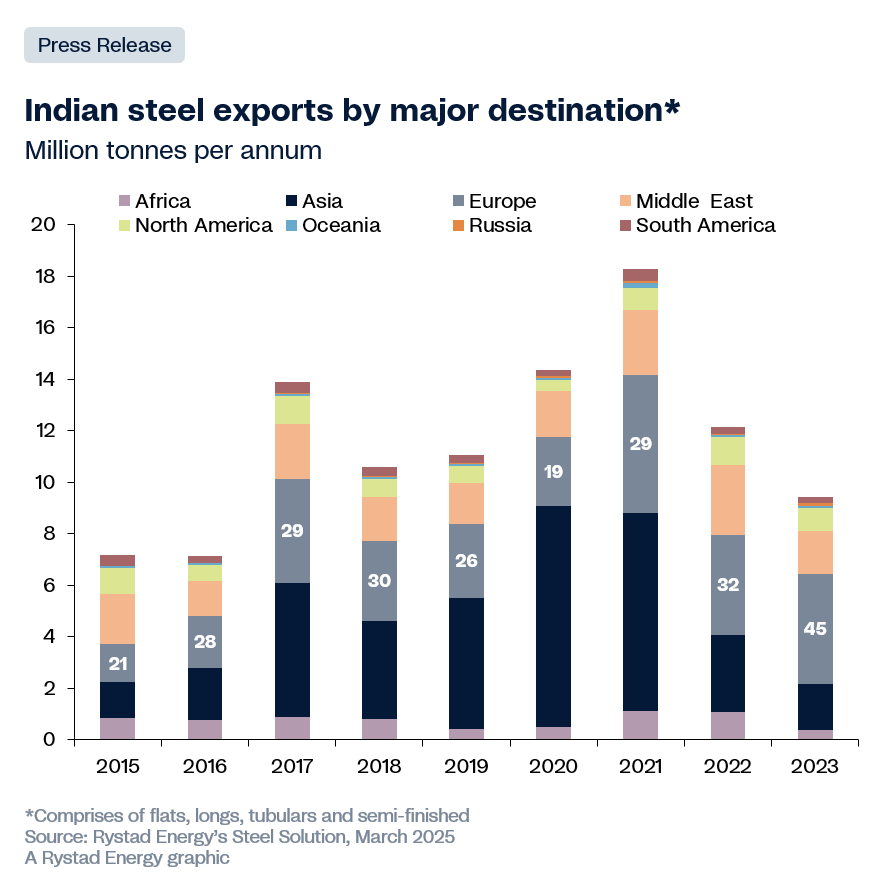
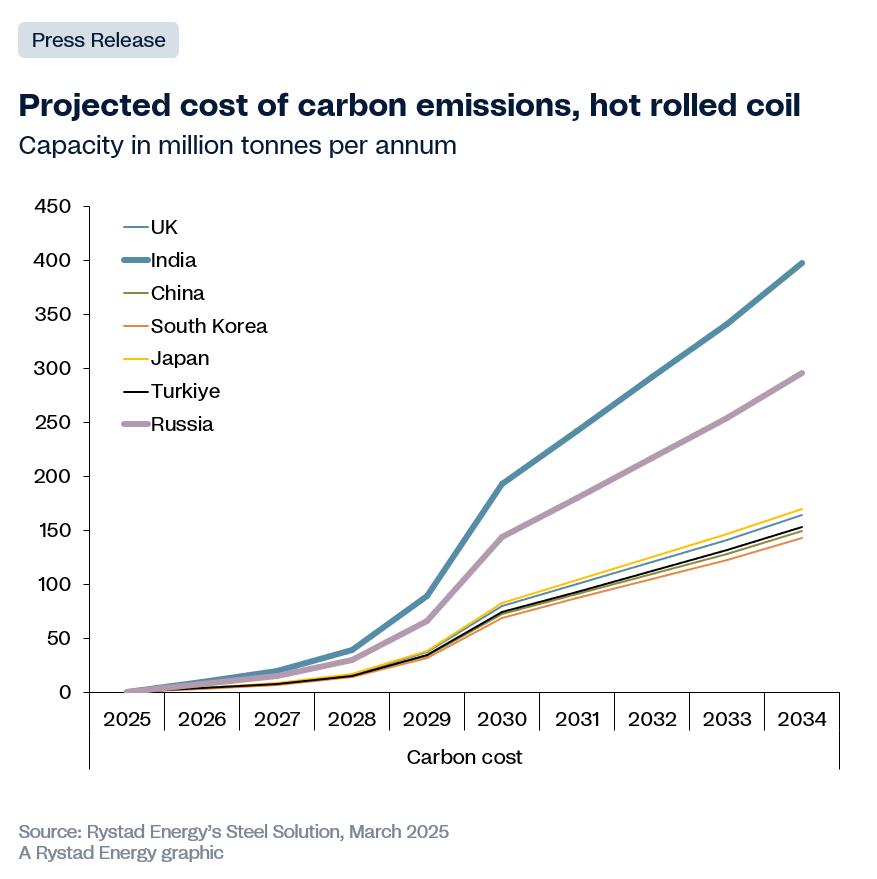
The Indian steel sector—the world’s second-largest—faces a critical challenge in 2025 as the European Union (EU) tightens its environmental standards, intensifying its focus on carbon neutrality. With Europe being key customer for Indian steel, accounting for 25% of exports, India must urgently comply with stricter carbon regulations to avoid steep financial penalties that could undermine its global position in the steel market. Rystad Energy’s research suggests that by 2034, India and Russia could face some of the highest carbon costs in steel production, potentially incurring levies of up to $397 per tonne, even if carbon prices remain stable.

Key policy shifts, such as the EU’s Carbon Border Adjustment Mechanism (CBAM), which will take full effect by 2034 but begins next year, will assign a carbon cost to imports, including steel, based on embedded carbon emissions. According to the EU’s Joint Research Centre (JRC), India’s steel production is more carbon-intensive than most of its global competitors. As a result, this policy could impose a potential surcharge of up to $80 per tonne by 2030 unless cleaner technologies are adopted in India. These rising costs threaten to undermine the country’s competitiveness in the European market, making its steel less attractive compared to lower-emission alternatives. South Korea and Turkey are well-positioned to benefit from this shift and could potentially displace India from the top three producers.

In the coming years, reducing carbon emissions could extend beyond regulatory compliance and become a competitive necessity as buyer sentiment continues to evolve. Governments and industries are increasing support for low-carbon technologies, and companies that fail to adapt risk falling behind. In India, where steelmaking remains heavily reliant on coal, transitioning to low-carbon alternatives such as natural gas-based ironmaking or green hydrogen will require substantial investment and innovation. However, with limited time for transition, India must confront the carbon cost challenge in front of them, as early adopters of greener production methods could gain a stronger competitive edge in global markets

Alistair Ramsay, Vice President, Supply Chain Research, Rystad Energy

 Learn more with Rystad Energy’s Steel Solution.

In response to these policy shifts, the Indian government and its biggest steel players are tweaking their approaches to adapt to their external environment. The Indian government introduced a green steel classification system under the Production Linked Incentive (PLI) scheme in December 2024. Under this framework, steel producing less than 2.2 tonnes of carbon dioxide (CO?) per tonne of finished steel qualifies as ‘green,’ while steel with emissions below 1.6 tonnes per tonne earns a five-star rating. The initiative aims to incentivize Indian steelmakers to cut emissions and adopt cleaner technologies. Discussions are also under way to mandate green steel in public sector projects, potentially reshaping domestic demand.

The nation’s top five largest steel producers – namely Tata Steel, JSW Steel, Jindal Steel & Power (JSPL), Steel Authority of India (SAIL) and AM/NS India – collectively account for more than 50% of the nation’s steel output and have made changes with some setting net-zero carbon goals as early as 2045. To curb emissions, these producers are also adopting a mix of renewable energy integration, process optimization and circular economy initiatives.

Tata Steel, for instance, will commission a 0.75 million tonne per annum (Mtpa) electric arc furnace (EAF) plant in Ludhiana by March for low-carbon steel production. The company has also invested in a carbon capture plant in Jamshedpur and is securing 379 megawatts (MW) of captive renewable power for its operations. Meanwhile, JSW Steel, targeting net-zero emissions by 2050, has raised $500 million through sustainability-linked bonds and is expanding production using low-carbon technologies. The company has also committed $1 billion to decarbonization and is incorporating biomass and hydrogen into its processes for steel making.

In addition, these domestic giants are also planning major capacity expansions, with total production projected to reach 189 Mtpa by 2035. While this growth is essential to meet both domestic and global demand, it must be carefully balanced with emission reductions if decarbonization and scale are to advance in tandem.

Currently, these companies are on track to cut emissions by only 43% in the next decade—well below the levels needed to comply with stringent EU standards and mitigate CBAM-related costs. Furthermore, if this trajectory continues Indian steelmakers could face carbon costs of up to $116 per tonne by 2034, assuming a carbon price of $100 per tonne. This slow progress leaves Indian steelmakers vulnerable to significant carbon taxes, potentially $116 per tonne by 2034, and jeopardizes their competitiveness in the EU due to rising carbon penalties and India's high carbon intensity.

By Rystad Energy

Peak Permian? Geology and Water Say We’re Close

  • Some areas in the Permian have hit geological limits while others, yet to be drilled, are not expected to be as prolific as the prime Tier 1 acreage.

  • Despite record U.S. crude oil production, limits to growth have started to emerge.

  • In the Permian, the gas-to-oil ratio (GOR) has steadily risen from 34% of total production in 2014 to 40% in 2024.

After more than a decade of relentless drilling in the top U.S. oil-producing basin, the Permian, some areas have hit geological limits while others, yet to be drilled, are not expected to be as prolific as the prime Tier 1 acreage that producers have started to exhaust.

Top executives at major shale firms have already expressed opinions that Permian oil production could hit its peak as early as the end of this decade.

To be sure, crude oil output in the top basin continues to rise, but growth has slowed since 2022—not only because producers restrain capex and don’t drill themselves into oblivion.

Higher gas-to-oil ratio and water-to-oil ratio in the Permian suggest that some formations in the basin are reaching geological constraints, and more drilling isn’t necessarily proportionate to the oil volumes produced.

The Permian still leads U.S. oil production growth and will do so in the coming years, forecasters including the Energy Information Administration (EIA) say.

Total U.S. crude oil production is expected to average 13.61 million bpd this year, rising to 13.76 million bpd next year, according to the EIA’s latest Short-Term Energy Outlook

Despite record U.S. crude oil production, limits to the growth have started to emerge, executives acknowledge.

Vicki Hollub, the chief executive of Occidental Petroleum, said at the CERAWeek conference early this month, “We think that between 2027 and 2030 it's likely that the U.S. will see peak production, and after that some decline.”

Ryan Lance, CEO at ConocoPhillips, expects U.S. oil production to plateau this decade and remain flat for an undefined period of time after 2030.

“It’s going to be a slow decline beyond that because there’s a lot of resource” left to drill, Lance told the CERAWeek conference.

However, what’s left to drill may not be as oil-yielding as the best Permian locations, which were the first to be tapped by drillers.

Production of associated natural gas from the Permian, the Eagle Ford, and the Bakken oil wells has surged over the past decade, the EIA says.

In the Permian, the gas-to-oil ratio (GOR) has steadily risen from 34% of total production in 2014 to 40% in 2024.

Pressure within the reservoir declines as more oil is brought to the surface, which allows more natural gas to be released from the geologic formation. The pressure will also decrease as more wells are concentrated within an area, the EIA says.

Another ratio is even more suggestive of the Permian oil wells and the operating costs for drilling wells—produced water.

The water-to-oil ratio in the Permian is much higher than in other basins. On average, four barrels of water are produced for each barrel of oil, according to data from oilfield water analytics firm B3 Insight cited by Reuters.

While the Permian crude production is set to exceed 6.5 million bpd in 2025, up from more than 6 million bpd in 2024, the basin “is simultaneously generating an unprecedented volume of produced water—a costly and complex byproduct of hydrocarbon extraction,” B3 Insight said this week.

Crude-focused wells in the Permian account for the vast majority of the produced water generated in the leading U.S. shale plays, analysts at RBN Energy said last year.

The higher produced water ratio will ultimately drive costs for oil producers higher, according to Shannon Flowers, director of crude and water marketing at Coterra Energy.

“There are only so many places to drill, inject and frac, and as that goes down, you still have to find a home for the rest of your produced water,” Flowers told Reuters.

Higher costs to dispose of, reuse, or recycle produced water isn’t good news for U.S. oil producers who are already concerned with the U.S. Administration’s preference of a $50 a barrel oil price.

“There cannot be "U.S. energy dominance" and $50 per barrel oil; those two statements are contradictory. At $50-per-barrel oil, we will see U.S. oil production start to decline immediately and likely significantly (1 million barrels per day plus within a couple quarters),” an executive at an exploration and production firm wrote in comments to the Dallas Fed Energy Survey for the first quarter of 2025.

“The U.S. oil cost curve is in a different place than it was five years ago; $70 per barrel is the new $50 per barrel,” the executive noted.

By Tsvetana Paraskova for Oilprice.com

Renewables Alone Cannot Power AI Infrastructure

By Robert Rapier - Mar 31, 2025

The exponential growth of artificial intelligence is creating a massive increase in electricity demand, requiring significant upgrades to energy infrastructure.

Utilities are facing challenges in meeting this demand, leading to a renewed focus on natural gas and nuclear power alongside renewables.

Investors are seeing new opportunities in the energy sector as the demand for power to support AI growth drives significant capital spending and potential earnings increases.


For decades, U.S. electricity demand grew at a predictable, modest pace. Utilities could plan around gradual increases driven by population growth and economic activity. But that era is over. A dramatic shift is underway, one that could define the next decade of energy infrastructure—and investment opportunity.

At the heart of this transformation lies the exponential growth of artificial intelligence (AI) and its insatiable appetite for electricity.

The AI Boom’s Hidden Cost: Electricity

The rise of AI-powered tools—especially those using large language models and machine learning—has created unprecedented demand for computing power. These complex models require massive amounts of electricity not just during training, but continuously during deployment (or inference) as well.

This isn’t just about a few extra servers. AI data centers are power-hungry operations, often requiring the energy equivalent of a small city. Some estimates suggest that U.S. data centers could consume more electricity by 2030 than entire countries such as Japan or Turkey.

AI isn’t the only driver. The ongoing electrification of vehicles, heating systems, and industrial processes is also pushing grid demand to levels not seen in a generation. Together, these trends are accelerating what many experts are calling a new era for American energy.

The Utilities Are Feeling the Strain

From Texas to Northern Virginia, electric utilities are scrambling to adapt. Regions that already host dense clusters of data centers—like Virginia’s so-called “Data Center Alley”—are hitting capacity limits. In Texas and the Midwest, utility CEOs are sounding alarms over the pace and scale of new AI-related load requests.

The challenges are both technical and political. Meeting these new demands often requires massive upgrades to transmission infrastructure—projects that can take five to ten years to permit and build. Meanwhile, delays frustrate developers and risk driving AI firms to seek power from independent suppliers or alternative locations.

Utilities are being forced to rethink everything: where and how they build generation, how they plan grid expansions, and how to regulate and forecast demand. The traditional demand modeling tools that rely on historical trends are no longer sufficient in this brave new world.

Not All Power Is Created Equal

While renewables like wind and solar will play an important role in the energy future, they alone cannot power a 24/7 AI infrastructure. These sources are intermittent and cannot always match real-time demand, especially when split-second latency and uptime are critical.

That’s why natural gas and nuclear are regaining prominence in grid planning. Several utilities have fast-tracked proposals for new natural gas peaker plants. Others are evaluating small modular nuclear reactors (SMRs) as potential solutions for delivering steady, low-carbon baseload power.

AI’s power requirements could also increase support for energy storage solutions and grid-balancing technologies. However, these systems remain expensive and are still in the early stages of widespread deployment.

What This Means for Investors

For investors, this is a seismic shift. For decades, electric utilities were considered slow-growth, defensive investments. Now, the sector is experiencing a renaissance.

Grid operators, gas suppliers, and infrastructure developers stand to benefit as capital spending surges. Electricity producers—particularly those operating in competitive markets where prices can spike with demand—may see dramatic increases in earnings.

This is also reshaping the outlook for infrastructure-focused investors. Pipelines, transmission companies, and storage providers are emerging as critical enablers of the AI revolution. Likewise, energy-related REITs and midstream partnerships may experience tailwinds as capital pours into grid expansion.

That said, the investment story isn’t without risk. Regulatory hurdles, permitting challenges, and community opposition to new infrastructure could delay projects. Companies that fail to adapt may be left behind.

From Regulated to Unregulated: The Role of Utility Structure

It’s also important to understand the difference between regulated and unregulated utilities. Regulated utilities—typically the local monopolies delivering power to your home—earn fixed returns set by state regulators. These companies offer predictable, steady dividends and are popular with income investors.

In contrast, unregulated (or competitive) utilities sell electricity into wholesale markets, where prices fluctuate based on supply and demand. These companies are more exposed to market volatility—but also stand to benefit the most from surging demand and price spikes.

In this new environment, unregulated utilities may be the biggest winners. In fact, some of the best performers in the S&P 500 over the past two years are unregulated utilities like NRG Energy and Vistra. Their ability to capture rising electricity prices without regulatory constraints positions them for potentially outsized gains. But regulated utilities will still benefit from increased demand, albeit with more muted returns.

The Data Center Explosion

Just how fast is AI pushing demand? Forecasts vary, but all agree on the direction: steeply upward, with some projecting the kind of growth that hasn’t been seen since the early days of industrial electrification.

To put this in perspective, data centers are already among the largest industrial power consumers in the U.S.—and their footprint is expected to double or even triple by the end of the decade. In some regions, AI-related demand is already outpacing available capacity, forcing companies to seek power directly from private producers or delay projects until new infrastructure comes online.

Policy, Planning, and Grid Resilience


The implications go beyond Wall Street. State regulators are struggling to revise outdated Integrated Resource Plans (IRPs) to account for this surge in demand. Policymakers face pressure to streamline permitting for generation and transmission projects while balancing environmental concerns and grid reliability.

Meanwhile, resilience is becoming a front-and-center issue. With extreme weather events on the rise and cyber threats looming, ensuring the AI-driven grid is reliable and secure is no small task.

Conclusion: AI May Be Virtual, But Its Energy Demands Are Very Real

Artificial intelligence may seem like a virtual revolution, unfolding in data centers and software code. But its impact on the physical world—particularly the energy grid—is tangible and immense.

For investors, the message is clear: the AI story is no longer just about chipmakers and software developers. It’s about the concrete, steel, and copper behind the servers. It’s about the utilities and energy companies keeping the lights—and the GPUs—on.

As the world becomes more reliant on artificial intelligence, electricity will become one of the most critical enablers of innovation. Those who understand this dynamic—and position their portfolios accordingly—will be best prepared for what comes next.


By Robert Rapier