Friday, April 04, 2025

Can Photos Change Our Eating and Buying Habits and Politics? 


 April 4, 2025
FacebookTwitter

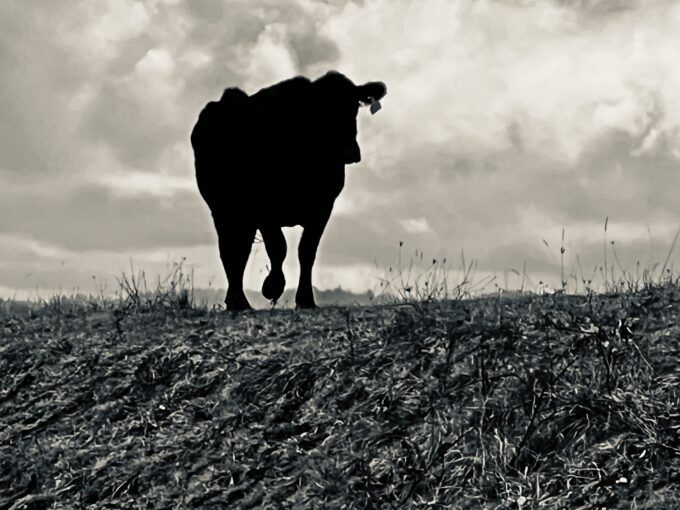
Black angus, Sauvie Island, Oregon. Photo: Jeffrey St. Clair.

The year was 1975. Actress Sally Struthers had charmed her way into America’s living rooms as Gloria Stivic Archie Bunker’s daughter on the hit sitcom All In the Family, married to “meathead.” But Struthers was known for something else. More prevalent than her appearances on All in the Family were her cloying pitches for the Christian Children’s Fund for which she was trying to use her “Family” fame.

Finally a glib SNL-writer wannabe came out and said what many were thinking when they saw her entreating, eternally earnest face: people were more interested in paying money for Struthers to shut up than helping the hungry children. Ouch.

The same phenomenon happened later with another charity: people began to dislike Jerry Lewis more than the muscular dystrophy telethons he ran.

Struthers’ and Lewis’ charities are not the only ones in which compassion turned against itself and people began to dislike the messenger. Animal exposes can also produce compassion backlash:

Yeah, yeah—we know veal calves are taken from their mothers at birth and allowed to freeze to death. We know chickens miss the knife and get boiled alive. We know newborn male chicks are ground up alive at hatcheries. What else is new? The problem is they still taste good and the cruelty videos ruin your appetite!

No one wants to be called bad and feel bad for their diet—and as long as there is more than one channel on peoples’ devices, they will tune out upsetting images.

 If farm practices are so cruel, why do restaurants, grocers and the government allow them people think. Aren’t there laws?

Animal Decimations

There is another backlash in addition to ridiculing empathy appeals—commercial interests.

If ever there were an appropriate use of the term “countless,” it is for the millions of farmed birds killed recently to prevent further spread of bird flu and profits.

Notice how big food and news outlets funded by big food have avoided displaying landfills of depopulated animals and terminated chickens? It might ruin people’s appetites… and sales!  (Of course, some of the terminated animals were fed to other animals—why waste good “protein”? Is that how bird flu got in cows’ milk, Big Food? Economies of scale?)

Like Covid, the current avian flu that is morphing to cows, pigs, pets and zoo animals before our very eyes was abetted—if not begun—by animal mistreatment. Most scientific studies attribute the first Covid—SARS—to practice of eating civet cats and raccoon dogs and slaughter-while-you-wait wet markets.

How does a virus mutating in the US spread so quickly to birds, pigs, cows and other animals? The oppressive incarceration of factory farming.

New York Times’ Columnist Nick Kristof Was Moved By Images

New York Times’ columnist Nick Kristof was no wild-eyed vegan but this is what he wrote after video of chickens legally boiled alive was released.

“Workers grab the birds and shove their legs upside down into metal shackles on a conveyor belt. The chickens are then carried upside down to an electrified bath that is meant to knock them unconscious. The conveyor belt then carries them–at a pace of more than two chickens per second–to a circular saw that cuts open their necks so that they bleed to death before they are scalded in hot water and their feathers plucked. Even when the system works as intended, the birds sometimes have legs or wings broken as they are shackled, the investigator said. And when it doesn’t work correctly, the birds’ end can be horrifying.”

Since Kristof wrote this, the slaughter line speeds have increased over the vehement objections of 26 groups of poultry worker representatives, worker rights advocates, occupational safety experts, animal right advocates, consumer rights advocates and public and community health organizations.

Upsetting Photos Can Work

Yes, a gory and emotional photo can make a difference if not censored by commercial interests or ridiculed. Who remembers “The Vulture and the Little Girl,” a 1993 photograph by Kevin Carter of a collapsed, famine-stricken child in Sudan with a vulture ready to pounce a few feet away?  Papers and magazines around the world published the photo and it was critical to fund raising efforts and famine relief that followed.


Martha Rosenberg is an investigative health reporter. She is the author of Big Food, Big Pharma, Big Lies.


The Rebellion of the Hippie Lumpen in Capitalist Berlin

BOOK REVIEW

 April 4, 2025
FacebookTwitter

Image by Nick Fewings.

West Berlin—the capitalist side of Berlin during the Cold War, was a city of radical ferment, especially in the 1960s into the 1980s. Groups calling themselves communist mixed with counterculture radicals, anarchists and varying combinations of any and all of the above. One of the best known of these groups called themselves the 2 Juni Bewegung—the 2nd of June Movement. Many of its members had previously been part of a loosely-knit band of provocateurs calling themselves Hasch Rebels. Of course, the Hasch referred to hashish, which was the most common form of cannabis available in Europe at the time. Like the Yippies in the United States, these folks were anti-authoritarian and leftlist, with most of them being from the German working class. Their targets included the police, the court system (which included many former Nazis), the mainstream press and US/West German imperialism, especially as it revealed itself in postwar Germany.

On June 2, 1967, many if not all of the individuals who would became the 2 Juni Bewegung took part in a protest against the Shah of Iran, who was visiting the city of Berlin. The Shah, who was the largest benefactor of US aid in the region we call the Middle East at the time, was gaining world renown for the repressive police state he was building in Iran. The protest turned violent when police working with Iran’s secret police the SAVAK, began to attack the crowd. A young man named Benne Ohnesborg was shot and killed. Hence, the name, 2 Juni Bewegung.

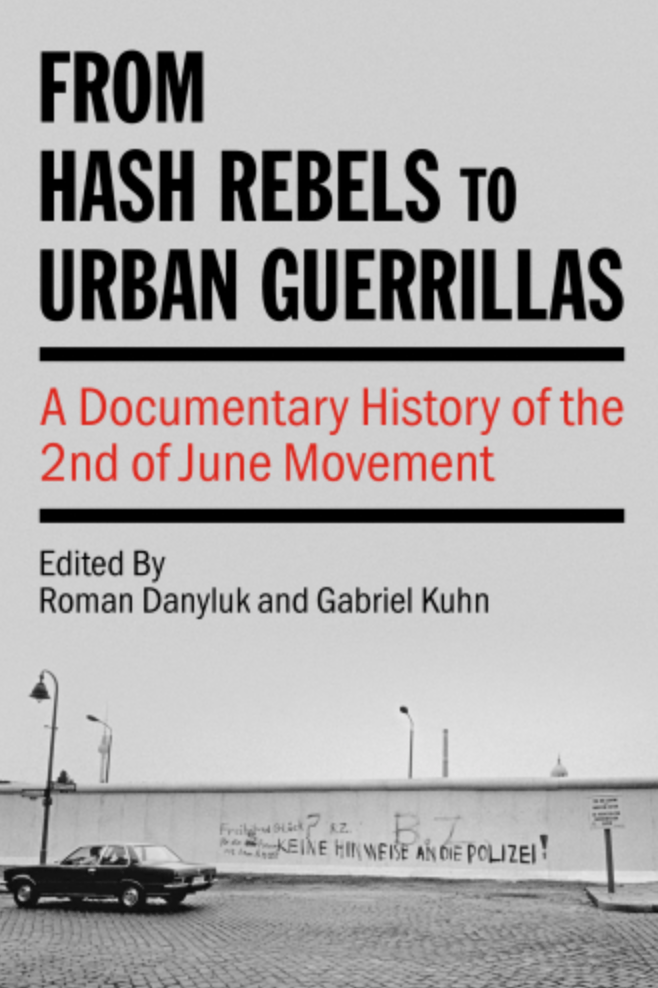
Although it certainly had its detractors, there was a relatively strong current in the western new left that supported and engaged in armed struggle. The reasons for this ranged from the political to the personal; from an impatience with the protest movements to a genuine attempt to create a revolutionary situation. Perhaps the best known of these groups engaged in armed struggle were Italy’s Red Brigades (BR), West Germany’s Red Army Fraktion (RAF) and the Weather Underground Organization (WUO) in the United States. This list does not not include groups from the Black liberation and other third world liberation movements in large part because of their very different relationship to US imperialism. The 2 Juni Bewegung should also be included in this list. The recent publication of From Hash Rebels to Urban Guerrillas: A Documentary History of 2 Juni Bewegung makes this quite clear.

Of the four groups mentioned above, it’s reasonable to state that each of them had their own approach. In other words, each group developed their praxis according to their understanding of what would be most effective for the role they hoped to play. Of course, that understanding was based on the makeup of their membership, their experiences in the greater society, who they were trying to engage and what their short and medium term goals were. For example, the Red Army Fraktion saw itself as part of the worldwide struggle against US imperialism—in league with the aremd fighters in the Vietnamese National Liberation Front and the Palestinian Liberation Organization. On the other hand, Italy’s Red Brigades considered their role to be one of organizing the working class of Italy into a revolutionary force. The Weather Underground, although originating from a desire to organize the white working class youth in the United States into a fighting force behind the Black revolutionary vanguard, ultimately spent most of its most active years acting more in the vein of the RAF, serving as something of a fifth column in support of the Vietnamese and other anti-imperialist/colonial struggles.

The 2 Juni Bewegung formed with the intention of fomenting revolution inside the metropole—the heart of western imperialism. Unlike the RAF and the WUO, it operated both underground and aboveground. This provided it with a consequent level of support among proletarian youth working and otherwise. This dynamic manifested itself in instances such as the distribution of leaflets in West Berlin after the group kidnapped conservative mayoral candidate Peter Lorenz and demanded the release of political prisoners in Germany. After 2 Juni Bewegung members and supporters provided the leaflets to various allies in the Berlin counterculture community, the leaflets were spread throughout the city. When all was said and done, between ten and twenty thousand were passed out, all while the city was locked down while the authorities searched for Lorenz, who was released unharmed after the prisoners had safely arrived in the then socialist country of South Yemen.

The basis of the group’s theory is simple and was one shared by many leftist groups in Europe, North America and elsewhere around the world. Its essence is expressed in this excerpt from a pamphlet written by the left feminist group Rote Zora in 1987: “capitalist accumulation turns all human activities, expressions and material conditions for survival into commodities.” The group’s analysis presciently displays a potential relevance to today, an example of which can be found in the closing statement of member Klaus Viehmann at his trial in 1981 (and reprinted with edits in the magazine Radikal later that year.) After discussing the state of the Left and anarchist movements, the counterculture and the Greens, the place of violence and the expanding police state from the street to the prisons, Viehmann turns his attention to the role of computer technology; “the collection of data,” he writes. “is one side of this dirty coin, and the access to it is the other.”(262) He continues in this vein, predicting the advent of a form of technofascism—where those with the computers can take over the world without leaving their secure facility. .

From Hash Rebels to Urban Guerrillas is a well-curated collection of many of the group’s leaflets, theoretical writings, transcripts of interviews and debates. Like they did with their earlier publication of the Red Army Fraktion’s documentary history, PM Press and Canada’s Kersplebedeb have produced a vibrant and informative text that is simultaneously history, prediction and even a potential source for contemporary organizing. The impeccable translation brings the lively, often impassioned and even humorous content of the originals to the English-speaking reader with all of it intact.

Ron Jacobs is the author of several books, including Daydream Sunset: Sixties Counterculture in the Seventies published by CounterPunch Books. His latest book, titled Nowhere Land: Journeys Through a Broken Nation, is now available. He lives in Vermont. He can be reached at: ronj1955@gmail.com


Reform the USDA


 April 4, 2025
Facebook

Harvey Washington Wiley, Chief Chemist of the Department of Agriculture’s Division of Chemistry (third from the right) with his staff in 1883 – Public Domain

Harry Truman once proclaimed: “No man should be president who doesn’t understand hogs.” That might explain the calamitous mess that President Trump and Elon Musk are making of our government today.

Clearly, Trump and Musk know nothing about four-legged farm animals. But they certainly know how to squeeze the government to fatten their own two-legged breed of corporate swine. Thus, the billionaire hucksters are bulldozing agencies that serve people’s real needs, while preserving those that subsidize corporate greed.

For example, the U.S. Department of Agriculture — a once-proud agency created by Abraham Lincoln to serve tillers of the soil. But today’s USDA has become a bottomless feeding trough for agribusiness giants and other financial powers that “till” taxpayers.

Our country’s Farm Program, meant to be a safety net for hands-on dirt farmers, is now a $20-billion-a-year subsidy that pays nothing to the vast majority of farm families. Instead, 75 percent of our money goes to the biggest and richest 10 percent of corporate fiefdoms, including billionaire speculators who never get any dirt under their fingernails.

Actually, the Trump-Musk chainsaw crew is whacking some USDA programs — such as food stamps for poor families, helping school districts buy from local farmers and ranchers, and other efforts providing modest help to grassroots people and communities.

But there’s not a peep from the duo about the bales of taxpayer cash hauled every year to their own class of rich elites.

A Department of Agriculture is as needed today as in Lincoln’s time. But an honest overhaul is necessary to return it to its democratic roots of serving the workaday people of rural America, freeing it from the corporate interests now running roughshod over those same people.

For more information, check out the Environmental Working Group at www.ewg.org.

James Hightower is an American syndicated columnist, progressive political activist, and author.