Is the Democratic party losing touch with working class voters? It’s hardly a debatable claim anymore. Exit polls from last November’s presidential election reveal that a commanding plurality of voters with incomes under $50,000 – 49%, in fact – voted for Trump, compared to just 48.5% for Harris. That’s an astounding turnaround from Barack Obama in 2008, who commanded 63% of these voters compared to 35% for John McCain. Even in 2012, when Obama’s re-election seemed in doubt for much of the year, the former president rebounded to earn 60% of the low-income vote, compared to 38% for Mitt Romney. Kamala Harris also suffered an unprecedented loss of support among minority voters – Hispanics, African Americans and Asian-Americans – which cost her in the final balloting.
But her historic collapse among the working class alone would have thrown the election to Trump, data shows.
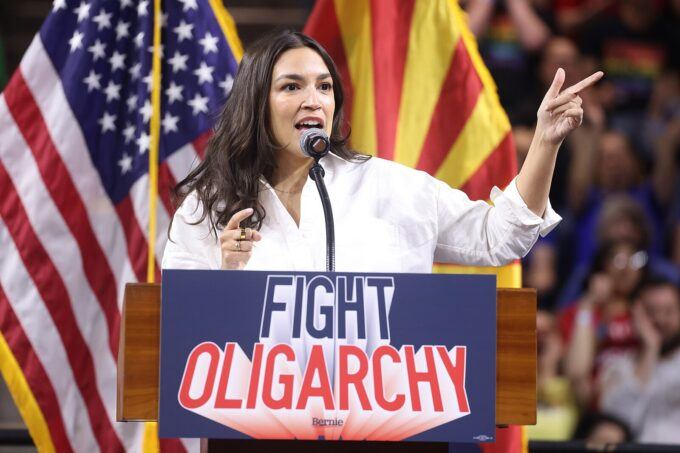
One obvious conclusion? Democrats need to focus on regaining their lost mantle as the “party of the working class” – the image they projected beginning with FDR and the banner they proudly carried for decades after World War II. Bernie Sanders, Elizabeth Warren and AOC are all avidly promoting this view. Sanders has been especially vocal in pointing out that the party’s strategy – despite its anti-Big Capital rhetoric – does not explicitly favor working class voters on such issues as expanding healthcare coverage through a “public option” or bolstering union organizing rights. And even where it does – for example – by calling for a “wealth tax” in addition to a more progressive income and higher corporate tax rate – the party, he argues, refuses to lead on these issues, hoping against hope that its public neutering of an openly working class agenda might appease moderates and swing voters, many of them Republican, who are genuinely alarmed at Trump’s excesses.
Harris, despite much early fanfare, failed in the end to mobilize record numbers of Democratic base voters – but she managed to capture just 50% of wavering independents. For the Sanders/AOC faction of the party, this is strong evidence that Democrats should stop talking out of both sides of their mouth when it comes to class politics. Rally the country with a steadfast populism rooted in the unmet economic needs of the vast majority of working class and lower middle class Americans – while pointing the finger at the “billionaire class” that dominates the GOP and that continues to skew tax and regulatory policies in their favor – and Democrats can win the White House again, their argument goes.
But can they, in fact? Democrats, it seems, don’t just have a political messaging problem anymore. Their messaging problem is rooted in a deeper crisis of the Democratic brand, and that brand crisis is rooted more deeply in what might be called the party’s “demographic” crisis. A growing share of Democratic voters no longer come from traditional working class backgrounds – either in the manufacturing sector, which has declined sharply, or in the newer, more flourishing low-paid service sector. In fact, most of today’s workers no longer identify with traditional working class politics, including strikes, walk-outs and battles over collective bargaining rights. Unionization stands at 32% in the public sector, but just 6% in the private sector, leaving the overall rate at about 11%. Many in the party are keeping this ideological tradition alive, because it’s been so fundamental to the Democratic “brand,” historically, but in a strict sociological sense, the class base of the party has evolved sharply over the past two to three decades.
It’s not just that the old working class has shriveled and the “new” working class is fragmented, and vulnerable to attack; it’s also because so much of the party isn’t even working class anymore.
The exit polls on who dominated the lowest income sector of the electorate are bad enough for Democrats, but consider just how wealthy and affluent a growing share of Democratic voters have become. Currently, nearly two-thirds – about 65 percent – of taxpayer households that earn more than $500,000 per year – in other words, the nation’s top 1%-2% – are located in Democratic Party districts – not Republican ones. Moreover, the 10 richest congressional districts in the country all have Democratic representatives in Congress. Where are they located? In die hard Blue states like California, New York, New Jersey and Virginia primarily. These upper-class Americans – earning $200,000 annually or more (top 5%, by income) – aren’t necessarily millionaires, though, in fact, a growing share are. Most, however, are the nouveau-riche beneficiaries of tax policies since the Reagan Revolution, people who have invested well – in stocks and real estate, and in estate plans – and thrived. These Democrats, like most voters, including some Republicans, think that extremes of wealth and poverty in America should be narrowed. However, these are not “tax and spend” liberals; in fact, they are likely to reject a wealth tax that cuts into their family assets, including their ability to pass on their wealth to heirs. If they own a small business, they’re also unlikely to support an expansion of union bargaining rights. While supportive of environmental causes, “excessive” regulatory controls on businesses generally worry them.
These upper-income Democrats would like to stay Democratic – they’ve voted that way for years – and they’re certainly hostile to Trump, but unless they continue to receive their own special favor, many might well defect to a “moderate” Republican – Nikki Haley, for example, if she were able to wrest control of the GOP from MAGA.
This shift in the party’s political base – though not necessarily its declared political agenda, especially at election time – actually started under Bill Clinton in the 1990s. It’s forgotten now but Clinton came from outside the ranks of the traditional liberal party establishment that had dominated its leadership ranks since FDR. As the candidate of “Third Way” or “New” Democrats, Clinton called for the party to abandon its age-old working class identity, to support free trade agreements like NAFTA, embrace tax cuts, reject “big” government, crack down on crime and illegal immigration and generally become more open to a wealth-building and social mobility agenda. By 1992, Democrats were desperate to reclaim power and Clinton’s pronounced tack to the right worked – twice. But Clinton’s full-throated embrace of neoliberalism – including a catastrophic deregulation of the banking sector that set the stage for the 2007 crash – also changed not just what the party stood for – but who it actually was.
Clinton’s policies coincided with – and helped accelerate – the decimation of America’s traditional manufacturing-based working class through “deindustrialization,” while accelerating the development of “new” White-collar occupational groups rooted in the burgeoning service sector and a plethora of rapidly expanding technology-based industries. Broadly speaking, the party has since come to be dominated by middle- and upper-middle class professionals, in addition to a growing cadre of small business innovators seeking to grow their companies into vast enterprises. The party’s core base is now among college educated professionals in academia and IT as well as doctors and lawyers, who, along with Hollywood celebrities and Silicon Valley’s leading entrepreneurs, have become some of the party’s biggest donors – and in the media, some of their most vocal influencers.
The ranks of the Democrats’ own “millionaire class” are also expanding rapidly. And believe it or not, many of these new millionaires are emerging from an unlikely place: skilled tradesmen and lower level public sector bureaucrats, everyone from HVAC workers and plumbers – including fledgling entrepreneurs – to firefighters, policemen and unionized workers with pensions (as well as top union leadership). These various sectors – distinct from the old semi-skilled blue-collar working class and in a social caste located far above the country’s lowest-paid workers in service industries and health care – are becoming the most visible face of the Democratic party now, and even many low-level party officials as well as those elected to state and local government increasingly resemble them.
Make no mistake: the GOP is still the biggest representative of the “billionaire” class. But even here, Democrats now have their own proud share. Corporate philanthropists like Warren Buffet, Georg Soros, Michael Bloomberg and Bill Gates, all top Democratic donors, are obvious examples, but even many prominent Democratic politicians, including Minnesota’s renegade former Rep. Dean Phillips (whose net worth was $642 million in 2018) and Illinois governor J.B. Pritzger come from the ranks of America’s top 1%. Pritzger is far richer than Trump, and indeed, far richer than many leading GOP donors. He’s worth nearly $4 billion; his wife Mary is worth another $2.5 billion. In fact, he’s the richest governor in the country – by far. The larger Pritzker family – which includes a total of 13 – yes, count’em – billionaires – owns the Hyatt hotel chain, which enjoys an enterprise value of more than $13 billion, with annual revenue approaching $7 billion. Pritzker himself has started several venture capital and investment startups, including the Pritzker Group, where he is managing partner.
What’s the point? It’s this: There’s a real and growing divide inside the Democratic party – but it’s not just an ideological divide, it’s a class divide. Bridging it, if that’s what party reformers want, won’t be easy. Clinton bridged it in the 1990’s because he inherited the economic collapse under George H.W. Bush then presided over a period of unbridled growth and prosperity – so the spoils of wealth could be shared, even as Clnton proceeded to consolidate corporate power. Obama did something similar – with less prodigious results – after the 2007-2008 crash demolished the GOP’s chances of prevailing after Bush 2. There was a real recovery, with steady if modest job growth, and ebullient optimism for America’s future across the board. While real wages continued to decline – just slightly – median household income increased by $2,800, or 5.2 percent, the largest annual increase on record, in fact.
But today’s political conjuncture is vastly different. The nation’s recent economic travails – including a steady decline in real wages – is clearly favoring, for now at least, the GOP. Trump has seized upon this opening, knitting together an unusual alliance of the extreme – and extremely complacent – uber-rich that have always voted Republican with the ranks of the angry and disgruntled working poor. Not all of these workers are the Democratic base voters that stayed loyal under Obama, but have since defected. Just as critically, a growing share of the so-called “low-propensity” voters that didn’t cast ballots in most recent election cycles have swung sharply behind Trump and MAGA. It’s the combination of those two segments – mostly working class, by education and income – that helped deliver Trump back to the White House, leaving the Democrats in shambles.
The Biden/Harris administration also reflected a cross-class “alliance,” even if its boisterous anti-Trump rhetoric disguised its true nature. But this is a different cross-class alliance, one that bridges the nouveau riche upper class and millionaire class at a tier below the 1% – basically the top 3%-5% – with the more submerged and downtrodden poor. Many of the latter groups are ethnic minorities that are still voting majority Democratic, though in far fewer numbers than before.
The class contradictions inside the Biden administration – bordering on schizophrenia – were apparent from the start, but a compliant media, anxious to create a broad anti-Trump front, never really reported them. One example: Biden’s support for lifting the SALT tax cap – from $10,000 to nearly $80,000 – in his 2021 spending bill. The change gave a huge break to top income earners – more than $125,000 each, to people in the highest tax brackets – but offered next to nothing – about $15 –to the 90% of middle class income earners that don’t itemize their taxes. Indeed, even former Obama economic advisers Jason Furman and Larry Summers saw Biden’s backroom maneuver as an unjustified “handout” to the rich – and publicly said so. Furman called it “obscene.” Russell Berman, writing in the Atlantic, noted: “Th[is] policy is no minor throw-in or pet project; its cost as a tax expenditure represents a significant portion of the overall bill and undercuts Biden’s goal of reducing inequality by shifting the tax [relief] from the poor and working class toward the wealthy.”
Other examples include Biden’s raising of the subsidies to private health insurance holders from those earning up to $100,000 annually to those earning up to $350,000 annually. And despite promising to promote nationalized health care, Biden offered $42 billion in additional subsidies to private health insurers to help steer people into corporate health plans that typically feature high out-of-pocket costs, routine claim denials and ever rising premiums. Companies and individuals that benefited from these policies aren’t just among the nation’s most affluent – they’re also top Democratic lobbyists and party donors.
Even Biden’s proposal to forgive student loans – which sounded so noble, on its face – would have benefitted higher-income families whose children had amassed the greatest burden of school debt at the nation’s most expensive schools. Households in the top 30% of the earnings distribution were slated to receive two-fifths of all dollars forgiven. Even among those with just $10,000 or $50,000 in debt, higher-income households would have received significantly more loan forgiveness than lower-income households. Is it any wonder that most of the nation’s youth remained largely unimpressed by this policy gesture, and gave Biden and Harris little credit at the polls?
Some pundits and pollsters have suggested that the two parties are close to “changing places” – Democrats favoring the rich, Republicans the poor. That’s far from true. But the recent demographic reversals, which are unmistakable now, do provide a huge image boost to the GOP, which has traditionally been stigmatized as the party of the White “Country Club” elite. By diversifying their class base –and rebranding themselves as a “multicultural populist working class party” – Republicans have boosted their public image, while the Democrats, by pitching their policies to the affluent, are all but forfeiting the “Good Samaritan” image that stamped the party in the popular imagination for generations.
The fall-out from this incipient realignment has proven devastating for Democrats. Their favorability rating among voters as a whole has cratered – to 27% – while the GOP’s has climbed upward to 45%. Democrats, even during politically fallow times, traditionally led the GOP in this popularity contest, albeit slightly, while in boom times, they enjoyed a substantial advantage. Neither party is held in exceptionally high esteem, of course, but Republicans are rapidly gaining support – with surges in party registration recorded nearly everywhere – while Democrats are fading fast. And dissatisfaction with the Democrats appears to be growing across the board, from Democrats, Republicans and independents alike.
Let’s be clear: class background and even class status do not necessarily translate into class stand. If they did, there would be no hope for economic redistribution and a semblance of social equality in America. Many of the country’s wealthiest Democrats do support broadly progressive policies, and many support philanthropies that donate heavily to progressive causes. For many, it’s a form of noblesse oblige, and a calculation that a fairer society is also more stable – and can better protect their own class interests over the long haul. Still, it says something about the Democrats that some of their loudest anti-Trump spokespersons – men like Phillips and now, Pritzker – don’t look anything like working class America. Nancy Pelosi’s net worth is estimated to be between $14 and $24 million, and still higher when her husband’s wealth is included. Even James Clybun, the party’s #3 and its main African-American powerbroker, saw his net worth skyrocket from a paltry $180,000 in 2020 to more than $3 million in 2024 – all of it gained while a Democratic president held office. The party still talks about its allegiance to the common man – and women – but in fact, it reeks of class privilege, with a smug thinly-disguised elitism that has turned off working class voters, leaving them vulnerable to Trump’s calculated overtures.
There is strong evidence that top Democrats – especially members of its wealthy political oligarchy – aren’t that concerned about the fortunes of working class voters – including the party’s traditional blue collar base – as long as the ranks of the affluent keep growing. Remember when Hillary Clinton in 2016 told West Virginia coal miners to find new jobs, because theirs wouldn’t survive in the new “green” era? At the time, her remarks were deemed “insensitive” – and Clinton, after watching her poll numbers plummet, walked them back. But she was only stating what many of the party’s poohbahs actually think, and are willing to say in their unguarded moments. Chuck Schumer made a similarly revealing statement on the eve of becoming Senate majority leader that year. Reflecting on the 2016 national Democratic electoral strategy, Schumer said that “for every blue-collar Democrat we lose in western Pennsylvania, we will pick up two moderate Republicans in the suburbs in Philadelphia, and you can repeat that in Ohio and Illinois and Wisconsin.” He was wrong, of course. Downplaying the need to galvanize working class voters, she lost the critical swing states. That hasn’t stopped the wealthiest and most entrenched Democratic party oligarchs from peddling this same misguided view – and despite successive defeats, they will likely do so again, if the party grassroots lets them.
What’s becoming abundantly clear – even if Democrats can’t publicly admit it – is that America’s deep and widening class divisions – divisions of income and education, lifestyle, religiosity and other cultural values and reference points – now run right through the heart of their own party, leaving them compromised, and unable to lead. These class divisions are not new – but they’re now more than ever, more nakedly balanced against the workers that once formed the core base of the party. Democrats, even at the top, used to feel strong pressure to try to accommodate and balance these divisions, but no longer. Can the party, with its current trajectory, survive much longer, politically? If not, should progressives continue to try to reform the Democratic Party from within – by shaming its leaders intro re-embracing its long-lost and largely forgotten past? Or is it time to break away and form a new kind of grassroots populist party, with less allegiance – inevitably – to Clintonian neoliberalism?
A vibrant third-party movement can’t be built overnight – and it may well require the emergence of a new zeitgeist in American society that demands a rejection of the two-party system and more thoroughgoing institutional reform, including the abolition of the Electoral College, which most voters support. Pressure from above to put the populist genie back into the bottle – apparent in 2016 and 2020, when the party forced Sanders & Co. into submission – will surely reassert itself. But will progressives in 2028 agree to go quietly into the night? Disaffected working class voters are drifting away, seduced by the allure of xenophobic populism, while more affluent Democrats – as fearful of the “socialist-left” as they are of Trump’s MAGA rabble – are turning on Sanders, hoping to silence him In 2016, Clinton and her supporters looked to the “Bernie Bros” – with whom they’d tangled – to help mobilize support for their candidate – and most, in the end, did. Today, Clinton mastermind James Carville wants to see Sanders and the entire left exiled to political Siberia. A stand-off, indeed a civil war, rooted in the party’s shifting class favoritism – may be inevitable now.
Can either side “win” this deepening class struggle inside the Democratic party? ‘Tis a fine old conflict – and with the Right resurgent, it’s unlikely to end well for anyone – least of all for the workers that few in the party leadership seem to champion in their souls anymore.