Sunday, August 17, 2025


Fleetzero & Glosten to Develop World’s Longest-Range Hybrid Electric Vessel

Glosten
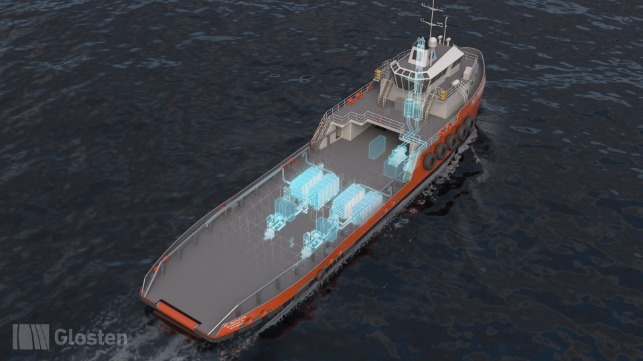
Vessel Rendering Courtesy of Glosten

Published Aug 16, 2025 6:21 PM by The Maritime Executive


[By: Glosten]

Fleetzero, a leading developer and manufacturer of modular propulsion platforms for hybrid and electric ships, has selected Glosten, a leading naval architecture and marine engineering firm, to design what is expected to be the world’s longest- range hybrid electric vessel. This collaboration marks a major step forward in the effort to offer zero-emission global shipping and expand the reach of electric propulsion in commercial maritime applications.

Glosten has been working with Fleetzero on the retrofit of a Lightering Support Vessel owned and operated by AET. This vessel is being outfitted with a plug-in hybrid-electric propulsion system and will transit primarily on battery power once the conversion is complete.

“This vessel will be a major milestone—not just for us, but for the entire industry,” said Steven Henderson, CEO of Fleetzero. “Partnering with Glosten allows us to showcase how our propulsion technology can enable economical, cleaner, and more efficient operations, while pushing the boundaries of what’s possible in shipping.”

“We’re excited to support Fleetzero in transforming this vessel,” added Morgan Fanberg, CEO & President of Glosten. “It’s a bold move toward the next generation of marine technology, and exactly the kind of advancement we’re proud to support.”

With the vessel design already underway, Fleetzero and Glosten will transition into detailed engineering in the coming months, with construction expected to begin in mid-2026. Once operational, the vessel will serve as a model for long-range hybrid-electric propulsion worldwide.

The products and services herein described in this press release are not endorsed by The Maritime Executive.


First Chinese Boxship of 2025 Arrives in Arkhangelsk via the Arctic Route

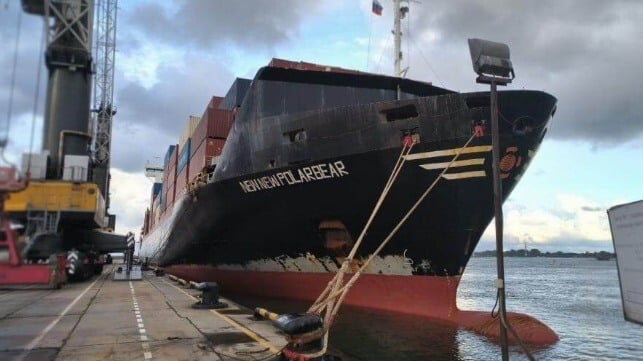
NewNew Polar Bear (courtesy NewNew Shipping)

Published Aug 17, 2025 2:36 PM by The Maritime Executive


As the Northern Sea Route (NSR) becomes busy for this year’s summer navigation, the first Chinese boxship has arrived in the Russian Arctic port of Arkhangelsk.

The vessel Newnew Polar Bear operated by the Chinese carrier Newnew Shipping was received at the port on Friday. The container ship delivered 497 containers at the port, marking the start of a busy season under the expanded Arctic Express N1 service. The service connects China’s Shanghai and Ningbo ports to Arkhangelsk, providing a shorter shipping option compared to the longer Suez Canal route.

Newnew Polar Bear left Shanghai in July 16 and took less than a month to arrive at Arkhangelsk. Following 13 successful voyages last year, which transported more than 20,000 TEU, NewNew Shipping Line announced it would expand its Arctic service. This also includes deploying larger container ship on the route, following in the path of EZ Safetrans Logistics, which became the first Chinese carrier to deploy a Panamax boxship in the NSR last year.

During this year, Arkhangelsk expects 20 vessel calls from China through NSR, which is almost double the number received last year. Over a dozen vessels have received permits for the Russian Arctic route this year, with voyages happening between the months of July and November. In the case of NewNew Shipping, five of its container ships have permits to transit NSR this season.

Commenting on the arrival of Newnew Polar Bear, Arkhangelsk region Governor Alexander Tsybulsky noted that the vessel delivered auto parts, PVC film and steel for Russian enterprises.

“We will load export cargo onto the vessel - products from our timber industry that are in high demand in China. In approximately just over three weeks, products from Arkhangelsk enterprises will be delivered in China,” added Tsybulsky.

Last month, NewNew Shipping agreed to invest around $2.5 billion for the expansion of Arkhangelsk port. The project is seen as part of the wider Chinese-Russian partnership to ramp up Arctic shipping. To conduct year-round navigation in the NSR, NewNew Shipping has also announced it will order several Arc7 ice class container ships in partnership with the Russian nuclear agency, Rosatom.

NewNew Polar Bear is believed to have caused a gas line rupture via anchor-dragging in the Gulf of Finland in October 2023. The vessel's former master has been arrested in connection with that incident. 


U.S. Coast Guard Keeps an Eye on Chinese Research Flotilla off Alaska

Xue Long 2 off Alaska, August 2025 (USCG)

Published Aug 17, 2025 5:32 PM by The Maritime Executive


The U.S. Coast Guard is still keeping an eye on five Chinese research vessels that are operating in the Arctic, in and near U.S. waters off Alaska. 

Last Wednesday, Coast Guard Arctic District dispatched an HC-130J long range search aircraft to intercept and query the flotilla of Chinese government ships. The five Chinese vessels include the Polar Class 3 icebreaker Xue Long 2, seen previously on Arctic and Antarctic missions; the Soviet-built icebreaking tug Zhong Shan Da Xue Ji Di (flagged with the Liberian registry); the brand new ice-class research vessels Ji Di and Tan Suo San Hao, both delivered in the last year; and Shen Hai Yi Hao, a conventional research vessel built to carry a deep-diving submersible.  

Tan Suo San Hao (USCG)

Zhong Shan Da Xue Ji Di (USCG)

Shen Hai Yi Hao (USCG)

The Chinese research presence in Alaska's far north is unprecedented, and comes amidst heightened tensions between Washington and Beijing. At about the same time as the Chinese presence intensified off Alaska, two U.S. warships conducted a freedom of navigation operation near Scarborough Shoal, a contested, Chinese-occupied reef in the South China Sea. 

The Coast Guard has more resources in Alaska than it did a few months ago. Bollinger's 59th and latest Fast Response Cutter, USCGC Earl Cunningham, was commissioned last week and will be based out of Kodiak, freeing up larger vessel assets for long-distance patrols. The Coast Guard's new interim icebreaker, USCGC Storis (ex name Aiviq), is currently in Seward and is expected to head further north soon, in the direction of the Chinese research flotilla. 


Sanctions Force Russia to Cancel Icebreaker Order and Layoffs at Shipyards

Russian shipbuilder
Onega Shipyard lost the icebreaker contract due to the impact of sanctions on a Turkish subcontractor and Western suppliers (Onega Shipyard)

Published Aug 15, 2025 12:43 PM by The Maritime Executive


Russia’s shipbuilding industry continues to feel the impact of Western sanctions, with the latest reports that a major icebreaker contract has been canceled. At the same time, shipyards in the Far East are also reporting layoffs due to a lack of new orders.

Russian media reports indicate that the state-owned ports operator Rosmorport has canceled a contract for two innovative icebreakers that had initially been ordered in July 2021, before the invasion of Ukraine. According to the reports, they are citing delays with the original delivery date pushed back from 2024 to December 2026, caused by the sanctions and the inability to obtain key equipment from the West. Rosmorport is reported to be demanding the return of an advance payment of $116 million.

The order had been placed with the Onega Shipyard in Russia’s Far East and was valued at approximately $200 million. The yard was to build two 95-meter (312-foot) icebreakers able to navigate through ice up to 1.5 meters (nearly 5 feet). The state-developed design was also innovative as it used dual-fuel propulsion with LNG.

Onega is reported to have subcontracted portions of the work to Turkey’s Kuzey Star Shipyard, with the reports saying the Turks were unable to proceed due to the sanctions. In addition, the design called for Azipods from France and a Wartsila generator, which were also restricted under the sanctions. Russia has said it was developing internal capabilities to cover the gaps in equipment due to the sanctions.

Reports indicate that with a lack of work, shipyards are increasing their layoffs. Onega was building commercial fishing boats, but has not won other orders from the state or the commercial industry. Analysts said one of the challenges is that the remote location in the Far East contributes to increased costs. 

Russia’s state shipbuilder, United Shipbuilding Corporation, is reporting plans for further layoffs, citing the lack of production orders. It has already reduced staffing levels at the Khabarovsk Shipbuilding Plant, one of the largest in the Far East, and is now reported to be moving to nearly close the facility. From a report of over 500 workers in 2023, employment was cut to 293 in 2024, and now 70 percent of the remaining staff will be laid off by the end of October. The report says employment will be reduced to just 90 people.

Employees at the Vympel shipyard in the Far East are also expected to be laid off. The report cites a lack of funding for fleet modernization.

While Russia officially denies the impact of the sanctions, they are believed to be a major concern for Vladimir Putin. Reports are that the Russian President will push Donald Trump to reduce sanctions in return for any concessions on the war in Ukraine during their meeting in Alaska on August 15.


Does the Maritime Industry Value the Critical Work of Salvors?

Marine
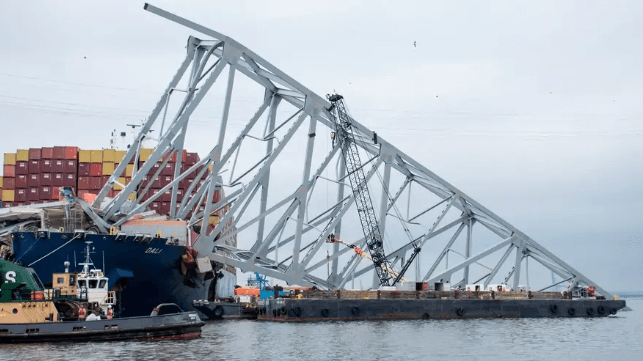
Salvors play a critical role in responding to major disasters, like the collapse of the Francis Scott Key Bridge, above (NTSB file image)

Published Aug 17, 2025 3:03 PM by James Herbert


The marine salvage industry is a vital part of the shipping industry ecosystem, and the International Salvage Union (ISU) is the association that represents the world’s salvage contractors. The core purpose of the ISU is to be the “credible, trusted and unified global voice of its members who facilitate world trade by providing marine services which save life, protect the environment, mitigate risk and reduce loss.” And that statement truly does capture the essence of our association.

As such, we have a firsthand view of the state of the industry, based on our data. The news is that the salvage industry remains under financial pressure as the ISU’s annual salvage industry statistics indicate – at a time when the impact of casualties is getting larger, particularly with container ships, and also because of the greatly increased amount of bunkers carried by the largest ships. 

The ISU statistics show gross revenues from all sources in 2024 (latest figures) at USD $406 million, which indicates a continuation of the recovery that started in 2023 compared with the historically low levels seen in 2022. Income is still substantially down on the typical levels of a decade ago, however.

We are encouraged that shipowners and the marine insurance community openly recognize the importance of our industry and the need for it to be financially sustainable.

ISU believes that the cornerstone of the funding of the industry should be income from awards based on Article 13 of the Salvage Convention. In short, it means a reward for the mostly commercial salvors who go to the aid of casualties at their own financial risk in the expectation that, if they succeed in saving property, they should receive an award based on the values salved and other factors like the danger of the situation.

Traditionally the key contract for such services was the Lloyd’s Open Form (LOF), but its use has decreased significantly in recent years. ISU continues to promote use of LOF - and the new edition published last year. We are realistic about the number of times the contract will be used each year, but we hope for an upturn, and so we shall follow developments with the new LOF closely.

Wreck removal is an important part of most salvors’ work and generally produces about 50% of the industry’s annual income. Much of this work (and indeed other marine services) is conducted using the BIMCO suite of wreck removal contracts—Wreckstage (lump sum payable in stages), Wreckhire (daily hire payments), and Wreckfixed (lump sum payment on a no-cure, no-pay basis). Work is ongoing to revise the contracts: a new edition of Wreckstage was published in 2024 and ISU along with other stakeholders are now working on revisions to Wreckhire and we look forward to continuing that work and then turning our attention to the Wreckfixed contract.

Turning to operational matters, last year saw ISU members respond effectively to the Baltimore bridge disaster - removing the collapsed bridge debris in difficult conditions and refloating the containership DALI. It was a case which demonstrated in practice the ISU’s key messages about the value of professional salvors in reducing loss, saving property, and keeping ports open.

Fires on containerships and battery fires in car carries and on RoRos are a continuing and significant concern. ISU members are often the only agency available to deal with such incidents and have a proud track record in this specialized field. Dealing with casualties that are powered by new types of fuel - LNG, hydrogen and ammonia - will be an increasing focus for the industry.

As well as saving life and property, salvors continue to prevent major incidents of marine pollution. In 2024 ISU members provided services to vessels carrying more than 2.4 million tonnes of potential pollutants. It shows the great environmental benefit of the salvage industry as well as the benefit of protecting shipowners’ reputations and supporting their Environmental, Social and Governance (ESG) requirements, which are now central to business operations.  

It is never difficult to make the case for the professional salvors who are the members of the ISU, and we are sure that the wider industry and our key stakeholders will continue to support us in our vital work.

James Herbert is Secretary General of the International Salvage Union.

The opinions expressed herein are the author's and not necessarily those of The Maritime Executive.

'Gloom' over Trump economy hits worst levels 'since the Great Recession': report


FILE PHOTO: U.S. President Donald Trump and Federal Reserve Chair Jerome Powell speak during a tour of the Federal Reserve Board building, which is currently undergoing renovations, in Washington, D.C., U.S., July 24, 2025. REUTERS/Kent Nishimura/File Photo

August 16, 2025
ALTERNET

According to the U.S. Bureau of Labor Statistics (BLS), unemployment in the United States was at 4.2 percent in July — which is far from a recession. But the BLS also found that the U.S. is hurting in terms of job creation; the 4.2 percent figure largely reflects Americans who are holding on to jobs they already have rather than starting new jobs. And President Donald Trump was so angry over the BLS' job creation data that he fired ex-BLS Commissioner Erika McEntarfer and nominated a MAGA loyalist for the position: E.J. Antoni, known for his work with the Heritage Foundation.

In an article published on August 16, Axios' Courtenay Brown lays out some reasons why so many Americans are feeling "gloomy" about the economy.

"Americans haven't been this gloomy about the job market since the Great Recession," Brown reports. "Why it matters: Fears about joblessness have surged since President Trump unveiled plans to impose steep tariffs on foreign goods. The economy might have hit a soft patch, but it has so far dodged the bleak predictions from a few months ago."

READ MORE: 'Pathetic and utterly irresponsible': Melania Trump slammed for 'weak performative stunt'

Nonetheless, Brown notes that "consumers are still bracing for the worst to come."

"As of early August," Brown explains, "that pessimism was in step with that of the 2008 financial crisis. About 62 percent of consumers believe unemployment will worsen in the year ahead, according to the University of Michigan's latest monthly survey. That's bounced around a little in the last few months, but consistently hung around levels not seen since the Great Recession…. The concerns about higher unemployment are paired with worries about an inflation resurgence."

The University of Michigan's consumer report was released on August 15.

Joanne Hsu, the report's director, is quoted as saying, "Although CPI inflation has not surged, our data show that consumers are still bracing for an increase in inflation to come. Moreover, consumers are also concerned that labor markets will weaken."

READ MORE: 'Trolling the president': How the myth of Trump's mental fitness has finally been revealed

Brown notes that The Great Recession was the United States' "worst economic downturn since the Great Depression."

When the stock market crashed in 1929, U.S. unemployment was only 3.2 percent, according to Investopedia. By 1932, it was up to 23 percent. Americans were so angry about the economy that year that Democratic presidential nominee Franklin Delano Roosevelt defeated incumbent GOP President Herbert Hoover by a landslide and picked up a whopping 472 electoral votes.

The Great Recession wasn't as severe as The Great Depression, but Brown recalls that in late 2008 and 2009, "The stock market was falling off a cliff, unemployment filings soared and the jobless rate would ultimately peak at 10 percent."

Brown continues, "Now: The economy is slowing, though fears are worse than the official data suggests so far. The unemployment rate is holding at a historically low 4.2 percent, as of July. Hiring has stalled, but so have layoffs. There are fewer unemployment filings now than in July 2021, when a record-low share of Americans (14 percent) said they anticipated higher unemployment in the year ahead."

Read Courtenay Brown's full report for Axios at this link.
From Minnesota to the US Capitol: Tracing the Threat of Christian Nationalism

It’s safe to say that Vance Boelter’s actions were at least partially motivated by sycophants and political figures who twisted the Gospel and scripture for their benefit.


Crowds arrive for the "Stop the Steal" rally on January 6, 2021 in Washington, DC.
(Photo by Spencer Platt/Getty Images)

Rev. Dr. Shannon Fleck
Aug 17, 2025
COMMON DREAMS 

It’s easy to look at Vance Boelter, who pleaded not guilty to federal charges for murdering a Minnesota state representative and her husband, and think of him as a deeply unwell individual who took out his personal anger and frustration on civil servants. But there’s more at play here.

The ideology reported to have likely contributed to Boelter’s violence is the same set of beliefs espoused by elected officials across the country, including US House Speaker Mike Johnson (R-La.), who flies a flag symbolic of those beliefs outside his office.

Boelter graduated from Christ for the Nations Institute, a nonaccredited Bible college in Texas, that is reported to be a “stronghold of the New Apostolic Reformation (NAR), the charismatic movement that teaches that Christians are called to take over the US government.” Adherents are taught “to see themselves as agents of the supernatural”—a belief Boelter seems to hold about himself based on correspondence with the New York Times. Notable alumni of the Institute include Lance Wallnau and Dutch Sheets. In addition to their roles as self-appointed NAR prophets, both are influential within MAGA circles and were big proponents of the Big Lie, preaching violence to win power.

The NAR, and the related Seven Mountain Mandate theology championed by Wallnau in particular, is a push for total control of society through any means necessary. The Appeal to Heaven flag, propped up by Sheets and associated with the movement, was proudly flown on January 6, 2021 by insurrectionists storming the Capitol building and infamously outside the home of US Supreme Court Justice Samuel Alito. Its presence outside the speaker’s office makes a clear declaration about Christian nationalism and the dangerous NAR as ever-present forces in the highest offices of power, shaping policies that impact the lives of millions of Americans.

Always painting political opponents as enemies of God and your work as God’s will, and calling on adherents to take up arms—even if the intent is metaphorical—leads adherents to being more open to violence.

Wallnau regularly appeared on Christian media outlets and platforms to prop US President Donald Trump up as a holy savior and has called for “spiritual warfare” and expressed support for political violence in support of Trump. Meanwhile, Sheets’ daily YouTube broadcasts reached more than 200,000 views a day to spread the Big Lie. In fact, Matthew D. Taylor, religious studies scholar and Christian nationalism expert, writes, “No Christian leader did more to mobilize Christians to be in DC on January 6 than Dutch Sheets.”

Though we don’t know how closely Boelter followed Wallnau and Sheets, it’s safe to say that his actions were at least partially motivated by sycophants and political figures who twisted the Gospel and scripture for their benefit.

Certainly, neither of these men told Boelter or anyone else to assassinate anyone or take violent action. However, always painting political opponents as enemies of God and your work as God’s will, and calling on adherents to take up arms—even if the intent is metaphorical—leads adherents to being more open to violence. Nonpartisan research organization PRRI, finds that support for Christian nationalism and adherence to right-wing authoritarian views correlate with acceptance of political violence.

For years, men like Wallnau and Sheets have joined the likes of Michael Flynn, David Barton, Sean Feucht, Charlie Kirk, Lara Locke, Alex Jones, Mike Lindell, Jackson Lahmeyer, current Federal Bureau of Investigations Director Kash Patel, and sitting elected officials, including Rep. Marjorie Taylor Greene (R-Ga.), touring the country through events like ReAwaken America and the Courage Tour. At each stop, they’ve framed their work as a “holy war,” offering speeches steeped in hateful, harmful rhetoric that created a permission structure for violence.

In the immediate aftermath of a tragedy, as happened in Minnesota, when we rush to characterize the perpetrator as a lone wolf, as crazy, we miss the forest for the trees. We begin to normalize the ideologies and conditions that contributed to the violence, risking more harm as they seep more deeply into our culture.

For example, proud evangelical and self-proclaimed “amateur historian” David Barton once called “the most influential evangelist you’ve never heard of,” has secured the ear of lawmakers, both local and national, and has had his fingerprints on “28 bills that have cropped up before 18 states this year,” including my home state of Oklahoma. He’s also one of the leading voices behind the movement to dismantle the US Department of Education—an initiative straight from the pages of Project 2025, which has become the Trump administration’s policy roadmap.

I’ve watched first hand as Oklahoma became a testing ground for Project 2025 and our schools dropped to among the worst in the nation. State Superintendent Ryan Walters has pushed for legislation requiring the Ten Commandments to be displayed in every classroom. Walters even went so far as to buy Bibles branded with Trump’s name, which he intended to place in every classroom in the state, while seeking to force teachers to teach liturgy instead of literacy.

We cannot, therefore, divorce what happened in Minnesota from the actions on Capitol Hill, in state legislatures, or at school board meetings across the country, for they are bound by an ideology that preaches power by any means necessary.


Rev. Dr. Shannon Fleck
The Rev. Dr. Shannon Fleck is the executive director of Faithful America, the largest online community of grassroots Christians putting faith into action for social justice.
Full Bio >

 US-Russia Talks: the Choice Between Peace and Escalation


Photo: AFP via Getty Images

Donald Trump came into office promising to end the war in Ukraine in 24 hours. Now, six months later, his high stakes meeting with Vladimir Putin in Alaska may have put the United States and Russia on a new path toward peace, or, if this initiative fails, could trigger an even more dangerous escalation, with warhawks in Congress already pushing for another $54.6 billion in weapons for Ukraine.

After emerging from the meeting, Putin correctly framed the historical moment: “This was a very hard time for bilateral relations and, let’s be frank, they’ve fallen to the lowest point since the Cold War. I think that’s not benefiting our countries and the world as a whole. Sooner or later, we have to amend the situation to move on from confrontation to dialogue.”

Trump said he will follow up by talking to NATO leaders and Zelenskyy, as if the U.S. is simply an innocent bystander trying to help. But in Ukraine, as in Palestine, Washington plays the “mediator” while pouring weapons, intelligence, and political cover into one side of the war. In Gaza, that has enabled genocide. In Ukraine, it could lead to nuclear war.

Despite protests from Zelenskyy and European leaders, Trump was right to meet with Putin, not because they are friends, but because the United States and Russia are enemies, and because the war they are fighting to the last Ukrainian is the front line of a global conflict between the United States, Russia and China.

In our book, War In Ukraine: Making Sense of a Senseless Conflict, which we have now updated and revised to cover three years of war in Ukraine, we have detailed the U.S. role in expanding NATO up to Russia’s borders, its support for the violent overthrow of Ukraine’s elected government in 2014, its undermining of the Minsk II peace accord, and its rejection of a peace agreement between Russia and Ukraine after only two months of war in 2022.

We doubt that Donald Trump fully grasps this history. Are his simplistic statements alternately blaming Russia and Ukraine, but never the United States, just a public façade for domestic consumption, or does he really believe America’s hands are clean?

At their first meeting in Saudi Arabia on February 18, senior U.S. and Russian negotiators agreed on a three-step plan: first to restore U.S.-Russian diplomatic relations; then to negotiate peace in Ukraine; and finally to work on resolving the broader, underlying breakdown in relations between the United States and Russia. Trump and Putin’s decision to meet now was a recognition that they must address the deeper rift before they can achieve a stable and lasting peace in Ukraine.

The stakes are high. Russia has been waging a war of attrition, concentrating on destroying Ukrainian forces and military equipment rather than on advancing quickly and seizing a lot more territory. It has still not occupied all of Donetsk province, which unilaterally declared independence from Ukraine in May 2014, and which Russia officially annexed before its invasion in February 2022.

The failure of peace negotiations could lead to a more aggressive Russian war plan to seize territory much faster. Ukrainian forces are thinly spread out along much of its 700 mile front line, with as few as 100 soldiers often manning several miles of defenses. A major Russian offensive could lead to the collapse of the Ukrainian military or the fall of the Zelenskyy government.

How would the U.S. and its Western allies respond to such major changes in the strategic picture? Zelenskyy’s European allies talk tough, but have always rejected sending their own troops to Ukraine, apart from small numbers of special operations forces and mercenaries.

Putin addressed the Europeans in his remarks after the Summit:

We expect that Kyiv and the European capitals will perceive [the negotiations] constructively, and that they won’t throw a wrench in the works, will not make any attempts to use some backroom dealings to conduct provocations to torpedo the nascent progress.

Meanwhile, more U.S. and NATO troops are fighting from the relative safety of the joint Ukraine-NATO war headquarters at the U.S. military base in Wiesbaden in Germany, where they work with Ukrainian forces to plan operations, coordinate intelligence and target missile and drone strikes. If the war escalates further, Wiesbaden could become a target for Russian missile strikes, just as NATO missiles already target bases in Russia. How would the United States and Germany respond to Russian missile strikes on Wiesbaden?

The U.S. and NATO’s official policy has always been to keep Ukraine fighting until it is in a stronger position to negotiate with Russia, as Joe Biden wrote in the New York Times in June 2022. But every time the U.S. and NATO prolong or escalate the war, they leave Ukraine in a weaker position, not a stronger one. The neutrality agreement that the U.S. and U.K. rejected in April 2022 included a Russian withdrawal from all the territory it had just occupied. But that was not good enough for Boris Johnson and Joe Biden, who instead promised a long war to weaken Russia.

NATO military leaders believed that Ukraine’s counter-offensive in the fall of 2022 achieved the stronger position they were looking for, and General Milley went out on a limb to say publicly that Ukraine should “seize the moment” to negotiate. But Biden and Zelenskyy rejected his advice, and Ukraine’s failed offensive in 2023 squandered the moment they had failed to seize. No amount of deceptive propaganda can hide the reality that it has been downhill since then, and 69% of Ukrainians now want a negotiated peace, before their position gets even worse.

So Trump went to Alaska with a weak hand, but one that will get weaker still if the war goes on. The European politicians urging Zelenskyy to cling to his maximalist demands want to look tough to their own people, but the keys to a stable and lasting peace are still Ukrainian neutrality, self determination for the people of all regions of Ukraine, and a genuine peace process that finally lays to rest the zombification of the Cold War.

The whole world celebrated the end of the Cold War in 1991, but the people of the world are still waiting for the long-promised peace dividend that a generation of corrupt, war-mongering leaders have stolen from us.

As negotiations progress, U.S. officials must be honest about the U.S. role in provoking this crisis. They must demonstrate that they are ready to listen to Russia’s concerns, take them seriously, and negotiate in good faith to achieve a stable and lasting agreement that delivers peace and security to all parties in the Ukraine war, and in the wider Cold War it is part of.
Medea Benjamin and Nicolas J.S. Davies are the authors of War in Ukraine: Making Sense of a Senseless Conflict, published by OR Books, November 2022.  Medea Benjamin is the cofounder of CODEPINK for PEACE, and the author of several books, including Inside Iran:  The Real History and Politics of the Islamic Republic of Iran. Nicolas J.S. Davies is an independent journalist, a researcher for CODEPINK and the author of Blood on our Hands:  The American Invasion and Destruction of IraqRead other articles by Medea Benjamin and Nicolas J.S. Davies.


Rise Up for Our Planet: September 18-21


It is crystal clear that millions of US Americans are prepared to organize and take action to fight the efforts of the Trump regime to impose a form of 21st Century fascism on the USA. From the first youth-led, #50501 actions in all 50 states on February 5 to the more than five million people who came out in over 2,200 localities on June 14, No Kings Day, and everything in between and since, it is unquestionable that there is a mass resistance movement that is not giving up.

History is calling upon us to step up, and we are doing so.

This resistance movement has been a multi-issue movement participated in by people with a wide diversity of radical to progressive to liberal to common sense sentiments but who are united in our fear, rage, and support for democracy and social and environmental justice.

One of the issues of this multi-issue movement has been the climate crisis, but it has not been a priority. This is the case even as the world’s scientists and accelerating extreme weather events worldwide are clearly saying that this existential crisis is getting worse, and time is running out to turn things around in enough time to prevent worldwide climate catastrophe.

Since the Trumpists have taken office it has become increasingly clear that, despite significant Republican voter support in many states for jobs-producing wind and solar energy and electric cars, the Trump Administration is doing everything it can to halt and reverse the growth of these critical industries. A few weeks ago the head of the EPA, Lee Zeldin, former NY Republican candidate for Governor, announced that he intends to try to overturn the “endangerment finding” upheld by the US Supreme Court 16 years ago. That finding determined that CO2, methane and four other greenhouse gases are pollutants that can be regulated and reduced.

But the climate movement in the US and elsewhere is fighting back. Finally, on the fall equinox weekend of September 20 and 21, the climate crisis will be a central issue in mass demonstrations around the US and beyond.

On the 20th world leaders will be gathering in NYC for the UN General Assembly and Climate Week. A major climate justice demonstration will be held that day in NYC, convened by international 350.org, DRUM, Climate Defenders and the Women’s March and endorsed by over 100 other groups so far. Simultaneous actions will happen on that day around the world as part of a Draw the Line campaign. The youth-led Fridays for Future is calling for actions around the world beginning on September 20. We are uniting across the world to demand a better future for our communities and for all living beings!

Then on Sunday, September 21, “Sun Day”, local actions around the country organized by national Third Act will “celebrate solar and wind power and the movement to leave fossil fuels behind. Solar energy is now the cheapest source of power on the planet—and gives us a chance to actually do something about the climate crisis. But fossil fuel billionaires are doing everything they can to shut it down. We will build, rally, sing and come together in the communities where we must work to get laws changed and work done.”

But this isn’t all that is happening five weeks from now. On the Thursday and Friday before this big weekend, September 18-19 in Washington, DC, actions are happening each day calling for: Hands Off Our Planet, No Fracking Petrostate

Thursday morning: Action at the monthly meeting of the Federal Energy Regulatory Commission (FERC) to demand that this agency do what the US DC Circuit Court of Appeals has said they must do: stop approving new methane gas projects unless they have done serious analyses of the greenhouse gas emissions and environmental justice impacts of proposed new methane gas pipelines and other infrastructure.

Thursday afternoon: Action at the federal headquarters of the Environmental Protection Agency as the beginning of a sustained national campaign to demand its restoration and the removal of Administrator Lee Zeldin.

Friday morning: A Petrostate Tour stopping at trade associations that have captured our government, compromised the environment, and violated private property rights, including the American Petroleum Institute (API), American Exploration and Production Council (AXPC), and the American Gas Association (AGA).

These DC actions are being organized by Beyond Extreme Energy, Elders Coalition for Climate Action, Third Act Actions Lab and the UnFrack FERC Campaign, supported by many others.

The peril our planet is in cannot be overstated. The popular democracy movement which has done so much over the last seven months to resist Trumpist tyranny must, really must, hit the streets next month.

Rise Up for Our Planet: September 18-21

It is crystal clear that millions of US Americans are prepared to organize and take action to fight the efforts of the Trump regime to impose a form of 21st Century fascism on the USA. From the first youth-led, #50501 actions in all 50 states on February 5 to the more than five million people who came out in over 2,200 localities on June 14, No Kings Day, and everything in between and since, it is unquestionable that there is a mass resistance movement that is not giving up.

History is calling upon us to step up, and we are doing so.

This resistance movement has been a multi-issue movement participated in by people with a wide diversity of radical to progressive to liberal to common sense sentiments but who are united in our fear, rage, and support for democracy and social and environmental justice.

One of the issues of this multi-issue movement has been the climate crisis, but it has not been a priority. This is the case even as the world’s scientists and accelerating extreme weather events worldwide are clearly saying that this existential crisis is getting worse, and time is running out to turn things around in enough time to prevent worldwide climate catastrophe.

Since the Trumpists have taken office it has become increasingly clear that, despite significant Republican voter support in many states for jobs-producing wind and solar energy and electric cars, the Trump Administration is doing everything it can to halt and reverse the growth of these critical industries. A few weeks ago the head of the EPA, Lee Zeldin, former NY Republican candidate for Governor, announced that he intends to try to overturn the “endangerment finding” upheld by the US Supreme Court 16 years ago. That finding determined that CO2, methane and four other greenhouse gases are pollutants that can be regulated and reduced.

But the climate movement in the US and elsewhere is fighting back. Finally, on the fall equinox weekend of September 20 and 21, the climate crisis will be a central issue in mass demonstrations around the US and beyond.

On the 20th world leaders will be gathering in NYC for the UN General Assembly and Climate Week. A major climate justice demonstration will be held that day in NYC, convened by international 350.org, DRUM, Climate Defenders and the Women’s March and endorsed by over 100 other groups so far. Simultaneous actions will happen on that day around the world as part of a Draw the Line campaign. The youth-led Fridays for Future is calling for actions around the world beginning on September 20. We are uniting across the world to demand a better future for our communities and for all living beings!

Then on Sunday, September 21, “Sun Day”, local actions around the country organized by national Third Act will “celebrate solar and wind power and the movement to leave fossil fuels behind. Solar energy is now the cheapest source of power on the planet—and gives us a chance to actually do something about the climate crisis. But fossil fuel billionaires are doing everything they can to shut it down. We will build, rally, sing and come together in the communities where we must work to get laws changed and work done.”

But this isn’t all that is happening five weeks from now. On the Thursday and Friday before this big weekend, September 18-19 in Washington, DC, actions are happening each day calling for: Hands Off Our Planet, No Fracking Petrostate

Thursday morning: Action at the monthly meeting of the Federal Energy Regulatory Commission (FERC) to demand that this agency do what the US DC Circuit Court of Appeals has said they must do: stop approving new methane gas projects unless they have done serious analyses of the greenhouse gas emissions and environmental justice impacts of proposed new methane gas pipelines and other infrastructure.

Thursday afternoon: Action at the federal headquarters of the Environmental Protection Agency as the beginning of a sustained national campaign to demand its restoration and the removal of Administrator Lee Zeldin.

Friday morning: A Petrostate Tour stopping at trade associations that have captured our government, compromised the environment, and violated private property rights, including the American Petroleum Institute (API), American Exploration and Production Council (AXPC), and the American Gas Association (AGA).

These DC actions are being organized by Beyond Extreme Energy, Elders Coalition for Climate Action, Third Act Actions Lab and the UnFrack FERC Campaign, supported by many others.

The peril our planet is in cannot be overstated. The popular democracy movement which has done so much over the last seven months to resist Trumpist tyranny must, really must, hit the streets next month.

Ted Glick works with Beyond Extreme Energy and is president of 350NJ-Rockland. Past writings and other information, including about Burglar for Peace and 21st Century Revolution, two books published by him in 2020 and 2021, can be found at https://tedglick.com. He can be followed on Twitter at twitter.com/jtglickRead other articles by Ted.