Sunday, August 17, 2025

Don’t stop press


Muna Khan 
Published August 17, 2025 
DAWN
The writer is an instructor of journalism.


ONE of the hardest things about solidarity is actually doing it versus the social media hashtag variety, ie, doing it for optics, like keyboard activism. The hard part consists of getting out to the press club every day, as we did, for example, when Gen Musharraf pulled the plug on Geo in 2007. I remember my two female colleagues from this paper and I going to the press club together to protest and then going to two police stations to check on our colleagues who had courted arrest. It did not matter that Geo was a competitor or that the young girls who also courted arrest were at another paper. The issue of freedom of press was far more important.

The channel would shut down again a decade later, but this time, there wasn’t as much solidarity. A lot had changed, mainly the fissures within press organisations, the co-opting of journalists into regimes to push narratives, along with a lot of repression and censure. People forget that you couldn’t say ‘establishment’ in the PTI government whereas that word is freely bandied about. This isn’t to suggest things are rosy as much as to say they’ve never not been.

Today, you only care about a person you define as a journalist because you subscribe to their viewpoint. That journalists have viewpoints and may as well be known as party spokespersons is the problem right there. Partisanship panders itself as news.

This is not unique to Pakistan. According to the Reuters Institute’s Digital News Report 2025, global trust in the media is declining rapidly. More people are dependent on social media and video platforms for their news. Online personalities and influencers shape public opinion now. I was most disturbed to read that 58 per cent of respondents (across 48 markets where the report was conducted) said “they feel unsure about their ability to distinguish truth from falsehood in online news”.

We have to find ways to preserve journalism.

This is where the hard work comes in. As journalists, we must stand by the very people we know are peddling falsehoods and benefiting monetarily from disinformation. Removing them from screens violates the provision of freedom of speech so we must stand for the principle. Because it can happen to us.

Imagine then the deafening silence from the West after Israel killed Gaza-based Al Jazeera reporter Anas al-Sharif and his colleagues, wiping out the entire Al Jazeera team there in the process. There is no justification for killing a journalist but this one in particular deserves the strongest condemnation from every single press organisation, politician, president, prime minister etc. But it has been slow to come because Israel said Anas was with Hamas.

We have reached new levels of ludicrousness and very few are calling it such.

“Frankly, I don’t care if al-Sharif was in Hamas or not,” president of the Foreign Press Association Ian Williams told CNN. “We don’t kill journalists for being Republicans or Democrats. Al-Sharif worked 24 hours and couldn’t possibly have time to work in a cell on the side.”

Plenty has been written on Israel’s murder of Anas and his colleagues — or total 238 journalists since the war began — in­­cluding by Zahid Hussain on Wednesday, so I don’t have anything new to say except this: we have to find ways to preserve journalism. And for that, it requires expressing solidarity with all journalists trying to do their job under excruciating circumstances. In Pakistan that means working in terrible conditions like delayed salaries and job insecurity. In India it means sensible journalists suddenly sounding like ‘godi media’ during the war in May.

In Gaza, it is repo­rting a genocide as it unfolds before our eyes while the Wes­tern world refuses to recognise it as such. Israel said it would kill Anas and every Palestinian knew it would happen. Anyone outside the Global North knows Israel plans to occupy Gaza next. Once it kills all the reporters, it is free to continue with its atrocities without impunity for there is no one left to report on its crimes.

Israel may let Western journalists in but given what we have seen of their reporting so far, we can imagine what they will do. When discussing Anas’s murder, a BBC anchor posed a question about proportionality. “Is it justified to kill five [Al Jazeera corrected the figure to four] journalists when you were only targeting one?” It is outrageous to suggest that targeting one was OK.

As the news director of Al Jazeera Asef Hamidi wrote in the Guardian, the world’s silence on Israel’s murder of journalists signals “a global collapse of the moral responsibility in safeguarding those who risk everything to shed light on the realities of war”.

Israel has so much blood on its hands but those who do not condemn the murder of journalists are equally complicit. No one will be left to speak up for us if we stay silent.

Published in Dawn, August 17th, 2025
Luxury work visa

Rafia Zakaria
Published August 16, 2025 
DAWN


EVER since US President Donald Trump entered the White House earlier this year, a huge faction of his Maga follower base has been demanding that he crack down on immigration. Trump has not wasted any time to give his people what they want. The first six months of his administration have seen mass deportations, changes to the birthright citizenship policy and the rounding up of people who have overstayed their visa.


The US recently initiated a pilot programme where even those applying for certain B category visas will have to post a bond that is anywhere from $5,000-$15,000. Applicants would have to post the bond before their visa was stamped. If they do not overstay their visa, the money would be returned. Naturally, such a policy means that travel to the US would be limited to increasingly smaller numbers of people.

The administration has also turned its attention to the H-1B work visa. The politics around this is important. Many among the Maga hard hitters have qualms about this visa because they see America-born workers losing out on high-skilled jobs on account of it. Some reports have stated that H-1B workers, on average, are making less than what US-born workers do, which anti-immigrant advocates say brings down wages for Americans. This visa has also drawn particular attention because Stephen Miller — a special adviser to Trump and the architect of his immigration policy — has targeted the visa structure, which has particularly benefited Indians. In 2022-2023, Indians are reported to have received 72.3 per cent of all H-1B visas. Most of these visas went to people working in the tech sector.

The anti-H-1B visa camp has swung into action.

As the critics have pointed out, spouses of H-1B workers are also allowed to work in the US. There are few restrictions on the holders of this visa. Maga supporters see Indians using this entire visa architecture to come to the US and take away jobs from Americans and bring down the wages of those with jobs in the same area.

It is no surprise then that the anti-H-1B camp has swung into action even as the US-India trade war has heated up in the past few days. At a press conference, Miller stated: “India portrays itself as being one of our closest friends in the world; but they don’t accept our products, they impose massive tariffs on us, we also know they engage in a lot of cheating on immigration policy.” These words appear to suggest that changes to the H-1B programme are set to be another front in the trade war against India and that powerful people in the administration see no problem in shutting out Indian workers from the US tech sector.

Some of this has to do with the evolving business models in Silicon Valley. Traditionally, tech firms have stressed keeping H-1B visa programmes as they are so that they can continue to hire engineers at relatively cheap rates. However, new business models that are increasingly integrating AI into their business operations are finding less need for tech workers in the numbers that were required before. It is also true that the US is producing engineers that can do these jobs. When the latter get jobs, it is a plus for the Trump administration that can boast about having created jobs for American workers.

Many believe that the high numbers of Indians on H-1Bs makes the US somehow dependent on India. This may have been true — until the advent of AI and the increasing political pressure to create jobs for American workers. Add to this, the increasing rancour between Trump and India and it was inevitable that the programme wou­ld face the changes that have been an­­­nounced.

According to the new rules, the current lottery system is going to be repl­aced by a weighted system that prio-ritises higher-paid em­ployees, which in turn, will benefit AI firms paying higher salaries. There will be fewer visas available for entry-level workers, unless of course companies pay them big amounts.

In effect, the new mechanism will make foreign workers very expensive and thus disincentivise prospective employers from hiring them if the vacancy can be filled by American employees. It also suggests that employers will face greater scrutiny and restrictions in the way visas are given out. The fact that all applicants have to have in-person interviews may also delay the process. As one analyst put it, the new H-1B visa is going to be a luxury work visa that only the richest of companies can afford. The proposed rules do not require congressional approval.

The new H-1B visa is going to severely restrict Indians getting tech jobs in the US. Ironically, while the trade disagreements between the US and India may be sorted out, the change in H-1Bs will curb Indian immigration to the US.

The writer is an attorney teaching constitutional law and political philosophy.
rafia.zakaria@gmail.com

Published in Dawn, August 16th, 2025
Alaska optics win for Putin

Published August 17, 2025 
DAWN

The writer is a former editor of Dawn.


IF the Gaza genocide does not serve as a strong enough daily reminder of how bereft of principles Western politics is, images of Russia’s President Vladimir Putin and his US counterpart Donald Trump beamed live from Alaska this weekend reinforced the point quite unequivocally.

President Trump makes no bones about how he deserves the Nobel Peace Prize. In his no-holds barred quest for being acknowledged as a peacemaker, not only did he bring in from the cold the Russian leader who has been a pariah in the eyes of the West, since his invasion of Ukraine in 2022, but also gifted his guest a great optics win.

From the arrival at an airbase near Anchorage where the two landed within minutes of each other and then alighted from their respective planes and walked on their respective red carpet strips to where they converged, it was a carefully choreographed move that seemed more designed by the guest than the host.

As Trump waited for Putin to walk the final few steps he brought his two hands together to applaud the Russian leader and then the two met and smiled before a handshake, patting each other in a gesture of warmth, even affection. It isn’t clear what the US TV networks were saying but the BBC seemed to struggle with the live broadcast.

Till he arrived in Alaska, Putin did not appear prepared to return any part of eastern Ukraine.

The BBC North America correspondent saw the presence of F-35 stealth warplanes on the tarmac as a force projection. A flypast by a B2 stealth bomber and four F-35s was also similarly described (with a mention of how the B2s released their bunker buster bombs against Iranian nuclear sites in June).

But to the unbiased observer, Putin appeared amused rather than being awed or fearful at the spectacle. In all likelihood, he saw it as a salute by the USAF just as the soldiers lined up either side of the red carpet to ‘present arms’ salute with their ceremonial rifles.

Such was the Russian leader’s confidence at being welcomed back into acceptance by reputedly the most powerful nation’s president that he set aside protocol and security considerations to ride in the Trump limousine while his own limousine, flown in from Russia earlier, followed.

Again, bizarrely, one of the people commenting on BBC TV said they weren’t sure if Putin spoke or understood English, while the Russian leader was visibly engaged in a continuous conversation with his host and later told the media he greeted Trump with a ‘Good afternoon, neighbour. Good to see you’ when he met him. In Alaska, only the Bering Strait separates the two.

As the motorcade was pulling away from the airport, Putin smiled and waved to the cameras. The significance of all this is clear from the fact that over the past three years, Putin, who has been indicted for war crimes by the International Criminal Court in The Hague, has not been received by any Western country. And here the red carpet had been rolled out for him.

After three hours of talks, the two leaders faced the media but did not answer questions. Putin read from a prepared statement where, after talking about the US-Russia history with specific reference to Alaska, he seemed to flatter Trump, saying that he endorsed the latter’s view that the Ukraine war would not have happened if he had been the US president.

Putin said the meeting, and what was agreed in it, will mark the beginning of peace in Ukraine if what he called the ‘root causes’ were addressed. For his part, Trump spoke briefly and started by saying, “There no deal until there is a deal”. He described the meeting as productive where many points were agreed on but “a few” remain.

Before leaving the podium, he also said he would now call the Ukrainian President Volodymyr Zelensky, European leaders and Nato officials for consultations.

The discussions must have gone well with the late-night White House announcement that the Ukrainian leader is arriving in Washington on Monday and will be received by Trump for talks. The European leaders, too, reacted positively to whatever they were told.

A peace deal will hinge on how far Putin and Zelensky and the latter’s Western European allies are willing to compromise on their ‘no land for peace’ stance. Till he arrived in Alaska, Putin did not appear prepared to return any part of eastern Ukraine his forces have captured. He also wants recognition of his 2014 annexation of Crimea.

For now, the security guarantees for Ukraine that are being discussed exclude any eastward expansion of Nato into Ukraine. Putin will also be averse to Western boots on the ground. It was, inter alia, talk of Nato expansion plans that first spooked Russia because, after the collapse of the Soviet Union, Moscow saw Ukraine as a buffer between Western Europe-Nato and itself.

Trump’s word may not amount to much as has been demonstrated by his support to the Gaza ethnic cleansing by Israel in contrast to his earlier reservations, but in this European conflict, he has moved away a shade from his earlier stance that only Ukraine will have to give up land for peace and it will be Europe and not the US which will offer security guarantees to Kiev.

But for Putin to leave the summit meeting beaming tells one how many compromises he has been forced to agree to, including the amount of land he would swap for peace. For now, he has pushed back by several weeks the likelihood of sterner US sanctions and also charmed his way to having Trump listen to his point of view face to face.

Trump can give himself any prize he wants, like our leaders have done, but hundreds of millions around the world will find any accolade he gets legitimate only if he moves from the end to the war in Ukraine to peace in Gaza and gives up his support for the ethnic cleansing and forced displacement of the Palestinians.

abbas.nasir@hotmail.com

Published in Dawn, August 17th, 2025
SMOKERS’ CORNER: 
THE SPECTRE OF 'WESTERNISATION'

Published August 17, 2025 
DAWN

For decades, conservatives, Islamists and populists in Pakistan have been launching tirades against ‘Westernisation’. Westernisation is the import and adoption of European culture, social and political ideas, and technology by non-Western societies. Interestingly, even though the US became perhaps the most active exporter of Westernisation after World War II, its own creation in the late 18th century was an outcome of Westernisation.

The US’ national and cultural identity were strongly influenced by European philosophy and history. Industrialisation in the US was significantly influenced by Britain, with early American industrial development largely based on British models and technologies.

Non-Western countries embraced Westernisation because it was linked to social, political and economic modernity and ‘progress’. It was closely linked to capitalism and democracy, even though many non-democratic regimes adopted it as well. But, by the late 1970s, critiques against Westernisation in non-Western regions began to find more space than before in the politics and intelligentsias of these regions. Westernisation started to be seen as a tool of ‘cultural imperialism’ and a cause of identity loss and the erosion of ‘traditional ways of life.’

For example, many Muslim-majority countries initiated projects to replace Westernisation’s economic, political and cultural products with ‘Islamic’ products. Ideas such as ‘Islamic constitutions’, ‘Islamic banking’, ‘Islamic science’ etc began being applied in the economic, political and cultural spheres. Such ‘Islamisation’ projects were an overarching response/reaction to Westernisation.

For decades, Pakistan’s political and cultural discourse has been framed as a struggle against ‘Westernisation’. But the real story is more complex — and China’s pragmatic approach to Westernisation shows that modernisation need not be hostage to ideology or faith

But this did not mean the outright rejection of ‘Western’ technology — as long as it was applied in an ‘Islamic manner.’ Western cultural products too were not rejected, as long as they did not offend ‘Islamic sensibilities.’ The outcome of all this was a complex fusion that produced societies of co-existing contrasts. But in such societies, it actually became almost impossible to reach a convincing consensus on exactly what was ‘Islamic’ and what wasn’t.

Westernisation in various Muslim countries was systematically demonised, but its ‘modernisation’ aspects prevailed. On the one hand, modernisation was compartmentalised (or only made available to certain sections of the society), and, on the other hand, it was ‘Islamised’ (for the ‘masses’).

Additionally, ‘postmodernism’ as a collection of political, economic and cultural critiques comprehensively vilified Westernisation — even though postmodernism too was a product of the West. Postmodernism romanticised ‘localism’ and saw the world as an assemblage of islands with their own ‘ways of life.’

Yet, postmodernism also celebrated hybridity and the mixing of cultures, which gave credence to what became to be known as ‘globalisation’. This dual and often contradictory nature of postmodernism is present in many Muslim-majority regions. Contradictions can produce a constructive synthesis but, in this case, it mostly produced confusion and identity crises.

Westernisation is no more a troubling spectre, though. One adopts it as a necessity — even selectively. Many non-Western countries have begun to use Western technologies and economic ideas to further evolve them and call them their own. China is an excellent case in point.

From 1979 onwards, the Chinese adopted Western economic and cultural ideas and technologies by first fully understanding them and then tweaking them in an entirely pragmatic manner (instead of on the basis of an ideology or faith). There might be a Chinese system of banking, for example, but it’s not called Confucius or Maoist banking.

Anyone talking disparagingly about Westernisation in Pakistan vis-a-vis Islam is only deepening the confusion. If they are willing to look beyond this, they will notice that, from the 1980s onwards, the more alarming issue has been that of ‘Indianisation’. And this is due to how ‘Islamisation’ was concocted to supposedly stall Westernisation. Let me explain.

‘Islamisation’ projects not only produced a complex (and confusing) duality, they also triggered sectarian and ethnic polarisation, especially in multi-ethnic/multi-sectarian regions such as Pakistan. The country’s polity contains multiple ideas of ‘true Islam.’ State-backed ‘Islamisation’ projects created tensions because these may not be acceptable to certain sects and sub-sects and even to certain ethnic groups. This triggers tensions that weaken Pakistani nationalism and identity.

Indian cultural products such as Bollywood films, though first banned in Pakistan in 1965, were unofficially allowed to be watched at home on VCRs in the 1980s — ironically during a dictatorship that was busy constructing an ‘Islamisation’ project in the country. The dictatorship did this to push so-called ‘un-Islamic’/‘Western’ behaviour indoors (such as watching films, holding ‘dance parties’, drinking alcohol etc), as the dictatorship got busy ‘Islamising’ the outdoors.

Years later, those bothered by the resultant contradictory duality began to see India as some magical place of democracy, secularism, freedom and, of course, great films. As the ‘Islamised’ outdoors became a mere aesthetic exercise to appease anti-Westernisation crusaders, Indianisation began working as a middle path between Westernisation and ‘Islamisation’ for an increasing number of Pakistanis.

Intellectuals, advertising executives, commercial brands, artists and everyday folk began revering Indian cultural, academic and political content because Pakistan’s own content in this regard continued to be weighed down by ‘Islamisation’. However, eventually, India itself began to roll back its revered democracy and secularism, bringing exclusivist ideologies such as Hindutva to the surface. Also, India’s cultural products began taking a more crass, anti-Pakistan turn.

The consequential retreat of Indianisation in Pakistan has been painfully slow. But it is receding. However, its influence on anti-state ethnic and Islamist groups (both militant and political) has grown. They see India as their vessel through which they will achieve their goals.

To neutralise Indianisation, which has now taken a more sinister turn, Pakistan needs to engage with Westernisation as China has. It has to be a pragmatic engagement, based on economic and political requirements. The engagement needs to be free of any ideology or faith, though.


Published in Dawn, EOS, August 17th, 2025
Invisible lives


Rabiya Javeri Agha 
Published August 16, 2025 
DAWN
The writer is chairperson of the National Commission for Human Rights

LONG before the city stirs, a sanitation worker descends into the underbelly of civilisation.


He owns no mask, no boots, no uniform; he only possesses second-hand shoes whose soles have long forgotten resistance, and a ragged scrap of cloth tied across his mouth. The cloth, damp with filth, clings to his face, offering no defence against the stench of sewage and rot. There is no protective gear — there never was. Only a body made disposable by the city it serves.


Each morning, without fail, the sanitation worker lowers himself into gutters, dry latrines and septic tanks armed only with a metal rod. When toxic gases overwhelm him, there is no ambulance; there are only fellow workers who haul his unconscious body out like a sack of waste. He wakes, bruised and breathless, to do it all again.

Official job notices for sanitary workers — hundreds documented in recent years — often specify, in clinical language, ‘Only non-Muslims eligible’.

Our Constitution, in Article 25, proclaims that “all citizens are equal before the law”. Yet this promise lies buried in sludge. Sanitation workers receive no pension, no health coverage, no formal contract. When one of them dies, and many do die, it is recorded as an ‘accident’. His family is left only with grief. There is no compensation, and his name vanishes into silence.

Someone labours beneath our feet to keep the streets clean.

The roots of this injustice can be traced back to colonial codifications of caste and enduring social norms that conflate certain bodies with impurity. Over the decades, the labour of manual scavenging and sewer-cleaning has been imposed upon marginalised religious communities: Hindu, Christian and lower-caste alike. The result is a rigid social hierarchy that Pakistan has yet to dismantle.

In contrast, India’s Prohibition of Employment as Manual Scavengers and their Rehabilitation Act, 2013, prohibits employing manual scavengers and cleaning sewers or septic tanks without protective equipment. It mandates rehabilitation and alternative employment, and obliges local authorities to identify and eliminate insanitary latrines. Yet even there, enforcement has been uneven.

Sanitary workers form the backbone of urban sanitation, removing blockages that, if left unattended, would flood the streets, spread disease and paralyse city life. Yet, society treats them as disposable.

In March 2024, four men entered a manhole in Sargodha without protective gear. They never emerged. Their deaths compelled the Punjab government to adopt standard operating procedures (SOPs), mandating certified masks, gloves, boots, gas detectors, regular health check-ups and mechanical alternatives to manual cleaning. Discriminatory job advertisements have since been removed in several jurisdictions, though some still appear. Some municipalities have begun regularising temporary sanitation workers, providing pensions, health coverage and grievance mechanisms.

Under Article 184(3), the National Commission of Human Rights filed a constitutional petition in the Supreme Court, seeking a declaration that manual sanitation and scavenging are illegal and unconstitutional. It asks the court to require provinces and municipalities to provide certified protective gear and health check-ups, phase out manual sewer-clearing in favour of mechanisation, abolish faith-based restrictions on sanitation work and establish an independent monitoring body. The petition has been admitted and awaits a hearing date.

Despite these ad­-vances, gaps re­­ma­­in. Punjab’s SOPs are not yet being en­­­forced unifor­mly. Other provinces have still to adopt binding safety protoco­­ls. Funding for me­­chanisation is limi­-

ted; municipal cap­acities vary widely. Social stigma persists; many citizens remain unaware that someone labours beneath their feet to keep their streets clean.

To close these gaps, we must ensure nationwide SOP enforcement. Federal oversight and regular audits are essential. The government of Pakistan must also allocate a budget for mechanised equipment; manual scavenging must end in law and practice.

It should integrate sanitation workers into social protection schemes; pensions, insurance and compensation must be guaranteed. It is also time to launch a dignity campaign.

The media, schools and local governments should highlight sanitation work as an essential public service, restoring respect to those who perform it.

Ending this injustice will require the commitment of the courts, governments and communities alike. The health of our cities — as well as the measure of our justice — depends on it.

The writer is chairperson of the National Commission for Human Rights.

Published in Dawn, August 16th, 2025
CLIMATE CRISIS

Cloudbursts are causing chaos in parts of India and Pakistan. Here's what they are

Cloudbursts are causing chaos in mountainous parts of India and Pakistan, with tremendous amounts of rain falling in a short period of time over a concentrated area


August 17, 2025 
By Riazat Butt | AP


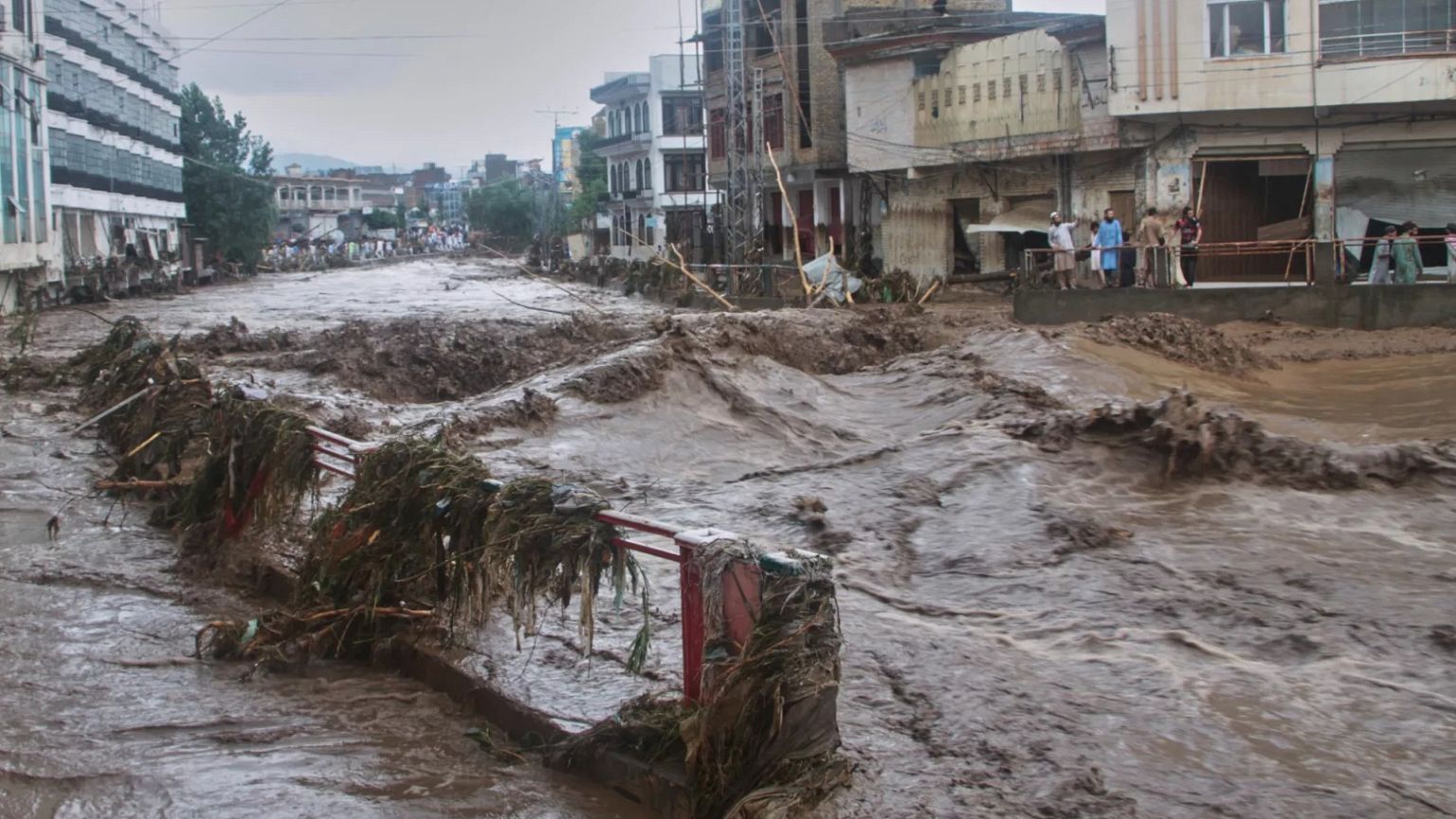
ISLAMABAD — Cloudbursts are causing chaos in mountainous parts of India and Pakistan, with tremendous amounts of rain falling in a short period of time over a concentrated area. The intense, sudden deluges have proved fatal in both countries.

As many as 300 people died in one northwestern Pakistani district, Buner, after a cloudburst. The strength and volume of rain triggered flash flooding, landslides and mudflows. Boulders from steep slopes came crashing down with the water to flatten homes and reduce villages to rubble.

The northern Indian state of Uttarakhand had a cloudburst earlier this month. Local TV showed floodwaters surging down a mountain and crashing into Dharali, a Himalayan village. In 2013, more than 6,000 people died and 4,500 villages were affected when a similar cloudburst struck the state.

They are complex and extreme weather events

A cloudburst occurs when a large volume of rain falls in a very short period, usually more than 100 millimeters (about 4 inches) within an hour over a localized area, around 30 square kilometers (11.6 square miles).

Cloudbursts are sudden and violent, with devastating consequences and widespread destruction, and can be the equivalent of several hours of normal rainfall or longer. The event is the bursting of a cloud and the discharge of its contents at the same time, like a rain bomb.

Several factors contribute to a cloudburst, including warm, moist air rising upward, high humidity, low pressure, instability and convective cloud formation.

Moist air is forced to rise after encountering a hill or mountain. This rising air cools and condenses. Clouds that are large, dense and capable of heavy rainfall form.

Hills or mountains act like barriers and often trap these clouds, so they cannot disperse or move easily. Strong upward currents keep moisture suspended inside the clouds, delaying rainfall.

When the clouds cannot hold the accumulated moisture anymore, they burst and release it all at once.

India and Pakistan have ideal conditions

Cloudbursts thrive in moisture, monsoons and mountains. Regions of India and Pakistan have all three, making them vulnerable to these extreme weather events.

The Himalayas, Karakoram and Hindu Kush mountain ranges are home to the world’s highest and most famous peaks, spanning multiple countries including India and Pakistan.

The frequency of cloudbursts in these two South Asian nations has been steadily rising due to a warming atmosphere, because a warmer air mass can hold more moisture, creating conditions for sudden and intense downpours.

The South Asian region has traditionally had two monsoon seasons. One typically lasts from June to September, with rains moving southwest to northeast. The other, from roughly October to December, moves in the opposite direction.

But with more planet-warming gases in the air, the rain now only loosely follows this pattern.

This is because the warmer air can hold more moisture from the Arabian Sea and Indian Ocean, and that rain then tends to get dumped all at once. It means the monsoon is punctuated with intense flooding and dry spells, rather than sustained rain throughout.

The combination of moisture, mountains and monsoons force these moisture-laden winds upward, triggering sudden condensation and cloudbursts.

They are hard to predict, but precaution is possible

It’s difficult to predict cloudbursts because of their size, duration, suddenness and complex atmospheric mechanisms.

Asfandyar Khan Khattak, a Pakistani official from the northwest province of Khyber Pakhtunkhwa, said there was “no forecasting system anywhere in the world” that could predict the exact time and location of a cloudburst.


The Pakistani government said that while an early warning system was in place in Buner district, where hundreds of people died after a cloudburst, the downpour was so sudden and intense that it struck before residents could be alerted.

Community organization SOST, which is also the name of a border village in Pakistan’s northern Gilgit-Baltistan region, says precautions are possible.

It advises people to avoid building homes right next to rivers and valleys, to postpone any travel to hilly areas if heavy rain is forecast, to keep an emergency kit ready, and to avoid traveling on mountainous roads during heavy rain or at night.

It recommends afforestation to reduce surface runoff and enhance water absorption, and regular clearing and widening of riverbanks and drainage channels.

Climate change is fueling their frequency


Experts say cloudbursts have increased in recent years, partly due to climate change, while damage from associated storms has also increased due to unplanned development in mountain areas.

Climate change has directly amplified the triggers of cloudbursts in Pakistan, especially. Every 1°C rise allows the air to hold about 7% more moisture, increasing the potential for heavy rainfall in short bursts.

The warming of the Indian Ocean and Arabian Sea pushes more moisture into the atmosphere. Melting glaciers and snow alter local weather patterns, making rainfall events more erratic and extreme. Environmental degradation, in the form of deforestation and wetland loss, reduces the land’s ability to absorb water, magnifying flash floods.

Climate change has been a central driver in the destruction seen in Pakistan’s northern areas.

“Rising global temperatures have supercharged the hydrologic cycle, leading to more intense and erratic rainfall,” said Khalid Khan, a former special secretary for climate change in Pakistan and chairman of climate initiative PlanetPulse.

“In our northern regions, warming accelerates glacier melt, adds excessive moisture to the atmosphere, and destabilizes mountain slopes. In short, climate change is making rare events more frequent, and frequent events more destructive.”


___


Associated Press writers Munir Ahmed and Riaz Khan contributed to this report from Islamabad and Peshawar, Pakistan, respectively.


Flash floods in India and Pakistan kill over 280 people, scores remain missing


Copyright AP Photo

By Euronews
Published on 16/08/2025 -

Flash floods triggered by torrential rains killed over 280 people in India and Pakistan. Rescuers continued their search for 80 missing in a Himalayan village and evacuated hundreds across the region.

Flash floods triggered by torrential rains killed over 280 people across India and Pakistan in the past 24 hours, with rescuers searching for at least 80 missing in a remote Himalayan village where cloudbursts devastated a Hindu pilgrimage site.

A relief helicopter carrying supplies to flood-hit areas in Pakistan's northwest crashed Friday due to bad weather, killing all five people aboard including two pilots.

In India-controlled Kashmir, at least 60 people died and 80 remained missing after flash floods struck the remote village of Chositi, where more than 200 Hindu pilgrims were eating at a community kitchen when floodwaters swept down the mountain.

At least 50 seriously injured people were treated in local hospitals, many of them rescued from a stream filled with mud and debris. Disaster management official Mohammed Irshad said the number of missing people could increase.

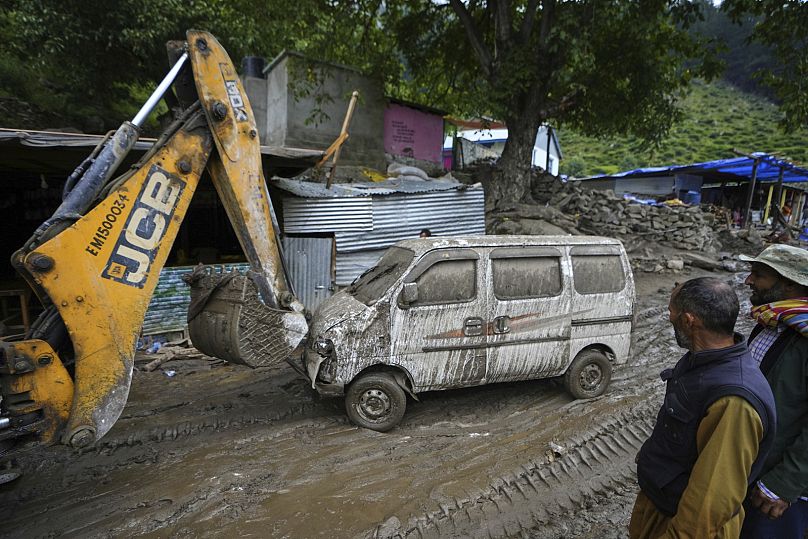
An earth mover clears a road after Thursday's flash floods in Chositi village, Kishtwar district, Indian-controlled Kashmir, 15 August 2025 AP Photo/Channi Anand

Chositi, in Kashmir’s Kishtwar district, is the last village accessible to motor vehicles on the route of an ongoing annual Hindu pilgrimage to a mountainous shrine at an altitude of 3,000 metres.

Officials said the pilgrimage, which began 25 July and was scheduled to end on 5 September, was suspended.

Photos and videos on social media show extensive damage with household goods strewn next to damaged vehicles and homes in the village.

Authorities made makeshift bridges Friday to help stranded pilgrims cross a muddy water channel and used dozens of earthmovers to shift boulders, uprooted trees and electricity poles and other debris.

Kishtwar district is home to multiple hydroelectric power projects, which experts have long warned pose a threat to the region’s fragile ecosystem.
Hundreds of tourists trapped by floods in Pakistan

In northern and northwestern Pakistan, flash floods killed at least 164 people in the past 24 hours, including 78 people who died in the flood-hit Buner district in northwest Pakistan on Friday.

Dozens were injured as the deluge destroyed homes in villages in Buner, where authorities declared a state of emergency Friday. Ambulances have transported 56 bodies to local hospitals, according to a government statement.

The helicopter that crashed on Friday was on a relief mission when it went down in the northwest, provincial Chief Minister Ali Amin Gandapur said.


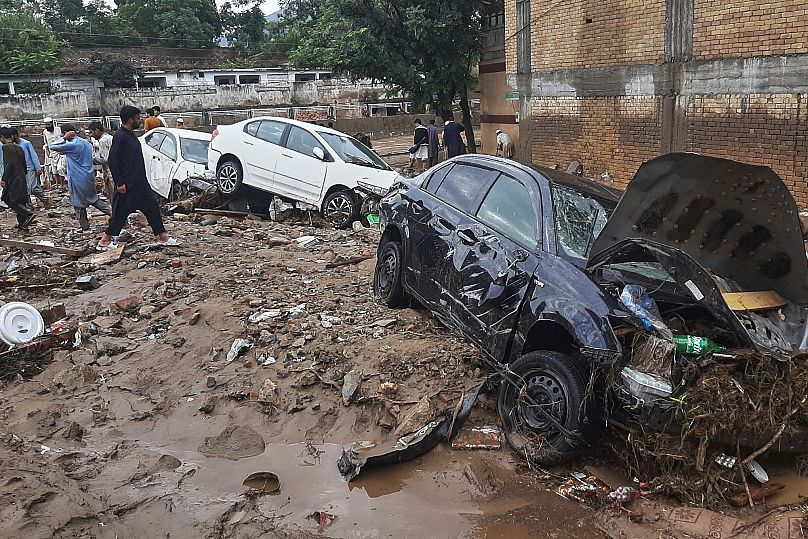
Residents examine damaged cars trapped in a mud following flash flooding due to heavy rains in Mingora, the main town of Swat Valley, northwestern Pakistan, 15 August 2025 AP Photo

Rescuers evacuated 1,300 stranded tourists from the mountainous Mansehra district hit by landslides on Thursday. At least 35 people were reported missing in these areas, according to local officials.

Rescuers backed by boats and helicopters worked to reach stranded residents. Dozens were still missing and the death toll is likely to rise, Kashif Qayyum said.

More than 477 people, mostly women and children, have died in rain-related incidents across the country since 26 June, according to the National Disaster Management Authority.

Rescuers evacuated some 1,600 people from mountainous districts in both countries as sudden downpours triggered floods and landslides across the region.
Cloudbursts to blame

Weather officials forecast more heavy rains and floods in the area.

Pakistan’s disaster management agency has issued fresh alerts for glacial lake outburst flooding in the north, warning travellers to avoid affected areas.

Sudden, intense downpours over small areas known as cloudbursts are increasingly common in India’s Himalayan regions and Pakistan’s northern areas, which are prone to flash floods and landslides.

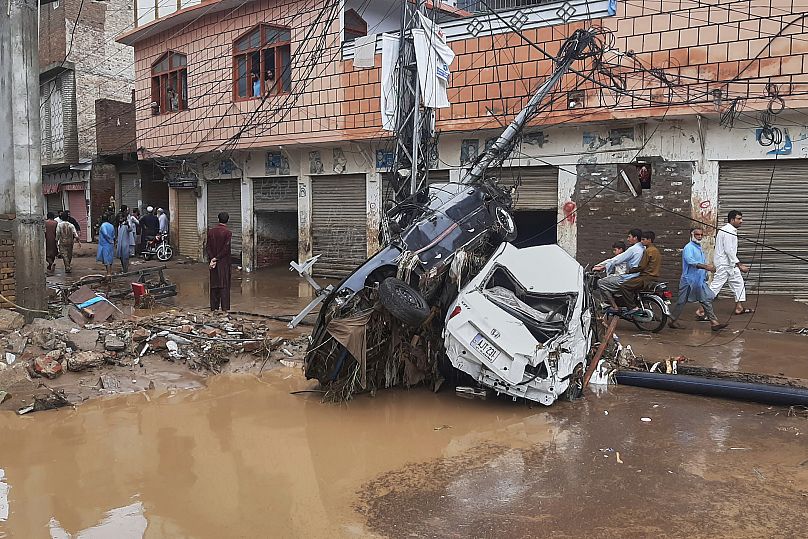
Residents walk next to damaged cars stuck to an electric pole following flash flooding in a neighbourhood of Mingora, 15 August, 2025 AP Photo

Cloudbursts have the potential to wreak havoc by causing intense flooding and landslides, impacting thousands of people in the mountainous regions.

Experts say cloudbursts have increased in recent years partly because of climate change, while damage from the storms also has increased because of unplanned development in mountain regions.

Related


A study released this week by World Weather Attribution, a network of international scientists, found rainfall in Pakistan from 24 June to 23 July was 10% to 15% heavier because of global warming.

In 2022, the country’s worst monsoon season on record killed more than 1,700 people and caused an estimated €34.2 billion in damage.


Nearly 200 Killed in One Day in Pakistan Flooding Fueled by Climate Crisis

"The death toll may rise as we are still looking for dozens of missing people," said a spokesperson for an emergency agency in northwestern Pakistan.


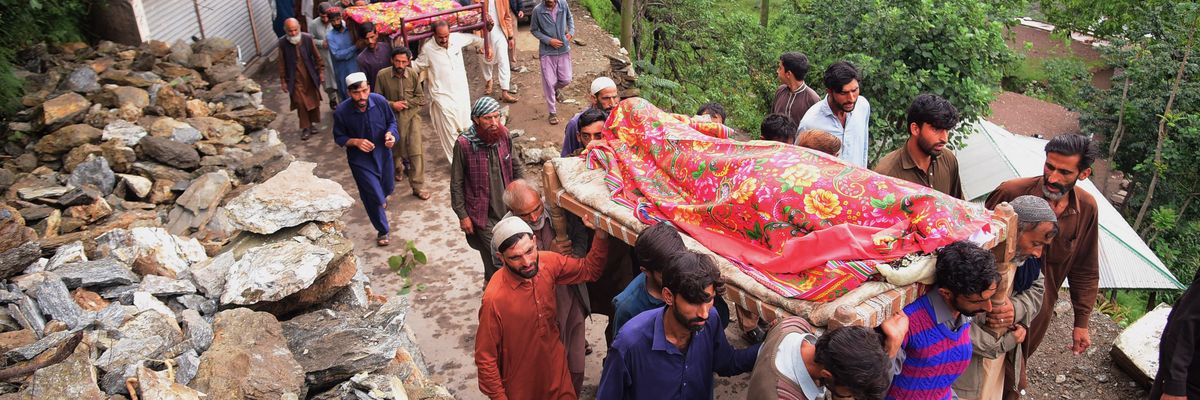
Mourners carry the coffins of people who were killed in flash floods in Naryean Behaak village in Pakistan on August 15, 2025.
(Photo by Sajjad Qayyum/AFP via Getty Images)

Julia Conley
Aug 15, 2025
COMMON DREAMS


Five people on a helicopter rescue team were among nearly 200 people killed by extreme rainfall and flooding in Pakistan in a single day on Friday—the country's latest emergency caused by increasingly severe monsoon seasons, which scientists say are being fueled by the human-caused climate crisis.

The vast majority of deaths were recorded in mountainous areas in the northwestern region, with at least 171 people killed on Friday in Khyber-Pakhtunkhwa.

As the Associated Press reported, "cloudbursts," or sudden and intense downpours over small areas, have become increasingly common in India and northern Pakistan in recent years and have caused landslides and flooding.

Pakistan has faced more extreme heatwaves and abnormal torrential downpours during its monsoon season, which typically occurs from June-September. Glaciers like those in the Gilgit-Balistan region, which hold 75% of Pakistan's stored water supply, have also been melting faster due to higher temperatures—another cause of flash floods. Several landslides have been reported along the Karakoram Highway in that region, which is heavily used by tourists and for trade.


International scientists at the World Weather Attribution said last week that rainfall in Pakistan from June 24-July 23 was 10-15% higher than it would have been without planetary heating linked to fossil fuel emissions, which have steadily risen since the 1950s with wealthy countries including the United States being the biggest contributors.

The death toll from the current ongoing extreme weather, which is expected to continue in the coming days, will likely rise significantly, said officials on Friday.

Authorities suspended an annual Hindu pilgrimage to a Sufi shrine in the northwestern Buner district, which began July 25 and was supposed to continue until early September.

About 78 people have been killed in Buner, mostly by floodwaters that swept them away and houses that collapsed.

Officials were helping nearly 4,000 pilgrims evacuate the area on Friday, building makeshift bridges to help people cross waterways and using dozens of excavators to move boulders, uprooted trees, and other debris.

"The death toll may rise as we are still looking for dozens of missing people," provincial emergency service spokesperson Mohammad Suhail told the AP.

A merchant in the Buner district told the New York Times that he had lost thousands of dollars in goods.

"Everything I had, groceries, edible items, is destroyed," Syed Mehmood Bacah said. "I could not save anything."

The disaster comes three years after Pakistan's worst monsoon season on record, in which flooding killed more than 1,700 people and caused an estimated $40 billion in damages.

Pakistan has become the world's fifth-most vulnerable country to climate disasters despite contributing only about 1% of the world's fossil fuel emissions.

The National Disaster Management Authority said the total number of rain-related deaths has now reached at least 556 since June 26, with more than 700 people injured.

Northern India has also been affected by flash flooding this week, with at least 44 people killed and more than 100 others injured in the Indian-controlled part of Jammu and Kashmir.


Heatwave continues to scorch France as fire risks and pollution rise


A severe heatwave continues to grip much of France this Saturday, stretching as far north as southern Brittany, with 54 departments placed under orange alert by Météo-France on the ninth day of a relentless heatwave also affecting the Iberian Peninsula. The hottest temperatures are forecast in the Aude and Hérault regions, with Montpellier expecting a scorching 42°C by Saturday afternoon.


Issued on: 16/08/2025 - RFI

A woman uses an umbrella to protect herself from the sun as she walks past Lyon City Hall during a heatwave, in Lyon, France August 9, 2025. REUTERS - Abdul Saboor

Local authorities in Montpellier have urged residents to seek out cooler places such as community centres for the elderly, swimming pools, museums, and administrative buildings to escape the intense heat.

This marks the second major heatwave of the summer in France and the 51st since 1947, events that experts say are becoming more frequent and severe due to climate change.

Residents are adapting as best they can. In Montpellier, 80-year-old retiree Marie Couture opens her windows early in the morning to bring in cooler air and is considering installing air conditioning after advice from her family.

Meanwhile, 78-year-old Annie Hugot in Nîmes opts for a simple bucket of ice in front of a fan to manage the heat, citing environmental and economic concerns about air conditioning.

In France, heatwaves have become more frequent over the last years. REUTERS - Gonzalo Fuentes

The heatwave is worsening fire risks across southern and central France, especially in the Aude, Vaucluse, and Drôme regions, where red alerts are in place for fire danger.

Around 330 firefighters remain deployed tackling a major fire in the Aude that has consumed 16,000 hectares and is not yet contained. Due to these conditions, mountain access in Vaucluse has been restricted, and popular tourist sites like Pic Saint-Loup near Montpellier are closed.

In addition to heat, the Bouches-du-Rhône region faces high ozone pollution levels, leading to continued road traffic restrictions in Marseille.

France registers a record 480 excess deaths during early summer heatwave

Meanwhile, thunderstorms are expected over parts of eastern France and southern Corsica on Saturday, offering some relief in those areas.

The heatwave is projected to ease from the north and west by Sunday and Monday, aided by incoming storms that should bring cooler temperatures and potentially end this prolonged spell of intense heat.


A Canadair firefighting plane drops water during a wildfire near Saint-Laurent-de-la-Cabrerisse, near Narbonne, southern France, August 6, 2025. © Manon Cruz / Reuters


Across Europe, Spain is also enduring a 14th consecutive day of extreme heat, with forecasts warning of fire risks and multiple active wildfires in the region. Recent fires in Spain and Portugal have claimed several lives, underscoring the harsh impact of these soaring temperatures exacerbated by climate change.


Death toll rises as wildfires continue to burn across southern Europe


Copyright Securite Civile via AP

By Emma De Ruiter
Published on 16/08/2025 - 

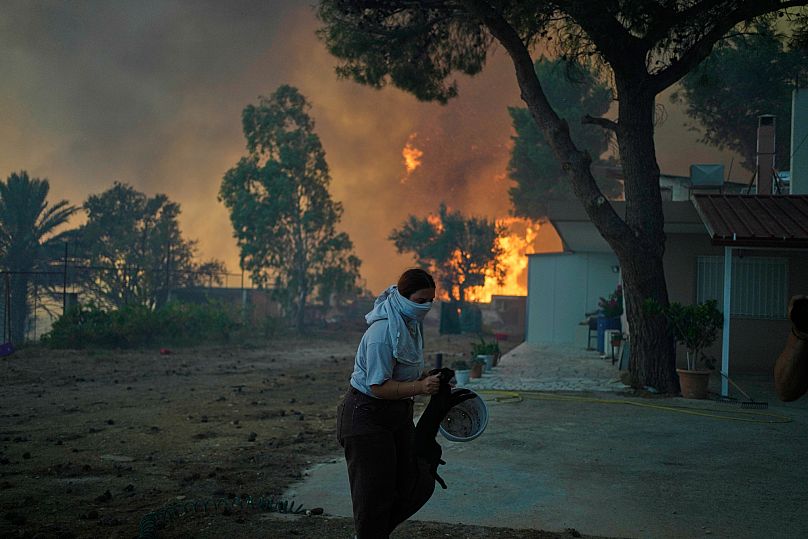
Firefighters in Spain, Portugal, Greece and Turkey continue to battle wildfires that have raged on for weeks. Hot and dry conditions are expected to persist, challenging efforts to contain the blazes.


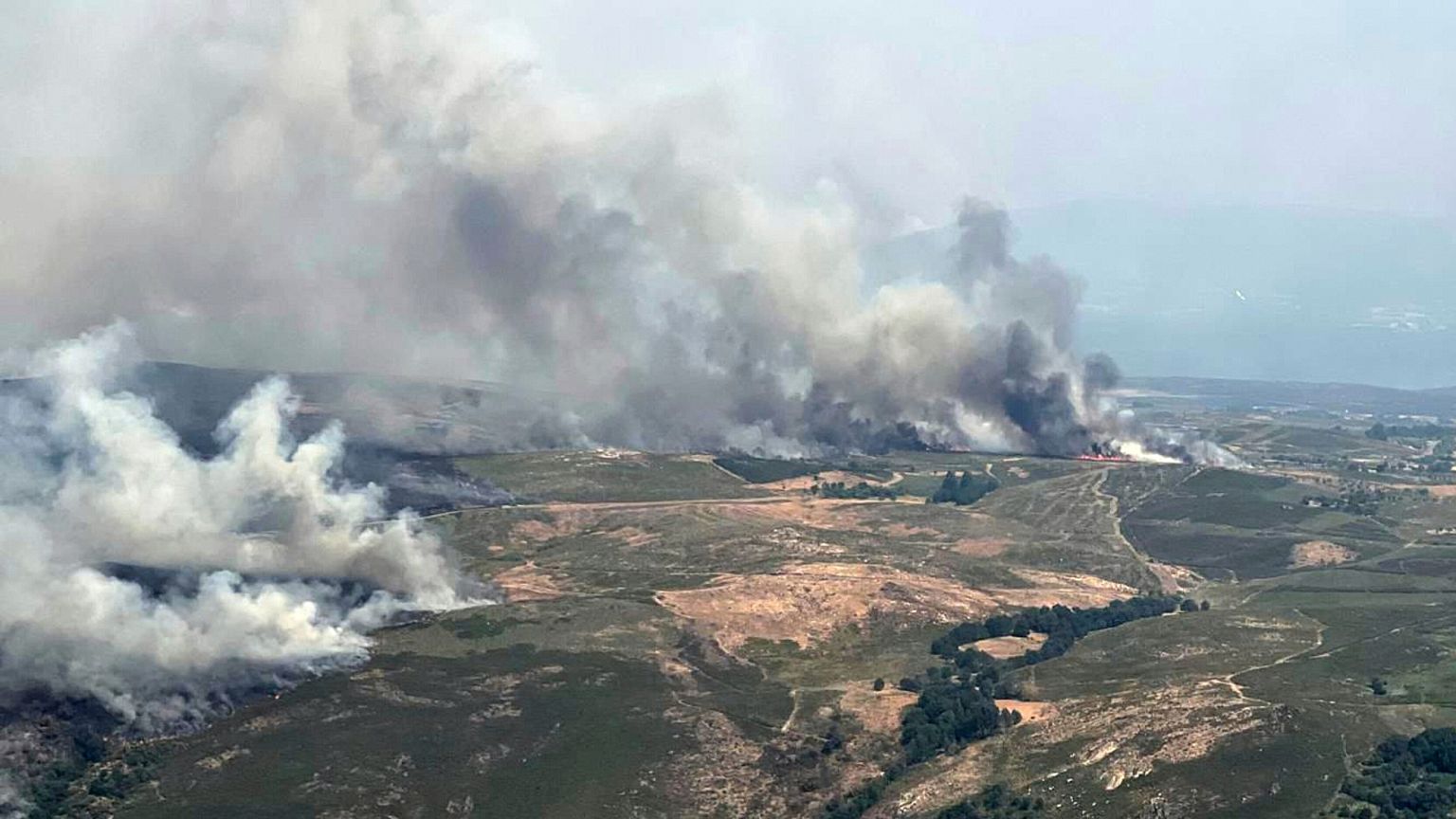
Wildfires continue to burn across southern Europe amid an ongoing heatwave that has challenged efforts to contain the blazes, while temperatures are set to climb over the weekend.

Spain is currently fighting 14 major fires, according to Virginia Barcones, general director of emergency services.

“Today will once again be a very tough day, with an extreme risk of new fires,” Spanish Prime Minister Pedro Sánchez wrote on X.

Three people have died in Spain as a result of the fires, including two volunteer firefighters. Sánchez expressed support for the family of the second volunteer, who died in a hospital in León on Thursday after suffering severe burns.

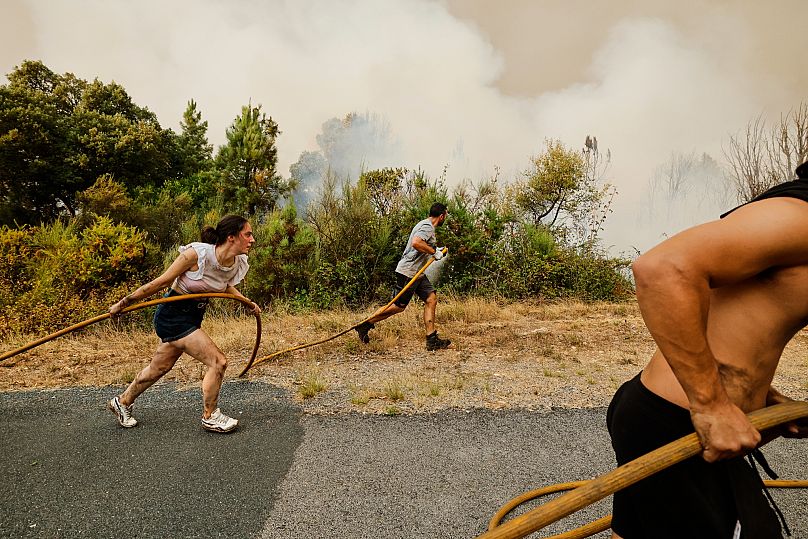
Local residents and volunteers work together to battle an encroaching wildfire in Larouco, northwestern Spain, Aug. 13, 2025. AP Photo/Lalo R. Villar

The national weather agency AEMET warned of extreme fire risk in most of the country, including where the largest blazes were burning in the north and west. A heatwave which brought temperatures exceeding 40C on several days this month is expected to last through Monday.

Fires in the Galicia region forced the closure of several highways. The high speed rail line connecting it to Spain's capital Madrid remained suspended.

The fires in Spain this year have burned 158,000 hectares of land, according to the European Union’s European Forest Fire Information System. That is an area roughly as big as metropolitan London.

First death from fires in Portugal


In Portugal, nearly 4,000 firefighters were battling fires on Friday. Seven major fires were active. Authorities extended the state of alert until Sunday as high temperatures are expected to last through the weekend.

In the Guarda district, a lack of resources is hampering efforts to subdue the flames. Fires have spread to the neighbouring municipalities of Pinhel and Trancoso.

In the village of Alverca da Beira, the flames reached an abandoned house. Concern for other neighbouring houses led dozens of people to try to extinguish the fire with their own means.


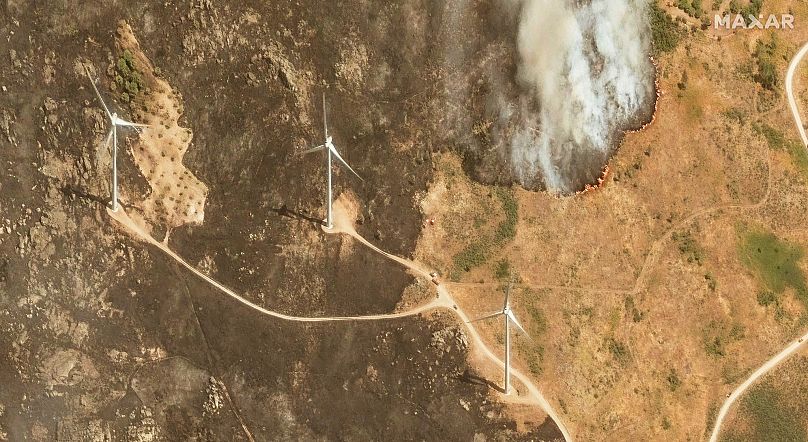
This satellite image provided by Maxar Technologies shows an active fire line for a wildfire in Trancoso, Portugal, Tuesday, Aug. 12, 2025. AP/Satellite image 
©2025 Maxar Technologies

On Saturday, the charred body of the former mayor of Vila Franca do Deão was found, making him the first fatality of the forest fires ravaging the country this summer.

The Portuguese government had on Friday requested assistance from the EU’s civil protection mechanism, a firefighting force that European countries in need can call upon. A day earlier, Spain received two Canadair water bomber aircraft after requesting EU help to tackle blazes for the first time ever.

In the past week, Greece, Bulgaria, Montenegro and Albania have also requested help from the EU’s firefighting force to deal with forest fires. The force has already been activated as many times this year as the entirety of last year's fire season.

New evacuation orders issued in Greece


On Friday, a wildfire in Greece burned out of control for a fourth day on the island of Chios, prompting several more overnight evacuations.

Two water-dropping planes and two helicopters were operating in the north of the island in the eastern Aegean Sea, where local authorities said a lull in high winds was helping firefighters early Friday.

Following a series of large fires in western Greece earlier this week, the fire service was on alert outside Athens and nearby areas in the south of the country where adverse weather conditions elevated the fire risk.

A woman takes away a cat as the fire approaches a house during a wildfire in Patras city, western Greece, Wednesday, Aug. 13, 2025. AP Photo/Thanassis Stavrakis

Firefighters in Turkey also continued to tackle fires across several provinces, and many appeared to be largely contained by Saturday.

Scientists say that climate change is exacerbating the frequency and intensity of heat and dryness in parts of Europe, making the region more vulnerable to wildfires.

The burning of fossil fuels like coal and gas releases heat-trapping gases, which are the primary driver of climate change.

Europe has been warming twice as fast as the global average since the 1980s, according to the EU’s Copernicus Climate Change Service.

The EU monitoring agency says that 2024 was the hottest year on record both globally and in Europe, which experienced its second-highest number of "heat stress" days.

Nature’s payback

Aisha Khan 
Published August 17, 2025
DAWN

The writer is chief executive of the Civil Society Coalition for Climate Change.

THE frequency and intensity of disasters is increasing in Pakistan with every passing year. This phenomenon, if allowed to continue unabated, will extract a heavy social, economic and political price. After the Paris Agreement, it has become common practice in Pakistan to attribute every disaster to climate change and cite lack of finance for unpreparedness. However, time has come for some serious soul-searching and honest introspection.

Deforestation and disaster reinforce each other through a negative feedback loop. Forest cover in Pakistan has been declining over the years. This reckless deforestation plays a significant role in what we are witnessing today in the form of hydrometeorological disasters and widespread devastation, wreaking havoc in the lives of communities.

The main forested areas in the country are situated in Azad Kashmir, KP and Gilgit-Baltistan. According to the Global Forest Watch, in 2020 KP had 937 kilohectares (2.3 million acres) of natural forest, extending over 12 per cent of its land area. In 2024, it lost 235 hectares (581 acres) of natural forests, equivalent to 40.8 kilotons of carbon dioxide emissions. The region of Malakand stands out for being the most responsible with 50pc tree cover loss at 1.73 kha compared to an average of 431 ha between 2005 and 2024. Hazara follows with loss of 1.49 kha in forest cover. KP has been losing forests at a rate of 1.5pc annually equivalent to 11,000 hectares per year between 2000 and 2023. In Chitral, projected loss under current trends is 23pc by 2030.

The loss of forest in the upper areas of Chitral, Kalam and upper Hazara has created large expanses of bare ground that is heating up much faster in the absence of tree canopy and undergrowth. This results in enhancing the land-sea thermal contrast as sun-exposed soil can reach extreme surface temperatures (often 5-8 degrees Celsius higher) than land under forest cover. Higher ground temperature intensifies local low pressure zones, strengthening the ‘heat pump’ effect that draws in moist monsoon winds inland from the Arabian Sea and Bay of Bengal. The reinforced vertical pull of hotter, drier surface air rises more vigorously when it collides with cool, moist air from the sea. The result is intense convective updrafts making it the perfect recipe for cloudbursts and landslides, glacial lake outburst floods and other hydrometeorological disasters.

Deforestation and disaster reinforce each other.

This year the Arabian Sea surface temperature is about 0.8ºC above average, with winds carrying more water vapour. When these moisture-laden winds meet deforested, superheated hillsides, the uplift and condensation are explosive. What we see happening in AJK, KP and GB are disasters amplified by deforestation.

The reports about the latest destruction of forest in Arandu Gol in Chitral and violation of forest rules in Makhniyal Guzara Forest in Hazara and Ayubia National Park are alarming and ominous developments. Deforestation is not only about environmental degradation, it is about loss of human life, disruption of livelihoods, displacement of vulnerable communities and destruction of costly infrastructure. There is an urgent need for an inquiry into the aforementioned allegations to arrest damage before it becomes a cause of the next major disaster.

The lessons of floods in 1992 and 2010 in Kalam and cloudbursts now in Babusar, GB, Mansehra, Buner and Swat should not be lost on us. The costs, both economic and social, are staggering. There is a direct connection between deforestation, flood severity and damages. Forest protection and taking firm action now can save us from risks associated with natural disasters.

Moreover, as a signatory to the Paris Agreement, Pakistan will sev­erely undermine its mitigation co-m­mitments if it allows forests to be decimated for timber, real estate development and money-making ventures by vested interest groups at the cost of compromising its emission reduction commitments.

Pakistan’s track record is poor. It is woefully behind in meeting SDG goals, faces challenges in implementing climate policies and seemingly lacks the ability to enforce forest rules and regulations. For how long can we blame external factors and refuse to take internal responsibility for things that we can control to reduce risks?

Sustainable development makes it necessary to reduce future economic burdens, safeguard communities from displacement and preserve health and livelihoods. With unchecked deforestation we are wilfully putting ourselves in harm’s way, contributing to intensification of disasters and exposing more people to risks.

Our future resilience depends on ecological restoration of degraded ecosystems and protecting existing forests from exploitation and deforestation.

aisha@csccc.org.pk

Published in Dawn, August 17th, 2025
Pakistan’s satellite reaches orbit, begins operations


APP 
Published August 17, 2025 

LAHORE: Pakistan’s new remote sensing satellite has successfully rea­c­hed orbit and begun operations, sources at the Spa­ce and Upper Atmosphere Research Commission (Su­­parco) said on Saturday.

The satellite was laun­ch­­ed from China’s Xich­ang lau­­nch centre on July 31.

The satellite has established stable communication links with ground stations and started acquiring high-resolution images for sending them to the ground.

This will make data available for various sectors of national life.

The satellite has high-quality imaging capabilities that will revolutionise urban planning and infrastructure development. It will also help monitor urban sprawl and development trends.

It will strengthen the na­­tural disaster prevention sys­­tem and enable rapid response by providing tim­ely data that could alert authorities to possibility of floods, landslides, earthquakes and other disasters.

The satellite will also play a role in environmental protection, such as monitoring melting of glaciers and deforestation.

According to experts, it will help boost agricultural production.

The satellite is expected to play a key role in execution of development projects like the China-Pakistan Economic Corri­dor, mapping transport networks, identifying geo-hazards and enabling the effective use of natural resources.

Published in Dawn, August 17th, 2025
Games industry in search of new winning combo at Gamescom 2025


By AFP
August 17, 2025


Almost 335,000 people attended last year's Gamescom 
- Copyright AFP/File Ina FASSBENDER

Kilian FICHOU

The global games industry gathers for the vast Gamescom trade fair in Cologne this week, with hopes that upcoming heavy-hitters like “GTA VI” can help the industry escape its doldrums.

Tuesday’s opening night event will show off major releases slated for the months ahead, with the starring role going to “Black Ops 7” — the new instalment in the sprawling “Call of Duty” saga.

Trade visitors will have Wednesday to peruse the stands and make connections, before tens of thousands of enthusiastic gamers are unleashed on the vast salon from Thursday to Sunday.

Last year’s Gamescom drew almost 335,000 people to the Cologne exhibition centre, where studios lay on vast stands with consoles or PCs offering hands-on play with the latest releases.

Nintendo is back in 2025 after staying away last year, surfing on record launch sales for its Switch 2 console.

And Microsoft’s Xbox gaming division will show off new portable hardware expected to be released towards the end of the year.

Sony, the Japanese giant behind the PlayStation, has opted out this time around.

The mood is mixed for the roughly 1,500 exhibitors attending this year, as major publishers have recently steered back into profitability but the job cuts seen over the past two years continue.

In early July, Microsoft said it would lay off around 9,000 people, with hundreds leaving game studios like “Candy Crush” developer King and several games cancelled, including “Perfect Dark” and “Everwild”.

– Battle for attention –

“The industry is consolidating quite a bit” after the bumper years when Covid-19 lockdowns created a captive audience, said Rhys Elliott of specialist games data firm Alinea Analytics.

Around 30,000 workers have lost their jobs since early 2023, according to tracking site Games Industry Layoffs — more than 4,000 of them so far this year.

Revenue in the global games market should hold steady at just under $190 billion this year, data firm Newzoo has forecast.

The number of players and hours spent with the medium are stable while an ever-expanding number of titles are jostling for attention.

And with leviathans like “Roblox” or “Fortnite” swallowing the attention of hundreds of millions of monthly users, “everyone’s fighting for a smaller share of that pie,” said Circana expert Mat Piscatella.

The need to find new audiences has pushed Microsoft’s Xbox, the biggest games publisher in the world, to switch strategy, increasingly offering its titles on competing console makers’ hardware.

“They’ve had really great success on the PlayStation platform. Sony is making a bunch of money on that too,” Piscatella said

“It’s a little bit of a win-win all the way around.”

Some PlayStation games are making the trip in the opposite direction, with “Helldivers 2” the first to be made available on Xbox as well as the traditional PC port.

– Success on a budget –

Shoring up sales is vital in an era where the cost of developing high-spec “AAA” games has mounted into the hundreds of millions of dollars — exposing studios to massive risk should their games not perform as hoped.

But several breakout hits have recently shown that lower-budget games can still win over players with gameplay, story and art style, such as four-million-selling French turn-based battler “Clair Obscur: Expedition 33”.

“There’s a realisation you don’t need to spend masses of money to deliver a high-quality game that can appeal broadly and so everyone is rushing towards that model,” said Christopher Dring, founder of industry website The Game Business.

But “for every ‘Clair Obscur’ success story, there are 10 games that fail to find an audience at all,” Piscatella pointed out.

“It’s hyper-competitive for those products outside of that big sphere” and smaller developers must fight hard for the funding they need to get games to market.

Nor is the cult-hit trend likely to displace the mega-budget mastodons.

Analysts predict that Rockstar Games’ vast “Grand Theft Auto VI” could notch up the biggest launch for any entertainment product in history.

That might be the juice the flagging industry needs to regain some of its mojo.


Israeli Navy Launches Deep Strike Missile Attack on Houthi Powerplant

Israel
Saar-6 corvette (IDF file image)

Published Aug 17, 2025 2:49 PM by The Maritime Executive


Early on Sunday morning, Israeli corvettes launched a missile attack on the Haziz power generation plant in the Houthi capital of Sana’a, Yemen. Israeli sources indicate the attack was mounted in response to the latest Houthi attempt to attack Israel on August 14.

A Houthi military spokesman had previously claimed that a ballistic missile was fired at Ben Gurion Airport, and that six drones had also been launched against Israel. The ballistic missile was intercepted well before it reached Israeli territory, one drone was shot down south of Eilat, and the other five drones have not yet arrived. The Houthi attack did not necessitate the sounding of any civil defense alarms.

 This is the second time that the Israeli Navy has been used to attack targets in Yemen, and is particularly noteworthy as it demonstrates that the Israeli Navy’s Saar-6 corvettes - which are likely to have been used to mount the attack - have more than just a littoral strike capability. The range demonstrated in this particular attack was at least 130 miles. The missile likely to have been used is the Blue Spear, developed for land attack purposes from the Gabriel anti-ship missile, and reputed to have a range of 300 miles carrying a 150lb warhead. Ukraine is believed to be reverse-engineering a version of this missile.

Use of the Navy avoids a long-range manned aircraft operation 1,250 miles down the Red Sea, involving not only F-16 strike platforms, but also intelligence, surveillance and refueling aircraft, search and rescue capability and possibly specialist aircraft for suppressing air defenses. Such operations are expensive in terms of fuel and aircrew hours, but also put aircrew at risk. Use of IAI Heron TP Eitan and the Elbit Systems Hermes 900 Kochav drones could also be a cost-effective alternative, except that the Houthis have demonstrated a capability to shoot down drones over land, so drone attacks are best reserved for harbor and coastal targets. The use of the Navy is not only cost-effective, it also has operational security advantages, as there is almost no signature of an impending attack.

Social media footage from Sana’a shows huge flames and a distraught local population, suggesting that the attack appears to have caused considerable damage. Infrastructure repairs in Yemen are particularly difficult, as routes into the country for spare parts are heavily circumscribed.

This latest attack comes on top of 13 previous Israeli attacks, some of which also targeted the power infrastructure in Houthi-controlled areas. The Haziz generating plant was the last operational facility supplying Sana’a public electricity network.

Shortly after the Israeli strike on Sunday, Houthi militants launched another ballistic missile attack on Israel. The single missile was intercepted, the Israeli Defense Forces said, and no damage was reported. Israeli officials pledged a forceful response. 

"This is only the beginning,” Israeli Defense Minister Israel Katz said following Sunday's Houthi attack. "What follows will be strong and painful. Whoever raises a hand against Israel, his hand will be cut off."