Monday, November 17, 2025

Ethiopia signs agreement for aluminum plant with Rusal

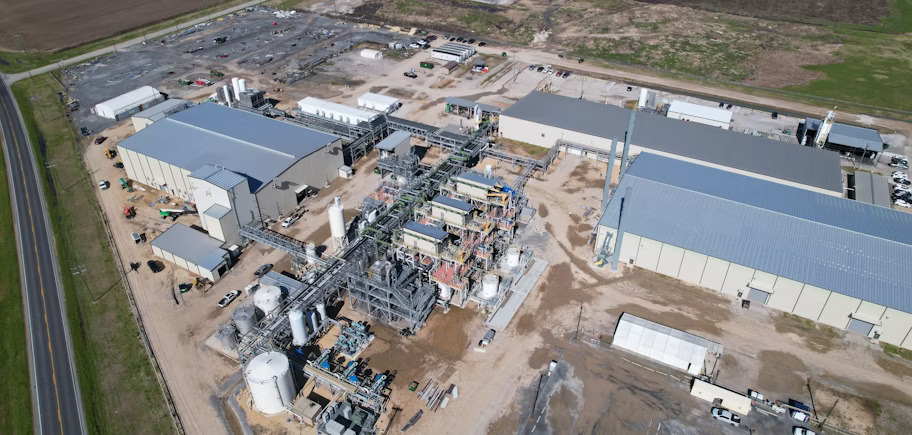
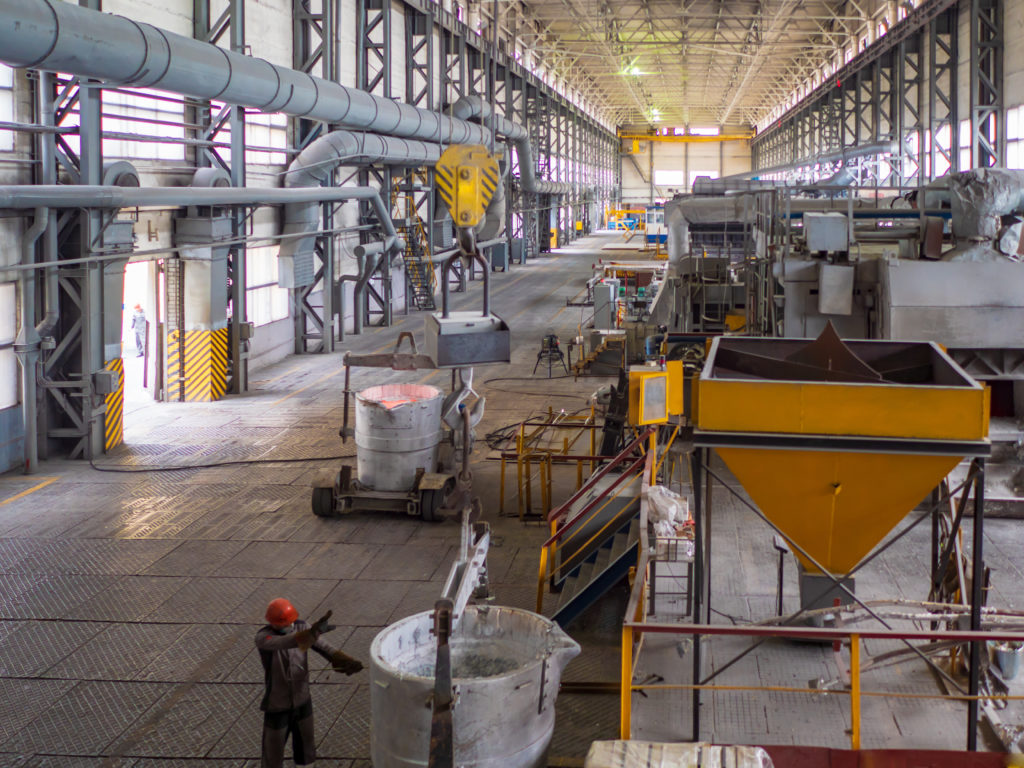
Aluminum plant. Stock image.

Ethiopian Investment Holdings has signed a preliminary agreement with Rusal to establish a large-scale aluminum smelter plant in Ethiopia, the state-run investment company said on Friday, the latest large investment announced in the country.

The proposed facility is expected to have an annual production capacity of 500,000 metric tons, and its first phase will cost about $1 billion, Ethiopian Investment Holdings said in a statement on its X account.

The project covered by the memorandum of understanding will take three to four years to complete, and the plant will have an operating period of up to 50 years, the investment firm said.

“Preliminary activities — including site identification and a comprehensive feasibility study — are already underway to ensure timely progress,” Ethiopian Investment Holdings said.

Rusal declined to comment.

In August, Ethiopia and Nigeria’s Dangote Group signed an agreement to build a $2.5 billion fertilizer manufacturing plant in the country’s south east.

In September, Russia and Ethiopia signed an action plan for the development and construction of a nuclear power plant in the east African country.

(By George Obulutsa, Vincent Mumo Nzilani and Anastasia Lyrchikova; Editing by Jan Harvey)


Syrah Resources, Tesla to further extend graphite supply deal deadline


The 11.25ktpa AAM facility at Vidalia commenced production in Q1 2024. Credit: Syrah Resources

Australia’s Syrah Resources said on Monday that it had agreed with Tesla to extend the deadline to tackle an alleged default of their graphite supply agreement for the second time in two months as the miner works to keep its US operations buoyant.

The Elon Musk-led automaker issued a default notice in July after Syrah allegedly failed to deliver conforming active anode material samples from its Louisiana processing facility for Tesla’s electric vehicle batteries.

Syrah said the original September 16 deadline, which was initially extended to November 15, had been further pushed to January 16, 2026.

“While Syrah does not accept it is in default under the offtake agreement, the parties have extended the cure date to 16 January 2026,” the company said in a statement.

Syrah’s 2021 contract with Tesla aimed to supply 8,000 metric tons of graphite anode materials over a four-year period from its Vidalia plant in the US state of Louisiana.

The facility is the only vertically integrated, large-scale anode material producer outside China, helping reduce US dependence on Chinese supplies that dominate the market.

Syrah said under its agreement, Tesla could terminate the offtake agreement if final qualification of the plant’s active anode material was not achieved by February 9, 2026.

Tesla did not immediately respond to a Reuters request for comment.

In a separate announcement, Syrah said a subsidiary had received $8.5 million under its United States International Development Finance Corporation loan of $150 million, lending support to its Balama graphite operations in Mozambique that faced operational disruptions last year due to nationwide protests.

(By Nikita Maria Jino; Editing by Jamie Freed)


Around 30 people killed in Congo copper mine incident, officials say

(Image courtesy of Enough Project | Flickr)

Around 30 people were killed at a semi-industrial copper mine in southeastern Congo on Saturday after a bridge collapsed, the country’s artisanal mining agency said.

An agency official told Reuters there were 49 deaths and 20 people had been taken to hospital in a critical condition as a result of the incident, which occurred on Saturday at the Kalando mining site in Lualaba province.

Artisanal mining employs an estimated 1.5 to 2 million people in Congo and supports more than 10 million indirectly.

The collapse was “caused by panic, reportedly triggered by gunfire from military personnel securing the site,” said Congo’s Artisanal and Small-Scale Mining Support and Guidance Service, known by its French acronym SAEMAPE.

Miners then “piled on top of each other, causing injuries and death”, SAEMAPE added in a statement on Sunday.

The Initiative for the Protection of Human Rights called for an independent investigation into the military’s role in the deaths, citing reports of clashes between miners and soldiers.

A military spokesperson did not immediately respond to a request for comment.

Roy Kaumba, the provincial interior minister, said in a televised statement that 32 people had been confirmed dead.

Mining accidents are common in unregulated artisanal mines, with dozens of deaths every year at sites where often ill-equipped diggers burrow deep underground.

(Reporting by Ange Adihe Kasongo and Congo newsroom; Writing by Robbie Corey-Boulet; Editing by Alexander Smith)


Barrick Mining considers splitting into two entities

Credit: Barrick Gold

The board of Canada’s Barrick Mining has raised the possibility of splitting the company into two separate entities, one focused on North America and the other on Africa and Asia, four sources familiar with the company’s thinking told Reuters.

A split could also include the outright sale of Barrick’s African assets as well as of the Reko Diq mine in Pakistan, once it has secured financing, according to the sources.

In Mali, Barrick is looking to resolve a dispute with the African nation’s military administration before selling the asset, sources said.

A Barrick spokesperson did not immediately respond to requests for comment. Interim CEO Mark Hill, asked on Monday about a possible split, said the company does not comment on speculation.

Talks are ongoing and nothing has yet been finalized, the sources said.

The plans, if they go through, would essentially reverse Barrick’s merger with Randgold in 2019, and shed assets brought in by former CEO Mark Bristow.

The company’s focus on North America, including Fourmile, a major undeveloped gold mine in Nevada, would ensure that Barrick does not get undervalued in case of a potential takeover offer, one of the sources said.

Fourmile mine test production is not due to start until 2029. Hill said earlier this week that the company would shift its focus to North America, prompting a ratings upgrade on its shares by analysts at Jefferies and elsewhere.

Shares of Barrick rose on the Toronto Stock Exchange on Friday following the Reuters report, closing up 3%.

Investors have said Barrick’s shares are undervalued and have asked the company to find ways to take better advantage of a historic rally in gold prices.

Although Barrick shares have jumped 130% this year, in the last five years the company’s returns have been lower than its peers, gaining 52% while Agnico Eagle has jumped 142%.

Investors had previously proposed that the company divide into one division with stable assets such as Nevada and Fourmile, and another with riskier assets in Africa, Papua New Guinea and Reko Diq, one of the people said.

As one of the few gold mining companies with assets spanning multiple continents, Barrick’s biggest risk has been mines in politically volatile regions, investors say.

Earlier this year, Barrick lost control of its most profitable mine, the Loulo-Gounkoto complex in Mali, leading to a $1 billion write-off. A dispute over the country’s new mining tax code led to the seizure of 3 metric tons of gold and a provisional administrator taking charge of the mine. Four Barrick employees are still incarcerated by the Malian administration.

“There has been a view that there is a lot of value in Nevada,” said one Barrick investor. If the Nevada mine were a publicly listed company on its own, it would be one of the world’s largest-capitalized gold mining companies, the investor added, asking not to be identified as they were not authorized to speak to the media.

The company has resisted splitting in the past because without Nevada, this investor said, there is not much of value in its other mines. Barrick runs the Nevada gold mine in partnership with Newmont Corp.

In addition to Nevada and Mali, the company’s other working facilities include copper mines in the Democratic Republic of Congo, gold in Tanzania, the Dominican Republic and Papua New Guinea.

(By Divya Rajagopal; Editing by Veronica Brown, Lisa Shumaker and Edmund Klamann)

Ghana scraps tax on minerals exploration to boost investment

Ahafo operation in Ghana. Photo by Newmont Mining.

Ghana will abolish value-added tax on mineral exploration and reconnaissance to boost investment in its mining sector, its finance minister said, as Africa’s top bullion producer seeks to reverse over two decades of sluggish new development.

Ghana, which has been overhauling its mining sector, introduced the levy 25 years ago amid broader fiscal reforms.

The 15% tax covers exploration-related expenses such as drilling and assay work, hiking upfront costs for companies operating in the high-risk early stages of mining projects.

Industry groups, including the Ghana Chamber of Mines, have long argued that the tax discouraged greenfield investment and eroded Ghana’s competitiveness versus the likes of Ivory Coast, Burkina Faso and Kenya, which exempt exploration from VAT.

“Abolishing VAT will revive investor confidence, stimulate greenfield activity, and ensure the long-term sustainability of the country’s mining sector,” Cassiel Ato Forson told parliament during the 2026 budget presentation on Thursday.

The measure, part of a broader VAT review, is aimed at promoting responsible mining and curbing unregulated prospecting that has degraded forests and waterways, Forson added.

Record gold output

The policy shift comes after Ghana posted record small-scale gold exports between January and October.

Shipments surged to 81.7 metric tons worth about $8.1 billion, surpassing large-scale exports of 74.1 tons worth $6.6 billion for the first time, according to finance ministry data. Ghana had aimed to produce about 144.5 tons of gold in 2025.

The surge underscores the impact of recent regulatory reforms that have formalized artisanal mining and tightened export controls, Forson said.

The Chamber of Mines welcomed the VAT removal.

“VAT on exploration negatively affected our competitiveness as a mining jurisdiction and was a clog on the pipeline of projects,” its president, Michael Akafia, told Reuters.

Ghana’s mining sector, which accounts for over a third of export revenues, is dominated by gold alongside bauxite and manganese.

The government launched an audit this month – part of broad reforms – to boost earnings from the industry.

Major operators include Newmont, AngloGold Ashanti, Gold Fields, Perseus, and China’s Zijin and Cardinal Namdini.

(By Christian Akorlie, Emmanuel Bruce and Maxwell Akalaare Adombila; Editing by Mark Potter)
 

South Korean Yards Want to Build U.S. Navy Ships in Korea

To complement Korea's U.S. shipbuilding investments, plans are afoot to get U.S. government orders for Korean newbuilds

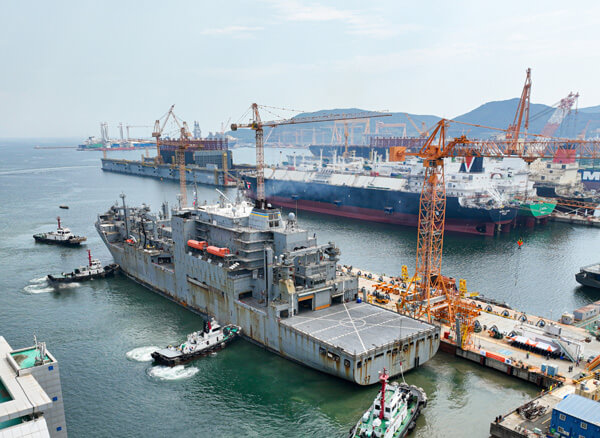
USNS Wally Schirra arrives to start a yard period at Hanwha, March 2025 (USN)

Published Nov 16, 2025 5:25 PM by The Maritime Executive


South Korea's business leaders are aware that a multi-billion-dollar diplomatic agreement to invest in the U.S. market could dent future plans for investment at home, since so much of South Korea's industrial capital will be going overseas to projects in the United States. They are responding with assurances of continued domestic spending, and hoping to balance the arrangement by building more products for U.S. customers within Korea - including U.S. naval vessels, according to Chosun Daily and Maeil Business News. 

"We have decided to seek institutional improvements to enable even the construction of US Navy vessels within South Korea," confirmed President Lee Jae-Myung last week. 

"The Korean shipbuilding industry is also preparing for U.S. business in a mutually beneficial direction," HD Hyundai Chairman Chung Ki-sun told Maeil last week. "Easing regulations on the defense sector in the U.S. is an important task.

Buying U.S. Navy vessels from foreign yards is currently prohibited by law, and doing it would require American political leaders to change or waive 10 USC §8679.

The plan, according to Chosun Daily, is to start with overhauls of naval auxiliary vessels, like fleet oilers; then proceed to overhauls of U.S. Navy combatant vessels; and then lastly, to pursue U.S. Navy newbuild construction contracts, only after finding a way around the legal prohibition on foreign construction of U.S. warships. 

The first step has already been done, starting with a successful yard period for USNS Wally Schirra (T-AKE-8) earlier this year. The second step is under way: in a deal formalized last week, the U.S. and Korea agreed to "further expand cooperation in shipbuilding and Maintenance, Repair, and Overhaul (MRO) . . . to include combat ships," according to Minister of National Defense An Kyu-baek. 

Moving beyond repair to include new construction would require several legal steps in the United States. The Trump administration could waive the foreign-shipyard legal requirement, and has the authority to do so. The White House has already placed overseas orders by buying a series of Coast Guard icebreakers from Finnish shipyards, without significant pushback from Congress. 

"Last month, U.S. Coast Guard ships could be built in Finland under U.S. President Donald Trump's order, and this could be applied to the Korea-U.S. shipbuilding cooperation project," HD Hyundai Chairman Chung Ki-sun told Maeil. "We are explaining it to the U.S. government at the corporate level, but we ask for special attention and support at the [Korean] government level."

Chosun notes that there is one more small political obstacle: Congress currently inserts a no-foreign-build clause in the annual defense appropriation bill, and this would need to be omitted or waived as well if orders were to proceed at scale. 


Norway’s MPCC Pursues Fleet Renewal with Four-Ship Newbuild Order

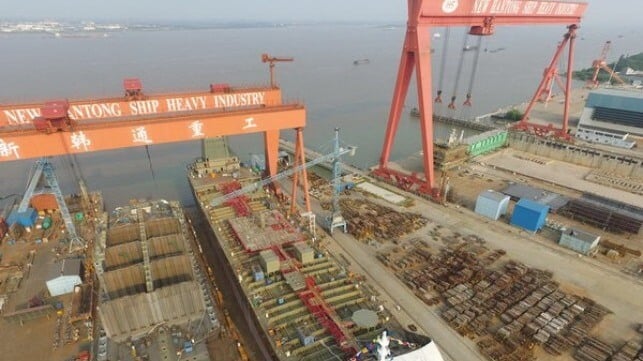
The quartet will be built at Jiangsu Hantong Ship Heavy Industry (Jiangsu Hangtong)

Published Nov 16, 2025 10:32 PM by The Maritime Executive


Norwegian boxship owner MPC Container Ships ASA (MPCC) is pushing ahead with a fleet renewal program after committing to invest $232 million in four newbuilds.

The company, which in recent months has been implementing a plan to divest less efficient vessels and pump investments into new tonnage, said that it has placed an order at Jiangsu Hantong Ship Heavy Industry for the construction of four 4,500 TEU container vessels. The newbuilds, each worth $58 million, are scheduled for delivery from the first half of 2028. The company has an option for two additional vessels at the same price.

MPCC highlighted that it has already secured a 10-year time charter with extension options for the four vessels with a leading global liner company. Both the company and the charterer collaborated in the vessel design and commercial structure to ensure an optimal fit for their network, operational profile, and long-term sustainability objectives.

The newbuilds, which will be financed through a balanced mix of equity and debt, will feature advanced energy-efficient technologies, reducing slot costs by about 50 percent compared to similar-sized peers.

The order for the four vessels is the latest that MPCC is making as part of its ongoing transition to a younger, more efficient, and environmentally compliant fleet. Last month, the company awarded contracts worth $66 million to Chinese Fujian Mawei Shipyard for two 1,600 TEU high cube container vessels whose deliveries are scheduled for the second half of 2027. THey will be deployed on fixed eight-year time charters.

In July, MPCC signed contracts for four 4,500 TEU container vessels with Chinese shipyard Taizhou Sanfu Ship Engineering worth a combined $228 million, with the newbuilds scheduled for delivery from the second half of 2027. Parallel to the newbuild contracts, the company announced the sale of three 1,300 TEU vessels for $32 million.

“Our fleet renewal strategy continues to gain momentum with this latest initiative,” said Constantin Baack, MPCC CEO. “With today’s announcement, MPCC has secured 10 newbuildings with attached charters this year, underscoring our ability to deliver value-accretive deals with top-tier partners and strengthen strategic customer relationships while reinforcing our commitment to long-term shareholder value.”

The Oslo-listed company, which operates a fleet of 54 vessels with an aggregate capacity of approximately 133,080 TEU, is upbeat over future market prospects. Its operating revenues increased to $138 million in the second quarter of 2025 compared to $131 million for the same period in 2024. MPCC saw its profits hit $78 million compared to $65 million in 2024.


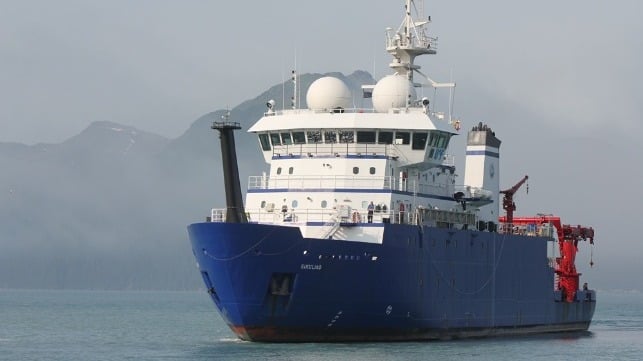
Alaska-Based Research Vessel to Support U.S. Antarctic Expedition in 2026

Sikuliaq (Sarah Spanos / UAF handout image)

Published Nov 16, 2025 9:54 PM by The Maritime Executive


The U.S. research vessel Sikuliaq has begun a long voyage to the Antarctica, achieving a new milestone in its decade-long polar expeditions. The Alaska-based vessel is owned by the National Science Foundation (NSF) and operated by the College of Fisheries and Ocean Sciences at the University of Alaska Fairbanks.

This is the first time for the vessel to undertake an Antarctic expedition, as it is largely used in waters around Alaska and the Pacific Northwest. Starting early next year, the 261-foot vessel will support three research projects in the Southern Ocean, which were previously scheduled for vessels whose contracts with NSF have ended. The charter for research vessel Laurence M. Gould expired in 2024. In July, NSF also made a decision to terminate the charter for the research icebreaker Nathaniel B. Palmer.

With looming budget cuts for polar science by the Trump administration, NSF is reallocating resources towards sustaining the three U.S. Antarctic research stations - McMurdo, Amundsen-Scott South Pole and Palmer Station. In addition, the NSF wants to transition from a two-vessel U.S. Antarctic Program (USAP) toward a single-vessel operation.

NSF is currently pursuing development of a research icebreaker to support U.S-funded Antarctic studies. In the short-term, NSF will utilize the U.S. academic research fleet, supported by the University-National Oceanographic Laboratory System operators. With Sikuliaq now heading to Antarctica, it appears the vessel will temporarily support USAP in 2026. Sikuliaq is classified as ice-capable, with capacity to break ice up to 2.5 feet thick.

The vessel left Alaska’s Dutch Harbor on November 14 and is on a 10-day transit to Honolulu. From there, Sikuliaq will embark on a three-week NSF-funded research project in the South Pacific. The project will study influences on shifting levels of ocean heat near the equator.

After the project, the ship will then travel south to French Polynesia and later to Punta Arenas, Chile. Here, the vessel will prepare for a series of research projects that will last through March 2026. Some of the planned studies include a coring project on Antarctica’s Seymour Island, which will evaluate the effects of a mass extinction event during the Cretaceous period. Another study will evaluate the ecology of the ocean bottom off the West side of the Antarctic Peninsula by using divers to collect invertebrate samples.


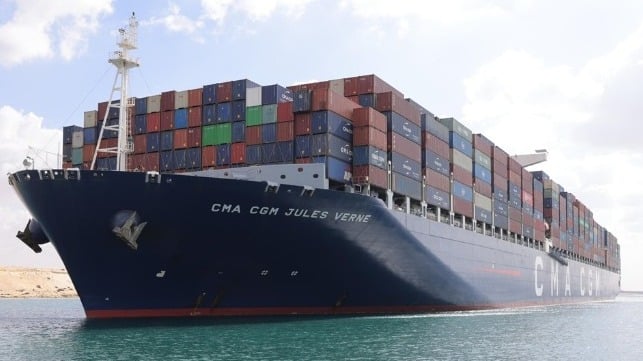
Suez Canal Upbeat About Traffic Rebound as CMA CGM Boxships Make Transit

SCA
Courtesy Suez Canal Authority

Published Nov 16, 2025 6:48 PM by The Maritime Executive


The Suez Canal Authority (SCA) is optimistic that transits are gradually returning to normal after the canal witnessed the passage of three mega ships operated by CMA CGM in a span of one week.

Just a day after the UN Security Council overwhelmingly voted to renew sanctions against the Yemeni Houthis’ who have been waging attacks on commercial vessels forcing them to avoid the Red Sea, SCA now believes the situation is easing and mega ships are making transits through the canal.

On November 15, the Suez Canal celebrated an operational milestone after the newly delivered CMA CGM ship Helium made its maiden transit through the waterway. Delivered by South Korean shipbuilder HD Hyundai Samho last month, the 335 meters with a gross tonnage of 130,000 tonnes is part of new series of 12 container vessels fitted with dual-fuel engines that can operate on methanol that are being built by CMA CGM, the world’s third-largest container shipping company. The ship transited the canal as part of the northbound convoy en route from Singapore and calling at Egypt’s Alexandria port.

Another CMA CGM boxship, Jules Verne, also transited the waterway as part of the northbound convoy en route from Singapore to Lebanon after safely passing through the Red Sea and the Bab El-Mandab Strait, a development the comes after the Houthis promised to stop attacks on ships following the ceasefire between Israel and Hamas.

Built in 2013, the voyage by the 396 meters ship with a gross tonnage of 176,000 tonnes is the first transit from the south through Bab El-Mandab, and its third transit through the canal. SCA is highlighting that Jules Verne is resuming transits after its last two southbound voyages this year in June and September, with the transit being inspired by incentives introduced in June.

Back then, SCA introduced an incentive scheme that introduced a 15 percent toll discount for container ships with a net tonnage exceeding 130,000 tonnes to encourage shipping lines to resume transits through the waterway.

The passage of Helium and Jules Verne came just a week after another CMA CGM container ship, the Benjamin Franklin, became the largest container ship to transit the canal in the past two years. The 399 meters ship with tonnage of 177,000 tonnes and a capacity of 17,859 containers, transited the waterway as part of the north convoy travelling from the United Kingdom to Malaysia, before safely passing through the Bab el-Mandeb Strait.

“The restoration of calmness once more to the Red Sea region will impose a new reality on the shipping community; that is the necessity of serious consideration by the shipping lines of amending navigation schedules so as to return to transiting through Bab el-Mandab and the Suez Canal once more,” said Admiral Ossama Rabiee SCA Chairman.

SCA is buoyant the gradual return of transits on Suez Canal, which before the onset of the Houthis attacks was one of the world’s busiest waterways with about 12 percent of the world trade volume passing through it, will result in improved revenues. The authority is forecasting to generate $4.2 billion in 2025, up from $3.9 billion last year. The canal achieved its highest-ever annual revenue in 2023, reaching $10.2 billion.

To achieve the revenue targets, SCA is hoping the calmness currently being witnessed in the Red Sea is sustained. As part of measures to further cripple the Yemeni Houthis, the Security Council agreed to renew sanctions on the militant group for another year until November 14, 2026. The resolution to renew the sanctions garnered 13 votes in favor with Russia and China abstaining.


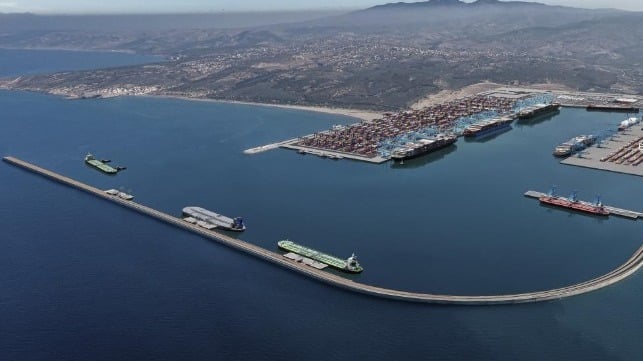
Morocco's Nador West Med Port to Start Up Ahead of Schedule

Nador West Med complex plans
Illustration courtesy Marsa Maroc

Published Nov 16, 2025 1:33 PM by The Maritime Executive


Morocco’s much awaited transshipment hub, Nador West Med Port, could be opened earlier than expected. In a budget presentation in Morocco’s parliament last week, Equipment and Water Minister Nizar Baraka revealed that the port is fully ready. The minister added that the port complex could begin operations by end of 2026, almost a year earlier than the scheduled opening time in 2027.

The government has now shifted focus to building port access roads and improving connectivity to other regions in Morocco. According to the Minister, the plan is to establish connections to major towns in northern Morocco including Fès, Taourirt and Oujda.

Terminal operators are also readying for the port’s opening. Last month, Morocco’s Marsa Maroc and CMA Terminals (a subsidiary of CMA CGM) finalized a joint partnership for the concession of the West Terminal at the Port of Nador West Med. MSC Group - through its subsidiary Terminal Investment Limited (TIL) - has also signed an agreement with Marsa Maroc for the concession of the second container terminal at Nador West.

With Nador West Med modeled on the success of Tanger Med port, it is expected to further disrupt container shipping market in the Mediterranean region. In its first phase, Nador Port will have capacity to handle 1.8 million TEU per year, which will rise to around 5.5 million TEU in the subsequent phases. This places the port in direct competition with established European transshipment ports such as Algeciras (which handled 4.7 million TEU in 2024) and Valencia (5.5 million TEU in 2024).

In fact, there have been concerns in Spain that emerging hubs such as Nador West Med could exacerbate the decline of Port of Algeciras. The argument is that strict environmental regulations in Europe create competitive disadvantages for Spanish ports compared to their Moroccan neighbors in the Mediterranean.

Spain’s State Ports agency has in the past urged for regulatory balance in Europe, warning of a possible decrease in shipping traffic in favor of Morocco. The Port Authority of the Bay of Algeciras estimates that its port could lose almost 60 percent of its transshipment volume to Tanger Med under a scenario of strict environmental regulations.


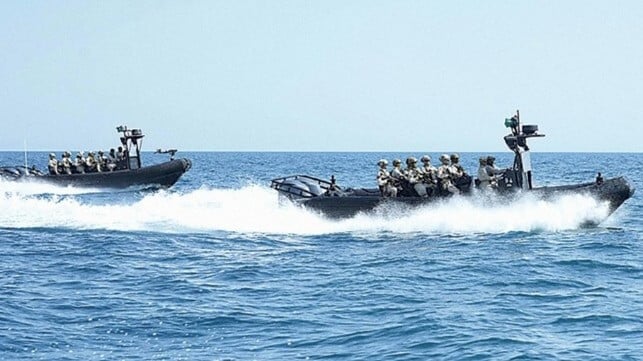
Blue Sword 2025 Shows Limits of Sino-Saudi Naval Cooperation

CJRC
Courtesy PLA

Published Nov 16, 2025 1:41 PM by The Maritime Executive


A 20-day joint exercise between Saudi and Chinese naval special forces has concluded at the Royal Saudi Naval Force (RSNF) King Abdulaziz Naval Base at Jubail on the Arabian Gulf.  The base is the home of the RSNF Eastern Fleet's Special Operations Group 1.  The Marine brigades of both the Western and Eastern Fleet of the RSNF each have a special force element.

The scope of this year's exercise remained similar to that of the two previous Blue Sword exercises, and did not involve the deployment of any Chinese naval vessels from the 48th Naval Escort Group now based in Djibouti. Thus it was not the harbinger of broader Saudi-Chinese military cooperation, showing limited ambition, and the training conducted was largely applicable to operations which each navy would wish to conduct on their own.

Over the course of the exercise, a total of about 100 special forces troops from both sides practiced counter-terrorism drills, both in built-up areas on land and at sea. The final exercise was the conduct of a hostage rescue from the crew of a hijacked vessel.

Blue Sword 2025 was the third joint naval special foces exercise that the two countries have conducted.  The exercise is held every two years, and rotates between the two countries. Blue Sword 2023 was held in Zhanjiang, Guangdong Province, the headquarters location of the Chinese South Sea Fleet.


Looting Reported Aboard Grounded Container Barge in Bahamas

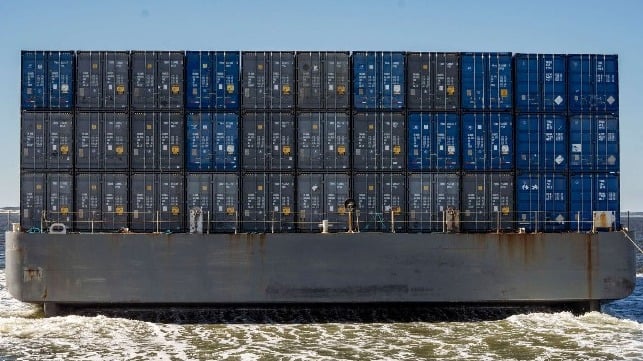
Container barge
File image courtesy Trailer Bridge

Published Nov 16, 2025 11:51 PM by The Maritime Executive


Last week, a container barge parted its tow wire and ran aground on a reef in the Bahamas, reportedly attracting looters from nearby communities.

According to the operator, the barge Brooklyn Bridge broke away from its towing vessel due to severe winds while en route from Florida to Puerto Rico. The barge then drifted aground on a reef off Abaco, at the northern end of the island chain. 

The operator commissioned a dive inspection and confirmed that there was no damage to the hull. No pollution was reported, and plans for a salvage operation to refloat the barge and bring it to a safe port got under way. 

In a complaint to Bahamian and American authorities, the operator said that looting occurred during the course of the grounding. Social media footage shows multiple small craft alongside the barge, most of them filled to capacity with appliances and boxed goods. In one video, cidsvilian personnel were seen climbing up and down the pigeonholes to access the main deck level. 

Craig Curtis, deputy ports director, confirmed to The Nassau Guardian that reports of looting had been received and that officers and military responders were dispatched to the scene. 

The barge was successfully refloated on Saturday, and it was under way on a return voyage to Jacksonville on Sunday. A follow-up salvage team will remove any related debris from the bottom around the grounding site. According to Nassau Guardian, a team from the Bahamas government will conduct a site assessment at the reef, which will determine the scope of any penalties for environmental damage. 

“We are profoundly grateful to the US Coast Guard, the US Navy and others who took quick action to help ensure our safety and establish a presence of Bahamian police to secure the barge and what was left of the cargo,” said Trailer Bridge CEO Mitch Luciano. 


Search Called Off for Survivors of Capsized Migrant Vessel off San Diego

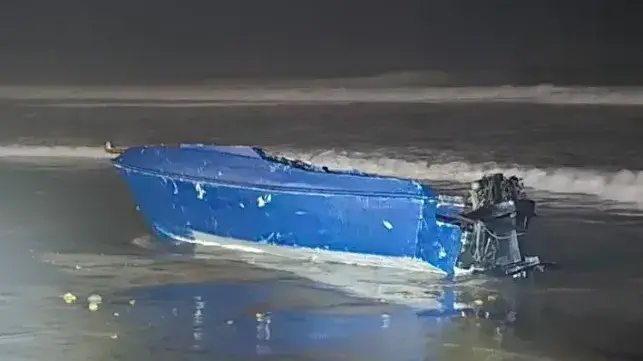
The panga on the shore at Imperial Beach, Nov. 14 (USCG)

Published Nov 16, 2025 3:26 PM by The Maritime Executive


On Saturday evening, the U.S. Coast Guard suspended its search for missing maritime migrants from a vessel that capsized just off Imperial Beach on Friday night. 

At 2340 hours on Friday, Coast Guard Sector San Diego received an alert from Imperial Beach Border Patrol that a panga-style boat in the surf near Seacoast Drive. Five minutes later, the sector command center learned that six foreign nationals were on the beach, including one deceased and one who had to be rescued from beneath the capsized vessel. 

A good Samaritan spotted bodies in the water near Imperial Beach Pier and reported it at 0145 hours on Saturday. All were recovered by a Coast Guard boat crew and transferred to Ballast Point, where local EMS responders pronounced them deceased. 

Four survivors were transported to a hospital by emergency medical services, and one individual was taken into custody by Imperial Beach Border Patrol. Several claimed Mexican citizenship but the others remain unidentified.

Responders believed that additional personnel had been aboard the panga and may have gone into the water. A large-scale search was launched, and rescue crews from multiple agencies and Coast Guard units responded, including personnel from local fire departments, the San Diego Sheriff's Office, and Customs and Border Patrol. 

No additional survivors were found, and the search was called off Saturday evening. Before making the decision to suspend the operation, the service searched for 17 hours over 12 square nautical miles, and conducted 133 nautical miles of search transits. 

"The Coast Guard extends its deepest condolences to the family, friends, and loved ones affected by this tragic incident," said Capt. Robert Tucker, Coast Guard Sector San Diego's commander. "This tragedy underscores the extreme dangers of attempting to cross the maritime border in unsafe, overloaded vessels and during dangerous weather conditions. We remain dedicated to protecting lives at sea and safeguarding our nation’s maritime borders."

Homeland Security Investigations has taken over the inquiry into the circumstances of the incident.