It’s possible that I shall make an ass of myself. But in that case one can always get out of it with a little dialectic. I have, of course, so worded my proposition as to be right either way (K.Marx, Letter to F.Engels on the Indian Mutiny)
Sunday, February 01, 2026
ANALYSIS
Gaza as a post-UN experiment: Inside Trump's Board of Peace
The Board of Peace for Gaza signals a shift away from multilateral institutions to personalised, transactional diplomacy driven by private business interests
US President Donald Trump’s newly created 'Board of Peace' has emerged as one of his most controversial foreign policy initiatives, drawing scepticism from close US allies and renewed accusations that he is seeking to upend the post-World War II international order.
Launched at the World Economic Forum, held earlier this month in Davos, Switzerland, the Board of Peace is to be a mechanism to oversee the “ceasefire” and reconstruction effort in Gaza in accordance with the second phase of Trump’s peace initiative announced in September 2025.
Nonetheless, the Board of Peace has since taken on a far broader and more ambiguous mission. Its charter grants it authority to intervene in conflicts worldwide, positioning it, according to critics, as a potential rival to the United Nations - one with Trump at its centre.
As chairman, he would wield veto power over key decisions, retain significant influence even after leaving office, and be able to appoint his own successor, while countries seeking permanent seats have been asked to contribute more than $1 billion.
Despite receiving provisional backing from the United Nations Security Council through a US-drafted resolution that grants it “legitimacy” through 2027, the Board of Peace has deepened divisions among global powers.
Though more than 20 nations have accepted invitations to join, initially at no cost, several European allies have refused, citing concerns about international law, governance, and the erosion of the UN’s role.
The absence of Palestinians
The Board of Peace’s structure includes powerful subcommittees, notably one overseeing Gaza’s reconstruction that features US, Israeli, Arab, and Turkish figures but excludes Palestinians - a decision that has fuelled further criticism and even friction with Israel’s own government.
Additional panels are tasked with implementing the board’s broader peace-building mandate and administering civilian affairs in Gaza.
Supporters argue the body could offer a more flexible alternative to existing institutions. But opponents warn that its concentration of authority, transactional approach to membership, and uncertain relationship with the United Nations risk reshaping global diplomacy in ways that are both unprecedented and destabilising.
Rather than being shaped by its own people, Gaza could be remade as a testing ground for externally imposed post-conflict models that prioritise profitability over justice. [Getty]
“One glaring weakness of the Gaza development plan concocted by President Trump and his son-in-law Jared Kushner is that they apparently did not consult with any Palestinians,” noted Gordon Gray, the former US ambassador to Tunisia, in an interview with The New Arab.
“It is quite possible that no Arabs were consulted at all, judging by the number of Arabic spelling errors in Kushner’s PowerPoint presentation.”
He added that the lack of answers to questions about how this plan will be implemented is another major shortcoming. Despite Kushner stressing that security in Gaza must be a top priority in order to secure investments, Trump’s son-in-law did not lay out the steps to be taken in order to establish such security, explained Gray.
The former American diplomat went on to say, “It is telling that no Palestinians or Israelis were present when Trump unveiled his so-called ‘Board of Peace.’”
The Board of Peace is about two key objectives, according to Mouin Rabbani, political analyst and co-editor of Jadaliyya. The first is disarming Hamas and other armed Palestinian groups. The second is real estate opportunities. “The Palestinian people, first and foremost those in the Gaza Strip, are a complete irrelevance, at most an obstacle to be removed,” he told TNA.
Rabbani’s assessment reflects a broader concern among analysts that the Board of Peace is less a diplomatic initiative than a vehicle for reengineering governance through economic leverage and security control. By framing peace as a technocratic problem to be solved through disarmament and investment, critics argue, the initiative sidelines questions of political rights, accountability, and self-determination.
In this reading, Gaza becomes not a site of post-conflict recovery shaped by its own population, but a testing ground for externally imposed models that prioritise profitability over justice.
“Trump is market-washing an Orwellian ‘peace’, stripping the term of every aspect of its original meaning and turning it into a device to pursue a new form of colonisation - one in which Trump is running the US not just as a cruel global empire but as a private business. Peace plans are becoming increasingly indistinguishable from business plans,” Dr Marina Calculli, assistant professor in International Relations at Leiden University, explained in a TNA interview.
“What we are seeing materialising before our eyes is an exit from politics in which Gaza is a laboratory for something spreading rapidly everywhere else - a new form of Leviathan where people are not treated as citizens, and not even subjects, but disposable bodies, whose life is valued only to the extent that they act as pacified poorly paid workers or consumers,” she added.
“When they fail to fulfil this role, their fate does not count any longer. This is how this supposed ‘peace’ is trying to render genocide not just ‘normal’ but marketable - a profitable enterprise opening new paths for business.”
The plans outlined for Gaza's reconstruction are untethered from the physical devastation on the ground, the political realities of occupation and blockade, and the basic constraints of resources, time, and security. [Getty]
International buy-in and growing fractures
Some of the countries which signed on to Trump’s Board of Peace have committed to purchasing permanent seats for $1 billion each. According to Trump, these funds will be used to finance Gaza’s reconstruction. But as Sarah Leah Whitson, executive director of Democracy for the Arab World Now (DAWN), told TNA, these pledged payments will not be sufficient for rebuilding the devastated territory.
“As welcome as international support for reconstruction is, the truth is that Israel bears legal responsibility for rebuilding Gaza in the wake of the unlawful destruction it has caused. To outsource these costs would be to reward Israel with impunity by avoiding the consequences of its crimes, both criminal and financial,” she explained.
A further set of questions arises from Trump’s invitation to Russian President Vladimir Putin to join the Board of Peace. While it remains unclear whether Putin will accept, the gesture alone has unsettled the United Kingdom and several of Washington’s other Western allies.
Putin has signalled that Moscow could contribute $1 billion to the Board, but only if the United States agrees to unfreeze Russian assets currently held under sanctions. As Dr Calculli observes, the overture to Putin reflects Trump’s characteristically transactional approach to diplomacy.
“Trump is willing to make his own interests in Palestine and Putin’s interests in Ukraine as part of a comprehensive deal, in the style of CEOs rather than statesmen. At the same time, he may be using the invitation to Putin and what could potentially come out of it as a bargaining chip to force Europe to make concessions on Greenland and Ukraine, too,” she told TNA.
Rabbani floated several possible motivations behind Trump’s decision to invite Putin to join the Board of Peace. The move may have been intended as a provocation toward European allies, NATO, and the International Criminal Court, or as an attempt to expand the board’s remit to include Ukraine, potentially sidelining the UN Security Council in the process.
“When an entire organisation is run by the whims of a single unstable individual, such questions are by definition difficult to answer,” he told TNA.
“But given a number of other members invited, I don't see anything unusual about the Putin invitation. Of course, the Europeans will yell and scream that Putin is an indicted war criminal while Netanyahu was democratically elected and a victim of anti-Semitism, etc., but they have made clear they can and should be ignored,” added Rabbani.
Peace as performance, not justice
Ultimately, the proposed Board of Peace does not read as a credible mechanism for justice or reconciliation, but rather as a hollow spectacle. By sidelining Palestinians from meaningful participation in decisions about their own land and future, the Board of Peace makes a mockery of the idea of justice.
Also troubling is how Trump’s vision for the Board of Peace extends far beyond Gaza. It gestures toward a global body operating under his personal authority, unmoored from institutional checks, international law, or even his formal role as President of the United States. This framing transforms peace from a collective, law-based endeavour into a personalised project of influence, where legitimacy flows from individual power rather than multilateral consent.
Finally, the plans outlined for Gaza’s reconstruction strain credibility to breaking point. They appear untethered from the physical devastation on the ground, the political realities of occupation and blockade, and the basic constraints of resources, time, and security.
In ignoring these realities, the plan treats reconstruction as a branding exercise rather than a material process rooted in human lives. Taken together, the Board of Peace stands not as a pathway to resolution, but as a stark reminder of how easily the language of “peace” can be emptied of meaning.
“There will be no peace in Israel-Palestine until Israeli occupation and apartheid rule over Palestine end. No measure of fantastic reconstruction planning or colonial governance structure will bring an end to these Israeli crimes, and without an end to Israeli crimes, resistance and conflict will naturally persist,” said Whitson. Giorgio Cafiero is the CEO of Gulf State Analytics Follow him on X: @GiorgioCafiero
Opinion
Trump's Board of Peace: A humiliating insult to Palestinians
Trump’s Board of Peace hands Gaza’s fate to unelected men, enabling Israel to intensify efforts to erase Palestinians & take their land, writes Ghada Karmi.
A moment’s reflection shows that the Board of Peace has too complex a structure and too large a membership to be concerned with Gaza alone, writes Ghada Karmi. [GETTY]
As news of Donald Trump’s ‘Board of Peace’ initiative broke at the World Economic Forum at Davos on 22 January, some of us wondered whether we were living in a parallel universe.
There was the universe of Trump and his son-in-law, Jared Kushner, celebrating the dawn of a rosy future for Gaza - restored infrastructure, water, sewage works, hospitals, bakeries, and, on the horizon, new shiny apartment blocks, neat industrial parks, even an airport; and then there was the other universe of Israel’s non-stop bombardment of what remains of Gaza. In this reality, more than 460 people, including 100 children and three journalists, have been killed since the ‘ceasefire’ last October - and Gaza’s wretched population has been forced into freezing sodden tents, struggling to survive starvation and disease.
Israel has made no secret of its aim to get rid of Palestinians from the country altogether, expelling those who survive its assaults and starvation policies. Supported to the hilt by the US, there is no way Israel will give up a once-in-a-lifetime opportunity to fulfil its wildest dreams: a land cleared of Palestinians, their history and culture expunged from the record as if they had never been.
That is why Israel destroyed every monument and building that could attest to a Palestinian history and presence in Gaza, creating a desert incapable of sustaining life.
This is the real universe, not the fantasy one presented by Trump and his associates. Even so, he has managed to sideline reality by dazzling everyone with his ‘Board of Peace’ proposal. There is no doubt the Board’s elaborate structure and membership have stolen the show. The ongoing destruction of Gaza and its people, though as cruel and brutal as ever, has shrunk into the background.
UN Security Council Resolution 2803, passed unanimously in November 2025, gave Trump’s plans legitimacy. The Board of Peace he subsequently introduced and which the Resolution legitimised was at first intended to be temporary and applicable only to Gaza. Its chairman-for-life would be Donald Trump, unelected and not accountable to anyone.
Board membership was also supposed to be for three years, renewable, unless applicants wanted to have lifetime membership on payment of $1 billion. 50 membership invitations are understood to have been issued so far, of which more than 21 have been accepted. These include a majority of the Arab states, some Muslim states, and others.
Israel, invited despite its destruction of Gaza which necessitated a Board of Peace in the first place, also accepted membership.
Linked to the Board of Peace is a confusing list of several subsidiary committees: an executive committee of unclear remit whose CEO is to be chosen by Trump, and a second executive committee tasked with running Gaza and whose members include Jared Kushner, Ajay Banga, the head of the World Bank, and Britain’s former prime minister, Tony Blair. There is also a 15-member ‘Palestinian National Committee’ composed of Palestinian ‘technocrats’ to manage Gaza’s everyday affairs, but have no authority otherwise.
So far, a committee chairman has been appointed to the National Committee, but no others. Finally, there is to be a so-called International Stabilisation Force supposed to prevent a renewal of hostilities, whose membership has not been settled due to Israeli objections.
A moment’s reflection shows that the Board of Peace has too complex a structure and too large a membership to be concerned with Gaza alone. Suspicion has therefore arisen about its true function. Is it meant to be a replacement for the UN itself?
The design of its logo is certainly reminiscent of the UN’s, even though it portrays the Americas, not the world, and, unlike the UN’s, is gilded throughout. It makes Trump the effective owner of Gaza and, with his so-in-law’s real estate ‘Gaza Riviera’ ambitions, aims to convert the territory – illegally occupied according to international law – into an investment opportunity.
Other rumours have concerned Israel’s plans for Gaza’s future, none of them benign. Israel is busy entrenching itself in an expanding buffer zone grabbing more and more of Gaza’s land, which may be the first and possibly only site of Trump’s Gaza development. Unsuccessful in having expelled the population out of Gaza, Israel is said to be planning for a giant camp to intern them in Rafah. Its attempts to export Gaza’s people to other countries, including Egypt, Indonesia, Somalia, and the Congo, have so far failed.
The takeaway from these frivolous and dangerous antics, is the basic reality that Gaza is Palestinian territory, and its inhabitants are Palestinians. They must be the only people to decide their own future. How insulting to them that a cast of Western warmongers, has-been politicians, predatory capitalists, and the arch perpetrator of genocide, Israel, should be included in the ‘Board of Peace’ which will decide their fate.
Palestinians have been continually humiliated and oppressed by western colonialism and its offshoot, Zionism, from the time of the Balfour declaration of 1917 up to Trump’s Board of Peace plan in 2026. All have been projects to crush, dismiss, or sideline their rights and aspirations.
It is deeply depressing to realise that the West has learnt nothing in its long history with the Middle East: that to extend respect and friendship in their dealings with its population is far superior to contempt and aggression.
Ghada Karmi is a former research fellow at the Institute of Arab and Islamic Studies, University of Exeter. She was born in Jerusalem and was forced to leave her home with her family as a result of Israel’s creation in 1948. The family moved to England, where she grew up and was educated. Karmi practised as a doctor for many years, working as a specialist in the health of migrants and refugees. From 1999 to 2001, Karmi was an associate fellow of the Royal Institute of International Affairs, where she led a major project on Israel-Palestinian reconciliation.
Opinions expressed in this article remain those of the author and do not necessarily represent those of The New Arab, its editorial board or staff.
The U.S. occupation of Gaza has begun
The plans for Donald Trump’s “Board of Peace” show that the goal is not just to make Gaza a playground for the wealthy, but to put it under permanent American occupation.
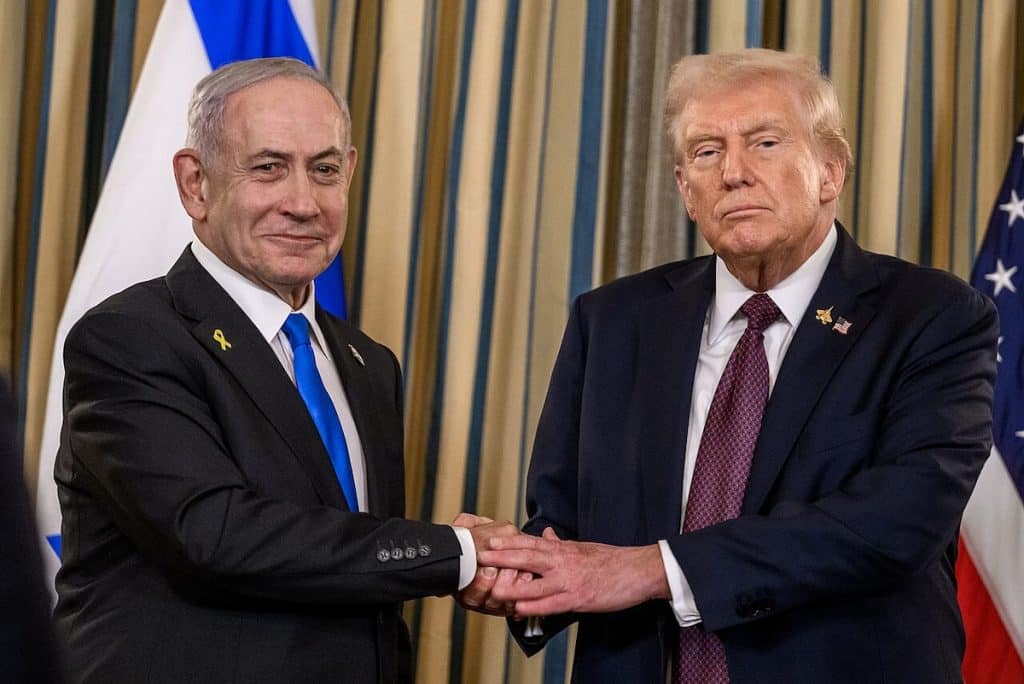
President Donald Trump and Israeli Prime Minister Benjamin Netanyahu shake hands after joint press conference announcing the U.S. peace plan for Gaza, Monday, September 29, 2025, in the State Dining Room of the White House. (Official White House Photo by Joyce N. Boghosian)
This week, Drop Site News revealed a draft resolution from Trump’s newly christened “Board of Peace.” The resolution outlines what is, in essence, Phase Two of Trump’s unrealistic peace plan that ushered in a new phase of horror in Gaza under the guise of a ceasefire.
The actions outlined in the resolution ignore realities on the ground and paint a very grim picture of what the United States is planning for Gaza. Far from abandoning the ludicrous and offensive imagery Trump shared in that AI video from last year of himself and Elon Musk on a beach in an unrecognizable Gaza, this resolution is the battle plan to turn Gaza into the playground for the wealthy that Jared Kushner presented to the World Economic Forum at Davos last week. It’s a Gaza where the only Palestinians remaining are those chosen to be the servants in the new regime.
It’s a Gaza under permanent American occupation. The “Executive Board” that would control Gaza
The Board of Peace (BoP) itself has drawn the most attention, but it is not the focal point for Gaza. The BoP is being set up as an international force to challenge the United Nations. It is currently populated entirely by far-right and autocratic figures, and will likely stay that way.
The BoP will be headed by Donald Trump and his role as Board Chair is personal, disconnected from his role as President of the United States. He has full power over the Board’s composition and full veto power over all of its actions. Trump will remain in control of the BoP until he decides to leave or he dies, and he has the sole authority to name his successor. You couldn’t build a clearer autocracy.
The BoP can delegate its authority as it wishes, and that is what it has done regarding Gaza. The “Executive Board” (EB) is the body that will govern Gaza. The EB itself will also have other areas within its portfolio, so it, too, has delegated its power to yet another group, dubbed the Gaza Executive Board (GEB). There is considerable overlap between the members of the EB and GEB.
The members of the GEB include some very familiar names like Steve Witkoff, Trump’s lead negotiator; Susan Wiles, his Chief of Staff; Jared Kushner, his son-in-law; and Tony Blair the former PM of the UK and a war criminal in the 2003 invasion of Iraq.
The rest of the names may be less familiar, but they are all important and, together, they draw a very worrisome picture of how this Board will behave.
Minister Hakan Fidan Ali Al-Thawadi is the Minister for Strategic Affairs of Qatar. He’s been a key figure in the negotiations between the U.S. and Hamas for the past year. Israel objected to his inclusion, but not too loudly. Al-Thawadi has cultivated a strong relationship with Trump.
General Hassan Rashad is the head of Egyptian intelligence.
Marc Rowan is an American billionaire and a major donor to Donald Trump’s presidential campaign. He is the chair of the United Jewish Appeal-Federation of New York, and a major figure in the American Jewish pro-Israel community. Rowan was a leader in the effort to silence academic and student activist criticism of Israel’s genocideandled the charge for the removal of University of Pennsylvania president Liz Magill in 2024.
Minister Reem Al-Hashimy is the Minister of State for International Cooperation in the United Arab Emirates. She was a leading spokesperson in support of the Abraham Accords.
Nickolay Mladenov is a long-time Bulgarian diplomat who has served as both a member of the European Parliament and a top United Nations official. He worked closely with Blair in the Quartet—an international body ostensibly charged with promoting a two-state solution in Israel and Palestine, but which failed utterly—and supported the Abraham Accords when they were agreed upon. Mladenov was enough of a diplomat that he was able to garner public praise from Israel, the U.S., the Palestinian Authority, as well as Hamas leaders. He has also been named by Trump as the “High Representative for Gaza,” so he will have a central role beyond just GEB membership in implementing the Trump plan. Mladenov expressed skepticism about Trump’s first-term “deal of the century,” so it will be worth looking into how Mladenov won Trump over.
Yakir Gabay is an Israeli who is also a citizen of Cyprus. A billionaire real estate tycoon, Gabay made some headlines with his involvement in pressing then-New York City Mayor Eric Adams to deploy police to violently crush the anti-genocide protests at Columbia University.
Sigrid Kaag is a long-time UN diplomat and former Foreign Minister of the Netherlands. She was most recently UN Special Coordinator for the Middle East Peace Process, although she resigned from that role last June. Kaag has not commented on her supposed appointment to the GEB, and it is questionable whether she has or will actually accept this role.
Not only are there no Palestinians on the Gaza Executive Board, but there is also no one with any history of advocating for Palestinian concerns and interests. The EB, to which the GEB will serve as “advisors,” includes much of the GEB: Witkoff, Wiles, Kushner, Blair, and Rowan are also on the EB, along with U.S. Secretary of State Marco Rubio and Deputy NSA Robert Gabriel.
Trump also appointed the head of the World Bank, Ajay Banga, and lawyer Martin Edelman, who has very close ties to both Trump and the UAE, to the EB. Aryeh Lightstone, a former adviser to Trump’s first-term Ambassador to Israel, David Friedman, and Josh Gruenbaum, a bureaucrat who has worked closely with Witkoff and Kushner, were appointed as advisers to the EB. Palestinians not included in planning Gaza’s future
While there are no Israelis on the Executive Board, it is stacked with extreme supporters of the Israeli right and of Netanyahu. This makes the vague mandate of the entire enterprise much more concerning.
The proposal published by Drop Site states that “the reconstruction and rehabilitation activities of the Board shall be dedicated solely to those who regard Gaza as their home and place of residence.”
But the proposal offers no opportunity for the people of Gaza to have any say at all in their present situation, let alone their future. The EB governs all of the laws. An American-led International Stabilization Force (ISF) controls all security.
The ISF is to be under the command of American Major General Jasper Jeffers. Trump, and Trump alone, has the power to remove the commander of the ISF and must personally approve any nominee to replace him.
The plan further states that “only those persons who support and act consistently [with Trump’s Comprehensive Plan for Gaza] will be eligible to participate in governance, reconstruction, economic development, or humanitarian assistance activities in Gaza.”
The only role currently envisioned for Palestinians in Gaza is to carry out the decisions made for them by others.
In other words, Palestinians who wish to be part of Gaza in any way must meet Trump’s litmus test of support for the external American control of the Gaza Strip. The same will be true for any business, NGO, or even individual who wants to participate in any way in rebuilding Gaza, physically, politically, or economically.
Ideally, for Trump and Jared Kushner, Gaza would be transformed into a giant “company town.” Most of the coastline would be dedicated to tourism. The bulk of Gaza’s eastern border with Israel would be dedicated to industrial zones and huge data centers, doubtless reflecting the massive investments Trump and his Emirati friends are making in AI.
In between would be residential areas separated by parks, agricultural, and sporting sites. In the West Bank, such parks and agricultural areas are frequently declared closed military zones and used for other purposes by the occupying force.
As has been apparent from the beginning, the only role currently envisioned for Palestinians is in the administration of the Executive Board’s decisions. In other words, Palestinian technocrats, laborers, and office workers would be “permitted” to carry out the decisions made for them by others. The U.S. occupation of Gaza
This resolution provides only a bit more substance to the half-baked ideas Trump has been putting forward since October. And it continues to envision a near-future where Hamas has voluntarily disarmed, Israel has pulled out of Gaza, and the ISF has assumed security control that is welcomed by whatever Palestinians remain in Gaza.
All of that remains fully in the realm of fantasy.
Hamas has repeatedly made it clear that it is willing to discuss decommissioning its weapons, but would not disarm. Given that Israel is, once again, funding rogue Palestinian gangs in Gaza, complete disarmament is suicide for many members of Hamas, Islamic Jihad, and other factions.
The United States is discussing offering amnesty and even a buy-back program for the weapons, but these offers are hardly useful if the lives of Hamas members are put at grave risk by disarmament, even if we assume that the U.S. keeps to its word and that Israel does not itself hunt these fighters down.
Moreover, Israel is bristling at this entire plan. They prefer to bring the hammer down again on Gaza, especially now that there are no hostages, dead or alive, to be concerned with.
Netanyahu is openly stating that Israel will allow no rebuilding in Gaza—where it is killing people, including infants, not only with its weapons but by denying Palestinians the materials to shelter from the winter elements—until Hamas is “disarmed.”
What is taking shape in Gaza is a new kind of foreign occupation. This time, the U.S. would be the leading force on the ground and an American-led occupation will face resistance just as the Israeli one does.
He is also declaring that Israel will maintain “security control” over Gaza in perpetuity. Israel has informed the U.S. that it wants to expand the zone of Israeli control in Gaza—which already encompasses well over half the Strip—rather than shrink it, as called for by Trump’s plan.
Israel has already reportedly drawn up a plan for a major military operation, a return to the full-blown genocide of last year, which it plans to launch in March unless the U.S. refuses to allow it to do so.
And, finally, a great deal of ambiguity remains about the potential makeup of the ISF. While numerous states have pledged to support the disarmament of Gaza, many have also expressed reluctance to be part of the force if it means having to confront armed Palestinian resistance groups.
There is a good reason for their reluctance. What is taking shape in Gaza is a new kind of foreign occupation. This time, the U.S. would be the leading force on the ground unless it allows Israel to renew its aggression, something Trump doesn’t want. It would mark the greatest failure of his long list of failures, undermining his claim to have “ended wars all over the world.”
But foreign troops are foreign troops. It is possible that the Trump administration has bought into its and Israel’s own nonsense so thoroughly that they really believe that as long as the boot on Palestinians’ necks is not Jewish, the Palestinians can be controlled and will not fight for their freedom. Because, in their telling, the entire Palestinian struggle is only about fighting “the Jews.”
But an American-led occupation will face resistance just as the Israeli one does. That will manifest even if Hamas is disarmed.
An American occupation of Gaza on Israel’s behalf will be just as unwelcome by Palestinians as an Israeli one backed by the United States. It may take some time for the people of Gaza to regroup from the past two and a half years to organize impactful resistance, but it will come, as it always has.
The solution is simple: allow Palestinians their freedom and their rights. But that solution is beyond the imagination of Washington and Tel Aviv. So, meet the new occupation. It will be no more pleasant than the old one.
OPINION
When Jewish moral reckoning overshadows Palestinian liberation
As Jewish anti-Zionists gain visibility, there is a danger of viewing the Gaza genocide solely as the backdrop for a Jewish reckoning. Instead, we must center Palestinian history and demands, and Jewish anti-Zionists have an important role to play.
Activists at a demonstration against the pro-Israel singer Matisyahu in Philadelphia, on March 22, 2024. (Photo: Joe Piette/Flickr)
What role does Jewish anti-Zionism actually play in Palestinian history? Does it change political outcomes? Has it ever altered the systems that organize Palestinian dispossession? Or does it primarily operate inside Western — often Jewish — moral and political worlds, gaining prominence at precisely the moments when Palestinians require something else entirely: pressure, leverage, interruption, consequence?
Gaza is being destroyed in real time. Tens of thousands of Palestinians have been killed. Entire neighborhoods have vanished. Hospitals, schools, universities, refugee camps reduced to rubble. Families erased. Lives shattered.
A genocide is underway. A century-long struggle continues. Yet public conversation often drifts back to Jewish self-examination, while Palestinian history, political demands, and political strategy are pushed to the margins.
This discourse is not new. What is new is the scale of devastation and the urgency of the Palestinian experience that is being displaced. The drift toward Jewish moral reckoning
Over the past year, Jewish anti-Zionist voices have become far more visible in the media discourse. This is happening for several reasons.
First, the scale and visibility of Gaza’s destruction have shattered decades of political cover and stripped away the moral framework that once sustained liberal Zionism. For many Jews raised within that framework, the rupture is profound and has led many, especially young Jews, to reject the mainstream Jewish organizations that have been in near-total alignment behind Israeli violence. This has not only become a critique of Israel but a revolt against communal authority.
Jewish activists have confronted communal leadership, walked out of institutions, organized mass protests, and publicly rejected Zionism. This shift matters. Jewish dissent has weakened longstanding taboos and opened space for Palestinian voices that were previously suppressed.
However, alongside this disruption, another pattern has emerged.
As Gaza burns, Western media increasingly frames the moment solely as a crisis inside Jewish communities. Coverage in major outlets centers Jewish disillusionment, generational conflict, and identity rupture as the key to understanding what is happening.
In these stories, Palestinians appear mainly as the trigger for Jewish transformation. But it is essential to acknowledge that Palestinian journalists, medics, organizers, and families — surviving under bombardment, documenting atrocities despite blackouts, organizing massive protests across the world — forced Palestine into global consciousness at a scale not seen in decades. Jewish anti-Zionist speech expands inside this space. It does not create it.
The danger is that Palestinian catastrophe simply becomes the backdrop for a moment of Jewish moral transformation.
A BBC segment in October 2025 on Jewish protesters in New York made this painfully clear. The camera followed Jewish activists through their emotional journeys — betrayal, awakening, rupture. Only near the end did the program cut to Gaza, where a Palestinian mother said, “We hope the world will listen now that others are speaking for us.” Her words were framed not as a political demand but as gratitude that Jewish voices had finally entered the conversation.
The effect is quiet but powerful. Palestinian catastrophe becomes meaningful mainly when it triggers Jewish moral change.
When the Gaza genocide is narrated as the moment “many Jews finally woke up,” decades of Palestinian dispossession are compressed into the background of a Jewish ethical story. Palestinian history becomes the stage on which another community’s moral drama is performed.
This does not erase Palestinians. It recenters the story away from them. A familiar Western pattern
For Palestinians, this displacement carries real political cost. Their struggle is no longer understood as an ongoing confrontation with a system of military rule, land theft, siege, and apartheid. Instead, it becomes a moral mirror for others.
This pattern is not simply a feature of the present moment. It reflects a long-standing habit in Western political culture.
For decades, Palestinian political life has been rendered legible mainly when it passes through Western institutional filters that privilege the moral narratives of others — diplomats, journalists, scholars, humanitarian officials, and, critically, Jewish interlocutors — over Palestinian political agency itself.
During the Oslo years, Palestinian resistance was recast as a problem of “confidence-building” and “mutual recognition” with Jewish Israelis while the material architecture of occupation expanded relentlessly on the ground. After 9/11, the Palestinian struggle was reframed through the language of counterterrorism and security management, reducing a national liberation movement to a policing problem. In each period, the same mechanism operated: Palestinian history was acknowledged only when it could be absorbed into another framework of legitimacy.
The present moment follows this familiar logic. Palestinian destruction is again rendered meaningful mainly as the catalyst for transformation elsewhere — now as the trigger for Jewish ethical crisis. This shift does not deny Palestinian suffering. It reorganizes its political significance.
Concrete examples are increasingly visible. Major Western outlets devote sustained coverage to internal struggles the the Jewish community — synagogues in crisis, federations under pressure, generational rifts — while Palestinian political analysis appears in fragments, often reduced to scenes of devastation or appeals for sympathy. Even inside solidarity spaces, media attention gravitates toward Jewish activists as interpretive guides, their statements treated as especially authoritative or reassuring for Western audiences.
The story of Gaza becomes less about confronting the systems that produce Palestinian death and more about managing Western moral injury.
This dynamic also operates inside movement structures. At several large demonstrations in 2024 and 2025, Palestinian organizers I was in conversation with reported pressure — from journalists and allied organizations alike — to foreground Jewish speakers in order to “broaden appeal” or “reduce backlash.” In some cases, Palestinian groups were urged to allow Jewish organizations to re-frame events whose political objectives had been developed by Palestinians themselves. The result was not erasure but displacement. Palestinian strategy and demands receded behind a narrative of Jewish moral awakening.
This is the deeper risk of recentering. The story of Gaza becomes less about confronting the systems that produce Palestinian death and more about managing Western moral injury. Palestinian time — marked by land confiscation, siege, incarceration, and generational displacement — is subordinated to the tempo of Western ethical reckoning.
The struggle over narrative orientation is not semantic. It determines whether the present moment produces meaningful pressure on the structures of domination or dissipates into another cycle of moral reflection.
That reorientation carries material consequences. When Gaza is framed mainly as a moral shock to Western conscience, the political response gravitates toward statements, condemnations, and symbolic gestures. When it is framed as a crime sustained by concrete systems — such as arms transfers, financial flows, diplomatic protection, and legal impunity — the response begins to target the machinery that enables the crime.
The struggle over narrative orientation is not semantic. It determines whether the present moment produces meaningful pressure on the structures of domination or dissipates into another cycle of moral reflection. What this moment demands
From a Palestinian perspective, the political usefulness of Jewish anti-Zionism is measured by one standard: does an intervention weaken the systems that sustain dispossession?
Moral clarity alone does not dismantle military power, arms transfers, financial support, diplomatic protection, or legal impunity.
From a Palestinian perspective, the political usefulness of Jewish anti-Zionism is measured by one standard: does an intervention weaken the systems that sustain dispossession?
Jewish anti-Zionism becomes politically meaningful only under specific conditions, which include confronting real centers of power, including governments, arms manufacturers, banks, courts, media institutions, and universities. This also means rejecting the tendency to treat Jewish voices as authorizing Palestinian claims, and foregrounding Palestinian demands in a way that recognizes and counters the the asymmetry in power that exists between Jews and Palestinians in the broader discourse.
It is also essential that Jewish anti-Zionists know when to step back. At key moments — such as South Africa’s genocide case at the International Court of Justice — Jewish groups amplified Palestinian legal submissions without recentering themselves. Sometimes the most effective intervention is not interpretation, but amplification.
Under these conditions, Jewish anti-Zionism can fracture elite consensus and weaken the ideological shield protecting Israeli violence. Without this orientation, it risks drawing the story back into Jewish self-reflection.
This is important because Jewish anti-Zionists now occupy positions of visibility inside institutions that long excluded Palestinians. That visibility can destabilize entrenched narratives. It can also reproduce familiar habits of moral self-focus.
Interventions that foreground Palestinian political demands apply pressure to the systems sustaining dispossession, but interventions that center Jewish moral reckoning pull the moment back into established narrative comfort.
Political change rarely follows the maturation of conscience. It follows shifts in power: when legitimacy fractures, alliances reorganize, and the costs of maintaining a system rise.
Solidarity that drifts into ethical self-reflection while Gaza burns loses its political force. Solidarity that targets arms manufacturers, funding pipelines, diplomatic shields, and legal impunity becomes part of the pressure capable of altering the calculus of dispossession.
This moment calls for interventions that shift structures rather than attention, reinforce Palestinian analysis rather than absorb it, and operate where leverage exists rather than where comfort lies.
Jewish anti-Zionism becomes consequential when it moves along this axis. It loses consequence when it circles back toward itself.
OPINION
Mike Huckabee is interfering with the work and witness of churches in the Holy Land with a goal of silencing Palestinian Christians
A recent statement by Church Patriarchs in Jerusalem rejecting Zionism was historic, and the response it provoked from U.S. Ambassador to Israel Mike Huckabee shows the steps Christian Zionists are taking to silence Palestinian Christians.
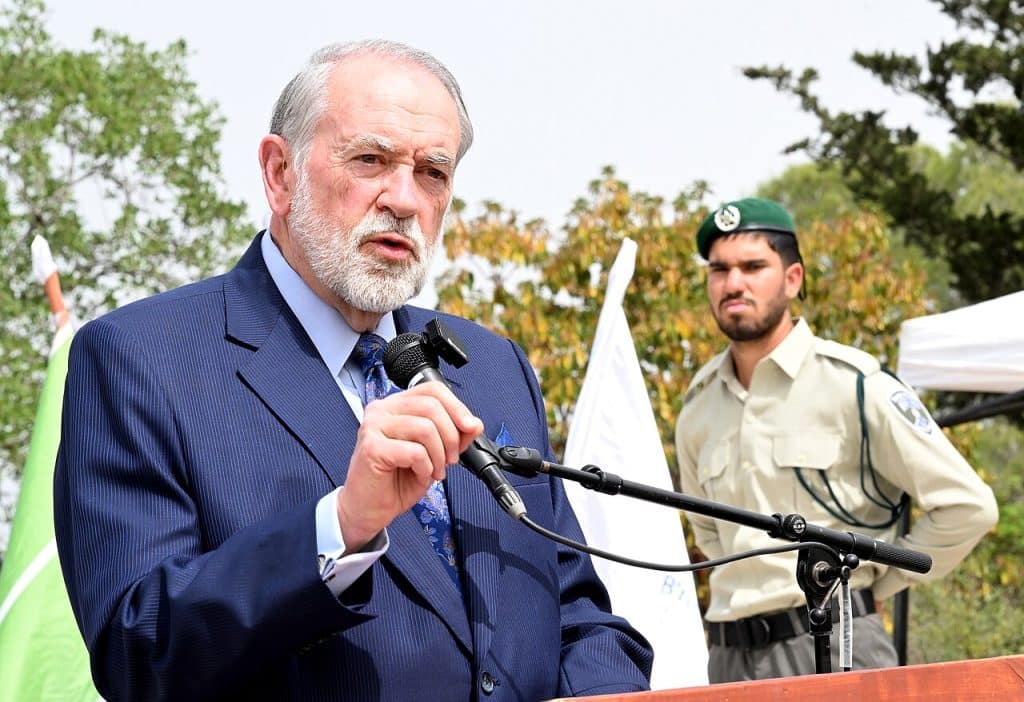
Ambassador Mike Huckabee’s Participation in Holocaust Martyrs’ and Heroes’ Remembrance Day 2025 Ceremony, April 24, 2025 (Photo: U.S. Embassy Jerusalem)
Last week, the Patriarchs and Heads of Churches in Jerusalem, the leaders of the historic churches in the Holy Land, issued a momentous statement clearly expressing their rejection of Christian Zionism. The statement was remarkable not only for its clarity but also for the moment of its release and the response it provoked from U.S. Ambassador to Israel Mike Huckabee, a vocal Christian Zionist. The episode highlights an emerging threat to the work and witness of the Palestinian church, as well as steps Christian Zionists are taking to erase our political voice.
The Patriarchs’ statement read, in part:
The Patriarchs and Heads of Churches in the Holy Land affirm before the faithful and before the world that the flock of Christ in this land is entrusted to the Apostolic Churches, which have borne their sacred ministry across centuries with steadfast devotion. Recent activities undertaken by local individuals who advance damaging ideologies, such as Christian Zionism, mislead the public, sow confusion, and harm the unity of our flock. These undertakings have found favor among certain political actors in Israel and beyond who seek to push a political agenda which may harm the Christian presence in the Holy Land and the wider Middle East.
What does this mean?
The statement is a response to disturbing developments taking place in Palestine that threaten the integrity, unity, and historical authority of the Christian Churches in the Holy Land. What specifically stirred the Patriarchs appears to be a growing pattern: the promotion of self-appointed local individuals or groups, welcomed at official political levels, who claim to represent Christians in Israel or the Holy Land while advancing Christian Zionist theology. Such initiatives have happened in the past and have gone unnoticed. But recently, such meetings have involved senior U.S. and Israeli officials, including Ambassador Huckabee, and increasingly pose a direct threat to the historic authority of the Heads of Churches and the integrity of the Christian faith. They undermine the centuries-old ecclesial structures (known as the Status Quo) that have maintained the unity of Christian communities in Palestine throughout a history of empire, colonialism, and occupation.
This is why Ambassador Huckabee felt compelled to publicly comment on the Patriarchs’ statement. He wrote in part, “It’s hard for me to understand why every one who takes on the moniker ‘Christian’ would not also be a Zionist.” The importance he gives the statement points to the serious stakes that issues of representation and power hold for Christians in the Holy Land and the degree of political interference Israel and its supporters are willing to exert to undermine anti-Zionist Christian voices.
It is worth asking why a U.S. representative would intervene at all in an internal matter of the Churches of Jerusalem. After all, the Patriarchs’ statement is not a political manifesto. It is a pastoral affirmation from those who legitimately represent Christian communities in the Holy Land. Huckabee’s response, therefore, reveals more about the political sensitivities exposed by the statement than about the statement itself. His reaction underscores precisely the concern the Patriarchs raise: certain political actors in Israel and abroad seek alternative Christian voices that are more aligned with their ideological and geopolitical agendas.
Huckabee’s interference cannot be separated from the broader political context. In recent years, we have witnessed systematic efforts by Israel and its allies, particularly the United States, to delegitimize official Palestinian representation. This process began with the weakening of the Palestinian Authority, criminalizing our resistance and our political parties. It continued with the designation of respected Palestinian NGOs as “terrorist organizations.”
It now appears this interference and repression is extending into the Christian sphere. Creating or empowering a local Palestinian Christian Zionist group provides a convenient alternative—a useful narrative—that allows political powers to bypass church leaders, silence prophetic Palestinian Christian witness (Kairos Palestine, Sabeel, Bethlehem Bible College, and others), and cast doubt on the legitimacy of long-established Palestinian institutions.
This is especially alarming at a moment when Palestinian Christians, alongside Muslims, have been among the most consistent and moral voices confronting genocide, mass displacement, and grave violations of international law in Gaza and beyond. Our advocacy has exposed not only Israeli policies but also the direct complicity of the United States. In this light, the emergence of a politically endorsed “Christian” voice that blesses occupation and its violence is not accidental. It serves a clear strategic purpose.
The Patriarchs’ language in their statement is also significant. Their critique of Christian Zionism and their emphasis on unity, representation, and pastoral responsibility closely echo the theological clarity of Kairos Palestine, particularly in its recently released document, Kairos II, A Moment of Truth: Faith in a Time of Genocide. Kairos II unambiguously names Zionism as a political ideology rooted in injustice and calls Christians worldwide to reject theological distortions that tolerate oppression.
For years, the Kairos movement has sought deeper alignment with church leadership, sometimes from the margins. In this statement, the Heads of Churches appear not only to defend the historical significance of their office but also to offer a practical and positive response to the Kairos call, affirming what is ultimately at stake: the future of Christian presence in Palestine. Their statement signals that the churches’ shepherds in Jerusalem increasingly recognize that neutrality in the face of political theology is impossible, and that safeguarding Christian unity today requires naming false theologies and resisting political manipulation. The Patriarchs are not merely protecting their institutional authority. They are defending the integrity of Christian witness in the land of Christ.
In this sense, Huckabee’s intervention confirms the urgency of the Patriarchs’ message. The struggle is no longer only about land or politics. It is also about who speaks for the Christian community, whose theology shapes—or helps to shape—global Christian understanding, and whether the churches of the Holy Land—and beyond—will be sidelined in favor of voices connected to Israel’s hegemonic and genocidal policies.
The Patriarchs’ statement is not defensive. The statement is prophetic. It draws a clear line between authentic church representation and politically manufactured alternatives. It reminds both the global church and the world that the Christian presence in Palestine cannot survive if it is severed from truth, justice, and the lived experience of its people, whose ancestors first claimed the faith and brought it to the world.
At this critical time, we are all encouraged to support our church leaders, helping to ensure that this clarity is preserved and strengthened, as the Patriarchs declare, “in the very land where our Lord lived, taught, suffered and rose from the dead.”
NAKBA 2.0
Palestinian children injured in Israeli raids, as illegal settlers step up attacks in West Bank
Israeli settlers, under the protection of Israeli forces, raid the Old City of Hebron in the southern West Bank on January 31, 2026. [Amer Shallodi – Anadolu Agency
Israeli forces wounded two Palestinian children during a raid on a refugee camp near Ramallah late Saturday, amid a series of separate attacks by illegal Israeli settlers on Palestinian property across the occupied West Bank, according to Palestinian sources, Anadolu reports.
The official Palestinian news agency WAFA said Israeli troops stormed Jalazone refugee camp north of Ramallah, sparking confrontations with residents during which soldiers fired live ammunition.
A 15-year-old boy was shot in the foot, while a 16-year-old sustained shrapnel wounds to the shoulder, the agency reported.
Israeli military incursions across the West Bank frequently trigger clashes, as youths throw stones at armored vehicles and troops respond with live fire and tear gas, often resulting in injuries.
In parallel incidents elsewhere in the West Bank, the Al-Baydar human rights organization said illegal Israeli settlers attacked Palestinian property in Khirbet al-Malih in the northern Jordan Valley, targeting residential tin structures and sheep pens.
The group said settlers also attempted to assault a woman at the scene, causing fear among residents, and described the attack as part of a systematic pattern aimed at pressuring Palestinian communities and undermining their livelihoods.
In another incident, WAFA reported that settlers attacked a Palestinian home in the town of Qusra, south of Nablus, before residents confronted them. No injuries were reported.
Since Israel launched its offensive on the Gaza Strip in Oct. 2023, arrests, raids, and attacks against Palestinians have intensified in the occupied West Bank and East Jerusalem.
In the nearly two-year period, at least 1,110 Palestinians have been killed, more than 11,500 injured, and over 21,000 detained in the West Bank, according to Palestinian figures.
NAKBA 2.0
A bloody season: the olive harvest in the West Bank
Journalists Rafaela Cortez and Ricardo Esteves Ribeiro embedded with Palestinians during the 2025 West Bank olive harvest. They witnessed terrible violence and oppression, including the killing of a 13-year-old boy, but also inspiring resistance.
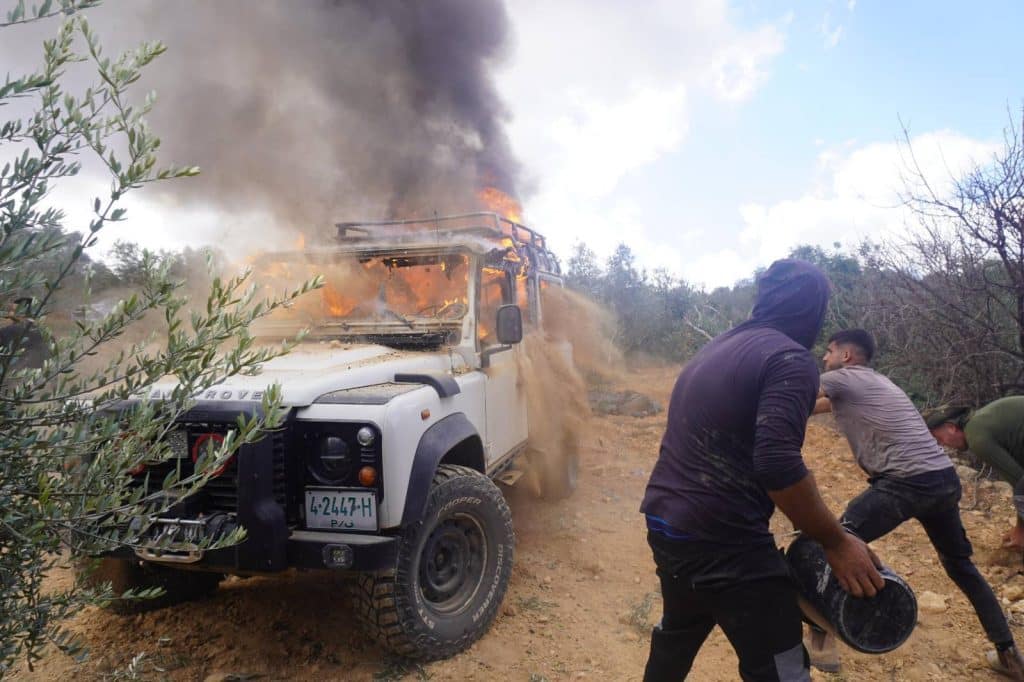
Palestinians put out a fire caused during an attack by Israeli settlers on Palestinians harvesting olives in the West Bank village of Beita, on October 10, 2025.
(Photo: Rafaela Cortez and Ricardo Esteves Ribeiro) LONG READ
Editor’s Note: This report first appeared in its original form as a podcast on the Mondoweiss Youtube channel. For more podcasts and video reporting like this, subscribe to our Youtube channel.
Friday, October 10, 2025
It’s a bit after eight in the morning. We’ve just arrived in Beita, a village in the north of the West Bank. The light is still soft, catching in the dust hanging on the road as people park their cars. Everyone is gathering here for the annual season of the olive harvest. Except this isn’t your typical olive harvest. Here, in occupied Palestine, picking olives comes with risks: injury, arrest, or even death.
“There are settlers trying to stop the farmers from harvesting their olives so we are coming to help them,” Munther Amira tells us. Munther is a Palestinian community organizer from Deir Aban, a Palestinian village ethnically cleansed in 1948. He grew up in the Aida refugee camp, in Bethlehem, where he still lives.
Today marks the first day of Zaytoun 2025, a campaign for the olive-harvest season organized by a number of Palestinian collectives to support farmers at the edges of Israeli settlements. Munther Amira has spent months helping coordinate this campaign: bringing in activists and journalists, planning the routes, handling the logistics, and trainings. Now that the season has begun, everything is suddenly becoming real.
“It’s a big happiness to have all these people here,” he says, looking around. There are dozens of us – mostly Palestinians, but also international solidarity activists from all over the world. “We don’t do it because we think the farmers are poor and weak,” Munther told us. “We do it as a way to say ‘thank you for being in the frontlines’.”
Olive groves aren’t what most people imagine when they hear the word “frontlines”, but in recent years, as settlements and outposts continue to multiply, the frontlines of Palestinian resistance to Israeli colonialism have shifted and expanded across the West Bank. And plots of land farmers could once reach are being progressively cut off by the encroaching occupation and the threat of violence. Munther Amira speaks of a different kind of genocide, of ethnic cleansing. “The people have to see what’s going on here,” he adds.
It’s not our first time in Palestine. We have been reporting on the subject, mostly in Portuguese, since 2017. But although we’ve been spending time here, every year, for the last few years, we’ve never actually been to the olive harvest before – and so, we don’t quite know what to expect. The weight of the occasion hasn’t fully set on us yet. For now, we’re in high spirits, slightly buzzing with caffeine, in awe of this large group of people steadily making their way up the rugged slopes.
Munther points to a new outpost on the top of the hill, Mevaser Shalom – Hebrew for “the peace bringer.” This morning, before we got here, settlers had already attacked a Palestinian family of three, who were taken to the hospital. As we walk, we see their blood on the ground, next to a couple of emptied tear gas canisters. The tear gas was shot by Israeli army soldiers, who offer 24/7 protection to the settlers.
People gather to start the harvest – tarps under the olive trees, their branches struck in a rhythm that has passed from generation to generation. Less than five minutes later, six Israeli soldiers arrive in a jeep. There are a few moments of quiet as the soldiers observe the group. But suddenly, the harvest starts to unravel.
It’s not even 10 a.m. when the first stun grenades and tear gas canisters start landing around us. A group of fifteen settlers runs across the olive groves, and a group moves to stop their advance, but the soldiers are quick to shield them. Wahaj Bani Moufleh, a Palestinian photojournalist and resident of Beita, is shot point-blank in his foot with a tear-gas canister, in what seems like a deliberate targeted attack. He’s wearing a blue vest with the word “press” on it. As people carry him toward an ambulance, soldiers fire more tear gas in their direction. The air becomes thick with acrid smoke.
Most of the settlers are kids, it seems. Unarmed teenagers shielded by heavily armed soldiers, and now by the Israeli border police as well. The border police arrive and immediately direct the farmers and the activists towards a specific patch of land. “On this side, you can do it,” they say. (picking olives, they mean). “That side is off limits”.
The harvest goes on in the background while Palestinian farmers and landowners argue with the Israeli authorities, insisting they should be able to pick olives everywhere – it is, after all, their land. Munther Amira, again: “They want to control everything to show that they have the power here. And we are trying to show that we have the power here.”
This standoff lasts for a few minutes. But, as it would turn out, the earlier display of violence was just a prelude to what was to come. A group of masked settlers descends from the hill, throwing rocks at a Palestinian family in a nearby slope and setting a car on fire. People rush over, shoving handfuls of dirt into the flames, hoping to put the fire down. Their efforts are met with a hail of rocks from the settlers and clouds of tear gas from the military.
Then, the settlers attack again from the slope we had just left. Everywhere we look, absolute chaos. The soldiers keep on sending stun grenades and tear gas in our direction. There’s people screaming, shouting, dodging the rocks that settlers keep hurling.
Most people sprint back to the cars. A few stay behind, on the other side of the hill, with little more than rocks. We’re unsure what to do. Do we keep documenting what we see? Try to interview people? Run? Stay put? In the end, we fall in with the group going back.
With tear gas clouds still hanging at a distance, we begin to take stock of what just happened. We wouldn’t have the full picture, however, until the following day. At least 10 people were injured, 8 cars were burned, including an ambulance.
Back at the cars, we join Munther Amira. He’s still catching his breath from the escape, but somehow, he’s laughing anyway. He lays out what we should expect from this year’s harvest: “A bloody season. It seems, from the first day.” And time would prove him right. What we saw on that first day, in Beita, would end up being a sort of microcosm of everything we could expect for the days ahead: clouds of tear gas, violent settlers, an army seemingly dedicated to protecting them while harassing and attacking both Palestinians and solidarity activists, in a land under siege.
By the end of the season, in mid-November, there would be more than 160 settler attacks, resulting in more than 150 injured Palestinians, almost 6000 trees destroyed, countless damaged vehicles, and one martyr, a 13-year-old kid we met during the harvest named Ayssam Jihad Ma’ala. We didn’t know his name then, but we would learn it soon enough.
We joined this year’s olive harvest campaign for 10 days. This is the story of what we witnessed – a story of incredible violence and oppression, but, most importantly, of community and resistance.
Saturday,October 11
It’s a little over eight in the morning. We’re back in Beita – this time, a much smaller group. One of the farmers invites us for tea, coffee, and some non-optional biscuits in the shelter he built as part of his effort to defend his land. This land belonged to his grandfather before him. Now it belongs to him.
We’ve gathered here because the olive groves we were planning to go to – the same ones from yesterday – are apparently off limits. We learned that from the four soldiers blocking our path with their military jeeps upon our arrival. Even though the family had gotten permission from the military before to harvest their land today, the army has now declared the area a closed military zone. They don’t bother showing us any proof.
About these so-called “agreements”. The previous day unfolded with plenty of back-and-forth negotiations between the Palestinians and the army over where people could or could not harvest olives. One grove was okay, the other was not. One side of the road was okay, the other was not. They call it security coordination.
Mind you, these are all Palestinian lands. Even within the framework of international law, all of these belong to Palestinians. We’re in Area B of the West Bank, according to the 1993 Oslo Accords. But even here, in recent years, the Israeli military has been increasingly blocking Palestinians from working their land unless they first coordinate with the army. This means the occupation forces get a say in when and how Palestinians can harvest. All of this for so-called “security reasons”. Of course, the real source of that insecurity seems clear enough: the ever-growing settler colony, with its settlers and outposts.
Since the reconstruction of the settler outpost Evyatar in 2021, Beita has become one of the West Bank’s frontlines. Ever since, Beita’s residents and solidarity activists have been staging recurrent protests against the outpost. And for that, the village paid a heavy price: tear gas canisters, sound bombs, live ammunition, movement restrictions and closures, as well as house raids and arbitrary arrests.
All across the hills of the West Bank, settlers keep building new outposts. Once fringe radicals, settler leaders like Finance Minister Bezalel Smotrich and National Security Minister Itamar Ben-Gvir are in the highest levels of the Israeli government, and they’ve used their power to further the violent settler-colonial expansion in the West Bank.
The harvest season is no longer the communal ritual it once was, as one Palestinian farmer later explains. The whole family used to gather around the fire to cook traditional Palestinian meals, he says. “Every year, we would have activities. We would have fun.” But not this year. This year, the fire is gone, replaced by provisions cooked and packed in advance, the kind of lunch meant to be eaten on the move, should the moment come when there’s an attack, and everyone has to flee. As if “they are the landowners,” he says, meaning the settlers and soldiers, and “we are the thieves.”
Another farmer steps forward. He tells us his grandmother is 95 years old, and she raised these trees in front of us as if they were her children. She would bring them water in a donkey, before there were any roads, to make sure they all had a sip. “When they attacked us yesterday, my grandmother cried,” he says. It’s as if they were attacking her children.
The group harvests olives for a while. But the peace doesn’t last long. We see a Palestinian farmer walking down the same road we were kicked out of, on the slope in front of us. A few seconds later, soldiers emerge behind him. A minute later, tear gas. A sharp, now-familiar sting fills our eyes with tears. Everyone starts coughing.
They keep shooting as we retreat, and an older man falls down, struggling with the tear gas. Soldiers shout through a megaphone. “You’re assaulting the State security,” one volunteer translates. “You need to leave.” We go up the road, further away from the army, to join some other families gathering at the top. A child lies on the ground and is having seizures. People start shouting at the soldiers to let an ambulance through, but it only comes minutes later. The kid is quickly carried inside and immediately taken to the hospital. He is only thirteen.
We have a few minutes to gather our bearings. The Palestinians around us don’t need a few moments to adjust – this is their reality. And so, as soon as the dust settles, they want to go back and resume the harvest. We’re a lot more jittery – there’s a drone flying overhead, and the soldiers could be back any time now. But the drone, they tell us, is always here. And so, we keep working.
In later retellings, we would often call this one of the quiet days. A good day, even. All in all, by the end of the day, the group picked 400kg of olives (roughly 880 pounds). We had a lovely lunch in the shade – hummus, muttabal, lentils, flatbread, pickles, olives, za’atar. We got to do some interviews, chat with each other, crack some jokes, and have a few coffee breaks to cool down.
Of course, this is not how we remember the day now. Because as we would discover exactly one month later, Ayssam Jihad Ma’ala, the thirteen-year-old kid who collapsed in front of us that day, never recovered. He went into a coma shortly after due to the lack of oxygen in his brain – a consequence of the tear gas – and died on November 11. A thirteen-year-old boy was martyred, all because he wanted to go to the olive harvest with his family.
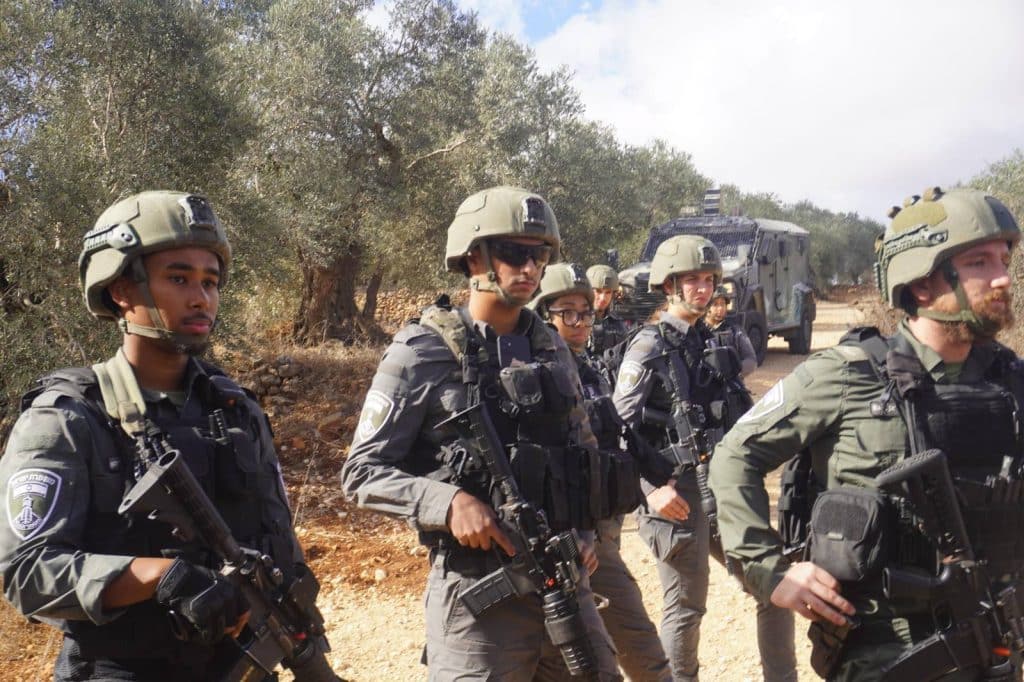
Fully-armed Israeli soldiers monitor Palestinians harvesting olives in the West Bank village of Beita, on October 10, 2025. (Photo: Rafaela Cortez and Ricardo Esteves Ribeiro)
Sunday, October 12
It’s 10:40 in the morning. Over a hundred people have gathered in Idna, a Palestinian town in the southern West Bank, close to al-Khalil (Hebron). This is technically area A of the West Bank, supposedly under full control of the Palestinian Authority. But it comes as no surprise that we already have unwanted company.
Two armed settlers are hiking up the slope to meet us, and behind them, what looks like soldiers. We had heard many accounts of armed settlers in military uniform, but this is the first time we’re a bit unsure of what we’re looking at – the first of many. The line is becoming blurrier every year, and not by accident. The state arms them, outfits them, and backs them at every level.
Over the next few days, we find ourselves asking, “soldier or settler?”, as if we’re playing a grim game of spot the difference. Do they wear helmets? Do they have insignias? Are their trousers the right color? But after a while, the exercise starts to feel like a technicality, a semantic issue rather than a practical one. At what point do we stop calling these paramilitary settlers civilians? And when the real soldiers collude with the settlers during their attacks, what’s the difference anyway?
The settlers and soldiers begin sending us back. We ask Munther what they are saying: “They… it’s forbidden to do anything,” he tells us. More settlers arrive, moving around us in a swarm. They dictate what people can or can’t do. They film the volunteers and the journalists, try to steal tarps and phones, and walk around like they own the place. But despite the harassment, people hold their ground. The crowd starts singing popular Palestinian songs. “Settlers, out, out,” they chant. The settlers, themselves, keep repeating “shh, shh, shh” – the sounds used to herd sheep and goats, gesturing for us to leave.
One of the settlers, dressed in military uniform, starts grabbing journalists, trying to pull them aside. We ask him why he’s trying to take people away. “Because it’s my land,” he says. Another settler joins in, speaking Hebrew. We tell him we don’t understand his language. He replies, “I don’t want you to understand me. If I want, I take you.”
Eventually, a group of about 13 soldiers and settlers force us all the way back to the town square where the day began. Some hundred and something – maybe two hundred – Palestinians and solidarity activists refuse to go any further. They sit in white plastic chairs, passing around coffee, cucumbers, and fruit. Three Palestinian kids, entirely unbothered by the soldiers and settlers right behind them, giggle and strike poses for the camera.
Monday, October 13
After nearly two hours on the road, we finally reach Qafr Qadum. “It’s one of the famous places here that run Friday demonstrations,” Munther tells us. “They still do them, sometimes.” For years, Qafr Qaddum has been a target of Israeli settler expansion. Munther Amira says it’s famous because its residents have held weekly protests for more than a decade, resisting the expropriation of hundreds of hectares of their land. The crowd is even bigger today – a fleet of buses and cars has brought hundreds of people all the way from Ramallah and elsewhere across Palestine.
Up the hill, we see what looks like the beginning of a settlement. Beside it, a makeshift structure similar to a military tower surrounded by Israeli flags and around fifteen settlers who never seem to look away. We begin climbing the hill toward the olive trees nearest the first structure of the outpost, roughly 20 meters away. And then, the harvest begins.
One of the settlers shouts to a Palestinian next to us. We ask one of the volunteers what he is saying: “He says that all of you are terrorists,” he replies.
Meanwhile, the military also joins us, summoned by the settlers. A few minutes in, one of the settlers – a teenager, by the look of him – pulls a mask over his face, a knife resting on his trousers. Another settler turns to a Palestinian journalist: “Your vest” – the press vest, he means, – “won’t stop the bullets.”
There are now around 15 soldiers and settlers, half of them wearing military-style outfits. One settler carries both a professional-looking camera and a semi-automatic weapon. It’s as if the outpost has its own photojournalist.
The masked settler starts shoving volunteers, hurling insults in Arabic. “Whore,” he shouts at one woman. Tensions rise, and for a moment, it seems the situation might spiral out of control any second. But fortunately, that’s not the case. Volunteers keep picking a few olive trees as they sing “Bella Ciao.” The trees are sparse, and the group eventually moves downhill. Below, soldiers and settlers start asking for people’s IDs, particularly the internationals. We ask why people are being told to leave. “It’s illegal,” one says. “It’s an army area,” another adds. They claim it’s dangerous for us to be there: “I’m worrying for you. I love you because of that.”
Closing off an area – declaring it a “closed military zone” where only authorized people may be – is routine during the olive harvest and for much of the rest of the year as well. The soldiers do it all the time. They do it to prevent protests, to protect settlers and settlements, and to prevent access not only for Palestinians but also for solidarity activists and journalists trying to reach agricultural land. In 2022 alone, they issued over 800 closed military zones – and the army itself has referred to this data as very incomplete.
Setting up a temporary, 24-hour military closed area is so simple that they used to carry around a printer in their jeeps, one activist tells us. Now, with smartphones, they don’t even need that. It’s so easy to set up that they don’t need to bother to lie about it. And yet, in all the days that followed, we never saw a single document, a single shred of evidence for any of these so-called closed military zones used to push us out. But it’s not that they actually need it. It was clear day after day – with or without a real military order, soldiers and settlers can do whatever they want.
Wednesday, October 15
It’s the fifth day of the olive harvest campaign – or rather, the 6th, if you count yesterday. Only we never made it there. We were supposed to go to Tusmyus Ayya, a Palestinian village north of Ramallah. But from what we were told, the Shabak, the Israeli security agency, threatened the mayor of the village. Something along the lines of “if all these people go there, people will die.” So, yesterday was canceled.
Today, we’re heading elsewhere – al-Nazla al-Sharkyia, near Tulkarem, in the northern West Bank. The day starts like many others – listening to Fairuz, grabbing coffee, catching a ride with Munther Amira. Only, this time, we’re also joined by Abeer Alkhateeb. That’s her singing along with Fairuz on the radio. Abeer is no stranger to any of this. Before we met, we’d already seen videos of her: a woman in oversized sunglasses, shouting at fully equipped soldiers, daring them to drop their weapons and face her. There’s a fierce spark in her. But the past few years have taken their toll. She laughs and tells us she’s very scared: “After my husband died, after the 7th of October, the situation became very dangerous.” Today, she’s scared, but she says, “I’m strong to be here. I will fight to be here.”
On the way to the olive grove, we pass by scattered families already at work and military jeeps stationed on a road ahead. They seem to be waiting for us. And surely, as soon as we reach the trees ourselves, not a single olive picked, we’re met with tear gas. We try to count the canisters being shot, but it’s a futile exercise. From that very first moment, tear gas rained down on us, relentlessly, even as we retreated.
Two hours on the road only to be kicked out in less than ten minutes. As we leave, paramedics tend to a woman who fell while fleeing from the tear gas. They think she might have broken her leg. Small fires flare up where many canisters landed, and people rush to put them out.
Back at the municipality building, people hand out water, coffee, and an assortment of manakeesh, thanking everyone for joining. A Palestinian man moves through the crowd, slipping small cucumbers in people’s pockets.
We’ve been going on and on about violence, but here, Palestinians turn even the ugliest of days into acts of community and solidarity. People have gathered here from all over – there’s paramedics, people handing out food and drink, others carrying tarps and ladders and tools. Munther and Abeer keep calling this way of doing things “fauda”, or chaos. But to us, it looks as if it’s more like a well-worn routine of people stepping in and taking care of one another.
Looking around, the mood is far from sour. There’s laughter and lively conversation, as if we weren’t just being tear-gassed ten minutes ago. No one here seems particularly surprised by the outcome. In fact, this is a common experience. Unlike us, always waiting, wondering – “Will the army appear? Will there be settlers?” – the Palestinians know full well what awaits them. And still, they go. Every single time. We would see as much again the following morning.
Thursday, October 16
It’s early morning in Kofr Rae, a village in the Jenin area, and we’re waiting in the municipal building – coffee in hand – for the rest of the group to join. To pass the time, we chat with Yasser, an engineer who works in the municipality. He, too, is coming to the olive harvest. When we ask him what he thinks will happen today, he laughs. “They will hit us,” he says. We assume the same: we will arrive, they will be waiting, and tear gas will follow. Yasser nods along, still laughing. “Yeah, yeah, yeah. Everything. You know that”.
When we’re ready to move, we climb into the trailer of an old tractor owned by one of the farmers, along with a couple of Palestinians. We start winding up a dirt road, dozens of cars in a huge caravan behind us, slowly moving through huge patches of olive groves on either side. Our travel companions point to the hilltops, naming settlements and outposts in the area. A few minutes later, we arrive. The army is already there, as Yasser predicted.
There’s four soldiers on the road – one of them covered with a black mask. It soon becomes clear he’s a sniper. Much like the day before, they start sending tear gas canisters as soon as we reach the olive grove. Only, this time, canisters are aimed low, at leg level, rather than into the air.
As we move back to another olive grove, we spot Manal Tamimi, a community organizer from the town of Nabi Saleh, another that became quite known for its Friday demonstrations. She tells us it’s the first time since October 7 that they have been able to reach these trees: “I think that’s why they are so intense, and why the settlers became more violent,” she says. But all they want is to harvest their olive trees. “It’s not that we are attacking or doing something illegal,” she adds.
Manal tells us we’re not going to pick any olives today, and she is right. The soldiers keep sending on tear gas, and soon enough, the group decides to retreat back to the cars, eyes and throats burning. Then, an already nasty situation gets worse. A group of settlers charges towards us, hurling rocks. Panic spreads. All around us, rocks are flying, people are shouting, and every driver is leaning on the horn. There’s six, seven, eight people trying to squeeze in cars built for five. Everyone scrambles to get away, but the dirt road is narrow, and the line of cars and buses struggles to move. Some people throw rocks back to slow the settlers’ advance. Further up the road, we finally squeeze onto a bus, its rear seats littered with shards of glass from the windows the settlers broke.
The experience leaves a bitter aftertaste. The next morning, that’s what we find ourselves watching for — the exit strategy. We wouldn’t find much relief.
Friday, October 17
It’s 8:43 in the morning. We’re in Silwad, a village just outside Ramallah, and there’s a 3km walk through the hills that separates us from the olive groves. We’ve been warned it might be a tricky day – “they’re raiding as fuck in the area,” one volunteer tells us.
We descend and climb the steep hills ahead. One of the activists tells us the exit plan is to come back the way we came. We don’t particularly like the sound of it, but what’s the alternative? Scrambling down the ravine until we hit the highway?
Along the road, dozens and dozens of burned olive trees, a burned car upside down, and three others next to some unfinished buildings. Everything feels very ominous. Later, Munther Amira explains that the construction was stopped after 7th of October. It became dangerous to even come here, especially after the settlers built the outpost.
Not long after the group starts picking olives, we see goats approaching. A Palestinian tells us they were stolen from the farmers. Behind them, a lone settler, possibly the goat thief, speaking on his phone, moving with the ease and confidence of a landowner. Except this isn’t his land. He comes and goes and the harvest continues.
Branches lie shattered everywhere. In some trees, only the trunk remains. One of the farmers stares in heartbreak at the destruction: “Why do they do this if they think Abraham told them that this land is for them?” he asks. He says the trees were like his children, much like the 95-year-old grandmother from Beita. It’s as if he lost members of his family, he says.
A while later, more settlers arrive – most of them teenagers. They are insisting – in a mix of English and Arabic – we leave. The group eventually decides it’s not worth the trouble, packs their things, and starts leaving. But the settlers block the Palestinians’ cars from leaving.
Not long after, the army comes, along with more settlers – this time, armed. The soldiers echo what the teenage settlers were saying. We have to leave. “This is a closed military area,” one of the soldiers claims. We ask if the settlers are required to leave as well. “They will leave when…” he begins, but immediately course-corrects: ”It’s their territory.” He tells us he does not wish to use force, but we’re interfering with the army and, he insists, we must leave.
But the settlers keep blocking the Palestinians’ cars. For the next fifteen minutes, they pile rocks on the road to block their path and perch on the cars’ hoods. One even stages a dramatic performance, pretending the car is running him over. All the while, we keep asking why the settlers are allowed to stay. Finally, as the car manages to escape and we finally head back, the soldier shouts an answer: “They’re allowed by law”, he says. He doesn’t bother specifying which law, and, frankly, he doesn’t have to.
Saturday, October 18
We were supposed to return to Beita today. But, we soon find out, that’s not going to happen. The village is completely closed off – no one in, no one out. So, when we finally set out, we head to Madama instead, a village close to Burin, in the north of the West Bank.
The days have started to blur at the edges. Early mornings, late nights, long drives, the constant threat of violence. We’re all pretty tired, and Munther Amira is no exception. We ask why he doesn’t take one day off. “I want to pick olives. This is what I want to do,” he replies. Funnily enough, on the 8th day of the olive harvest, that’s exactly what happens. Dozens of people manage to pick olives from morning until mid-afternoon – with two different families, at that. We have a big meal for lunch – rice with chicken, salad, labneh, and some pickled chilies. Almost – almost – like the good old days.
“Doing the tea on the fire, having our meal here, cooking kallayt bandora, tomatoes on the fire, having dukkawzeit, you know, I think even these small things we lost,” Munther says. Like the farmers in Beita were telling us. It’s not just picking olives, he adds, “it’s being together, singing together, eating together.” He calls it the season of happiness. “This is the happiness, being together.”
As a refugee, Munther Amira doesn’t have any olive groves of his own. That was his dream – to harvest olives with his family. But they cannot; their land was taken in 1948. And so, Munther started going to the olive harvest with other families during university, as a volunteer. Eventually, he set up a kind of patrol with Abeer Alkhateeb – a precursor to the Zaytoun 2025 campaign. Only, back then, there was no program at all. Just fauda, chaos. “If you need any help, just call us”, they would say. And that was it. They would drive around to the most dangerous areas, telling people to call if they had any trouble. Munther, Abeer and maybe ten others, moving across the West Bank.
The mood today is definitely different from last days. And it’s not because Madama is somehow easier. Not only are we in Area C, but we’re apparently in a closed military zone – the army even stopped the car of one of the activists earlier this morning, at a checkpoint at the entrance of the village. But somehow, we slipped in. And here we are, picking olives, sitting together for lunch, having multiple rounds of coffee, and juice, and cake. There’s even music.
Yes, today was a good day, the kind that feels like it has the power to tilt the balance of the game. But days in occupied Palestine don’t line up like that, neatly, one after the other. There is no promise of continuity, no continuous trajectory from good to better. A good day isn’t necessarily followed by another. And the next morning proved it – it was not a good day at all.
Sunday, October 19
We are on our way to Farkha, a village in the Ramallah area. We have barely reached the town square when the first scraps of news begin to filter through – something bad happened in Turmus Aya, a village nearby. Settlers attacked the harvest and Afaf Abu Alia, a 52-year-old woman, was struck in the head by a masked settler and rushed to the intensive care unit with internal bleeding.
In Farkha, the day unfolds much like most: dozens of people join, the harvest begins, and we’re quickly confronted by a group of soldiers and settlers. We ask repeatedly why people are being told to leave. Nobody cares to answer. At one point, a soldier – or settler? – took the car keys from Abdallah Abu Rahma, one of the organizers of the Zaytoun 2025 campaign. For a while, we are stuck in a standstill – them insisting we leave, the group refusing to leave without the car keys.
Eventually, the keys are returned and everyone climbs back up the hill from which we came. “This is the occupation,” Abdallah says. “They don’t need to see any Palestinians here.” At one point, one of the soldiers tells him this is an Israeli area. “You hear me”, he answers. “This olive [tree], my great-great-great-grandfather planted it before the State of Israel was here.”
Monday, October 20
The Israeli Channel 4 broadcasts a segment naming Munther Amira, Abdallah Abu Rahma and Mu’ayyad Sha’aban, the head of the Wall and Settlement Resistance Commission from the Palestinian Authority, as “terrorists”. All three men, the report notes, have served prison sentences in the past and are now the supposed “masterminds” behind the Zaytoun 2025 campaign. According to the report, this initiative was never about harvesting olives at all, but about provoking the peaceful settlers nearby.
The whole broadcast leans heavily on the suggestion that the Knesset – the Israeli parliament – ought to intervene before all this unravels into “another 7th of October”. Moments later, we get a message from Munther Amira: “I think we will not move tomorrow,” he says. “Because of the incitement against me, Mu’ayyad and Abdallah.” The roads around Bethlehem are crowded with checkpoints, and who knows what could happen if he’s stopped in one. And so, he stays home.
We never made it to the olive harvest the next day. A couple of days later, we boarded a plane back to Portugal. But the bloody campaign, as Munther had predicted, went on. And he, of course, went back to the fields. According to the United Nations, between October 1st and November 10th, there were more than 160 attacks from settlers in almost 100 towns and villages. More than 150 Palestinians were injured.
And still, Munther describes the campaign as a success. Not because of the number of families that were helped or even the number of olives that were picked. As he explained earlier, it wasn’t really just about that. It was about breaking that invisible but violent barrier that, for at least two years, has been separating people from their lands. It was about shattering that fear. Sumud, they say, in Arabic. Steadfastness. Not leaving the land. To stay.
And stay they did. Even in the year of the highest number of recorded attacks, even amidst the threats, the violence, the sleepless nights and aching bodies, every day, Palestinian farmers and several dozen volunteers rose in the first hours of the morning to set out – quite stubbornly – towards their lands. And even when they were driven back, day after day, pushed out and attacked, they thought of nothing but going back. When we asked people why they keep going, they told us, simply, “it’s our land”.
Back in al-Nazla al-Sharkyia, a farmer caught up with us after escaping dozens of tear gas grenades – kicked out of his own land. He hadn’t been able to reach his land since the 7th of October due to the increase in state and settler violence, and things were only getting worse. “We are tired from this life”, he told us. But as soon as we asked him whether he would try again soon, while still breathing heavily, one eye on the drone above, he summed it all up: “ I will try all the time. All the time I will try to reach my land. I’m still here, I’m still here, I’m still here. I do not leave my land. I do not leave. This is my land.”
Rafaela Cortez Rafaela Cortez is a journalist based in northern Portugal focusing on inequality, discrimination, and the broader structures of violence shaping daily life in both Portugal and Palestine.
Ricardo Esteves Ribeiro Ricardo Esteves Ribeiro is a journalist based on the border between Northern Portugal and Galicia. He reports on the occupation of Palestine and the people resisting it since 2017. He’s a co-founder of Fumaça, a Portuguese investigative journalism podcast.