Nonviolent Climate Activist Group Says It’s Been Targeted by FBI ‘Terrorism’ Task Force
“This is an escalation against the climate movement as a whole, and the next phase of this administration’s crackdown on dissent,” said Extinction Rebellion.
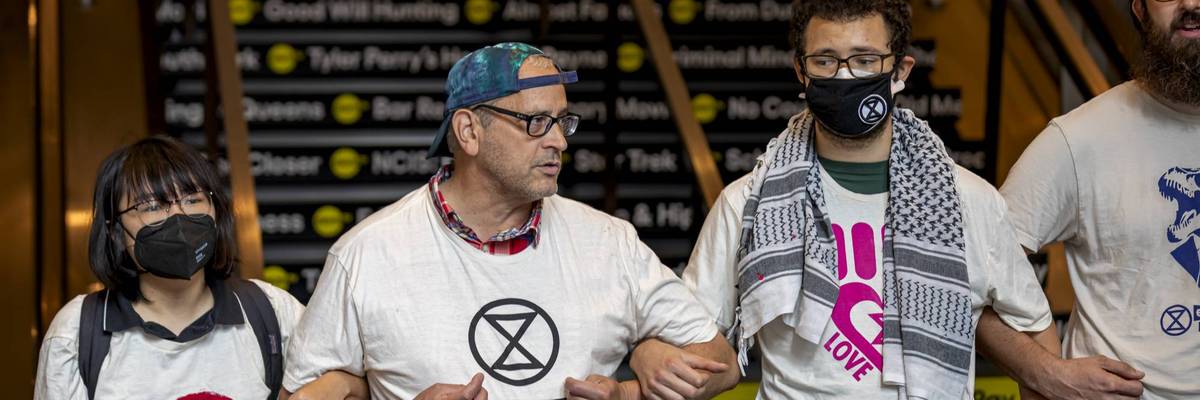
Climate activists with Extinction Rebellion block escalators inside CBS Studios on September 10, 2025.
(Photo by Michael Nigro/Pacific Press/LightRocket via Getty Images)
Stephen Prager
Feb 18, 2026
COMMON DREAMS
As the Trump administration broadens its efforts to criminalize dissent, a nonviolent climate advocacy group says the FBI is targeting it with a terrorism investigation.
Using a dubious legal designation of “domestic terrorism,” the US Department of Justice (DOJ) has ramped up its efforts to surveil those it considers to be domestic enemies—including members of left-wing groups with no history of violence.
The New York City chapter of the group Extinction Rebellion said one of its former members came into the crosshairs earlier this month.
In a statement on Wednesday, the group said that a former member was visited by two special agents, one of whom was from the FBI’s Joint Terrorism Task Forces, at their residence 200 miles outside New York City.
They said the agents asked about their involvement with Extinction Rebellion. The member declined to respond, referring the questions to their attorney.
The former member, who has chosen to remain anonymous, told the Intercept that they hadn’t been involved with the group in two years and hadn’t participated in any actions they thought would warrant FBI involvement.
“I believe this to be a significant escalation of the criminal legal system against Extinction Rebellion and find it very troubling,” Ron Kuby, an attorney for Extinction Rebellion, said. “This is usually the way we find out an actual investigation is underway and is often followed by other visits and other actions.”
He said he found it strange that Extinction Rebellion would become the target of a terrorism investigation. Members of the group take part in acts of what they call “nonviolent civil disobedience” such as blocking roads, sit-ins at public buildings, and occasional vandalism.
The group has sought to use these tactics to draw attention to leaders’ inaction in fighting the climate crisis. Increasingly, they have launched protests against the Trump administration’s policies more broadly, including its deployment of federal immigration agents in cities across the country.
While its actions can be disruptive, Extinction Rebellion has always been nonviolent, Kuby said, and its tactics are at worst misdemeanor offenses, which typically wouldn’t interest federal law enforcement.
“[Extinction Rebellion NYC] is a nonviolent, decentralized group of artists, small business owners, parents, retired teachers, and everyday New Yorkers. We are not terrorists!” said a statement from Extinction Rebellion Global posted to social media on Tuesday. “We use artistic nonviolent organized protests, community outreach, and strategic advocacy to empower everyday citizens and drive meaningful environmental change.”
“This is an escalation against the climate movement as a whole, and the next phase of this administration’s crackdown on dissent that many of us have been expecting,” the group continued.
The New York City chapter of Extinction Rebellion is not the first to receive FBI visits during the second Trump administration.
Last year, six members of its sister group in Boston said the feds came to their doors, all on the same day in March, and questioned them without providing any business cards or explanation for their visit.
According to WBUR reporting at the time, none of the activists questioned had a history of participating in violent protests or of facing felony charges in federal or Massachusetts courts.
Jeff Feuer, a lawyer in Cambridge who has represented climate activists for more than three decades, told the outlet, “Until this year, I have never heard about the FBI or any other federal law enforcement officer visiting or questioning any of the hundreds of climate activists that I have personally represented.”
After months of denial, US Attorney General Pam Bondi acknowledged during a contentious House Judiciary Committee hearing earlier this month that the department does, in fact, have a list of “domestic terrorist organizations” being compiled under President Donald Trump’s National Security Presidential Memorandum 7, which was described as a national directive to use the Joint Terrorism Task Forces to focus on “leftist” political violence in America.
That memo, commonly referred to as NSPM-7, was first obtained by independent journalist Ken Klippenstein in September. It laid out a national strategy to “disrupt” individuals or groups that “foment political violence” before it takes place.
NSPM-7 described many vaguely defined political viewpoints as potential “indicators” that one is a possible domestic terorrist, including: “anti-Americanism,” “anti-capitalism,” and “Anti-Christianity”; “extremism” on “migration,” “race,” and “gender”; and “hostility to those who hold traditional views” on “family,” “religion,” and “morality.”
In another memo that leaked in December, Bondi—who just months before pledged under oath there would “never be an enemies list” compiled by the DOJ—directed the department to compile a list of potential “domestic terrorism” organizations that espouse “extreme viewpoints on immigration, radical gender ideology, and anti-American sentiment.”
It directs federal law enforcement agencies to refer “suspected” domestic terrorism cases to the Joint Terrorism Task Forces, which will then undertake an “exhaustive investigation contemplated by NSPM-7” that will incorporate “a focused strategy to root out all culpable participants—including organizers and funders—in all domestic terrorism activities.”
During the hearing, Bondi refused to say which groups and entities were on the list of so-called “domestic terrorists,” though she acknowledged it existed, saying, “I know antifa is part of that.”
Trump designated “antifa,” referring to a loose confederation of antifascist groups, as a “domestic terrorist organization” in October, even though there is no formal “domestic terrorism” statute in US law.
It is unclear whether a formal federal investigation into Extinction Rebellion is underway or if it is part of NSPM-7.
An internal document shared with the Guardian in November revealed that the FBI had launched “criminal and domestic terrorism investigations” into “threats against immigration enforcement activity” in at least 23 regions across the US—including New York. It acknowledged that some of the investigations were related to the “countering domestic terrorism” memo.
“'Domestic terrorism’ may not yet be a criminal charge, but the Trump administration is gearing up to create it,” Extinction Rebellion NYC said on Wednesday. “NSPM-7... will be the broadest criminalization of free speech since McCarthyism or the height of the Civil Rights Movement. And while this fossil-fueled administration has already failed in some attempts to silence critics, we understand the broader context within which our specific activities sit.”
“This is an escalation against the climate movement as a whole, and the next phase of this administration’s crackdown on dissent,” said Extinction Rebellion.
Climate activists with Extinction Rebellion block escalators inside CBS Studios on September 10, 2025.
(Photo by Michael Nigro/Pacific Press/LightRocket via Getty Images)
Stephen Prager
Feb 18, 2026
COMMON DREAMS
As the Trump administration broadens its efforts to criminalize dissent, a nonviolent climate advocacy group says the FBI is targeting it with a terrorism investigation.
Using a dubious legal designation of “domestic terrorism,” the US Department of Justice (DOJ) has ramped up its efforts to surveil those it considers to be domestic enemies—including members of left-wing groups with no history of violence.
The New York City chapter of the group Extinction Rebellion said one of its former members came into the crosshairs earlier this month.
In a statement on Wednesday, the group said that a former member was visited by two special agents, one of whom was from the FBI’s Joint Terrorism Task Forces, at their residence 200 miles outside New York City.
They said the agents asked about their involvement with Extinction Rebellion. The member declined to respond, referring the questions to their attorney.
The former member, who has chosen to remain anonymous, told the Intercept that they hadn’t been involved with the group in two years and hadn’t participated in any actions they thought would warrant FBI involvement.
“I believe this to be a significant escalation of the criminal legal system against Extinction Rebellion and find it very troubling,” Ron Kuby, an attorney for Extinction Rebellion, said. “This is usually the way we find out an actual investigation is underway and is often followed by other visits and other actions.”
He said he found it strange that Extinction Rebellion would become the target of a terrorism investigation. Members of the group take part in acts of what they call “nonviolent civil disobedience” such as blocking roads, sit-ins at public buildings, and occasional vandalism.
The group has sought to use these tactics to draw attention to leaders’ inaction in fighting the climate crisis. Increasingly, they have launched protests against the Trump administration’s policies more broadly, including its deployment of federal immigration agents in cities across the country.
While its actions can be disruptive, Extinction Rebellion has always been nonviolent, Kuby said, and its tactics are at worst misdemeanor offenses, which typically wouldn’t interest federal law enforcement.
“[Extinction Rebellion NYC] is a nonviolent, decentralized group of artists, small business owners, parents, retired teachers, and everyday New Yorkers. We are not terrorists!” said a statement from Extinction Rebellion Global posted to social media on Tuesday. “We use artistic nonviolent organized protests, community outreach, and strategic advocacy to empower everyday citizens and drive meaningful environmental change.”
“This is an escalation against the climate movement as a whole, and the next phase of this administration’s crackdown on dissent that many of us have been expecting,” the group continued.
The New York City chapter of Extinction Rebellion is not the first to receive FBI visits during the second Trump administration.
Last year, six members of its sister group in Boston said the feds came to their doors, all on the same day in March, and questioned them without providing any business cards or explanation for their visit.
According to WBUR reporting at the time, none of the activists questioned had a history of participating in violent protests or of facing felony charges in federal or Massachusetts courts.
Jeff Feuer, a lawyer in Cambridge who has represented climate activists for more than three decades, told the outlet, “Until this year, I have never heard about the FBI or any other federal law enforcement officer visiting or questioning any of the hundreds of climate activists that I have personally represented.”
After months of denial, US Attorney General Pam Bondi acknowledged during a contentious House Judiciary Committee hearing earlier this month that the department does, in fact, have a list of “domestic terrorist organizations” being compiled under President Donald Trump’s National Security Presidential Memorandum 7, which was described as a national directive to use the Joint Terrorism Task Forces to focus on “leftist” political violence in America.
That memo, commonly referred to as NSPM-7, was first obtained by independent journalist Ken Klippenstein in September. It laid out a national strategy to “disrupt” individuals or groups that “foment political violence” before it takes place.
NSPM-7 described many vaguely defined political viewpoints as potential “indicators” that one is a possible domestic terorrist, including: “anti-Americanism,” “anti-capitalism,” and “Anti-Christianity”; “extremism” on “migration,” “race,” and “gender”; and “hostility to those who hold traditional views” on “family,” “religion,” and “morality.”
In another memo that leaked in December, Bondi—who just months before pledged under oath there would “never be an enemies list” compiled by the DOJ—directed the department to compile a list of potential “domestic terrorism” organizations that espouse “extreme viewpoints on immigration, radical gender ideology, and anti-American sentiment.”
It directs federal law enforcement agencies to refer “suspected” domestic terrorism cases to the Joint Terrorism Task Forces, which will then undertake an “exhaustive investigation contemplated by NSPM-7” that will incorporate “a focused strategy to root out all culpable participants—including organizers and funders—in all domestic terrorism activities.”
During the hearing, Bondi refused to say which groups and entities were on the list of so-called “domestic terrorists,” though she acknowledged it existed, saying, “I know antifa is part of that.”
Trump designated “antifa,” referring to a loose confederation of antifascist groups, as a “domestic terrorist organization” in October, even though there is no formal “domestic terrorism” statute in US law.
It is unclear whether a formal federal investigation into Extinction Rebellion is underway or if it is part of NSPM-7.
An internal document shared with the Guardian in November revealed that the FBI had launched “criminal and domestic terrorism investigations” into “threats against immigration enforcement activity” in at least 23 regions across the US—including New York. It acknowledged that some of the investigations were related to the “countering domestic terrorism” memo.
“'Domestic terrorism’ may not yet be a criminal charge, but the Trump administration is gearing up to create it,” Extinction Rebellion NYC said on Wednesday. “NSPM-7... will be the broadest criminalization of free speech since McCarthyism or the height of the Civil Rights Movement. And while this fossil-fueled administration has already failed in some attempts to silence critics, we understand the broader context within which our specific activities sit.”
 |
FBI BEGAN TARGETING ENVIRONMENTAL ACTIVISTS AS TERRORISTS AFTER 9/11 |
From the web to the streets, the president of the United States is weaponizing the federal government to hunt, prosecute, and punish his enemies.
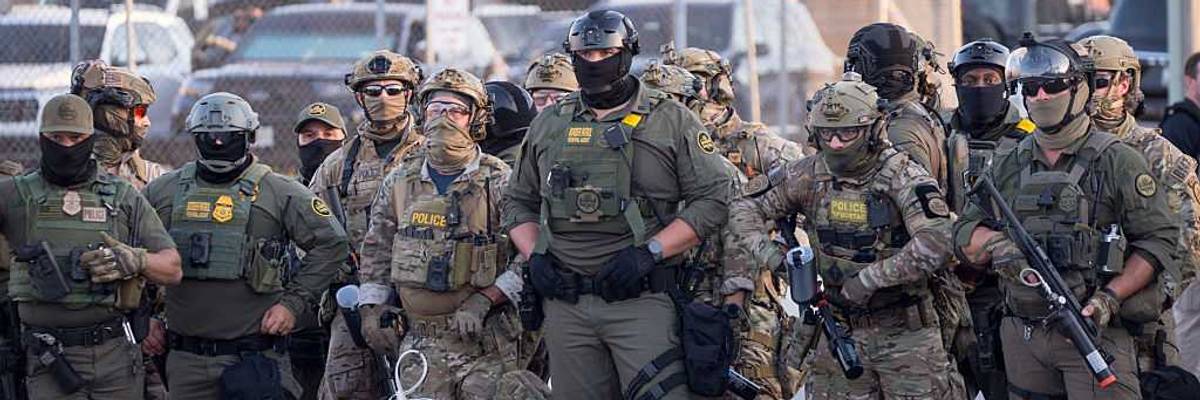
US Immigration and Customs Enforcement agents, Department of Homeland Security personnel, and Border Patrol Commander Gregory Bovino stand together amid a tense protest outside the ICE processing facility in Broadview, Illinois, on September 27, 2025.
(Photo by Jacek Boczarski/Anadolu via Getty Images)
Jordan Liz
Feb 19, 2026
Common Dreams
In recent months, the Department of Homeland Security has issued hundreds of administrative subpoenas to tech companies demanding the personal information of social media accounts that track, criticize, or oppose Immigration Customs and Enforcement. This includes Google, Reddit, Meta, and Discord, which—in a move that makes far more sense now—recently announced it will require users to submit a face scan or upload an ID to access full content.
While alarming, this is only the latest step in a year-long effort by President Donald Trump’s DHS to expand its online surveillance apparatus under the guise of combating left-wing “political violence” and “domestic terrorism.” In February 2025, The Intercept revealed that ICE was soliciting pitches for an automated system that would scan social media and other sites for anti-ICE sentiment and threats. If anything “suspicious” were detected, a contractor would conduct a detailed review of the user’s background, including:
Previous social media activity which would indicate any additional threats to ICE; 2). Information which would indicate the individual(s) and/or the organization(s) making threats have a proclivity for violence; and 3). Information indicating a potential for carrying out a threat (such as postings depicting weapons, acts of violence, refences [sic] to acts of violence, to include empathy or affiliation with a group which has violent tendencies; references to violent acts; affections with violent acts; eluding [sic] to violent acts.
To estimate one’s “potential for carrying out a threat” or “proclivity for violence,” contractors would draw on “social and behavioral sciences” and “psychological profiles.” Sentiment analysis would likely be carried out by machine-learning algorithms. While details here are sparse, the important point for now is that this review would attempt to assess one’s present and future threat to ICE based on the agency’s own internal (and politically biased) criteria.
Once flagged, the system would scour a target’s internet history and attempt to reveal their real-world location and offline identity. Contractors would provide ICE with a slew of personal information including: “photograph, partial legal name, partial date of birth, possible city, possible work affiliations, possible school or university affiliation, and any identified possible family members or associates.”
All of this meant to invoke fear, silence dissent, and consolidate power for Trump and his allies. Yet, despite the dangers, we must resist.
In October 2025, Wired reported that ICE plans to drastically expand their surveillance capabilities by hiring nearly 30 private contractors to scan social media sites and convert posts, photos, and messages into new leads for enforcement raids.
In January 2026, investigative journalist Ken Klippenstein revealed that DHS and the FBI have over a dozen “secret and obscure” watch lists they use to track “protesters (both anti-ICE and pro-Palestinian), ‘Antifa,’ and those who are promiscuously labelled ‘domestic terrorists.’” These watch lists include a classified social media repository code named Slipstream, as well as others “used to link people on the streets together, including collecting on friends and families who have nothing to do with any purported lawbreaking.” This reporting came a few days after a video was released online of an ICE agent telling a protester that they have a “nice little database” and “now you’re considered a domestic terrorist.”
These watch lists are an extension of Trump’s National Security Presidential Memo 7 (NSPM-7). That memo mandates a “national strategy to investigate and disrupt networks, entities, and organizations that foment political violence so that law enforcement can intervene in criminal conspiracies before they result in violent political acts.” Per the memo, domestic terrorism is fomented by the spread of “'anti-fascist’ rhetoric” including, “anti-Americanism, anti-capitalism, and anti-Christianity,” as well as “extremism on migration, race, and gender.”
The labeling of any view Trump disagrees with as “domestic terrorism” is dangerous and strategic. As Rachel Levinson-Waldman, the director of the Brennan Center for Justice’s Liberty and National Security Program, notes, under the Patriot Act, “Any federal or state crime can be used as the basis for a domestic terrorism investigation if it is ‘dangerous to human life’” and “appear[s] to be intended to intimidate or coerce a civilian population” or the government. This broad basis allows DHS to use its vast policing and surveillance powers to investigate civil rights organizations, activists, and donors to progressive causes as well as online critics. Regardless of the outcome of their investigation, being suspected of domestic terrorism—regardless of how unconstitutional, frivolous, and politically motivated the charge—can have lasting impacts, including loss of employment and housing, inability to conduct financial transactions, as well as public stigma.
Importantly, the image of the “domestic terrorist” is quite different from the ordinary criminal. The “domestic terrorist” does not simply violate the law, they commit “ideologically driven crimes” aimed to destroy the nation and its people. They represent a far greater threat. This is why the State Department has been revoking the visas of hundreds of students who express “pro-Hamas” views, whether in protest, newsletters, or on social media. For Secretary of State Marco Rubio, the presence of “these lunatics” is contrary to the national security and interests of the United States. The State Department has also denied visas to people “celebrating” the death of Charlie Kirk for similar reasons.
National security is also the basis for imposing denaturalization quotas for foreign-born citizens as well as the Trump administration’s efforts to restrict birthright citizenship for the children of undocumented immigrants. In each case, “national security,” “left-wing political violence,” and “domestic terrorism” are used to justify the denial of rights and the abuse of federal powers.
For US-born citizens like Renee Good, Alex Pretti, Marimar Martinez, or those subjected to ICE’s mass digital surveillance, those punitive measures are unavailable. Instead, the designation of “domestic terrorist” is meant to mark them as traitors—as people who, like “pro-Hamas” visa holders or “dangerous illegal criminal aliens more broadly,” do not belong in this country. For this administration, they are essentially citizens in name only—they do not “share our values, contribute to our economy, and assimilate in our society.” Thus, they too must be subjected to the full arsenal of policing and surveillance powers at DHS’ disposal.
In fact, for Trump, these “faux” citizens are a greater threat than undocumented immigrants. As then-presidential candidate Trump put it, “I think the bigger problem is the enemy from within, not even the people that have come in and destroying our country. […] I think the bigger problem are the people from within. We have some very bad people. We have some sick people. Radical left lunatics.” But the reality is that far from sick, bad, or radical, these are ordinary law-abiding people whose only crime is defying the rising piss-stained tide of Trump’s authoritarianism.
The dangers here are real and serious: The blatant First Amendment violations; the widening of DHS’ mass surveillance capabilities; the policing of dissent, both actual and possible; the coordinated effort to undermine digital activism; the complicity of tech companies in furthering the fascist ambitions of the Trump administration; the malicious smearing of those who oppose this administration as “domestic terrorists”; as well as the reality—unnerving, though far from unprecedented—that from the web to the streets the president of the United States is weaponizing the federal government to hunt, prosecute, and punish his enemies.
All of this meant to invoke fear, silence dissent, and consolidate power for Trump and his allies. Yet, despite the dangers, we must resist. We must continue calling out ICE’s abuses, championing Palestinian sovereignty, denouncing Trump’s vile imperial and colonial ambitions, and protecting our rights and freedoms from the real domestic terrorist threat: the Trump administration.
Our work is licensed under Creative Commons (CC BY-NC-ND 3.0). Feel free to republish and share widely.
Jordan Liz
Jordan Liz is an Associate Professor of Philosophy at San José State University. He specializes in issues of race, immigration and the politics of belonging.
Full Bio >
In recent months, the Department of Homeland Security has issued hundreds of administrative subpoenas to tech companies demanding the personal information of social media accounts that track, criticize, or oppose Immigration Customs and Enforcement. This includes Google, Reddit, Meta, and Discord, which—in a move that makes far more sense now—recently announced it will require users to submit a face scan or upload an ID to access full content.
While alarming, this is only the latest step in a year-long effort by President Donald Trump’s DHS to expand its online surveillance apparatus under the guise of combating left-wing “political violence” and “domestic terrorism.” In February 2025, The Intercept revealed that ICE was soliciting pitches for an automated system that would scan social media and other sites for anti-ICE sentiment and threats. If anything “suspicious” were detected, a contractor would conduct a detailed review of the user’s background, including:
Previous social media activity which would indicate any additional threats to ICE; 2). Information which would indicate the individual(s) and/or the organization(s) making threats have a proclivity for violence; and 3). Information indicating a potential for carrying out a threat (such as postings depicting weapons, acts of violence, refences [sic] to acts of violence, to include empathy or affiliation with a group which has violent tendencies; references to violent acts; affections with violent acts; eluding [sic] to violent acts.
To estimate one’s “potential for carrying out a threat” or “proclivity for violence,” contractors would draw on “social and behavioral sciences” and “psychological profiles.” Sentiment analysis would likely be carried out by machine-learning algorithms. While details here are sparse, the important point for now is that this review would attempt to assess one’s present and future threat to ICE based on the agency’s own internal (and politically biased) criteria.
Once flagged, the system would scour a target’s internet history and attempt to reveal their real-world location and offline identity. Contractors would provide ICE with a slew of personal information including: “photograph, partial legal name, partial date of birth, possible city, possible work affiliations, possible school or university affiliation, and any identified possible family members or associates.”
All of this meant to invoke fear, silence dissent, and consolidate power for Trump and his allies. Yet, despite the dangers, we must resist.
In October 2025, Wired reported that ICE plans to drastically expand their surveillance capabilities by hiring nearly 30 private contractors to scan social media sites and convert posts, photos, and messages into new leads for enforcement raids.
In January 2026, investigative journalist Ken Klippenstein revealed that DHS and the FBI have over a dozen “secret and obscure” watch lists they use to track “protesters (both anti-ICE and pro-Palestinian), ‘Antifa,’ and those who are promiscuously labelled ‘domestic terrorists.’” These watch lists include a classified social media repository code named Slipstream, as well as others “used to link people on the streets together, including collecting on friends and families who have nothing to do with any purported lawbreaking.” This reporting came a few days after a video was released online of an ICE agent telling a protester that they have a “nice little database” and “now you’re considered a domestic terrorist.”
These watch lists are an extension of Trump’s National Security Presidential Memo 7 (NSPM-7). That memo mandates a “national strategy to investigate and disrupt networks, entities, and organizations that foment political violence so that law enforcement can intervene in criminal conspiracies before they result in violent political acts.” Per the memo, domestic terrorism is fomented by the spread of “'anti-fascist’ rhetoric” including, “anti-Americanism, anti-capitalism, and anti-Christianity,” as well as “extremism on migration, race, and gender.”
The labeling of any view Trump disagrees with as “domestic terrorism” is dangerous and strategic. As Rachel Levinson-Waldman, the director of the Brennan Center for Justice’s Liberty and National Security Program, notes, under the Patriot Act, “Any federal or state crime can be used as the basis for a domestic terrorism investigation if it is ‘dangerous to human life’” and “appear[s] to be intended to intimidate or coerce a civilian population” or the government. This broad basis allows DHS to use its vast policing and surveillance powers to investigate civil rights organizations, activists, and donors to progressive causes as well as online critics. Regardless of the outcome of their investigation, being suspected of domestic terrorism—regardless of how unconstitutional, frivolous, and politically motivated the charge—can have lasting impacts, including loss of employment and housing, inability to conduct financial transactions, as well as public stigma.
Importantly, the image of the “domestic terrorist” is quite different from the ordinary criminal. The “domestic terrorist” does not simply violate the law, they commit “ideologically driven crimes” aimed to destroy the nation and its people. They represent a far greater threat. This is why the State Department has been revoking the visas of hundreds of students who express “pro-Hamas” views, whether in protest, newsletters, or on social media. For Secretary of State Marco Rubio, the presence of “these lunatics” is contrary to the national security and interests of the United States. The State Department has also denied visas to people “celebrating” the death of Charlie Kirk for similar reasons.
National security is also the basis for imposing denaturalization quotas for foreign-born citizens as well as the Trump administration’s efforts to restrict birthright citizenship for the children of undocumented immigrants. In each case, “national security,” “left-wing political violence,” and “domestic terrorism” are used to justify the denial of rights and the abuse of federal powers.
For US-born citizens like Renee Good, Alex Pretti, Marimar Martinez, or those subjected to ICE’s mass digital surveillance, those punitive measures are unavailable. Instead, the designation of “domestic terrorist” is meant to mark them as traitors—as people who, like “pro-Hamas” visa holders or “dangerous illegal criminal aliens more broadly,” do not belong in this country. For this administration, they are essentially citizens in name only—they do not “share our values, contribute to our economy, and assimilate in our society.” Thus, they too must be subjected to the full arsenal of policing and surveillance powers at DHS’ disposal.
In fact, for Trump, these “faux” citizens are a greater threat than undocumented immigrants. As then-presidential candidate Trump put it, “I think the bigger problem is the enemy from within, not even the people that have come in and destroying our country. […] I think the bigger problem are the people from within. We have some very bad people. We have some sick people. Radical left lunatics.” But the reality is that far from sick, bad, or radical, these are ordinary law-abiding people whose only crime is defying the rising piss-stained tide of Trump’s authoritarianism.
The dangers here are real and serious: The blatant First Amendment violations; the widening of DHS’ mass surveillance capabilities; the policing of dissent, both actual and possible; the coordinated effort to undermine digital activism; the complicity of tech companies in furthering the fascist ambitions of the Trump administration; the malicious smearing of those who oppose this administration as “domestic terrorists”; as well as the reality—unnerving, though far from unprecedented—that from the web to the streets the president of the United States is weaponizing the federal government to hunt, prosecute, and punish his enemies.
All of this meant to invoke fear, silence dissent, and consolidate power for Trump and his allies. Yet, despite the dangers, we must resist. We must continue calling out ICE’s abuses, championing Palestinian sovereignty, denouncing Trump’s vile imperial and colonial ambitions, and protecting our rights and freedoms from the real domestic terrorist threat: the Trump administration.
Our work is licensed under Creative Commons (CC BY-NC-ND 3.0). Feel free to republish and share widely.
Jordan Liz
Jordan Liz is an Associate Professor of Philosophy at San José State University. He specializes in issues of race, immigration and the politics of belonging.
Full Bio >

No comments:
Post a Comment