Turkish authorities have blocked a convoy carrying aid to Kobane, a predominantly Kurdish town in northern Syria encircled by the Syrian army
The New Arab Staff & Agencies
31 January, 2026
Turkish authorities have blocked a convoy carrying aid to Kobane, a predominantly Kurdish town in northern Syria encircled by the Syrian army, NGOs and a Turkish MP said on Saturday.
They said the aid was blocked before it reached the Turkey-Syria border, despite an agreement announced on Friday between the Syrian government and the country's Kurdish minority to gradually integrate the Kurds' military and civilian institutions into the state.
Twenty-five lorries containing water, milk, baby formula and blankets collected in Diyarbakir, the main city in Turkey's predominantly Kurdish southeast, "were prevented from crossing the border", said the Diyarbakir Solidarity and Protection Platform, which organised the aid campaign.
"Blocking humanitarian aid trucks carrying basic necessities is unacceptable, both from the point of view of humanitarian law and from the point of view of moral responsibility," said the platform, which brings together several NGOs.
Earlier this week, residents of Kobane told AFP they were running out of food, water and electricity because the city was overwhelmed with people fleeing the advance of the Syrian army.
Kurdish forces accused the Syrian army of imposing a siege on Kobane, also known as Ain al-Arab in Arabic.
"The trucks are still waiting in a depot on the highway," said Adalet Kaya, an MP from Turkey's pro-Kurdish DEM party who was accompanying the convoy.
"We will continue negotiations today. We hope they will be able to cross at the Mursitpinar border post," he told AFP.
Mursitpinar is located on the Turkish side of the border, across from Kobane.
Turkish authorities have kept the border crossing closed since 2016, while occasionally opening it briefly to allow humanitarian aid to pass through.
DEM and Turkey's main opposition CHP called this week for Mursitpinar to be opened "to avoid a humanitarian tragedy".
Turkish authorities said aid convoys should use the Oncupinar border crossing, 180 kilometres (110 miles) away.
"It's not just a question of distance. We want to be sure the aid reaches Kobane and is not redirected elsewhere by Damascus, which has imposed a siege," said Kaya.
After months of deadlock and fighting, Damascus and the Syrian Kurds announced an agreement on Friday that would see the forces and administration of Syria's Kurdish autonomous region gradually integrated into the Syrian state.
Kobane is around 200 kilometres from the Kurds' stronghold in Syria's far northeast.
Kurdish forces liberated the city from a lengthy siege by the Islamic State group in 2015 and it took on symbolic value as their first major victory against the militants.
Kobane is hemmed in by the Turkish border to the north and government forces on all sides, pending the entry into the force of Friday's agreement.
Reshaping Syria's northeast: What now for the SDF?

The government's push into the northeast is reshaping Syria's balance of power, leaving the SDF's future and the country's reunification hanging in the balance
Analysis
Cian Ward
29 January, 2026
Deir Az-Zour, Syria - Two nail-biting hours after the deadline for last week's ceasefire in northeast Syria expired on Saturday, Syria’s Ministry of Defence announced that they had decided to extend the truce for an additional 15 days.
The announcement came following a major conflagration in Syria since mid-January, when the government launched an offensive against the Kurdish-majority Syrian Democratic Forces (SDF) in Syria’s northeast.
It followed a week of clashes in Aleppo’s Kurdish neighbourhoods of Achrafieh and Sheikh Maqsoud, and a government offensive in SDF positions in eastern Aleppo.
Just under a week into the operation in northeast Syria, tribes in the largely Arab provinces of Raqqa and Deir Az-Zour, who had been allies with the SDF for years, defected to the side of the government. This forced the SDF to retreat to Kobani, Qamishli, and Hasakah, where larger populations of Kurds are situated.
On 18 January, a 14-point peace deal was agreed between the two sides that stipulated the SDF’s integration, but it was never effectively implemented on the ground as both sides kept fighting.
A second deal was then announced that provided the SDF with four days for “internal consultations” to develop a concrete plan on how they could integrate. On Saturday, the deadline expired without response, and for two hours the country held its breath, not knowing if the northeast was about to be plunged back into war. At the 11th hour, the ceasefire was eventually extended, and is now due to expire on 8 February.
SDF commander Mazloum Abdi was in Damascus on Tuesday for further talks as part of efforts to reach a new security arrangement in the northeast.
A source close to the Kurdish side told Al-Araby Al-Jadeed, The New Arab's sister site, that the government’s internal security forces are expected to enter Hasakah city alongside the SDF’s internal security - perhaps as soon as the next 48 hours.
Cian Ward
Washington's shifting loyalties
The US announced plans last week to transfer 7,000 Islamic State (IS) prisoners from detention facilities under the control of the SDF to Iraq. The 15-day ceasefire extension was ostensibly to provide the US military time to achieve this.
Washington’s decision could signal a degree of pessimism about the ability of the SDF and the government to agree on an integration deal, alongside its diminished trust in the SDF’s capacity to guarantee the security of its prisons in the face of continued fighting.
According to Reuters, the US had reportedly given Damascus the tacit green light to launch the recent operation against its erstwhile ally.

The SDF have lost significant amounts of territory that they held in northeastern Syria following the government's recent offensive. [Getty]
The US played a role in the very formation of the SDF in 2015 by pushing a collection of left-leaning Kurdish-dominated groups - the largest of which was the YPG - into forming a more coherent military and political structure.
The SDF became Washington’s preferred security partner and was provided with large amounts of US weapons, training, and military support to pursue its fight against IS in Syria.
It is clear that Washington still hopes for a deal between the two sides, with Tom Barrack, US Special Envoy to Syria, posting on X that, “the ceasefire represents a pivotal inflection point, where former adversaries embrace partnership over division”.
However, what is also evident is that the US has switched its allegiance and now views Damascus as its primary partner in Syria moving forward - ultimately deeming that its interests lie in the SDF’s complete integration, rather than Syria’s continued fragmentation.
For many on the SDF side, however, this has come as an abject betrayal of years of blood, sweat, and tears that they have spent fighting IS on Washington’s behalf.
At the same time, the US administration was reportedly angry that Syrian forces had encircled Kurdish-majority cities despite the 18 January truce, with officials considering reimposing sanctions if mass violence against Kurds takes place and fighting continues.
The US played a role in the very formation of the SDF in 2015 by pushing a collection of left-leaning Kurdish-dominated groups - the largest of which was the YPG - into forming a more coherent military and political structure.
The SDF became Washington’s preferred security partner and was provided with large amounts of US weapons, training, and military support to pursue its fight against IS in Syria.
It is clear that Washington still hopes for a deal between the two sides, with Tom Barrack, US Special Envoy to Syria, posting on X that, “the ceasefire represents a pivotal inflection point, where former adversaries embrace partnership over division”.
However, what is also evident is that the US has switched its allegiance and now views Damascus as its primary partner in Syria moving forward - ultimately deeming that its interests lie in the SDF’s complete integration, rather than Syria’s continued fragmentation.
For many on the SDF side, however, this has come as an abject betrayal of years of blood, sweat, and tears that they have spent fighting IS on Washington’s behalf.
At the same time, the US administration was reportedly angry that Syrian forces had encircled Kurdish-majority cities despite the 18 January truce, with officials considering reimposing sanctions if mass violence against Kurds takes place and fighting continues.
Shelly Kittleson
The SDF's next move
One of the biggest questions is what comes next. Will the SDF lay down its weapons or will it continue its fight for a decentralised Syria? Could internal disagreements cause a split within the movement itself?
Following the 20 January ceasefire, decisions about the future now rest with the SDF. This period of internal consultation is due to them “hypothetically trying to get everyone who has power within the movement on board with the deal,” Alexander McKeever, researcher and author of the This Week in Northern Syria newsletter, told The New Arab.
He notes that whilst the SDF and their civilian government have official transparent hierarchies, “it is unclear if that has any bearing on how decisions are made. Instead, decision making is made by a number of senior cadres,” whose influence isn't necessarily reflected in their position.
There is a common line given by the pro-government side that SDF commander Mazloum Abdi is a moderate who is seeking a deal, but is being spoiled by others, perhaps with PKK ties, behind the scenes. However, according to McKeever such claims are entirely unsubstantiated.

The US has switched its allegiance and now views Damascus as its primary partner in Syria moving forward. [Getty]
In reality, it is notoriously difficult to assess the internal divisions within this shadowy network of cadres as they are extremely effective at showing a united front publicly.
“At the end of the day, this is a well-disciplined guerilla movement in which every major decisionmaker has spent years in the mountains socialised within the organisation [fighting the Turks,]” he adds.
This makes it “quite hard to predict whether or not they could be a split,” he explained to TNA. The SDF has no track record of public splits, however, the government's offensive represents the single gravest existential threat it has ever faced, and so the possibility can’t be ruled out.
In reality, it is notoriously difficult to assess the internal divisions within this shadowy network of cadres as they are extremely effective at showing a united front publicly.
“At the end of the day, this is a well-disciplined guerilla movement in which every major decisionmaker has spent years in the mountains socialised within the organisation [fighting the Turks,]” he adds.
This makes it “quite hard to predict whether or not they could be a split,” he explained to TNA. The SDF has no track record of public splits, however, the government's offensive represents the single gravest existential threat it has ever faced, and so the possibility can’t be ruled out.
Islamic State prisoners
The government’s offensive caused several IS prisons to be abandoned by the SDF as it withdrew, with a number of IS detainees and family members escaping over the last week.
At al-Shaddadi prison in Hasakah province, 120 IS members escaped after Arab tribal elements reportedly seized the facility and released those inside. According to the government, 83 of those have since been recaptured.
Despite this, it remains unclear how many of those accused of IS affiliation inside the SDF’s prison network are actually members of the group. Large families gathered outside al-Aqtan prison in Raqqa province last week demanding the release of their relatives, as a component of SDF fighters holed up inside negotiated their safe transfer to SDF territory.
Paul Iddon
Those families denied that their imprisoned relatives were members of IS, instead claiming that they had been unjustly targeted by the SDF as part of a broader pattern of systematic discrimination against the Arab community in SDF-controlled territory.
Following the successful negotiation of the SDF fighters’ safe departure to Kobani province, it emerged that Syrian authorities had found and released 120 underage prisoners inside al-Aqtan, many of whom had been accused of being members of IS.
The government also took control of the infamous Al-Hol camp, and the government has since decided to bring these detention facilities under the formal jurisdiction of the Ministry of Justice, potentially signalling that it is seeking to resolve the file and free the prisoners from years of political limbo. What form that takes, however, is yet to be determined.
An existential war for Kurds
Many Kurds, meanwhile, consider the threat posed by Damascus’ new government to be existential.
“We don’t know what will happen to our families,” one man, Daher, told TNA in Kobani. The city is surrounded on three sides by the Syrian government and on the fourth by Turkey, who consider the SDF as an arm of the PKK - a group that has fought a decades-long insurgency against Ankara.
Under siege for at least a week, it was only on Sunday that the Syrian government opened two humanitarian corridors into the region.
“These are the same people who massacred thousands on the coast and in Suweida,” Daher told TNA. “We are terrified that if they come, there will be massacres.”
If there is no deal to be made, this fight-or-die mentality will certainly strengthen the resolve of the SDF and the Kurdish populations living under their control in the face of a renewed government offensive.
Last week, the SDF issued a general mobilisation, calling on “all segments of our people to arm themselves and prepare to confront any potential attack”. Daher says he witnessed hundreds of residents in Kobani bringing their weapons to enlistment centres to sign up with the SDF.
“These people are now our reserves; they are currently on standby in case the enemy attacks, after which they will join the fight,” he told TNA. “How can I live in peace with those terrorists? They are no better than IS.”
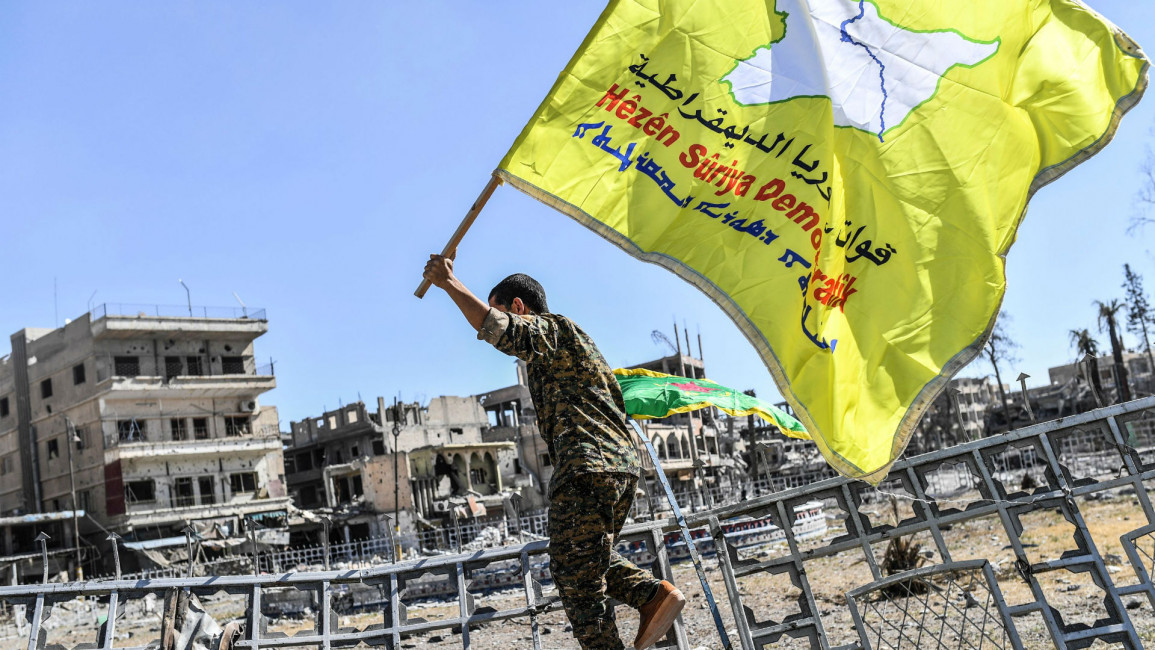
Many Kurds consider the threat posed by Damascus' new government to be existential. [Getty]
It is a common sentiment in some parts of Syria, from Alawite areas on the coast to Druze-majority Suweida, pointing to a broader disaffection among many minority communities as Damascus seeks to centralise authority by force under the rhetoric of national unity.
This pattern of using repeated coercion to bind the country together, without providing an effective sense of justice, has been criticised by many for papering over the cracks that ripped the country apart over a decade of civil war.
Damascus may be able to extend its authority to the northeastern borders of Syria, but that doesn't necessarily mean it will be able to bring the four corners of the country into the centralised authority’s fold.
Suweida, for example, remains an open wound, while on the coast, widespread dissatisfaction amongst Alawites triggered protests last December, with calls for federalism amid an ongoing low-level insurgency.
Even if the government does win a war against the SDF, it doesn’t necessarily mean the bloodshed will stop in Syria’s northeast.
Cian Ward is a journalist based in Damascus, covering conflict, migration, and humanitarian issues
It is a common sentiment in some parts of Syria, from Alawite areas on the coast to Druze-majority Suweida, pointing to a broader disaffection among many minority communities as Damascus seeks to centralise authority by force under the rhetoric of national unity.
This pattern of using repeated coercion to bind the country together, without providing an effective sense of justice, has been criticised by many for papering over the cracks that ripped the country apart over a decade of civil war.
Damascus may be able to extend its authority to the northeastern borders of Syria, but that doesn't necessarily mean it will be able to bring the four corners of the country into the centralised authority’s fold.
Suweida, for example, remains an open wound, while on the coast, widespread dissatisfaction amongst Alawites triggered protests last December, with calls for federalism amid an ongoing low-level insurgency.
Even if the government does win a war against the SDF, it doesn’t necessarily mean the bloodshed will stop in Syria’s northeast.
Cian Ward is a journalist based in Damascus, covering conflict, migration, and humanitarian issues
Follow him on X: @CP__Ward
Supplies running out at Syria’s Al-Hol camp as clashes block aid deliveries

FILE PHOTO: Detainees gather at al-Hol camp after the Syrian government took control of it following the withdrawal of Syrian Democratic Forces (SDF), in Hasaka, Syria, January 21, 2026. (Reuters)
AP
January 31, 2026
DAMASCUS: An international humanitarian organization has warned that supplies are running out at a camp in northeast Syria housing thousands of people linked to the Daesh group, as the country’s government fights to establish control over an area formerly controlled by Kurdish fighters.
The late Friday statement by Save the Children came a week after government forces captured Al-Hol camp, which is home to more than 24,000 people, mostly children and women, including many wives or widows of Daesh members.
The capture of the camp came after intense fighting earlier this month between government forces and members of the Kurdish-led and US-backed Syrian Democratic Forces during which forces loyal to interim President Ahmad Al-Sharaa captured wide areas in eastern and northeastern Syria.
The SDF signed a deal to end the fighting after suffering major defeats, but sporadic clashes between it and the government have continued.
Save the Children said that “critical supplies in Al-Hol camp are running dangerously low” as clashes are blocking the safe delivery of humanitarian aid.
It added that last week’s clashes around the camp forced aid agencies to temporarily suspend regular operations at Al-Hol. It added that the main road leading to the camp remains unsafe, which is preventing humanitarian workers from delivering food and water or running basic services for children and families.
“The situation in Al-Hol camp is rapidly deteriorating as food, water and medicines run dangerously low,” said Rasha Muhrez, Save the Children Syria country director. “If humanitarian organizations are unable to resume work, children will face still more risks in the camp, which was already extremely dangerous for them before this latest escalation.”
Muhrez added that all parties to the conflict must ensure a safe humanitarian corridor to Al-Hol so basic services can resume and children can be protected. “Lives depend on it,” she said.
The SDF announced a new agreement with the central government on Friday, aiming to stabilize a ceasefire that ended weeks of fighting and lay out steps toward integrating the US-backed force into the army and police forces.
FILE PHOTO: Detainees gather at al-Hol camp after the Syrian government took control of it following the withdrawal of Syrian Democratic Forces (SDF), in Hasaka, Syria, January 21, 2026. (Reuters)
AP
January 31, 2026
DAMASCUS: An international humanitarian organization has warned that supplies are running out at a camp in northeast Syria housing thousands of people linked to the Daesh group, as the country’s government fights to establish control over an area formerly controlled by Kurdish fighters.
The late Friday statement by Save the Children came a week after government forces captured Al-Hol camp, which is home to more than 24,000 people, mostly children and women, including many wives or widows of Daesh members.
The capture of the camp came after intense fighting earlier this month between government forces and members of the Kurdish-led and US-backed Syrian Democratic Forces during which forces loyal to interim President Ahmad Al-Sharaa captured wide areas in eastern and northeastern Syria.
The SDF signed a deal to end the fighting after suffering major defeats, but sporadic clashes between it and the government have continued.
Save the Children said that “critical supplies in Al-Hol camp are running dangerously low” as clashes are blocking the safe delivery of humanitarian aid.
It added that last week’s clashes around the camp forced aid agencies to temporarily suspend regular operations at Al-Hol. It added that the main road leading to the camp remains unsafe, which is preventing humanitarian workers from delivering food and water or running basic services for children and families.
“The situation in Al-Hol camp is rapidly deteriorating as food, water and medicines run dangerously low,” said Rasha Muhrez, Save the Children Syria country director. “If humanitarian organizations are unable to resume work, children will face still more risks in the camp, which was already extremely dangerous for them before this latest escalation.”
Muhrez added that all parties to the conflict must ensure a safe humanitarian corridor to Al-Hol so basic services can resume and children can be protected. “Lives depend on it,” she said.
The SDF announced a new agreement with the central government on Friday, aiming to stabilize a ceasefire that ended weeks of fighting and lay out steps toward integrating the US-backed force into the army and police forces.
Deal reached with Kurdish-led SDF is a ‘victory for all Syrians,’ Syrian ambassador to UN tells Arab News
Ephrem Kossaify
February 01, 2026
ARAB NEWS
Ephrem Kossaify
February 01, 2026
ARAB NEWS
SAUDI ARABIA
Ibrahim Olabi says ceasefire and phased integration agreement shows that Kurdish-led SDF’s “best success story” lies within the Syrian government
Lauds Saudi Arabia’s “consistent diplomatic role in encouraging de-escalation and supporting Syria’s reintegration into the regional and international system”
NEW YORK: A landmark ceasefire and phased integration agreement between the Syrian government and the Kurdish-led Syrian Democratic Forces was announced on Friday, a deal senior Syrian officials described as a major step toward national unity and stability following years of conflict and stalled negotiations.
Speaking with Arab News in New York, Ibrahim Olabi, the Syrian Arab Republic’s permanent representative to the UN, described the agreement as not only a military and administrative achievement but a symbolic victory for all Syrians, one that reflects the country’s collective aspirations for peace, reconstruction and international cooperation.
He said that stability, equitable resource distribution and internal security underpin the deal’s significance. He also highlighted broad international support and specific engagement from countries such as Saudi Arabia and the US.
He said that Saudi Arabia had played a consistent diplomatic role in encouraging de-escalation and supporting Syria’s reintegration into the regional and international system, including through calls to lift sanctions and back state institutions.


 Detainees gather at al-Hol camp in Hasaka, Syria, on January 21, 2026, after the Syrian government took control of it following the withdrawal of Syrian Democratic Forces. (REUTERS)
Olabi said that the current deal differed because it advanced those earlier understandings into a more detailed, time-bound and technically defined agreement, shaped by new political and military realities and reinforced by international and UN backing
“We believe this agreement is the next step from the initial agreement. It has more technical details, more timeframes, and is more nuanced than the framework agreement signed a couple of days ago. International powers and the UN have welcomed it, and the new political and military realities all contribute to its success,” he said.
Saudi Arabia has welcomed the ceasefire and integration deal, lauding it as a step toward peace, national unity and stability. A Ministry of Foreign Affairs statement reaffirmed the Kingdom’s support for Syria’s sovereignty, unity and territorial integrity. It said that the deal could help to advance security and stability, ease humanitarian suffering, and create conditions conducive to reconstruction and the return of displaced Syrians, while emphasizing the importance of a Syrian-led political process.
Olabi characterized Saudi support as consistent with the Kingdom’s long-standing backing for a sovereign, unified Syria.


Ibrahim Olabi says ceasefire and phased integration agreement shows that Kurdish-led SDF’s “best success story” lies within the Syrian government
Lauds Saudi Arabia’s “consistent diplomatic role in encouraging de-escalation and supporting Syria’s reintegration into the regional and international system”
NEW YORK: A landmark ceasefire and phased integration agreement between the Syrian government and the Kurdish-led Syrian Democratic Forces was announced on Friday, a deal senior Syrian officials described as a major step toward national unity and stability following years of conflict and stalled negotiations.
Speaking with Arab News in New York, Ibrahim Olabi, the Syrian Arab Republic’s permanent representative to the UN, described the agreement as not only a military and administrative achievement but a symbolic victory for all Syrians, one that reflects the country’s collective aspirations for peace, reconstruction and international cooperation.
He said that stability, equitable resource distribution and internal security underpin the deal’s significance. He also highlighted broad international support and specific engagement from countries such as Saudi Arabia and the US.
He said that Saudi Arabia had played a consistent diplomatic role in encouraging de-escalation and supporting Syria’s reintegration into the regional and international system, including through calls to lift sanctions and back state institutions.
The Syrian Arab Republic's national flag. (AFP)
As for Washington, Olabi said, it had come to view a unified Syrian state as serving US and regional interests, and saw integration within the Syrian government as the SDF’s most viable long-term protection.
“We are viewing the milestone that was achieved today as a success for all Syrians and for Syria. All Syrians benefit from stability, from having security apparatus in their towns. All Syrians benefit from resources being under the control of the state because they can be equitably distributed. The same thing goes for borders. All Syrians benefit when there is calm, domestically, which then also has regional implications and reconstruction implications,” he said.
“So, we view it as a success, as a victory for all Syrians.”
He added that the agreement built on existing momentum generated by earlier understandings and international endorsements, as well as shifting political and military realities, creating conditions that made this phase more likely to hold.
The core of the Jan. 30 agreement is a phased integration of SDF military units and administrative bodies into Syrian state structures, beginning with security arrangements and progressing toward full institutional incorporation.
As for Washington, Olabi said, it had come to view a unified Syrian state as serving US and regional interests, and saw integration within the Syrian government as the SDF’s most viable long-term protection.
“We are viewing the milestone that was achieved today as a success for all Syrians and for Syria. All Syrians benefit from stability, from having security apparatus in their towns. All Syrians benefit from resources being under the control of the state because they can be equitably distributed. The same thing goes for borders. All Syrians benefit when there is calm, domestically, which then also has regional implications and reconstruction implications,” he said.
“So, we view it as a success, as a victory for all Syrians.”
He added that the agreement built on existing momentum generated by earlier understandings and international endorsements, as well as shifting political and military realities, creating conditions that made this phase more likely to hold.
The core of the Jan. 30 agreement is a phased integration of SDF military units and administrative bodies into Syrian state structures, beginning with security arrangements and progressing toward full institutional incorporation.
Soldiers stand guard as Syrian government forces make their way to the city of Hasakeh in northeastern Syria on January 20, 2026. (AFP)
This model, Olabi said, was intended to avoid abrupt shifts that could destabilize fragile local dynamics.
“The phased integration approach falls within the wider theme that the Syrian government has always been open to proposals, to ideas, to debate whatever really works in having a united, strong, stable Syria,” he said.
“It starts with the security component, then it goes to the administrative component, then it goes to state institutions. We thought one month would be a reasonable timeframe. The idea is not to rush things, but also not for things to take too long, all Syrians are interested in moving ahead to the future, putting the past 14 years of conflict and factionalism behind them.”
Under the agreement, SDF fighters will begin joining national security units and brigades, and Interior Ministry forces will be deployed in key Kurdish-held cities including Hasakah and Qamishli, where the Syrian government’s presence had been limited for years.
A new military formation, including three brigades drawn from SDF elements, will be part of the broader Syrian army structure, with Kurdish civil institutions integrated into the state’s administrative framework.
This model, Olabi said, was intended to avoid abrupt shifts that could destabilize fragile local dynamics.
“The phased integration approach falls within the wider theme that the Syrian government has always been open to proposals, to ideas, to debate whatever really works in having a united, strong, stable Syria,” he said.
“It starts with the security component, then it goes to the administrative component, then it goes to state institutions. We thought one month would be a reasonable timeframe. The idea is not to rush things, but also not for things to take too long, all Syrians are interested in moving ahead to the future, putting the past 14 years of conflict and factionalism behind them.”
Under the agreement, SDF fighters will begin joining national security units and brigades, and Interior Ministry forces will be deployed in key Kurdish-held cities including Hasakah and Qamishli, where the Syrian government’s presence had been limited for years.
A new military formation, including three brigades drawn from SDF elements, will be part of the broader Syrian army structure, with Kurdish civil institutions integrated into the state’s administrative framework.
Members of the Kurdish-led Syrian Democratic Forces (SDF) queue to settle their status with Syrian government in Raqqa, Syria, on January 27, 2026. (REUTERS)
Olabi stressed that the accord gave time for orderly integration, not immediate absorption, and that this timeframe was agreed in consultation with the SDF to promote confidence and minimize friction.
Addressing concerns over the sincerity of guarantees for SDF members against reprisals or loss of status, Olabi pointed to the government’s longstanding overtures and previous interactions with the Kurdish leadership, and to the government’s conduct throughout negotiations as evidence of its approach.
“(SDF chief) Mazloum Abdi was welcomed in Damascus as a hero, not as a villain or as an enemy. The SDF as a whole were always welcomed in Damascus, and we were always engaging with them and always trying to find ways. They have seen that we have no interest in reprisals, no interest in the situation deteriorating. We would like to move forward. International partners have also noticed that the Syrian government has no interest in escalating a situation,” he said.
BIO
Ibrahim Abdulmalik Olabi was appointed the permanent representative of the Syrian Arab Republic to the UN on Aug. 19 last year. Before that, he served as special adviser on international legal affairs to Syria’s Ministry of Foreign Affairs and Expatriates from Feb. 2025. He holds a master’s in public policy from the University of Oxford, an LLM in security and international law, and an LLB from the University of Manchester.
On the question of dispute resolution, Olabi made clear that all disputes would be addressed internally, through dialogue among Syrian factions, keeping the process fully within the country’s control.
“Any sort of disputes that may arise are things that we have to resolve together. The door has always been open. We didn’t want to resort to any military solutions, and the same will apply again. People have seen that we went into not one agreement, but four or five different versions of it. There is no judge or jury or adversarial group — it’s Syrian factions coming together to build the Syria they want.”
The agreement follows months of intense clashes between Syrian government forces and Kurdish armed groups in Aleppo’s Sheikh Maqsoud and Ashrafiyah districts in December 2025 and January 2026. The fighting left dozens of fighters dead on both sides and forced thousands of civilians to flee their homes. Several ceasefire agreements collapsed before this latest deal, underscoring the fragility of trust and the risks of renewed escalation.
Olabi stressed that the accord gave time for orderly integration, not immediate absorption, and that this timeframe was agreed in consultation with the SDF to promote confidence and minimize friction.
Addressing concerns over the sincerity of guarantees for SDF members against reprisals or loss of status, Olabi pointed to the government’s longstanding overtures and previous interactions with the Kurdish leadership, and to the government’s conduct throughout negotiations as evidence of its approach.
“(SDF chief) Mazloum Abdi was welcomed in Damascus as a hero, not as a villain or as an enemy. The SDF as a whole were always welcomed in Damascus, and we were always engaging with them and always trying to find ways. They have seen that we have no interest in reprisals, no interest in the situation deteriorating. We would like to move forward. International partners have also noticed that the Syrian government has no interest in escalating a situation,” he said.
BIO
Ibrahim Abdulmalik Olabi was appointed the permanent representative of the Syrian Arab Republic to the UN on Aug. 19 last year. Before that, he served as special adviser on international legal affairs to Syria’s Ministry of Foreign Affairs and Expatriates from Feb. 2025. He holds a master’s in public policy from the University of Oxford, an LLM in security and international law, and an LLB from the University of Manchester.
On the question of dispute resolution, Olabi made clear that all disputes would be addressed internally, through dialogue among Syrian factions, keeping the process fully within the country’s control.
“Any sort of disputes that may arise are things that we have to resolve together. The door has always been open. We didn’t want to resort to any military solutions, and the same will apply again. People have seen that we went into not one agreement, but four or five different versions of it. There is no judge or jury or adversarial group — it’s Syrian factions coming together to build the Syria they want.”
The agreement follows months of intense clashes between Syrian government forces and Kurdish armed groups in Aleppo’s Sheikh Maqsoud and Ashrafiyah districts in December 2025 and January 2026. The fighting left dozens of fighters dead on both sides and forced thousands of civilians to flee their homes. Several ceasefire agreements collapsed before this latest deal, underscoring the fragility of trust and the risks of renewed escalation.
Detainees gather at al-Hol camp in Hasaka, Syria, on January 21, 2026, after the Syrian government took control of it following the withdrawal of Syrian Democratic Forces. (REUTERS)Olabi said that the current deal differed because it advanced those earlier understandings into a more detailed, time-bound and technically defined agreement, shaped by new political and military realities and reinforced by international and UN backing
“We believe this agreement is the next step from the initial agreement. It has more technical details, more timeframes, and is more nuanced than the framework agreement signed a couple of days ago. International powers and the UN have welcomed it, and the new political and military realities all contribute to its success,” he said.
Saudi Arabia has welcomed the ceasefire and integration deal, lauding it as a step toward peace, national unity and stability. A Ministry of Foreign Affairs statement reaffirmed the Kingdom’s support for Syria’s sovereignty, unity and territorial integrity. It said that the deal could help to advance security and stability, ease humanitarian suffering, and create conditions conducive to reconstruction and the return of displaced Syrians, while emphasizing the importance of a Syrian-led political process.
Olabi characterized Saudi support as consistent with the Kingdom’s long-standing backing for a sovereign, unified Syria.
Two women walk among tents at Roj camp, one of the detention facilities holding thousands of Daesh group members and their families, in the al-Malikiyah area of northeastern Syria, on Jan. 29, 2026. (AP)
“The Kingdom of Saudi Arabia has been a key partner and key ally of the Syrian people, first of all, for many, many, many years and of the new Syrian government and the new Syrian leadership. We’ve seen that since day one. We’ve seen that when President Trump met President Ahmad Al-Sharaa; it was the first time that happened in Riyadh,” he said.
“We’ve seen their support for calling for the ending of sanctions, the institutional support that they’re giving in terms of working with us to build our capacity so that we have a stable Syria. Crown Prince Mohammed bin Salman has been a key ally, and the fact that they are welcoming such a statement is in line with the policies that they’ve had in supporting a united, strong and stable Syria,” he said.
Tom Barrack, the US ambassador to Turkiye and special envoy for Syria, welcomed the agreement in a post on X on Friday. He described it “as a profound and historic milestone in Syria’s journey toward national reconciliation unity and enduring stability,” adding that it affirmed “the principle that Syria’s strength emerges from embracing diversity and addressing the legitimate aspirations of all its people.”
Olabi said that the US administration recognized the mutual benefits of a stable, unified Syria.
“The United States, under President Trump and his envoy to Syria, Ambassador Tom Barrack, have seen that it is in US interests to have a stable, unified Syria. They have also seen that the SDF’s best protection, best success story is within the Syrian government,” he said.
Barrack noted that this moment was of “particular significance” for the Kurdish people, whose “extraordinary sacrifices” and “steadfast resilience” have been crucial in defending Syria and protecting vulnerable populations.
The recent Presidential Decree No. 13 represents a “transformative stride” toward equality, restoring citizenship, recognizing Kurdish as a “national language,” and correcting “longstanding injustices” to affirm the Kurds’ place in a secure, inclusive Syria.
Earlier this month, President Al-Sharaa issued a decree formally recognizing and protecting Kurdish cultural and civil rights, including language and representation, as part of broader efforts to address longstanding grievances. The move was presented by the Syrian government as a state decision independent of ongoing negotiations with armed groups.
Olabi said: “That question should be separated from the rights of Kurds, because for us, the Kurds are a key component that live all across Syria — in Damascus, in Aleppo, in Afrin, in Idlib and elsewhere. As you know, the decree granting Kurdish rights was issued independent of the negotiation. It wasn’t an outcome of the negotiation, it wasn’t during the negotiation.”
Israel has continued military operations inside Syria over the past year following the removal of Bashar Assad from power, carrying out repeated airstrikes and ground incursions that Al-Sharaa’s government says have violated its sovereignty and killed Syrian civilians, even as it has signaled its openness to diplomatic engagement.
“The Kingdom of Saudi Arabia has been a key partner and key ally of the Syrian people, first of all, for many, many, many years and of the new Syrian government and the new Syrian leadership. We’ve seen that since day one. We’ve seen that when President Trump met President Ahmad Al-Sharaa; it was the first time that happened in Riyadh,” he said.
“We’ve seen their support for calling for the ending of sanctions, the institutional support that they’re giving in terms of working with us to build our capacity so that we have a stable Syria. Crown Prince Mohammed bin Salman has been a key ally, and the fact that they are welcoming such a statement is in line with the policies that they’ve had in supporting a united, strong and stable Syria,” he said.
Tom Barrack, the US ambassador to Turkiye and special envoy for Syria, welcomed the agreement in a post on X on Friday. He described it “as a profound and historic milestone in Syria’s journey toward national reconciliation unity and enduring stability,” adding that it affirmed “the principle that Syria’s strength emerges from embracing diversity and addressing the legitimate aspirations of all its people.”
Olabi said that the US administration recognized the mutual benefits of a stable, unified Syria.
“The United States, under President Trump and his envoy to Syria, Ambassador Tom Barrack, have seen that it is in US interests to have a stable, unified Syria. They have also seen that the SDF’s best protection, best success story is within the Syrian government,” he said.
Barrack noted that this moment was of “particular significance” for the Kurdish people, whose “extraordinary sacrifices” and “steadfast resilience” have been crucial in defending Syria and protecting vulnerable populations.
The recent Presidential Decree No. 13 represents a “transformative stride” toward equality, restoring citizenship, recognizing Kurdish as a “national language,” and correcting “longstanding injustices” to affirm the Kurds’ place in a secure, inclusive Syria.
Earlier this month, President Al-Sharaa issued a decree formally recognizing and protecting Kurdish cultural and civil rights, including language and representation, as part of broader efforts to address longstanding grievances. The move was presented by the Syrian government as a state decision independent of ongoing negotiations with armed groups.
Olabi said: “That question should be separated from the rights of Kurds, because for us, the Kurds are a key component that live all across Syria — in Damascus, in Aleppo, in Afrin, in Idlib and elsewhere. As you know, the decree granting Kurdish rights was issued independent of the negotiation. It wasn’t an outcome of the negotiation, it wasn’t during the negotiation.”
Israel has continued military operations inside Syria over the past year following the removal of Bashar Assad from power, carrying out repeated airstrikes and ground incursions that Al-Sharaa’s government says have violated its sovereignty and killed Syrian civilians, even as it has signaled its openness to diplomatic engagement.
Members of the Kurdish-led Syrian Democratic Forces (SDF) queue to settle their status with Syrian government in Raqqa, Syria, on January 27, 2026. (REUTERS)
labi referred to a December 2025 tweet by President Trump after an Israeli incursion that killed 13 Syrians. “The Syrian government has said since day one that we will uphold the 1974 agreement between Syria and Israel, an agreement that withstood the test of time for over 50 years. We even engaged publicly and openly with Israel through US mediation,” he said.
“But Israel’s actions have been against Syrian interests. Syria is not going to be a threat to anyone. We are always open to diplomacy and constructive engagement. If there are legitimate security concerns, we can address them. But land grabs and destabilization are something we cannot tolerate. No government in Syria can give away Syrian rights.”
On how trust can be rebuilt after years of factional fighting, Olabi emphasized a distinction between the SDF as an armed faction and Syria’s Kurdish population at large, who have endured decades of discrimination. “The Kurds have seen our discipline in operations, the decree protecting their rights, and our openness to engage. That is why many chose to move from Aleppo to Afrin,” he said.
The Syrian government on Friday declared the Al-Hol and Roj camps northeast Syria, which house families linked to former Daesh fighters, as formal security zones. Security at the camp collapsed following the withdrawal of SDF amid intense fighting, with reports of escape by possibly 1,500 Daesh-linked individuals.
 A boy eats bread as displaced Syrians take shelter in a mosque after clashes between the Syrian Democratic Forces and the Syrian army, in Qamishli, Syria, on January 29, 2026. (REUTERS)
Humanitarian aid is now blocked. The camp holds roughly 24,000 people — mostly women and children — including about 14,500 Syrians, 3,000 Iraqis and 6,500 foreign nationals.
“The Syrian government inherited a very complicated situation at Al-Hol, with many families of former Daesh fighters. We have taken responsibility for both security and humanitarian management. We are also urging states whose nationals are detained there to take responsibility. The UNHCR and other UN agencies are engaged, and we hope to address this in a humane, just, and secure way over the coming weeks,” he said.
As Syria and the SDF embark on this integration phase, analysts caution that while the ceasefire provides a framework, deep-seated distrust, unresolved grievances and external pressures could destabilize progress.
Olabi, however, maintained that the focus remained on Syrian autonomy and the state’s responsibility to protect all citizens. “People have seen that we have no interest in reprisals. We would like to move forward,” he said.

labi referred to a December 2025 tweet by President Trump after an Israeli incursion that killed 13 Syrians. “The Syrian government has said since day one that we will uphold the 1974 agreement between Syria and Israel, an agreement that withstood the test of time for over 50 years. We even engaged publicly and openly with Israel through US mediation,” he said.
“But Israel’s actions have been against Syrian interests. Syria is not going to be a threat to anyone. We are always open to diplomacy and constructive engagement. If there are legitimate security concerns, we can address them. But land grabs and destabilization are something we cannot tolerate. No government in Syria can give away Syrian rights.”
On how trust can be rebuilt after years of factional fighting, Olabi emphasized a distinction between the SDF as an armed faction and Syria’s Kurdish population at large, who have endured decades of discrimination. “The Kurds have seen our discipline in operations, the decree protecting their rights, and our openness to engage. That is why many chose to move from Aleppo to Afrin,” he said.
The Syrian government on Friday declared the Al-Hol and Roj camps northeast Syria, which house families linked to former Daesh fighters, as formal security zones. Security at the camp collapsed following the withdrawal of SDF amid intense fighting, with reports of escape by possibly 1,500 Daesh-linked individuals.
A boy eats bread as displaced Syrians take shelter in a mosque after clashes between the Syrian Democratic Forces and the Syrian army, in Qamishli, Syria, on January 29, 2026. (REUTERS)Humanitarian aid is now blocked. The camp holds roughly 24,000 people — mostly women and children — including about 14,500 Syrians, 3,000 Iraqis and 6,500 foreign nationals.
“The Syrian government inherited a very complicated situation at Al-Hol, with many families of former Daesh fighters. We have taken responsibility for both security and humanitarian management. We are also urging states whose nationals are detained there to take responsibility. The UNHCR and other UN agencies are engaged, and we hope to address this in a humane, just, and secure way over the coming weeks,” he said.
As Syria and the SDF embark on this integration phase, analysts caution that while the ceasefire provides a framework, deep-seated distrust, unresolved grievances and external pressures could destabilize progress.
Olabi, however, maintained that the focus remained on Syrian autonomy and the state’s responsibility to protect all citizens. “People have seen that we have no interest in reprisals. We would like to move forward,” he said.





 A pro-Palestinian activist is arrested during a demonstration in London earlier this month [Getty]