Wednesday, February 11, 2026


France demands investigation into diplomat cited in Epstein files

French Foreign Minister Jean-Noël Barrot has demanded an investigation into diplomat Fabrice Aidan following the revelation that the foreign affairs secretary shared a long email correspondence with late sex offender and financier Jeffrey Epstein. French media reported that Aidan had resigned from his position at the United Nations in 2013 after having been caught visiting child sex abuse material websites.


Issued on: 11/02/2026 
By: FRANCE 24
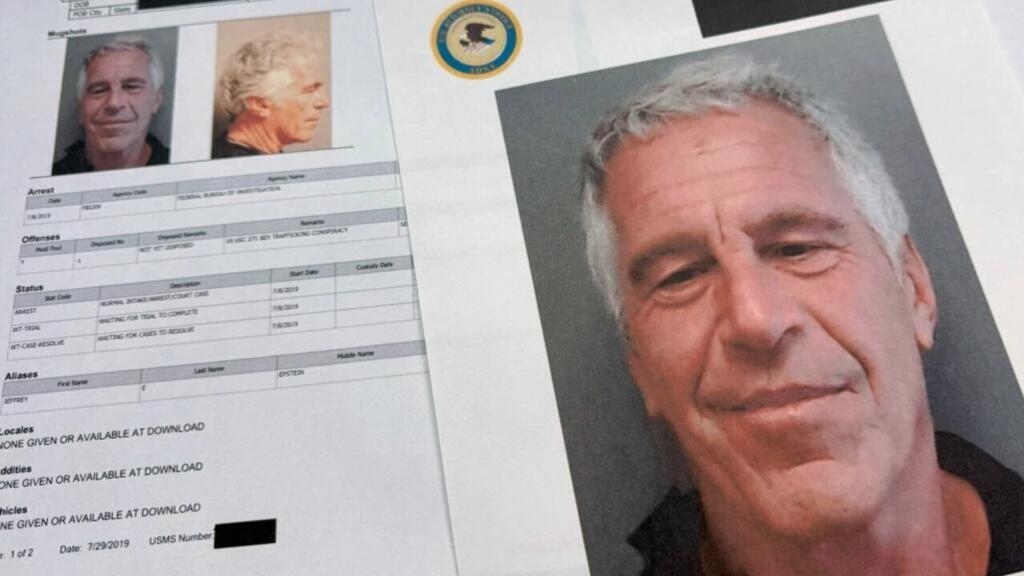
Documents included in the publication of files connected to Jeffrey Epstein by the US Department of Justice, photographed on January 2, 2026. © Jon Elswick, AP

France's Foreign Minister Jean-Noël Barrot has requested a probe after the name of a French diplomat on leave appeared in numerous emails to convicted sex offender Jeffrey Epstein.

"I was appalled," Barrot said on Wednesday.

In an X post late on Tuesday, he said he was referring allegations against Fabrice Aidan to the public prosecutor, and launching an internal inquiry.

The ministry described Aidan as a "principal foreign affairs secretary on leave for personal reasons and holding positions in the private sector".


A mere mention in released files from the investigation into the disgraced New York financier, who died in prison in 2019 while charged with sex trafficking underage girls, does not imply wrongdoing.

But French media, after unearthing his name in the files, reported he had shared email correspondence with Epstein from 2010 to 2017.

Investigative website Mediapart late Tuesday reported that the FBI had flagged Aidan as having consulted child sexual abuse websites while he was working at the New York-based United Nations from 2006 and 2013, leading to an internal probe and his resignation.

Aidan was during that time adviser to Norway's Terje Rod-Larsen, an adviser to the UN secretary general. Norwegian police said on Monday they were investigating Rod-Larsen over his ties to Epstein.

Mediapart also reported that Aidan sent UN documents and reports to Epstein.


Epstein files special: Revelations, Redactions & Ramifications

THE WORLD THIS WEEK © FRANCE 24
47:54


Aidan could not be immediately contacted for comment. He appeared to have deleted his Linkedin professional networking profile as of Wednesday morning.

After the UN headquarters in New York, Aidan then went on to work for the UN cultural agency UNESCO.

Energy group Engie, for whom he had been working more recently, told AFP it had let him go.

"In light of the information brought to our attention and reported in certain media, which would concern a period prior to his joining the group, Engie has decided to relieve Fabrice Aidan from his duties," it said.

The fallout of the latest Epstein files released by the US Department of Justice has led to former minister Jack Lang resigning from his position as the head of a top cultural body called the Arab World Institute.

He has however denied any wrongdoing, saying he was "shocked" that his name appeared in the statutes of an offshore company that Epstein founded in 2016.

His daughter Caroline, who allegedly owned half the shares in the company, has resigned from two positions.

(FRANCE 24 with AFP)


US Commerce Secretary admits Epstein island lunch as pressure mounts to resign


US Commerce Secretary Howard Lutnick on Tuesday acknowledged having lunch on Jeffrey Epstein’s private island in 2012, as newly released records intensified scrutiny of his past ties to the convicted sex offender and fuelled calls for his resignation.


Issued on: 11/02/2026 -
By: FRANCE 24
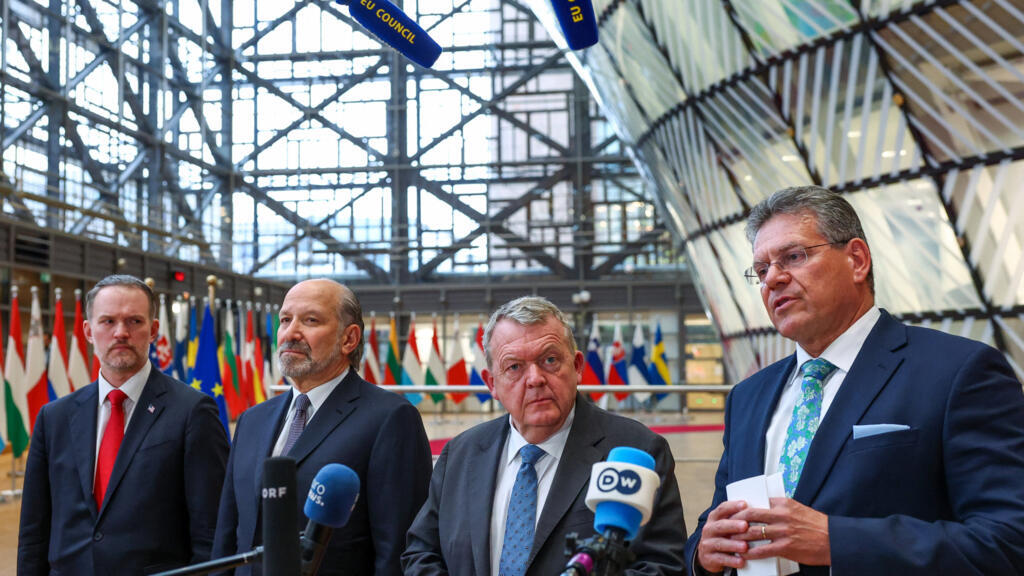

U.S. Commerce Secretary Howard Lutnick, U.S. Trade Representative Jamieson Greer, Denmark's Foreign Minister Lars Loekke Rasmussen and EU Trade Commissioner Maros Sefcovic speak to the media in Brussels, Belgium, November 24, 2025. © Piroschka Van De Wouw, Reuters

Facing growing calls for his resignation, US Commerce Secretary Howard Lutnick admitted Tuesday to having lunch on Jeffrey Epstein’s private island in 2012, but strenuously denied any closer relationship with the convicted sex offender.

Lutnick’s ties to Epstein have come under intense scrutiny after email exchanges included in newly released files undermined his earlier insistence that he had cut all links with the late financier back in 2005.

So far, President Donald Trump’s administration has stood by Lutnick, with White House Press Secretary Karoline Leavitt saying the president “fully supports” him.

She added that he “remains a very important member” of Trump’s team.


Epstein, a convicted sex offender who had ties to top business executives, politicians, celebrities and academics, was found dead in his New York jail cell in 2019 while awaiting trial for sex trafficking minor girls.

In a podcast last year, Lutnick recounted moving in next door to Epstein in 2005 and receiving a house tour that left him disturbed. He and his wife decided that he would “never be in the room with that disgusting person, ever again”.


© France 24
01:52


“So I was never in the room with him socially, for business or even philanthropy,” he said.

But records have emerged showing Lutnick’s plans in 2012 to meet Epstein for lunch in Little Saint James, notoriously known as “Epstein Island”.

“We had lunch on the island, that is true, for an hour,” Lutnick told a Senate committee hearing.

But he stressed that he was with his wife, children and nannies.

“We were on family vacation,” he said.

Asked if he saw anything untoward, Lutnick maintained that besides his family and that of another couple who were present, he only saw staff who worked for Epstein on the island.

High-profile people have come under scrutiny for visits to Little Saint James, the private redoubt in the US Virgin Islands where prosecutors alleged Epstein trafficked underage girls for sex.
No ‘relationship’

Lutnick stressed to the Senate Appropriations Committee on Tuesday: “Over a 14-year period, I did not have any relationship with him. I barely had anything to do with that person.”

The billionaire was referring to the period starting in 2005 when he moved to a New York home where Epstein was his neighbour. He said that he met Epstein when they were both in New York.

He has come under fire from US lawmakers, however.

Democratic Senator Adam Schiff said Monday that “Lutnick has no business being our Commerce Secretary, and he should resign immediately”.

He added that Lutnick’s earlier denial of dealings with Epstein raises “serious concerns about his judgement and ethics”.

On Sunday, Republican lawmaker Thomas Massie also told CNN the commerce secretary “should just resign”, citing similar resignations in Great Britain.

And Robert Garcia, the top Democrat on the House oversight committee, charged in a social media post that Lutnick “has been lying about his relationship with Epstein”.
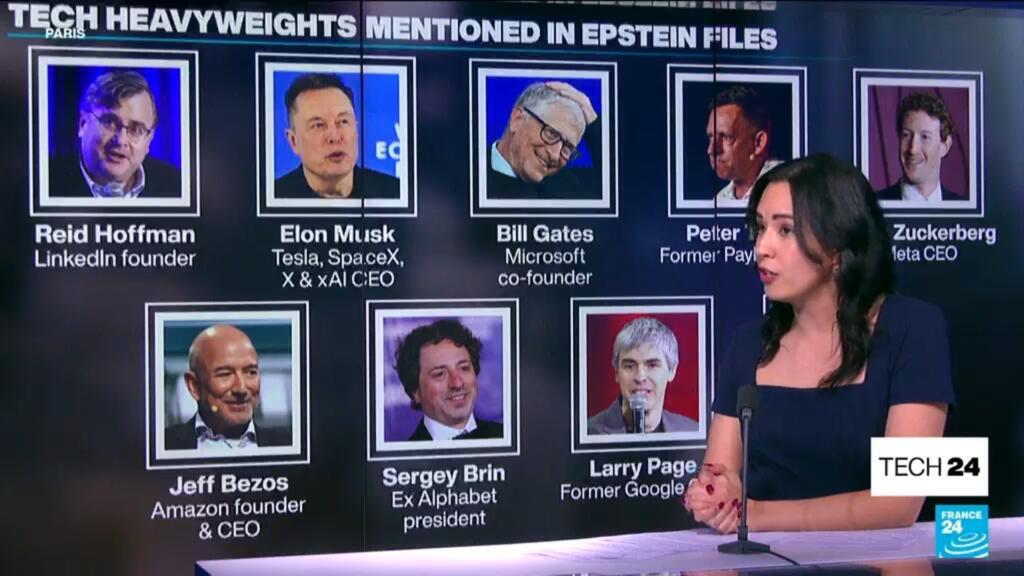

Tech 24 © France 24
05:27


“He said he had no interactions with Epstein after 2005, yet we now know they were in business together,” Garcia said.

Released documents indicated the men had become investors in a firm some time after the island visit, although it is unclear if they personally engaged over the deal. They also appear to have communicated through assistants on other occasions.

Lutnick denied Tuesday that he had dinner in Epstein’s New York City home in 2011, although he acknowledged that the documents indicated a planned meeting with Epstein in May that year.

The commerce chief was also questioned about documents that suggested Epstein had an interest in meeting his nanny, but said this “had nothing to do with me”.

“I have nothing to hide, absolutely nothing,” Lutnick said.

Lutnick – a close ally of Trump’s – served as chief executive of financial services firm Cantor Fitzgerald before becoming US commerce secretary last year.

(FRANCE 24 with AFP)


Democrats introduce 'Virginia's law' named for Epstein accuser to end shield for sex traffickers

Victims of convicted sex trafficker Jeffrey Epstein and Congressional Democrats introduced a new bill on Tuesday which would eliminate the statute of limitations for adult victims and would broaden victims' legal recourse.


Issued on: 10/02/2026 
By: FRANCE 24
Video by:Monte FRANCIS
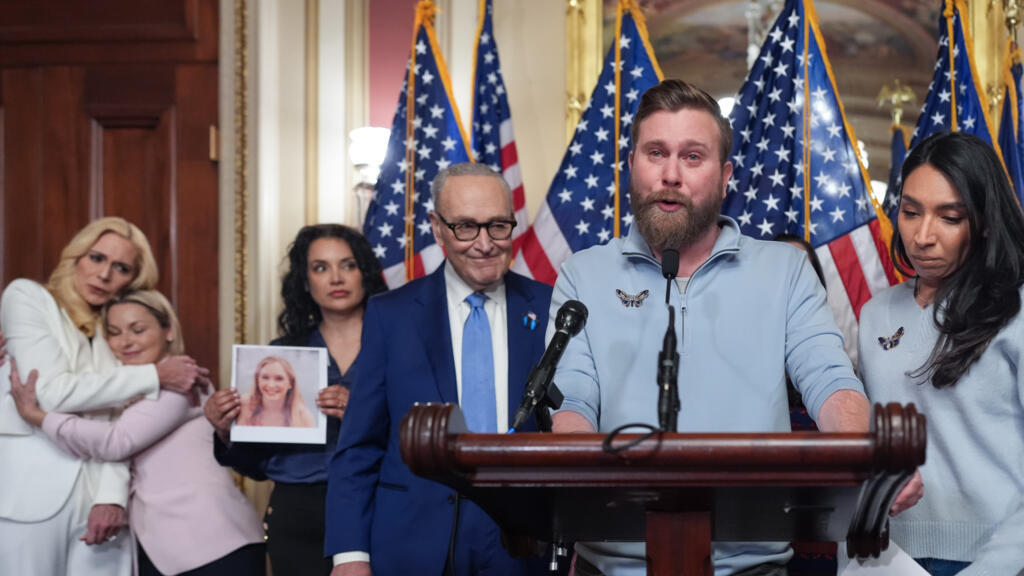
Sky Roberts, brother of Virginia Giuffre, speaks as survivors of Jeffrey Epstein's abuse and US lawmakers gather to introduce Virginia's Law at the Capitol in Washington, February 10, 2026. © J. Scott Applewhite, AP
01:50


Congressional ​Democrats introduced legislation on Tuesday that they said would eliminate the statute of limitations that has shielded sex ⁠traffickers such as the late financier Jeffrey Epstein.

Senate Democratic Leader Chuck Schumer and Representative Teresa Leger Fernandez announced the proposal alongside Epstein victims and Virginia Giuffre's family. The proposal – Virginia's Law – is named after Giuffre, ​one of Epstein's most prominent accusers, who died by suicide last year.

The bill's fate ‍in the Senate and House of Representatives, which are both controlled by Republicans, is unclear.

However, a bipartisan effort was successful last ​year to compel the Department of Justice to release all unclassified files in its Epstein ​investigation.


Epstein files: US Justice Dept has been 'destroyed from within', former prosecutor says

SPOTLIGHT © FRANCE 24
11:15

"Virginia's dream was to inspire and empower survivors to come forward in a world that too often turns away from abuse and pushes it into the shadows. She wanted to bring light," said Sky Roberts, Giuffre's brother.

A teary-eyed Roberts, speaking at a press conference in the US Capitol, was asked about a photograph that has been made public showing former UK prince Andrew Mountbatten-Windsor with his arm around Giuffre.

WATCH MORE‘Entitled’: UK monarchy and national security at risk over Andrew’s Epstein links

"I think he should show up in front of ‍our Congress," Roberts responded, adding, "He has a lot of questions he needs to answer."

The Democrats' new bill would end the statute of ​limitations for adult victims or their survivors bringing civil suits, which would include many of Epstein's alleged victims. It broadens victims' legal recourse in additional ways, including covering applicable sex crimes occurring beyond US ‌soil if a US court has jurisdiction.

Though Epstein died in 2019, transparency and accountability for victims of his abuse have led to oversight investigations and passage of ‍the Epstein files law.

DOJ said it has released nearly 3.5 million pages of documents, though some files are heavily redacted. Members of Congress began reviewing unredacted files on Monday. Schumer has been calling for all the unreleased files, which he said number in the millions, to also be made public.

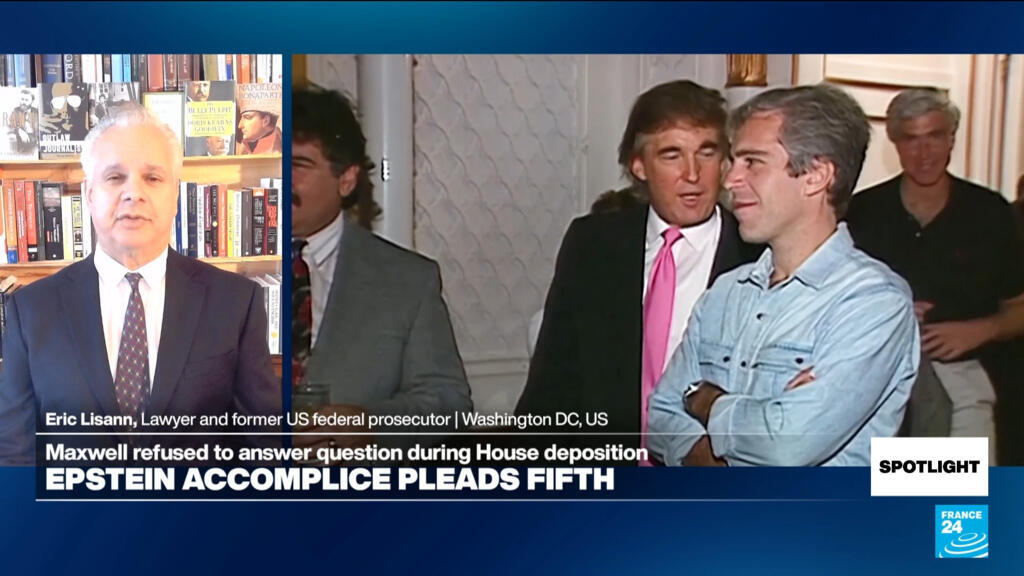
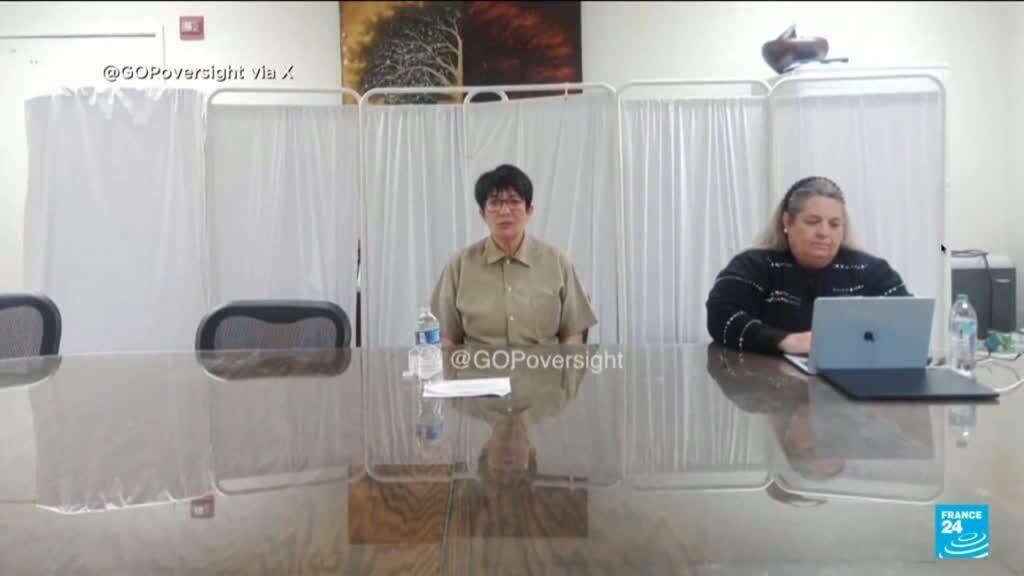
The House Oversight Committee interviewed Epstein associate Ghislaine Maxwell virtually on Monday in a private deposition.


Ghislaine Maxwell refuses to answer questions from congressional Epstein committee
© France 24
02:02


Maxwell, who was found guilty in 2021 for her ‍role in helping Epstein sexually abuse teenage girls, refused to answer questions. She is serving a 20-year prison sentence.

Former President ‌Bill Clinton and ​former Secretary of State Hillary Clinton are set to testify separately behind closed doors in the committee's Epstein investigation later this month.

(FRANCE 24 with Reuters)

US scores worst-ever result in corruption index as democracies backslide


Anti-graft watchdog Transparency International (TI) has warned that corruption is worsening in democracies worldwide and said the United States had fallen to its lowest-ever score on the 2025 Corruption Perceptions Index.


Issued on: 11/02/2026 - RFI

The Berlin-based TI said the global average score had fallen to its lowest level in more than a decade.

US President Donald Trump, since returning to the White House early last year, has upended domestic and foreign politics while ramping up pressure on institutions ranging from universities to the Federal Reserve.

Fed Chairman Jerome Powell is currently under investigation by Trump's Department of Justice after resisting pressure from the president to reduce interest rates.

TI raised concerns over "actions targeting independent voices and undermining judicial independence" in the US.

"The temporary freeze and weakening of enforcement of the Foreign Corrupt Practices Act signal tolerance for corrupt business practices," the watchdog's research says.

The Trump administration's gutting of overseas aid has also "weakened global anti-corruption efforts", it added.

The group's index assigns a score between zero (highly corrupt) and 100 (very clean), based on data reflecting the assessments of experts and business executives.

Data sources have previously included the World Economic Forum and the Economist Intelligence Unit.

Global average lowest in a decade

Overall, the number of countries scoring above 80 has shrunk from 12 a decade ago to just five this year.

In particular, there is a worrying trend of democracies seeing worsening perceived corruption – from the United States (64), Canada (75) and New Zealand (81), to various parts of Europe, like the United Kingdom (70), France (66) and Sweden (80).

The global average score was 42, its lowest level in more than 10 years.

"The vast majority of countries are failing to keep corruption under control," the report said, with 122 countries out of 180 posting scores under 50.

The US case illustrates a trend in democracies experiencing a "decline in performance" in battling corruption, according to the report, a phenomenon it also said was apparent in the UK and France.

While such countries are still near the top of the index, "corruption risks have increased" due to weakening independent checks, gaps in legislation and inadequate enforcement.

"Several have also experienced strains to their democracies, including political polarisation and the growing influence of private money on decision-making," the report noted.

Protecting civic space

The report also pointed out that corruption tends to be tackled better in countries where civic space is guaranteed and protected.

"Those where the freedoms of expression, assembly and association are duly safeguarded are generally more resilient against corruption and score better on the CPI," the report said.

But countries where these freedoms are lacking are more likely to lose control of corruption: 36 of the 50 countries where the CPI scores have significantly declined have also seen a reduction in civic space.

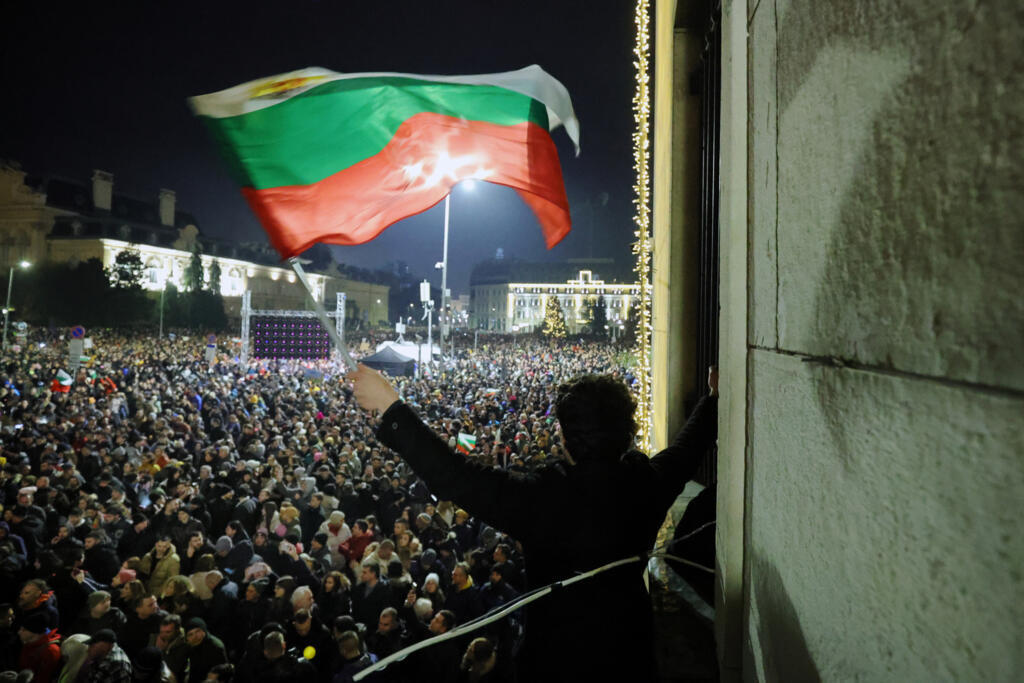
Tens of thousands of Bulgarians filled Sofia's central square, demanding the government's resignation amid rising anger over corruption and contested economic policies, Sofia, Bulgaria, 10 December, 2025. © AP - Valentina Petrova

The worst-performing countries in the European Union were Bulgaria and Hungary, both scoring just 40.

The report said the government of Hungary's nationalist leader Viktor Orban, in power since 2010 and facing a tough battle for re-election in April, "has systematically weakened the rule of law, civic space and electoral integrity for over 10 years".

"This has enabled impunity for channelling billions – including from European Union funds – to groups of cronies through dirty public contracting and other methods," the report said.

The watchdog noted that the government of Prime Minister Robert Fico in neighbouring Slovakia, with a score of 48, is "weakening investigations of corruption and organised crime, especially those involving senior officials".

Denmark top of the class

The highest-ranked nation in the index for the eighth year running was Denmark with a score of 89.

Among the more positive stories of progress in the report was Ukraine, which scored 36.

The government of President Volodymyr Zelensky has faced widespread public anger over graft allegations against those close to him, even as the country is hammered by Russian attacks.

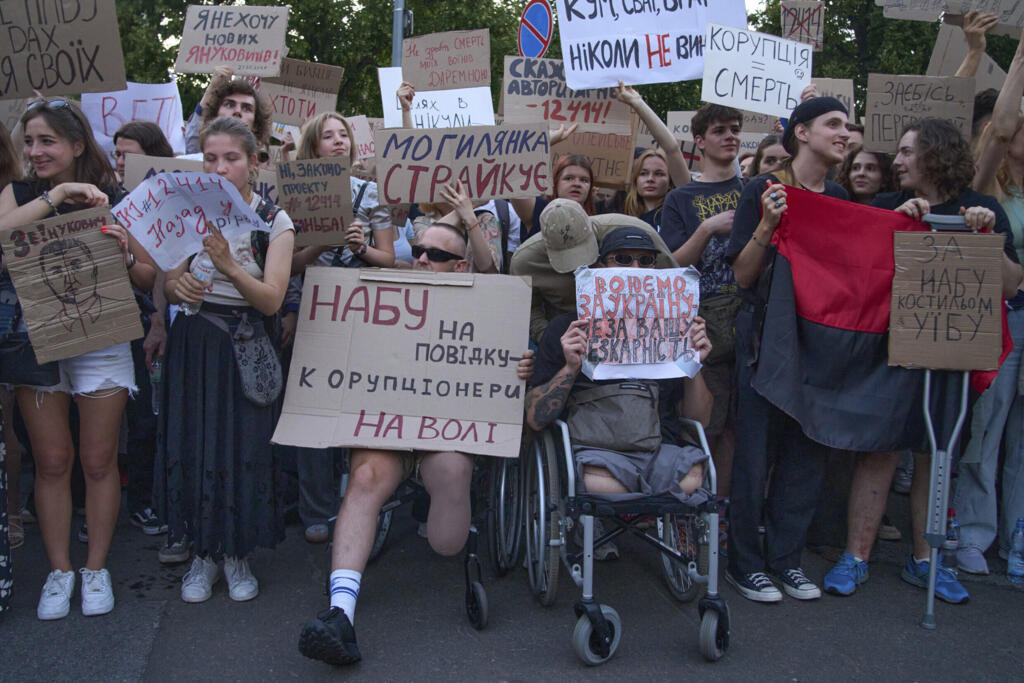
War veterans who lost their legs in Russia-Ukraine war hold signs saying "We fight for Ukraine, not for your impunity" during a protest against a law targeting anti-corruption institutions in central Kyiv, Ukraine, 23 July 2025. © Efrem Lukatsky / AP

However, TI noted that "the fact that these and many other scandals are being uncovered ... shows that Ukraine's new anti-corruption architecture is making a difference".

It hailed the "civil society mobilisation" last year, which prompted Zelensky to backtrack in an attempt to curb the independence of anti-graft bodies.

At the bottom of the index, the countries scoring below 25 are mostly conflict-affected and highly repressive countries, such as Venezuela (10) and the lowest scorers, Somalia and South Sudan, which both score nine.

(with AFP)


'Democracy loses out': France sinks to new low in annual global corruption index


France dropped to a historic low in a global corruption index released Tuesday in the wake of high-profile scandals involving former president Nicolas Sarkozy, far-right leader Marine Le Pen and a government cover-up of wrongdoing at the Perrier mineral water company.


Issued on: 10/02/2026 
FRANCE24
By: Joanna YORK


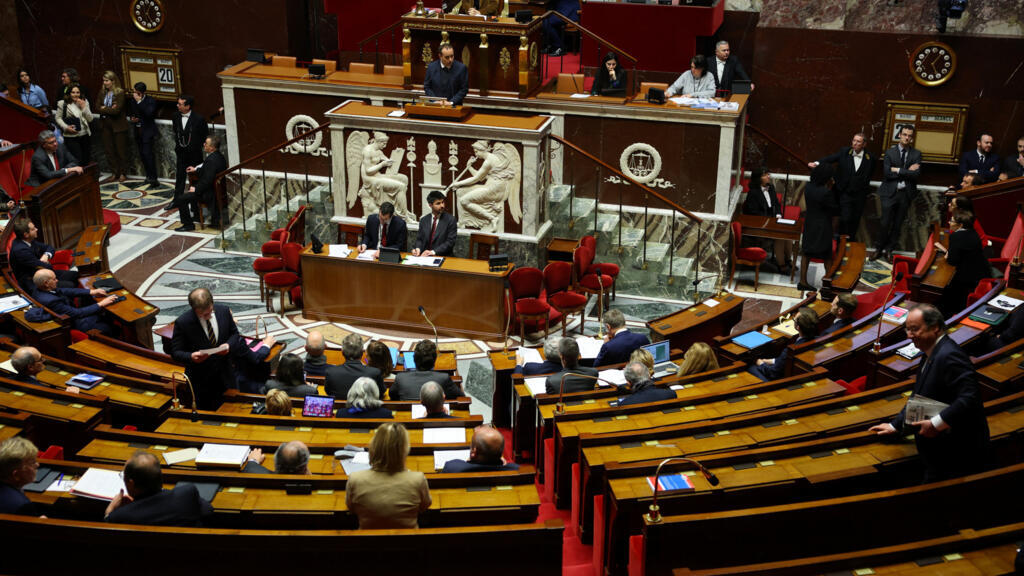
A view of the hemicycle at the National Assembly in Paris, France, on January 20, 2026. © Sarah Meyssonnier, Reuters

France dropped on Tuesday to an all-time low in Transparency International’s annual corruption perceptions index, with the organisation warning of “democratic danger” if politicians fail to act.

The Corruption Perceptions Index is compiled by experts and businesspeople who rank 182 countries on their perceived corruption levels in the public sector based on data from institutions including the World Bank and the World Economic Forum.

Countries score between zero, for those seen as highly corrupt, and 100, for those seen as very clean. In the 2025 edition released on Tuesday, Denmark ranked top with 89 points and South Sudan lowest with a score of 9.

France was given a score of 66 points, one point lower than 2024, and slipped down in the overall rankings to 27th place – its worst performance since the index, which was created in 1995, implemented its current methodology in 2012.

France’s poor score comes on the back of three high-profile corruption cases that dominated headlines last year.

A Senate report released in May found that the French government covered up consumer fraud by food giant Nestle, allowing the company to use prohibited treatments to produce "natural" mineral waters, including Perrier.

Ex-president Nicolas Sarkozy was imprisoned for 20 days in October after being found guilty of illegally seeking funding for his successful presidential campaign from former Libyan leader Muammar Gaddafi.

And, in an ongoing scandal, far-right leader Marine Le Pen and others from her National Rally party were found guilty in March of embezzling European Parliament funds.

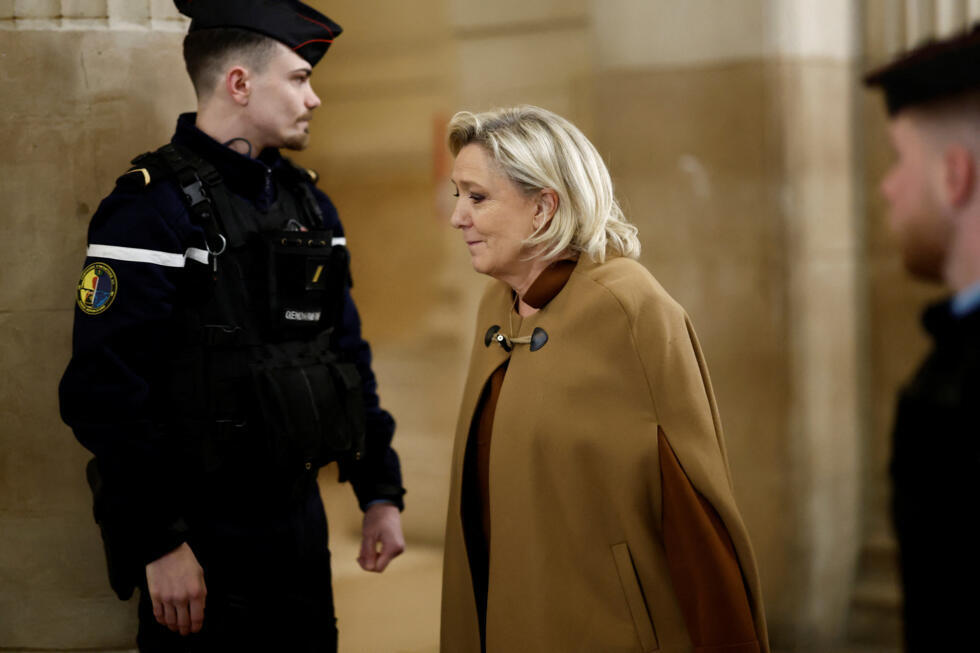
Le Pen appeared in a Paris court this week to appeal the verdict which, if upheld, will ban her for running in the 2027 presidential elections.


French far-right leader Marine Le Pen arrives for a hearing at the Paris courthouse on the Ile de la Cité on February 3, 2026. © Benoit Tessier, Reuters

'No political leadership'

These notable cases have “contributed to the deterioration in the perception of corruption”, said Florent Clouet, chief executive of Transparency International France.

But beyond the headline-grabbing scandals, the organisation has identified several key factors in France allowing an increase in the perception of corruption.

“The most significant problem, in our view, is the lack of political will – there is absolutely no political leadership in the fight against corruption,” Clouet said.

A recent plan to strengthen anti-corruption measures has not been championed by any MPs or presented at the weekly Council of Ministers chaired by President Emmanuel Macron, and accusations of corruption at the heart of government seem increasingly common.

Paris mayoral hopeful and current Culture Minister Rachida Dati is the latest in a series of serving ministers to face corruption charges.

France's culture minister Rachida Dati to be tried on corruption charges
La ministra de Cultura de Francia, Rachida Dati, durante la sesión en la Asamblea Nacional este 30 de junio de 2025. AFP - LUDOVIC MARIN
01:29


The lack of political support for anti-corruption measures is compounded by under-resourced investigation and prosecution bodies.

The National Financial Prosecutor's Office (Le parquet national financier) is overrun, with “each pair of magistrates ... dealing with 80 cases, when the original plan was for them to handle eight cases”, Clouet said.

There is also a chronic lack of personnel at leading financial investigation agencies the central anti-corruption office (l’Office central de lutte contre la corruption et les infractions financières et fiscales) and the High Authority for Transparency in Public Life.

“As a result, we find ourselves in a situation where, basically, they are unable to properly carry out the missions for which they were created,” Clouet said.

The president of the High Authority for Transparency in Public life in April called on the government to increase its budget, saying that of 13,000 declarations made by public officials in 2024, it only had capacity to verify 5,000.

While these organisations were set up to monitor high-ranking officials and public servants, an additional issue is the lack of oversight at lower levels of government.

“There is great difficulty detecting and combating what is known as 'low-intensity corruption', involving relatively small amounts of money that slip under the radar of prevention and detection mechanisms,” Clouet added.
A ‘worrying trend’

Rather than being an outlier, Transparency International found the issues in France are part of a “worrying trend” of “backsliding scores in traditionally well-performing democracies” including CanadaNew ZealandSweden and the UK.

Globally, more than two thirds of all countries surveyed received a score lower than 50 and “the vast majority of countries are failing to keep corruption under control", the report found.

Over the past decade, progress has “stalled” in Western Europe and “been deteriorating” in the US, which dropped to a new low of 64, it added.

Indeed, US President Donald Trump’s dismantling of decades-old measures to fight corruption seem to have inspired other countries to loosen their own laws.

“In the current geopolitical climate, Europe should be raising, not lowering, its anti-corruption ambitions. Corruption is not inevitable,” said Flora Cresswell, regional adviser for Western Europe at Transparency International.

But “that's not what's happening. Europe tends to follow the United States’ lead,” Clouet said.

The degradation in the public's perception of corruption comes with serious consequences, he warned, causing disenchanted citizens "to abstain from politics" as well as driving "social anger, which can fuel illiberal political forces. In all cases, it's democracy that really loses out.”

A survey released on Monday by the Cevipof research institute found that just 22 percent of people in France say they have confidence in politics – a four percent drop on the previous year.


Iran's exiled opposition fractures amid climate of fear online


Iran's exiled opposition is increasingly fractured as the country marks the anniversary of the 1979 Islamic Revolution on Wednesday – with activists, researchers and journalists reporting intimidation campaigns and deep political divisions that make collective action difficult.


Issued on: 11/02/2026 - RFI


Opponents of the Iranian regime living abroad say that rather than uniting in an effort to change realities on the ground, they are splitting and turning on each other.

A minority has created what some describe as a climate of fear – particularly on social media – targeting anyone who voices disagreement.

“It’s tough right now,” British-Iranian anthropologist Pardis Shafafi, who researches state violence and political repression in Iran, told Norwegian news site Filter Nyheter.

Shafafi, a member of the EHESS, a Paris-based academic research centre, said she did not expect her comments to trigger attacks from a pro-monarchist group in Europe.

She described heightened activism from radical fringes of the opposition in exile.

"When you post things online, it's very common for a stranger to question you about yourself and the people you follow," she said. "And it very often spirals into accusations of espionage."

Shafafi is not the only one reporting this pattern: blacklists and death threats issued against journalists or researchers accused of being propagandists.

Hiding in silence


Whether monarchist, left-wing, nationalist or Islamist, opposition figures abroad continue to tear each other apart.

In France, several public figures of Iranian origin have described – publicly or anonymously –receiving threats after speaking out in ways seen as too sympathetic to the Iranian regime. One filed a complaint against unknown individuals over death threats but declined to give an interview.

Reza Pahlavi, the son of Iran's former king and the best-known opposition figure abroad, has tried to distance himself from the most radical voices in the monarchist camp. But those voices have succeeded in creating a toxic climate.

Self-censorship is spreading among opponents.


"The majority is hiding in silence, out of fear," said Aïda Tavakoli, a French-Iranian activist and founder of We Are Iranian Students, a non-partisan secular organisation linked to student opposition groups in Iran.

The activist told RFI she can detect in the most extreme positions taken by some – "a minority", she said – the immense pain of experiencing grief from a distance, mixed with survivor's guilt and the absence of a place to channel anger.

Prison scars

"Many activists now in exile were imprisoned by the Islamic Republic," Shafafi said. "For these people, contradiction is not just a narrative disagreement. It is the denial of the most traumatic event that happened to them."

Shafafi is the author of The Long Iranian Revolution – State Violence and Silenced Histories, due to be published in June.

Extreme polarisation within the opposition is also fuelled by an inability to agree on the legacy of the 1979 Islamic Revolution. But after the worst repression ever experienced by modern Iran, some want to believe in a resurgence.

"I have many more people from all political sides – monarchists, republicans, left-wing, right-wing, feminists and non-feminists – contacting me to ask whether we could find unity because we don't recognise ourselves in the extremes on either side," Tavakoli said.

At a conference in Paris last week, Tavakoli recognised some of the people behind violent comments posted on social media. "They came to thank me and said it helped them to understand that our disagreement is not personal violence," she told RFI.

Cyber pressure

It is all the more important to work to overcome disagreements, Shafafi said, because the authorities exploit them.

"A large part of these conflicts is a smokescreen created by trolls working for the regime," she said. "It equips and finances this cyber-army to ensure the opposition remains fragmented and to discredit anyone who manages to rally support.

"We saw this pattern in 2022 and it is important to remember it. What the regime fears most is a popular and united movement that is coherent and capable of opposing it."

This story was adapted from the original version in French by Aabla Jounaïdi

Iran And The Art Of The Retread – OpEd

February 11, 2026 
By Ivan Eland


The upcoming negotiations between the United States and Iran may be the only way to avoid military conflict between the two countries. President Donald Trump, assuming that recent large public anti-regime protests have weakened the Iranian government, has taken what he sees as an opportunity to pressure the Iranians over their nuclear and ballistic missile programs and assistance to foreign groups in the Middle East. He has moved air and naval forces to the region and may even think such threats or actions could collapse the regime.

Trump’s military intimidation could take a couple of different paths. A politician who has campaigned on staying out of foreign bogs seems to have become drunk with the potential of military action after the U.S. military’s successful snatch of Venezuelan President Nicolas Maduro. Yet Trump avoided a sustained military action on the ground that would have been required to change the socialist regime there. Instead, he seems to have been satisfied with the surviving regime providing him protection money in the form of revenues from a prospective rejuvenation of the now-outdated and decrepit Venezuelan oil industry. (However, Trump may be out of office before such raw imperialism results in substantial payments.)

Thus, the first path the U.S. might follow in its threats or actions toward Iran is limited military strikes to coerce more concessions from Iran. The Iranians already seem willing to negotiate a deal similar to the one negotiated by Barack Obama in 2015 but loudly scrapped by the incoming Trump administration: Iran severely limits its enrichment of nuclear material and sends its stockpile of such material to a third country.

It would not be the first time that Trump has made threats and then settled for a “for-show” agreement similar to the one he could have gotten without the blustering. This outcome seems to be happening in the case of the recent Trump military threats against Greenland. Negotiations with Denmark and Greenland, a semi-autonomous region of that country, will likely arrive at a point similar to where Trump started before the threats: the ability to greatly expand the U.S. military presence on the island, with only a few legal niceties changed.

The same sleight of hand was used during the first Trump administration, after he had railed against the unfairness of the Bush I/Clinton North American Free Trade Agreement during the 2016 election campaign, only to scrap it and negotiate the only slightly modified U.S.-Mexico-Canada Agreement (USMCA) subsequently after taking office.

Thus, Trump’s threats, along with his desire for short-term, very public “wins,” might leave him satisfied with an updated, minimally modified version of Obama’s 2015 nuclear deal with Iran. However, he would never admit that that was all he got.

Yet one factor looms in the background that has not been present in these other cases: Trump’s desire to be regarded as the greatest friend of Israel among U.S. presidents. In addition to the Iranians giving up their nuclear program, Israeli officials aim to limit Iran’s work on ballistic missiles that could strike their territory and its assistance to regional groups that could do the same: for example, Hamas in Gaza, Hezbollah in Lebanon, and the Houthis in Yemen. Also, Israel successfully persuaded Trump to attack Iran’s nuclear program in 2025, not only to try “obliterate” it (which obviously failed, as demonstrated by the continued negotiations over it) but also to take down Iranian air defenses to allow future attacks. Israel applauds any U.S. attacks on Iran, because they weaken its primary regional foe.

However, in war, the enemy has a vote. Iran’s nuclear program is designed primarily to deter Israel, as is its ballistic missile program and aid to regional allies. With its air defenses already denuded, Iran might be especially reluctant to give up these two deterrents in any negotiations.

The second path Trump could go down is heavier military strikes to try to take out remaining deeply buried Iranian nuclear facilities, or as a final decisive blow to attempt to collapse an already weakened regime. But why expend such firepower when Iran already seems ready to severely limit its nuclear program through negotiation? Also, perversely, heavy U.S. military strikes may actually strengthen the Iranian regime by inducing the well-known “rally-around-the-flag” effect, which increases popular support when a government is attacked by an outside enemy, especially a more powerful one.

Trump still seems to want to avoid foreign quagmires, so maybe he will take path number one: negotiating a revamped Obama-style nuclear deal with Iran, selling it as something shiny and new, and then calling it a day. In contrast, the more ambitious and risky second path could lead to further unplanned escalation if the Iranians fail to capitulate or choose to go down fighting.


This article was also published at the Independent Institute


Ivan Eland

Ivan Eland is Senior Fellow and Director of the Center on Peace & Liberty at The Independent Institute. Dr. Eland is a graduate of Iowa State University and received an M.B.A. in applied economics and Ph.D. in national security policy from George Washington University. He has been Director of Defense Policy Studies at the Cato Institute, and he spent 15 years working for Congress on national security issues, including stints as an investigator for the House Foreign Affairs Committee and Principal Defense Analyst at the Congressional Budget Office. He is author of the books Partitioning for Peace: An Exit Strategy for Iraq, and Recarving Rushmore.


Iranian Regime Seeks To Reclaim Lion And Sun Symbol Embraced By Protesters – Analysis

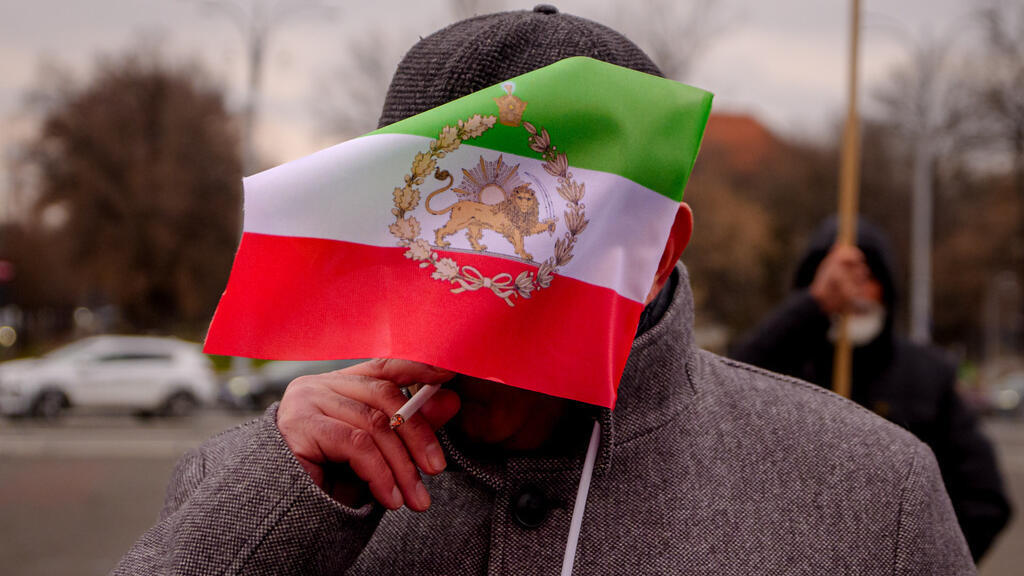
A demonstrator takes part in a rally in support of Iranians in Bucharest, Romania, on Sunday 1 February 2026. AP - Andreea Alexandru

February 11, 2026 
RFE RL
By Mani Parsa

Reeling from massive demonstrations, Iran’s theocratic rulers are scrambling to reclaim the traditional Lion and Sun symbol, which has been embraced by anti-regime demonstrators.

Ali Akbar Salehi, director of the government-run Iranology Foundation, asserted on February 8 that the Islamic republic owns the Lion and Sun symbol — and condemned its use by “others.”

The Lion and Sun has long been one of Iran’s enduring national symbols, in use until the country’s 1979 Islamic revolution. Its origins trace back to astrology — symbolizing the sun in the Leo constellation — but from the 12th century, it became deeply embedded in Iranian art and culture.

From the 15th century onward, the symbol appeared intermittently on Iranian flags. But after the Islamic revolution, the Lion and Sun was outlawed and condemned as a vestige of the oppressive, Westernizing monarchy. As a replacement, the regime embellished Iran’s green-white-red tricolor with four crescents and a sword, surmounted by a diacritic, which formed a stylized representation of the Arabic word “Allah.”

Speaking at the First National Congress on Foreign Policy and the History of Foreign Relations, Salehi insisted that the Islamic republic of Iran owns the symbol and said that it had clear religious roots.

‘We Gave Them This Lion And Sun’

“The philosophy of the Lion and Sun is from Ali (a close companion of the Prophet Muhammad), God, and religion. We gave them this Lion and Sun, now others are using it, even though it belongs to us,” Salehi said.

The “others” Salehi was referring to are the anti-regime protesters who, in recent weeks, have hoisted the Lion and Sun flag in the streets — a symbol of national pride, secularism, and defiance of theocratic rule.

Protests in Iran erupted on December 28 over economic woes including currency collapse but morphed into anti-regime demonstrations that were met with lethal force, with thousands of people killed.

The Lion and Sun also became a prominent symbol for Iranians abroad demonstrating against the regime. As a gesture of support for the protesters, the social media platform X announced on January 9 that it was replacing the current Iranian flag emoji with the Lion and Sun.

According to Salehi, the Iranian state still has an international legal claim on the Lion and Sun symbol. In 1922, the Red Lion and Sun Society was formed, Iran’s equivalent of the Red Cross and Red Crescent humanitarian organizations. And under the 1929 Geneva Conventions, the Lion and Sun was recognized as one of three official emblems — alongside the Red Cross and Red Crescent — for safeguarding medical aid.

In the wake of the 1979 Islamic Revolution, Iran swapped its red Lion and Sun for the Red Crescent, in keeping with other Muslim states. The International Red Cross and Red Crescent Federation, however, upholds Iran’s sole legal claim to the traditional emblem and its right to use it whenever it chooses.

Ongoing Debate

Salehi, who has a nuclear engineering background and was once the head of the Atomic Energy Organization of Iran, is no stranger to controversy. Appointed head of the Iranology Foundation in 2025, academics from the University of Tehran wrote an open letter, calling his appointment “inappropriate” because of his lack of expertise.

And this isn’t the first time there has been debate about the Lion and Sun. In May 2020, parliamentary deputy Qolam Haydar Ebrahim Baysalami said: “The possibility of returning the red Lion and Sun emblem to Iran is possible through the Foreign Ministry.” “The Red Crescent,” he added, “is an Ottoman emblem and replacing it with the red Lion and Sun was a historical oversight.”

Six years earlier, in May 2014, Ali Younesi, the senior assistant for ethnic and religious minorities for former moderate President Hassan Rohani, said that the Lion and Sun in the former Iranian flag were “symbols of Ali and Muhammad” and suggested that the motif replace the Red Crescent.

At the time, Younesi’s remarks provoked strong reactions from some members of the Iranian parliament. As a response, the hard-line Mashreq news website republished part of a speech by Ayatollah Ruhollah Khomeini, the founder of the Islamic republic, where he denounced the “ill-fated ‘Lion and Sun.'”

“The Iranian flag should not be an imperial flag, the emblems of Iran should not be imperial emblems. They should be Islamic emblems,” Khomeini said. “The works of the tyrant must go. These are the works of the tyrant…. It should be the works of Islam.”

RFE/RL journalists report the news in 21 countries where a free press is banned by the government or not fully established.


Tehran ready for nuclear inspections, insists it is not seeking weapons

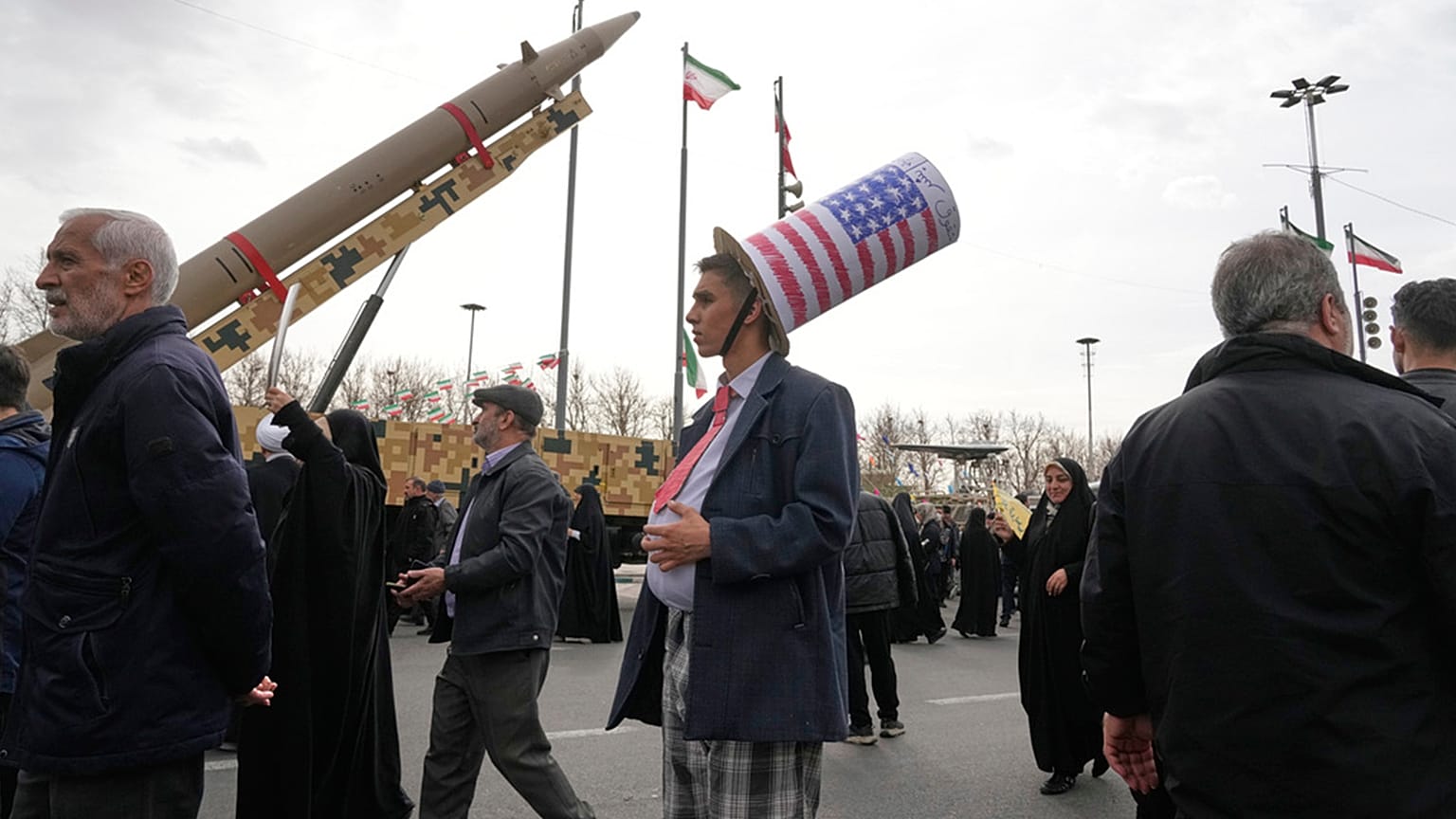
A man wears an Uncle Sam hat as he stands in front of an Iranian-built missile during a rally marking 1979 Islamic Revolution at the Freedom Sq in Tehran, 11 February 2026
Copyright AP Photo

By Euronews
Published on 

Iran’s President Masoud Pezeshkian said on Wednesday Tehran is ready for any verification of its nuclear programme, amid renewed talks with the US and raging internal unrest.

Iranian President Masoud Pezeshkian said on Wednesday his country is prepared for "any verification" of its nuclear programme, insisting Tehran is not seeking atomic weapons.

"We are not seeking to acquire nuclear weapons. We have stated this repeatedly and are ready for any verification," Pezeshkian said during a speech at Azadi Square in Tehran marking the 47th anniversary of Iran's Islamic Revolution.

"Our country, Iran, will not yield to their excessive demands," he added, after Tehran resumed indirect talks with Washington on its nuclear programme.

The anniversary comes as the country's ruling theocrats remain under pressure from US President Donald Trump, who suggested sending another aircraft carrier group to the Middle East.

Trump made the suggestion in an interview published Tuesday night, as Israeli Prime Minister Benjamin Netanyahu prepares to come to Washington to push the US toward the strictest possible terms in any agreement reached with Tehran in the fledgling nuclear talks.

The US bombed Iranian nuclear sites last June during a 12-day Iran-Israel conflict.

IAEA access remains suspended

Meanwhile, the International Atomic Energy Agency (IAEA) has not been able to verify the status of Iran's near weapons-grade uranium stockpile since the 12-day conflict, when Tehran suspended its cooperation with the UN nuclear watchdog.

IAEA chief Rafael Grossi reached an agreement with Iranian Foreign Minister Abbas Araghchi in September 2025 to resume inspections, but the UN reimposed sanctions on Iran that same month, leading the country to halt implementation of the agreement.

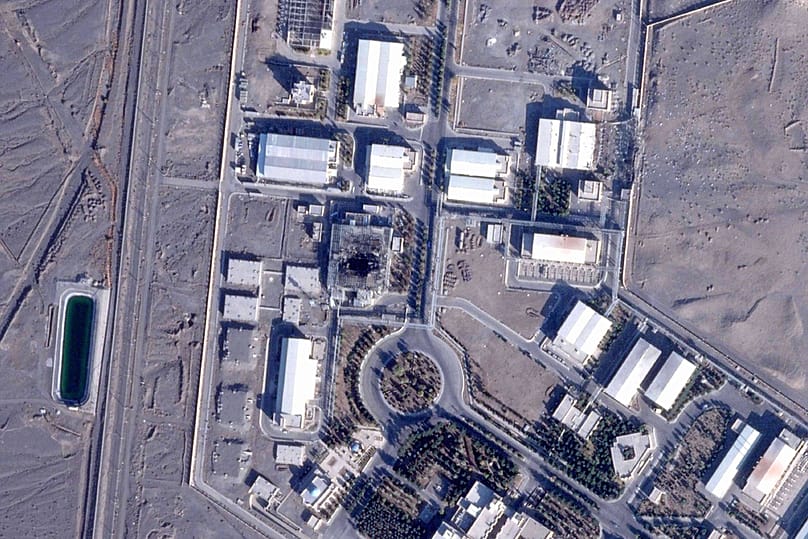
This satellite image from Planet Labs PBC shows the rubble of the Pilot Fuel Enrichment Plant at Iran's Natanz nuclear enrichment site on 3 December 2025 AP Photo

A fresh round of indirect nuclear talks between Iran and the US concluded in Muscat on last Friday, mediated by the Sultanate of Oman.

Pezeshkian has described the talks as "a step forward," emphasising that Tehran's rationale concerning the issue is based on the rights enshrined in the Non-Proliferation Treaty.

Senior Iranian security official Ali Larijani travelled from Oman to Qatar on Wednesday, with Qatar hosting a major US military installation.

A country torn

The anniversary also comes as the public angrily denounced Tehran's bloody crackdown on nationwide protests that took place in late December and early January.

Protests began on 28 December 2025, sparked by a currency collapse and persistent hyperinflation, but quickly turned into nationwide anti-regime demonstrations, prompting Tehran's violent crackdown and a complete information blockade.

Human rights organisations and insiders in Iran have reported that anywhere from 6,000 to 30,000 are feared killed in the suppression, although precise casualty figures remain difficult. Authorities have also detained tens of thousands across the country.

In mid-January, the US president urged Iranians to keep protesting, stating "help is on the way".

However, Trump has held off on an intervention following a restart in US-Iran talks and what Washington said was a pledge by Tehran to halt the crackdown, including any executions of arrested demonstrators.

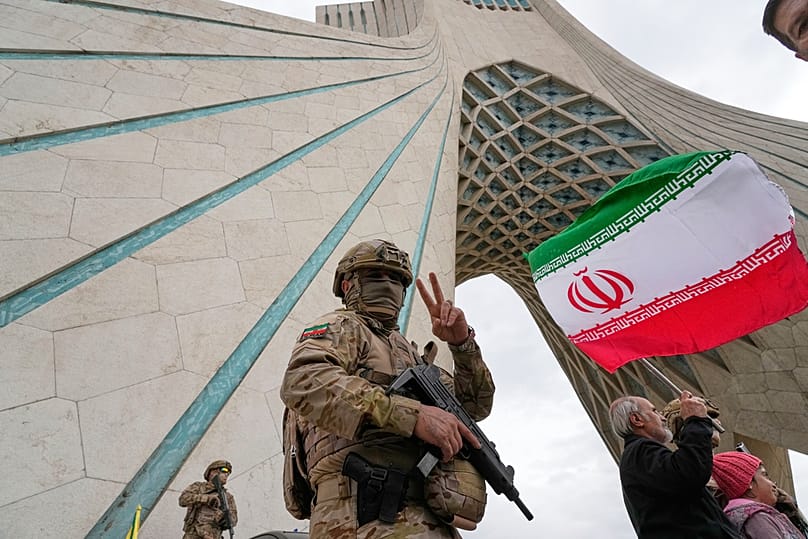
A member of the Revolutionary Guard flashes a victory sign at the freedom monument tower during an annual rally marking 1979 Islamic Revolution in Tehran, 11 February 2026 AP Photo

On Iranian state TV, authorities broadcast images of people taking to the streets across the country Wednesday to support the theocracy and its 86-year-old Ayatollah Ali Khamenei.

But on Tuesday night, as government-sponsored fireworks lit the darkened sky, witnesses heard shouts from people’s homes in the Iranian capital, Tehran, of “Death to the dictator."

In the streets Wednesday, people waved images of Khamenei and his predecessor Ayatollah Ruhollah Khomeini, the founder of the Islamic Republic, alongside Iranian and Palestinian flags. Some chanted “Death to America” and “Death to Israel.”

Others criticised Iran's exiled Crown Prince Reza Pahlavi, who had been calling for anti-government protests.


Iran: 207 Executions In Three Weeks As ‘No To Executions Tuesdays’ Expands To 56 Prisons In 107th Week – OpEd

February 11, 2026 
By Mahin Horri

On Tuesday, February 10, 2026, political prisoners across Iran marked the 107th consecutive week of the “No to Executions Tuesdays” campaign. The hunger strike, which began as a protest within prison walls, has now expanded to 56 detention facilities nationwide, including Evin, Ghezel Hesar, and prisons in major provincial capitals. This expansion comes in the immediate aftermath of the nationwide uprising in January 2026, posing a direct challenge to the clerical regime’s intensified crackdown.

In a statement released for the 107th week, the striking prisoners highlighted a dramatic surge in capital punishment aimed at quelling public dissent. According to the campaign, in the first three weeks of the current Persian month (starting January 21, 2026), the regime has executed over 207 individuals, including two women. The statement notes that thousands of detainees face the threat of execution without due process. Specifically, the prisoners raised the alarm for Kurdish political prisoner Naser Bekrzadeh, who has been sentenced to death for the third time and faces imminent execution.

The crackdown has extended beyond protesters to include professionals aiding the injured. The statement reports that security forces have arrested numerous lawyers, doctors, and medical staff, a move the prisoners describe as indicative of the regime’s “growing terror” following the January uprising.

Despite the repression, the prisoners emphasized that the path forward is resistance, not submission. “Compatriots, in these conditions, silence is not an option; the only option and path to salvation is outcry and protest,” the statement read. They further articulated their vision for the future: “In these sensitive conditions, we desire a free and equal Iran, devoid of violence and executions, and the ‘right to self-determination’ by the people.”

The campaign has transcended prison walls, finding a “new stage” of social expansion. In tandem with the hunger strikes inside, residents in dozens of cities—including Tehran, Tabriz, Isfahan, Rasht, Zahedan, and Kermanshah—have staged protests supporting the prisoners. The slogan “No to Executions” has become a common chant in street demonstrations.

Protesters have adopted radical slogans linking the executions to the survival of the Supreme Leader’s regime. Chants documented during these protests include “Fire is the answer to execution,” “Freedom for political prisoners is the national slogan,” and “Khamenei’s crime: thousands of martyrs of the January uprising.”

Families of the incarcerated and those killed during protests have become the “stable pillars” of this movement, rallying with photos of their loved ones and chanting “Do not execute.” This solidarity has effectively bridged the gap between individual grievances and a collective national demand for the abolition of the death penalty.

The participating prisons in the 105th week of the hunger strike include: Evin Prison (women’s and men’s wards), Ghezel Hesar Prison (units 2, 3, and 4), Karaj Central Prison, Fardis Prison in Karaj, Greater Tehran Prison, Qarchak Prison, Khorin Prison in Varamin, Chobindar Prison in Qazvin, Ahar Prison, Arak Prison, Langerud Prison in Qom, Khorramabad Prison, Borujerd Prison, Yasuj Prison, Asadabad Prison in Isfahan, Dastgerd Prison in Isfahan, Sheiban Prison in Ahvaz, Sepidar Prison in Ahvaz (women’s and men’s wards), Nezam Prison in Shiraz, Adelabad Prison in Shiraz (women’s and men’s wards), Firuzabad Prison in Fars, Dehdasht Prison, Zahedan Prison (women’s and men’s wards), Borazjan Prison, Ramhormoz Prison, Behbahan Prison, Bam Prison, Yazd Prison (women’s and men’s wards), Kahnuj Prison, Tabas Prison, Birjand Central Prison, Vakilabad Prison in Mashhad, Gorgan Prison, Sabzevar Prison, Gonbad-e Kavus Prison, Qaemshahr Prison, Rasht Prison (men’s and women’s wards), Rudsar Prison, Haviq Prison in Talesh, Azbaram Prison in Lahijan, Dizel Abad Prison in Kermanshah, Ardabil Prison, Tabriz Prison, Urmia Prison, Salmas Prison, Khoy Prison, Naqadeh Prison, Miandoab Prison, Mahabad Prison, Bukan Prison, Saqqez Prison, Baneh Prison, Marivan Prison, Sanandaj Prison, Kamyaran Prison, and Ilam Prison.


Mahin Horri writes for the People's Mojahedin Organization of Iran (PMOI/MEK).

Judge seeks to declassify documents in 2013 killing of RFI journalists in Mali

More than a decade after the killing of RFI journalists Ghislaine Dupont and Claude Verlon in northern Mali, a French judge is requesting to declassify more documents that may shed new light on the case.


Issued on: 09/02/2026 - RFI

French journalists Ghislaine Dupont (R) and Claude Verlon (L), were murdered in Mali in 2013. AFP - SIA KAMBOU

The anti-terrorism investigating judge looking into the assassination of the journalists sent the request last month to the French Ministry of the Armed Forces.

This comes after a request from the plaintiffs in the civil lawsuit.

“There have already been several declassifications, but they were limited, with documents heavily redacted,” Danièle Gonod, president of the Association of Friends of Ghislaine Dupont and Claude Verlon, told French news agency AFP.

According to Gonod, authorities had previously invoked the top-secret nature of the documents, citing the need to protect French sources in Mali.

French forces had been supporting Mali against insurgents for nearly a decade, but were pulled out in the wake of a military takeover in August 2020.

“Today, there is no longer a single French soldier in Mali, so there are no sources left to protect,” Gonod said.

Ghislaine Dupont, 57, and Claude Verlon, 55, were abducted while reporting for RFI and killed on 2 November, 2013 near the town of Kidal, just months after France launched Operation Serval to counter jihadist groups threatening to seize the Malian capital of Bamako.

Unanswered questions

While the group al-Qaeda in the Islamic Maghreb had previously claimed the murders of Dupont and Verlon, the precise circumstances surrounding their deaths have never been fully clarified.

According to French authorities, a convoy of French soldiers discovered the journalists’ bodies near the pick-up truck driven by their abductors. Investigators said the vehicle had broken down, bolstering the theory of a failed hostage-taking carried out by a jihadist group. The reporters were said to have been slain by gunfire.

However, Danièle Gonod says that telephone data gathered during the investigation points to “a real jihadist network, political and organised, with ties to Algeria".

Discrepancies in French Army account on 2013 murder of RFI reporters in Mali

The judge is now requesting intelligence on two suspects believed to be still alive: Sidan Ag Hita, one of the alleged masterminds, and Hamadi Ag Mohamed, one of four men said to have carried out the abduction.

The judge noted that Sidan Ag Hita had since become “an important jihadist leader”, reportedly negotiating directly with the Malian state over hostage releases.

The judge also requested information on Cheikh Ag Haoussa, a Tuareg leader who was due to meet the journalists in Kidal.

According to the judge, Haoussa was allegedly seen hours before the abduction in the company of Baye Ag Bakabo, identified as the head of the team that kidnapped and killed the two journalists.
Deadly attacks stall trade in key corridor between Senegal and Mali

More than 4,000 empty shipping containers are stranded inside Mali as insecurity on the main trade route to Senegal makes transport too dangerous, raising fears of supply disruption and higher prices in a country where most imports pass through the port of Dakar.


Issued on: 07/02/2026 - RFI

A container ship operated by CMA CGM, a French shipping giant that serves West Africa. Its vessels and containers are among those affected by disruptions on the Mali-Senegal trade route. AFP - SAMEER AL-DOUMY

The Malian Shippers’ Council, a body attached to Mali’s transport ministry, this week said the situation has become a major concern for national and regional supply chains.

It warned that empty containers are running dangerously low at the port of Dakar, threatening supplies to Mali and putting pressure on Malian businesses.

The authorities demanded the return of more than 4,000 containers still inside the country, most of them owned by shipping giants MSC and Hapag-Lloyd. It is not clear how long the containers have been blocked.

RFI contacted the Malian Shippers’ Council and the transport ministry for an explanation on why the containers remained blocked, but neither responded.

Route too dangerous

A Malian entrepreneur, who said he also has containers waiting to be returned to Dakar, told RFI that while the authorities wanted to send a positive signal to shipping companies, “they have no solution to offer”.

“We can’t find a transporter willing to make the journey,” the business owner said – pointing to a rise in jihadist attacks in recent months in the Kayes region near the Senegalese border.

The risk, he said, became brutally clear last Thursday, when at least a dozen truck drivers were killed after their convoy was ambushed, despite being escorted by the army. “You can’t force people to take that risk.”

He added that empty containers are not escorted on return journeys and warned of the threat posed by homemade mines and the very poor state of the road, which forces trucks to travel slowly and leaves them exposed for longer.

Another Malian business owner said trucks have also been stuck in the capital, Bamako, because of fuel shortages.

The disruption has been linked to an embargo imposed in early September by the jihadist group JNIM, which has been gradually contained by the Malian army but continues to heavily disrupt supplies of petrol and diesel.

Customs hold-ups


Operators have also complained about delays at customs in Bamako.

“Containers can wait several days before being taken off a truck, then several weeks or even months before all the formalities are completed,” one of them told RFI, while also alluding to problems of corruption.

“Angry drivers sometimes just leave without the containers,” the man said.

Customs procedures in Bamako have recently been sped up, but only for fuel tankers entering the country, to make fuel distribution easier and limit the impact of the jihadist embargo.

Meanwhile shipping companies are also facing a major financial hit. The price of a new container is around €5,000 – so 4,000 of them unreturned adds up to some €20 million worth of equipment.

Economists say logistics costs are quickly passed on to consumers, who are at risk of being hit hard given that nearly 70 percent of Mali’s imports pass through the port of Dakar.

With Ramadan approaching, Mali’s transitional authorities have repeatedly said they are working to secure supplies and fight price hikes.

Two-way street

The current blockage comes just months after tensions flared in the opposite direction. In November, full containers were stuck at the port of Dakar, waiting to be transported to Mali beyond the allowed storage period.

Mali later secured a full cancellation of storage penalties for Malian companies and was granted a three-month deadline to clear the containers. At the time, more than 2,000 were blocked at the port.

Mali’s transport minister, Dembélé Madina Sissoko, travelled to Dakar to plead the country’s case. According to the Malian Shippers’ Council, only 304 containers are now still waiting at the port.

The council has given their owners until 24 February to collect them, warning that no exemption will be granted after that deadline.

Shipping companies have not spoken publicly on the issue and have allowed Mali’s transitional authorities to relay their concerns, raised during a meeting in Dakar on 20 January.

Three months ago, shipping lines CMA CGM and MSC briefly suspended deliveries to Mali, citing insecurity and fuel shortages. The measures were later lifted after talks with Mali’s transitional authorities, although the details of those negotiations were not made public.

This story was adapted from the original version in French by David Baché.
A PIECE OF THE ACTION FOR PROTECTION

DR Congo weighs price of security in minerals deal with US

A minerals-for-security deal between the United States and the Democratic Republic of Congo is facing a constitutional challenge in Kinshasa, with critics warning the government may be underselling the country’s vast mineral wealth. The partnership was praised by US President Donald Trump during a visit to Washington last week by President Félix Tshisekedi.


Issued on: 09/02/2026 - RFI

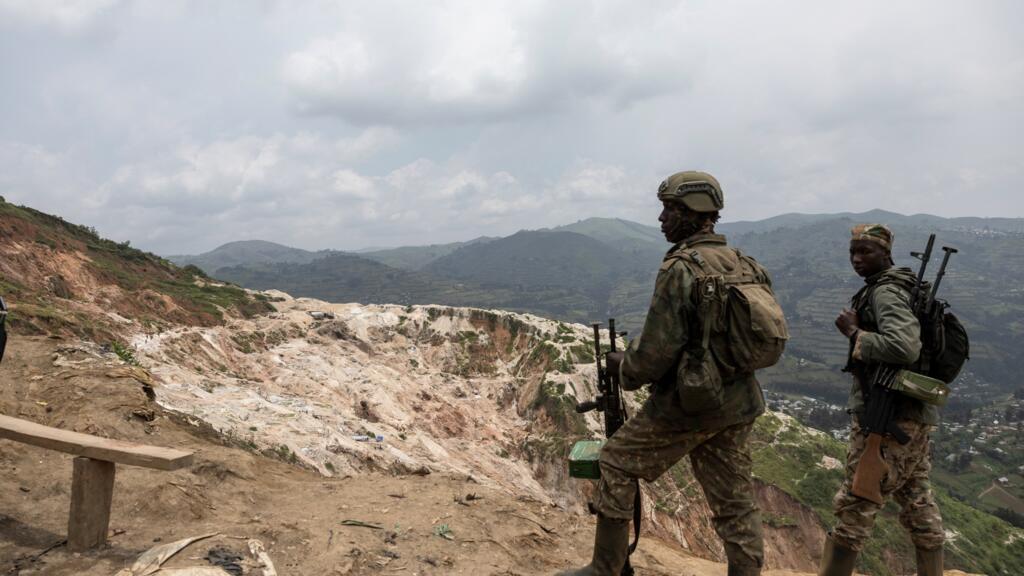
M23 soldiers stand at the mining pits in Rubaya on 5 March, 2025. Ravaged by conflict for 30 years, eastern DRC is believed to hold between 60% and 80% of the world's reserves of coltan, an essential mineral for manufacturing electronic equipment. © AFP - CAMILLE LAFFONT

By:Zeenat Hansrod

Congolese lawyers and human rights defenders filed a petition on 21 January arguing the agreement should have been approved by parliament and may even require a referendum under the constitution.

Last Thursday, Trump praised Tshisekedi at the annual National Prayer Breakfast in Washington – a gathering of US political leaders and foreign dignitaries – calling him a “good guy”.

Asking Tshisekedi to stand up and be applauded as a strong partner to the United States, Trump added that he was a “very brave and wonderful man".

The praise came two months after Congo and the United States signed a Strategic Partnership Agreement on critical minerals, linked to the Washington Accords, a US-brokered peace deal between Congo and Rwanda signed on 4 December by Tshisekedi and Rwandan President Paul Kagame.

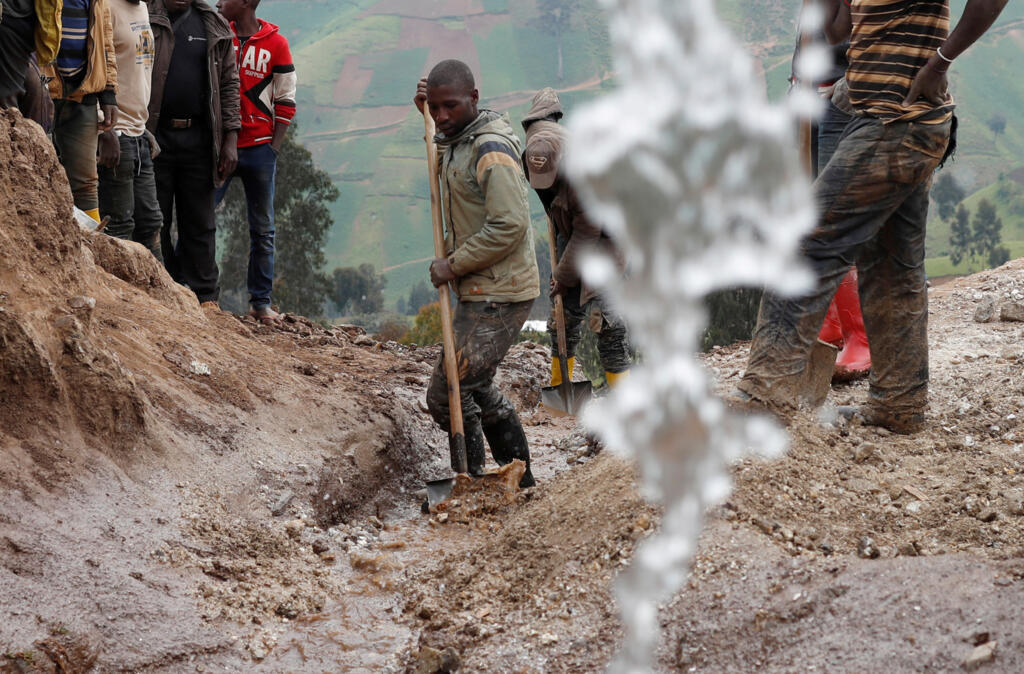
Miners work in a coltan mine in Birambo, Masisi territory, North Kivu Province of Democratic Republic of Congo, 1 December, 2018. © Reuters/Goran Tomasevic

Minerals and security

The move gives the US preferential access to Congolese minerals including cobalt and coltan – which are essential for batteries, electronics and defence manufacturing.

Washington says the arrangement will help stabilise eastern Congo while reducing US reliance on China for critical minerals.

In early February, the United States stepped up efforts to secure critical mineral supply chains. Secretary of State Marco Rubio convened 54 countries and the European Commission for talks on critical minerals, attended by Tshisekedi and six other African delegations.

Last December, while celebrating his “America First” foreign policy, Trump told supporters: “I actually stopped the war with Congo and Rwanda. And they said to me, ‘Please, please, we would love you to come and take our minerals.’ Which we’ll do.”

The agreement has triggered debate in Congo about sovereignty, oversight and who benefits from the country’s mineral wealth.

RFI spoke to Maurice Carney, who heads Friends of the Congo, a Washington-based organisation supporting the Congolese lawyers and civil-society groups behind the constitutional challenge.

RFI: The Trump administration is selling this agreement as a big win for both the Americans and the Congolese. Trump said Tshisekedi and he signed the largest minerals deal in US-Africa history. How is it violating the Congolese constitution?

Maurice Carney: It violates various aspects of the constitution, in particular section 214, which states that international agreements should go through the Congolese parliament and may even be subjected to a referendum. The lawyers are arguing that this never happened.

It hasn’t been presented to parliament, even though the agreement calls for changes in Congo’s laws, fiscal policy, mining laws and quite possibly constitutional changes.If you look at what has unfolded over the past year in Congo’s market, the Congolese government instituted a ban on cobalt because it felt the Chinese were flooding the market and wanted to rein in cobalt exports, which it was able to do successfully.

Now, according to this agreement with the United States, if Congo wanted to do that again in the future, it would be required to report quarterly to the US ambassador in Kinshasa about any fiscal or trade policy changes it would like to make. It would also have to be presented to the Joint Steering Committee for discussion and consensus.

The Joint Steering Committee of this agreement is made up of five US representatives and five DRC representatives.

The Democratic Republic of Congo is the world’s largest producer of cobalt. © Getty Images


RFI: Is Trump or the Trump family personally gaining from the strategic partnership agreement with DRC, given reports documenting how Trump and his family have profited since his accession to the White House, reaping billions shadowed by conflicts of interest?

MC: I know there are groups here in Washington doing investigative work to see whether Trump and his family are benefiting, but they haven’t released their reports yet.

We do know that people close to him are lined up to benefit from some of these investments. For example, Bloomberg News has reported that former campaign finance co-chair Gentry Beach, who runs a company in Texas, is preparing to invest in the Rubaya coltan mines currently under occupation by the M23 and Rwandan soldiers.

RFI: China is made to look like a big bad wolf, thriving in eastern DRC’s unstable environment, according to Congressman Ronny Jackson, keeping American companies out by colluding with Kinshasa to impose unreasonable taxes on them. How fair and sustainable do you think the US will be compared with China?

MC: That’s a good question. I think the characterisation of China is really a mischaracterization because China has just been ahead of the United States. It has been willing to go into the Congo where the United States has not.

The United States had one of the largest copper and cobalt mines in the Congo through its company Freeport McMoRan and had ownership of the Tenke Fungurume mines. They sold them on the market and China bought them.

So the US is trying to play catch up. We don’t know the extent to which it will be successful. But certainly, China hasn’t been a bad actor.

It has done business with the Congolese government and negotiated with the Congolese government. That’s what there is to it.

As for the agreement that’s been signed, the United States has laws and standards, and we don’t see them being applied. For example, when entering into agreements abroad around minerals, we usually seek prior and informed consent from local communities. Local communities in Congo have been excluded from all these discussions.

There are questions of labour rights, human rights and environmental rights, and we haven’t seen any of those pursued by the United States before any of these deals have been signed or money has been distributed.

Some 50 members of Congress wrote to Trump in 2025 calling on the administration to address how the minerals-for-security agreement would deal with labour, human rights, environmental protections and informed consent from local communities. We haven’t seen a response to that letter.


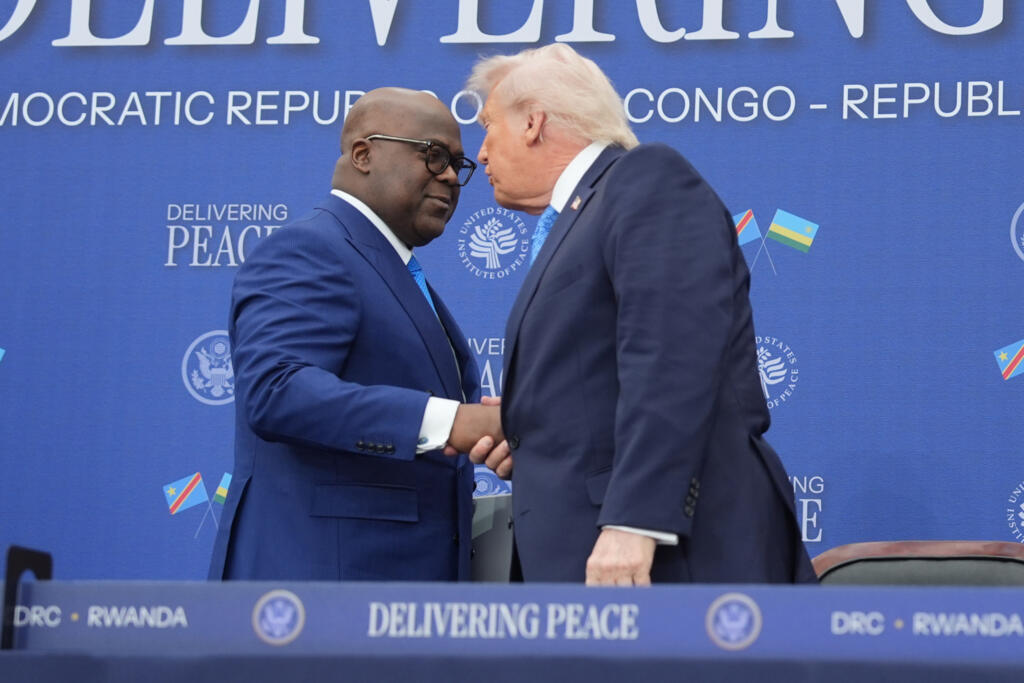
Democratic Republic of the Congo President Felix Tshisekedi (L) shakes hand with United States President Donald Trump (R) at the signing ceremony of the Washington Accords with Rwanda on 4 December 2025. © AP/Evan Vucci

RFI: How is Congo’s rapprochement with Washington affecting relations with China?

MC: China hasn’t said much, and I’m not sure there’s much that can be said.

The Chinese do business differently on a global scale than the United States. They confine themselves mostly to business transactions, economics and trade, whereas the United States gets involved in politics.

RFI: How is that going to translate on the ground, in terms of China’s presence in DRC?

MC: At the moment, it’s a status quo. China got its deals.

The deals aren’t being challenged by the DRC government. In fact, one of the big questions before the agreement was made public was what the DRC had to offer, considering China controls about 80 percent of the copper and cobalt mines in the Congo.

You see that the United States is not able to encroach on those deals, other than the aspect of the strategic partnership agreement that says Congo can offer its minority stake in existing deals.

If you look at the deals being established, the US government has had to, for example with the Orion and Glencore deal, establish joint partnerships.

In fact, the US doesn’t even have mining companies there. They’re setting up and trying to catch up. China is in the pole position, so to speak.

The big question is whether the United States will be able to catch up. China is far ahead, not only in minerals extraction but also in processing and refining across the supply chain.

RFI: Is the US government investing more than American private companies in DRC through this agreement?

MC: Absolutely. The US government is taking the lead and investing in two areas. One is the mines for critical minerals. The second is infrastructure to ship those minerals out, particularly through the Lobito Corridor in Angola.

What we see unfolding is not just memorandums of understanding and agreements, but money and investment flowing directly from the US government. We’re up to around 3.8 billion dollars lined up to be invested through the International Development Finance Corporation.

This interview has been lightly edited for clarity


Cambridge University museum set to return Benin bronzes to Nigeria

A Cambridge University museum will shortly return around 100 Benin bronzes to Nigeria as part of a major restitution initiative, the UK's weekly newspaper the Observer has reported.


Issued on: 10/02/2026 

Benin Bronzes exhibited at the National museum Onikan in Lagos on 21 June, 2025. AFP - TOYIN ADEDOKUN

By: Melissa Chemam with RFI

The institution backed a 2022 claim by Nigeria's National Commission for Museums and Monuments (NCMM) calling for the return of 116 objects looted by British armed forces during the 1897 sacking of Benin City.

The term "Benin bronzes" refers to objects crafted from brass and ivory as well as bronze, which were seized during the colonial-era military expedition.

Among the returned bronzes that will travel in the coming months are wood and ivory sculptures, as well as commemorative heads of King Oba and Queen Mother Lyoba Idia.

The decision follows the formal request from the National Commission for Museums and Monuments in Nigeria (NCMM), made in January 2022, for the return of artefacts.

The University’s Council supported the claim and authorisation from the UK Charity Commission was subsequently granted.

"Physical transfer of the majority of the artefacts will be arranged in due course," the university’s council added.

Seventeen pieces will remain on loan and on display at the museum for three years in the first instance, to be accessible to museum visitors, students and researchers in the UK.
'Pride and dignity'

A return that contributes to "restoring the pride and dignity" of the Nigerian people, according to Olugbile Holloway, Director General of the NCMM.

"By agreeing to cede some of its approximately 500 works from Benin City, the British institution has decided to respond favorably to a request made in 2022 by the Commission," he said.

He added that "the return of cultural items for us is not just the return of the physical object, but also the restoration of the pride and dignity that was lost when these objects were taken in the first place."

Professor Nicholas Thomas, Director of the Museum of Archaeology and Anthropology, in Cambridge said: “It has been immensely rewarding to engage in dialogue with colleagues from the National Commission of Museums and Monuments, members of the Royal Court, and Nigerian scholars, students and artists over the last ten years."

Over the period, support has mounted, nationally and internationally, for the repatriation of artefacts that were appropriated in the context of colonial violence, he added.

"This return has been keenly supported across the University community.”

Blood and Bronze: unveiling the British Empire's brutality in Nigeria

European move

The university’s decision is in line with similar commitments made by other UK, US and European museums. The Netherlands also announced last year the restitution of more than 100 Benin bronzes to Nigeria.

Netherlands agrees to return 119 Benin statues to Nigeria

Other institutions in the Uk also agreed to return stolen artefacts to Ghana.

These returns come as pressure mounts on Western museums and institutions to address the restitution of African artefacts plundered during colonial times by the USA, France, Germany and Belgium.

French senators adopted a bill in January to simplify the return of artworks looted during the colonial era to their countries of origin.

However, the British Museum still refuses to return part of its collection.