Wednesday, January 21, 2026

Trump actively dismantling the international rules-base order
Trump actively dismantling the international rules-base order
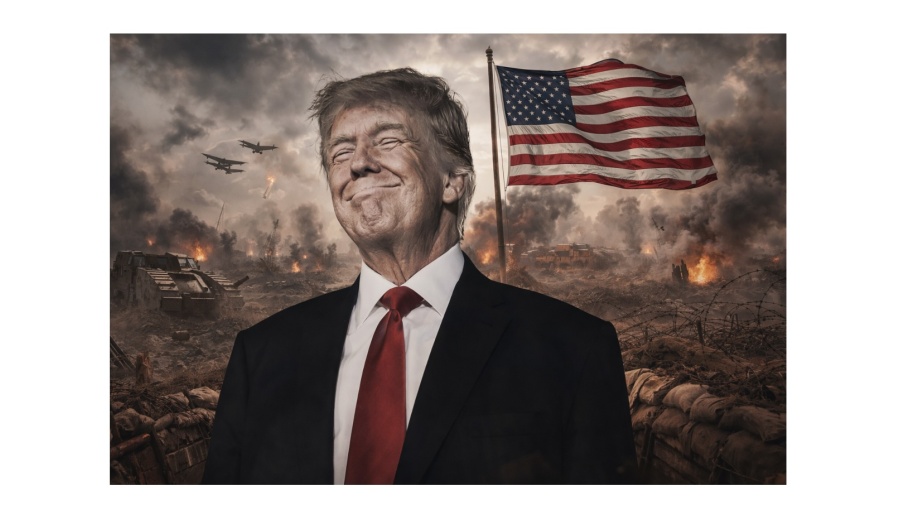
US president Trump is systematically dismantling the international order and may provoke a major trade war with Europe that will hurt everyone. / bne IntelliNews
By Ben Aris in Berlin January 21, 2026

Trump is actively dismantling the international rules-based order, dismantling or sidelining the multinational institutions that have been built up since the end of WWII, and put himself personally in charge of running the world.

This process has been unfolding for a year already. It started in Ukraine when he conflated the principled support for Ukraine’s stand against Russian aggression with business deals.

As part of his 28-point peace plan (28PPP) was a proposal to seize the Central Bank of Russia (CBR)’s frozen $300bn in reserves and create a $100bn Ukraine restoration funds and another $200bn US-Russia investment fund for commercial joint venture projects – a major sop for Russian President Vladimir Putin and a de facto rehabilitation of Russia into the international community. In addition, Trump tied any support for Ukraine to the minerals deal that was signed on April 30 and gave significant concessions to US companies, but offered no critical security guarantees in return whatsoever.

That episode could still be sold as a “pragmatic” solution to winning over US support for Ukraine’s fight to regain control over its sovereign territory, but with the decapitation of Venezuelan President Nicolás Maduro’s regime on January 3 all pretence at following the rules was dropped.

America’s early morning bombing and helicopter assault on Caracas. The kidnapping of a sitting president. The cold-blooded execution of 100 Venezuelan presidential guards and their Cuban colleagues. And Trump’s open admission that the entire operation was all about grabbing control of Venezuela’s oil. This was all totally illegal under international law and flies in the face of the UN Charter that is supposed to be the bedrock of the international order.

To add insult to injury, Trump’s decision to hand over the concession to dispose of 50mn barrels of oil seized as part of the raid to his mega-donor Vitol, the world’s largest independent oil trader, to dispose of was a corrupt insider deal worthy of the Kremlin and Putin’s sweetheart deals for his inner circle of stoligarchs.

Trump is becoming bolder and bolder as he asserts his transactional approach to geopolitics. The emerging new economic paradigm is a return to nineteenth century imperialism where might-makes-right is the new rule book. This was codified in the recently released National Security Strategy (NSS) where the trans-Atlantic shared values “special relationship” that has driven US-EU relations since the end of WWII is over. Europe has been downgraded to simply being a US market and the White House has openly said it will interfere with European domestic politics, favouring the parties of the far-right. The upgraded Monroe Doctrine that is spelled out in the NSS is a reassertion of “America First, and everyone else last”.

The latest escalation is even more extreme. All coming one on top of the other, Trump is now proposing to send in 100,000 troops to Greenland, which has a population of 57,000 people, to take control of the country for the sake of US “national security” needs. It will be the easiest invasion ever, as US soldiers will outnumber the unarmed Greenlanders five-to-one and can simply walk into the parliament building without firing a shot.

Trump has justified this plan by claiming that Russia and China “may” annex the island, which is complete nonsense. China’s foreign ministry issued a statement this week, calling on Trump to drop the “fake China-threat” argument, used to justify his own “selfish” ambitions.

Russia has never expressed any interest in Greenland either, but has bitterly objected to Trump’s proposed annexation of Greenland. The idea of US troops establishing bases on the island, which lies on Russia’s northern border creates a security issue for the Kremlin where there was none before – very similar to the Kremlin’s objection of Nato moving into Ukraine on Russia’s western borders, just across from European Russia where 80% of the population lives.

Just the possibility of the US moving missiles into a new “51st state” that could strike Russian missile and military bases deep inside the country, that were previously out of range of European-based Nato munitions, would create a new security crisis where none existed before. Russia would inevitably respond. It invaded Ukraine simply because the US refused to contemplate any exclusion from Nato for Ukraine despite the fact the White House and Brussels have adamantly repeated there was never any plans to allow Ukraine into Nato. Turning Greenland into a US militarised proxy, even if no more bases are built and no troops are stationed there, is a giant step on from any possible Nato-proxy threat Ukraine poses to Russia.

The implications of a US annexation of Greenland are too grim to contemplate. One Nato country attacking and annexing another Nato country spells the end of Nato. It flies in the face of the UN charter. It makes the US the enemy of Europe, more aggressive and threatening than Russia or China. Putin has invaded Ukraine which is neither a member of the EU nor Nato. Trump would have invaded Greenland, which is a member of both.

A US annexation of Greenland means there are no rules at all anymore. But that was already clear after Trump ordered the kidnap of Maduro purely so he could seize Venezuela’s oil.

Peace Council

Trump’s efforts to dismantle the international order are no longer haphazard or piecemeal. As the process goes on, it is becoming systematic and it is escalating.

2025 was characterised by a series of ad hoc measures, but as his confidence grows he is now attempting to institutionalise the process. The latest initiative is to set up a “Board of Peace” that is an attempt to sideline the UN and silence the voices of all the other countries in the world in the process.

This could trigger a new and extreme crisis. Europe, in particular, has been put in a desperate position where it now has to choose to either stand up to Trump and stick to its principles or trigger a debilitating trade war.

Europe’s collective economy is already flat on its back due to the boomerang effect of the Russian sanctions. France is facing a major budget deficit crisis it has lost control of. Germany’s economic model has been wrecked by the end of cheap Russian gas and has been in recession for three years now. And the UK is being strangled by its mounting and increasingly unsustainable debt burden.

The game is in play in Davos where European leaders are due to meet Trump in the next few days and have an almost impossible choice to make.

Trump is proposing to set up a conflict resolution body, the Board of Peace, with himself as chairman and retaining veto powers over any decision the council reaches.

We don’t need a Peace Council. We already have one. It’s called the UN. And everyone is already a member of that. Trump is actively trying to usurp the UN and put himself personally in charge of running the world. If Russian President Vladimir Putin had done this, he would be called a fascist and compared to Hitler.

So far invitations to join the Peace Council have been extended to 60 countries. (The UN has 193 members.) Countries that have already said yes include UAE, Kosovo and Israel. Belarus President Alexander Lukashenko gleefully signed off on accepting his invitation yesterday. Russia has also been invited but the Kremlin is still thinking about it. (The Kremlin has always said the UN is the appropriate body to run a multipolar world.)

Other countries that have reacted positively to the idea include Hungary, Vietnam, Kazakhstan, Argentina, Morocco and Canada. Those that have already definitely rejected the invite include France, Norway and Sweden. Notably, Brussels has yet to comment. Trump says he only needs three countries to say yes to set the Council up.

The foundation of the rules based international order was established by the UN Charter signed in 1945 that was designed to prevent another world war. It commits members to sovereign equality, non-use of force, territorial integrity, and peaceful settlement of disputes. The economic and financial governance was covered by the Bretton Woods deal in 1944 and trade by General Agreement on Tariffs and Trade (GATT) in 1947.

Trump has already withdrawn from multiple UN institutions, most notably the Paris Climate Agreement. But that process is now accelerating, after he recently cancelled the US membership in 66 international institutions, 31 of them UN bodies including the UN Human Rights council and WHO. On economics he has threatened to punish any country that tries to drop the dollar and on trade he is using the US status as a major trade partner to weaponize tariffs with his poignantly named Liberation Day tariff regime.

The construction of an international order has been going on since the end of WWII. A major plank in this effort were Helsinki Accords signed in 1975 by 35 states, specifically including the US and the Soviet Union that codified the rules and stabilised tensions during the Cold War.

The Accords emerged from the Conference on Security and Co-operation in Europe (CSCE) that set post-war borders in Europe, and created rules for coexistence between East and West. Crucially, they linked security, economic cooperation, and human rights into a single framework in three “baskets”: the inviolability of existing borders in Europe; trade and economic cooperation; and guarantees for human rights and fundamental freedoms

Trump is proposing to throw all this work out of the window and Europe, as the leader of the values-based system, is now facing an existential choice.

French President Emmanuel Macron summed up the issues in his speech delivered in Davos on January 20. Wearing sunglasses to conceal his eye condition, the president warned that the world is entering a phase of “increasing instability”.

“International law is trampled underfoot and the only law that seems to matter is that of the strongest,” he told the assembled captains of the global economy.

“We are approaching a world without rules,” he cautioned, in a speech marked by explicit references to the return of “imperial ambitions” and the “normalization of conflict as a political tool.”

Former Nato Secretary General Anders Fogh Rasmussen put it even more bluntly: "The time for flattery of Trump is over."

Should I stay or should I go?

Following the raid on Caracas, the threats of bombing Iran (which still might happen next week) and now the potential invasion of Greenland, the EU’s policy of appeasing Trump is facing a litmus test. Trump has largely ignored all European demands and entreats so far. Europe is coming up to a red line where it may be forced to take retaliatory trade action itself. Putin and Chinese President Xi Jinping must be looking on in amazement.

But European leaders are split on Trump's offer to join the Peace Council and the issue will only deepen the already increasingly divided EU. It is clear that France will fight back, but for countries like Britain, which is not an EU member, London may choose to fold and attempt to revive its own “special relation” with the US, forged in the days of the Margret Thatcher, Ronald Reagen double act. Hungarian Prime Minister Viktor Orban and Slovak Prime Minister Robert Fico will go with Trump. The Nordic states will oppose him.

The Peace Council has already undermined Western unity in the Ukraine conflict. Lukashenko was delighted by the offer and leapt on the possibility to reagitate Belarus’ return to the, albeit Trumpian, international order. (Although he also made it clear he was not going to pay the $1bn membership fees Trump is demanding.)

Trump is clearly narked by Macron’s criticism and leaked private messages from Macron in which the French president proposed organizing a G7 summit in Paris, even with the possibility of inviting Russia on the sidelines of the meeting, which would have marked the first high-level rapprochement since the start of the war in Ukraine. In Davos, Macron denied any such meeting was planned and avoided elaborating on the episode.

Polish Prime Minister Donald Tusk is another one that is calling for a showdown. He urged European countries to resolutely defend their interests amid “blackmail” by Trump. Tusk, without directly mentioning either the US or Trump, called on European partners to stop "appeasement" and to defend their interests more firmly.

"Appeasement is always a manifestation of weakness. Europe cannot afford weakness - neither towards enemies nor towards an ally. Appeasement ends with a lack of results - except humiliation. At this time, European perseverance and confidence are very much needed," the Polish Prime Minister noted.

The choice is between economic wellbeing and points of principles. The US-Europe trade pair is the biggest in the world with over $1 trillion of annual turnover. At the same time, they have also the heaviest mutual foreign direct investment (FDI) of some $5 trillion investment stock in each other’s country – the fruits of 80 years of that special relationship.

A major trade war would wreck this relationship permanently with major economic consequences.

Now we are waiting to see what will happen next. Trump is firing his first salvos, threatening to put 10% on European countries that do not join the Peace Council, and singled out France for a 200% tariff on champagne.

The EU has already prepared its own retaliatory package of tariffs that target things like US-made motorbikes and bourbon whiskey in case Trump rolls out his threatened 10% additional tariffs on top of the 15% already conceded by European Commission President Ursula von der Leyen last year. However, if things escalate, Brussels has its "trade bazooka" in reserve: a set of regulations that could freeze US companies out of the European market entirely.

 

Trump says US and NATO reach framework for Greenland deal, suspends tariffs on Denmark

Trump says US and NATO reach framework for Greenland deal, suspends tariffs on Denmark
Donald Trump in Davos meetings has changed directions on Greenland. / bne IntelliNews
By bne IntelliNews January 21, 2026

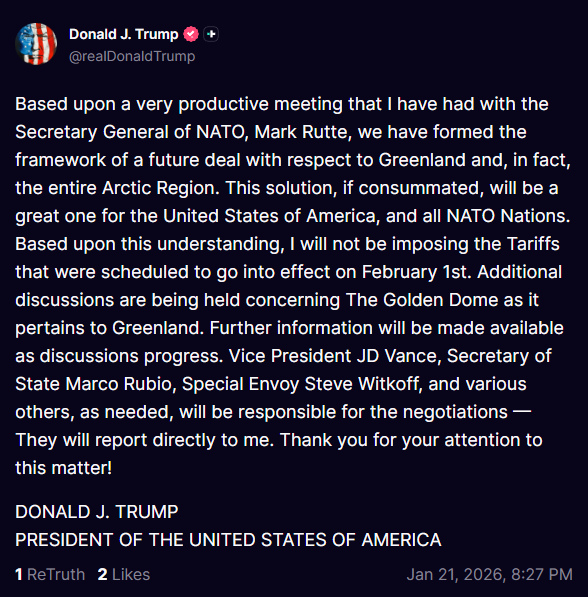
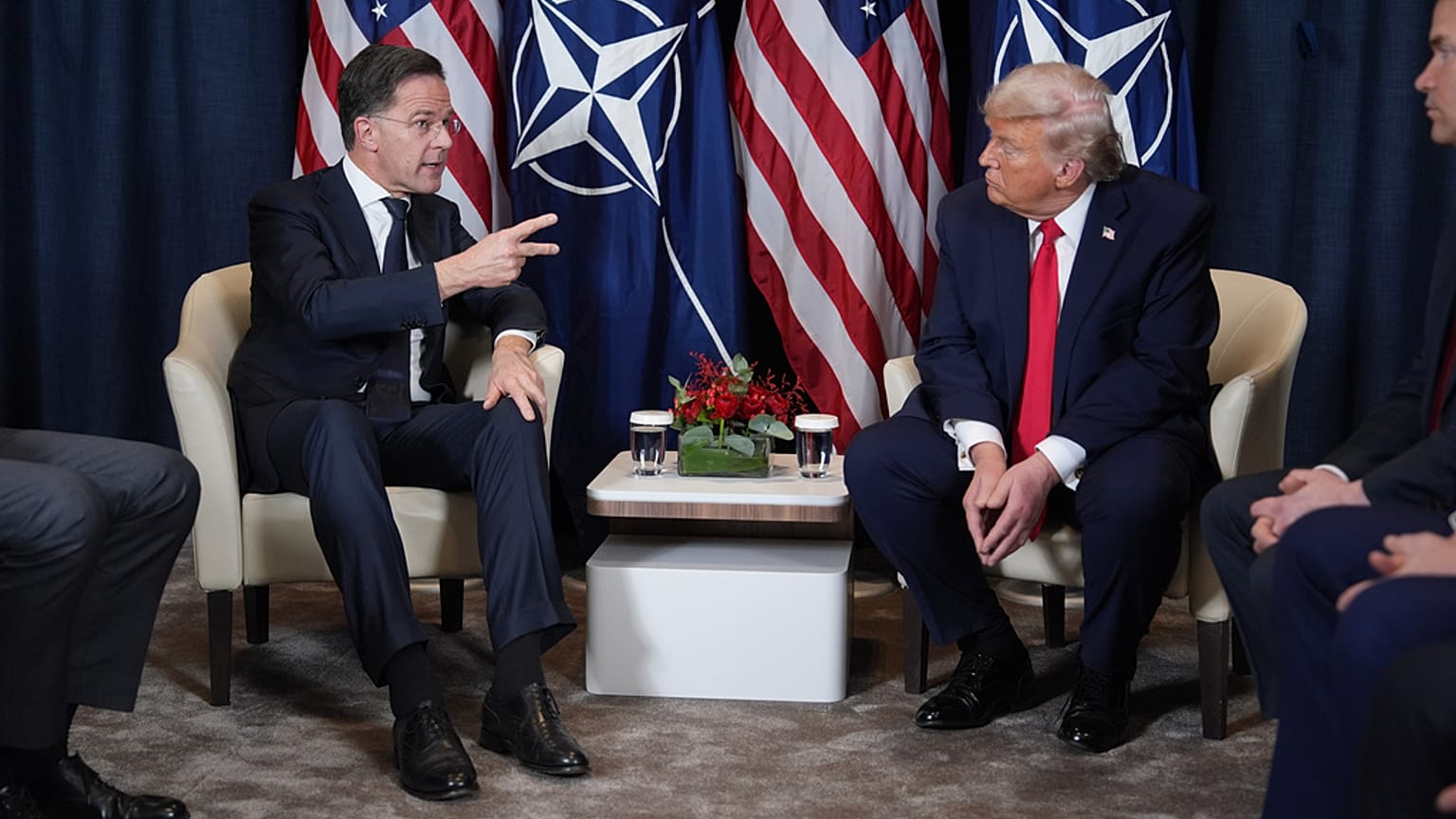
US President Donald Trump announced the United States and NATO have formed the "framework of a future deal" regarding Greenland and the Arctic region following a meeting with NATO Secretary General Mark Rutte, stating he will not impose tariffs on Denmark that were scheduled for February 1.

"This solution, if consummated, will be a great one for the United States of America, and all NATO Nations," Trump said in a statement posted on social media, Truth Social, on January 21.

Trump said additional discussions are being held concerning "The Golden Dome as it pertains to Greenland" and that Vice President JD Vance, Secretary of State Marco Rubio, Special Envoy Steve Witkoff and various others will be responsible for negotiations, reporting directly to him.

The announcement represents a significant development in Trump's pursuit of acquiring Greenland, an autonomous Danish territory, which he has repeatedly expressed interest in controlling for strategic and resource reasons.

The president said the framework emerged from what he described as a "very productive meeting" with Rutte. Trump did not provide specific details about the nature of the agreement or timeline for finalising the deal.

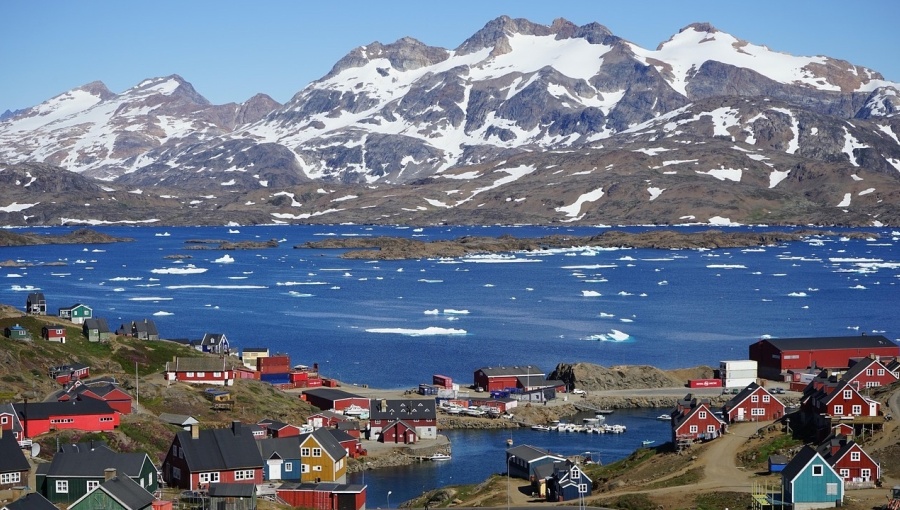
Greenland, home to a major US military installation at Thule Air Base, has strategic importance for Arctic operations and contains significant mineral resources. The island has been part of the Kingdom of Denmark since 1721, though it gained home rule in 1979 and expanded self-governance in 2009.

Danish officials have previously rejected Trump's interest in purchasing Greenland, with former Prime Minister Mette Frederiksen calling the idea "absurd" in 2019 during Trump's first term.

Trump's decision to suspend the planned tariffs on Denmark comes as his administration has threatened trade measures against various countries. The president did not specify what tariffs were scheduled for February 1 or provide details about trade disputes with Denmark.

Trump suspends European tariffs after 'framework' Greenland deal agreed

US President Donald Trump meets with NATO Secretary General Mark Rutte during a meeting at the World Economic Forum in Davos, 21 January 2026
Copyright AP Photo

By Aleksandar Brezar
Published on 

The announcement came hours after Trump's Davos speech, where repeated the US needed Greenland for national and global security, and said NATO members they could agree to US control and "we'll be very appreciative."

US President Donald Trump announced late Wednesday he would not impose tariffs on eight European nations scheduled to take effect on 1 February, citing progress in talks with NATO Secretary-General Mark Rutte on Greenland in Davos.

Trump said the two leaders reached "the framework of a future deal with respect to Greenland" during what he described as productive discussions, and declared the potential agreement would benefit the US and all NATO members.

"Based upon this understanding, I will not be imposing the tariffs that were scheduled to go into effect on 1 February," Trump wrote on Truth Social.

The tariffs, announced days before the World Economic Forum, were set to start at 10% on goods from France, Germany, the United Kingdom, Denmark, Sweden, Norway, the Netherlands and an eighth country, with rates climbing to 25% by June.

Trump had demanded the levies remain until European nations supported US acquisition of Greenland from Denmark.

Trump said US Vice President JD Vance, Secretary of State Marco Rubio, Special Envoy Steve Witkoff and other officials would handle negotiations, reporting directly to him.

The announcement came hours after Trump's Davos speech, where repeated the US needed Greenland for national and global security, and said NATO members they could agree to US control and "we'll be very appreciative."

Trump also excluded the possibility of the US using force to take control of the Arctic island.

Rutte had urged "thoughtful diplomacy" during his own Davos remarks Wednesday, acknowledging tensions within the alliance whilst expressing commitment to finding solutions on Greenland.

Trump had earlier this week published a private message from Rutte pledging to work toward a resolution.

The tariff threats had triggered emergency EU meetings scheduled for Thursday and discussions of retaliatory measures. French President Emmanuel Macron had advocated activating the EU's anti-coercion instrument, while European Commission President Ursula von der Leyen warned the bloc's response would be "unflinching, united and proportional."

Trump's Greenland campaign has opened the deepest rift between Washington and its European allies in decades.


 Tariff threat over Greenland risks spillover to Central and Southeast Europe

Tariff threat over Greenland risks spillover to Central and Southeast Europe
US President Donald Trump plans to impose tariffs on European countries that oppose his demand for Washington to take control of Greenland.
By bne IntelliNews January 21, 2026

A fresh transatlantic trade confrontation triggered by US President Donald Trump’s threat to impose sweeping tariffs on European allies over Greenland is raising concerns about economic fallout across the European Union, with Central and Southeast European member states likely to feel the impact indirectly through weaker demand from Germany and broader financial market turbulence.

Trump has vowed to “100%” follow through on his threat to impose tariffs on European countries that oppose his demand for Washington to take control of Greenland, a semi-autonomous territory of Denmark. European allies have rallied behind Denmark’s sovereignty, with Copenhagen’s foreign minister warning that the US president “cannot threaten his way to ownership” of the Arctic island.

On January 19, Trump declined to rule out the use of force and said he would proceed with tariffs on goods arriving in the United States from EU members Denmark, Finland, France, Germany, the Netherlands and Sweden and fellow European countries Norway and the UK. 

The eight countries had issued a joint statement on January 18, warning of escalation following US tariff threats. 

He wrote on his Truth Social platform: “Greenland is imperative for National and World Security. There can be no going back — On that, everyone agrees!”

Trump has said he will impose a 10% tariff “on any and all goods” sent from the eight countries from February 1, rising to 25% from June 1, unless Denmark agrees to sell Greenland to Washington.

Denmark has warned that any US military action in Greenland would spell the end of Nato. Several European countries have in recent days sent small troop contingents to Greenland in a largely symbolic show of solidarity.

German Chancellor Friedrich Merz said the tariffs would benefit no one and expressed hope of meeting Trump during the World Economic Forum in Davos.

“We do not want this escalation. We do not want a trade dispute with the United States of America,” Merz told a press conference on January 19, newswires reported.

The European Union is set to hold an emergency summit in Brussels on January 22 to discuss its response. EU foreign policy chief Kaja Kallas told the European Parliament the bloc had “no interest to pick a fight, but we will hold our ground”.

“But trade threats are not the way to go about this,” she added. “Sovereignty is not for trade.”

Global markets sold off sharply on January 20 as investors feared a renewed US-EU trade war, recalling the economic damage caused by previous tariff disputes in 2025.

The S&P 500 fell 2.1%, its worst day since October, while the Nasdaq dropped more than 2.4% and the Dow Jones lost around 870 points. European markets also declined for a second day, with Germany’s DAX down 1% and the pan-European STOXX 600 falling 0.7%.

In 2025, earlier rounds of US-EU tariffs weighed on export-oriented economies across Europe, cutting growth forecasts, raising costs for manufacturers and weakening business confidence. This had an effect on Central and Eastern Europe, which is deeply embedded in German-led supply chains.

Fitch Ratings said in a report on January 19 that Germany would be the economy hardest hit by any new round of tariffs, with knock-on effects for its regional trading partners.

“The threat of Greenland-related US tariffs on European allies and European retaliatory measures … signifies a serious upsurge in transatlantic tensions, posing risks to trade and growth,” the rating agency said.

Fitch estimates that a 10% tariff could reduce European GDP by about 0.5% by end-2027, and that a 25% tariff would roughly double that impact. For Germany, GDP could be 0.8-0.9% lower under a 10% tariff scenario, and nearly twice that under a 25% shock.

“Germany, where we forecast GDP growth of 1.2% this year and 1.4% in 2027, would be hardest hit,” Fitch said.

Think tank Bruegel said in a statement that Trump’s move amounted to economic coercion. “It is difficult to think of a clearer case of economic coercion in breach of international law,” Bruegel said.

Fitch also said implementation was uncertain, as Trump would likely rely on the International Emergency Economic Powers Act (IEEPA), which is currently under review by the US Supreme Court.

Beyond trade, Fitch warned that the biggest long-term risk was geopolitical.

“Outside the trade and growth hit from tariffs, the main potential sovereign credit impact … is from the implications for the viability of Nato and the credibility of its collective defence commitment,” it said, adding that tensions could raise defence spending pressures across Europe and increase vulnerability to hybrid threats from Russia.

Impact in CEE and SEE

For Central and Southeast Europe, the damage would come mainly through Germany, which is the region’s largest export destination and a key hub in automotive, machinery and electronics supply chains.

Baltic states

Although Latvia, Lithuania and Estonia were not among the eight European countries that issued the joint statement on January 18, they have publicly aligned themselves with the message supporting Denmark.

Support for the joint position was confirmed on social media by Latvian Prime Minister Evika Siliņa, Lithuanian President Gitanas Nauseda and Estonian Prime Minister Kristen Michal, signalling Baltic solidarity with Denmark and wider European partners.

For Estonia, Latvia and Lithuania, any escalation would be felt mainly through indirect channels. While direct exports to the United States are limited, the Baltic economies are tightly integrated into EU supply chains, meaning tariffs could weaken demand from key partners such as Germany and weigh on manufacturing and growth. Previous US-EU tariff disputes, including measures imposed during the Trump administration, increased costs for exporters and undermined business confidence, with some estimates suggesting a full-scale tariff conflict could cut up to 0.5 percentage points from Lithuania’s GDP growth.

As small, open economies, the Baltic states continue to favour a coordinated EU response and negotiated solutions, but the episode highlights their exposure when trade tensions intensify between larger powers. 

Bulgaria

A EU-US trade conflict over Greenland could have a knock-on effect on Bulgaria through its integration into European supply chains, even though the United States is not a major trading partner. Any escalation would hit Bulgarian exporters indirectly, as key partners such as Germany and Italy could face higher costs or weaker demand, weighing further on Bulgaria’s already strained trade balance.

Previous US tariffs have had a measurable impact on Bulgaria. Bulgaria’s economy ministry last year put the total hit to exports at about €620mn, with direct losses of €468mn and significant spillovers from EU trade. Exports to the United States were expected to fall by nearly one-third, shaving around 0.35% off GDP in 2025, despite the US accounting for only 3.3% of Bulgarian exports. The larger risk lies in prolonged disruption to EU demand, as elevated US tariffs on European goods dampen growth prospects for export-oriented economies like Bulgaria.

Defence Minister Atanas Zapryanov said on January 21 that Sofia does not plan to send Bulgarian military personnel to participate in the exercise in Greenland, Bulgarian National Radio reported.

Croatia 

Croatian Prime Minister Andrej Plenković said on January 20 that Croatia supports dialogue with the United States and stands in solidarity with Denmark over initiatives related to Greenland, warning that careless rhetoric could harm transatlantic relations.

Speaking after his first day at the World Economic Forum in Davos, Plenković said Croatia’s position was “solidarity with Denmark and a reasonable solution through dialogue with the United States of America”. 

The previous round of tariffs did not have a significant direct impact on Croatia, which is less dependent on manufactured exports than many of its regional peers, given its large tourism and services sector. However, it may be affected via a broader European slowdown, particularly in key partners such as Germany.

Czechia

The Czech finance ministry recently upgraded its 2026 growth forecast to 2.4%. However, the figures were released on January 19 just as the latest escalation in the trade wars between the US and EU began to pick up. Trade war escalation led to a series of worsening forecasts for the export-oriented Czech economy last spring, and this could be repeated in 2026 if a tariff war is not averted.

Czechia’s populist Prime Minister Andrej Babiš downplayed the Greenland dispute, saying he had bought a globe for for CZK15,000 (€618) to “exactly know where Greenland is” and that “arguments of President Trump about China and Russia are relevant, and agreement needs to be made.”

Hungary

Hungary, which has sought to cultivate strong political and economic ties with Washington, has refused to endorse a joint EU stance on the escalating diplomatic tensions over Greenland, marking a break with its EU partners on the issue.

Foreign Minister Peter Szijjarto said Budapest views the matter as a bilateral issue that should be resolved through direct negotiations between Washington and Copenhagen. The government has not responded to Trump’s threats to impose higher tariffs on more than half a dozen EU countries for opposing his ambition to take control of Greenland.

In line with Washington, Budapest has criticised the US-EU trade agreement reached last year as unfavourable to the bloc. Existing tariffs, including a 25% duty on vehicles and other products, have weighed on Hungary’s export-oriented economy, particularly the automotive sector, though their impact has been mostly indirect. Hungary’s direct exports to the United States remain limited, with negative effects felt primarily through the slowdown in the German economy.

Poland

Poland has avoided sending troops to Greenland and has sought to maintain close ties with Washington. Warsaw has been careful to avoid any direct rebuke of the US and instead stressed Poland’s focus on alliance cohesion.

“Poland looks after what is essential for our security, which is cooperation among allies with the US at the forefront. There is no Nato without the US Poland’s role is to connect,” Deputy Prime Minister Władysław Kosiniak-Kamysz said.

Denmark, “which we respect very much”, has exclusive rights over Greenland and should reach an understanding with Washington, Kosiniak-Kamysz also said. 

“Among friends, there can be differences of opinion and emotions, but there must be no differences about the goal, which is building security,” the minister added.

But the US’ new security strategy, published in December, rattled Poland by apparently plotting to weaken the EU by breaking it up merely into a group of “sovereign nations”. 

Poland has long relied on the US as its foremost security partner, having hosted US troops on its soil and spent tens of billions of złoty on American equipment.

“Dear American friends, Europe is your closest ally, not your problem … Unless something has changed,” Prime Minister Donald Tusk addressed the US on social media at the time.

Romania

In line with the position of President Nicusor Dan, Foreign Minister Oana Toiu avoided taking sides in the conflict between the European Union and the United States, prompted by Trump’s decision to take over Greenland “one way or another” — a conflict in fact not mentioned by either Toiu or Dan in their public communications. 

Security and subsequent macroeconomic stability (cost of financing) impacts of the developments outweigh the trade implications of tariffs mentioned by Trump.

For Romania, which hosts US military assets on its territory and largely depends on the security provided by the alliance, given its proximity to Russia and weak military endowment, a weakening of the alliance followed by a weaker stance on the Eastern Flank is a worst case scenario to be avoided at any cost.  Macro-economically, the first transmission channel is the cost of financing and the fiscal consolidation gains under these circumstances, more than economic implications.

"From our perspective, Romania's next steps must be de-escalation steps. Romania has a very clear interest in strengthening Nato, it has a very clear interest in the transatlantic relationship, both in terms of security and economic components,” Toiu told Euronews.

In a brief and ambiguous message posted on X, Dan reacted to the rising tensions between the United States and its European partners related to the transfer of Greenland from Denmark to the US. 

“I am deeply concerned by the escalation in public statements between transatlantic partners and allies regarding recent developments. We have to resume talking directly to each other, at the appropriate diplomatic levels,” Dan tweeted. 

Slovakia

The escalation of trade wars between EU countries and the US is expected to inflict a further blow on the Slovak economy, which has already been hit by US-imposed tariffs on imported goods, and which is dependent on Germany as its largest trading partner.

Slovakia is the largest car producer per capita worldwide and Germany is a key destination for its robust car industry.

“We don’t export some of the parts made in the automobile industry directly to the US, but export those to countries such as Germany, which the assemble cars and export those to the US, and would be negatively affected as well,” if Germany was targeted by the new US tariffs, Ján Oravec, chairman of the Inštitút slobody a podnikania (Freedom and Business Institute) was quoted as saying by the state broadcaster STVR. 

Prime Minister Robert Fico, a political ally of Trump, has so far avoided direct criticism of the tariff threat after visiting Trump at his Mar-a-Lago residence. Foreign Minister Juraj Blanár said Slovakia preferred “diplomacy and peace, not tensions or fights”, while reiterating that Greenland was part of Denmark under international law.

Slovenia

US announcements about introducing additional tariffs on the European Union or individual member states are not in the interest of transatlantic relations, Slovenian Prime Minister Robert Golob said, RTV SLO reported.

“Announcements of additional tariffs against the EU or its member states do not contribute to good transatlantic relations. I believe the EU will respond to any possible measures in a unified way,” the Prime Minister’s Office said.

Foreign Minister Tanja Fajon said it was crucial for both the European Union and the European Commission to react clearly and decisively.

“This is a common market, and every step will be extremely important,” Fajon said, warning that the situation could set a dangerous precedent, particularly in relation to Greenland.

Contributions from reporters in Belgrade, Bucharest, Budapest, Prague, Skopje, Vilnius and Warsaw. 

Trump Tariff Threats Drive UK Closer to EU

  • Economists from Capital Economics have warned that President Trump's proposed 10 per cent tariffs on UK goods, tied to the dispute over Greenland, could trigger a recession if the £22 billion impact is felt immediately.

  • The geopolitical fallout from the tariff threat could push the UK to side with the EU, driving a wedge through transatlantic relations and potentially damaging NATO.

  • Market analysts suggest the episode is less about Greenland and more about investors repricing a geopolitical risk premium across global currencies and capital flows due to increased policy unpredictability.

President Trump’s latest tariff package could plunge the UK economy into a recession, top economists have warned, upping the stakes for Keir Starmer as he responds to threats against Greenland. 

The US president warned leading European nations, including the UK, he would slap additional 10 per cent tariffs on goods imports if a deal for Greenland’s annexation was not agreed. 

Analysts at Capital Economics have warned that the new tariffs could trigger a recession for the UK economy if the impact is felt “all at once”. 


The tariff hit could amount to up to 0.75 per cent of UK GDP, equivalent to around £22bn. 

“With the UK economy currently growing by 0.2 to 0.3 per cent a quarter, if this hit came all at once it could trigger a recession,” Capital Economics chief UK economist Paul Dales said. 

“But it’s likely to be spread over many quarters.”

Recession warning issued by City

Economists suggested that there could be an immediate growth spurt in January as firms rushed to boost exports before the 1 February deadline in the same way manufactures kicked into gear ahead of last April’s tariff deadline.

But it remains unclear whether Trump’s new tariffs would ‘stack’ on top of existing ones or whether they applied to all products and undermine the US-UK trade deal. 

Dales added there were questions over whether tariffs were legal pending a US Supreme Court decision on trade, which could be revealed as soon as Tuesday.

The UK’s response to tariffs would also be crucial in calculations around the economic impacts, he said.

“Any attempt by the US to seize Greenland would drive a wedge through transatlantic relations and inflict potentially irreparable damage on NATO.

“In that scenario, it’s hard to imagine the UK not siding with the EU. Arguably, then, the latest tariffs could nudge the UK closer to the EU and further away from the US.”

On Monday, Starmer urged allies to engage in “calm discussion” on trade and diplomatic approaches to Greenland, suggesting risks to the UK were “more direct now than at any time we can remember”. 

Market analysts are weighing up the impacts of Trump’s new geopolitical threats, with eToro’s Lale Akoner suggesting that his threats could deepen “policy unpredictability” and contribute to lowered investment levels. 

“For investors, this episode is less about Greenland and more about a geopolitical risk premium being repriced across currencies, equities and cross-border capital flows in the days ahead,” Akoner said.

By City AM