It’s possible that I shall make an ass of myself. But in that case one can always get out of it with a little dialectic. I have, of course, so worded my proposition as to be right either way (K.Marx, Letter to F.Engels on the Indian Mutiny)
What’s behind the Trump administration’s transatlantic provocations on UK free speech and who does the dark agenda really belong to?
The ‘free speech’ debate is wrapped in confusion. Political commentators agonise over questions such as ‘ Does the UK really have free speech? Are we too strict? Not strict enough? How can the US be so self-contradictory? And how do we negotiate with the US in this incredibly difficult and sensitive territory?
Donald Trump’s attitude to the free speech debate seems baffling. We witness the glaring contradiction of his administration relentlessly condemning European countries for restricting free speech, allegedly in a North Korean way, whilst simultaneously silencing dissenters, including their own news media and beloved comedians.
We can’t credit Trump with a logical brain, but the hypocrisy is barefaced. We feel equally bewildered on hearing Trumpworld expressing grief and rage at so-called ‘radical left attacks’ such as Charlie Kirk’s murder, whilst barely registering cases where the politics are reversed, like the far-right extremist Vance Boelter’s recent murder of a Democrat lawmaker. No flags were flown at half-mast. Trump could barely recall it. What’s behind this preposterous hypocrisy?
The US first amendment on free speech is regulated in areas such as obscenity, child pornography, certain employment and other legal contexts. But the amendment fully protects hate speech. It’s a slightly grey area since speech that incites imminent lawless action or “potential violence” isn’t protected.
However, most of what would qualify as hate speech in other western countries is “legally protected” in the US. As regards the specific domain of hate speech, speakers have an absolute right to express any opinion about other people or institutions, however dangerous. In this domain, speech contains no red lines; anything goes.
This absolutist notion of hate speech binds it to other parts of the American psyche, including prevailing culture of r contempt for gun control. The freedom of citizens to speak and act as they please must be ring-fenced, whether or not it leads to harm, and should have the same unfettered, wild-west powers as the right to bear arms. To be truly American, words like guns, should remain unrestricted.
By contrast, in the UK and elsewhere, hate speech is regulated, a restraint which embeds two reasonable assumptions: Hate speech is a punishable offence because it is capable of causing psychological harm. Being told ‘you should be raped’ is a harmful speech act, whether rape happens or not.Even if we dispute the capacity of hate speech in itself to cause harm – the ‘it’s only words’ argument – it can trigger harmful physical actions. It’s why the court jailed Lucy Connolly for suggesting migrant hotels should be set alight, and why online attacks on MPs mean they need increased physical security. Jo Cox was murdered because ‘mere words’ led to a physical act. Moral ladders and the free speech continuum
Regulated hate speech is vastly more complex and controversial than the absolute freedoms US haters enjoy because it is constrained by moral norms. What counts as morally acceptable occupies a response continuum and becomes relativised to who is speaking. At one end of the continuum is speech which is unacceptable to almost everyone (for example, endorsing paedophilia). One step further along we have e.g. rape threats, unacceptable to most (though secret chat happens about both activities).
Further along is, for example, racially abusive speech. At this point consensus starts to crumble on what constitutes hate speech and what should be penalised. Racists justify their verbal attacks using a muddled set of grounds: ‘it’s just words and so isn’t harmful’; ‘it’s just an emotional expression of legitimate frustration’; ‘it’s true (and therefore should be said)’; ‘regardless of whether or not it’s true or harmful, punishing me is a violation of my right to free speech’.
This messy grab-bag of excuses is often deployed, tacitly or explicitly, jointly or in part, to justify the use of hate speech.
When we move to the domain of, for example, anti-trans or misogynist hate speech the picture becomes even cloudier, with some believing its wrongness isn’t up for debate , and others claiming that it absolutely is. Disparate starting points
Here, one person’s hate speech is another’s reasonable debate topic. Thus ‘trans person x isn’t a woman’ is, for some, a putative fact, for others, a discussion subject, and, for others, an instance of hate speech that undermines x’s core sense of identity and encourages dangerous anti-trans behaviour. Different groups are at different points on the moral ladder and hence occupy different positions on what counts as acceptable.
The domain of acceptability in hate speech constantly changes cultural shape but is expanding alarmingly with the rightward shift in attitudes. ‘Ethnic minorities should leave the country’ is racist hate speech for some but not for others. For advocates, such controversial statements can be further tamed with the handy new prefix ‘I’m not racist but …’
For all these reasons, democracies struggle with the cultural sensitivities around hate speech and with implementing workable, meaningful regulations. It’s precisely this complexity that makes the ‘free speech’ debate ripe for exploitation by the far-right. Trump: ‘free speech’ king
It’s puzzling and alarming that, as Adam Bienkov notes, the repression of free speech is happening “in a country whose own constitution explicitly protects [it]”. But the truth is that Trump’s regime doesn’t want free speech as such. They want two other things instead.
They want to claim ‘free speech’ as part of their wholesale expropriation of the democratic narrative. Like ‘liberalism, sovereignty and justice’, genuine free speech, they argue, truly belongs to America but is absent from European ‘faux democracies’. It’s ‘us (not them) who truly value this fundamental freedom’.
But crucially, Trump’s regime also wants to restrict the use of free speech, including the absolute right to express hatred, to supporters of their own far-right ideology.
Challengers are not, it turns out, entitled to this freedom. With true irony, far-right ideologues fall back on the regulatory notions they despise to silence dissenters. “Attorney General Pam Bondi’s warning that the administration will “absolutely target anyone using hate speech” applies only to those, including Democrats, seeking to contest the administration’s own hate-driven racist, misogynist, anti-diversity, world view. Making sense of the hypocrisy
Herein then lies some background for Trumpworld’s massively hypocritical use of ‘free speech’. They have weaponised their expropriated, idealised notion of absolute free speech as a mechanism for pumping out their own ideological far-right propaganda through the world’s communication arteries. This flow helps to undermine democracy and bolster the ‘superiority’ of Trumpworld.
At the same time, they borrow the notion of regulated free speech when challenged to suppress dissent. This restriction enables Trumpworld to distribute the wide-ranging contempt it harbours without obstacles, in particular those presented by democratic free speech regulation. It “secures the licence to speak with impunity, [free from] the consequences of that expression”, Nesrine Malik argues.
We see this multi-purpose weaponisation of free speech in the Trump administration’s response to Connolly’s jail sentence. Their complaint that it constitutes an “infringement of Lucy’s freedom of expression” leans on the absolutist notion that there should be no restraints on what people can say. It also portrays the UK as a repressive regime whose ‘faux free speech regulations’ result in the imprisonment of ‘innocent people’. All of this endorses and amplifies Connolly’s dangerous message.
Similarly, Trump’s assertion, during his UN speech, that Sadiq Khan ‘wants to implement Sharia law’, looks, particularly to the Muslim community, like hate speech, likely to accelerate dangerous anti-Muslim behaviour. But Trump was able to spread his anti-Muslim message by falling back on his presumed entitlement to peddle hate speech with absolute impunity.
Farage makes the one-way direction of this entitlement clear. He has a long history of arguably racist commentary in which he explicitly links immigrants with terrorism and expresses anti-Muslim views.
When Starmer recently called a Reform policy “racist”, Farage objected that it “will incite the radical left” and “directly threaten the safety of his campaigners”. Here Farage is effectively framing Starmer’s comment as hate speech. Like Bondi, he is appealing to our regulated notions of free speech to silence critics of his own presumed exclusive right to freely disseminate his poisonous rhetoric. Chiming in
This rhetoric has leaked into our cultural bloodstream over time and now features on our moving ladder of moral norms.
When UK voices agree with Trump’s and Farage’s dog whistle attacks, they are availing themselves of the various mutually inconsistent excuses described earlier: saying ‘Kahn wants Sharia law for London’ is just ‘stating an innocent fact’. ‘Calling for migrant hotels to be set alight’ is just ‘words’ or ‘an expression of legitimate frustration’. ‘Punishing Connolly and those who defend her constitutes an attack on our civil liberties’.
Know your bully
Whilst regulated free speech seeks to protect citizens against harm, it is perceived by the far right as an obstacle to the regressive, authoritarian world order they are intent to roll out. Condemning Europe’s ‘free speech failures’ is like cargo hauliers complaining about blocked shipping lanes. The far right’s abusive double standards undermine constraints on the global free flow of their propaganda and on the temerity of anyone wanting to challenge them.
Our UK struggle with how to apply truly democratic, ethically regulated free speech is a good struggle – a necessary, negotiated part of the grown-up complexity and nuance of living with others in a genuine democracy. But we must keep clear sight of the precise ways in which authoritarian bullies are exploiting the principle of free speech for their own ends. Claire Jones writes and edits for West England Bylines and is co-ordinator for the Oxfordshire branch of the progressive campaign group, Compass
Right-Wing Watch Smear of the week – right-wing meltdown over Gary Neville’s flag comments, once again exposes right’s ‘free speech’ hypocrisy
The usual suspects in the right-wing press flew into predictable hysteria this week, over Gary Neville’s comments on the Union Jack and St. George’s flags. Once again, the self-appointed champions of ‘free speech’ revealed how little they actually value it, especially when it comes from voices they dislike.
The former Manchester United and England footballer sparked a frenzy after posting a video in which he suggested that patriotic symbols like the Union Jack have become associated with division and hostility, particularly among what he described as “angry, middle-aged white men.”
Neville linked this surge in aggressive nationalism to Brexit, far-right protests outside asylum seeker hotels, and tensions after the terrorist attack on the Heaton Park Hebrew Congregation synagogue during Yom Kippur.
“It’s turning the country on itself,” Neville warned in the video, which quickly racked up over 1.2 million views.
The Daily Express gushingly reported that Neville was being ‘taunted’ after images emerged of Union Jacks and St. George’s crosses tied to lampposts outside his Hotel Football in Manchester. The story framed this petty prank as some kind of public rebuke, ignoring the fact that Neville had called for the removal of a flag from a construction site he is redeveloping, not a ban on flags altogether.
It seemed the Daily Mail had initiated the panic, with the Express noting how an anonymous worker had told the Mail that staff were required to attend mandatory “toolbox talks”- routine safety briefings – to enforce a ban on “political messaging”, with dismissal as a possible consequence.
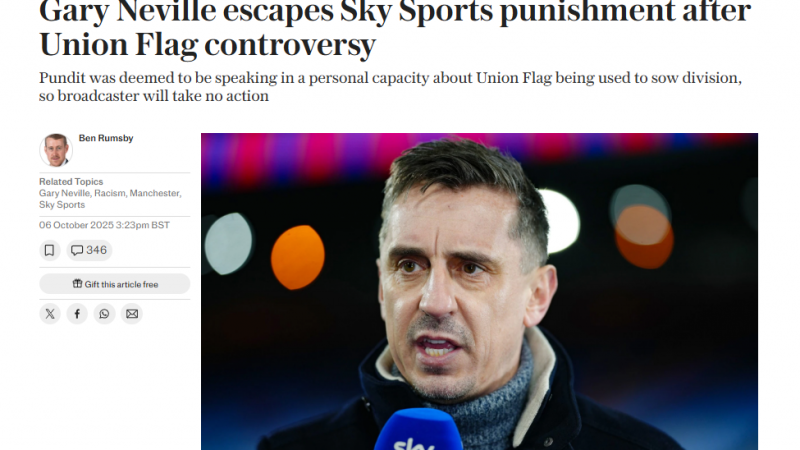
The Telegraph, meanwhile, went for a different angle, running with the headline: “Gary Neville escapes Sky Sports punishment after Union Flag controversy.”
The article made it clear that it had been deemed that Neville had spoken in a personal capacity, not as a Sky pundit, so therefore the broadcaster won’t take further action. But that didn’t stop the paper running with the implication that some sort of disciplinary action should have been considered.
But it was GB News’ presenter Carole Malone who went headfirst off the deep end.
“People like Gary Neville are part of the reason evil Islamists now live among us in Britain,” she said in an inflammatory rant.
She accused him of being an ‘idiot’ and sympathising with “Islamists who want us destroyed” over “patriotic Britons,” before descending into a tirade of personal insults:
“The poor sap is labouring under the illusion he has a brain – a political brain – when he’s embarrassingly devoid of any political nous.
“In fact, he’s a bit like his superhero, Keir Starmer, who has as much political aptitude as your average gnat. Both are so out of touch with the people of this country that they’re a joke.”
Her attack not only misrepresents Neville’s views but also dangerously conflates criticism of nationalism with sympathy for terrorism, a line of thinking that surely should have no place in responsible media.
What this latest media meltdown truly exposes is the hollow core of right-wing media’s free speech crusade. When Gary Neville expresses a personal, critical opinion, backed by real-world examples of how nationalism can fuel division, the same outlets that shout about “cancel culture” and “woke censorship” scramble to silence or mock him.
The irony wasn’t lost on observers, and reader wrote:
“Very well said Gary Neville. Although it does seem to have got a lot of “patriots” very upset. Mainly middle-aged white men.
“Free speech, anyone?”
Tuesday, June 21, 2022
FASCISTS HAVE NO RIGHT TO FREE SPEECH
Poilievre promises to protect freedom of speech on campus, appoint a 'Free Speech Guardian'
Catherine Lévesque - National Post
The idea of withholding federal funds from universities in order to protect free speech on campus is not new.
Conservative leadership hopeful Pierre Poilievre is threatening to remove direct federal research and other grants from Canadian universities if they do not commit to protect academic freedom and free speech from “campus gatekeepers.”
If he forms government, Poilievre promises to appoint a former judge which will act as a “Free Speech Guardian” who will ensure that universities respect the principles enshrined in the Charter of Rights and Freedoms, in particular section 2(b) which protects “freedom of thought, belief, opinion and expression.”
The former judge will be responsible for ensuring compliance by universities to these principles of academic freedom and free speech, but will also investigate claims of academic censorship.
Examples could include having pro-life or pro-Israel student groups cancel events or lose resources because of their different viewpoints, or having professors such as Jordan Peterson resign his post because of his “unacceptable philosophical positions” from his own account .
The “Free Speech Guardian” would be responsible for enforcing Poilievre’s policy by reporting to the federal government on universities’ breaches and for recommending reductions in direct federal grants to those that do not uphold the principles in the Charter. Federal-provincial transfers would not be affected by the free speech requirements.
There would, however, be limitations to Poilievre’s proposal. Hate speech will continue to be prohibited, as the courts have rules that it can be banned under the Charter.
“The Charter protects free speech, not hate speech, as explained by the Supreme Court of Canada. So does my academic freedom and free speech policy,” said Poilievre in a written statement to the National Post when asked for more specifics.
The idea of withholding federal funds from universities in order to protect free speech on campus is not new. In fact, former Conservative leader Andrew Scheer made this a promise during his own leadership campaign in 2017, and reiterated in his victory speech that “the foundation of our democracy is the ability to have a debate about any subject.”
But education remains a provincial jurisdiction and some provinces have already taken action to do just that.
In 2019, Ontario announced that all colleges and universities had developed, implemented and complied with a free speech policy while ensuring that hate speech and discrimination are not allowed on campus. Alberta also encouraged all publicly funded post-secondary institutions to adopt the Chicago Principles to encourage freedom of speech around that time.
More recently, Quebec adopted a law to enforce new rules around academic freedom across the province, ensuring that “any word” can be spoken in a university classroom as long as it is used in an academic context. Quebec’s initiative was an indirect response to a University of Ottawa professor’s use of the N-word during a lecture that led to her suspension. The events played out differently in Ontario, where the province’s free speech policy had no effect, and in Quebec, where politicians of all stripes ran to the professor’s defence, invoking her right to use the derogatory word.
Poilievre’s campaign did not respond to followup questions regarding if his free speech policy would let a professor use the N-word in class for academic purposes.
Geneviève Tellier, a professor at the University of Ottawa who co-authored a book to denounce her colleague’s treatment at the time of her suspension, said that Ontario’s free speech policy was already in place when the events happened and did not change anything to the situation.
She seemed skeptical of Poilievre’s suggestion to have a national oversight, adding that it would only add another level of complexity. “We already have a Free Speech Guardian. It’s the Charter of Rights and Freedoms,” said Tellier in an interview. “And we have the judicial system. Do we need something else? In my opinion, it would only add another administrative burden.”
She also added that Poilievre seems to mix up freedom of speech and academic freedom, stressing that universities do not exist to advance different agendas, but to advance knowledge.
That being said, it came as no surprise to the professor of political studies why the leadership candidate would tap into that theme as part of his campaign.
“Because there’s the word freedom. His whole campaign is driven by freedom.”
Sunday, May 12, 2024
Failure To Safeguard Free Speech Is Always a Problem
Recent crackdowns on free assembly are a reminder that the state will always finish first in deplatforming contests. Parts of Canada’s Online Harms Bill may be a massive overreach that chills speech at the worst time possible.
Source: Jacobin Chad Davis - University Police order protesters to leave. Flickr.
Campuses throughout the United States and Canada are witnessing a surge of free expression and assembly that is being met with repressive crackdowns. Largely driven by calls for justice in Gaza, for a lasting cease-fire, and for a free Palestine, students have occupied buildings, set up encampments, and held protests.
Responses to the action have varied in intensity, from state monitoring to snipers on rooftops and police violence against students and faculty. But all of it amounts to direct attacks on freedom of assembly and speech. Free Speech Under Fire
Free speech is fundamental to democratic self-government. In the West, we tend to keep some distance between our democracy and our capacities to direct it, which is to say “self-government” is at best action at distance. Our politics are driven by representatives and state institutions rather than citizens. The former typically chart the course and navigate it. The latter vote every so often in an election.
From time to time, the many make themselves heard, often when they believe the state — or other power brokers — are condoning or actively participating in heinous violations of the principles of justice. Campus protests are a barometer for outrage. They are a signal that a line in the sand has been crossed. In recent decades, such protests have rallied against the Iraq War and against the bankers — and the 1 percent — and the politicians who shilled for them in the aftermath of the 2008 financial crisis.
Now, as before, free speech is under fire as citizens assert their right to assemble and demand something from their government. However, the tension between free expression and efforts to curb it extends beyond campus actions. In Ontario, the legislature banned the wearing of a keffiyeh, calling it “political.” Meta has been accused of silencing support for Palestine on its platforms. In a chilling instance of stifling free press, the Israeli cabinet recently shut down Al Jazeera’s operations in Israel. And lest anyone think the matter is merely a left-wing issue, in Brussels, local politicians attempted to shut down a radical right-wing conference with police, citing a threat to public safety, before a court ordered them to let the event proceed.
President Joe Biden is siding with the reactionary right and a slew of other politicians on curbing assembly and speech as police crack skulls and arrest protesters across the country. In Canada, one Liberal MP called for “university administrators, police,” and, as necessary, governments, “to act” against campus encampments. The state of free speech and assembly appears to be at a nadir — and these liberties need defenders to step up and advocate for broad and deep commitments to each. The Online Harms Act
In Canada, the government is considering its Online Harms Act, Bill C-63, which is meant to deal with the sprawling problem of various threats that emerge from the internet, including hate speech, incitement to violence, counseling harm, nonconsensual sharing of intimate content, bullying children, and content that sexually victimizes minors.
Against the backdrop of ailing free-speech rights, the appearance of this bill, or some elements of it at least, is inauspicious, even as other bits are utterly essential. The bill may be seeking regulatory and criminal solutions for some of the most heinous and harmful behavior imaginable, but it is fraught with potential problems, as internet expert Michael Geist notes, since “the challenge will be to ensure that there is an appropriate balance between freedom of expression and safeguarding agains[t] such harms.”
Geist points out that the bill covers “obvious harms,” which it does. But he notes that “there are clearly risks that these definitions could chill some speech and a close examination of each definition will be needed.” While prohibitions and penalties will be more obvious and defensible in some cases (sharing intimate images without consent, for instance, or creating, storing, or sharing abusive material involving children), they will be far trickier in other instances (hate speech, or even incitement).
While existing Canadian jurisprudence addresses speech-related issues, Open Media, a digital-rights advocacy organization, warns that the tribunal process included in the bill for certain offenses “is not obligated to follow normal rules of evidence in court, or evaluate whether the offending speech was true.” There is also worry that Bill C-63 is too broad, too punitive with carceral and financial penalties, too far reaching, and too open to abuse.
The Canadian Civil Liberties Association is calling for “substantial amendments” to the bill, as it worries a provision on speech restriction in the bill “has the potential to censor strong opposition to political authorities.” Beverly McLachlin, former chief justice of the Supreme Court of Canada, suspects that the bill, if passed, will face court challenges.
In sum, it’s a critical moment for speech rights in the United States and Canada, and potentially a critical juncture in which free speech maximalists across the ideological divide have a reason to come together to protect fundamental rights necessary for democracy. As a rule, the state will clamp down on speech that threatens the status quo and elite hegemony, especially if that speech has the potential to sway public opinion and policy. However, while the state has supreme power to disperse and deplatform, it isn’t the only threat. The Boomerang Risk
In recent years, voices from the liberal chattering class and the campus left have been far too ready and eager to silence critics and opponents, often foreclosing discussion and debate on spec and thus inviting the same treatment in return. At times, this effort to redact opinions and ideas that are deemed offensive has reached absurd heights, as with the school library that removed all materials published before 2008 in an effort to delete objectionable material from the prejudiced past.
Yes, certain speech crosses the line and becomes so odious that it genuinely oppresses, harms, and prevents others from taking part in social, economic, political, or cultural life. But these are extreme cases. While this speech is still protected under the First Amendment in the United States — unless it is a direct incitement to harm — hate speech is regulated in Canada.
There has been a concerning expansion of what counts as extreme, as the liberal-left has come to abandon a commitment to free speech. This shift risks boomeranging repercussions, as we witness now in legislature, on campuses, and in the streets. The net result is a more anemic democracy, a less engaging public sphere, and a weaker pro–free speech movement that ought to be secure and ecumenical.
Robust free speech protections also open space for debate, discussion, and deliberation that may change minds, but there’s more to speech than persuasion. When free speech is protected, the rights of individuals and groups to struggle for their conception of justice is protected, and their capacity to extract better policies and outcome from the state is bolstered. Speech isn’t merely about debate; it’s about connection, mobilization, communication of preferences, and the struggle for change among those who know what they want.
The impulse to shout down anyone who agrees with us or, worse, to crack down on them with force, compromises free speech and assembly for everyone. We should refrain from such behavior and instead prioritize safeguarding the rights of those with whom we disagree. This approach is not only principled but also strategically useful — we strive to uphold these rights for ourselves as much as our opponents. If there ever was a time to double down on a broad commitment to speech and assembly rights, it’s now.
Monday, December 13, 2021
Free expression is not in opposition to equality — it is essential to attain it, new book argues
Dilemmas of Free Expression, edited by University of Waterloo political scientist Emmett Macfarlane, is a new book that explores the contemporary issues surrounding free expression in Canada — issues that consistently make headlines in Canada, and abroad. This excerpt is an edited version of the introduction to the book, which is published by the University of Toronto Press.
Among the panoply of traditional civil rights, freedom of expression stands as the alpha and omega. Rights like the right to protest, freedom of association, freedom of religion, and freedom of the press quickly disintegrate into charred vessels absent the foundation provided by free expression.
Other rights, like the right to vote, similarly hinge on our ability to freely communicate, argue, debate, and advance ideas. And where would equality rights or other values related to the cultivation of a just society be without free expression?
As the Supreme Court of Canada enunciated in one of its earliest judgments under the Charter of Rights and Freedoms, “the freedom to express oneself openly and fully is of crucial importance in a free and democratic society,” and as such it is “an essential value of Canadian parliamentary democracy.”
The protection of free expression is integral, the Court outlines in another judgment, for seeking and attaining the truth, for participation in social and political decision making, and for “diversity in forms of individual self-fulfillment and human flourishing.”
What, then, to make of a contemporary context in which free expression is seemingly under threat on a variety of fronts and in which public discourse around free speech itself appears increasingly polarized along ideological lines?
A gamut of political and social issues related to free expression demonstrate quite clearly that the limits of the right are no more easily identifiable now than they ever were. Some of this is the direct result of new challenges and technologies.
Aside from the plethora of substantive legal and policy issues at stake, one of the animating features of this collection is recognition that the quality of public debate around free expression has generally been poor, and that in the news and social media terrains it has felt very much like a pitched ideological battle.
On the far right, provocateurs seek to win a perverse form of free speech martyrdom when politicians, organizations, or university administrators overreact and censure or investigate controversial or discriminatory messages.
Notorious public figures like Jordan Peterson, a University of Toronto professor who garnered media coverage after questioning whether human rights law would require him to use the preferred pronouns of trans people, and Ezra Levant, who was subject to complaints for publishing anti-Muslim cartoons, have developed a degree of fame for having been on the wrong end of attempts at censorship, be it by universities or human rights tribunals.
They have developed a fan base that treats them as champions of free speech, although caution is warranted when it comes to viewing their broader advocacy as genuine. It is not uncommon to see people of their ilk lash out at mere social criticism for their speech, or in some cases even call for, or engage in, attempts at censorship themselves.
There are, it sometimes seems, few principled commentators who speak out against censorship regardless of whether the content of the expression aligns with their ideological world views. I was one of those who spoke out when administrators and faculty at Wilfrid Laurier University famously hauled Lindsay Shepherd, a teaching assistant, before them for questioning after she showed a tutorial group a clip (featuring Jordan Peterson) of TVO’s current affairs program The Agenda discussing the use of non-binary pronouns.
Yet it is also important to acknowledge how disingenuous and hateful some of the expression at the centre of these controversies can be. For example, the debates prompted by the Peterson and Shepherd incidents over the use of preferred pronouns of trans people call into question people’s very identities, and arguably their human dignity.
In some ways, understanding what prompted this debate is perplexing, because it evinces an unwillingness to treat people with basic respect (one honestly wonders when or how someone could be forced to use a particular pronoun to refer to someone rather than simply using their name – the controversy itself has an incredibly manufactured feel to it).
It is also a discourse filled with, to put it diplomatically, misleading statements about the law. Peterson, for example, mischaracterized a federal law (claiming the human rights legislation could send him to prison) that did not even apply to his situation as a university employee, where relevant provincial law, not federal, would apply.
Yet far-right discourse is not the only culprit degrading the quality of debates on free expression. Some self-styled progressives have contributed to the illiberal sentiment that the promotion of free speech is itself a nefarious thing. There are even efforts among some to equate speech with violence (something the Supreme Court has appropriately rejected).
Fundamental to this view is the idea that permitting the free expression of offensive or hateful views is antithetical to equality. Yet there seems to be little recognition that allowing for limits on offensive speech empowers some authority – be it the state, university administrators, or some other person in power – to draw lines of acceptability in a context where there will be widespread disagreement about what counts as hateful.
More fundamentally, the deleterious effects of weakening speech protections are just as likely to be turned against equity-seeking and historically oppressed groups than they are to work in their favour. It results in the sort of culture that spurred Dalhousie University to launch a disciplinary investigation against a student for the crime of speaking out against “white fragility” because other students found it offensive.
By setting free expression in opposition to equality, certain progressives forget that the fight for the latter is contingent on the former: free expression is what enables the calling out of white supremacy and racist policies, and it is of course core to the right to protest. In short, free expression is perhaps the most important tool in the arsenal for those who would fight on equality’s behalf.
Instead, from some progressive circles there is a knee-jerk desire to censor and sanction controversial, hateful, or otherwise offensive opinions and forms of speech. Beyond eroding a principle that equality seekers themselves depend on, this has also directly contributed to the martyrdom and rising profiles of people like Levant, and in so doing creates a broader political culture in which free speech is increasingly seen to be associated with the right wing of the ideological spectrum.
The tactic continuously backfires because its most common impact is to bring more media attention to the speaker and the offensive views that those trying to censor or deplatform wanted to quash in the first instance. More importantly, the belief that expression should be regulated on the basis of content implies that there are decision makers who can be trusted with the authority to decide what views are acceptable.
This is not a problem limited to speech deemed unlawful; it applies as much, if not more often, firmly within the boundaries of lawful speech. In 2017, Andrew Potter, then the director of the McGill Institute for the Study of Canada, penned an op-ed after a traffic jam on a Montreal highway left hundreds of people stranded in their cars overnight.
In his essay, Potter decried a “mass breakdown in the social order” and wrote that “Quebec is an almost pathologically alienated and low-trust society.” Political elites in Quebec, including Premier Philippe Couillard, condemned the op-ed. Potter soon “resigned.” If the Quebec establishment can exert enough pressure on McGill University that the institution would fire an established academic and writer like Potter over an allegedly offensive op-ed, why would we think individuals facing systemic forms of oppression would not be even more vulnerable to such tactics?
Indeed, we see across North America that it is not just far-right forms of expression resulting in rings and censorship on university campuses.
The public debate over free speech too often seems to boil down to the charge of “you can’t say that” or the defence of “my free speech.” There is no sense on one side that social criticism in the face of unpopular speech is free speech.
There is no sense on the other side that in a free and democratic society one must learn to live with the right of others to express themselves, not only in saying things you disagree with but also in saying things that might make you angry or sad. This is not an argument for free speech absolutism. Indeed, there is no such thing as a free speech absolutist.
Instead, any assessment of the legitimacy of particular restrictions on free expression depend on the purpose, context, and nature of the limit. In a free and democratic society, limits on speech should come with a high justificatory burden. When limits are established, and especially when those limits are not content-neutral, empowering state officials or similar actors to draw lines within the bounds of the law on the permissibility of certain forms of expression is an exercise fraught with difficulty.
This is true even when the purported aim of regulation is to enhance free expression. For example, the Province of Ontario recently mandated, under threat of funding cuts, that every publicly funded university and college develop a “free speech policy” based on the University of Chicago Statement on Principles of Free Expression.
The move is designed to ensure that post-secondary institutions remain places for open discussion and free enquiry, that ideas and opinions not be censored based on their offensiveness, and that members of the community not be permitted to obstruct or interfere with the freedom of others to express their views.
On the surface, the free speech policy enacts basic rules any sensible university administration would already have in practice in order to protect free expression as a value concomitant with the university’s wider mission. Yet the policy has come under criticism for threatening free expression, particularly as it relates to an implicit desire to quash protests against controversial speakers.
Since peaceful protest itself is a protected form of expression, balancing the interests at stake is exceedingly difficult. When does a protest become so disruptive as to prevent the free expression of ideas by members or invitees of the university community? And why do we think university administrators – or the provincial government, for that matter – are capable of identifying that line?
What is needed are forward-looking appraisals of ways to confront challenging moral issues, policy problems, and controversies that pay heed to the fundamental right to free expression.
Sunday, September 21, 2025
ATTACK ON FREE SPEECH
Donald Trump’s Most Authoritarian Week Yet
Andrew Perez, Nikki McCann Ramirez and Asawin Suebsaeng Sat, September 20, 2025
ROLLING STONE
It was clear Donald Trump and his allies would ramp up their crackdown against any and all opposition in the wake of the assassination of right-wing activist Charlie Kirk — and this week, the president’s second administration unleashed its most authoritarian blitz yet.
The Trump administration got late-night host Jimmy Kimmel’s show taken off the air by threatening companies’ broadcast licenses if they continued to run his show. Trump and his team threatened to strip the tax-exempt status of liberal nonprofit groups, while the president called for left-wing activists to be jailed for protesting him at dinner. Trump announced he’ll once again try to designate “antifa” — America’s disparate anti-fascist movement — as a terrorist group, with no legitimate basis, clarifying once again where he stands on the whole fascism question.
Meanwhile, the administration worked toward its goal to deport a legal U.S. resident for speaking out against Israel’s relentless assault on Palestine. Reports trickled out that Trump would fire a U.S. attorney for failing to bring charges against one of his enemies, before Trump publicly called for his departure and he quit.
This ugly, authoritarian week didn’t happen in a vacuum. Trump just last month mused about how Americans want a “dictator,” and the administration now appears to be using Kirk’s shocking murder as an excuse to escalate Trump’s ongoing campaign for total power.
The ramp-up began on Monday, as Vice President J.D. Vance hosted Kirk’s podcast from the White House and huddled with Stephen Miller, Trump’s deputy White House chief of staff and the man responsible for leading his mass vengeance campaign.
“You have the crazies on the far left who are saying, ‘Stephen Miller and J.D. Vance, they’re going to go after constitutionally protected speech. No, no, no,” Vance said, before immediately pledging to go after a network of liberal nonprofits that supposedly “foments, facilitates, and engages in violence.”
During the discussion, Miller repeatedly invoked Kirk’s death to justify the effort to shut down liberal groups.
“The last message that Charlie sent me was — I think it was just the day before we lost him — was that we needed to have an organized strategy to go after the left-wing organizations that are promoting violence in this country,” Miller said. He added, “With God as my witness, we are going to use every resource we have at the Department of Justice, Homeland Security, and throughout this government to identify, disrupt, dismantle, and destroy these networks.”
As the MAGA movement worked to get people fired for sharing negative thoughts about Kirk, conservative media outlets honed in on comments Kimmel made in the wake of his killing — twisting Kimmel’s words to make them seem like a fireable offense. And on Wednesday, Trump’s Federal Communications Commission (FCC) chairman, Brendan Carr, began issuing explicit threats, demanding that broadcasters take Jimmy Kimmel Live! off the air.
Speaking with right-wing influencer Benny Johnson, Carr pressured broadcasters to tell ABC: “‘Listen, we are going to preempt, we are not going to run Kimmel anymore, until you straighten this out because we, we licensed broadcaster, are running the possibility of fines or license revocation from the FCC.’”
Carr added, “We can do this the easy way or the hard way. These companies can find ways to take action on Kimmel, or there is going to be additional work for the FCC ahead.”
Within hours, ABC had indefinitely suspended Kimmel’s show and two large broadcast companies, Nexstar and Sinclair, announced they wouldn’t run it. (Note: The companies all have regulatory matters before the FCC.) Sources told Rolling Stone that while multiple executives at ABC and its parent company, Disney, did not feel that Kimmel’s comments merited a suspension, they caved to pressure from Carr.
“They were terrified about what the government would do, and did not even think Jimmy had the right to just explain what he said,” a person familiar with the internal situation said on Thursday, calling the decision “cowardly.”
Throughout Trumpland and the federal government, there was a heightened sense of glee over their silencing of Kimmel. Administration officials feel emboldened by the multiple scalps they’ve now collected — first Stephen Colbert, now Kimmel — to the point that they’re confident they have momentum to pressure corporate bosses to get rid of Trump’s late-night nemeses over at other networks.
Two Trump advisers told Rolling Stone that potential FCC investigations of Comcast are being viewed as a plausible route to pressure the NBC brass into sidelining, or dumping, late-night host Seth Meyers, whom Trump similarly despises. Aides at the White House and Republican National Committee often monitor the latest from liberal late-night shows, including Meyers’ program, to see if there’s any sound bite that Trump and company can quickly exploit — and that focus has only intensified in the aftermath of the Kirk slaying, two of those aides note.
The Trump administration’s threats against broadcasters have come under criticism from some conservatives. Sen. Ted Cruz (R-Texas) described Carr’s “easy way or the hard way” line as being something “right out of Goodfellas,” calling it “dangerous as hell.” The editorial board at Rupert Murdoch’s Wall Street Journal called out “the Carr FCC’s abuse of its power.”
Sen. Cynthia Lummis (R-Wyo.), on the other hand, has apparently decided the First Amendment is no longer sacrosanct, because someone murdered Kirk. “Under normal times, in normal circumstances, I tend to think that the First Amendment should always be sort of the ultimate right. And that there should be almost no checks and balances on it,” Lummis said, according to Semafor. “I don’t feel that way anymore.”
Trump, himself, seemed eager on Thursday to threaten more media companies over their coverage as he spoke with reporters on Air Force One, saying that the networks “give me only bad press” and “maybe their license should be taken away.”
The same day as Kimmel’s ouster, Trump declared that he would attempt to designate “antifa” — short for anti-fascist — a terrorist organization. Given that the anti-fascist movement lacks any sort of centralized system of organization or leadership, it’s unclear how the administration would enforce such a designation or the scope of those it would target.
When an NPR reporter asked Trump on Air Force One how he would target antifa, he said, “We’re going to see. Did they have anything to do with your network? We’re going to find out.”
Trump also this week called on a group of protesters who bothered him to be jailed. Activists from the anti-war group CodePink recently located the president at Joe’s Seafood near the White House as he ventured out to see the city streets during his military deployment to the nation’s capital. The protesters made it into the restaurant near Trump and shouted at him: “Free D.C.! Free Palestine! Trump is the Hitler of our time!”
Trump is mad about it. “They should be put in jail, what they’re doing to this country is really subversive,” he said on Monday, adding that he asked Attorney General Pam Bondi to look into bringing “criminal RICO” racketeering cases against them. On Thursday, Trump said of the protesters, “I think they were a threat.”
Amid Trump’s attacks on free expression and a free press, one of the president’s most sustained attacks on speech received less attention as it turned more ugly.
On Wednesday, it was reported that the Trump administration could soon deport Mahmoud Khalil to Algeria or Syria. The administration already jailed Khalil for months after revoking his green card over his pro-Palestine activism. Khalil, whose wife and baby are American citizens, was released in June per a judge’s order.
There was news about Trump’s apparent attempt to wield the Department of Justice against one of his most personal enemies.
On Thursday, ABC News reported that Trump planned to fire the U.S. Attorney for the Eastern District of Virginia for refusing to bring charges against New York Attorney General Letitia James, after prosecutors failed to find evidence she committed mortgage fraud.
James led the civil fraud case against the Trump family’s business empire. Trump was ordered to pay $355 million in damages in the case last year, before it was tossed last month.
In any other administration, news that the president intended to fire a prosecutor for failing to charge a political enemy would be treated as a massive scandal — indeed, it’s similar to the scandal that led to the resignation of George W. Bush’s attorney general, Alberto Gonzales.
Trump is different. When a reporter asked him Friday in the Oval Office if he wanted to fire Erik Siebert, Virginia’s acting U.S. Attorney — a guy Trump nominated — the president said, “Yeah, I want him out.” Trump complained about the prosecutor receiving blue slips, or customary endorsements, from Virginia’s two Democratic senators, whom he called “bad guys.” Siebert resigned afterward.
With everything going on, it might have been easy to miss the news Trump ordered more strikes on boats in the Caribbean supposedly carrying drugs — attacks so lawless that John Yoo, Bush’s torture memo author, felt the need to register his concern. “We can’t just consider anything that harms the country to be a matter for the military,” Yoo said. “Because that could potentially include every crime.”
Trump deployed the National Guard to Memphis, Tennessee, continuing his militarized crackdown on Democratic-led cities, while his masked goons roughed up a Democratic congressional candidate protesting outside an Immigration and Customs Enforcement facility in Illinois.
Late in the day Friday, The Washington Post reported that the Pentagon — under the leadership of former Fox News host Pete Hegseth, who’s calling himself the “Secretary of War” — will now require journalists who want press badges to agree not to gather any information that hasn’t been officially approved for release. That is, of course, literally a reporter’s job.
Speaking in the Oval Office on Friday, Trump claimed he’s “a very strong person for free speech,” before asserting, as he keeps saying, that 97 percent of reports about him are negative. “That’s no longer free speech,” he said. “That’s just cheating.”
Charlie Kirk believed in the right to 'evil speech.' Do his allies?
Taylor Seely, Arizona Republic Sat, September 20, 2025
Charlie Kirk built his reputation championing free speech before his assassination in Utah on Sept. 10.
He debated thousands of students who disagreed with him and said the U.S. Constitution protected so-called "hate speech," "ugly speech," "gross speech" and even "evil speech."
Yet in the week since Kirk's assassination at a college, his supporters have sought to punish people for speech they find inappropriate. They include government officials, whose statements and actions have raised alarm among First Amendment advocates and sparked national debate over what sort of speech is and isn't protected by the Constitution.
Comedian Jimmy Kimmel's late-night show was suspended after Federal Communications Commission Chairman Brendan Carr made veiled threats. U.S. Attorney General Pam Bondi said she would prosecute "hate speech," and President Donald Trump said TV stations that criticize him too much should possibly have their broadcast licenses revoked.
In Arizona, a sports reporter and a fitness instructor lost their jobs over comments they made about Kirk. A Pima County Sheriff's deputy was put on leave for social media posts that “are alleged to be inappropriate."
An anonymous website called "Expose Charlie's Murderers" was launched to collect submissions about anyone who posted anti-Kirk sentiments. It published their names and screenshots of what they said. It temporarily went offline, but has since returned as "Cancel the Hate," with a mission "to hold individuals accountable for their public words and actions when those words promote political violence, discrimination or endanger the lives of others." Visitors to the site could not submit or view submissions as of Sept. 19.
The initial website was broadly described as a doxxing effort. Doxxing, or posting people's personally identifying information online with the intent to harm them, is illegal in Arizona, but attorneys say it may be difficult to prosecute.
Free speech scholars maintain the most vile and reprehensible speech, including that which celebrates someone's death, is legally protected — not from the consequences meted by private employers, but from government suppression. The First Amendment protects the public from the government limiting speech, not anyone else.
Kirk's closest allies have said people shouldn't encourage violence or joke about it in the aftermath of murder, and that if private companies want to cut ties with people who do, they have a First Amendment right to do that. Their views about government suppression of speech are less clear.
Meanwhile, some of Kirk's fans who knew him through his campus events and social media or radio show, have expressed skepticism over broad-swath firings
Kirk himself was controversial. Some viewed what he said as extreme, hateful, racist and sexist. Others said detractors misrepresented or misunderstood Kirk's beliefs.
The varying perspectives reflect a nation grappling with free expression when political violence enters the fold. Speech that legally is allowed is clashing against what Kirk's allies deem culturally acceptable, and those in power appear to have taken their side. Free speech advocates have warned against the clamp downs.
“The Republican Party is not going to hold the executive branch forever. And you can very easily see the federal government (and future) Democratic officeholders doing the exact same thing,” Adam Steinbaugh, an attorney at the Foundation for Individual Rights and Expression, said.
Kirk's Turning Point allies on firings, Kimmel and Bondi
Two top Turning Point officials mostly emphasized private employers' rights when discussing firings and government officials' involvement in free speech issues.
Turning Point Action Chief Operating Officer Tyler Bowyer told The Arizona Republic the government shouldn't be "protecting the licensing of people who have that dark energy," referring to Kimmel. He also re-shared a social media post that said the Kimmel suspension was done for Charlie and that, "We're just getting started."
But Bowyer declined to comment on the propriety of Carr as a government official making statements condemning Kimmel, saying it wasn't his place and that he was more focused on the role of ABC.
Carr is one of three current FCC commissioners who make decisions about whether to grant, or revoke, broadcasting licenses. Before Kimmel's suspension, Carr suggested on a podcast that if ABC affiliates didn't take their own action to address Kimmel, the FCC would get involved.
Andrew Kolvet, executive producer of "The Charlie Kirk Show" and spokesperson for Turning Point, told The Republic, "Nobody's saying you can't say it. I'm not saying you belong in prison. I'm just saying if I'm your employer, I'd fire you."
Kolvet called Bondi's comments about prosecuting "hate speech," which were broadly rejected by legal scholars, "unfortunate," and that while he appreciated her intent to honor Charlie, "we have to be careful about using the right language." Kirk's fans skeptical of firings, call for courage and more debate
Some of Kirk's supporters in Arizona seemed to show more tolerance for disrespectful speech.
At a vigil for Kirk at Arizona State University, Phoenix resident Janice Bailey, 52, said, "We live in a country of free speech and they (critics) have a right to that opinion." Bailey said she was "on the fence" about firings.
"Just like I don't think government should be dictating certain things about our lives and our decisions, it's kind of hard for a workplace employer. I think it's wrong," she said. "I won't lie and say I wasn't happy about some of the ones that I've seen, the really mean and hateful ones. I think it's a very fine line and you have to be really careful."
Bailey said she had followed Kirk for years, and felt his death was a "wake up call" for her and other Christians. She said she thinks the tragedy would lead to more people engaging in conversation with others they disagree with.
"To show love, to show grace and to be able to debate and interact with people we don't agree with, but in a loving way. To love our neighbors no matter what their beliefs are. That's what he did, that's what he stood for. I hope to pick up that mantle," Bailey said.
Kane Adamson, 19, said firings were a "double edged sword. I think if we preach free speech, then I feel like everybody's entitled to it as well. There's certain stuff that should be not said, in a sense, but I feel like as a society, we should practice what we preach."
Adamson said "people have lost sight" of the importance of debate and the First Amendment. He thought the more people followed their faith and spoke about problems publicly, the better society would be.
"Especially now that he's gone, I think everybody needs to have courage to have faith and whatever they believe in. It doesn't matter if nobody agrees. As long as we come together as a country," Adamson said. What Arizona's doxing law allows, doesn't allow
Attorneys at the Phoenix law firm Snell & Wilmer wrote in 2021 that the law "should help prevent harassing online behavior."
But a provision of the law says the doxing must "in fact incite or produce that unwanted physical contact, injury or harassment."
The attorneys wrote that that could serve as "a significant bar to prosecuting doxing events."
The law also exempts social media platforms, which attorneys wrote, "may frustrate individuals or corporate clients seeking to stop a widespread doxing event."
The Republic's Stephanie Murray contributed reporting.
Taylor Seely is a First Amendment Reporting Fellow at The Arizona Republic / azcentral.com. Do you have a story about the government infringing on your First Amendment rights? Reach her at tseely@arizonarepublic.com or by phone at 480-476-6116.
Seely's role is funded through a collaboration between the Freedom Forum and Journalism Funding Partners. Funders do not provide editorial input.
The US right claimed free speech was sacred – until the Charlie Kirk killing
J Oliver Conroy Sat, September 20, 2025
THE GUARDIAN
Jimmy Kimmel speaks in to a microphone as someone holds a phone with Trump's mouth over the top of his mouthIllustration: Guardian Design/Andy Kropa/Getty
In the emotionally and politically charged days since the killing of Charlie Kirk, the conservative youth activist who was a close ally of Donald Trump, one statement has loomed large. On Monday, the US attorney general – the official in charge of the rule of law in America – said that the Trump administration would “absolutely target” those who espouse “hate speech” about Kirk.
Unlike in many other countries, hate speech is protected by US law unless it incites imminent violence or constitutes a true threat. But that did not deter the nation’s top law enforcement officer, who also suggested that – for example – a print shop employee who refused to print flyers memorializing Kirk could be “prosecuted”.
Since Kirk was shot to death while speaking to college students in Utah earlier this month, the US has been gripped by a bitter debate about the relation between political speech and violence. Bondi later walked back some of her remarks, in part because of criticism from other conservatives worried about the reframing of “free speech” as “hate speech”. But Trump, Vice-President JD Vance, White House adviser Stephen Miller and other top Republicans have framed Kirk’s death as the consequence of what they claim is unchecked and violent rhetoric, which they blame on the left wing alone.
It is a remarkable turn from prominent American conservatives, who until Trump’s return to power in January had long complained of a censorious leftwing “cancel culture” but now seem happy to reframe that, too, as “consequence culture”. Nancy Mace, a House representative, sounded a lot like the progressives she has often decried for their political correctness when she declared last week, during an effort to censure one of her opponents in Congress, that “free speech isn’t free from consequences”.
Many conservatives are also now championing a public campaign to get fired from their jobs any Americans who made light of Kirk’s death or disparaged him or his politics in death. Meanwhile, administration officials are proceeding with drafting an executive order for Trump aiming to “combat political violence and hate speech”, the New York Times recently reported.
Kirk’s assassination was a “despicable act of political violence, an attack on a figure who built his brand around campus debating, and the outrage, grief, and anger is understandable”, Aaron Terr, the director of public advocacy at the Foundation for Individual Rights and Expression (Fire), said.
But instead of recommitting to free speech as a “fundamental value”, the response from many public officials “has been the opposite. They are using the tragedy to justify a broad crackdown on speech,” he said.
“They are openly collapsing the distinction between political dissent and political violence, and it sounds like they are laying the foundation for mass censorship and surveillance of political critics.”
The pressure campaign’s biggest trophy so far is the talk show host Jimmy Kimmel. After an episode of his show in which Kimmel seemed to suggest (wrongly, according to reports) that Kirk’s assassin had Maga sympathies, the Trump-appointed chair of the Federal Communications Commission (FCC), the government agency that regulates broadcasting, urged TV networks to drop Kimmel’s show. On Wednesday, ABC announced that it was suspending the program indefinitely.
The FCC chair, Brendan Carr, applauded ABC’s surrender – even though just two years ago he said that free speech is a crucial “check on government control. That is why censorship is the authoritarian’s dream.”
“It’s an overreaction,” Katie Fallow, an attorney at the Knight First Amendment Institute, said, “and it is an example of the kind of ‘cancel culture’ that major figures on the right have been criticizing for so many years. Now they’re just doing a complete about-face and engaging in it themselves.”
Bondi’s rhetoric is a particularly “alarming threat” given her status overseeing American law enforcement, Veena Dubal, a law professor at the University of California, Irvine, and the general counsel of the American Association of University Professors (AAUP), said. It is also “a signal that not only does this administration not care about the first amendment, they don’t seem to really understand it.”
Although Kimmel is the most prominent media figure to have been punished so far, in recent days a number of journalists have faced the loss of their jobs or other disciplinary measures, either at the direct instigation of conservative pressure or in seeming preemption of it. Earlier in the week the Washington Post – under Jeff Bezos, who has cosied up to Trump and whose ownership has seen the opinion section move closer to the political right – terminated the columnist Karen Attiah for, she said, her unflattering writing about Kirk’s political views.
Academics, too, are under threat, with three professors at Clemson University in South Carolina recently fired for making allegedly inappropriate social media posts about Kirk’s death. Dubal is concerned by this aggressive campaign to get professors fired or disciplined for their “extramural” speech, particularly when academics are often contractually entitled to rigorous processes before they can be terminated.
It seems as though many employers have decided that it is worth violating principles of academic freedom and contractual obligation, she said, rather than “displease the president, or displease rightwing donors. And that’s a political calculation, it’s a legal calculation. But it’s dangerous.”
Indeed, Fallow finds the attempt to suppress speech after Kirk’s death disturbing because she sees it as part of a larger and “unprecedented” attempt by the second Trump administration to use “every available lever of power to try and suppress dissent and chill speech” – including but not limited to threatening universities with investigations or financial penalties because of protests on campus; targeting law firms with executive orders for their legal work; deporting international students for participating in protests or writing op-eds; kicking reporters out of White House press conferences based on their publications’ coverage; and bringing frivolous defamation lawsuits against media outlets.
The general message, Fallow said, is that if you disagree with Trump or his allies “you’re going to be in the administration’s crosshairs”.
Although some people have defended the suspension of Kimmel or the firings of professors on the grounds that these are private employer decisions, and not matters of first amendment-protected public speech, Dubal and other experts feel that the government’s increasingly naked involvement makes it difficult for that argument to carry water.
“Here … you have a vice-president [Vance] who’s calling for employers [and] third-party vigilante organizations and individuals to force employers to terminate their employees and others based on speech,” Dubal said. “Coercive government speech is very different than the creation of political cultures where it’s not okay to say certain things based on social response. I think what we’re seeing is really, at least for my own lifetime, unprecedented.”
Conservatives are making arguments similar to the ones that some progressives used to make about cancel culture, Terr noted, particularly during the wave of firings, de-platformings, and social-media shamings that occurred during the national “reckoning” after George Floyd’s murder. “And conservatives at the time, I think rightly, argued that we should think of free speech not just as a legal right, but as a broader cultural value.”
Now, Terr said, “many of the same politicians who have long railed against cancel culture are leading the loudest calls for censorship – often using, either explicitly or implicitly, rationales that they’ve dismissed when invoked by the left: ‘This is hate speech.’ ‘This is misinformation.’ ‘This will lead to violence.’ ‘Stochastic terrorism.’ ‘This speech makes us unsafe.’ It’s amazing. And I think the lesson here is that once the justification for censorship is put on the table, it’s a loaded gun just waiting to be picked up by the other side.”
Some conservatives have pushed back. Bondi’s remarks, especially, were condemned by rightwing commentators including Matt Walsh and Tucker Carlson. Referring to Bondi, Walsh wrote on social media: “Get rid of her. Today. This is insane. Conservatives have fought for decades for the right to refuse service to anyone … Now Pam Bondi wants to roll it all back for no reason.”
Walsh also argued that a crackdown on speech would come back to haunt the right: “Every Trump supporter right now applauding Trump threatening ABC with consequences unless they suspend Jimmy Kimmel must also applaud when a Democratic president in 4yrs threatens Fox News with consequences unless they suspend Greg Gutfeld. Hey Maga, do you understand?”
Dubal said she thought conservative pundits were right to lambast Bondi. “There are principles of speech in this country that apply broadly … and the idea that they were going to go after businesses and individuals based on protected speech was really kind of shocking.”
The late Kirk was an inconsistent defender of free speech – his organization, Turning Point USA, famously maintains a “watchlist” of professors it describes as dangerously leftwing – but some conservatives have argued that Kirk would not want the right to turn against free expression. “You hope that Charlie Kirk’s death won’t be used by … bad actors to create a society that was the opposite of the one he worked to build,” Carlson recently said.
Trump and his allies are suddenly downplaying the First Amendment
THEY ONLY BELIEVE IN THE SECOND AMENDMENT
Analysis by Aaron Blake, CNN Fri, September 19, 2025
President Donald Trump speaks to members of the media on the South Lawn of the White House on September 16. - Bonnie Cash/UPI/Bloomberg/Getty Images
“The path forward is not to mimic the ACLU of the mid 90’s,” White House adviser Stephen Miller posted on X (formerly Twitter), referring to the epitomic free-speech-absolutist organization. “It is to take all necessary and rational steps to save Western Civilization.”
Yes, they say, they support the First Amendment. But they also suggest the times call for a new approach – one that’s often at odds with their former rhetoric
The other case in point is Republican Sen. Cynthia Lummis of Wyoming. In an interview with Semafor, Lummis was remarkably blunt about her own sudden recalculation.
“Under normal times, in normal circumstances, I tend to think that the First Amendment should always be sort of the ultimate right,” she said, “and that there should be almost no checks and balances on it.”
Then she added: “I don’t feel that way anymore.”
Sen. Cynthia Lummis at the US Capitol on July 1.
- Graeme Sloan/Bloomberg/Getty Images/File
The Wyoming senator suggested a crackdown on people saying “insane things” and connected it to political violence like Kirk’s assassination.
Just two years ago, Lummis introduced the “Free Speech Protection Act,” which would have barred the government from directing online platforms to censor constitutionally protected speech. “If we let the Biden administration restrict our freedom of speech,” she said at the time, “there is no telling what other sacred freedoms they will come for next.
Lummis said out loud what plenty of others have suggested. High-profile Trump allies have also downplayed the importance of protecting free speech rights at this moment, suggesting drastic times call for drastic measures.
Attorney General Pam Bondi signaled Monday, in comments she later tried to clarify, that the government would prosecute people for hate speech – this despite the Supreme Court having affirmed over and over again that hate speech is protected.
“There’s free speech, and then there’s hate speech – and there’s no place, especially now, especially after what happened to Charlie, in our society,” Bondi said on a podcast.
She later claimed she didn’t mean to refer to hate speech broadly, but to speech that’s inciting violence.
On Fox News on Thursday, former Trump White House press secretary Kayleigh McEnany said ABC’s suspension of Jimmy Kimmel amid clear pressure from the Trump administration “has nothing to do with the First Amendment.”
“For all the concern about ‘The First Amendment! The First Amendment!’ I mean, they are apoplectic, Jesse,” McEnany told host Jesse Watters. “What about all the amendments that Charlie Kirk lost? Because Charlie Kirk has no amendments right now. None.”
And perhaps most strikingly, Trump suggested Thursday that Kirk himself might suddenly reevaluate his views on free speech if he were alive today.
Charlie Kirk holds a debate event at the University of Washington in Seattle, on May 7, 2024. - David Ryder/Reuters
“Charlie said that there was no such thing as hate speech,” Fox host Martha MacCallum told the president in an interview. She was citing a 2024 Kirk quote in which he said hate speech “does not exist legally in America” and is protected by the First Amendment.
“Yes,” Trump said, before adding: “He might not be saying that now.”
Trump later complained that free speech has come to mean “you’re, like, able to do anything.”
This exchange is particularly remarkable. Kirk’s past comments about free speech are a problem for Trump’s new crackdown. Kirk was a free-speech absolutist, if there ever was one. Many, including some on the right, have argued that what Bondi was saying on Monday and what Trump is trying to do are anathema to Kirk’s views – and it’s all being justified in his name.
And the fact that Trump now feels the need to explain away Kirk’s comments on hate speech suggests he’s headed in a decidedly un-Kirk direction on the issue of free speech.
That’s a shift from where he and his allies had been, even earlier in this term. On Trump’s first day in office, he signed an executive order ostensibly aimed at taking the government out of the speech-policing business. “Government censorship of speech is intolerable in a free society,” it said. Miller, likewise, in 2022 labeled free speech the “cornerstone of democratic self-government” and equated censorship to fascism.
Not all Republicans are toeing the new line, though. Sen. Ted Cruz of Texas on Friday became the strongest GOP critic yet of Federal Communications Commission Chairman Brendan Carr’s role in pressuring ABC to suspend Kimmel.
Cruz called it “dangerous as hell” and “right out of ‘Goodfellas,’” going on to argue Democrats would use that precedent against conservatives when back in power.
“They will silence us,” Cruz added. “They will use this power, and they will use it ruthlessly.”
The increasing question is whether the American people are going to tolerate this sudden downplaying of First Amendment concerns.
It could be a tough sell, including on the right.
A demonstrator holds a sign reading "Protect Free Speech" outside the El Capitan Theatre in Hollywood, California, on Thursday. - David Pashaee/Middle East Images/AFP/Getty Images
A 2022 Siena College poll for the New York Times opinion section showed just 30% of Americans said there is sometimes a need to shut down free speech if it’s “anti-democratic, bigoted or simply untrue.” Just 26% of Republicans took this view.
A Vanderbilt University poll last year showed Americans said 59%-41% that free speech should be unfettered – that it shouldn’t be restricted by content, speaker or subject. And the right was much more likely to take that view; 70% of Republicans and 77% of MAGA Republicans agreed there should be no such restrictions.
Gauging views on speech is difficult, because “free speech absolutism” is rarely truly absolute. Most everyone agrees that things like inciting violence aren’t protected.
But the Trump administration is clearly targeting speech that comes up well shy of that standard. Kimmel’s purported offense was saying something that made it sound like Kirk’s assassin was MAGA. And Trump is talking about stripping the licenses of broadcasters for being too critical of him.
So they’ve set about trying to convince their supporters that the times are extraordinary enough for truly extraordinary measures – like disowning their own high-minded views from the very recent past.
Charlie Kirk's death sparked a free speech debate. Here's what experts say about First Amendment rights.
Shakari Briggs Fri, September 19, 2025 Houston Chronicle
WEST PALM BEACH, FLORIDA-JULY 26: Charlie Kirk, who founded Turning Point USA, speaks before former President Donald Trump's arrival during a Turning Point USA Believers Summit conference at the Palm Beach Convention Center on July 26, 2024 in West Palm Beach, Florida. Trump had earlier in the day met with Israeli Prime Minister Benjamin Netanyahu at Mar-a-Lago.
Photo by Joe Raedle/Getty Images) (Joe Raedle/Getty Images
People across the country have been fired from their jobs and students have been expelled from school for their comments about Kirk, sparking a debate about freedom of speech.
"Political violence is a threat to our democracy," ACLU of Texas said in a statement. "The growing pattern of disciplinary responses to speech across Texas - including suspensions, firings and institutional investigations - is also a threat to our democracy. While some institutional policies may allow for some of these responses, the overall pattern risks stifling free speech.
Despite being a proponent of free speech, Charlie Kirk's legacy has been accompanied by silencing discourse from detractors. In a major move by Walt Disney Company, which owns ABC Network, the media conglomerate suspended Jimmy Kimmel Live! Wednesday in what they called a decision to preempt the show "indefinitely."
The action came on the heels of Kimmel's Monday night monologue that included remarks about Kirk and President Donald Trump.
Critics argue the move comes as both Disney and Nexstar Communications Group have business dealings with the Federal Communications Commission. Disney hopes to get regulatory approval for ESPN's acquisition of the NFL Network. At the same time, Nexstar needs Trump's approval to close out its $6.2 billion purchase of Tegna Inc., a rival broadcasting company.
Nexstar said it planned to pull Jimmy Kimmel Live! as early as Wednesday, describing Kimmel's comments as "offensive and insensitive at a critical time in our national political discourse."
"In general, government cannot constitutionally punish people for saying things the government doesn't like," said Rebecca Tushnet, Frank Stanton Professor of the First Amendment at Harvard Law School. "That's long been a pillar of American free speech law; whether it continues to be true depends a lot on whether individuals and institutions push back against this coercion."
In back-to-back calls for action, Gov. Greg Abbott demanded that the administration at two Texas universities expel students for their remarks about Kirk. Texas State University moved swiftly to expel a student just hours after Abbott insisted the public institution set an example.
While it's unclear if Texas Tech University expelled its students, officials did confirm the student was no longer enrolled. In both instances, viral videos showed each student making fun of Kirk's untimely demise.
"Students expelled from public universities on the basis of their speech could sue for reinstatement and potentially for damages, and they should win," Tushnet told the Chronicle. "Given how long litigation can take, however, that can be cold comfort." What is the First Amendment?
The First Amendment protects freedom of speech. It states, in part, that Congress shall make no law... abridging freedom of speech."
Written as part of the Bill of Rights proposed by the First Congress in September 1789, the First Amendment protects the right to freedom of religion and expression from government interference.
What are your rights to free speech in the workplace?
According to Zach Greenberg, Foundation for Individual Rights and Expression's (FIRE) faculty legal defense, public employees who work for the government, such as public school teachers, have the First Amendment that protects their rights to speak.
Under the First Amendment, those individuals have the right to speak in their private capacities on matters of public concern, and that includes the right to speak on social media to discuss political issues like the Charlie Kirk assassination. Is there a difference between First Amendment rights when it comes to public sector and private sector jobs?
Greenberg says public universities and institutions are bound by the First Amendment. Therefore, they're legally required under the Constitution to protect their employees' free speech rights.
However, private institutions, universities and companies are not bound by the First Amendment. Those entities are "free to do what they want, subject to the state law and their own internal rules." Does a social media policy in the workplace override an employee's use of free speech?
Greenberg outlined that the First Amendment, which is a part of the Constitution, is the "supreme law of the land," making it supersede "any state or federal or local policy to the contrary." Are there limitations to the First Amendment when it comes to one's rights being violated?
If one works for a private company, Greenberg says the limitations come down to the company's own policies and state law.
"Some states have rules that punish employees for their speech, such as their political affiliation, but it wouldn't be a First Amendment issue; that would be a state law or contract issue between you and the company."
Is it illegal for a governor to demand that public and/or private universities expel students for freedom of speech?
Greenberg says that, based on the law, governors still must obey the First Amendment and respect people's free speech rights.
"The governor can pressure schools to punish students and professors with what they say, but the schools cannot act on those requests," he said. "That would violate the rights of individuals." What legal recourse do students, teachers and professors have for being punished for expressing their views?
Greenberg insists that anyone facing university suspension can use the First Amendment to defend themselves in the proceedings. Additionally, he says they can hire an attorney to sue the university for First Amendment retaliation under 42 U.S. Code § 1983. That also applies to educators whose First Amendment rights have been violated due to political pressure.
"The First Amendment does not protect speech that incites violence or unlawful behavior, but it does protect Texans' right to criticize public figures - including their past words and actions - even if that speech offends or provokes controversy," ACLU of Texas said in a statement. "Any government or institution that punishes or threatens to punish this type of speech, especially under pressure from political leaders, raises serious constitutional concerns.
"We urge Texas leaders and schools to uphold our democratic values of open inquiry, academic freedom, and free expression. Our democracy depends on respectful dialogue - not censorship, retaliation, or violence."
White House threats against liberal groups test free speech protections
Rebecca Beitsch
THE HILL Fri, September 19, 2025
The Trump administration’s plans to go after left-leaning groups are prompting fear among nonprofits and activists that the government will run roughshod over the First Amendment in an effort to target them in the wake of Charlie Kirk’s assassination.
Vice President Vance and Stephen Miller, a White House deputy chief of staff, made clear they would use Kirk’s death as a rallying cry to target left-wing groups they claimed were disproportionately responsible for provoking political violence.
“With God as my witness, we are going to use every resource we have at the Department of Justice, Homeland Security and throughout this government to identify, disrupt, dismantle and destroy these networks and make America safe again for the American people,” Miller said in a conversation with Vance, who was guest hosting Kirk’s show this week.
“We’re going to go after the NGO [nongovernmental organization] network that foments, facilitates and engages in violence,” Vance added.
There’s no indication Kirk’s shooter had broader associations, but Vance vaguely accused “radical left lunatics” of fomenting extremism.
It’s not clear what the legal basis would be for any prosecution, and also unclear is whom they plan to go after — though 100 different nonprofits immediately sensed they may be a target.
In an open letter Wednesday, the groups — which have spoken out against political violence — said such moves would impact both their advocacy and their funding.
“Organizations should not be attacked for carrying out their missions or expressing their values in support of the communities they serve. We reject attempts to exploit political violence to mischaracterize our good work or restrict our fundamental freedoms, like freedom of speech and the freedom to give. Attempts to silence speech, criminalize opposing viewpoints, and misrepresent and limit charitable giving undermine our democracy and harm all Americans,” the coalition said in the letter.
Rep. Dan Goldman (D-N.Y.) said such efforts would be a clear abuse of the justice system and a Constitution that protects free speech, but would nonetheless let the process be the punishment for vulnerable groups.
“They are just looking for an excuse to go after nonprofits, liberal groups … what they call the racial left … so that they can bring the weight of the federal government down on them, even though they have no evidence that they have done anything wrong that would warrant an investigation,” Goldman, a former federal prosecutor, told The Hill.
“They could come up with some, you know, small nonprofit that supports immigrants, or that opposes domestic violent extremists or white nationalists. And they could issue subpoenas all their documents and records and all this stuff, which would then require them to get a lawyer and require them to spend tens of thousands of dollars just responding to the subpoena,” he added, saying it could “bankrupt them and destroy them.”
“Many small organizations do not have that money, and so this is really just a pretext to run these small organizations out of business.”
The comments come amid a broader effort by the Trump administration to target speech in the wake of Kirk’s death.
Vance endorsed calling out and even reaching out to the employer of people viewed as having unsavory views.
And Attorney General Pam Bondi found herself in hot water after saying she would go after those who promote hate speech — which is largely protected under the First Amendment — and even threatened to prosecute Office Depot over an employee’s refusal to print posters for a vigil honoring Kirk.
Nonetheless, administration officials are said to be preparing an executive order that would address political violence, though the details of that order are still being finalized.
In the meantime, multiple Justice Department officials have suggested they could use federal racketeering laws, known as RICO, to target left-wing groups they claim are working together to target others through doxing.
In raising the idea of RICO charges, Deputy Attorney General Todd Blanche this week cited the case of a group of progressives who protested the president during his night out for dinner in Washington, D.C.
Vance also suggested the administration could specifically target the Ford Foundation and the Open Society Foundations, both of which have ties to liberal megadonor George Soros.
And Trump late Wednesday announced he was designating antifa as a domestic terrorist group, a move that won plaudits on the right but had unclear practical implications.
Trump previously made a similar declaration in 2020, and federal officials have said antifa is a decentralized movement without a clear leader or structure. Trump said Wednesday he would recommend investigations into those funding antifa, an indication the declaration could be used to more broadly crackdown on left-wing groups the administration is skeptical of.
However, most major left-leaning groups and institutions have categorically condemned Kirk’s killing and political violence generally.
“They’re just trying to be very threatening to left wing, or groups that they perceive to be left wing. And I think it’s red meat for their base. … There’s no evidence I’ve seen that any of these particular groups did anything to feed into the murder,” said Rep. Glenn Ivey (D-Md.), a former prosecutor.
“So I think it’s an overall attack on the First Amendment, ironically, because they’re trying to praise Kirk for being such a First Amendment proponent, but they’re doing things to undermine it across the board.”
Ivey said he saw no avenue to bring any charges against groups.
“I haven’t even heard grounds for a civil lawsuit against anybody. I haven’t seen anything really that would fall even close to that category. Certainly nothing to prosecute,” he said.
Blanche’s suggestion of RICO charges was also panned by the two former prosecutors.
“I think it demonstrates that they don’t know what they’re talking about,” Ivey said.
And Goldman, a former colleague of Blanche in the Southern District of New York, said the deputy attorney general was improperly citing RICO despite his familiarity with such cases.
“There’s no coordinated organization, and to start talking about RICO, where you would have to prove a criminal enterprise that is in the business of committing crimes and that has committed specific racketeering acts to be connected somehow to hate speech, is totally preposterous and is yet another degradation of the Department of Justice. And I’m frankly embarrassed for Todd Blanche that he actually went on TV and said that,” he said.
“Because I worked with Todd Blanche. Todd Blanche charged a lot of RICO cases when he was there. He knows what a RICO case is, and he knows that there is no possible way to use hate speech as a predicate for a RICO case, and for him to mislead the American people on national television about that brings disgrace to the Department of Justice.”
Some GOP voices have criticized the Trump administration for suggesting the Justice Department go after such groups.
“It’s not very unifying. There are some people saying terrible things out there, but the president and the vice president have the opportunity to speak to our higher angels. And you know, there’s Democrats who’ve been targeted. So I just, I wish it was more unifying,” Rep. Don Bacon (R-Neb.), a moderate, told The Hill.
“And by the way, I don’t mind shaming people if they say something bad. But using the force of government is not about freedom of speech. It’s anti freedom of speech. So I’m not aligned with the behavior. They don’t have the power — the Constitution gives people the right to say what they want.”
But Trump’s allies in Congress have also raised their eyebrows at the comments.
“Look, in America, it’s a very important part of our tradition that we do not — this is a conservative principle and certainly an American principle — we do not censor and silence disfavored viewpoints,” House Speaker Mike Johnson (R-La.) told reporters this week.
Rep. Chip Roy (R-Texas) didn’t directly respond to the threats of prosecution but floated the creation of a select committee in Congress that could play a role in reviewing the work of left leaning groups.
He mentioned Soros’s group, migrant support groups, as well as the Southern Poverty Law Center, a nonprofit that works on voting rights and criminal justice reform in addition to its work monitoring white supremacists and other extremist groups.
“We just need to pursue the truth. And I present it to the American people,” he said.
“What I’m saying is the American people need to know the organization of the left. They act like they’re all like freakin’ puppies and unicorns and rainbows. ‘Look at us. We’re so nice. We love everybody.’ And the fact is, there, it’s an organized effort to attack the people that I represent.”
Copyright 2025 Nexstar Media, Inc. All rights reserved.
Some Republicans start rejecting the First Amendment’s free speech protections
Steve Benen Fri, September 19, 2025
MSNBC
By any fair measure, it’s been a rough week for the First Amendment. Donald Trump, for example, said “evening shows” are “not allowed” to criticize him, and networks that give him “only bad publicity” risk losing their broadcast licenses.
Alas, we can keep going. A federal agency helped push a comedian off the air. The attorney general vowed to go after speech she considered “hate speech.” The deputy attorney general talked about a possible federal investigation into people who heckled Trump at a restaurant. Responding to a conservative reporter who said that anti-war protesters near the White House “still have their First Amendment right,” the president replied, “Yeah, well, I’m not so sure.”
With the government’s encouragement, employers have punished, suspended or fired countless Americans who talked about Kirk’s death in ways the right didn’t like. Immigrants were told that government officials would monitor their speech and, if they expressed views about Kirk’s death in ways federal agencies found objectionable, that their visas could be revoked.
If that weren’t quite enough, Politico reported, “The Pentagon’s crackdown on employees accused of mocking Charlie Kirk’s death has startled troops, who fear an increasing stranglehold on what they’re allowed to say.”
But there’s no reason to assume we’ve reached the bottom.
Fox News’ Kayleigh McEnany argued on Thursday night to colleague Jesse Watters, “For all the concern about the ‘the First Amendment, the First Amendment’ — they’re apoplectic, Jesse — what about all the amendments that Charlie Kirk lost? Because Charlie Kirk has no amendments right now. None.”
I’m not altogether sure what that meant. For that matter, I’d be curious how Fox News responded if, after other deadly shootings, someone argued, “For all the concern about the ‘the Second Amendment, the Second Amendment,’ what about all the amendments that the victims lost? Because the victims have no amendments right now. None.”
But I think what McEnany was getting at is the idea that there was a tragic violent crime, which she suggested necessarily makes constitutional legal protections less important.
Those on-air comments followed an interview in which Fox News’ Martha MacCallum reminded Donald Trump that Kirk rejected the very idea of “hate speech.” The president replied, “He might not be saying that now.”
Meanwhile, on Capitol Hill, others on the right are thinking along similar lines. Semafor reported:
In fact, some Republicans who consider themselves defenders of unfettered speech are getting more comfortable with limiting it. Sen. Cynthia Lummis, R-Wyo., told Semafor that ‘an FCC license, it’s not a right. It really is a privilege.’
“Under normal times, in normal circumstances, I tend to think that the First Amendment should always be sort of the ultimate right,” the Wyoming Republican said. “And that there should be almost no checks and balances on it. I don’t feel that way anymore.”
The far-right senator added, “I feel like something’s changed culturally. And I think that there needs to be some cognizance that things have changed. We just can’t let people call each other those kinds of insane things and then be surprised when politicians get shot and the death threats they are receiving and then trying to get extra money for security.”
It’s possible that all of this is a short-term, immediate effect of a deadly tragedy, and that cooler heads will prevail in time. But it’s also possible that we’re watching a major political party, which is becoming increasingly comfortable with an authoritarian vision, fundamentally reassess its view of the First Amendment.
This article was originally published on MSNBC.com