Showing posts sorted by relevance for query VALENTINES DAY. Sort by date Show all posts

Thursday, February 14, 2008

Valentines Day Hour Of The Wolf

The ancient Roman orgiastic festival of Lupercalia, was transformed into St. Valentine by Christianity and then into Valentines Day by the English finally to become dominated by commercial American Greeting Card and Confectionery interests in the 19th Century.


The youths then donned loincloths made from the skin of the goat and led groups of priests around the pomarium, the sacred boundary of the ancient city, and around the base of the hills of Rome. The occasion was happy and festive. As they ran about the city, the young men lightly struck women along the way with strips of the goat hide. It is from these implements of purification, or februa, that the month of February gets its name. This act supposedly provided purification from curses, bad luck, and infertility.
http://www.jonfoster.com/illustration%20images/illustration%20images1%20copy/lupercalia.gif

LUPERCAʹLIA, one of the most ancient Roman festivals, which was celebrated every year in honour of Lupercus, the god of fertility. All the ceremonies with which it was held, and all we know of its history, shows that it was originally a shepherd-festival (Plut. Caes. 61). Hence its introduction at Rome was connected with the names of Romulus and Remus, the kings of shepherds. Greek writers and their followers among the Romans represent it as a festival of Pan, and ascribe its introduction to the Arcadian Evander. This misrepresentation arose partly from the desire of these writers to identify the Roman divinities with those of Greece, and partly from its rude and almost savage ceremonies, which certainly are a proof that the festival must have originated in the remotest antiquity. The festival was held every year, on the 15th of February,a in the Lupercal, where Romulus and Remus were said to have been nurtured by the she-wolf; the place contained an altar and a grove sacred to the god Lupercus (Aurel. Vict. de Orig. Gent. Rom. 22; Ovid. Fast. II.267). Here the Luperci assembled on the day of the Lupercalia, and sacrificed to the god goats and young dogs, which animals are remarkable for their strong sexual instinct, and thus were appropriate sacrifices to the god of fertility (Plut. Rom. 21; Servius ad Aen. VIII.343).b Two youths of noble birth were then led to the Luperci, and one of the latter touched their foreheads with a sword dipped in the blood of the victims; other Luperci immediately after wiped off the bloody spots with wool dipped in milk. Hereupon the two youths were obliged to break out into a shout of laughter. This ceremony was probably a symbolical purification of the shepherds. After the sacrifice was over, the Luperci partook of a meal, at which they were plentifully supplied with wine (Val. Max. II.2.9). They then cut the skins of the goats which they had sacrificed, into pieces; with some of which they covered parts of their body in imitation of the god Lupercus, who was represented half naked and half covered with goat-skin. The other pieces of the skins they cut into thongs, and holding them in their hands they ran through the streets of the city, touching or striking with them all persons whom they met in their way, and especially women, who even used to come forward voluntarily for the purpose, since they believed that this ceremony rendered them fruitful, and procured them an easy delivery in childbearing. This act of running about with thongs of goat-skin was a symbolic purification of the land, and that of touching persons a purification of men, for the words by which this act is designated are februare and lustrare (Ovid. Fast. II.31; Fest. s.v. Februarius). The goat-skin itself was called februum, the festive day dies februata, the month in which it occurred Februarius, and the god himself Februus.

http://www.greeklandscapes.com/images/athens_museum/DSC00839.jpg
Robert Esiner in his provocative study; Man into Wolf associates the Lupercalia leather eros and public S&M rituals with the modern phenomena of lycanthropy;werewolfism and vampirism. Which was brilliantly portrayed in the movie the Howling, one of the most under-valued cult werewolf films of the eighties.

MAN INTO WOLF 

AN ANTHROPOLOGICAL INTERPRETATION

OF SADISM, MASOCHISM, AND LYCANTHROPY

In analysing the basic factors leading to sadism and maso-
chism Dr. Eisler draws attention to what he describes as 'a feeble
sympathetic resonance', the lack of emotional response, the
insanity affecting altruistic feeling which forms so large a part
of the constitution some of us describe as the psychopathic per-
sonality. This, however, according to Eisler, is not simply a
throw-back to primeval savagery, for, as he shows, primitive
man in his primeval forest was not a killer but rather a peaceful
creature le bon sauvage. In confirmation of this fact the author
mentions numerous small tribes who have never as yet heard
of or encountered war. Killing and being killed has been a
developmental process whereby the carnivorous, predatory
packs, the ancestors of the hunting and game-seeking tribes,
have preyed on the vegetarian, frugivorous, peace-loving herds.
Eisler elaborates his theme by utilizing Jung's conception of
archetypal race memories. Such memories may be not only
ancestral, but may occur even in the sub-human animal strata


So this valentines day let your inner wolf out.

http://www.jayfife.com/images/art/werewolf.jpg

SEE:

A Little Eros For Valentine's Day


Passover Song


Find blog posts, photos, events and more off-site about:
, , , , , ,
, , ,

Wednesday, February 14, 2007

Valentines Day Challenge


Valentines Day is the most overt expression of heterosexuality in our culture. The assumption made is that your sweetie is a member of the opposite sex. All of the commercial cultural products are aimed with this assumption in mind.

So as I picked up my obligatory card and gifts for my sweetie, from me and the cats and dogs, hmm, I wondered; what about gay and lesbian couples?

I saw no cards for Mary and Alice or Adam and Steve. No his and his flowers or her and her chocolates. And then I came across this posting at Alternet;

We in the gay and lesbian community understand coming out, but I've found that coming out isn't easy for some heterosexual folks to understand. They still think, but WHY do you NEED to come out?

To answer that, I have a challenge for you: This Valentine's Day, don't indicate to anyone all day what the gender of your sweetie is. Evade. When people ask, "What are you doing this evening?" Say, "I'm having dinner with a someone special," or, "My partner and I are seeing a movie." Some people will assume that the person you reference is of the opposite sex. Some people may think you are in a same-sex relationship. How do you feel about that? How do you think gay and lesbian people feel?


Since I regularly use the term 'my partner' rather than wife, I understand the phenomena. Though in the labour movement and in other progressive circles this term is used more often than the term husband or wife so I am used to it being sexual orientation neutral, and being an acceptable practice.


I used partner long before it was socially acceptable, being an anarchist and coming as it does from the anarchist tradition of Free Love referring to ones lover as companiero, companion,comrade, or close friend, showing that we are partners not property of each other.

Mollie Steimer and Senya Fleshine
Anarchist activists who were in their 80’s at the time of these interviews (both are now deceased). Steimer, defendant in the celebrated “Abrams Case” (one of the most important civil liberties cases in US legal history, it was the first important prosecution under the 1918 Espionage Act. The Supreme Court upheld the convictions of Steimer and her comrades, Jacob Abrams, Samuel Lipman, Hyman Lachovsky, and Jacob Schwartz, for giving out leaflets protesting American intervention in Soviet Russia.). She was deported from the United States to the Soviet Union in 1921.

There, she met Senya Fleshine, then secretary to Emma Goldman (also an immigrant to the United States, he had not been deported to the Soviet Union, but had hurried back when the revolution broke out. He participated in the historic attack on the Winter Palace, and was acquainted with the Ukrainian anarchist general, Makhno.) . Steimer and Fleschine became “companieros”, and lived together for the next 60 years, although several times separated by war, revolution, and imprisonment. In 1923, they were both deported from the Soviet Union for their anarchist activities and protests against authoritarian rule. They lived in various places in Europe (mostly in Paris), until Nazism forced them to flee to Mexico in 1940, and where they stayed until the ends of their lives. Senya became a nationally-known photographer, assisted in his photographic studio by Mollie, under the name of “Semo” (orSenya-Mollie).


The image “http://nihilpress.subvert.info/love2.jpg” cannot be displayed, because it contains errors.


Find blog posts, photos, events and more off-site about:
, , , , , , , , , , , , , , , , ,

Tuesday, February 14, 2023

In Pictures
Photos: Valentine’s Day celebrations around the world
The February 14 occasion is marked in many countries but traditions are often very different.


A Palestinian man balances a giant teddy as he rides a motorcycle on Valentine's Day in Gaza City. 
[Majdi Fathi/NurPhoto via Getty Images]


AL JAZEERA
Published On 14 Feb 2023

Valentine’s Day, named after a Christian saint, may now be marked in countries around the world but traditions are often very different – and sometimes have nothing at all to do with romance.

While in Europe it is all about couples celebrating their relationship, in the United States it is as much about schoolchildren marking friendships, while in Japan women give chocolates to their bosses.

The origins of the annual February 14 occasion are shrouded in mystery but the day is, of course, associated with the cult of Roman Christian martyr Saint Valentine, who lived in the third century AD.

He literally lost his head over love – decapitated on the orders of Emperor Claudius II, they say, for secretly performing weddings. According to the legend, Valentine cured his jailer’s blind daughter and the day before his death slipped her a note signed “Your Valentine”.

In England, the exchange of messages known as “Valentines” on February 14 developed with the rise of the postal service in the 19th century, with the sender often signing off “Your Valentine”.

The celebration took a commercial turn in the mid-19th century in the US, with the invention of mass-produced greeting cards. Promoters quickly got the idea to extend the “tradition” beyond lovers, with schoolchildren often expected to bring a Valentine card for every one of their classmates.

Today it has become a $20bn business.

The Japanese Valentine tradition began after World War II when confectionery makers came up with the idea of having women offer chocolates to their bosses and boyfriends on February 14.

A half-century later, the practice has become an annual ritual, with millions of Japanese women giving pralines or ganaches to show affection, friendship or professional respect.

But elsewhere, the holiday – a relatively recent import from the West – often clashes with conservative cultural forces as well as anti-capitalist sentiment in parts of society.

A bouquet made of onions, tomatoes and garlic is displayed at a flower market in Manila, the Philippines. The bouquet is part of a Valentine's Day gimmick by a flower store owner who says it is more practical than giving flowers because you can cook it afterwards. [Aaron Favila/AP Photo]

People walk past a heart-shaped balloon displayed in a shop window in Krakow, Poland. [Beata Zawrzel/NurPhoto via Getty Images]
A man walks past a mural with swans in Dublin, Ireland. 
[Artur Widak/NurPhoto via Getty Images]
A worker in Sesquile, Colombia, collects carnations to be trimmed and packaged for shipment to the US and different Asian and European countries for Valentine's Day. [Juancho Torres/Anadolu via Getty Images]
Trimmings and flowers are seen near the feet of floral designers working to arrange bouquets for customers on the eve of Valentine's Day at a florist in Louisville, Kentucky, US.
 [Jon Cherry/Reuters]
A newlywed couple poses for pictures on Valentine's Day at a marriage registration office in Hangzhou, Zhejiang province, China. 
[China Daily via Reuters]
A girl burns incense at Ha Pagoda (Chua Ha) on Valentine's Day in Hanoi, Vietnam. Ha Pagoda is known as the pagoda to pray for love in Hanoi, where many young people go to pray for luck in their love lives, especially on Valentine's Day.
 [Luong Thai Linh/EPA]
A couple on elephants receive their marriage licence during a ceremony at the Nong Nooch Tropical Garden in Chonburi, Thailand. 
[Athit Perawongmetha/Reuters]

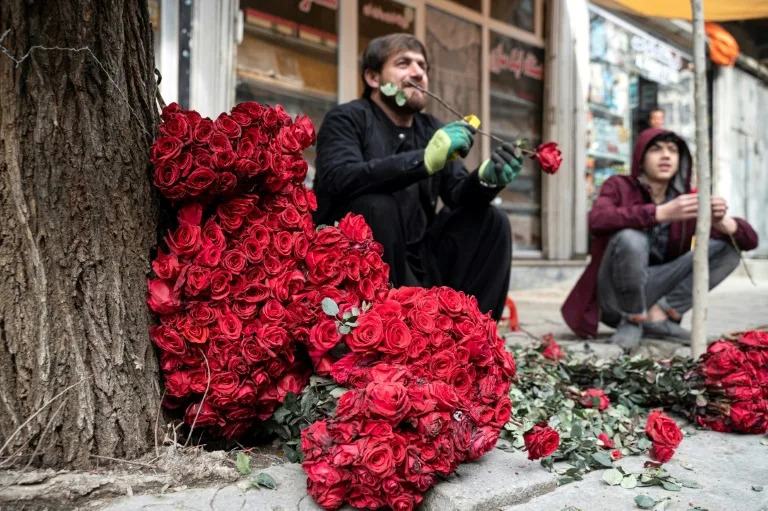
Kabul florists heartbroken over Taliban Valentine's Day ban

Florists with wilting bouquets of red roses and street vendors clutching unsold balloons were heartbroken in the Afghan capital on Tuesday after the Taliban's morality police banned Valentine's Day celebrations.

While Valentine's Day has never been widely celebrated in Afghanistan, some well-off residents in cities have developed a tradition of marking the lovers' day in recent years.

In Kabul's famed Flower Street, shops were full of heart-shaped garlands and red stuffed animals, but hopelessly empty of customers.

In the window of one outlet, a poster signed off by the Ministry for the Promotion of Virtue and Prevention of Vice warned shoppers: "Avoid celebrating lovers' day!"

The poster said Valentine's Day "is not Islamic and is not part of the Afghan culture but a sloganeering day of the infidels".

"Celebrating the day of lovers is showing sympathy to the Christian Pope," it read.

Officers from the ministry patrolled the area in their white uniforms, trailed by an armed escort, an AFP correspondent reported.

A poster on the window of a shop in Kabul warns residents to "Avoid celebrating lovers' day!" © Wakil KOHSAR / AFP

Kneeling in front of his shop, Omar -- who did not share his surname -- pruned thorns and withered petals from his stock of flowers.

"[The Taliban authorities] published and distributed their order to every shop," he told AFP.

"I don't think I could sell these flowers today, people aren't buying," he said.

"You can see we have no customers -- the situation is very bad."

An AFP reporter saw a young couple furtively buy flowers and quickly leave the scene when they saw the morality police patrol.

"The situation has changed -- we can't celebrate it like other years," said browsing shopper Zahrah, married for seven years.

"But we do celebrate it. There are some restrictions and the situation is not good, but we celebrate it at home."

The vice ministry could not be reached for comment on the exact nature of the ban.

The Taliban authorities have issued various restrictions on social life in the country since they came to power in August 2021.

Music, social media apps and video games have all come under scrutiny by the ultra-conservative government.

The authorities have particularly cracked down on Afghan women, effectively squeezing them out of public life.


Afghan men are reflected on the glass of a gift shop along Flower Street in Kabul © Wakil KOHSAR / AFP


New Banksy spotted as mystery street artist claims Valentine's Day mural

Elusive street artist Banksy has claimed his latest piece of work that appeared at the beginning of the week in Margate, Kent, alluding to domestic violence


By Tristan Cork
Kieren Williams
News Reporter
14 Feb 2023


Banksy has unveiled a new Valentine’s Day ‘Mascara’ artwork, focusing on domestic violence.

The infamous street artist has revealed his latest work which appeared in Margate, Kent, at the beginning of the week.

It shows a woman dressed in 1950s-style clothing wearing cleaning gloves.

She’s pushing someone, presumably her husband, into a discarded freezer but all you can see is his legs poking out the end.

However, the piece is a commentary on the massive issue of domestic violence in the UK and abroad.

On closer inspection, the woman can be seen to be sporting a black eye and has seemingly had a tooth knocked out.

Further inspection of the art shows the housewife has a black eye and lost a tooth - presumably due to domestic abuse 

The image, also shared to his almost 12 million Instagram followers, also shares the artwork’s name ‘Valentine’s Day Mascara’.


This marks the first work the elusive artist has claimed since his surprise stint working in Ukraine in October and November last year.


It is his first back in Britain for over a year since he produced thousands of t-shirts to raise money for the Colston 4 in Bristol when they were being taken to court at the end of December 2021.

The work is typical of Banksy’s style and pairs together the environment, an overturned dumped freezer, with his art to make a commentary on social or political issues.

It first appeared Monday morning and was spotted by locals, kickstarting speculation that it might be another Banksy - but it wasn’t claimed until today.

Local resident Amy Richardson told BristolLive she first saw it first thing on Monday morning after a broadband van was driven away from the spot, and it was there behind.

It is not the first time Banksy has created art in Kent, back in 2017 he made a piece which depicted a man on a ladder chipping away a star from the EU flag.

Nor is it the first time the celebrated street artist has marked Valentine’s Day either as three years ago he released a new take on The Girl with the Balloon - one of his most renowned pieces.

This time, on a wall on a house in Bristol, he showed the girl bursting the balloon with a catapult which shed rose petals down the wall.

A Valentine's Day message from Banksy comments on violence against women

February 14, 2023
BILL CHAPPELLTwitter

People gathered to see a Banksy artwork on the side of a house in Margate, England, on Valentine's Day. The work depicts a 1950s housewife with a swollen eye, missing a tooth — and apparently shutting a man in a freezer. The freezer was later removed by council workers.
William Edwards/AFP via Getty Images

At first glance, she could be a prototypical 1950s housewife, wearing an apron over a smart gingham dress, complete with yellow cleaning gloves. But this is a Banksy artwork on the side of a building we're talking about, and the woman is pushing a freezer door closed — and a man's legs are jutting out the other end.

The woman is also hurt. She appears to be missing a tooth, and an eye is swollen shut. And that's where the title comes in: "Valentine's Day mascara," according to a post to Banksy's Instagram account on Tuesday.


Abusive relationships are disturbingly common. Here's how to support a loved one

The most-liked reply to Banksy's post reads: "Fighting violence used against women. Even on Valentines Day. Always!"

The artwork appeared in Margate, a city in southeastern England, becoming the latest locale for a graffiti installation by one of the world's most famous living artists. It reportedly appeared on Monday; one day later, local officials dismantled parts of the tableau.


A new Banksy mural adorns a destroyed building in Ukraine

The original work had incorporated an actual freezer and a toppled chair, following Banksy's tradition of mixing everyday items with paint and other media. As word of the artwork spread, people flocked to snap photos of themselves posing alongside the woman — resilient, triumphant and injured.

Then the freezer was taken away, leaving a void.


Workers remove a chest freezer that was part of an artwork by street artist Banksy, along the side of a house in Margate, southeast England.
William Edwards/AFP via Getty Images

The local Thanet District Council said that while the graffiti art is a genuine Banksy, and it was on the wall of a privately owned property, the chest freezer "has been removed by council operatives on the grounds of safety as it was on public land."

The council added, "The fridge freezer is now in storage and will be returned once it has been made safe to the public. We will be contacting the owner of the property to discuss the options to preserve the artwork for the district."


Some local residents mocked the council for invoking the need to keep public spaces tidy as a rationale for taking the art work apart.

"The council saying it was removed for safety reason is a bit short sided, considering that there is a side road next to the Banksy with a pile of rubbish and wood full of nails," resident Davide Restifo told The Isle of Thanet News, submitting a photo of unsightly debris to prove his point.

Sunday, February 14, 2021

Biden calls for gun law reforms three years after Parkland school shooting

President Joe Biden called on Congress Sunday to pass "commonsense gun law reforms" on the third anniversary of the Marjory Stoneman Douglas High School shooting in Parkland, Fla., that left 17 dead. Photo by Gary Rothstein/UPI | License Photo

Feb. 14 (UPI) -- President Joe Biden marked the third anniversary of the mass shooting at Marjory Stoneman Douglas High School in Parkland, Fla., with a call for gun legislation on Sunday.

In a statement remembering the 17 people -- 14 students and three staff -- killed by a gunman in the Feb. 14, 2018 shooting, Biden called on Congress to pass "commonsense gun law reforms," including required background checks on all gun sales, a ban on assault weapons and high-capacity magazines and eliminating immunity for gun manufacturers that "knowingly put weapons of war on our streets."

"The Parkland students and so many other young people across the country who have experienced gun violence are carrying forward the history of the American journey. It is a history written by young people in each generation who challenged prevailing dogma to demand a simple truth: we can do better. And we will," said Biden.

Florida Gov. Ron DeSantis ordered flags to be lowered to half-staff on Sunday and filed paperwork to create a "Marjory Stoneman Douglas High School Memorial Day" to be observed annually beginning on Feb. 14, 2022.

"Our state and nation will never forget February 14, 2018," DeSantis wrote on Twitter. "We remember the 17 innocent lives that were lost on that tragic day. Their legacies will endure."

Many of the student survivors and their families engaged in activism calling for gun reform following the shooting, spawning the national "March For Our Lives" movement.

In the months after the shooting Sen. Rick Scott, then the governor of Florida, signed $400 million of legislative reforms for school security, mental health and gun control. The legislation bans the use of bump stocks -- devices that allow the rapid firing of certain firearms -- increased the minimum rifle purchasing age from 18 and 21, and instituted a three-day waiting period on all firearm purchases.

Other states also passed similar legislation in the following months to expand background checks, ban bump stocks and limit magazines among other restrictions.

Family members of the victims, led by Manuel Oliver, whose son Joaquin was killed in the shooting, created a series of "shame cards" to send to Congress in order to hold lawmakers to task for a lack of federal action on gun control since the shootings.

Gunman Nikolas Cruz, a former student at the school, faces 17 counts of first-degree murder and 17 counts of attempted murder for the shooting. His case was delayed in late December 2019 and has faced further delays in part due to the COVID-19 pandemic.

On Parkland anniversary, Biden calls for tougher gun laws
AP NEWS
By BOBBY CAINA CALVAN

1 of 6

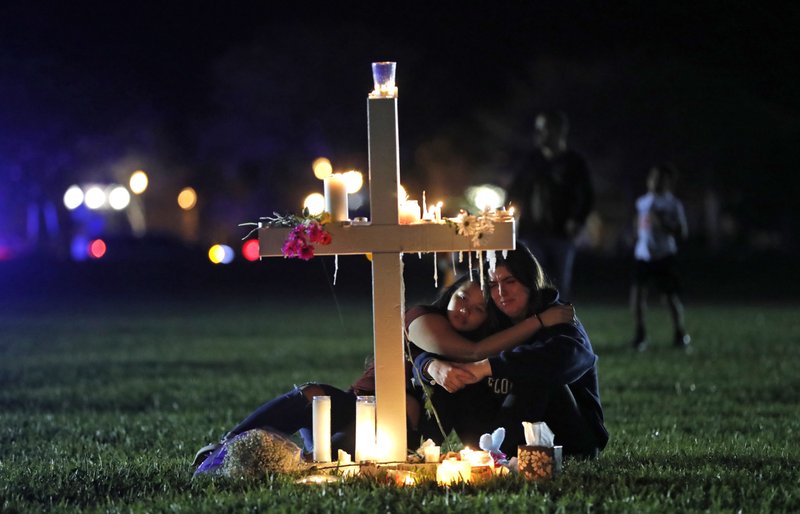
FILE - In this Feb. 15, 2018 file photo, people comfort each other as they sit and mourn at one of seventeen crosses, after a candlelight vigil for the victims of the shooting at Marjory Stoneman Douglas High School, in Parkland, Fla. Sorrow is reverberating across the country Sunday, Feb. 14, 2021, as Americans joined a Florida community in remembering the 17 lives lost three years ago in the Parkland school shooting massacre. President Joe Biden used the the occasion to call on Congress to strengthen gun laws, including requiring background checks on all gun sales and banning assault weapons. (AP Photo/Gerald Herbert, File)


TALLAHASSEE, Fla. (AP) — Sorrow reverberated across the country Sunday as Americans, including President Joe Biden, joined a Florida community in remembering the 17 lives lost three years ago in the Parkland school shooting massacre.

“In seconds, the lives of dozens of families, and the life of an American community, were changed forever,” Biden said in a statement released Sunday.

The president used the occasion to call on Congress to strengthen gun laws, including requiring background checks on all gun sales and banning assault weapons.

There was no time to wait, the president said. “We owe it to all those we’ve lost and to all those left behind to grieve to make a change. The time to act is now.”


Gov. Ron DeSantis ordered flags be lowered to half staff from sunrise to sunset across the state to honor those who perished when a former student of Marjory Stoneman Douglas High School opened fire on campus with an AR-15 rifle on Valentines Day in 2018.

When the gunfire ended, 14 students and three staff members were dead, and 17 others were wounded. The suspect, Nikolas Cruz, is still awaiting trial.

In his proclamation for a day of remembrance, DeSantis asked fellow Floridians to pause for a moment of silence at 3 p.m. Sunday.

“The Parkland community is resilient in the wake of tragedy, reminding us just how strong and united Floridians can be in the face of such devastating loss,” the governor said in his proclamation.

The Republican governor also noted some of the school safety measures enacted since the tragedy three years ago, including money to install panic alert systems at schools across the state and to strengthen programs meant to prevent violence before they occur.

The panic alert measure was dubbed “Alyssa’s Law,” in honor of 14-year-old Alyssa Alhadeff, one of the students killed three years ago.

Parkland parents have been divided over how lawmakers should respond.

Ryan Petty, whose daughter Alaina was 14 when she was killed in the shooting, addressed the president in a tweet Sunday.

“Mr. President, thank you for remembering the loved ones taken from us 3 years ago,” he wrote. “Alaina loved this country and the freedoms it guarantees. Common sense tells us that honoring her life does not require infringement on the rights of law-abiding citizens.”

In an interview Sunday, Petty said the president’s proposals won’t prevent more tragedies.

“It’s wrong to focus on the weapon,” said Petty, who is now a member of the state school board. “For those who understand what happened that day, there were mistakes. This was the most preventable school shooting in the history of our country. The warning signs were there. It was clear the killer had intentions to attack the school.”

Petty remembered his daughter as a friend to everyone, and recounted how important community service was to her.

“For those of us who lost loved ones that day, it’s pretty much like any other day. We miss them. There’s nothing we can do to bring them back. The only thing we can do is move forward and try to honor their memories and make sure this doesn’t happen to any other families,” he said.

But critics of the governor and Republican-controlled Legislature say guns are too easily accessible and say more needs to be done to keep assault-style guns away from potentially bad actors.

“The passage of time has done little to heal the heartbreak we felt upon hearing the shocking news three years ago today, nor dulled our sense of outrage at the lack of consequential legislative action from lawmakers since that horrible morning — laws that would prevent another Parkland from ever happening again,” said Manny Diaz, the chair of the Florida Democratic Party.

Over the years, deadly violence targeting schools has shaken the nation — including the Virginia Tech shootings in 2007 that claimed 32 lives and the Sandy Hook Elementary School massacre in 2012. Even before the Parkland tragedy, there was already plenty of anguish in Florida over gun violence. Less than two years before, another gunman shot up the Pulse nightclub in Orlando, killing 49 people.

None of the deadly events produced comprehensive gun laws. Mass shootings have galvanized gun control advocates, who have been met with resistance from Republican lawmakers and their 2nd Amendment allies. It remains to be seen what will be done on the federal level, despite Democratic control of the White House and both chambers of Congress.

“This Administration will not wait for the next mass shooting to heed that call. We will take action to end our epidemic of gun violence and make our schools and communities safer,” the president said his statement Sunday.


In addition to background checks and an assault-weapons ban, Biden is calling on Congress to outlaw high-capacity magazines and make gun manufacturers liable for the role their products play in violence.

“For three years now, the Parkland families have spent birthdays and holidays without their loved ones,” Biden said.

“Today, as we mourn with the Parkland community, we mourn for all who have lost loved ones to gun violence,” he said.

“Over these three years, the Parkland families have taught all of us something profound,” the president continued. “Time and again, they have showed us how we can turn our grief into purpose – to march, organize, and build a strong, inclusive, and durable movement for change.”

___

Follow Bobby Caina Calvan on Twitter at https://twitter.com/BobbyCalvan.

Wednesday, May 08, 2024

Students and staff are calling on Imperial College London to end its complicity in the climate crisis


 by The Canary
7 May 2024
in Analysis

This article was updated on 7 May at 8pm to reflect an error. Imperial College London informed us that as of 31 January 2024 it no longer invests in EOG Resources and Berkshire Hathaway. It also claimed that it “does not have any existing fossil fuel investments – its investment portfolio currently has no exposure to companies that derive revenues from fossil fuel extraction”. The Canary looked into this last claim. Read more below.

Hundreds of Imperial College London students, staff, and alumni – including former government chief scientific advisor David King – have called on the university to fully divest its £542m endowment from the fossil fuel industry.

Imperial College London must divest from fossil fuels

In December 2022, the student group Imperial Climate Action (ICA) released a student petition, which has now received 792 signatures. A similar open letter has garnered over 200 signatures from Imperial academics. The Imperial College Union, which represents the university’s student body, also supports full divestment.

The open letter is directed towards professor Brady, professor Walmsley, and professor Ryan – the president, provost, and vice-provost of the university, respectively.


Prominent alumnus David King, as well as special representative for climate change and alumna Harvard professor Naomi Oreskes who has written extensively on the fossil fuel industry misinformation, have joined calls on Imperial College London to divest from fossil fuels.

The student open letter outlines the profound misalignment of all major fossil fuel companies with the goals of the Paris Agreement. It also notes the disproportionate impact of the climate crisis on women, Indigenous Peoples, working-class communities, and low-emitting nations in the Global South.

The letter goes on to state that:


the College’s continued investment in fossil fuel companies is in contradiction with the climate science being produced by its own academics.

This makes clear that all new investment in oil, coal or gas expansion must cease immediately.


‘Imperial Net Zero’… Really?

The fossil fuel companies that remained in Imperial’s portfolio, EOG Resources and Berkshire Hathaway, were there until 31 January 2024; something this article previously did not state. Imperial College London told the Canary that:


The university does not have any existing fossil fuel investments – its investment portfolio currently has no exposure to companies that derive revenues from fossil fuel extraction.

The Canary looked at Imperial College London’s latest endowment fund breakdown. Aside from it having direct investments in some of the most notoriously unethical, environment and human rights-abusing companies on the planet – like Rio Tinto Mining, McDonald’s, and Nike – it also still has indirect holdings in companies that, contrary to its claims, do indeed “derive revenues from fossil fuel extraction” – albeit they don’t take the fossil fuels directly out of the ground themselves.

For example, Imperial College London has indirect (i.e. through an investment vehicle) holdings in General Electric. As campaign group As You Sow wrote in November 2023:


the General Electric Company (GE), whose technology is used to produce 30% of global electricity, continues to expand global reliance on fossil fuels through the sale of high-emitting, long-lived products including natural gas-powered turbines and liquid natural gas infrastructure. The emissions from downstream use of these carbon-intensive products accounts for 90% of GE’s total carbon footprint. Continued investments in such high-carbon energy infrastructure locks in high emissions for decades, jeopardizing the achievement of global net zero targets.

In the past year, GE’s sales of natural gas-powered turbines have increased.

So, while Imperial College London can claim it doesn’t have investments in “companies that derive revenues from fossil fuel extraction” – this has a distinct stench of whataboutery when it has investments in companies like General Electric that directly derive revenue from the burning of fossil fuels.

It all seems a bit like Imperial College London are greenwashing, don’t you think?
Greenwashing?

Students at Imperial stated their grave concern that, until it divests, Imperial is lending its world-renowned reputation for scientific excellence to companies ignoring climate science at every turn, helping to greenwash their reputations and add legitimacy to their false sustainability claims.

Amidst these calls for divestment, Imperial has announced the release of the Imperial Zero Index. The index will be used to ‘assess annually how its energy industry collaborators are performing in their commitment, strategy and operational efforts towards net zero’.


The university has stated that it will disengage from collaborations with companies that score poorly in this assessment.

However, it remains unclear if investments are to be included in this assessment, yet campaigners are urging the university not to apply this index to its investments – where evidence and precedent in the sector for divestment, is overwhelming – and to heed the calls of the Imperial community to fully divest from the fossil fuel industry.

Imperial’s investment policy currently states that it will only invest in Fossil Fuel companies that are aligned to the Paris Agreement. Yet, there is already overwhelming evidence that the fossil fuel industry is not transitioning its business model in line with the Paris Agreement, instead doubling down on long-term fossil fuel expansion several orders of magnitude greater than the planet can withstand.
Unresponsive to demands

In addition, the Imperial Climate Action group has stated that “decades of investor engagement efforts” have failed to transition these companies away from their core oil, coal and gas business models. Fossil fuel companies continue to invest billions into new long-term fossil fuel expansion projects.

The student letter makes the case that “divestment by respected public institutions is a key strategy… as it helps to expose fossil fuel companies’ failure to voluntarily shift their business models”, helping to pave the way for the necessary legislative action to compel companies to halt destructive business practices.

In other words, investor engagement approaches rely on companies voluntarily transitioning their business models. Divestment approaches aim to increase public awareness of company malpractice, and therefore pressure on governments to force companies to halt practices and make the necessary transitions within the timelines dictated by science.

Imperial College has continued to delay taking action on the matter, and has been unresponsive to demands of its staff and students.
Break up with fossil fuels for Valentine’s Day

In response to this, ICA undertook an action for Valentines Day, in which multiple students signed a valentine’s day card asking Hugh Brady (the university president) to break up with fossil fuels. A response has not been given to the student group:


This action is the latest in Imperial Climate Action’s Fossil Free campaign It is coordinated by student-led campaigning charity People & Planet in partnership with SOS UK’s Invest for Change campaign.

The Fossil Free campaign has seen almost 75% of UK universities divest from fossil fuels. This includes 21 out of the UK’s 24 research-intensive Russell Group universities, further showing how Imperial College London is falling behind in the sector.

Ioana Balabasciuc, divestment campaign leader at Imperial Climate Action, said:


With time running out, and the fossil fuel industry rolling back the inadequate climate transition plans it had committed to, it has never been clearer that light-touch shareholder engagement is not the answer.

We need institutions like Imperial to join the rest of the university sector and stop pedalling this myth. Instead, Imperial must mobilise its reputational influence to put pressure on our government to finally legislate against the fossil fuel industry’s catastrophic business practices.

The scientific evidence is unequivocal and strongly condemns the fossil fuel industry’s deliberate disregard for alarming indicators of climate change. We don’t require yet another index to comprehend this; we need full divestment from fossil fuels.
Imperial College London: it’s time to act

Naomi Oreskes said:


Around the globe, world leaders and citizens have recognized the need for immediate action to address the climate crisis. Yet, fossil fuel development continues unabated, in part because banks, financial institutions and individual investors continue to invest in it.

The time has come to stop the flow of finance that supports and sustains this damaging industry. As a leader in science, technology, and engineering, Imperial College should have been at the forefront of the divestment movement. Instead, Imperial stands as one of the few Russell Group universities still investing its endowment in fossil fuels. It is time to fix this!

David King said:


The climate crisis has entered a new phase.

Key scientific information now available on the rapid rate of ice loss from Greenland to 30m tons per hour following on from the data showing that over the past 15 years the Arctic Circle has been heating up at four times the rate of the global average temperature rise since the pre-industrial period.

I strongly urge the College to divest from those fossil fuel industries, including Shell, BP and Exxon-Mobil, that are still investing in new oil and gas discovery. As many economists point out, this will not only worsen our chances of a manageable future for humanity, it will also prove to be a stranded economic asset.

Wednesday, February 14, 2007

A Little Eros For Valentine's Day


Alternet had this article about activism and love for Valentines day;
Why Love Is Our Most Powerful, Lasting Form of Activism

Which is very much what I said here;Socialism Is Love

And it got me thinking about the left wing Freudians like Norman O. Brown. One of the philosophers who was widely read in the Sixties and Seventies but who is forgotten now. Yet Brown only recently passed away, five years ago.

His attack on repression and embrace of Eros against Thantos (death) spoke to the crisis of rigidity, authoritarianism and the war culture in America and around the world in that period. Not unlike the situation of world crisis we find ourselves in now.

Like Marcuse's; Eros and Civilization,
and the various works of Paul Goodman and Eric Fromm, and those of Wilhelm Reich, reading Browns work was a liberatory experience.

For Valentines day I can think of no better suggestion than remember Norman. O. Brown.

Brown like Fromm and the radical theologian Harvey Cox a Dionysian Christian,embraced the idea of death and resurrection as liberation, and that the secret gnosis was to embrace life not death, in that Christos was life against death.

Like
Jane Ellen Harrison who in her work Themis described the revolutionary aspect of Dionysus as being the young god who embraces life even in death, against the sterility and rigidity of the old pantheon of dead stone faced Gods of Greece. By the time of the Bacchanae, the Greek pantheon stood as statues in the edifice of State. Appolianic culture was ridden with wars and patriarchy as it was the creator of high culture and civilization of the Greek State.

This dialectic is also reflected in the later works of Harold Bloom and Camille Paglia.

In his work Loves Body....

Brown here draws much more on ethnography and myth, in addition to psychoanalysis, and he strives for a fusion of the pagan/Dionysian with a radical Christian mysticism. (This latter is noteworthy, because it calls upon potentialities in Christianity that are far different either from the “liberal theology” of Brown’s day or from the heavy fundamentalism that is the main face of Christianity in America today. Brown’s emphasis on the joyousness of the Resurrection, on the “resurrection of the body,” is diametrically opposed to the sadomasochistic body hysteria/disgust of Mel Gibson’s Passion of the Christ). Brown also moves from the formidably learned and argumentative discourse of Life Against Death to a more poetic, more willfully fragmentary style of writing. Love’s Body is short on any concrete discussion of how we might get from here to there, from civilized repression to redemption in the body of Dionysus/Christ, but it’s ferociously visionary in a way that stands as a reproach to more timid social, cultural, and religious theorists.


Norman Brown, Playful Philosopher, 89, Is Dead

October 4, 2002
By DOUGLAS MARTIN


Copyright 2002 The New York Times Company

Norman O. Brown, an erudite and spectacularly playful
philosopher whose attempt to psychoanalyze nothing less
than history itself entranced intellectuals, beguiled New
Age seekers and sold many books, died on Wednesday in Santa
Cruz, Calif. He was 89.

His son Thomas N. Brown said he had Alzheimer's disease and
died at an assisted-living residence.

Dr. Brown was a master of philosophical speculation, mixing
Marx, Freud, Jesus and much else to raise and answer
immense questions. Alan Watts, the popular philosopher,
sang his praises. His works joined David Riesman's ``Lonely
Crowd'' and J.R.R. Tolkien's ``Lord of the Rings'' on the
reading lists of undergraduates aspiring to the
counterculture.

Scruffy pilgrims streamed to commune with him, only to
discover a short-haired man who lived in a split-level
house and avoided drugs. A meticulous student of ancient
Greek who was given to long, meditative walks with his
golden retriever, he was not a little perplexed when
magazine and newspaper articles linked him to the new left,
LSD and the sexual revolution.

``I have absolutely no use for the human-potential
movement,'' he said in an interview with Human Behavior
magazine in 1976.

His books were nonetheless gobbled up by scholars eager to
respond to hip-sounding ideas that combined erudition and a
poetical mysticism.

``Reading Brown was a little like taking drugs, only it was
more likely to lead to tenure,'' the sociologist Alan Wolfe
wrote in The New Republic in 1991.

In his ``Life Against Death: The Psychoanalytical Meaning
of History'' (Wesleyan University Press, 1959), he said
individuals and society were imprisoned by an essentially
Freudian ill: repression. He argued that the only escape
was to face death head-on and affirm life.

Maurice Richardson wrote in The New Statesman: ```Life
Against Death' is a running dive off the Freudian
springboard into history's deep end. It is a fascinating
book, discursive, inconsequent, sometimes preposterous, but
full of interesting ideas, product of a learned man in a
tight place, one of those rare genuine stimulators.''

Dr. Brown's book ``Love's Body'' (Random House, 1966)
discussed the role of erotic love in human history,
describing a struggle between eroticism and civilization.
He voted against civilization, a stance that elicited
praise and criticism.

Among his critics was Brigid Brophy in The New York Times
Book Review, who called Dr. Brown's assertion that
schizophrenics might be saner than those without the
disease ``the most preposterous ever made in serious
print.''

His ``Closing Time'' (Random House, 1973), an interweaving
of quotations from James Joyce's ``Finnegans Wake'' with
excerpts from the works of the 18th-century philosopher
Giambattista Vico, was ``an extraordinary tour de force,''
Library Journal said.

Norman Oliver Brown was born in El Oro, Mexico, on Sept.
25, 1913. His father was an English mining engineer, and he
was mainly reared and educated in England, where his tutor
at Balliol College, at Oxford University, was the eclectic
historian Sir Isaiah Berlin. He earned his doctorate in
classics at the University of Wisconsin.

From 1943 to 1946 he served in the Office of Strategic
Services, the forerunner of the Central Intelligence
Agency. He became a friend of Herbert Marcuse, another
intelligence analyst and later analyst of society, and
those philosophers later engaged in spirited intellectual
debates for many years.

In 1938 he married Elizabeth Potter, who survives him. In
addition to her and his son Thomas, of Santa Cruz, he
leaves another son Stephen, who lives near Armstrong,
British Columbia; his daughters Rebecca Brown of Monte Rio,
Calif., and Susan Brown of Iowa City; and five
grandchildren.

Dr. Brown was a professor at Wesleyan University, the
University of Rochester and the University of California at
Santa Cruz.

He was a Marxist by sensibility and intellectual
inclination in the 1930's, and worked in the leftist
presidential campaign of the Progressive Party's Henry
Wallace in 1948. By the early 1950's, he decided that
politics did not answer the important questions, and became
enamored with Freud. He even learned to interpret his
dreams, which had the unwanted side effect of ruining his
sleep.

Sir Stuart Hampshire, an English philosopher who had known
Dr. Brown since they were students at Oxford, said
yesterday in a telephone interview that Dr. Brown was ``a
victim of theories,'' whether those of Marx or Freud. He
said Dr. Brown's idea that it was possible to abandon
Freudian morality in choosing an unrepressed life was ``not
really his life or anybody's life.''

But Sir Stuart praised many of Dr. Brown's intellectual
insights, mentioning in particular his recognition of
Jonathan Swift's hatred of the physical functions of the
body.

``Nobody had ever said that before,'' he said. ``It was
very, very intelligent.''

Jay Cantor, who teaches a mix of literature, philosophy and
psychoanalysis at Tufts University, said yesterday by phone
that Dr. Brown was brilliant at connecting seemingly
disparate subjects to form new insights. A typical example:
``If Freud is true it is because of connections with the
Gospel, and if the Gospel is true it is because of
connections with Marx, and if Marx is true it is because of
connections with James Joyce.''

Dr. Brown typically used memorized quotations to make the
connections, Dr. Cantor said. He added that Dr. Brown had a
modern poet's sensibility in his writings, allowing ``the
symbolism and the history of the words he used to lead his
thoughts.''

``Everything is only a metaphor,'' Dr. Brown wrote in
``Love's Body,'' ``there is only poetry.''

His favorite poetic sentiment was about how we all die with
unlived lives in our bodies. Dr. Cantor suggested that this
referred to ``the difficulty of breaking the mental chains
we carry within us.''


ZIZEK, NORMAN O. BROWN & THE PSYCHOLOGY OF CULTURE
by Richard Koenigsberg


According to Slavoj Zizek, the fundamental level of ideology is that of an
"(unconscious) fantasy structuring our social reality." Ideology is not a
"dreamlike illusion," rather is a "fantasy- construction which serves as a
support for our 'reality' itself." Matthew Sharpe notes that just as an
individual subject's discursive universe will "only ever be unified through
recourse to a fantasy," so too the public ideological frame wherein
political subjects take their bearings can only function through the vehicle
of what Zizek calls "ideological fantasies."

Norman O. Brown's writings in Life Against Death: The Psychoanalytical
Meaning of History allow us to expand upon Zizek's views. In contemporary
theory, concepts such as culture, ideology, discourse and narrative usually
are taken as "givens." These concepts are used to "explain" the mind, but
are not themselves considered to be subject to explanation. However, one may
pose questions such as: Why do particular discourses become dominant within
a given society? Why do some narratives replicate whereas others do not? How
may we account for the structure and shape of particular ideologies, and the
passion with which they are embraced?

Whereas Lacanian theorists view the mind as a product of the symbolic order,
Norman O. Brown seeks to explain the nature of the symbolic order itself.
Brown states that culture represents a set of "projections of the repressed
unconscious." Symbolic objects in culture, according to Brown, exist to the
extent that they perform psychological functions for the subject. Culture,
Brown declares, exists in order to allow human beings to "project the
infantile complexes into concrete reality, where they can be seen and
mastered."


The Freudian Left

The body was also the nexus of repression for Brown, and his “eschatology of immanence” (to use Susan Sontag’s memorable phrase (262)) foreshadows the postmodernism of many from Dilleuze to Irigaray:

With the whole world still in the bourgeois stage of competitive development and war, the thing to remember about Marx is that he was able to look beyond this world to another possible world, of union, communion, communism…And after Freud, we have to add that there is also a sexual revolution; which is not to be found in the bourgeois cycle of repression and promiscuity, but in the transformation of the human body, and abolition of genital organization. (1968, 246)

Brown is at pains to point out that the most basic of Freud’s speculations demand not only a science of culture, but also a revolution:

In a neurosis, according to Freud, the ego accepts reality and its energy is directed against the id… In a psychosis, the ego is overwhelmed by the id, severs its connection with reality, and proceeds to create for itself a new outer and inner world. The healthy reaction, according to Freud, like a neurosis, does not ignore reality; like a psychosis it creates a new world, but, unlike psychosis, it creates a new world in the real world; that is, it changes reality. (1959, 154)

For Brown, who remains the most Freudian of our triumvirate, sublimation (the result of repression) is essentially desexualization wherein the ego, incapable of accepting its own negation in death, dilutes its life and connects its “higher sublimations” (socially accepted transferences of erosic energy such as work and industry) to lower regions of the body in what Brown terms a “dialectical affirmation-by-negation.” If the simplest example of such sublimation-as-desexualizing is infantile thumb sucking, the “most paradoxical” is anality, and Brown concludes his magnum opus, Life Against Death with a simply astonishing deconstruction of “the excremental vision” in western literature and philosophy. In a discussion ranging form Luther’s eschatology, to Berkeley’s tar-water and Kant’s “categories of repression” we find a conclusion of sorts: “It is by being the negation of excrement that money is excrement; and it is by being the negation of the body (the soul) that the body remains a body-ego” (1959, 161).


Norman O. Brown, 1913-2002

Norman O. Brown was born in New Mexico in 1913 and educated at Balliol College, Oxford, and at the University of Wisconsin. His tutor at Oxford was Isaiah Berlin. A product of the 1930s, Brown was active in left-wing politics - for example, in the 1948 Henry Wallace presidential campaign - and his work belongs within the history of Marxist, as well as psychoanalytic, thought. During World War II, he worked in the Office of Strategic Services, where his supervisor was Carl Schorske and his colleagues included Herbert Marcuse and Franz Neumann. Marcuse urged Brown to read Freud, leading, in 1959, to Brown’s most memorable work, Life Against Death. Brown taught Classics at Wesleyan University and was a member of the History of Consciousness Department at the University of California at Santa Cruz. Although Life Against Death made him an icon of the New Left, he successfully eschewed publicity, insisting to the end on his primary identity as teacher.

There is still no better introduction to Life Against Death than the one that Brown wrote in 1959. The book was inspired, he explained, by a felt ‘need to reappraise the nature and destiny of man’. The ‘deep study of Freud’ was the natural means for this undertaking. His motives, Brown continued, were political in the most profound sense of the term: ‘Inheriting from the Protestant tradition a conscience which insisted that intellectual work should be directed toward the relief of man’s estate, I, like many of my generation, lived through the superannuation of the political categories which informed liberal thought and action in the 1930s.’ ‘Those of us who are temperamentally incapable of embracing the politics of sin, cynicism and despair’, he added, were ‘compelled to re-examine the classic assumptions about the nature of politics and about the political character of human nature.’

How did it come about, at the dawn of the 1960s, that Freud appeared as the successor to a ‘superannuated’, but not yet surpassed, Marxist project? Life Against Death addressed this question. Until the 1960s, as Marx had well understood, the overwhelming fact of human life had been the struggle for material existence. The ‘affluence’, ‘cybernation’, and ‘conquest of space’ that were becoming apparent signalled that this struggle need no longer dominate. As John Maynard Keynes prophesied, even a glimpse at ‘solving the economic problem’ would provoke a society-wide ‘nervous breakdown’ or creative illness in which the ends of society would come in for re-examination. Marxism lacked the means for this re-examination but psychoanalysis did not. However, Freud in the 1950s was understood to be a conservative refuter of liberal and Marxist illusions of progress and not as their successor. As Norman Podhoretz - then a student who, along with Jason Epstein, discovered and promoted the book - noted, Brown disdained the ‘cheap relativism’ of Freud’s early critics such as Karen Horney and Erich Fromm and understood that ‘the only way around a giant like Freud was through him’.

Brown’s reading of Freud in Life Against Death had two main theses. first, Brown offered a riddle: ‘How can there be an animal that represses itself?’ Freud’s texts offered a solution. The determining element in human experience, in Brown’s reading, was the fear of separation, which later takes the form of the fear of death. What we call individuation is a defensive reaction to this primal fear and is ‘based on hostile trends directed against the mother’. Driven by anxiety, the ego is caught up in ‘a causa sui project of self-creation’; it is burdened with an ‘unreal independence’. The sexual history of the ego is the evidence of this unreality. Desexualization (the transformation of object-libido into narcissistic libido) is the primary method by which the ego is built up.

While Brown’s emphasis on the infant’s psychical vulnerability was true to Freud, his one-sided denigration of the ego was not. According to Brown, what psychoanalysis considered the goals of development - ‘personal autonomy, genital sexuality, sublimation’ - were all forms of repression. Above all Brown criticized psychoanalysis for endorsing dualism: the separation of the soul (or psyche) from the body. The true aim of psychoanalysis, he argued, should be to reunite the two. This can be achieved by returning men and women to the ‘polymorphous perversity’ of early infancy, a state that corresponds to transcendence of the self found in art and play and known to the great Christian mystics, such as William Blake and Jakob Boehme. The key was to give up the ego’s strivings for self-preservation; genital organization, Brown wrote, ‘is a formation of the ego not yet strong enough to die’. Brown called repression the ‘universal neurosis of mankind’, a neurosis that every individual suffered.

History, or the collective individual, he continued, went through an analogous process of trauma, repression and the return of the repressed. History, then, had the structure of a neurosis. In particular, Brown saw the birth of capitalism as the nucleus of the neurosis, a critical period, somewhat akin to the stage of the Oedipus complex in the evolution of the individual. Just as, in Freud’s original formulation, the infant moved from anality to genitality, so, Brown believed, in the transition from medieval to modern capitalist society, anality had been repressed, transformed and reborn as property. Capitalism at root, Brown argued, was socially organized anality: beneath the pseudo-individuated genitality of early modern society, its driving force was literally the love of shit. The Protestants, he held, had been the first to notice this. Luther, in particular, regularly called attention to the Satanic character of commerce, by which Brown meant both its daemonic, driven character and its excremental overtones of possession, miserliness and control. The papacy’s ultimate sin, according to Luther, was its accommodation to the world, meaning to commerce or the Devil. Once again, as for the individual, Brown viewed death as the portal to life. Max Weber, he argued, in linking Protestantism to capitalism, emphasized the calling but left out the crucifixion. According to Brown, ‘the Protestant surrenders himself to his calling as Christ surrendered himself to the cross’, meaning that a free, unrepressed merging with this world was the path to resurrection and to the transcendence of the soul/body divide.

Life Against Death will always be associated with Herbert Marcuse’s Eros and Civilization, which appeared four years earlier and which inevitably influenced Brown. Whereas Brown articulated his impossibly utopian vision of an unrepressed humanity in prophetic tones, Marcuse distinguished surplus repression - the repression imposed by alienated labour and class society - from necessary repression, the repression that was inevitably involved in separation from the mother, the struggle with the instincts, and death. Both books reflected the historic possibilities of automation, but Marcuse’s added a note of realism missing in Brown’s. Furthermore, in the ecumenical 1960s, the Christian substructure of Brown’s thought was barely noticed, although it became even more prominent in his 1965 Love’s Body. By contrast Eros and Civilization was unremittingly secular. In one sense, however, Brown’s book advanced beyond Marcuse’s. Whereas Marcuse still suggested that most psychic suffering originated in social demands imposed on the individual from the outside, Brown was closer to Freud in grasping the ‘mind-forg’d manacles’ rooted in the painful facts of dependence and separation.

Although published in the 1950s, Life Against Death found its main audience among the polycentric, globally dispersed, revolution-oriented student and youth groups known collectively as the New Left. Just as such ‘extremist’ sects of the Reformation as the Anabaptists, Diggers and Holy Rollers sought to experience salvation on earth, so the New Left rejected Freud’s insistence that repression was inevitable. In doing so, it served as a kind of shock troop, limning the horizon of a new society. Life Against Death spoke to its key preoccupations: the belief that the socio-political world was intrinsically mad, the rejection of the nuclear family, the desire to transcend distinctions and boundaries, to bring everything and everyone together, the rejection of sublimation and the achievement ethic in favour of authenticity, expressive freedom and play. Like Eros and Civilization it rested its claims on the ego’s original, ‘inseparable connection with the external world’. Giving voice to the communal ethos of the time, it provided an underpinning to the New Left’s critique of instrumental reason, its desire for a new connectedness with nature, and its attempt to liberate sexuality from its genital, heterosexual limits; indeed, to eroticize the entire body and the world.

What, finally, can we say about a work whose tone and vision seem almost infinitely alien to our own ‘post-utopian’ times? Brown’s perception of the liberating potential of the modern economy was not wrong, but it required cultural and political transformations that necessarily occurred only in partial and limited ways. If Brown missed the fact that the fantastic power of the modern economy can be and has been harnessed for life, he illuminated its dark and daemonic underside in ways that we have still not fathomed. It is also worth remembering that the dreams that arise in great periods of social upheaval do not disappear for ever. Rather, they go underground, as the 1960s went underground and were reborn in the women’s movement, in the upheavals of 1989, and in the anti-globalization struggles of today. Memorializing Brown’s death is one way to encourage what he believed in above all: rebirth.

Eli Zaretsky


Find blog posts, photos, events and more off-site about:
, , , , , , , , , , , , , , , , , ,