Antarctica’s Red Flag Warning
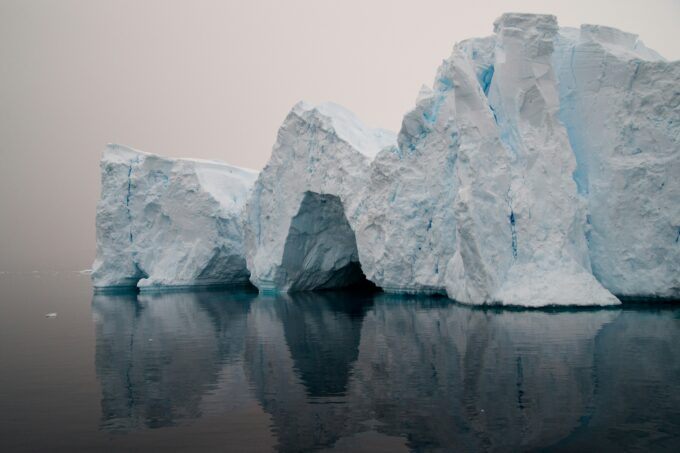
Image by Torsten Dederichs.
Antarctica has moved to “the front of the line” as a global warming threat that’s already well beyond expectations, and it’s happening fast. Based upon statements by polar scientists over the past 18 months, it warrants a Red Flag Warning, meaning higher than expected risks of catastrophic meltdown within current lifetimes.
This meets criteria for the latest international concern surrounding climate change: “When is enough, enough” for world leaders to take to heart the risks of ecosystem failures and take extraordinary, drastic, unprecedented measures in unison to hopefully head off the onset of a maniacal worldwide climate system. There are people of stature who believe it (climate change) is already over the top, meaning “it’s too late.” But this is not universal belief.
Antarctica may be the catalyst that tips the scales enough to scare the daylights out of world leaders, but will this be recognized early enough for extreme mitigation measures to hopefully take hold well before EVs, with electron sparks flying, are left floating on city streets throughout the world?
Antarctica has been commanding more public attention as the principal ogre of global warming’s impact on sea levels simply because it is the biggest monster in the room, and it’s starting to move, a lot. Increasingly, the science that once, not so long ago, thought of Antarctica as an issue for the distant future, has turned tail as the rapidity of global warming has changed the entire complexity of the continent’s future. Its future is now, not a hundred years from now.
The risk of massive sea level rise flooding coastal megacities has jump-started from a distant hundred years hence, or more, to today’s generation, right now. This new unanticipated risk has been hammered home by statements from scientific meetings over the past 18 months with explicit warnings of Antarctica’s meltdown advancing much faster than ever expected:
The 11th Scientific Committee on Antarctic Research meeting d/d August 2024 attended by 1,500 scientists: “Antarctica’s glacial melt is advancing faster than ever before in recorded history.” Quote by Gino Casassa, glaciologist head of Chilean Antarctic Institute: “Based upon current trends, sea levels will be up 13 feet by 2100.” If this happens, sea levels by 2035-40 will shock the world. After all, 13 feet doesn’t suddenly happen in the year 2099. And this is the first time such a projection (13’) has gone public.
A couple of months after that scientific meeting, 450 polar scientists held an emergency meeting in Australia d/d November 2024 issuing a press release to the public: “If we don’t act, and quickly, the melting of Antarctica ice could cause catastrophic sea level rise around the globe within our lifetimes.” The 450 polar scientists claim: “Drastic action is necessary regarding CO2 emissions as soon as possible.” Immense global warming-induced shifts were found in Antarctica. And this is the first time a group of polar scientists has stated “catastrophic sea level rise within our lifetimes.”
Now, a new study has discovered evidence of Antarctica mimicking Greenland’s meltdown dynamics, which are pervasive: Ruth Mottram, et al, The Greenlandification of Antarctica, Nature Geoscience, October 2025. Indeed, this study adds a new layer to outcries by scientists that a very big problem is about to burst loose with Antarctica’s meltdown phase.
Disturbingly, the Mottram, et al study exposes new dimensions of meltdown risks in Antarctica that should shatter any opposition to confronting global warming with every available resource guided by top notch scientists: “Both satellite data and field observations in Antarctica reveal alarming signs of a Greenland-like meltdown, with increased surface melting of the ice fields, faster-moving glaciers and dwindling sea ice. Some scientists are sounding the alarm, warning that the rapid ‘Greenlandification’ of Antarctica will have serious consequences, including an accelerated rise in sea levels and significant shifts in rainfall and drought patterns.” (Bob Berwyn, Scientists Warn About the ‘Greenlandification’ of Antarctica, Inside Climate News, October 16, 2025)
The immediate risk for today’s generation could be West Antarctica coming apart at the seams with enough ice melt alone to raise sea levels by 10 feet due to its uniquely vulnerable geographic setting. Overall, the entire Antarctic continent contains approximately 200 feet of sea level rise, which would take hundreds of years for complete meltdown, keeping in mind that every foot of sea level rise on the way to 200 feet equates to 100 feet of flooded shoreline; this puts every coastal megacity in the world at risk, within today’s generation.
The Ocean Mega-Heat Threat, since 2023
It’s entirely possible that current projections of sea level rise should be tossed out the window as ocean heat content exceeds all expectations. Indeed, this new risk is already a measurable factor that’s truly “scary” in the words of the co-author of a recent ocean dynamic study: “Record-Breaking 2023 Marine Heatwaves,” which observed 500 days with 96% of the ocean in consistent extreme heatwaves (hard to imagine but true) in a continual pattern 2023-24-25 well above all expectations, a Red Flag Warning for Antarctica.
Uninhabitable Ocean Environments
A comparable heatwave of 500 days on land would cause immeasurable death and destruction. Already, western Australia in 2025 witnessed 30,000 dead fish washed ashore as ocean temps registered 5C above normal, and the LA Times reported unprecedented numbers of dead marine mammals on California shorelines: Marine Mammals are Dying in Record Numbers Along the California Coast, Los Angeles Times, October 3, 2025, which, according to the article: “Raises questions about whether some ocean environments are becoming uninhabitable.”
This supports the finding of a dangerous “regime shift” in the ocean, a staggering new development. The co-lead scientist of “Record-Breaking 2023 Marine Heatwaves,” Zeng Zhenzhong, PhD, Earth Systems Scientist, China Southern University of Science & Technology commented on the study results: “I am scared,” which scientists never admit, but they are saying it now.
According to crucial data (used worldwide by scientists) provided by the National Oceanic and Atmospheric Administration (NOAA, which is on Trump’s chopping block) the top 2,300 feet of the ocean has experienced a stunning 5-fold increase in heat content in only five years. This type of horrible news serves to destroy the climate denialism narrative.
Of special concern, if Greenland-type pervasive meltdown hits West Antarctica’s notorious Doomsday Glacier, Thwaites, the world’s largest most unstable glacier at 80 miles wide, then the world may be about to change beyond anybody’s worst nightmare. For the record, Antarctica’s sudden unruly behavior exposes the utter failure and downright stupidity of climate denialism and avoidance of the issue. Ocean heat not only turns regions of the ocean uninhabitable; it’s also the primary cause of Antarctic ice sheet/glacial meltdown.
Of additional concern, a new 20-year study by 35 international teams found worldwide glaciers, excluding Greenland and Antarctica, melting down with “staggering volumes of ice loss,” more than Greenland and Antarctica combined and accelerating by nearly 40% over the past decade, extraordinarily fast for massive ice glaciers. This throws a whole new ingredient into sea level rise as cascading terrestrial glaciers create havoc for surrounding villages and cities and major river systems while accelerating sea level along with Greenland and Antarctica.
All of which prompts serious questions: Is this new direction in worldwide glacier meltdown included in current scientific models for sea level rise? Probably not, which means nobody is sure which end is up.
“What can be done about it” is by far the most provocative question of the 21st century.
But more importantly, massive glacial meltdown throughout the world hasn’t been formally recognized as a major threat to the world’s coastal megacities by the world at large, meaning, a “world approach” to some kind of solution is not even on the table. And thinking out loud: Is there really a solution? Maybe sea walls?
A Small Kingdom at the Top of the World
Arctic Council logo – Fair Use
In May, Denmark, quietly sophisticated, often underestimated, took over the chair of the Arctic Council. Its leadership mattered not just for climate and security, but for how smaller countries navigate great-power rivalries in a literally thawing world.
For the remaining eighteen months, Denmark will continue setting the agenda for a region that’s no longer the silent, frozen corner it once was. I’m no Arctic expert but even last May it was obvious this would be a defining moment.
My great-great-grandfather, Jens Bach, sat for decades in the Danish parliament, travelling regularly from Thisted in northern Jutland to Copenhagen. This was two islands and a heroic commute away. In his day, Greenland came up often. Denmark was moving towards a more formal rule over what they called “the big island in the north.” Inevitably, Greenland still comes up. Geography and history have long half-lives in Danish politics.
Copenhagen, for instance, has announced new Arctic defense spending. This includes radar in East Greenland, drones, and upgraded patrol ships. Nothing flashy, Denmark doesn’t really do flashy, but certainly deliberate. Around the Arctic table sit the US, Russia, Canada, Norway, Finland, Sweden, and Iceland. Nuance goes only so far.
Three forces define Denmark’s Arctic moment: great-power rivalry, Greenlandic self-determination, and rapid climate change.
Greenland gives Denmark its major seabed claims in the Arctic Ocean, a legal and geological smørrebrød layered with what diplomats call “resource and sovereignty implications.” Don’t underestimate this. Further phrases like “continental shelf” hide very real power politics.
At home, the debate over Greenland’s future is sharpening. Greenlandic leaders, diplomats, and scholars have long refined arguments. It’s easy to see how greater autonomy, even independence, would redefine Denmark’s Arctic role, as well as its sense of itself.
Famously, the United States, never shy about its geography, is taking a growing interest in Greenland’s direction. This escalated big time last year when Denmark summoned the US chargé d’affaires over alleged “influence efforts” in Greenland.
The Arctic Council includes six Indigenous organizations as Permanent Participants. Add to that rising attention still to Indigenous rights, plus the post-colonial relationship between Copenhagen, Nuuk, and Tórshavn, and we see Denmark’s history in the region is not a side note.
Then there’s the climate question, the most relentless of all. Melting ice opens new shipping routes and resource hopes, but also new risks. Denmark and Greenland are being pressed to lead on Arctic emissions, black carbon, and methane. The future here isn’t theoretical. Along Greenland’s rugged coast, ice loss and chemical change are already reshaping ecosystems and livelihoods.
Security planners in Copenhagen are having to adjust, too. Those new ships, a polar research vessel, more patrols. Quiet, bureaucratic preparedness. The Danish way, but still a signal. Undersea cables, cyber resilience, counter-intelligence, all no doubt standard topics now in defence meetings. Even telecom companies must receive a scrutiny that would have seemed absurd not so long ago.
Russia looms as the most immediate military concern, especially in the cyber and “a wee bit too close” sea or air encounters. China, as usual, plays the patient investor. The US does, in fact, remain Denmark’s indispensable, if sometimes overbearing, ally.
But if Copenhagen gets it wrong, it could end up sidelined in its own strategic backyard, leaving it wedged between Washington’s impatience, Beijing’s quiet capital, and Greenland’s growing assertiveness.
Nor is it helped by Trump’s habit of treating allies as optional accessories. We saw this last week with the favoritism shown to Hungary in the form of a one-year exemption from sanctions. Greenland didn’t enjoy being discussed like a real estate listing, and neither did Denmark. When science diplomacy and trust fray, Copenhagen’s instinct will be to lean more towards Europe, not less. It’s hardly ice-core astrophysics.
Admittedly, all of this can sound rather forbidding and strategic, but there’s a heartbeat underneath. One Danish relative of mine emigrated to the US, only to return home “to die” after a grim diagnosis in New York. He then lived another forty years. The Arctic, like life, doesn’t move in straight lines.
So too with Denmark’s Arctic role. The path can bend but not break, shaped by resilience, restraint, and the admirably stubborn endurance of small nations in big weather. Not everyone believes in surrendering the playground to the bully. The world turns on the appetites of great powers, but sometimes it survives on the alertness and civility of the small ones to win through.
And maybe in that, Denmark can serve us all.

No comments:
Post a Comment