Southeast Europe rocked by wave of anti-corruption protests
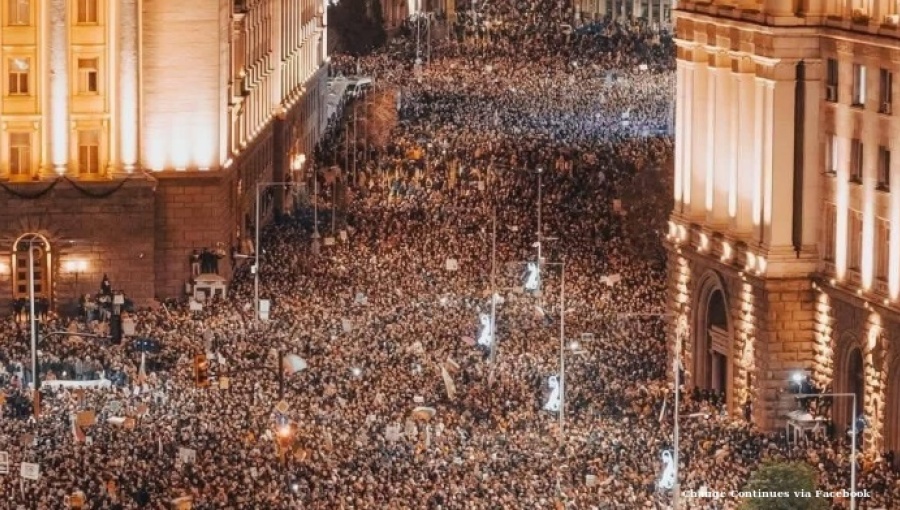
A wave of anti-corruption protests is spreading across Southeast Europe, exposing deep public anger over graft, negligence and weak accountability.
Demonstrations have simmered for over a year in Serbia following a deadly infrastructure disaster, toppled Bulgaria’s coalition government last week and most recently erupted in Romania over allegations that the judiciary has been “captured” by political interests. In North Macedonia, the families of victims of a catastrophic nightclub fire returned to the streets last month as the landmark corruption trial began. Together, the protests highlight persistent governance challenges in the region.
Bulgarian government falls after mass rallies
Bulgaria’s parliament on December 12 unanimously accepted the resignation of Prime Minister Rosen Zhelyazkov, a day after he stepped down ahead of a sixth no-confidence vote triggered by mass protests over corruption and contested budget plans.
Zhelyazkov resigned the previous day, less than three weeks before Bulgaria is due to adopt the euro on January 1, 2026. Officials have said the political turmoil will not derail the currency transition.
His year-old coalition government had come under mounting pressure after tens of thousands of people took to the streets on December 10 for the third major rally in two weeks. An estimated 150,000 protesters gathered in Sofia, with thousands more in other cities, denouncing corruption, government inefficiency and the political elite.
The cabinet, formed in January 2025, had survived five earlier no-confidence votes. Minutes before lawmakers were due to debate a sixth, Zhelyazkov announced his resignation at an emergency news conference in parliament, saying the decision reflected the “will of the people”.
Yet another snap election is now likely as the two largest parliamentary groups – former prime minister Boyko Borissov’s GERB party and the opposition Change Continues-Democratic Bulgaria alliance – have already ruled out attempts to form a new government within the current parliament.
Protests over Romania’s ‘captured’ judiciary
In neighbouring Romania, protests broke out last week after allegations of corruption within the judiciary.
More than 170 magistrates have joined an action group accusing the judicial system of being “captured”, following revelations by investigative outlet Recorder that alleged political interference in high-profile corruption cases.
The claims, confirmed publicly by judge Raluca Moroșanu, intensified street protests in Bucharest and several major cities on December 11. More than 1,000 people rallied in the capital, with hundreds more in Cluj-Napoca and Iași, demanding the resignation of High Court president Lia Savonea, National Anticorruption Directorate (DNA) head Liviu Voineag and Interior Minister Cătălin Predoiu, a former justice minister.
The demonstrations followed the broadcast of a two-hour Recorder documentary on public television alleging systematic pressure on judges and prosecutors.
At a tense press conference convened by the Bucharest Court of Appeal to rebut the allegations, Moroșanu publicly backed judge Laurențiu Beșu, whose testimony lay at the heart of the investigation.
“I came here to support my colleague, Laurențiu Beșu, and to say that everything he said there is true,” Moroșanu said. “If he is contradicted, it is a lie.”
She described a climate of intimidation within the courts, alleging that judges were “terrorised with disciplinary actions”. Explanations offered by court leadership were met with scepticism by journalists and civic groups.
Later, judge Daniela Panioglu told Euronews she believed corruption in the judiciary was pervasive. “I don’t know if anything works better in Romania than corruption in the judiciary,” she said, adding that Savonea “controls almost everything that happens”.
Savonea rejected the allegations, saying the testimonies cited were unsupported by verifiable facts and did not correspond to reality.
Sustained unrest in Serbia
Serbia has seen the region’s most sustained protest movement, driven by public outrage over corruption, urban development and a fatal infrastructure collapse that has become a national symbol of alleged negligence.
Protests over the November 2024 collapse of a railway station canopy in the northern city of Novi Sad that killed 16 people, one of the country’s worst infrastructure disasters, have been ongoing for more than a year. In the largest recent protest,
Tens of thousands of people gathered in Novi Sad on November 1 to mark one year since the disaster. Citizens assembled at 16 locations across the city – one for each victim – before marching to the station for a minute’s silence.
The protests, which began as an outpouring of grief, have evolved into a broader challenge to President Aleksandar Vucic and his ruling Serbian Progressive Party (SNS), with demonstrators demanding accountability and early elections. They have already led to the resignation of former prime minister Milos Vucevic earlier this year.
Days later, students in Belgrade staged a “warning protest” against plans to redevelop the former General Staff building, a bomb-damaged complex once declared a cultural monument, into a luxury hotel and residential project backed by Jared Kushner, the son-in-law of US President Donald Trump.
Under the slogan “We are a living wall”, demonstrators formed a human chain around the site, accusing the government of bypassing legal procedures and “selling off history”. The redevelopment was enabled by a special law adopted by parliament, which authorities said served the public interest.
The unrest comes as Serbia faces mounting economic and diplomatic pressure, including US sanctions on its sole oil company, factory closures, criticism from the European Union and strained energy talks with Russia.
Nightclub fire trial begins in North Macedonia
In North Macedonia, public anger has centred on a devastating nightclub fire in the town of Kocani that killed 63 people and injured more than 190 earlier this year.
Four days before the defendants were due to go on trial, families of the victims marched through Skopje on November 15, demanding truth and accountability. Hundreds of protesters dressed in black carried a banner bearing the faces of the dead as they walked from the main square to the Criminal Court.
Investigators said the club was operating illegally in a former warehouse, without adequate exits or safety permits, and had used unlawful pyrotechnics. Interior Minister Panče Toškovski acknowledged serious violations but did not resign.
Prime Minister Hristijan Mickoski, whose right-wing VMRO-DPMNE party returned to power in June 2024, described the disaster as a “mass murder” driven by corruption and institutional indifference, while placing blame on previous governments.
The case, involving 34 individuals and three legal entities, is seen as a critical test for the judiciary in a country plagued by low public trust and accusations of political influence. Human rights groups have said they will monitor the proceedings closely.
The tragedy was highlighted in the European Union’s latest progress report on North Macedonia, which warned that corruption remains widespread and a serious concern.

No comments:
Post a Comment