U.S. companies are aiming to make huge profits from the Gaza reconstruction plan, with several billionaires on Trump's Board of Peace openly discussing the opportunity to make billions.
February 25, 2026
MONDOWEISS
MONDOWEISS
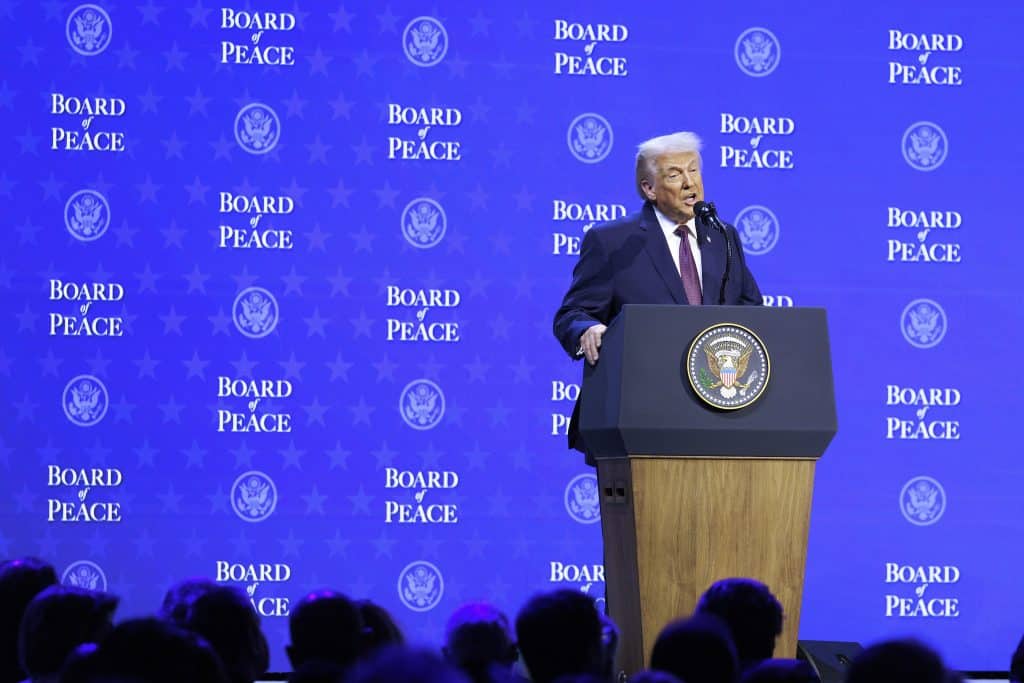
Donald Trump announces the “Board of Peace” on January 22, 2026, at the World Economic Forum in Davos, Switzerland.(Photo: ©2026 World Economic Forum / Benedikt von Loebell)
Last week, The Guardian reported that the Trump administration is planning to build a 350-acre military base in Gaza to house the future International Stabilization Force (ISF).
Plans reviewed by the newspaper reveal that the base will be “ringed by 26 trailer-mounted armored watch towers, a small arms range, bunkers, and a warehouse for military equipment for operations.”
At this time, it’s unclear who will be hired to construct the base, but the report is yet another reminder that Gaza’s reconstruction could generate massive profits.
Members of President Donald Trump’s controversial Board of Peace openly expressed this sentiment at the group’s first meeting, framing Gaza as a potential money-maker.
“The coastline alone is 50 billion dollars of value alone on a conservative basis… it just needs to be unlocked and financed,” said billionaire Marc Rowan, an executive member of the board and the head of the private equity firm Apollo Global Management.
Another board member, Israeli-Cypriot billionaire Yakir Gabay, told the crowd that Gaza’s coast could be “developed as a new Mediterranean Riviera with 200 hotels and potential islands.”
At the World Economic Forum (WEF) in Davos last month, Trump’s son-in-law, Jared Kushner, admitted that private-sector investment in Gaza could be “a little risky,” but said it would provide “amazing investment opportunities.”
“As you guys know, peace is a different deal than a business deal, because you’re changing a mindset,” he added.
As Quincy Institute research associate Nick Cleveland-Stout points out in Responsible Statecraft, Kushner could end up reaping the benefits of these opportunities, as his private equity firm, Affinity Partners, already has billions invested across the Gulf region.
Another possible partner is the disaster response firm Gothams LLC, which recently submitted a proposal to the White House that guarantees 300% profits via a seven-year trucking and logistics plan.
The Austin-based Gothams LLC gained attention last year after it landed a $33 million contract to help run the South Florida Detention Facility, the infamous migrant jail nicknamed “Alligator Alcatraz.”
“We provide solutions to the most challenging problems in high-leverage situations and strive to make a positive impact on the communities where we live and work,” declares the company’s website. “By combining military precision with private sector agility, we are built to accomplish more.”
When questioned about the proposal by The Guardian, Chris Vanek, a partner at Gothams, who has been coordinating with the Trump team, denied having any discussions about investment or returns with the White House.
“The Board of Peace, Palestinian and Israeli stakeholders, and the US Department of State asked me to assist with planning efforts based on my extensive experience in conflict zones, reconstruction, and disaster response,” said Vanek. “There is no existing agreement or contract, and I have provided this assistance at my own expense in support of peace efforts.”
Gothams “did not respond directly to questions about the profit margin,” noted The Guardian.
Reuters recently reported that North Carolina-based UG Solutions is in talks with the Trump administration to secure a role in Gaza’s reconstruction.
“Our proposal was received positively, but until the Board of Peace clarifies what its priorities are for security, UG Solutions is planning internally for a range of possible ways to support efforts in Gaza,” a UG Solutions spokesperson told Reuters.
The firm provided security for the Gaza Humanitarian Foundation (GHF) last year, and was heavily criticized by the United Nations after over 1,000 Palestinians were killed while attempting to reach aid sites. The operation was shut down after a ceasefire was announced.
Former GHF employee Anthony Aguilar alleged that he saw Israeli soldiers commit war crimes at the sites where UG Solutions provided security.
Aguilar told Democracy Now that the aid sites were “designed as death traps.”
“Those sites were built in the middle of those areas intentionally,” he explained. “It’s not by accident. That, in and of itself, to designate humanitarian distribution sites to service an unarmed, starving population, to build them deliberately in an active combat zone, is a violation of the Geneva Convention protocol. It’s a violation of humanitarian law. And in my opinion, it’s a violation of humanity in general.”
“The GHF and those who stand behind it have Palestinian blood on their hands; they are not welcome to return to Gaza,” said Palestinian NGOs Network head Amjad al-Shawa.
“I’m a real estate person at heart, and it’s all about location,” Trump has said, in reference to Gaza redevelopment. “And I said, look at this location on the sea, look at this beautiful piece of property, what it could be for so many people.”
Last week, The Guardian reported that the Trump administration is planning to build a 350-acre military base in Gaza to house the future International Stabilization Force (ISF).
Plans reviewed by the newspaper reveal that the base will be “ringed by 26 trailer-mounted armored watch towers, a small arms range, bunkers, and a warehouse for military equipment for operations.”
At this time, it’s unclear who will be hired to construct the base, but the report is yet another reminder that Gaza’s reconstruction could generate massive profits.
Members of President Donald Trump’s controversial Board of Peace openly expressed this sentiment at the group’s first meeting, framing Gaza as a potential money-maker.
“The coastline alone is 50 billion dollars of value alone on a conservative basis… it just needs to be unlocked and financed,” said billionaire Marc Rowan, an executive member of the board and the head of the private equity firm Apollo Global Management.
Another board member, Israeli-Cypriot billionaire Yakir Gabay, told the crowd that Gaza’s coast could be “developed as a new Mediterranean Riviera with 200 hotels and potential islands.”
At the World Economic Forum (WEF) in Davos last month, Trump’s son-in-law, Jared Kushner, admitted that private-sector investment in Gaza could be “a little risky,” but said it would provide “amazing investment opportunities.”
“As you guys know, peace is a different deal than a business deal, because you’re changing a mindset,” he added.
As Quincy Institute research associate Nick Cleveland-Stout points out in Responsible Statecraft, Kushner could end up reaping the benefits of these opportunities, as his private equity firm, Affinity Partners, already has billions invested across the Gulf region.
Another possible partner is the disaster response firm Gothams LLC, which recently submitted a proposal to the White House that guarantees 300% profits via a seven-year trucking and logistics plan.
The Austin-based Gothams LLC gained attention last year after it landed a $33 million contract to help run the South Florida Detention Facility, the infamous migrant jail nicknamed “Alligator Alcatraz.”
“We provide solutions to the most challenging problems in high-leverage situations and strive to make a positive impact on the communities where we live and work,” declares the company’s website. “By combining military precision with private sector agility, we are built to accomplish more.”
When questioned about the proposal by The Guardian, Chris Vanek, a partner at Gothams, who has been coordinating with the Trump team, denied having any discussions about investment or returns with the White House.
“The Board of Peace, Palestinian and Israeli stakeholders, and the US Department of State asked me to assist with planning efforts based on my extensive experience in conflict zones, reconstruction, and disaster response,” said Vanek. “There is no existing agreement or contract, and I have provided this assistance at my own expense in support of peace efforts.”
Gothams “did not respond directly to questions about the profit margin,” noted The Guardian.
Reuters recently reported that North Carolina-based UG Solutions is in talks with the Trump administration to secure a role in Gaza’s reconstruction.
“Our proposal was received positively, but until the Board of Peace clarifies what its priorities are for security, UG Solutions is planning internally for a range of possible ways to support efforts in Gaza,” a UG Solutions spokesperson told Reuters.
The firm provided security for the Gaza Humanitarian Foundation (GHF) last year, and was heavily criticized by the United Nations after over 1,000 Palestinians were killed while attempting to reach aid sites. The operation was shut down after a ceasefire was announced.
Former GHF employee Anthony Aguilar alleged that he saw Israeli soldiers commit war crimes at the sites where UG Solutions provided security.
Aguilar told Democracy Now that the aid sites were “designed as death traps.”
“Those sites were built in the middle of those areas intentionally,” he explained. “It’s not by accident. That, in and of itself, to designate humanitarian distribution sites to service an unarmed, starving population, to build them deliberately in an active combat zone, is a violation of the Geneva Convention protocol. It’s a violation of humanitarian law. And in my opinion, it’s a violation of humanity in general.”
“The GHF and those who stand behind it have Palestinian blood on their hands; they are not welcome to return to Gaza,” said Palestinian NGOs Network head Amjad al-Shawa.
“I’m a real estate person at heart, and it’s all about location,” Trump has said, in reference to Gaza redevelopment. “And I said, look at this location on the sea, look at this beautiful piece of property, what it could be for so many people.”
Gaza does not need new overlords
The U.S. plan for Gaza is the final stage of Israel’s genocide. Bombs and bulldozers obliterated Gaza’s landscape, and now skyscrapers and data centers aim to dismantle its social fabric and capacity to resist.
The U.S. plan for Gaza is the final stage of Israel’s genocide. Bombs and bulldozers obliterated Gaza’s landscape, and now skyscrapers and data centers aim to dismantle its social fabric and capacity to resist.
February 26, 2026
MONDOWEISS
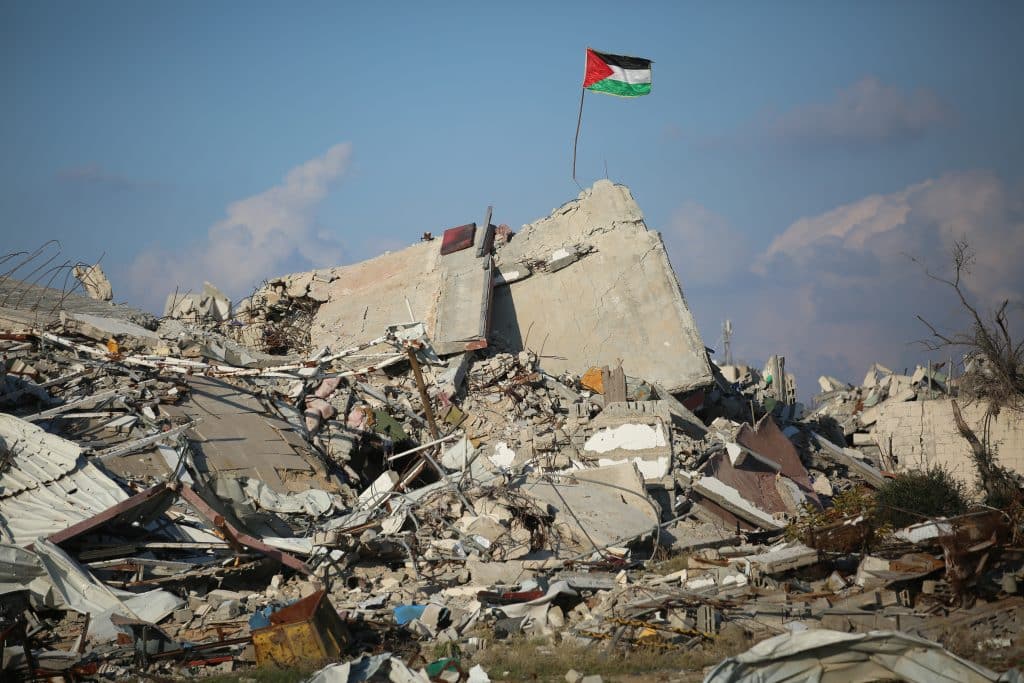
Displaced Palestinians return to their destroyed homes in the al-Maghraqa area south of Gaza City, January 31, 2024. (Photo: Omar Ashtawy/APA Images)
Every few decades, a new group of powerful men gathers around a table to decide what to do with Gaza or with Palestinians in general. The language changes. The underlying logic does not.
The latest proposals to “govern” postwar Gaza, from Jared Kushner’s beachfront development fantasies to the so-called “Board of Peace” and various international trusteeship schemes, are presented as bold, forward-looking visions. In reality, they are just recycling the same colonial framework that has governed Palestinian life for over a century: external actors decide what Palestinians need, what they may have, and what they must become in order to deserve it.
Gaza’s crisis was never a problem of governance or waiting for the right foreign administrator. It was, and remains, the product of a specific political structure: prolonged military occupation, a seventeen-year siege that strangled every dimension of life, and a settler-colonial project that treats Palestinian existence as an obstacle to be managed or removed. These are the roots. Everything else — the poverty, the misery, the desperation — is a symptom.
Yet every plan now circulating wants to treat the symptoms while leaving the roots untouched. They promise reconstruction without ending occupation. They offer economic incentives without political rights. They propose “deradicalization” programs without acknowledging that it is the violence of dispossession, not some cultural deficiency, that drives resistance. This is not new. The logic of “economic peace,” the idea that Palestinians can be pacified with jobs and consumer goods while their land is taken and their rights denied, has been tried repeatedly. It failed under the Oslo framework. It failed under the Quartet’s conditional aid regime.
It failed because no amount of economic programming can substitute for freedom.
What is new, and what should alarm anyone paying attention, is the scale of ambition behind the current proposals. Kushner did not misspeak when he described Gaza’s waterfront as “very valuable” real estate. The vision is not reconstruction. It is erasure. Build data centers and luxury resorts on the ruins of Shuja’iyya and Rafah. Erect skyscrapers where neighborhoods, mosques, schools, and cemeteries once stood.
The “Dubaification” of Gaza is not a development plan. It is the final stage of a process that began with bombs and D9 bulldozers: dismantle not only Gaza’s physical infrastructure but its social fabric, its cultural institutions, its memory, its capacity to produce defiance.
This is what makes these plans more than cynical. They are parasitic on genocide. The destruction of over seventy percent of Gaza’s built environment, the killing of tens of thousands, the displacement of nearly the entire population — these are not obstacles the planners must work around, but the necessary preconditions required by planners. You cannot build a seaside resort in a living neighborhood.
I grew up in Deir al-Balah. The Gaza I knew was not a blank slate awaiting foreign investment. It was a place dense with life, with teachers and poets and engineers and farmers and students who debated politics and planned futures despite the blockade. The idea that this place and its people need to be reimagined by men who could not name a single street in Gaza City is not visionary. It is colonial in the most precise sense of the word.
These plans may be attempted. Contracts may be signed. Renderings may be published. But they will not work — for the same reason every previous attempt to govern Palestinians without their consent has not worked. Palestinians are not a problem to be solved or a population to be pacified. They are a people with political demands that no amount of construction can build over: an end to occupation, the right of return, sovereignty, and freedom.
Until those demands are addressed, every plan imposed on Gaza from the outside will meet the same fate. And when it fails, Palestinians will say what they have always said: we told you. The problem was never Gaza. The problem was what you did to it, and what you refused to stop doing.
Every few decades, a new group of powerful men gathers around a table to decide what to do with Gaza or with Palestinians in general. The language changes. The underlying logic does not.
The latest proposals to “govern” postwar Gaza, from Jared Kushner’s beachfront development fantasies to the so-called “Board of Peace” and various international trusteeship schemes, are presented as bold, forward-looking visions. In reality, they are just recycling the same colonial framework that has governed Palestinian life for over a century: external actors decide what Palestinians need, what they may have, and what they must become in order to deserve it.
Gaza’s crisis was never a problem of governance or waiting for the right foreign administrator. It was, and remains, the product of a specific political structure: prolonged military occupation, a seventeen-year siege that strangled every dimension of life, and a settler-colonial project that treats Palestinian existence as an obstacle to be managed or removed. These are the roots. Everything else — the poverty, the misery, the desperation — is a symptom.
Yet every plan now circulating wants to treat the symptoms while leaving the roots untouched. They promise reconstruction without ending occupation. They offer economic incentives without political rights. They propose “deradicalization” programs without acknowledging that it is the violence of dispossession, not some cultural deficiency, that drives resistance. This is not new. The logic of “economic peace,” the idea that Palestinians can be pacified with jobs and consumer goods while their land is taken and their rights denied, has been tried repeatedly. It failed under the Oslo framework. It failed under the Quartet’s conditional aid regime.
It failed because no amount of economic programming can substitute for freedom.
What is new, and what should alarm anyone paying attention, is the scale of ambition behind the current proposals. Kushner did not misspeak when he described Gaza’s waterfront as “very valuable” real estate. The vision is not reconstruction. It is erasure. Build data centers and luxury resorts on the ruins of Shuja’iyya and Rafah. Erect skyscrapers where neighborhoods, mosques, schools, and cemeteries once stood.
The “Dubaification” of Gaza is not a development plan. It is the final stage of a process that began with bombs and D9 bulldozers: dismantle not only Gaza’s physical infrastructure but its social fabric, its cultural institutions, its memory, its capacity to produce defiance.
This is what makes these plans more than cynical. They are parasitic on genocide. The destruction of over seventy percent of Gaza’s built environment, the killing of tens of thousands, the displacement of nearly the entire population — these are not obstacles the planners must work around, but the necessary preconditions required by planners. You cannot build a seaside resort in a living neighborhood.
I grew up in Deir al-Balah. The Gaza I knew was not a blank slate awaiting foreign investment. It was a place dense with life, with teachers and poets and engineers and farmers and students who debated politics and planned futures despite the blockade. The idea that this place and its people need to be reimagined by men who could not name a single street in Gaza City is not visionary. It is colonial in the most precise sense of the word.
These plans may be attempted. Contracts may be signed. Renderings may be published. But they will not work — for the same reason every previous attempt to govern Palestinians without their consent has not worked. Palestinians are not a problem to be solved or a population to be pacified. They are a people with political demands that no amount of construction can build over: an end to occupation, the right of return, sovereignty, and freedom.
Until those demands are addressed, every plan imposed on Gaza from the outside will meet the same fate. And when it fails, Palestinians will say what they have always said: we told you. The problem was never Gaza. The problem was what you did to it, and what you refused to stop doing.
Moroccan opposition leader criticises foreign minister over Gaza “Peace Council” role
February 27, 2026
February 27, 2026
Middle East Monitor

Secretary-General of Morocco’s Justice and Development Party, Abdelilah Benkirane. [Photo/alquds.co.uk]
Abdelilah Benkirane, Secretary-General of Morocco’s Justice and Development Party (PJD), has criticised Foreign Minister Nasser Bourita over remarks concerning Morocco’s reported leadership of a programme to combat hate speech in Gaza under the framework of the US-backed “Peace Council”.
In a video published on his official Facebook page, Benkirane questioned the context and implications of statements attributed to the foreign minister, warning that they could be interpreted in ways that harm Morocco’s image and its longstanding position on the Palestinian issue.
Benkirane stressed that Bourita was speaking not in a personal capacity but as a representative of the Moroccan state, arguing that this required greater caution and precision when addressing sensitive political matters.
The PJD leader said that calls to promote “coexistence” in the current circumstances risked being understood as an attempt to persuade Palestinians not to regard Israel as an adversary. He argued that any discourse on coexistence should instead be directed towards the occupying power rather than the population living under occupation.
He further claimed that Israel was not genuinely committed to coexistence, asserting that the conflict remained fundamentally about land and displacement rather than a temporary political dispute.
While acknowledging that foreign policy ultimately falls under the sovereign authority of King Mohammed VI, Benkirane said this did not prevent political parties or public opinion from expressing positions on international affairs.
He reiterated his party’s long-standing opposition to normalisation with Israel, describing it as a principled stance embedded in the party’s political platform and internal decisions.
Benkirane concluded by arguing that lasting peace could only be achieved through restoring Palestinian rights, calling for efforts to persuade the United States administration to treat Palestinians fairly rather than exert pressure on them.
Secretary-General of Morocco’s Justice and Development Party, Abdelilah Benkirane. [Photo/alquds.co.uk]
Abdelilah Benkirane, Secretary-General of Morocco’s Justice and Development Party (PJD), has criticised Foreign Minister Nasser Bourita over remarks concerning Morocco’s reported leadership of a programme to combat hate speech in Gaza under the framework of the US-backed “Peace Council”.
In a video published on his official Facebook page, Benkirane questioned the context and implications of statements attributed to the foreign minister, warning that they could be interpreted in ways that harm Morocco’s image and its longstanding position on the Palestinian issue.
Benkirane stressed that Bourita was speaking not in a personal capacity but as a representative of the Moroccan state, arguing that this required greater caution and precision when addressing sensitive political matters.
The PJD leader said that calls to promote “coexistence” in the current circumstances risked being understood as an attempt to persuade Palestinians not to regard Israel as an adversary. He argued that any discourse on coexistence should instead be directed towards the occupying power rather than the population living under occupation.
He further claimed that Israel was not genuinely committed to coexistence, asserting that the conflict remained fundamentally about land and displacement rather than a temporary political dispute.
While acknowledging that foreign policy ultimately falls under the sovereign authority of King Mohammed VI, Benkirane said this did not prevent political parties or public opinion from expressing positions on international affairs.
He reiterated his party’s long-standing opposition to normalisation with Israel, describing it as a principled stance embedded in the party’s political platform and internal decisions.
Benkirane concluded by arguing that lasting peace could only be achieved through restoring Palestinian rights, calling for efforts to persuade the United States administration to treat Palestinians fairly rather than exert pressure on them.

No comments:
Post a Comment