It’s possible that I shall make an ass of myself. But in that case one can always get out of it with a little dialectic. I have, of course, so worded my proposition as to be right either way (K.Marx, Letter to F.Engels on the Indian Mutiny)
Saturday, August 08, 2026
First Russian Sanction Package from the New UK Government
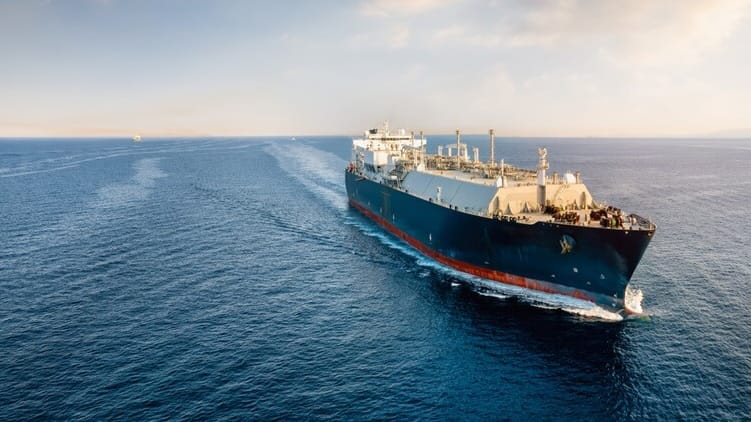
Demonstrating consistency the new UK government launched its first sanction package including a newly acquired Russian LNG carrier (file photo)
Two and a half weeks after the newest British government was officially formed, the newly named foreign secretary, Ed Miliband, announced the first Russian sanction package of the new government. The government of the new Prime Minister, Andy Burnham, is attempting to show solidarity and consistency in policy.
The new package is modest in scope but targets the shipping and energy sector as well as banks and what it terms “shady businesses” for their role in supporting the war in Ukraine. A total of 19 listings were added to the sanctions regime.
Miliband emphasized that the first package “reinforced the UK’s commitment to the people of Ukraine by announcing new measures against those supporting the Kremlin’s war effort.” Like their predecessors, the new government said they are continuing to target the networks and revenue streams on which the Kremlin relies.
As part of the effort, the new package is targeting the LNG operations by listing a recently acquired LNG carrier. The vessel, built in Korea, was acquired by Russian interests in May and transferred to the Russian flag as the Arctic Express (IMO 9333591). It is being managed by SMP Techmanagement of St. Petersburg. The 84,000 dwt vessel is reported to already be involved in the transport of Russian gas to third countries. The vessel’s AIS shows that it departed China’s Tieshan on Wednesday, August 5.
The UK also listed an Indian ship management company, Frion Ship Management, that it asserts supported the sale of the Arctic Express into Russian ownership and control. The package follows the latest efforts in the EU, as it lists vessels recently sold into the Russian register, as Europe looks to also crack down on vessel sales to Russia.
The five additional listings include four shadow fleet crude oil tankers reportedly registered in Palau, San Marino, and Barbados. It also included one product tanker registered in Barbados. These vessels join 644 other listings in the UK database of sanctions linked to the shipping sector.
The other portion of today’s sanctions package includes four companies that the UK says are importing tantalum and niobium, rare metals critical for producing military equipment. It also lists six additional banks.
Miliband, who had been serving until July as Energy Minister in the prior government, highlights that since taking office, he has attended the ASEAN conference in Manila, where they focused on Ukraine, and, along with the Prime Minister, met with Ukrainian President Volodymyr Zelensky. He also flew to Washington, D.C., to meet with US Secretary of State Marco Rubio to discuss Russia and Ukraine.
The UK highlights that this year alone, it imposed sanctions on over 500 individuals, entities, and ships as part of the Russian sanctions regime. They are attempting to signal that there will be consistency in the effort as the new government moves forward.
Russian Navy Augments its Long-Term Presence in English Channel
NOT A SHADOW FLEET, THE REAL THING
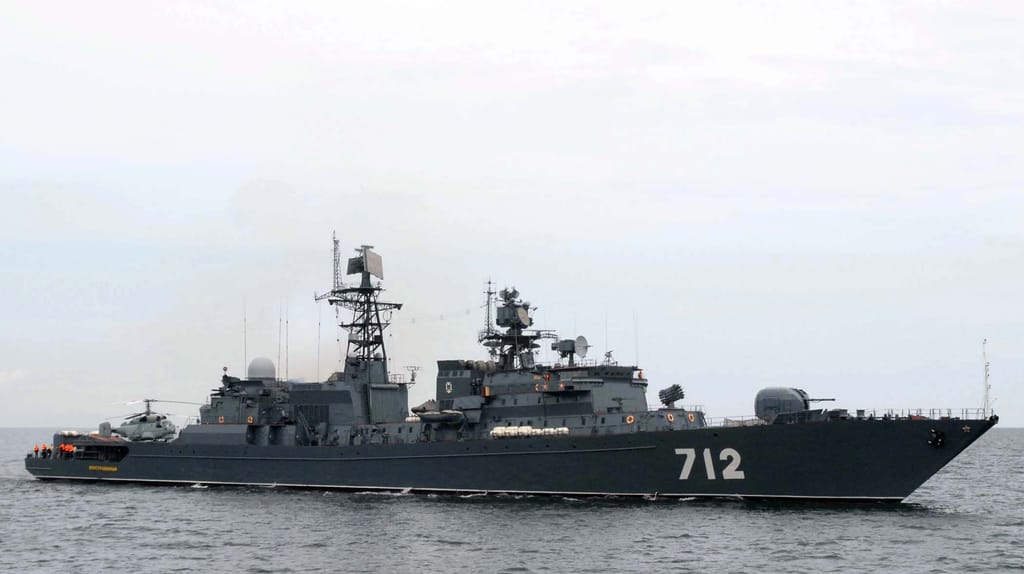
Neustrashimy and her embarked helicopter in friendlier times, exercising alongside NATO forces in the Baltic, 2008 (USN file image)
The Russian frigate RFS Neustrashimy (now F722) has settled into its role as the Russian Navy’s piquet ship stationed in the English Channel, suggesting she is a permanent replacement for RFS Admiral Grigorovich (F494), which arrived back in Baltiysk, its home port in the Kaliningrad enclave, on July 16.
On August 1, the Neustrashimy was seen stationary and tied up alongside the Vishnya Class specialist intelligence collection vessel RFS Vasiliy Tatishchev (SSV-231) close up to the Galloper Wind Farm, 15nm off Clacton and the Suffolk coast. It is not clear why the Russian Navy has chosen the Galloper Wind Farm as a regular logistics transfer point, possibly because it is difficult to miss as a rendezvous point, or because the wind farm provides some form of protection.
The two vessels were not seen transferring fuel, although this could have been undetected, but the trans-shipment will have at least included fresh rations. The RFS Vasiliy Tatishchev appears to have come out the Baltic Fleet headquarters at Baltiysk in Kaliningrad to undertake the replenishment task. Hitherto, a full replenishment with fuel has been conducted by the warship tying up alongside the Amur Class base repair ship PM-82, which has now returned home.
On August 3, the Neustrashimy revealed that it had been hiding a Ka-27 helicopter in its aircraft hangar, a type which this frigate class was designed to carry. The presence on board of a Ka-27 will prove something of a headache for the Royal Navy, as the Russians will now be able to maintain over-watch of two of their dark fleet merchant vessels simultaneously and over a wider area as they transit the English Channel.
Without calling on the aid of the Sky News helicopter to help with the observation effort (Sky News having spotted a replenishment operation in the same area on July 17), it will make the Royal Navy’s task of keeping an eye on Russian activity more complex. There is already a mismatch between the Russian capability at sea and their British escorts: often the Royal Navy fields a single minesweeper or patrol vessel, either armed with a 30mm cannon, or sometimes even an unarmed Royal Fleet Auxiliary, and there may now be a need for an onboard helicopter to respond to Russian aerial activity. Moreover, the Russian presence in the Channel and the North Sea now seems semi-permanent.

No comments:
Post a Comment