On the eve of the 35th anniversary of Ukraine’s independence, I find myself wondering whether my country will still exist in another 35 years. Vladimir Putin’s full-scale invasion, the rollback of democracy, a severely damaged market economy, and the degradation of every social system compel me, as a Ukrainian woman, to ask whether Ukraine will survive another 35 years if the status quo remains unchanged.
When Ukraine gained independence in 1991, its population stood at 52mn—larger than neighbouring Poland and twice the combined population of Hungary, the Baltic states, and Belarus. Today the official figure is only 20–25mn and declining rapidly. Last year alone the country officially lost 800,000 people—roughly half a million through death and 300 thousand through emigration—while the birth rate was three times lower than the death rate. This year the trend continues: a quarter of a million new refugees in the first half of the year alone, and births now running four times lower than deaths.
Meanwhile, nearly 12mn residents—more than half the population—are pensioners or people with disabilities. The war is draining the country’s last reserves of strength. On one side is life under constant, brutal Russian attacks; on the other is an economy short of people, without reliable electricity, with outdated healthcare lacking doctors, and with education inaccessible in full to a third of Ukrainian children.
The militarization of the economy—prioritizing weapons production while remaining wholly dependent on Western funding—cannot attract, support, or be accepted by the entire population. The only “value added” seems to be produced in endless social-media posts and videos of explosions inside Russia.
Ukraine’s external debt and poverty keep rising. According to the latest World Bank data, poverty has climbed from 36% to 41%.
That is why Ukraine today stands at a crossroads. One possible path is Finland; the other is Afghanistan.
Finland once lost battles and territory. The defeat was crushing and painful. Yet Finland won its nation and its future.
By contrast, the West today is supporting a strategy of Ukraine’s obvious defeat along Afghan lines. Twenty years of war and a trillion dollars in Western aid produced dependence in Kabul rather than sovereignty, an absence of genuine leadership, tolerance of the corruption that hollowed out Kabul’s institutions, and the censorship deemed necessary for “support.” The result was an Afghan government that, after many years of Western backing, could not stand against the Taliban on its own.
Today’s Western strategies are moving Ukraine down that very same road. Our institutions are buckling under corruption and a self-assured autocracy; our people are fleeing and losing their faith; and Russia keeps advancing. We lose territory and we lose people every single day, without pause—and with them, our chance at a future.
To defend the policies Ukraine is pursuing today is to defend a status quo that is an Afghanistan path for Ukraine and a historical shame for the West. This policy has turned Ukraine into a country without political or economic agency. If nothing changes urgently, the country is unlikely to withstand even a few more years of such a brutal war in its hot phase. There will simply be no one left to defend it.
Have any of the Western experts who defend the current strategies performed even the most basic arithmetic? If Ukraine still has 25mn people under the most optimistic estimates, of whom 12mn are pensioners or disabled and another 5mn are children under 18, then the adult population is at most 7mn—perhaps 9mn if we remain optimists. Among them, half are men. The current strategy therefore assumes that 3.5-4.5mn Ukrainian men must defeat a Russia of more than 140mn people that has 38–42mn men of mobilization age. In other words, an average of 4mn Ukrainians against an average of 40mn Russians.
On top of that, Russia actively recruits soldiers from poorer countries and offers financial incentives for joining the army—$10,000—that Ukrainians can only dream of.
Neither logic, nor history, nor even the film ‘300’ teaches anything to those who, from the comfort of the West, insist on fighting Russia with Ukrainian lives. The overwhelming majority of Ukrainians I know and talk to every day oppose this approach.
In 35 years, Ukraine has never developed a coherent political ideology. With only a blurred understanding of liberal and conservative values, the Ukrainian political class operates on pathological populism as its main principle of governance. Yet never has the degradation of politics been as severe as during this war.
The radicalization of society, the promotion of war as the only possible form of existence, militarization, and the artificial elevation of controversial historical figures as a new ideology of the present—all of this divides Ukrainian society and drives many more people to consider leaving. Such artificial constructs may produce interesting profiles in Western liberal media, but they cannot save Ukraine from catastrophe.
Nevertheless, the Ukrainian nation—from Donbas to nationalist Lviv and Volyn’—has always gravitated toward conservative-centrist positions. The family as the foundation of society, the church in its various branches as the foundation of faith, and the acceptance of new cultures, ethnicities, and religions as the foundation of community—these remain the things that unite Ukrainians, together with the shared horrific history in which every family carries terrible stories of the Nazi crimes during WW2 and the Holodomor and repressions engineered by Stalin’s Soviet Union. This common ground could become the factor that unites people around an ideological platform natural to Ukraine—one capable not only of saving the country and its future but of guaranteeing lasting stability.
Ukraine can and should become a frontier between the West and Russia. Extremes have never been popular among Ukrainians, a nation of innovation and agribusiness. A strong pull toward education (in the 2010s more than 80% of Ukrainians held higher-education degrees), innovativeness (it was a Ukrainian who led the first program to launch a human into space), and the agricultural sector (rich black soil, chernozem, covers roughly 60–65% of Ukraine’s total land area and over 65% of its arable land) have long been Ukrainian strengths. Total disregard for human life in war has been Russia’s strength.
Ukraine needs more than territorial compromises to achieve peace. It needs leadership that prioritizes the intellectual possibilities of legal nuances and agreements in order to preserve diplomacy and the strategic chance of recovering territory. Above all, it needs measures that preserve people and enable the realistic return of those who have become refugees. Ukraine needs the restoration of democracy, elections, economic recovery, and hope for the future.
Current strategies do not merely undermine all of this while propping up an unsustainable status quo; they lead Ukraine directly toward military, social, and intellectual collapse.
A future of winter humanitarian crisis, further mass emigration, growing numbers of graves, and widespread societal PTSD is steadily approaching. Strategically, people with conservative ideologies are coming to power in the West—people who do not support this unjustified and brutal war, many of whom understand that it cannot be won militarily. This means that if Ukraine does not take its own future into its hands and build new strategies, it will lose partners as quickly as it is losing people.
Iuliia Mendel is a journalist and Zelenskiy’s former press secretary. She posts on X at @IuliiaMendel.
Ukraine turned 35 on August 24 and its president spent the occasion asking for two things: money and missiles.
Volodymyr Zelenskiy told reporters in Kyiv on August 23 that ballistic missile defence and war funding were Ukraine's "two major challenges". The defence ministry is carrying a budget shortfall of $27bn this year, he said, and Kyiv has asked for 360 interceptors for its US-made Patriot batteries, hoping to end up with 300.
The budget shortfall was borne of necessity rather than bad planning. Under attack by the Armed Forces of Russia (AFR), a decision at the start of this year was made to take what money had come in and spending it all on building the medium- and long-range drone fleet that has been playing havoc on Russia’s supply chains behind the lines and striking Russian oil refineries across the country. But Ukraine’s allies have been tardy in sending subsequent tranches and now the budget is starting to run out of cash. Ukraine spent money earmarked for the second half of the year in the first half. The hole now has to be filled twice over. Of the $27bn, 8bn-10bn is needed in advance simply to arm the army through January 2027 while nearly $20bn covers military salaries and payments to the families of the dead.
It’s more money than the finance ministry was using a month ago, and it lands at the moment Kyiv's European money is moving slowest. Ukraine is waiting on €30bn ($35bn) of EU funds whose release is tied to the Verkhovna Rada passing the enabling legislation - a condition Zelenskiy turned into a pointed request that "the entire parliament, including the opposition" get on with it. "Neither the government nor the opposition has this €30bn, and the money is needed for the defence of the entire country," he said. Kyiv has already asked the West for $101bn over two years to keep the state running.
During the day’s speeches, European Commission President Ursula von der Leyen offered Kyiv a lifeline saying she was going to accelerate the transfer of €6bn of the €90bn EU loan allocation to Kyiv for defence spending to tide the government through the rest of the summer.
Who turned up, and who did not
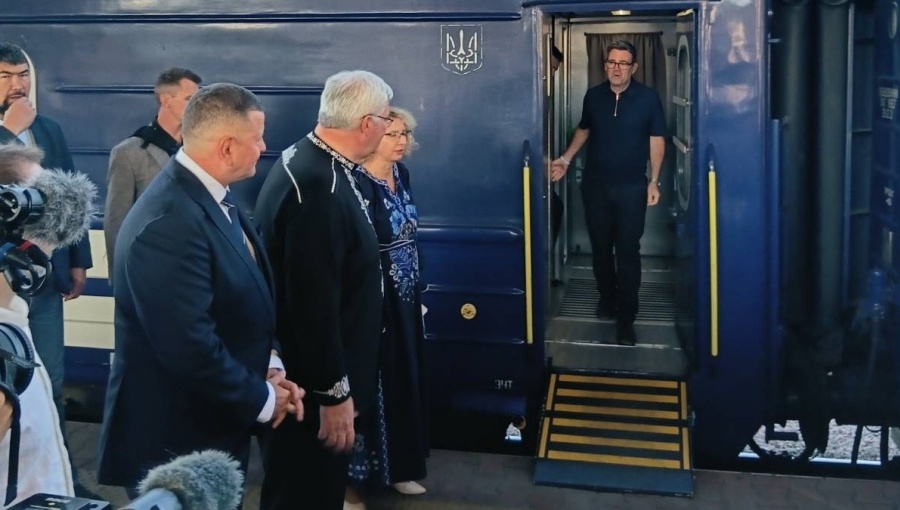
Leaders of more than 30 countries in the Coalition of the Willing joined the Kyiv meeting on August 24, some in person but most by video link. Foreign Minister Andrii Sybiha greeted European Council president Antonio Costa, UK Prime Minister Andy Burnham, Luxembourg's Luc Frieden, Moldova's Maia Sandu and Estonia's Alar Karis off the train at Kyiv station; the leaders of Lithuania, Latvia, Denmark, Norway and Finland had arrived the day before.
Washington sent a congratulatory statement and a new charge d'affaires, who began his mission in Kyiv on August 23. Secretary of State Marco Rubio sent a message saying the United States "is committed to Ukraine's sovereignty and continues to work to support a negotiated settlement", European Pravda reported, citing the State Department. The long-trailed first visit to Ukraine by special envoy Steve Witkoff and Jared Kushner was put off again, blamed on the intensity of Russian strikes on Kyiv, but underscored the lack of interest of the Trump administration in resolving the conflict. Witkoff and Kushner have been in Moscow a dozen times, but have yet to visit the Ukrainian capital.
Former US vice-president Mike Pence went instead - in a private capacity. "Ukraine is winning this War," he told the local TV. "With the right support of America and our Allies, the brave Ukrainian people can achieve a victory for freedom for themselves and the Free World."
Norway used the visit to pledge NOK85bn ($9.2bn) for 2027, matching this year, most of it military and much of it to be spent buying weapons from Ukraine's own defence industry. Prime Minister Jonas Gahr Store told Zelenskiy the money would go to the Nansen Support Programme. "Support and reconstruction of Ukraine are also important for European security," he said.
The election question
The awkward questions came from Ukrainian journalists, not the visitors. Asked about calls for wartime elections that disgruntled ex-Defence Minister Mykhailo Fedorov has demanded last year, Zelenskiy was blunt: "It would be a tsunami for the state and split Ukraine apart. My strategy is to bring the country through to the end of the war, and to preserve an independent and sovereign state."
Fedorov repeated his demand at the weekend elections should be held now and denounced corruption inside the Ukrainian state, saying the president had “questions to answer.”
Zelenskiy did not engage with the corruption charge, saying only that Fedorov had overstepped his role. Fedorov says his dismissal followed a clash with former commander-in-chief Oleksandr Syrskyi and resistance to his attempts to clean up military procurement.
There is still no workable way to let soldiers near the front, several million Ukrainians abroad and people under occupation, to vote safely, Zelenskiy argued. More recently even some of Fedorov's supporters have backed away from the demand as unworkable. Fedorov has also lost some of his shine, tarred with accusations that his own political ambitions are taking precedence over what is good for the country. A KIIS poll released this month found 57% of Ukrainians want elections only after a peace agreement and a complete end to the fighting. The most recent poll still puts Zelenskiy as front runner with former commander-in-chief General Valerii Zaluzhnyi second and Fedorov third, although the order keeps changing and Ukraine’s domestic politics has been thrown into turmoil by a slew of recent scandals.
Ukraine's constitution does not itself ban wartime elections; it extends parliament's mandate under Article 83 until a new Rada meets after martial law ends, and keeps the incumbent president in office under Article 108 until a successor is sworn in. The prohibition comes from the 2015 martial law statute and the 2019 Electoral Code, which suspend all elections - presidential included - while martial law is in force. However, earlier this year the Rada passed amendments which, in theory, clear the way for wartime elections.
Overall in several recent polls, Zelenskiy continues to trail Zaluzhny, Kyrylo Budanov, the former military intelligence chief who now runs the presidential administration, and Fedorov, and leads only the anti-rating poll – a list of politicians voters say they would not back under any circumstances. Another survey has found Ukrainians are more worried about corruption in the presidential administration than about Russian bombs.
Nobody in the office, and nothing on the president
Zelenskiy was pressed on the corruption cases now circling the Bankova, including those involving Iryna Mudra, the former deputy head of the President's Office, who was caught up in a racketeering scandal run out of the president’s office. He said he had learned of the allegations at the same time as everybody else and that what was published was enough to justify dismissing her.
"They take certain steps - we respond to those steps. If it's a minister and there are grounds to dismiss them, then they're dismissed," he said, adding that the heads of the anti-corruption agencies "understand perfectly well that I'm not involved in anything like that. And that matters to me."
The independent anti-corruption organs NABU and SAPO searched premises linked to Mudra and MP Vadym Stolar on August 19. The constitution bars the investigation of a sitting president by NABU, which is why the question keeps returning as a political one rather than a legal one.
Not us on Nord Stream
Zelenskiy also used the Nordic-Baltic Eight meeting to deny Ukrainian involvement in the Nord Stream sabotage, five days after Germany's federal prosecutor announced the arrest in Croatia of Ukrainian national Volodymyr Zhuravliov, who is accused of masterminding the explosion in 2022 that destroyed Europe’s major energy pipeline.
"At a high level, we have discussed this with the German side. They know perfectly well that Ukraine was not behind the execution or the very concept of the execution of the relevant operation," he said, adding that the prosecutor general's office and the foreign ministry were both cooperating and that Ukraine was "absolutely open to joint steps regarding the investigation".
Zhuravliov was picked up while working on a Hollywood film about the sabotage. It is the third attempt to detain him: German investigators sought him in Poland in the summer of 2024, when he crossed back into Ukraine before an arrest warrant could be executed, and again in autumn 2025, when a Polish court declined to extradite him. A second suspect, Serhii Kuznetsov, has been in German custody since last summer.
Missiles and tech transfers
Ukraine has run out of US-made Patriot interceptor ammo, the only weapons in its arsenal capable of stopping Russia’s ballistic missiles. The skies are open and Russia has been able to hit cities across Ukraine all summer with impunity. Zelenskiy has spent months touring capitals looking for stock that does not exist as the US has run out of ammo too.
With nothing to give, allies have started handing over knowledge instead. Washington granted Ukraine the right to make Patriot interceptors missiles in July, though that plan looks more useful for Ukraine's next war than this one. Even that gesture has fallen on stony ground after US manufacturers have reportedly been reluctant to share their technology with Ukraine, afraid it will out produce and undercut their own production. With a heavy Russian winter bombardment looming, Zelenskiy has started to sound increasingly desperate in the last month as he is running out of options.
Burnham arrived in Kyiv on August 24 with a version of the same offer. The UK will allow MBDA to declassify information about British-made components in the Anglo-French Storm Shadow/SCALP cruise missile, letting Ukraine work towards building its own, and will help France stand up long-range missile assembly lines in the country. "The Ukrainian people should be in no doubt: the United Kingdom stands with you today and for as long as it takes," Burnham said, continuing a tradition started by his predecessor UK former Prime Minister Keir Starmer who signed a “100-year partnership” deal with Ukraine in January 2025.
Moscow will read the new missile supply deals as an escalation, and the timing does not help: Russia has already accused Britain of deliberately escalating the war by allowing strikes with British-made drones on Russian targets and argued that takes the UK from a mere “supplier” to an “active participant” in the war against Russia via its Ukrainian proxy. Russia has recalled its ambassador to London over the weekend without naming a replacement. Berlin is moving the same way, with a €12bn long-range missile arsenal of its own on the drawing board, missiles designed to hit targets deep inside Russian territory.
A declassification notice is not an interceptor, and a French assembly line in Ukraine is a project that won’t appear for years - the same lag that makes the Patriot licence a gesture rather than a solution. What Ukraine has between now and the spring is whatever arrives from allied stocks, plus its own drones, and a defence budget $27bn short.
The war both economies are fighting
The rhetoric is grandiose. The practical consequences of the pledges made in Kyiv during Independence Day are negligible. The talk is running in parallel with an escalation in a brutal tit-for-tat missile war that is escalating steadily. Putin prefixed the celebration with a potent warning the day before in an interview on Russian state TV, saying that Bankova had opened a “Pandora’s box” by attacking Russia’s retail sector with strike on e-commerce logistics of Wildberries and now Ozon, which was struck for the first time on August 21 in a rapidly expanding warehouse war.
Neither side is winning. Ukrainian drones have moved from Russian refineries to Russian retail, hitting Wildberries warehouses through the summer and burning Russia's biggest Ozon warehouse in Orenburg at the weekend, part of a campaign in which both sides are now targeting each other's civilian economy. Russia has responded with a disproportionate retaliation and is attempting to systematically destroy Ukraine’s retail infrastructure piece by piece.
A double-tap drone daytime strike on a shopping centre in Kryvyi Rih at the weekend, Zelenskiy's home town, killed at least 16 people on August 21 and injured 130. Odesa port infrastructure has been hit hard enough that Ukraine’s main grain export terminal has been closed down in a blow that could cost Ukraine 5.3% of GDP by 2027. Even a company as dominant as Nova Poshta, which lifted profits 24% while its depots burned, is now sorting parcels on a decentralised backup system. When the mercury begins to fall, the Russian onslaught is widely expected to intensify.

No comments:
Post a Comment