Showing posts sorted by relevance for query Kundalini. Sort by date Show all posts

Thursday, December 11, 2025

 Outside the West, the Kundalini tradition presents a model of the ‘divine feminine’ beyond binary gender

(The Conversation) — Drawn from tantric traditions, Kundalini points to spiritual practices that go beyond traditionally understood concepts of the masculine and feminine.


A piece of art shows the tantric tradition's depiction of Kundalini and energy centers – or chakras. (Tantrika painting/Wellcome Collection, CC BY)

Sravana Borkataky-Varma and Anya FoxenDecember 10, 2025


(The Conversation) — The notion of the divine feminine is a recurring motif in American pop culture, playing with the assumptions people make when referring to God – often the deity described in the Bible – as “He.”

Whether it’s Alanis Morissette’s iconic portrayal of God in the 1999 comedy “Dogma” or Ariana Grande’s titular declaration in her 2018 track “God is a Woman,” the effect is the same: a mixture of irreverence and empowerment. It dovetails, moreover, with a ubiquitous political slogan: “The future is female.”

But in a historical moment when society is bitterly contesting ideas about gender, we’d note that these notions still rely on a simplistic binary.


As two scholars who study the entangled history of spirituality and gender, we often observe an especially fraught version of this dynamic playing out among “spiritual but not religious” practitioners, often called spiritual seekers. To many such people, the divine feminine represents an escape from oppressive gender norms, and yet many stumble in trying to reconcile the idea with the embodied realities of biological sex.

An approach that escapes this dilemma is the centuries-old Kundalini tradition, which paints a model of the divine feminine beyond gender altogether.

The feminine Shakti

There are certainly examples of the feminine divine to be drawn from Christian and other Abrahamic religious traditions. Yet many seekers quickly find themselves reaching beyond these borders.

When they do, one of the first concepts they come across is Shakti, a divine feminine energy that manifests in the human body as the electrifying force of Kundalini. Both terms originate in South Asian religions – especially Hinduism – that fall under the broad umbrella of tantra.

Tantric cultural and spiritual traditions, which began to emerge in the early centuries of the Common Era, take a positive perspective on the material world in general and the human body in particular, as opposed to traditions that regard both as inherently illusory or sinful. In tantra, the material world and physical body are suffused by divine energy. This energy is called Shakti, and it is feminine.

Another key idea common to tantric traditions is that the universe is composed of two fundamental principles – or rather that it has two poles: a dynamic energy, which is female, balanced by an unchanging consciousness, which is male. As the great Goddess, Shakti goes by many names, including Durga, Kali and myriad others. The masculine principle is usually called Shiva, though this can vary as well.


Divinity beyond binaries

Tantric traditions span over a millennium in time and a subcontinent in space, so it should come as no surprise that they are incredibly diverse. However, most practices that enjoy global popularity today, especially those centered on the divine feminine energy of Kundalini, can be traced to a specific tradition called Kaula Tantra, which developed in the northeast of modern-day India near Kashmir.
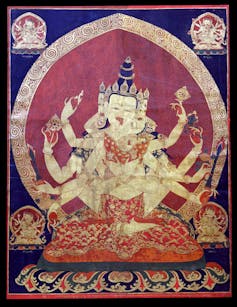

A picture of tantric art from the 19th century.
Pictures From History/Universal Images Group via Getty Images


This tradition is distinctive by maintaining that while the cosmos is polar, it is also nondual, meaning that there is only one ultimate reality. So, the pairing of Shakti and Shiva, feminine and masculine, energy and consciousness, is best understood not as a binary but as the two sides of a Mobiüs strip, where one seamlessly flows into the other.

Take a strip of paper, twist it into a figure eight – also the symbol we use for infinity – and glue the back to the front. That’s the Kaula model of the universe.

In such a world, Shiva is Shakti. The masculine is the feminine. Both are divine, but even more than this, both are ultimate, because there is no difference between them. God is goddess, and both are nonbinary.

Awakening Kundalini

Kundalini yoga is a centuries-old practice quite different from the branded version popularized more recently by Yogi Bhajan. It involves using complex meditative and physical techniques to awaken and raise this energy from its usual resting place in the bottom of the torso.


In doing this, tradition says the practitioner experiences a radical transformation both of the body and of consciousness. Premodern texts describe Kundalini’s fiery energy burning through the tissues of the body, shooting up to the crown of the head, where the feminine Shakti unites with her masculine counterpart and all dissolves into oneness.

While some texts treat this ascent as equivalent to a sort of voluntary death, others describe how, once she has ascended, Kundalini returns to bathe the body in a cooling nectar of immortality, resulting in an embodied state of enlightenment and liberation.

According to this tradition, the body may appear the same but is now enlivened with a new consciousness that has transcended all dualities – including male and female.

Is the divine feminine female?

Human gender norms often prove difficult to shake, however. Though the energy of Kundalini is understood as feminine, Kundalini yoga in South Asia has been traditionally practiced by men. The reasons for this are perhaps almost entirely social, and yet they remain a powerful force.

Ironically, the very fact that Kundalini is often believed to be associated with womanhood has resulted in women being excluded – or at least deprioritized – from cultivating their own practice. Instead, they have historically become assistants or accessories to the enlightenment of men.

The fieldwork we present in our recent book on the topic bears this out. Among South Asian practitioners, the common attitude is that women embody the maternal principle, and this makes them extremely powerful. In them, the energy of Kundalini operates naturally. Men, on the other hand, need to be purified by a woman through ritual in order to effectively engage in Kundalini practice.
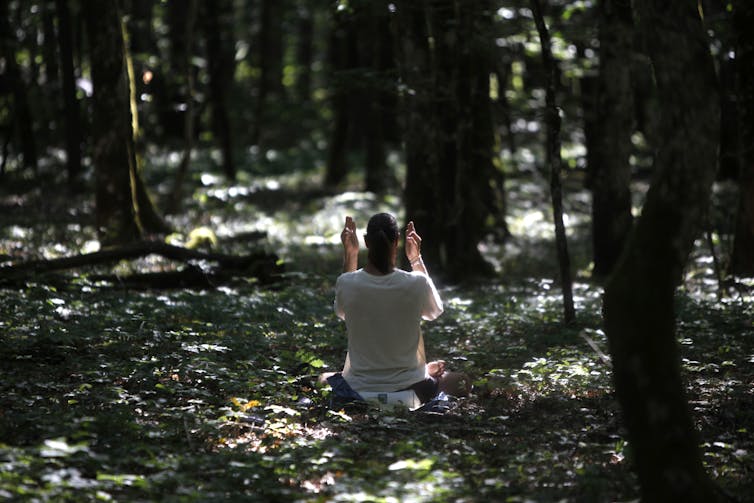


A woman meditates during festival for a modern, branded version of Kundalini yoga.
Godong/Universal Images Group via Getty Images

Such ideas are also common among Western practitioners, who tend to believe women have a more natural aptitude for Kundalini awakening. One of our subjects said this is because women have less ego. Another attributed it to female sexual fluids.

However, cultural difference plays a role, too. Western notions of the divine feminine are much more inclined to cling to the binary, resisting the idea that male and female bodies alike are ultimately woven from the same nondual reality.

Most striking, perhaps, one man who had spent a lifetime among seekers at spiritual retreats in the U.S. and South America told us of a long-held and common belief that only women were capable of Kundalini experience. It was, to him, an energy exclusive to the female body. He recounted having been shocked, only months prior, at encountering a copy of the 1967 classic “Kundalini: The Evolutionary Energy in Man,” authored by the decidedly male Gopi Krishna.

The broader point, however, is that the historical core of Kundalini practice has always been about transcending all dualities.

Thus, even as a goddess representing the ultimate “She,” Kundalini is best understood as nonbinary. Perhaps if we can wrap our heads around this idea, we can cultivate a more inclusive empowerment.

(Anya Foxen, Associate Professor of Religious Studies, California Polytechnic State University. Sravana Borkataky-Varma, Instructional Assistant Professor of Comparative Cultural Studies, University of Houston. The views expressed in this commentary do not necessarily reflect those of Religion News Service.


The Conversation religion coverage receives support through the AP’s collaboration with The Conversation US, with funding from Lilly Endowment Inc. The Conversation is solely responsible for this content.

LA REVUE GAUCHE - Left Comment: Search results for SOPHIA

LA REVUE GAUCHE - Left Comment: Search results for GNOSTICISM

LA REVUE GAUCHE - Left Comment: Search results for TANTRA

LA REVUE GAUCHE - Left Comment: Search results for WENDY DONIGER


Monday, February 26, 2024


Yoga provides unique cognitive benefits to older women at risk of Alzheimer’s disease, study finds


UCLA Health researchers suggest using Kundalini yoga to compliment standard memory training exercises


Peer-Reviewed Publication

UNIVERSITY OF CALIFORNIA - LOS ANGELES HEALTH SCIENCES


A new UCLA Health study found Kundalini yoga provided several benefits to cognition and memory for older women at risk of developing Alzheimer’s disease including restoring neural pathways, preventing brain matter decline and reversing aging and inflammation-associated biomarkers – improvements not seen in a group who received standard memory training exercises. 

The findings, published in the journal Translational Psychiatry, are the latest in a series of studies led by UCLA Health researchers over the past 15 years into the comparative effects of yoga and traditional memory enhancement training on slowing cognitive decline and addressing other risk factors of dementia.  

Led by UCLA Health psychiatrist Dr. Helen Lavretsky of the Jane and Terry Semel Institute for Neuroscience and Human Behavior, this latest study sought to determine whether Kundalini yoga could be used early on to prevent cognitive decline and trajectories of Alzheimer’s disease among postmenopausal women. 

Women have about twice the risk of developing Alzheimer’s disease compared to men due to several factors including longer life expectancy, changes in estrogen levels during menopause and genetics. 

In the new study, a group of more than 60 women ages 50 and older who had self-reported memory issues and cerebrovascular risk factors were recruited from a UCLA cardiology clinic. The women were divided evenly into two groups. The first group participated in weekly Kundalini yoga sessions for 12 weeks while the other one group underwent weekly memory enhancement training during the same time period. Participants were also provided daily homework assignments. 

Kundalini yoga is a method that focuses on meditation and breath work more so than physical poses. Memory enhancement training developed by the UCLA Longevity center includes a variety of exercises, such as using stories to remember items on a list or organizing items on a grocery list, to help preserve or improve long-term memory of patients. 

Researchers assessed the women’s cognition, subjective memory, depression and anxiety after the first 12 weeks and again 12 weeks later to determine how stable any improvements were. Blood samples were also taken to test for gene expression of aging markers and for molecules associated with inflammation, which are contributing factors to Alzheimer’s disease. A handful of patients were also assessed with MRIs to study changes in brain matter. 

Researchers found the Kundalini yoga group participants saw several improvements not experienced by the memory enhancement training group. These included significant improvement in subjective memory complaints, prevention in brain matter declines, increased connectivity in the hippocampus which manages stress-related memories, and improvement in the peripheral cytokines and gene expression of anti-inflammatory and anti-aging molecules. 

“That is what yoga is good for -- to reduce stress, to improve brain health, subjective memory performance and reduce inflammation and improve neuroplasticity,” Lavretsky said. 

Among the memory enhancement training group, the main improvements were found to be in the participants’ long-term memory.  

Neither group saw changes in anxiety, depression, stress or resilience, though Lavretsky stated this is likely because the participants were relatively healthy and were not depressed. 

While the long-term effects of Kundalini yoga on preventing or delaying Alzheimer’s disease require further study, Lavretsky said the study demonstrates that using yoga and memory training in tandem could provide more comprehensive benefits to the cognition of older women. 

“Ideally, people should do both because they do train different parts of the brain and have different overall health effects,” Lavretsky said. “Yoga has this anti-inflammatory, stress-reducing, anti-aging neuroplastic brain effect which would be complimentary to memory training.”   

Article: Cognitive and immunological effects of yoga compared to memory training in older women at risk for Alzheimer’s disease Published Feb. 14, 2024, Lavretsky et al., Transl Psychiatry 14, 96, ISSN 2158-3188, https://doi.org/10.1038/s41398-024-02807-0 

Sunday, July 19, 2020

Kundalini-like notions in ancient Egypt


 Here is an excerpt from Jack Lindsay's magnificent work of
scholarship 

ORIGINS OF ALCHEMY IN GRAECO-ROMAN EGYPT  
Barnes and Noble, 1970, 
pp. 190-3.  

He gives evidence for the existence of an awareness of the Kundalini,
the Serpent Power, in ancient Egypt.  The paragraphing is mine.

Dan Washburn

------------------------------------

... it is of interest to note that the notion of up-and-down,
down-and-up, as distinct from that of the lower world merely reflecting
the upper, is to be found in ancient Egyptian thought. The caduceus of
Hermes has prototypes that can be found in early eastern imagery, from
India to Egypt.

The rod or staff can be linked in a general way with the sacred Tree,
Mountain, or Ded-pillar that are prominent in Egyptian mythology and
ritual; and much light is cast on the inner meaning of these symbols by
Indian ideas. There we find the idea of an invisible canal called nadi
in Sanskrit (from n„da, movement). Various translations have been made
of the term: subtle canals (tubes), luminous arteries, psychic canals or
nerves. There were many nadi, but three chief ones: Ida, Pingala, and
Susumna. The last-named, the most important, corresponded to the
vertebral column, Brahma-danda: "the microcosm of the macrocosm." It was
the great road for the movement of the spiritual forces of the body; and
around it were twined, like the two snakes on HermesĆ­ staff, the two
other nadi, Ida on the left, female and passive, and Pingala on the
right, male and active. On the top of Susumna, at a point corresponding
to the top of the skull, shone the Sun. Along the central axis were
located six main centres or cakras (circles, wheels, represented in the
shamanist rituals of Central Asia by the six cuts made in the Tree
before which the shaman falls in his possessed fit of initiation and
which in turn represent the six heavens through which he ascends, with
mimed episodes at each stage.) 

At the base of the spine, like a snake coiled in its spirals, sleeps
Kundalini, the Ƭigneous serpentine powerƮ, which awakens during the
initiation and rises up, from base to top, through the various cakras
till it reaches Sahasrara, located at the suture on the crown where the
two parietal bones meet. This aperture, the Brahme (Brahme-randhra), is
the place where Ƭthe Sun rises.Ʈ The original text thus expresses the
imagery: ƬThe Bride [Kundalini] entering into the Royal Highway [the
central nadi] and resting at certain spots [the six cakras] meets and
embraces the Supreme Bridegroom and in the embrace makes springs of
nectar gush out.Ć® A Brahmin of Malabar, speaking of the Dravidian
caduceus, said, "The snakes that enlace represent the two currents that
run, in opposite directions, along the spine."

But can we definitely transport these notions into ancient Egypt? It
seems that we can. Take such a representation as that from the tomb of
Ramses VI of a staff on which stands a mummified figure; between him and
the staff-top is a pair of horns, and wriggling across the staff, lower
down, in opposite directions, are two snakes. The dead man, at the last
Hour in the Book of the Underworld, leaves his mortal remains, sloughs
them, and is reborn as the scarab Khepri. A stele sets out the idea:
"Homage to you, Mummy, that are perpetually rejuvenated and reborn." The
horns on top of the staff are called Wpt, "summit of the skull, to open,
divide separate" -- that is, the parietal bones are thought of as
opening to release the reborn dead-man. Wpt also means the Zenith of the
Heaven. A figure in the tomb of Osorkon II at Tanis stands with a snake
in each hand; the snakes criss-cross in their undulant movement, forming
an X across the body. A symbol often cut on scarabs and scaraboids is
that of the Ded pillar with a snake hanging on either side, the heads
going in opposite directions. The word Imakh (Blessed) in its ending and
especially in its determinative is represented by the spinal column with
an indication of the medulla; the ending also denotes the canal or
channel of the spine of the snake through which the Sun passes -- the
Night Sun in the Underworld. So the one symbol brings together the ideas
of Blessedness, Spine, Spinal Canal (of the Sun). The Sun emerging at
the end of the snake staff is both the dead man reborn and the newborn
Sun (Khepri); the dead man emerges from the spinal column at the top of
the skull, and is rebornóthe sun emerges from the spinal night-canal and
is reborn; the dead man and the sun are one.

We may add that Sa, which means the Back, the Spine, and which enters
into the god name Besa, is homonymous with Sa, which means Protection.
The determinate connected with Imakh appears also in Pesedj, which takes
on the meaning of both Spine and Illuminationóa meaning attested from
the time of the Pyramid Texts. The root Ima of Imakh merges again with
the homonymous Tree assimilated to the Ded-pillar and expressing the
luminosity of the sun.

We see, then, in ancient Egyptian thought a system closely analogous to
that of India which we discussed. The individual spine and the
world-pillar are identified; there is a concept of life-forces moving up
and down this axis; the skull top is also the sky-zenith; the new birth
of the life-force is one with the rising of the sun. The
microcosm-macrocosm relationship is very close to what we find in
alchemy, but with the latter the whole system operates on a new and
higher level of philosophic and scientific thinking.

In Greek thought we do not find anything so precise as the systems in
Sanskrit and Egyptian; but with the growth of ideas about the pervasive
pneuma the notion of forces descending into the body and ascending out
of it appears. Porphyrios cites an Oracle of Apollo:

The stream separating from PhoibosĆ­ splendour on high and enveloped in
the pure AirĆ­s sonorous breath falls enchanted by songs and by ineffable
words about the Head of the blameless recipient:
it fills the soft integument of the tender membranes, ascends through
the Stomach and rises up again and produces a lovely song from the
mortal pipe.

Porphyrios comments that the descending pneuma enters into the body,
Ƭand, using the soul as a base, gives out a sound through the mouth as
through an instrument.Ć® We are reminded of the ecstatic noises of the
Gnostics which were thought to echo the music of the spheres. The lovely
song from the mortal aulos seems to go straight up to the celestial
source of pneuma in the sun. The down-and-up, up-and-down pattern is
completed.

Perhaps a confused version of the ideas we saw associated with Imakh,
Sa, Pesedj, appears in a magical intaglio of terracotta where we see a
serpent twining round a star-topped staff; parallel with the staff rise
an altar surmounted with a staff (starred at either end) on the right
and a schematic human form standing on its head on the left. Here there
seems depicted an up-and-down flow of forces. On a blue-flecked onyx a
monstrous figure (with scarab-body, human legs, head of a maned animal)
stands crowned, holding in each hand a staff round which a snake twines.
One staff has a goat-head, the other a dog-head; and under the
creatureĆ­s feet is an Ouroboros enclosing a man, perhaps ithyphallic,
and what seems a thunderbolt. The head of the Ouroboros is down at the
bottom. The crown is made of a disk set on long horns and flanked with
four uraei. There seem here defined two contrary motions: one of the
scarab-sun (upwards to the large crown), and one of the cosmic serpent
(downwards into the underworld of death). Interpretation of such obscure
objects cannot but be doubtful, though there does seem a link with the
complex of ideas and images we have discussed. A passage in
Hippolytos' account of the Peratai [a gnostic sect - Dan] also reveals
this complex in a slightly confused form. He is discussing an
up-and-down movement. The Son, he says, brings down from above the
paternal Signs and again carries aloft those Signs when they have been
"roused from a dormant condition and made into paternal characteristics
-- substantial from unsubstantial being; transferring them hither from
thence". The Son's cerebellum is "in the form of a Serpent", that is, a
serpent-head, "and they allege that this, by an ineffable and
inscrutable process, attracts through the pineal gland the pneumatic and
life-giving substance emanating from the vaulted chamber [? both the
skull and the heavenly vault]. And on receiving this, the cerebellum in
an ineffable way imparts the Idea, just as the Son does, to Matter; or,
in other words, the seeds and genera of things produced according to the
flesh flow along into the spinal marrow." Though the description is
unclear, the idea of an up-and-down, down-and-up flow of pneuma is
certainly present, as also that of an entry of divine force through the
cerebellum into the spinal column. The Peratai thus interpreted the
phrase, "I am the Door," in John.81

We may add that the idea of the staff of Hermes as a resolving or
balancing power between two opposing principles (the snakes) appears in
a tale, given by Hyginus, that Mercury saw two snakes fighting in
Arcadia and put his staff between them, thus arresting the conflict;
hence the caduceus as an emblem of peace.
 
Jack Lindsay
ORIGINS OF ALCHEMY IN GRAECO-ROMAN EGYPT  
Barnes and Noble, 1970

PERMANENT URL
https://tinyurl.com/y2zoeb92