Showing posts sorted by relevance for query ‘divine feminine’. Sort by date Show all posts

Thursday, December 11, 2025

 Outside the West, the Kundalini tradition presents a model of the ‘divine feminine’ beyond binary gender

(The Conversation) — Drawn from tantric traditions, Kundalini points to spiritual practices that go beyond traditionally understood concepts of the masculine and feminine.


A piece of art shows the tantric tradition's depiction of Kundalini and energy centers – or chakras. (Tantrika painting/Wellcome Collection, CC BY)

Sravana Borkataky-Varma and Anya FoxenDecember 10, 2025


(The Conversation) — The notion of the divine feminine is a recurring motif in American pop culture, playing with the assumptions people make when referring to God – often the deity described in the Bible – as “He.”

Whether it’s Alanis Morissette’s iconic portrayal of God in the 1999 comedy “Dogma” or Ariana Grande’s titular declaration in her 2018 track “God is a Woman,” the effect is the same: a mixture of irreverence and empowerment. It dovetails, moreover, with a ubiquitous political slogan: “The future is female.”

But in a historical moment when society is bitterly contesting ideas about gender, we’d note that these notions still rely on a simplistic binary.


As two scholars who study the entangled history of spirituality and gender, we often observe an especially fraught version of this dynamic playing out among “spiritual but not religious” practitioners, often called spiritual seekers. To many such people, the divine feminine represents an escape from oppressive gender norms, and yet many stumble in trying to reconcile the idea with the embodied realities of biological sex.

An approach that escapes this dilemma is the centuries-old Kundalini tradition, which paints a model of the divine feminine beyond gender altogether.

The feminine Shakti

There are certainly examples of the feminine divine to be drawn from Christian and other Abrahamic religious traditions. Yet many seekers quickly find themselves reaching beyond these borders.

When they do, one of the first concepts they come across is Shakti, a divine feminine energy that manifests in the human body as the electrifying force of Kundalini. Both terms originate in South Asian religions – especially Hinduism – that fall under the broad umbrella of tantra.

Tantric cultural and spiritual traditions, which began to emerge in the early centuries of the Common Era, take a positive perspective on the material world in general and the human body in particular, as opposed to traditions that regard both as inherently illusory or sinful. In tantra, the material world and physical body are suffused by divine energy. This energy is called Shakti, and it is feminine.

Another key idea common to tantric traditions is that the universe is composed of two fundamental principles – or rather that it has two poles: a dynamic energy, which is female, balanced by an unchanging consciousness, which is male. As the great Goddess, Shakti goes by many names, including Durga, Kali and myriad others. The masculine principle is usually called Shiva, though this can vary as well.


Divinity beyond binaries

Tantric traditions span over a millennium in time and a subcontinent in space, so it should come as no surprise that they are incredibly diverse. However, most practices that enjoy global popularity today, especially those centered on the divine feminine energy of Kundalini, can be traced to a specific tradition called Kaula Tantra, which developed in the northeast of modern-day India near Kashmir.
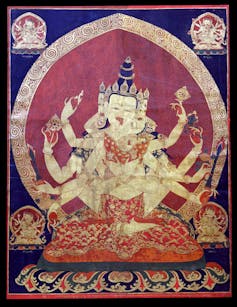

A picture of tantric art from the 19th century.
Pictures From History/Universal Images Group via Getty Images


This tradition is distinctive by maintaining that while the cosmos is polar, it is also nondual, meaning that there is only one ultimate reality. So, the pairing of Shakti and Shiva, feminine and masculine, energy and consciousness, is best understood not as a binary but as the two sides of a Mobiüs strip, where one seamlessly flows into the other.

Take a strip of paper, twist it into a figure eight – also the symbol we use for infinity – and glue the back to the front. That’s the Kaula model of the universe.

In such a world, Shiva is Shakti. The masculine is the feminine. Both are divine, but even more than this, both are ultimate, because there is no difference between them. God is goddess, and both are nonbinary.

Awakening Kundalini

Kundalini yoga is a centuries-old practice quite different from the branded version popularized more recently by Yogi Bhajan. It involves using complex meditative and physical techniques to awaken and raise this energy from its usual resting place in the bottom of the torso.


In doing this, tradition says the practitioner experiences a radical transformation both of the body and of consciousness. Premodern texts describe Kundalini’s fiery energy burning through the tissues of the body, shooting up to the crown of the head, where the feminine Shakti unites with her masculine counterpart and all dissolves into oneness.

While some texts treat this ascent as equivalent to a sort of voluntary death, others describe how, once she has ascended, Kundalini returns to bathe the body in a cooling nectar of immortality, resulting in an embodied state of enlightenment and liberation.

According to this tradition, the body may appear the same but is now enlivened with a new consciousness that has transcended all dualities – including male and female.

Is the divine feminine female?

Human gender norms often prove difficult to shake, however. Though the energy of Kundalini is understood as feminine, Kundalini yoga in South Asia has been traditionally practiced by men. The reasons for this are perhaps almost entirely social, and yet they remain a powerful force.

Ironically, the very fact that Kundalini is often believed to be associated with womanhood has resulted in women being excluded – or at least deprioritized – from cultivating their own practice. Instead, they have historically become assistants or accessories to the enlightenment of men.

The fieldwork we present in our recent book on the topic bears this out. Among South Asian practitioners, the common attitude is that women embody the maternal principle, and this makes them extremely powerful. In them, the energy of Kundalini operates naturally. Men, on the other hand, need to be purified by a woman through ritual in order to effectively engage in Kundalini practice.



A woman meditates during festival for a modern, branded version of Kundalini yoga.
Godong/Universal Images Group via Getty Images

Such ideas are also common among Western practitioners, who tend to believe women have a more natural aptitude for Kundalini awakening. One of our subjects said this is because women have less ego. Another attributed it to female sexual fluids.

However, cultural difference plays a role, too. Western notions of the divine feminine are much more inclined to cling to the binary, resisting the idea that male and female bodies alike are ultimately woven from the same nondual reality.

Most striking, perhaps, one man who had spent a lifetime among seekers at spiritual retreats in the U.S. and South America told us of a long-held and common belief that only women were capable of Kundalini experience. It was, to him, an energy exclusive to the female body. He recounted having been shocked, only months prior, at encountering a copy of the 1967 classic “Kundalini: The Evolutionary Energy in Man,” authored by the decidedly male Gopi Krishna.

The broader point, however, is that the historical core of Kundalini practice has always been about transcending all dualities.

Thus, even as a goddess representing the ultimate “She,” Kundalini is best understood as nonbinary. Perhaps if we can wrap our heads around this idea, we can cultivate a more inclusive empowerment.

(Anya Foxen, Associate Professor of Religious Studies, California Polytechnic State University. Sravana Borkataky-Varma, Instructional Assistant Professor of Comparative Cultural Studies, University of Houston. The views expressed in this commentary do not necessarily reflect those of Religion News Service.


The Conversation religion coverage receives support through the AP’s collaboration with The Conversation US, with funding from Lilly Endowment Inc. The Conversation is solely responsible for this content.

LA REVUE GAUCHE - Left Comment: Search results for SOPHIA

LA REVUE GAUCHE - Left Comment: Search results for GNOSTICISM

LA REVUE GAUCHE - Left Comment: Search results for TANTRA

LA REVUE GAUCHE - Left Comment: Search results for WENDY DONIGER


Saturday, May 10, 2025

A GNOSTIC BIBLE

Feminine Translation Bible receives award from Religion Communicators Council

Mark 7 Publishing


RNS Press Release Distribution Service
May 8, 2025

The Holy Bible Feminine Translation, the only word-for-word translation that translates the Holy Spirit to the feminine gender, received the Award of Merit from the Religion Communicators Council.

The Holy Bible Feminine Translation Expanded Edition 2 was published July 2024 in paperback and digital pdf by Mark 7 Publishing.

The Holy Bible Feminine Translation Version (FTV-Bible) is a word-for-word translation containing bias free Scriptures that uses the American Standard Version of 1901 (ASV) for its starting textual base. The ASV is the product of the work of over 50 Evangelical Christian scholars that has been called “The Rock of Biblical Honesty.”  The goal of this Bible is to carry forward this legacy of biblical Honesty with recognition of the dual feminine attributes of God as well as His dual masculine attributes.

The FTV-Bible is a result of interpreting and translating the Bible through the Discipline of the Cross of YHWH, written 6,876 times, pronounced Yahweh. The Study section shows the cross is a consistent destination of seven Sprits of God that deciphers Bible text called Jesus’ Witness Cipher.

Bridging Beliefs in the HOLY BIBLE Feminine Translation Version

A Bridge to Gender Balance
The Divine Feminine is a spiritual and philosophical concept representing the feminine counterpart to traditionally patriarchal and masculine frameworks in religion, culture, and energy systems. The Divine Feminine in this Feminine Translation Bible can be seen as the dual feminine attributes of God. The Most-High Holy Spirit of Light, heavenly Mother of the Son of God, and Sons of Light, plus the earthly mother of all living humans, serve as a bridge to counterbalance gender in this Bible.

An Earth to Heaven Bridge
This Bible was translated through the Discipline of the Cross, where on the foot it is written: BeholdI am YHWH —the God of all flesh(Jer 32:27)   All living humans are translated to be children of our Father God through His divine feminine daughter Eve, the mother of all living humans (Gen 3:20)   whom we are all natural descendants on the foot of an Earth to Heaven Bridge— the Tree of Life Cross.(Cipher 3)  She bruised the head of the serpent when she birthed her God appointed seed, Seth, who began the righteous line of all the “elect” Patriarchs in Luke’s ascending genealogy of Jesus Christ.(Cipher 31) The Elect are those predestined to be saved. (Cipher 36)

Numbered Bridges (Study section)
There are 15 crosses numbered 77 77 77 77 in the Old Testament, that together is a bridge of understanding for Israel to the 77 77 77 77 Genealogy Cross of their Messiah, who begins the New Testament. These bridges are previously hidden signs that the Jews demanded, while the Greeks looked for wisdom (1Cor 1:22) The number 77 is the signature number of Jesus Christ. (Cipher 48)

A 6,000 Year Bridge (Study section)
Jesus Witness Cipher is a timeless phenomenon for deciphering Bible text that teaches one how to SEE and visually perceive Scripture through the Cross. This previously hidden, recurring, phenomenon is timeless, because it has consistently structured Scripture that bridges a period of 6,000 years using 40 different human authors.  Validated with the Discipline of Biblical Numbers, this timeless Cipher bears witness of a single divine author of the Bible 77 times. It illustrates how the Cross is the consistent destination of Seven Spirits of God, that answer seven questions in divine order, that seamlessly bridges the Old Testament to the New Testament.


Since 1949, the Wilbur Awards have been presented annually to recognize excellence in the communication of religious issues, values, and themes in public secular media.Through the awards, the Religion Communicators Council (RCC) recognizes the work of individuals, production companies and agencies as they communicate about religious issues, values and themes with professionalism, fairness, respect and honesty.

Past winners include Morgan Freeman, Oprah Winfrey, Jane Pauley, Mister Rogers, CBS Sunday Morning, ABC’s 20/20, Meet the Press, Vanity Fair, Canadian Broadcasting Corporation, and the New York Times.

The Award of Merit is the level of recognition provided by the Religion Communicators Council, for work deemed meritorious and worthy of acknowledgment

###

Contact:
JW Farquhar
Mark 7 Publishing
8035170451
farquhar.jw@gmail.com

Disclaimer: The views and opinions expressed in this article are those of the authors and do not necessarily reflect the official policy or position of RNS or Religion News Foundation.

Thursday, November 30, 2023

Essay
The original feminist BDSM cult
Was Aristasia therapy magic or kink?

BY MARY HARRINGTON
November 30, 2023

In 1984, the tiny Irish seaside town of Burtonport attracted a swarm of international press attention. The occasion was the opening of a new educational establishment: St Bride’s School for Girls, residing in a former hotel previously home to a New Age commune known locally as “The Screamers”.

At the opening, Burtonport’s mayor cut the ribbon. The community expressed pride. But the school wasn’t for children: it offered adult women — paying guests — the opportunity to roleplay as schoolgirls for a holiday.

The story of this strange establishment isn’t just about ooh-la-la play-acting. The house was home to the “Silver Sisterhood”: a female separatist subculture so reactionary they wore Victorian clothing, rejected electric lighting, and refused to listen to music except on a wind-up gramophone. And yet, its members were in some ways 50 years ahead of their time: forerunners of reality-warping contemporary phenomena such as BDSM, cosplay, computer gaming — and also the weird online Right.

The roots of this sect reach back to mid-century counterculture Oxford — and, still further, into the febrile occult subcultures of nineteenth and early-twentieth century Europe. There, a group of eccentric scholars and antiquarians began positing a syncretic “Perennialist” or “Traditionalist” doctrine of eternal, immutable, spiritual truth, evident throughout all traditional cultures – but that had been in decline since the Renaissance. The principal exponent of this outlook was the French writer RenĆ© GuĆ©non (1886-1951), whose The Crisis of the Modern World (1946) sets out his doctrine of modernity as decline.

Where GuĆ©non’s work is relatively apolitical, Traditionalism’s other leading light was the aristocratic Italian writer and one-time Dadaist painter Julius Evola (1898-1974), a pagan monarchist and esoteric race theorist so far to the Right that in 1942 his passport was confiscated by the Italian Fascist party for political extremism.


Traditionalism’s legacy has spread in some strange directions since. Those influenced more by GuĆ©non today include King Charles, for example, and, on the more Evola-flavoured side, Right-wing figures including Trump’s one-time strategist Steve Bannon, and “Putin’s Brain” Aleksandr Dugin.

That legacy also includes the Silver Sisterhood. According to a 2022 BBC interview with one of its founders, who now goes by the name Mary Guillermin, it all began at an Oxford feminist consciousness-raising group in the Seventies, exploring ancient goddess worship. Presumably that was also where GuƩnon got into the mix; in any case, what emerged was an all-female Perennialist group, keen to put their Goddess-tinged ideas into practice.

This they did this first at Hebden Bridge in Yorkshire, where they tried to live as though men and modernity had simply never happened — even coining their own pseudo-ancient dialect, “Rhennish”. This group then found its way to Atlantis House, via a previous social link to the “Screamers”, to pursue spiritual withdrawal from modernity. An American radical women’s magazine recounts the experience of visiting, in early 1984, what sounds like a devout, low-tech pagan feminist sect: “I enjoy praying, wearing skirts among women, living in a structured household with a low technological level, and dissolving somewhat the accumulated patriarchal grime in my brain cells”.

But with money constantly an issue, the group’s commitment to formal hierarchy seemed to offer a more lucrative business opportunity than craft shop and tea room — and thus a disciplinarian retro-roleplay establishment was born: St Bride’s School for Girls. With Guillermin (then calling herself Brighe Dachcolwyn) as headmistress, the prospectus promised a “total experience” of vintage-themed, all-female schoolgirl roleplay. Journalists descended, fascinated by the surreal combination of Victorian dress and lifestyle with discipline so strict as to hint at the fetishistic.

Guests, meanwhile, extolled its immersiveness, with one telling the BBC: “It’s an entire world. It envelops you.” This is the consistent theme in the bizarre history that followed. Guillermin, in her 2022 interview, describes their creation as a key spiritual practice for the early community: a practice she calls “living theatre”.

Along with exploring the mind-altering effects of action roleplay, the group also pursued another emerging form of world-building: text-based adventure gaming. For paradoxically, despite ostensibly rejecting modernity out of hand, the women of Atlantis House also made pioneering contributions to early gaming, developed by the mysterious “Priscilla Langridge”, a founding Silver Sister who often appeared veiled, and refused ever to be photographed by the press. The two most noted of Langridge’s games were “The Secret of St Bride’s”, published 1985, (you can play it online here) and a “Jack the Ripper” game, the first such creation to receive an 18 certificate.

According to some reports, the mysterious Langridge was a Sixties Oxford theology scholar, who played a key role in developing the group’s founding “Aristasian” religious outlook: a blend of Perennialism and Seventies feminism with both esoteric and exoteric components. The esoteric dimension of this worldview was most clearly set out some years later, in The Feminine Universe, where the probably-pseudonymous author “Miss Alice Trent” argues that very earliest instances of Perennial Wisdom were feminine, because “the original Creator is feminine”.

Since then, though, the world has declined from the primordial eternal truth, and expelled the divine feminine principle from mainstream culture. This decline reached its nadir in “the cultural collapse of the 1960s”, which Aristasians call “the Eclipse”. Everything since that time is referred to as “the Pit”: a hellish apotheosis of patriarchy “in which the Masculine Principle has come to dominate the culture absolutely, extirpating femininity even from the heart of woman itself”.

For its original adherents, Aristasianism was a self-contained esoteric outlook, with a practice of “living theatre”, ritual goddess-worship, and technological simplicity. For those who didn’t go home again, the immersiveness could be too much. One woman, “Sophia”, spent nearly a year as a “maid” in the house, where she was frequently beaten; in the end she escaped and later brought criminal charges against Guillermin for assault.

But by then things were already coming apart for the larger experiment. In 1992, not long after “Sophia” departed, so too did the Aristasians. Amid a dispute over property ownership, two of the previous Screamer owners broke into Atlantis House, where they found a dark, musty interior with almost no modern appliances or conveniences — and in a room upstairs, a row of tiny desks and a blackboard, complemented by willow canes leaning against the wall. According to reports at the time, the house was also strewn with antisemitic and sadomasochistic literature, along with correspondence between Guillermin and then-BNP leader, John Tyndall.

Even after this scandal-ridden dissolution of St Bride’s, though, “Aristasia” lived on: as reactionary as ever in its aesthetic, and increasingly BDSM-flavoured in its income streams. In 1993 Guillermin (now calling herself “Miss Partridge”) and Langridge cropped up again in Oxford, this time supporting an anti-metric campaign, hosting “Romantia” retro soirees, and offering discreet corporal punishment experiences. By this point, the more exoteric Aristasian mythology appears to have solidified: a kind of female-separatist high fantasy, with anti-technology retro styling and a side order of BDSM. In this world, Aristasia-in-Telluria is the corrupt, earthly imitation of the real world: Aristasia Pura, a parallel universe, world, existing on a different planet sometimes called “Herthe”. There are no men, and the two sexes are blondes and brunettes, respectively submissive and dominant.

Around the same period, the group founded Wildfire Publishing, which produced female-centric BDSM literature, including a title called The Female Disciplinary Manual, which is much what you’d expect. According to press reports of its 1995 launch, at that point there were several full-immersion Aristasian houses dotted around England, where members lived out the Aristasian reality including its practice of corporal punishment.

Certainly, at least one such establishment existed in 1996, when Channel 4 made a documentary about it. Guillermin, now styling herself “Miss Martindale”, features heavily, teaching lessons and disciplining “girls” for minor infractions. At Wildfire Publishing, meanwhile, fantasy, reality, and Perennialist theology found their most effective delivery mechanism yet: not video games, but fetish literature. The 1996 Children of the Void informs readers: “Morally and culturally, civilisation has ended, just as completely as it would physically have ended if it had been obliterated by atomic bombs.” Meanwhile the narrative mixes expositions of Aristasian feminine essentialism and slightly leaden dialogue with a hefty side-order of spanking porn.

It ought to surprise me that mashing up Right-wing reactionary occultism with Seventies radical feminism should produce mystical cosplay seasoned with BDSM. But somehow it doesn’t. Perhaps the extremism scholar Jeffrey Kaplan is right about the “cultic milieu”: that what matters for fringe ideologies isn’t their place on some imaginary political compass, but how far they are from the mainstream. But more than trying to place Aristasia politically, their enduring interest lies in the dedication they showed to testing just how far you can warp reality through force of play-acting.

SUGGESTED READING
The case for the sexual revolution
BY KAT ROSENFIELD

“You can call it therapy,” Guillermin said in 2022 of the group’s “living theatre” practice, “or you can call it magic”. Was there really something occult going on? Or were they just kinky weirdos? Guillermin happily acknowledged in 2022 that Jack the Ripper, which despite its 18 certificate focused more on occult and Masonic subplots, was designed for “philosophical education”. And she repeatedly dismissed regular “kink” devotees as “silly monkeys”.

Whatever the original intent, though, the richness of Aristasian experiments in parallel realities collapsed with the ascendancy of the central, technological alternate reality that today structures nearly all of culture: the internet. By the end of the 2000s, Aristasia had largely lost its hold in “Telluria”, becoming an online-only fandom that finally imploded in a dispute over anime. Guillermin now resides in California, where she works as a therapist espousing the same “divine feminine” spirituality as ever.

But perhaps it didn’t fail. For Aristasia’s immersive practices — if not the aesthetic — are now almost as mainstream as the internet. The group was well ahead of the curve in realising the potential of computer gaming for those who dream of other worlds. And multiple reports suggest that Langridge was actually male, implying another type of personal interest in seeking to alter reality through performance.

More generally still, Aristasian “living theatre” anticipated cosplay. Internationally popular today, and usually viewed as a fun, it also attracts a minority who, like Guillermin, treat the hobby as a kind of consciousness-altering magic. Meanwhile, the notion that one can alter the world by “LARPing” — acting as if your version is already true — has become a crucial political concept in a world that appears increasingly unreal.

Meanwhile, Wildfire Publishing and the broader Aristasian fixation on power, hierarchy and corporal punishment has now become so normalised today that some even claim it’s reasonable to ditch a partner for not being kinky enough. And like cosplay, BDSM also attracts a minority who view it as something altogether more mind-altering.

So Aristasia succeeded beyond measure, in propagating previously mystical practices into mainstream culture. But it failed, just as signally, to have any effect on post-Sixties culture, except in pioneering the virtualisation of reactionary politics. For while the group’s actual links to the Right are ambiguous, the Aristasian route from efforts to do Traditionalism “IRL”, all the way to purely virtual fandom, reflects a broader contemporary tendency among the weird Right. Here, even as the liquefaction of “traditional” social forms seems ever more complete, nostalgic visions of bygone ages flourish: visions that, however, never seem to make it out of the digital realm.

What, then, is the lesson of Aristasia — whether for reactionaries, or anyone else? It is surely an ambivalent one: that the easiest dimension in which to create your own reality is the internet. But this comes at the price of being ever less able to realise your vision in real life. For that, you still need charismatic leadership, quasi-religious doctrine, real-world community, and a willingness to look silly in the eyes of the world. For those who embrace this more difficult path, though, the story of Aristasia offers a backhanded kind of hope: that if you roleplay hard enough, then even in apparent failure you end up shaping the future.


Mary Harrington is a contributing editor at UnHerd.