Showing posts sorted by relevance for query GNOSTICISM. Sort by date Show all posts

Saturday, November 27, 2021

This tiny minority of Iraqis follows an ancient Gnostic religion – and there's a chance they could be your neighbors too

James F. McGrath, Professor of New Testament Language and Literature, Butler University, Butler University
Fri, November 26, 2021,

Like their ancient ancestors, contemporary Mandaeans revere John the Baptist and consider baptism the most important of their religious rituals. Hadi Mizban/AP

In March 2021 Pope Francis became the first leader of the Roman Catholic Church to visit Iraq. The number of Christians in Iraq has fallen sharply in the past two decades amid mass violence at the hands of the Islamic State group. Iraq stands today in the region of the ancient Babylonian Empire, generally understood as the homeland of the patriarch Abraham, the foundational figure shared by Judaism, Christianity and Islam – commonly called the “Abrahamic” religions.

As the pope met with local Christian and Muslim leaders, the names of other, smaller religious groups found in Iraq also made the news. One of these was likely unfamiliar to the majority of those in the English-speaking world: the Mandaeans. Also called Sabians, they are followers of the last Gnostic religion to survive continuously from ancient times down to the present day.

Gnostic religions view the material world as the product of a mistake in the heavenly realm, the creation of one or more inferior divine beings rather than the supreme God. Gnosticism also emphasizes that human beings can become aware of this and prepare their souls to escape from under the influence of the malevolent spiritual forces that created and rule this realm, so that when they die they can ascend to the good realm that lies beyond them.

As a scholar of religion, I’ve been involved in translating into English one of the Mandaeans’ sacred texts, known as the Mandaean Book of John. Working in this area has also connected me with the living tradition and persuaded me that more people need to know about Mandaeans.

The ancient roots of Gnosticism


Mandaeism, like other forms of Gnosticism, is an esoteric religion whose literature remains mostly in the hands of priestly families. Their sacred texts are written in a distinctive alphabet used only for that purpose. The contents and meaning of these works are largely unknown even to most Mandaeans, never mind others.

But the Mandeans’ alternative view has periodically attracted popular interest. In the 19th century, their most important sacred text, the Great Treasure or Ginza Rba, was translated into Latin. That is believed to have contributed to the heightened interest in esoteric mysticism and spirituality in that era. However, this was largely among people who had no contact with or real awareness of the Mandaeans in the present day.


Baptism: The core of Mandaean religion


A follower being baptised during a Mandaean baptism ceremony in the Nepean river at Emu Plains on October 26, 2014 in Sydney, Australia.

The Mandaeans’ central ritual is baptism: immersion in flowing water, which is referred to in Mandaic as “living water,” a phrase that appears in the Bible’s New Testament as well. Baptism in Mandaean faith is not a one-time action denoting conversion as in Christianity. Instead it is a repeated rite of seeking forgiveness and cleansing from wrongdoing, in preparation for the afterlife.

“Baptist” today usually denotes a form of Christianity, but Mandaeans aren’t Christians. They have a special place, however, for the individual who is said to have baptized Jesus, namely John the Baptist. The Mandaean Book of John, which I was involved in translating, tells stories about John the Baptist and attributes speeches to him containing various ethical teachings.

In the first half of the 20th century, the Mandaeans received significant attention from New Testament scholars who thought that their high view of John the Baptist might mean they were the descendants of his disciples. Many historians think that Jesus of Nazareth was a disciple of John the Baptist before breaking away to form his own movement, and I am inclined to agree.

Whatever tensions and competition there may have been among Mandaeans, Jews and Christians in Iraq in the past, today they seek to coexist amicably, finding themselves in a context in which all minority groups face much the same struggle to survive and maintain their identity.

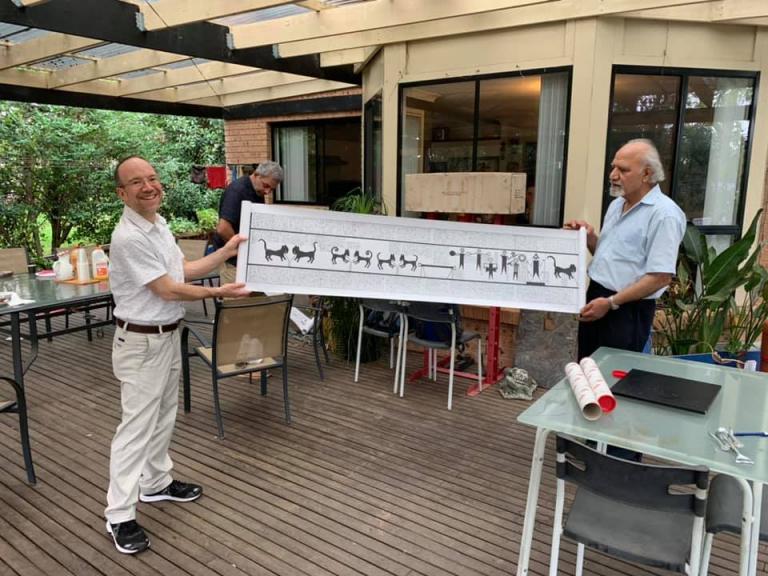
A number of Mandaean scrolls contain fascinating artwork and illustrations depicting varied images including the celestial figures mentioned in their texts, scenes from the afterlife, trees and animals. All are drawn in a style that isn’t quite like what one finds in the artwork or illustrated manuscripts of other religions. One of my favorite scenes in the scroll known as Diwan Abatur depicts people being tormented with trumpets and cymbals in purgatories through which souls are liable to pass. The point is most likely the loud noise such instruments can make, and not a negative statement about music in general.


James F. McGrath holds a copy of the Mandean work known as the Diwan Abatur, created and owned by the Mubaraki, an Australian family of Mandeans. Courtesy of the author, CC BY


Mandaeism today

Estimates vary as to how many Mandaeans there are today. Some can still be found in their historic homelands in Iraq and Iran. However, persecution in those places has led to the creation of small but significant Mandaean diaspora communities in such places as Australia, Sweden and the U.S.

This scattering, combined with Mandaeans’ dwindling numbers, has made it much harder for them to preserve their identity and pass their traditions along to the next generation. Mandaeans do not accept converts or consider children of marriages with non-Mandaeans to be part of their religious community, which has also contributed to their dwindling population.

There is a reasonable chance that Mandaeans may be among your neighbors, whether you live in San Diego, San Antonio or Sydney. Look for them, and you may get a chance to do more than catch a glimpse of living history.

This article is republished from The Conversation, a nonprofit news site dedicated to sharing ideas from academic experts. It was written by: James F. McGrath, Butler University.

Read more:

What s the religious exemption to Title IX and what’s at stake in LGBTQ students’ legal challenge


Armenians displaced from Nagorno-Karabakh fear their medieval churches will be destroyed


Ancient texts encouraged hope and endurance when they spoke of end times

James F. McGrath received funding from the National Endowment for the Humanities to support his work on the critical edition, translation, and commentary of the Mandaean Book of John referred to in this article.

Thursday, December 28, 2006

Bulgarian Women Abused

Migrant Bulgarian women are being raped, abused and threatened with death in both Christian Europe and Islamic Countries.

Muslim Brotherhood hails lynching of innocent Bulgarian nurses

Raping and lynching in exotic Greece


There is a Bogomil Blog that has an online campaign for clemency for the Bulgarian Nurses and Palestinian Doctor sentenced to death in Libya.

America's newest lynching ally.

Free the Bulgarian nurses and the Palestinian doctor prisoners in Libya!


Of course the Bulgarians have always been subject to abuse since their country is the origin of the Bogomil heresy.

And this is the subtext of the persecution of Bulgarian women as 'filthy', 'disease carriers'. It is a prejudicial religious and cultural meme carried by Islam and Christianity because both confronted the Bogomil heresy in the Balkans.

Briefly, Bogomilism was both dualist and 'puritan'.
It was dualist in that it believed that Satan or Satanael, God's rebel elder son, was the creator of the universe. All matter therefore derives from an autonomous evil principle at war with God. Our bodies and their functions are unsanctified and cannot be sanctified. Satan made the body of man; the soul only was from God. It was puritan in that it rejected most of the dogmas and rites of the church as a human superstructure without the authority of Christ - an illusion which Satan has foisted on us. Thus typical Bogomil doctrine rejected all the Old Testament except the Psalms and retained of the New only Jesus's teachings in the Spirit. His whole human life, as partaking of matter, was necessarily mere appearance. Atonement and Redemption become meaningless if man, created not by God but by Satan, never fell. The Mother of God and the Cross are hateful debasements; the sacraments, including marriage, valueless; the Doctors of the church - false teachers. The doctrine of the Trinity was interpreted in various unorthodox ways. Their practice therefore was deceptively simple: prayer to God and to his true emanation, Jesus - especially the Lord's Prayer; non-involvement as far as possible in all the toils of matter, including sexual abstinence; the avoidance of wine and all food of living origin.


The medieval cemetery had about 110 of these large stone slabs, carved with various Bogomil motifs.

Bogomil
The most common figure on the gravestones is the big hand guy. He is carved with a crossbow behind one cocked arm and with a ring floating Tolkein-like over a grotesquely exaggerated upheld hand. His wears the gear of an armored knight.
Bogomil_cemetery Bogomil_cemetery_1 Bogomil_cemetery_2 Bogomil_cemetery_3
The Bogomils (also called “Patarenes”) were the original all-Bosnian, indigenous high civilization. (More on the Bogomil Heresy). Consequently, current 21st Century Bosnian nationalism uses them as a symbol. Religiously the Bogamil culture is interesting. They were heretics persecuted by Rome. Pressure from the Catholic Church eventually aggravated the Bogomils to the point where they either capitulated to Catholicsim, or,more often, were so turned off by Catholicism that they left Christianity and converted in large quantities to Islam when the Ottomans came, forming the backbone today of who we think of as “The Bosnian Muslims”. Whatever. I just know I like their tomb carvings.


The origin of the Bogomils begins in the schismatic power struggles of the early Chrisitan Church State. The Bogomil and other gnostic sects were the origin of Protestantism, and the modern Anabaptist and Baptist movements. As with most religious movements they began as a protest against church and state doctrine and repression.

The now defunct Gnostic social-religious movement and doctrine originated in at the time of Peter I of Bulgaria (927-969) as a reaction of the state and clerical oppression. In spite of all measures of repression, it remained strong and popular until the fall of Bulgaria in the end of 14th century.

"From AD 830, the Armenian branch of the Paulician movement was centered on a village called Tondrak, hence the name Tondrakites. They attacked the feudal privileges of the Armenian barons, who united with the clergy in persecuting and suppressing them. The Tondrakites are hailed by modern Soviet historians as ancestors of present-day Communism; a tract purporting to be their manual of doctrine was published in 1898, under the title The Key of Truth. The Paulicians are also important for their influence on the development of Bogomilism in the Balkans, where there were important Armenian colonies, particularly in Bulgaria."

The cardinal point of the Paulician heresy is a distinction between the God who made and governs the material world and the God of heaven who created souls, who alone should be adored.
They thought all matter bad. It seems therefore obvious to count them as one of the many neo-Manichaean sects, in spite of their own denial and that of modern writers.

The whole ecclesiastical hierarchy is bad, as also all Sacraments and ritual. They had a special aversion to monks. Their own organization consisted first of the founders of their sect in various places. These were apostles and prophets. They took new names after people mentioned by St. Paul, thus Constantine called himself Silvanus; apparently they claimned to be these persons come to life again. Under the apostles and prophets were "fellow-workers" (synechdemoi) who formed a council, and "notaries" (notarioi), who looked after the holy books and kept order at meetings. Their conventicles were called, not churches, but "prayer-houses" (proseuchai). They maintained that it was lawful to conceal or even deny their ideas for fear of persecution; many of them lived exteriorly as Catholics. Their ideal was a purely spiritual communion of faithful that should obliterate all distinctions of race. Their enemies accuse them constantly of gross immorality, even at their prayer-meetings. One of their chief leaders, Baanes, seems to have acquired as a recognized surname the epithet "filthy" (ho ryproz). They would recognize no other name for themselves than "Christians"; the Catholics were "Romans (Romaioi), that is, people who obey the Roman emperor, as the Monophysites called their opponents Melchites. Harnack sums them up as "dualistic Puritans and Individualists and as "an anti-hierarchic Christianity built up on the Gospel, and Apostle, with emphatic rejection of Catholic Christianity" (Dogmengeschichte, II 528).


The influence of the Bogomil heresy spread across Europe through out the Medieval period reaching France and even England.

In its most successful form it became associated with the Cathars of France. Who practiced a communist equality between people a sharing of those goods in common, and equality between men and women.

It is the Bogomil beliefs that create the confusion between pre-Christian and post Christian Gnosticism.


The Bogomils were without doubt the connecting link between the so-called heretical sects of the East and those of the West. In the 12th and 13th centuries, the Bogomils were already known in the West as "Bulgari". In 1223 the Albigenses are declared to be the local Bougres.
The Bogomils spread westwards, and settled first in Serbia; but at the end of the 12th century the king of Serbia persecuted them and expelled them from the country. Large numbers took refuge in Bosnia, where they became known as Patareni. From there they moved to Italy and Hungary. In the 15th century the conquest of Hungary by the Turks ended the persecution of the Bogomils. It is claimed that a large number of the Bosnians accepted Islam. Few or no remnants of Bogomilism have survived in Bosnia.
The Bogomils disappeared because of persecution and the expansion of Islam, but elements of their ideas and folklore persisted for centuries in Slavic lands, and it is still an open question whether the reference Bulgari in Europe has associations of heresy.


BULGARIAN BOGOMIL

AND APOCRYPHAL IDEAS

IN MEDIEVAL ENGLISH CULTURE


This book will offer its readers an unusual trip in the medieval culture of Europe, following and proving as it does the conveyance of a large number of apocrypha and Bogomil literature to England. It is a well-known fact that Bogomilism, or haeresia Bulgarorum, spread all over Europe by branches like the Cathars, the Patarenes, the Poblicans (same Popelicani), the Begins, the Spirituals and even later offshoots. Until now, however, it was assumed - particularly by 20th century medieval studies - that the heresy reached England only occasionally, appearing in Oxford in 1162. The heretics were stigmatised and banished then and there is no other record of Cathar presence.

ACCORDING THE DUALISTS (BOGOMILS, CATHARS AND LOLLARDS)

CHRIST FREES ALL SOULS FROM THE HELL

The photograph shows a miniature from the St. Albans Psalter (Albani Psalter). As one can see here Christ saves all souls – “out of helle mennes souls” to quote The Vision of Piers Plowman (Passus XVIII, l. 373). The Psalter was created possibly between 1123 and 1135 at St. Albans Abbey near London. We are very grateful for this high quality reproduction provided personally by Dr. Helmar Härtel from the Herzog August Bibliothek Wolfenbüttel, where the St. Albans Psalter is kept.

Christ leads the souls away from hell.Mural painting from the Boyana Church, 13th century. The Bulgarian art critic Kiril Krustev is convinced that the anonymous Boyana artist was under the influence of Bogomil ideas. The salvation of all souls is emphasized by Avel with a shephard’s stick (visible to the left ), among other descendants of Adam. Photo: Vl. Vitanov. More information in DUALIST IDEAS IN THE ENGLISH PRE-REFORMATION AND REFORMATION (Bogomil-Cathar Influence on Wycliffe, Tyndale, Langland and Milton). Bul- Koreni Publishing House, Sofia. 2005, p.p. 117-120; 129-130.

Both compositions correspond to the apocryphal Gospel of Nicodemus extensively used by the Dualists.


It is this rise of speculation and the concept of the 'secret' or 'lost' book , more of which I will deal with in a separate posting, which becomes key to the heretical movements in Europe through the decline of Feudalism and the rise of the humanist protestant movements. It is this lost or secret book that influenced Dan Browns Da Vinci Code, and which is why the Catholic Church has gone on a campaign denouncing it as a Gnostic Heresy. Hey its only a novel.

Gnosticism Sells Big

By Gary Potter

Editors Introduction: The ancient heresies known as Gnosticism are very much in our midst, forming an integral part of the "culture of death" referred to frequently by the Holy Father. In this powerful critique, Gary Potter confronts one of its latest literary expressions: The Da Vinci Code.

Like other gnostics, the Cathars rejected the sacraments, except for one they made up, a sort of Last Rite called the consolamentum. However, unlike some other dualists, there was a pragmatic side to the Cathars. They frankly recognized that most men and women are incapable of lives of total self-denial. Those who could manage it were honored by the Cathars as the perfecti (the Perfect Ones). Most were simply credentes, ordinary believers. The difference ultimately did not much matter since the consolamentum was held to absolve believers from all sins so that it was not necessary to try to live virtuously. This meant, in practice, that Cathars could (and often did) give themselves to lives of orgiastic debauchery and remain confident in being "saved" — as long as they received consolamentum at the end. "Should a Believer survive after having been given the consolamentum, he would be smothered to death by his family in a practice known as the endura. The endura was necessary because the administration of the consolamentum could only be performed once in a person's life, and it was seen as absolutely necessary to assure the salvation of the non-Perfect among the members of the community." (This writer has tried to research the point, but cannot say if there were any Cathar theologians who taught consolamentum "by desire.")

Another difference between Catharism and some other forms of gnosticism was that in its ranks women were more-or-less equal to men. They, too, were seen as capable of becoming perfecti to the extent very many of either gender could. It appears women may even have played roles in Cathar ceremonies in the way that female lectors, acolytes and Extraordinary Eucharistic Ministers do in the Novus Ordo Church. It should go without saying that among the Cathars suicide was not regarded as sinful. On the contrary, this world being evil, leaving it voluntarily was perfectly reasonable, even virtuous.


The Bogomil or Bulgarian heresy gave us the term bugger.

Thus a historical cultural prejudice exists within the European imaginination in particular about Bulgarians but overall applied ot all Slavs.

The Origin of "Bulgarian" as a Euphemism for Gays

Long before modern homophobia as expressed by Church Fathers and Imans, the Bogomil heresy gave Christianity and Islam an excuse to depict a people and an idea/ideology as being a contagion, a disease. Not unlike the current mythologies around homosexuality and AIDS/HIV.

Islam already had contact with the Zorastrian dualist heretics the Yzedi/Yezedi/Yezidi, who still exist in the Kurdish region of Iraq and remain persecuted by Islam. While persecuted for heresy they had not been equated with pestilence or disease, the attribution of these qualities to the Bogomil, makes them unique.

Of course its comes down to sex, all religion does. And not just homosexuality but sex without procreation. Which is the core of the Bogomil heresy.


The impression among the clergymen wasn't lesser, in 1106, Theophylact of Ohrid wrote to the Basileus John Comnenus:
"One of the monks and clergymen [a Bogomil leader called Vasiliy, Slav name], to my misfortune, scorned God and became a prey to shamelessness, rejecting the human feeling of shame, and assumed the figure of a harlot, rejected his own image and ate meat rather than fasting, [became] libertine rather than forbearing... That is why I ordered that this contagious and common disease be expelled from these territories [...]"


The relevant feature of these gnostic forerunners of Ashmolean Rosicrucianism is the doctrine of utter depravity of the "flesh" which is the direct source of the materialist dogmas of Bacon, Descartes, Locke, Newton, et al. The sexual perversions of the Cathars are a direct, doctrinaire correlative of this materialist dogma of theirs. Briefly, one of the cult's Elect was forbidden to place his semen in the vagina of a woman, lest he cause the procreation of newborn human flesh! The spirit inhabiting the Elect must be kept apart from the utter depravity of the fleshly process of human procreation. The Cathar cult was known in France as the Bulgarian cult, or "Les Bougres," which translated into English as "the Buggers." Because of the cult's peculiar sexual perversion, which flowed from their gnostic doctrine of separation of matter and spirit, it resorted to various other kinds of sexual activity, and thus the name "Bugger" became associated in English with homosexuality.

Another term that came into use in the twelfth century but gained ground after 1235, is Bulgarus "Bulgarian," whence French bougre and English bugger (from which the nouns of action bougrerie and buggery were subsequently derived). It was the merit of a heresy hunter Robert le Bougre to have confounded all the heretical sects under one name, which became synonymous with "heretic" and then "sodomite" and "usurer." Catholic inquisitors accused adherents of dualist sects of practicing the detestable vice, in part because of their unconventional views on sexual morality. English "buggery" is not, however, unambiguously attested in the sexual sense until the penal law of Henry VIII in 1533; it is nowhere found in Middle English. This term is the semantic reflex of the equation sodomite = heretic in late medieval Latin Christendom paralleled by such phrases as Ketzer nach dem Fleisch alongside Ketzer nach dem Glauben.

And the Catholic Church continues to battle against the Bogomil heresy, even today.....

French couple, not wanting children, denied marriage by parish priest

METZ, France (CNS) -- A French bishop has defended a parish priest in northern France who refused to officiate at a marriage because the couple planned not to have children. Bishop Pierre Raffin of Metz said the priest was correct in denying the marriage because the church requires the "personal adherence to the Catholic Church's vision of marriage -- that marriage is entered into freely, for life, and for the procreation of children." Bishop Raffin said the church regularly granted marriage to people unable to conceive children "for reasons of age or physical impediment," but required healthy couples to express their willingness to procreate "in writing and publicly" at the moment of marriage. "The absence or explicit refusal, hard and confirmed, of one of these dispositions prevents the priest from solemnizing a religious marriage," he said.


See

Heresy

Gnosis

Gnostic


Find blog posts, photos, events and more off-site about:
, , , , , , , , , , , , , , , , , , , , , ,

Wednesday, December 06, 2006

Snakes Alive

Magick predates all relgion as this new discovery confirms. Ritual is NOT religion, it is human conciousness making itself known to itself and the other. A message and a rememberance.


World's Oldest Ritual Discovered --
Worshipped The Python 70,000 Years Ago


A startling archaeological discovery this summer changes our understanding of human history. While, up until now, scholars have largely held that man's first rituals were carried out over 40, 000 years ago in Europe, it now appears that they were wrong about both the time and place.

Associate Professor Sheila Coulson, from the University of Oslo, can now show that modern humans, Homo sapiens, have performed advanced rituals in Africa for 70,000 years. She has, in other words, discovered mankind's oldest known ritual.

The archaeologist made the surprising discovery while she was studying the origin of the Sanpeople. A group of the San live in the sparsely inhabited area of north-western Botswana known as Ngamiland.

Coulson made the discovery while searching for artifacts from the Middle Stone Age in the only hills present for hundreds of kilometers in any direction. This group of small peaks within the Kalahari Desert is known as the Tsodilo Hills and is famous for having the largest concentration of rock paintings in the world.

The Tsodilo Hills are still a sacred place for the San, who call them the "Mountains of the Gods" and the "Rock that Whispers".

The python is one of the San's most important animals. According to their creation myth, mankind descended from the python and the ancient, arid streambeds around the hills are said to have been created by the python as it circled the hills in its ceaseless search for water.

Sheila Coulson's find shows that people from the area had a specific ritual location associated with the python. The ritual was held in a little cave on the northern side of the Tsodilo Hills. The cave itself is so secluded and access to it is so difficult that it was not even discovered by archaeologists until the 1990s.

When Coulson entered the cave this summer with her three master's students, it struck them that the mysterious rock resembled the head of a huge python. On the six meter long by two meter tall rock, they found three-to-four hundred indentations that could only have been man-made.

"You could see the mouth and eyes of the snake. It looked like a real python. The play of sunlight over the indentations gave them the appearance of snake skin. At night, the firelight gave one the feeling that the snake was actually moving".

It was a major archaeological find five years ago that made it possible for Sheila Coulson to date the finds in this little cave in Botswana. Up until the turn of the century, archaeologists believed that human civilisation developed in Europe after our ancestors migrated from Africa. This theory was crushed by Archaeologist Christopher Henshilwood when he published his find of traces from a Middle Stone Age dwelling in the Blombos Cave in Southern Cape, South Africa.


Some still do.....

Study: First Europeans lived in Italy

ROME, Nov. 7 (UPI) -- A team of Italian scientists says it has determined the first Europeans lived in southern Italy and not Spain, as had been thought.

Researchers from universities in Rome, Turin, Florence and Ferrara say a collection of fossilized flint tools and other instruments found in the southeastern region of Puglia has been dated to about 1.7 million years ago -- predating the oldest Spanish finds by nearly 1 million years, the Italian news agency ANSA reported.

The researchers say their discovery means paleontologists will have to redraw maps charting the path of ancient man out of Africa.

"This discovery reopens the debate on the origin of the population of the whole of Europe," said Carmelo Petronio of Rome's La Sapienza University. "It supports the theory that the first Europeans migrated westward across the Near East and not from northwestern Africa.


Once ritual becomes institionalized as a Theism which then maintains specialists; priests, it goes from being empowering spirituality of the community/commune to oppression. As I wrote here;


“The Shaman/Trickster appears in the cave paintings of the Early European Tribes, about 18,000 about years ago. Warriors don't appear until about 9,000 years ago. Kings appeared even later. It appears historically that the Shaman/Trickster came a lot earlier, perhaps even before the cave painters appeared. The Shaman/Trickster is closely tied to hunting, and hunting and gathering were the origin of human society, maybe 50,000 years ago. The warrior and the king are possible only after the development of cities.THEORIES ON THE NORTH AMERICAN TRICKSTER

Magick in practice is mnemonic, it is a remembrance of mans development of tool making and technics, the subconscious memory that labour altered our consciousness. The tools of magick, the cup, the pentangle, the athame, the wand and the sword are mnemonic symbols of the development and transition of the human from the dominance of the world of nature, into nature’s transformer, the magi. The invocations and the evocations of magickal chants are the voice of humankind speaking of and to the names of the natural world as it are transformed by our labour. [4] As the world changes so do the deities, the reifications of the world made in the image of man. Or to put it another way "That which is mostly observed, is that which replicates the most."

“Man makes religion, religion does not make man. Religion is, indeed, the self-consciousness and self-esteem of man who has either not yet won through to himself, or has already lost himself again. But man is no abstract being squatting outside the world. Man is the world of man – state, society. This state and this society produce religion, which is an inverted consciousness of the world, because they are an inverted world,” as Marx says in his introduction to his Critique of Hegel below. And we could add that man also makes science, and that magick which originates science[5], as it does religion, it continues to be a different form of science, natural science as opposed to technic based science of capitalism.

And as Frazer says in the Golden Bough; "So far, therefore, as the public profession of magic has been one of the roads by which men have passed to supreme power, it has contributed to emancipate mankind from the thraldom of tradition and to elevate them into a larger, freer life, with a broader outlook on the world. This is no small service rendered to humanity. And when we remember further that in another direction magic has paved the way for science, we are forced to admit that if the black art has done much evil, it has also been the source of much good; that if it is the child of error, it has yet been the mother of freedom and truth."[6]


Ophism is the earliest and longest living magickal meme in our memories and continues through Christianity and the other Abrahamaic religions thanks to Ophidian Gnosticism.


Serpent

The worship of the serpent is found in many parts of the Old World, although it is not unknown in the Americas. In Australia, the Aboriginal people worship a huge python, known by a variety of names but universally referred to as the Rainbow Serpent, that was said to have created the landscape, embodied the spirit of fresh water and punished lawbreakers. The Aborigines in southwest Australia called the serpent the Waugyl, while the Warramunga of the east coast worshipped the mythical Wollunqua. In Africa the chief centre of serpent worship was Dahomey. but the cult of the python seems to have been of exotic origin, dating back to the first quarter of the 17th century. By the conquest of Whydah the Dahomeyans were brought in contact with a people of serpent worshippers, and ended by adopting from them the beliefs which they at first despised. At Whydah, the chief centre, there is a serpent temple, tenanted by some fifty snakes. Every python of the danh-gbi kind must be treated with respect, and death is the penalty for killing one, even by accident. Danh-gbi has numerous wives, who until 1857 took part in a public procession from which the profane crowd was excluded; a python was carried round the town in a hammock, perhaps as a ceremony for the expulsion of evils. The rainbow-god of the Ashanti was also conceived to have the form of a snake. His messenger was said to be a small variety of boa. but only certain individuals, not the whole species, were sacred. In many parts of Africa the serpent is looked upon as the incarnation of deceased relatives. Among the Amazulu, as among the Betsileo of Madagascar, certain species are assigned as the abode of certain classes. The Masai, on the other hand, regard each species as the habitat of a particular family of the tribe.


SERPENT - WORSHIP. 1911 Encyclopaedia Britannica.

From all parts of the world there is a very considerable body of evidence for the prominence of the serpent in religion, mythology and folk-lore. Snake-. Preval- worship still prevails largely in India, and a writer e p ee in in 1896 remarks that the previous census showed in varying the North-West Provinces over 25,000 Naga (serpent) forms. worshippers, 123,000 votaries of the snake-god Gaga, and, in the Punjab, some 35,000 special votaries of the snake godlings.' The evidence from modern India can be supplemented by the medieval and ancient Indian sources, and, in particular, by the representations of the adoration of snake-deities on the Buddhist topes of Sanchi and Amravati. 2 There we find, not indeed living serpents, but deities with serpent-symbolism, indicating a composition of various strata of religious belief, analogous to the evidence for serpent-symbolism from Babylonia, Crete, Greece or Peru; for the higher religions have almost invariably retained in their ritual and belief, sometimes with only slight modification, cruder conceptions which can still be studied in less elevated form among the lower races of India, Africa or America. The result is instructive when we turn to the numerous serpent myths and legends from the Old World and the New, to the stray notices in old writers, or to the fragmentary scraps of popular superstition everywhere. Modern scientific research has vividly illustrated the stereotyped nature of the human mind; there is a general similarity in the effect of similar phenomena upon people at a similar stage of mental growth; there is an almost inherent or unconscious belief which has been transmitted through the countless ages of man's history. At the same time, apart from the gradual evolution of religious and other conceptions there are the more incidental and artificial influences which have shaped them. Hence, our evidence for serpent-cults everywhere represents varying stages in the historical development of a few related fundamental ideas which are psychologically explicable; and it is impossible to deal with the subject geographically or historically. It is most useful, perhaps, to survey some of the general features of belief as an introduction to the more complex inquiries which involve a consideration of other subjects over a larger field.

Ophis (greek ophis: serpent)

Cornelius Agrippa wrote: "Pherecydes the Syrian describeth the fall of the devils, and that Ophis, that is the devilish serpent, was the head of that rebelling army" (Three Books of Occult Philosophy, Book III, Ch. 18).

This history of Ophis as a demon is particularly unusual: he appears to be one of those creatures carried over from earlier greek mythology, eventually making the transition from Titan (and godhead) to being mis-identified as a possible Lucifer.

Ophion is the presumed origin of this name, a titan who had the form of an enormous serpent. Ophion, by some earlier greek myths, ruled Olympus with his wife, Eurynome, long before the appearance of Zeus and the other olympian gods. He was displaced by Cronus, another titan, who was later deposed by the thunder god.

A sect of Gnostics named the Ophites worshipped Ophis as the serpent (whom was later reincarnated as Christ) in Genesis¹. Ophis is identified as the serpent who persuaded Adam and Eve to eat the fruit from the tree of knowledge, thus disobeying the Demiurge's attempt at witholding knowledge from them.


OPHITES [Ophites] [Gr.,=believers in the serpent], group of Gnostic sects notorious for extreme cultism and inverted morality. Certain of these sects were known as Naasseni. Almost all that is known of Ophitism has been gleaned from St. Irenaeus, Origen, and other writers opposed to Gnosticism . The Ophites carried to extremes the teaching of Marcion that an essential hostility exists between the God of the Old Testament and the God of the New Testament. The Ophites held that the Old Testament villains were actually heroes and revered Cain, the Sodomites, and the Egyptians. Specially worshiped was the serpent, as the creature in Eden that tried to give Adam and Eve the knowledge withheld from them by Jehovah. Much of the serpent worship and the occult ritualism was probably symbolic of certain esoteric knowledge. The Ophites acknowledged Jesus as the savior, but rejected the importance of the crucifixion; Christ came to reveal gnosis (knowledge), not to die for people's sins. One Ophitic hymn, the Hymn of the Naasenes, survives.

Bibliography: See E. Buonaiuti, Gnostic Fragments (1924); R. M. Grant, Gnosticism and Early Christianity (1959, rev. ed. 1966).

The Ophite Diagrams are ritual and esoteric diagrams used by the Ophite gnostic sect, who worshipped the serpent from the Garden of Eden. They also viewed the Old Testament god as the evil god Yaltabaoth.

Celsus described them as ten separate circles, circumscribed by one circle, the world-soul, Leviathan, divided by a thick black line, Tartarus, together with a square, with words said at the gates of Paradise. Further to this, the Ophites were said by Celsus to add the sayings of prophets, and circles upon circles, with some things written within the two great cosmological circles representing god the father, and god the son.


Moses' Brazen Serpent as It Relates to Serpent Worship in Mesoamerica
Wallace E. Hunt Jr.
Provo, Utah: Maxwell Institute, 1993. Pp. 121–31


The Ignorant Demiurge

When gnostic Genesis interpretation comes as far as the Snake, the main lines of gnostic narrative are already clear. The Snake may only cover a few logical possibilities: He is good, evil, or neutral. If good, then the Tree of Knowledge has to be good, and for the sake of economy the Snake may only be one of the available good characters of the narrative in disguise, unless an uneconomical solution is chosen and the Snake becomes a new character. Thus he can only be Sophia (or a duplicate thereof), the Savior, or a third representative of the Pleroma. If the Snake is evil, then the Tree of Knowledge must be evil as well, unless a solution of compromise is chosen and the Snake, although evil, would act for a while like a channel for the Pleroma. As evil, the Snake can only be the Devil or the Demiurge or a duplicate (angel) of one of them. As neutral, “the Snake is the Snake” (to paraphrase Lord Byron)—he is just a temporary mouthpiece for someone else’s message. Yet this would be an uneconomical solution that gnostics tend to avoid.

Taken altogether, gnostic hermeneutical candor is total. No limit is imposed on the number of transformations of myth. In the case of the Snake, as well as in other cases, we may say that the number of logical bricks that could be inserted at that point in the narrative sequence has been exhausted. Any other brick would be fanciful or, worse, redundant. Then why does tradition, which appears to be on the wrong side of logic, seem so austere and the antitraditional gnostics, whose logic is almost impeccable, so fantastical? Because a mythical narrative is a multiple-choice sequence, and gnostic thinkers (those who shared the two premises, or rather rejections, mentioned above) were able, at least for a while, to fill in not one but all cases.

Toward the beginning of Islam, gnostics were exhausted, wrung out from history by the relentless pressure of traditional powers and especially the Christians, who had switched from a persecuted religion at the beginning of the IVth century into a totalitarian, persecuting state religion by the end of the same century. Christians were motivated in suppressing gnosticism by that peculiar feeling of guilt one gets from the existence of a brash, heedless, and decidedly troublesome close relative. Yet the system set in motion by the gnostics was not exhausted. Therefore new, so-called dualistic trends sprang up to manifest it, realizing more of its potentialities.

The Serpent Code


The Tale of Serpent Worship in Ireland and Christianity's Role in its Destruction


Ireland was once infested with snakes. It was, if you believe the Christian stories of St. Patrick, who supposedly expelled them with his Baculum Jesu or Staff of Jesus (according to Giraldus Cambrensis or Gerald of Wales.) Of course Ireland has no indigenous snakes at all and so we must be speaking here of a symbolic representation - but, symbolic of what?

For years, scholars, Christians and even alternative historians have been arguing over what exactly St Patrick was eradicating. Of course, there is precious little evidence that even St Patrick came to Ireland, just as there is no evidence St Paul went to Malta and kicked out the snakes there too! In fact, this wonderfully symbolic tale can be found in many places and always in association with the serpent. So what's the truth?

Across Ireland there are hundreds of crosses, many of which can be proven to have pre-Christian origins, and many are entwined with images of serpents. The same is true of other locations, such as Malta we have just mentioned - although here the snakes are found upon ancient megalithic monuments. These are remnants of a pre-existent serpent-worshipping cult that we discovered existed across the known world in ancient times. In fact, the very reason that Ireland was said to be infested with serpents, was in reality a Christian code word for serpent worshippers. And Ireland has not been the only place infested and eradicated of serpent worshippers. Malta, Rhodes, India, Greece and many more have all at one time or another been laid waste of the serpent cult, so often misread as solar worshippers. The truth of the solar worship becomes obvious once one understands the beliefs of the serpent cults. They worshipped the esoteric or inner light of themselves or wisdom which was manifested in the sky as the sun and this light came about via methods pertaining to the inner serpent energies, [1] as they perceived them. These inner serpentine and solar linked visions were then manifested or physically represented in megalithic monuments, oral folktales and art.

Samuel Zwemer, The Influence of Animism on Islam - CHAPTER XI ...

We turn finally to Serpent-worship in Islam. Here also we are surprised to find how much animism remains in Moslem lands and lives and literature; all covered of course with the charitable mantle of their creed. The Arabic dictionary gives two hundred names for snakes. As-Suhaili says that when God caused the serpent to come down to the earth, He caused it to alight in Sijistan which is the part of God's earth abounding most in serpents, and that if it were not for the 'Irbadd — (the male viper) eating and destroying many of them, Sijistan would (now) have been empty of its people owing to the large number of them (in it).

Ka'b-al-Ahber states that "God caused the serpent to alight in Ispahan, Iblis in Jeddah, Eve on Mount 'Arafah, and Adam on the mountain Sarandib (Ceylon) which is the land of China in the Indian Ocean." The curious may find much on serpent lore in Damiri (Vol.I, p. 631). The most common belief is that serpents are often human beings in the form of snakes. The serpent has a place also in the story of Creation which is given as follows: "Al-Kurtubi relates in the commentary on the XL chapter of the Kuran on the authority of Thawr b. Yazid, who had it from Khalid b. Ma'dan regarding Ka'b al-Ahbar as having said, 'When God created the Throne, it said, 'God has not created anything greater than myself,' and exulted with joy out of pride. God therefore caused it to be surrounded by a serpent having 70,000 wings; each wing having 70,000 feathers in it, each feather having in it 70,000 faces, each face having in it 70,000 mouths, and each mouth having in it 70,000 tongues, with its mouths ejaculating every day praises of God, the number of drops of rain, the number of the leaves of trees, the number of stones and earth, the number of days of this world, and the number of angels,— all these numbers of times. The serpent then twisted itself round the Throne which was taken up by only half the serpent while it remained twisted round it. The Throne thereupon became humble."6

The following story is told on the authority of one of the Companions of Mohammed: "We went out on the pilgrimage, and when we reached al-'Ari, we saw a snake quivering, which not long afterwards died. One of the men out of us took out for it a piece of cloth in which he wrapped it up, and then digging a hole buried it in the ground. We then proceeded to Makkah and went to the sacred mosque, where a man came to us and said, 'Which of you is the person that was kind to 'Amer b. Jabir?' Upon which we replied, 'We do not know him.' He then asked, 'Which of you is the person that was kind to the Jann?' and they replied, 'This one here,' upon which he said (to him), 'May God repay you good on our account! As to him (the serpent that was buried) he was the last of the nine genii who had heard the Koran from the lips of the Prophet?'"


And it seems that the best literature on the subject remains that published over 100 years ago. Or at least the most prolific publishing. Of course it was the age of Imperialism, colonial Africa was a rich find for would be anthropologists.

Worship of the Serpent

This is an early 19th century study of Ophiolatreia, or snake-worship. Deane's primary thesis here is that ancient serpent worship was based on memories of the Garden of Eden. He has a monomaniacal devotion to the subject of snake worship and sees evidence of it everywhere. Deane reviews a massive amount of data from antiquity, travelers tales, and legend and folklore. A particularly compelling portion of the book describes ancient megalithic temples such as the Avebury and Carnac complexes as giant representations of snakes. One wonders what he would have made of the ancient American mound builders, who made huge sinuous earth sculptures in the Ohio valley.

Because he wrote before such advances such as the decipherment of Egyptian hieroglyphics, excavations in Mesopotamia, detailed knowledge of eastern religions in the west, and the systematic study of folklore and anthropology, much of this information is outdated or incorrect. For instance, many of his etymologies can't be supported by modern historical linguistics. On the other hand, many later discoveries added to our understanding of the special role that snakes and other reptiles play in religion and mythology.

Modern writers from Carl Sagan to David Icke have taken the same themes and derived interesting, if controversial theses of their own. Sagan (in The Dragons of Eden) wrote about the ancient relationship between mammals and reptiles which goes back to the time of the dinosaurs. Sagan pointed out that there is a section of our brain, which is morphologically and functionally similar to a reptile brain, embedded in our brain stem, called the "Reptilian Complex". He also discussed the fear of snakes which seems to be hard-wired into our brains, and inferred that it began in the primordial struggle for survival between reptiles and mammals. At the other end of the spectrum, Icke believes that a shapeshifting race of reptilians have dominated history and even today are the secret rulers of our planet. Certainly, the full account of this topic has yet to be written.


Serpent and Siva Worship
and Mythology in Central America, Africa, and Asia and the Origin of Serpent Worship (1877)


Hyde Clarke and C. Staniland Wake

Comprehensive treatise on the Serpent Cultus.

From the Preface:
The researches and explorations of travelers, scientists and learned investigators, are every day adding to our knowledge of teh Serpent-Cultus. It is rising above the old conception of an obscure and ill-defined superstition, to the dimensions of a religion, distinctly outlined in its characteristic features, and by no means without a recondite metaphysical basis. Not only did the children of Israel burn incense to the symbolical animal from Moses til Hezehiah, but the Hamitic races " from Memphis to Babylon," and all indeed at the far East and remote West, who accepted as sacred, what Mr. Brown denominates, "The Great Dionysiak Myth."

Tree and Serpent Worship

By S. Beal
The Journal of the Royal Asiatic Society of Great Britain and Ireland
New Series, 1888, pp. 547-548

Universality of Serpent-Worship
W. G. Moorehead
Old Testament Student, Vol. 4, No. 5 (Jan., 1885), pp. 205-210

Tree and Serpent Worship: Or Illustrations of Mythology and Art in India in the First and Fourth Centuries after Christ. From the Sculptures of the Buddhist Topes at Sanchi and Amravati
by James Fergusson Anthropological Review, Vol. 7, No. 26 (Jul., 1869), pp. 217-230
And somethings never change when it comes to Africa and the thousands year old cultures of the Kalahari desert. DeBeers versus the Bushmen


Of course we knew it would all end up with sex. You know Sex=Sin, so how could you avoid it. In the begining was Adam, Eve and Steve the serpent makes three. Since the serpent in all ages and belief systems is the icon for procreation.

The Sex Worship and Symbolism of Primitive Races - Sex Worship II

An animal symbol which has probably been of universal use is that of the snake or serpent. Serpent worship has been described in almost every country of which we have records or legends. In Egypt, we find the serpent on the headdress of many of the Gods. In Africa the snake is still sacred with many tribes. The worship of the hooded snake was probably carried from India to Egypt. The dragon on the flag and porcelain of China is also a serpent symbol. In Central America were found enormous stone serpents carved in various forms. In Scandinavia divine honors were paid to serpents, and the druids of Britain carried on a similar worship.

Serpent worship has been shown by many writers to be a form of sex worship. It is often phallic, and we are told by Hargrave Jennings that the serpent possibly was added to the male and female symbols to represent desire. Thus, the Hindu women carried the lingam in procession between two serpents; and in the sacred procession of Bacchus the Greeks carried in a sacred casket the phallus, the egg, and a serpent.

The Greeks also had a composite or ideal figure. Rays were added to the head of a serpent thereby bringing it into relation with the sun god Apollo; or the crest or comb of a cock was added with similar meaning.

Many reasons have been offered to explain why the serpent has been used to represent the male generative attribute. Some have called attention to its tenacity of life; others have spoken of its supposed mystic power of regeneration by casting its skin. Again, it seems probable that the form is of symbolic significance. However this may be, we find that this universal serpent worship of primitive man was a form of phallicism so prevalent in former times.


As is often the case in the Ophidian mythos; the snake contains within intself that sexual dualism so necassary for creation. And the result is again another form of berdache, or transgender shamanism as Edward Carpenter noted a hundred years ago.


NAAGAMANDALA (Serpent worship/ritual)

Nagamandala
Coastal Karnataka (Dakshina Kannada and Udupi district) has a fantastic all night ritual performed during December to April. The ritualistic performance starts before monsoon. Serpent worship is common among the Hindus all over India. Serpent God is a symbol of fertility and life.

This ritual is observed mostly by the Brahmins. 'Naagamandala' is performed by two groups of performers; the 'paatri' (a Brahmin) who gets possessed after inhaling the areca flowers becomes the cobra God. The second group of propitiating is 'Naagakannika'. The 'Naagakannika', a female serpent, which is actually a male disguised in female dress or visual costume (half male and half female costumes). This character is identified as 'ardhanaari' or 'naagakannika' who dances and sings around an elaborate serpent design drawn with natural colors on the sacred ground.

The dance 'naaga' takes place around this 'mandala' drawings. The all night dance and song propitiation creates an awe inspiring experience. Brahmins utter the mantras in sanskrit and the other proceedings take place in Kannada.


And no article dealing with Snakes, Ophites, Ophidian worship, serpents, serpent worship, is complete without reference to, well you know.....


See


Primitive People

Primitive Man

Magick


Gnosis

Gnostic

Serpent

Sea Serpents/Sea Monsters


Find blog posts, photos, events and more off-site about:

, , , , , , , , , , , , , , , , , , , , , , ,, , ,