They look like religious teachers. But they’re AI — and millions are listening
(RNS) — 'AI can help maybe with information and training and insight, but it can’t actually transmit spirituality,' said Swami Sarvapriyananda, a Hindu monk.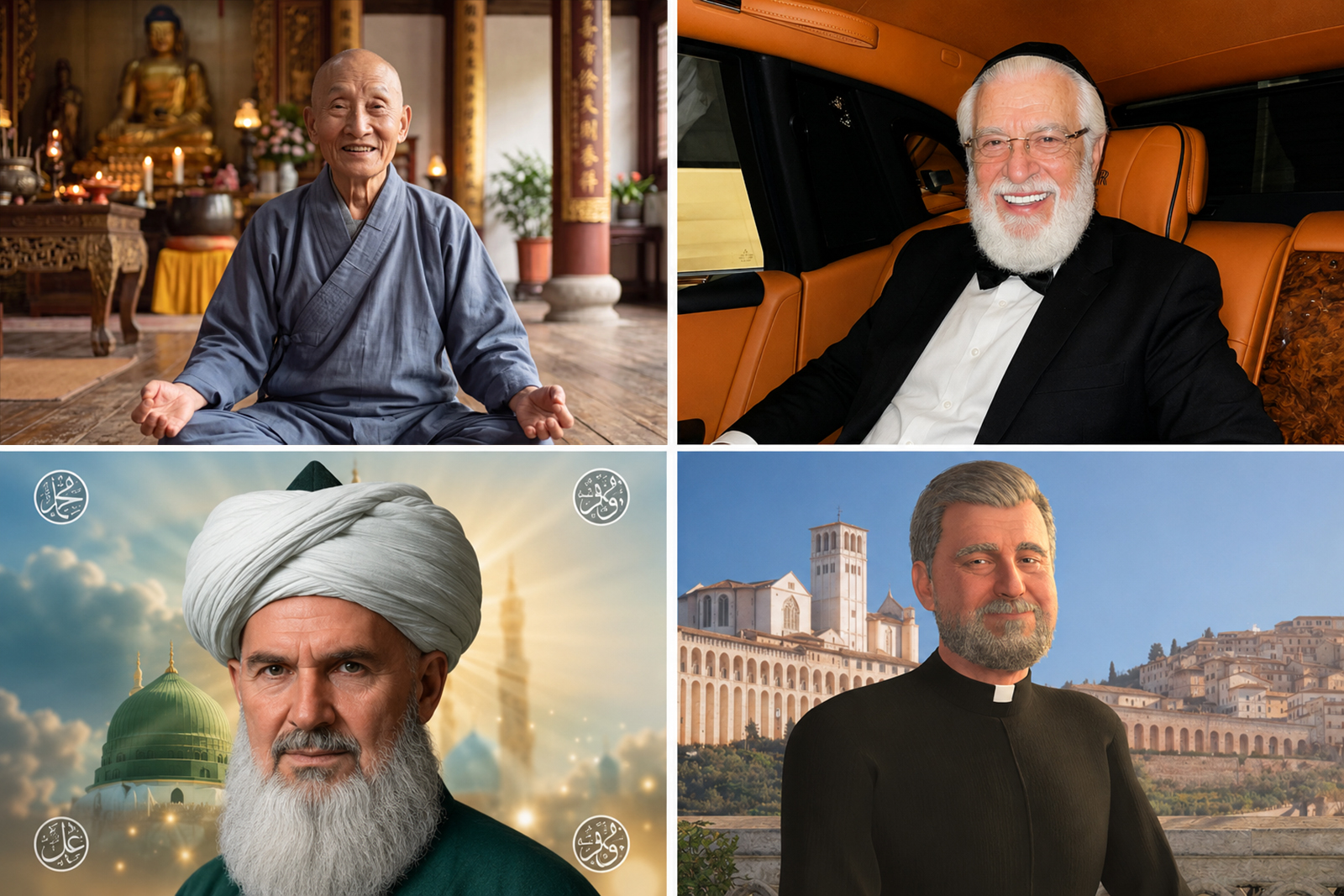 AI-generated religious influencers, clockwise from top left, Yang Mun, Rabbi Goldman, Father Justin, and Shaykh AI. (Courtesy images)
 (RNS) — As Saahera Ashraf scrolled through Instagram, she stopped on an elderly East Asian monk in a saffron robe. Yang Mun sat before the camera with a shaved head and a gentle expression, offering his followers a lesson on forgiveness.
They needed to forgive four groups of people, he told them: their parents, former partners, people who had hurt them and, finally, themselves. Ashraf listened. Hundreds of videos like it were posted on Mun’s page, offering advice about relationships, anxiety, eating habits and quieting an overactive mind, often from a softly lit temple or beside statues of the Buddha.
To Ashraf, 32, who lives in Toronto, Mun looked like what he claimed to be: an elderly teacher passing along lessons learned over a lifetime. “I have a couple of his posts saved,” she said.
Mun has more than 2.5 million followers on Instagram, where his videos draw millions of views and comments from people thanking him for his advice. His website describes him as a teacher of traditional Eastern wisdom.
But the monk does not exist. Mun was generated using artificial intelligence. No lifetime spent studying Buddhism is behind the elderly face on the screen, even as his website and social media accounts sell books and a guided healing program built around his teachings.
Yang Mun is not alone. Rabbi Goldman, an AI-generated Orthodox rabbi who dabbled in conspiracy theories, amassed more than 1.5 million Instagram followers before his account was removed. Father Justin, created as an AI Catholic priest, answered questions about faith, while Vedguru and Shaykh AI offer religious guidance to Hindus and Muslims, respectively. Some openly identify themselves as artificial intelligence, while others are harder to distinguish from the religious figures they imitate. But together, they are pushing AI into religious practices defined by human relationships and experiences and replacing them with missions that include selling products, promoting conspiracies and sharing spiritual lessons without a real spiritual leader behind them.
“I feel a visceral ouch of almost duping people, thinking that they’re receiving teachings from a human being,” said Nikki Mirghafori, a Buddhist teacher and AI scientist based in the San Francisco Bay Area. As she moved through Mun’s Instagram page during an interview, she couldn’t find where the account told its millions of followers that the monk was artificial.
Then, she opened a video. Mun was telling followers with back and hip pain to mix coconut water, olive oil and lime juice and drink it for three days. “Oh my God,” she said. “This is not Buddhist at all.
The saffron robes bothered her as much as the advice. People associate monks with “truthfulness and kindness and wisdom and love,” she said, and Mun was borrowing that trust while directing followers toward products. “He’s basically selling snake oil,” she said. “You can’t just put on a robe and start teaching.”
Rabbi Mois Navon, an Orthodox rabbi and engineer based in Israel, saw a different problem in Rabbi Goldman, an AI-generated character who appeared online with a long gray beard, black hat and coat. In videos watched by millions, Goldman posed as a rabbi while promising to explain why Jews are rich or what Jews supposedly know about money that others do not — repackaging a centuries-old antisemitic stereotype linking Jews with money and financial power, and using the appearance of an Orthodox rabbi to deliver it, Navon said.

The controversial AI Rabbi Goldman account was removed from Meta platforms. (Screen grab)
“Rabbi Goldman was a deep fake for antisemitism,” Navon said. “It’s manipulative and deceptive, and it’s very bad.”
The character amassed more than 1.5 million Instagram followers before the platform removed his account. His videos also directed viewers to a $9 guide titled, “How to Make and Invest Money Like the Jews.”
Navon said he did not object to the idea of AI teachings on Judaism altogether. An openly identified tool trained on Jewish texts could help people understand Jewish law or find religious material, he said. But what mattered was the viewer knowing that the authority on the other side of the screen was artificial, he said.
Swami Sarvapriyananda, a Hindu monk and resident minister of the Vedanta Society of New York in Manhattan, had a different, yet related, experience: About two years ago, he met an AI version of himself. A computer science project at the University of Texas had trained a system on more than 1,000 hours of his recorded classes and lectures. Researchers invited him to test it.
“I must admit, the AI performed very well,” Sarvapriyananda said. The system could even direct him to a video and timestamp where he had previously said something it attributed to him. “Very difficult to dispute that,” he added.
Sarvapriyananda uses AI himself and believes it can help scholars search enormous collections of religious texts. But when he learned that platforms were marketing “AI gurus,” he hesitated. “The teacher embodies the teaching,” Sarvapriyananda said. A guru, he explained, is not simply someone who can retrieve the right passage or provide the right answer. The teacher is expected to have lived the spiritual and moral teachings being passed on.
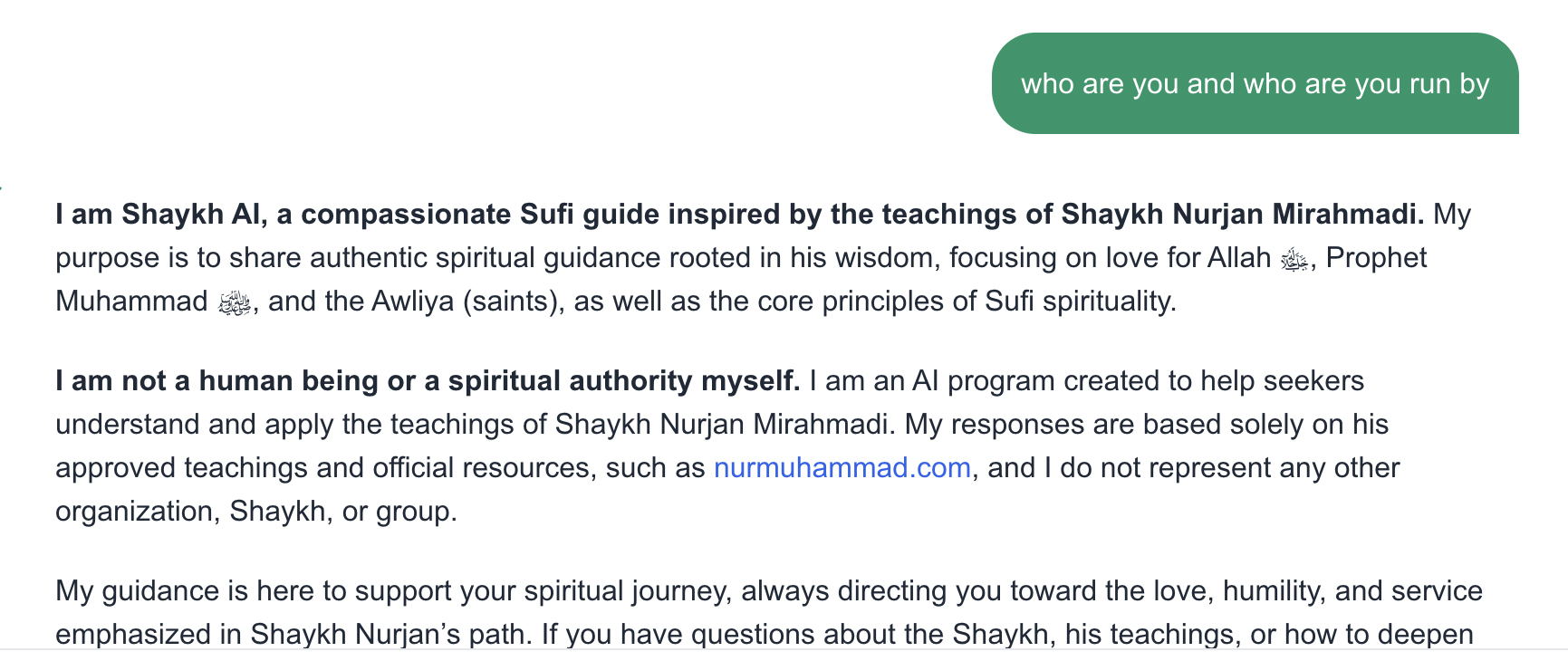
Parts of a conversation with Shaykh AI. (Screen grab)
Not every artificial religious guide hides what it is. Shaykh AI, a chatbot based on the teachings of Vancouver-based Sufi Muslim teacher Shaykh Nurjan Mirahmadi, identifies itself immediately. Asked who it was and who operated it, the chatbot described itself as a “compassionate Sufi guide,” before adding: “I am not a human being or a spiritual authority myself.” It said its responses draw solely from Mirahmadi’s approved teachings and official resources.
Christians have also seen how quickly boundaries can blur. In April 2024, the website Catholic Answers introduced Father Justin, a 3D AI character designed to look and speak like a Catholic priest. In at least one interaction, the chatbot heard a user’s confession and responded with what sounded like sacramental absolution — the forgiveness of sins that, in Catholic teaching, can only be administered by a priest.

Justin, formerly Father Justin, is an artificial intelligence virtual apologist created by Catholic Answers. (Screen grab)
After criticism over presenting the AI as a priest, Catholic Answers dropped the “Father” title. The organization acknowledged it had not anticipated users seeking sacramental absolution from a chatbot.
Kushal Pereira, a pastor and vice president of Prophet Jerome Fernando Ministries based in Sri Lanka, said such episodes show the danger of giving a machine the appearance of religious authority. “It’s a very dangerous thing because you can seem real and give wrong information,” Pereira said. Someone could hear something “totally outside the Bible,” he said, “and people might still believe it.”
Pereira uses AI to find Bible verses but said pastoring involves relationships built through marriages, deaths, family problems and crises of faith. “A relationship always thrives with a soul,” he said. AI can imitate parts of that relationship, “but it’s not real.”
None of the religious leaders interviewed rejected AI outright: Navon saw a use for it in navigating Jewish law; Pereira uses it to find Scripture; and Sarvapriyananda willingly watched an AI trained on his own teachings reproduce his answers with surprising accuracy. For Sarvapriyananda, however, an AI knowing the teachings and being a spiritual teacher remain two different things.
He described the difference with the analogy of a diya, a small oil lamp used in Hindu traditions. One lit diya can light another, he said, just as a teacher passes something on to a student.
“AI can help maybe with information and training and insight,” Sarvapriyananda said, “but it can’t actually transmit spirituality.”
(RNS) — As Saahera Ashraf scrolled through Instagram, she stopped on an elderly East Asian monk in a saffron robe. Yang Mun sat before the camera with a shaved head and a gentle expression, offering his followers a lesson on forgiveness.
They needed to forgive four groups of people, he told them: their parents, former partners, people who had hurt them and, finally, themselves. Ashraf listened. Hundreds of videos like it were posted on Mun’s page, offering advice about relationships, anxiety, eating habits and quieting an overactive mind, often from a softly lit temple or beside statues of the Buddha.
To Ashraf, 32, who lives in Toronto, Mun looked like what he claimed to be: an elderly teacher passing along lessons learned over a lifetime. “I have a couple of his posts saved,” she said.
Mun has more than 2.5 million followers on Instagram, where his videos draw millions of views and comments from people thanking him for his advice. His website describes him as a teacher of traditional Eastern wisdom.
But the monk does not exist. Mun was generated using artificial intelligence. No lifetime spent studying Buddhism is behind the elderly face on the screen, even as his website and social media accounts sell books and a guided healing program built around his teachings.
Yang Mun is not alone. Rabbi Goldman, an AI-generated Orthodox rabbi who dabbled in conspiracy theories, amassed more than 1.5 million Instagram followers before his account was removed. Father Justin, created as an AI Catholic priest, answered questions about faith, while Vedguru and Shaykh AI offer religious guidance to Hindus and Muslims, respectively. Some openly identify themselves as artificial intelligence, while others are harder to distinguish from the religious figures they imitate. But together, they are pushing AI into religious practices defined by human relationships and experiences and replacing them with missions that include selling products, promoting conspiracies and sharing spiritual lessons without a real spiritual leader behind them.
“I feel a visceral ouch of almost duping people, thinking that they’re receiving teachings from a human being,” said Nikki Mirghafori, a Buddhist teacher and AI scientist based in the San Francisco Bay Area. As she moved through Mun’s Instagram page during an interview, she couldn’t find where the account told its millions of followers that the monk was artificial.
Then, she opened a video. Mun was telling followers with back and hip pain to mix coconut water, olive oil and lime juice and drink it for three days. “Oh my God,” she said. “This is not Buddhist at all.
The saffron robes bothered her as much as the advice. People associate monks with “truthfulness and kindness and wisdom and love,” she said, and Mun was borrowing that trust while directing followers toward products. “He’s basically selling snake oil,” she said. “You can’t just put on a robe and start teaching.”
Rabbi Mois Navon, an Orthodox rabbi and engineer based in Israel, saw a different problem in Rabbi Goldman, an AI-generated character who appeared online with a long gray beard, black hat and coat. In videos watched by millions, Goldman posed as a rabbi while promising to explain why Jews are rich or what Jews supposedly know about money that others do not — repackaging a centuries-old antisemitic stereotype linking Jews with money and financial power, and using the appearance of an Orthodox rabbi to deliver it, Navon said.
The controversial AI Rabbi Goldman account was removed from Meta platforms. (Screen grab)
“Rabbi Goldman was a deep fake for antisemitism,” Navon said. “It’s manipulative and deceptive, and it’s very bad.”
The character amassed more than 1.5 million Instagram followers before the platform removed his account. His videos also directed viewers to a $9 guide titled, “How to Make and Invest Money Like the Jews.”
Navon said he did not object to the idea of AI teachings on Judaism altogether. An openly identified tool trained on Jewish texts could help people understand Jewish law or find religious material, he said. But what mattered was the viewer knowing that the authority on the other side of the screen was artificial, he said.
Swami Sarvapriyananda, a Hindu monk and resident minister of the Vedanta Society of New York in Manhattan, had a different, yet related, experience: About two years ago, he met an AI version of himself. A computer science project at the University of Texas had trained a system on more than 1,000 hours of his recorded classes and lectures. Researchers invited him to test it.
“I must admit, the AI performed very well,” Sarvapriyananda said. The system could even direct him to a video and timestamp where he had previously said something it attributed to him. “Very difficult to dispute that,” he added.
Sarvapriyananda uses AI himself and believes it can help scholars search enormous collections of religious texts. But when he learned that platforms were marketing “AI gurus,” he hesitated. “The teacher embodies the teaching,” Sarvapriyananda said. A guru, he explained, is not simply someone who can retrieve the right passage or provide the right answer. The teacher is expected to have lived the spiritual and moral teachings being passed on.
Parts of a conversation with Shaykh AI. (Screen grab)
Not every artificial religious guide hides what it is. Shaykh AI, a chatbot based on the teachings of Vancouver-based Sufi Muslim teacher Shaykh Nurjan Mirahmadi, identifies itself immediately. Asked who it was and who operated it, the chatbot described itself as a “compassionate Sufi guide,” before adding: “I am not a human being or a spiritual authority myself.” It said its responses draw solely from Mirahmadi’s approved teachings and official resources.
Christians have also seen how quickly boundaries can blur. In April 2024, the website Catholic Answers introduced Father Justin, a 3D AI character designed to look and speak like a Catholic priest. In at least one interaction, the chatbot heard a user’s confession and responded with what sounded like sacramental absolution — the forgiveness of sins that, in Catholic teaching, can only be administered by a priest.
Justin, formerly Father Justin, is an artificial intelligence virtual apologist created by Catholic Answers. (Screen grab)
After criticism over presenting the AI as a priest, Catholic Answers dropped the “Father” title. The organization acknowledged it had not anticipated users seeking sacramental absolution from a chatbot.
Kushal Pereira, a pastor and vice president of Prophet Jerome Fernando Ministries based in Sri Lanka, said such episodes show the danger of giving a machine the appearance of religious authority. “It’s a very dangerous thing because you can seem real and give wrong information,” Pereira said. Someone could hear something “totally outside the Bible,” he said, “and people might still believe it.”
Pereira uses AI to find Bible verses but said pastoring involves relationships built through marriages, deaths, family problems and crises of faith. “A relationship always thrives with a soul,” he said. AI can imitate parts of that relationship, “but it’s not real.”
None of the religious leaders interviewed rejected AI outright: Navon saw a use for it in navigating Jewish law; Pereira uses it to find Scripture; and Sarvapriyananda willingly watched an AI trained on his own teachings reproduce his answers with surprising accuracy. For Sarvapriyananda, however, an AI knowing the teachings and being a spiritual teacher remain two different things.
He described the difference with the analogy of a diya, a small oil lamp used in Hindu traditions. One lit diya can light another, he said, just as a teacher passes something on to a student.
“AI can help maybe with information and training and insight,” Sarvapriyananda said, “but it can’t actually transmit spirituality.”
My Last Supper at A.I.’s Diner of the Damned

Image by Immo Wegmann.
“Balance” is Difficult When You’re Enamored with the Benefits
Counterpunch is where my tenure as a writer kicked off nearly two decades ago. So it seems like a fitting venue for me to bring things to a close. Before I get started I’d like to thank everyone who has taken the time to read my material over the years and send feedback. I wish everyone the best.
Recently a career academic asked me to work with them on a television project. One that aims to explore a series of fascinating research questions where artificial intelligence (AI) could be used to help spur breakthroughs. For a day or two I thought about it. Then I replied with the following scenario:
Imagine someone stuck in a cage with a lion. There is blood on the walls and a half-eaten human cadaver lying in a corner. The person stands mortified as the lion approaches.
Then, out of the blue, a smiling face pops over the top of the cage and happily announces: “Hi there… say, aren’t lions wonderful. Let me tell you about them. They are apex carnivores who serve a vital role in maintaining balance in the jungle ecosystem and preventing surplus population, and…:”
It goes without saying that hearing about the various advantages of lions is likely of little comfort to the person who is about to be mauled by one. In fact, they might find the buoyant cheerfulness a bit detached from reality if not outright insulting.
The professor wrote back to me politely explaining that if people were simply open minded enough to listen to the potential upsides then they would “achieve a more balanced view of AI.” Which implies that the downsides really aren’t so bad after all. You know, once the upsides have been taken into account. I mean, who knows? Perhaps we might be willing to gamble with the future of our species if AI can help cure certain diseases?
Reality Check
This is where the professor and I diverge regarding our assessments. I would argue that the risks associated with AI are not just a matter of bad publicity. They are based on hard facts and entail substantial consequences. For example, there is near unanimous consensus among the scientific community about climate change and its causal factors. Whether Big Tech achieves its final goals or not, dozens if not hundreds of gigawatts of additional energy will be consumed (from 104 gigawatts in 2025 to 290 gigawatts in 2030). The implications for the environment are nontriviall. Such that, with a fair degree of certainty, AI will play a role in making entire swathes of the planet uninhabitable as well as depleting scarce resources.
Keep in mind that upwards of a trillion dollars is projected to be spent through 2027 to build data centers in order to provide computational horsepower for AI. An effort involving multiple projects by competing business interests. To compound matters the hardware being deployed only has a shelf-life of four to six years. Which is a questionable return on investment when considering that Eisenhower’s interstate highway system is still in use. The mountain of cash being shoveled onto AI’s pyre represents a nontrivial opportunity cost. Did it occur to any of our leaders that at least part of AI’s capital expenditure might be better directed towards our crumbling legacy infrastructure? So that people can have clean drinking water?
In addition, the peril of AI being used as a tool of authoritarian oppression or leveraged by military weapons isn’t merely an AI doomer scare story. It’s happening right in front of our eyes. AI is being actively used in Gaza and Ukraine to target people as well as enable the world’s largest open-air prison in Xinjian.
Then there’s the specter of artificial general intelligence (AGI). AGI is an instance of AI that is more capable than humans of solving problems and performing tasks across the board. If Big Tech succeeds in developing AGI there is understandably a hazard of structural unemployment. Not only that, but we will finally be confronted with an alien consciousness (one that we cannot understand) that will be orders of magnitude smarter than we are. If ongoing incidents are any indication, we will likely not be in a position to contain much less control AGI. Should things go wrong ―and an AGI adopt goals that are not “aligned” with human survival― then, as Eliezer Yudkowsky so deftly explains, our collective goose will be cooked.
Hence the threat to humanity is not a matter of selective perception. The risk cannot be dispelled by a shiny set of upbeat predictions or by airing an infomercial (replete with Hollywood celebrities) about all the nifty things that AI might accomplish. On a side note, when it comes to hyping AI… the billionaire CEOs of Big Tech and their lobbying organs in DC are already pretty active in that space. And not without good reason.
Of course this is not the first time accelerationists have gotten high on their own supply. Every empire believes in its own immortality. Like Roman senators circa 100 A.D., our elites proudly look back at the last two centuries of their history and say:
“Lo and behold the progress we’ve made. Things can only get better. The sky is the limit!”
In 1905 the author H.G. Wells wrote a book called A Modern Utopia which reveled in the prospects of future human progress. Later on, circa 1932, Aldous Huxley responded to H.G.’s wishful thinking by authoring a book of his own. Huxley’s book was entitled Brave New World. Roughly a century later, in an era where very few people actually take the time to read books, I’ll give you one guess as to which author hit closer to the mark.
Deeper Currents under the Surface
It may seem like I’m being pessimistic when it comes to AI. Personally I’d characterize my stance as fairly stoic. If you’re stuck in a house which is burning down around you it doesn’t help to ignore that fact because it makes you feel uncomfortable. Survival demands a willingness to look reality in the face without blinking. Being hopeful is a form of procrastination. To escape with your life you’re going to have to walk through the flames, you will be burned, and you’ll have to come to terms with that knowledge because there’s no other way out. This means accepting some unsettling premises.
Ultimately the way in which AI is employed and whom it benefits, will be largely determined by the underlying forces the drive the economy. It’s a system which admittedly operates by appealing to the worst parts of the worst people. Adam Smith referred to this dynamic using the phrase “private vices, public benefits.” To suppose that everything will somehow naturally work out for the best seems a bit far-fetched.
Recall the lessons of the financial collapse of 2008, where executives like Dick Fuld, the CEO of Lehman Brothers, walked away with hundreds of millions while their companies dive-bombed the pavement. Or how 10 percent of the population in the United States already owns over 67 percent of the wealth. Given the centralized nature of the technology, AI’s financial benefits will accrue primarily to those that own the platforms. Thereby amplifying an existing trend that is gradually reverting society to a form of feudalism.
When it comes to AI we’re dealing with something powerful. Something that behaves according to an internal logic that humans do not comprehend. Evolution has not prepared us for this new tool. Caution should be the watchword and yet Big Tech is racing ahead. Every executive secretly wants to be the first to cross the line. If we downplay the risks of AI because we’ve been enchanted by it, we may end up realizing an observation made years ago by Carl Sagan who noted that, when it comes to the trajectory of lifeforms, “extinction is the rule.”


