It’s possible that I shall make an ass of myself. But in that case one can always get out of it with a little dialectic. I have, of course, so worded my proposition as to be right either way (K.Marx, Letter to F.Engels on the Indian Mutiny)
Sunday, October 18, 2026
Unmanned Vessel Deploys With Carrier Strike Group for the First Time
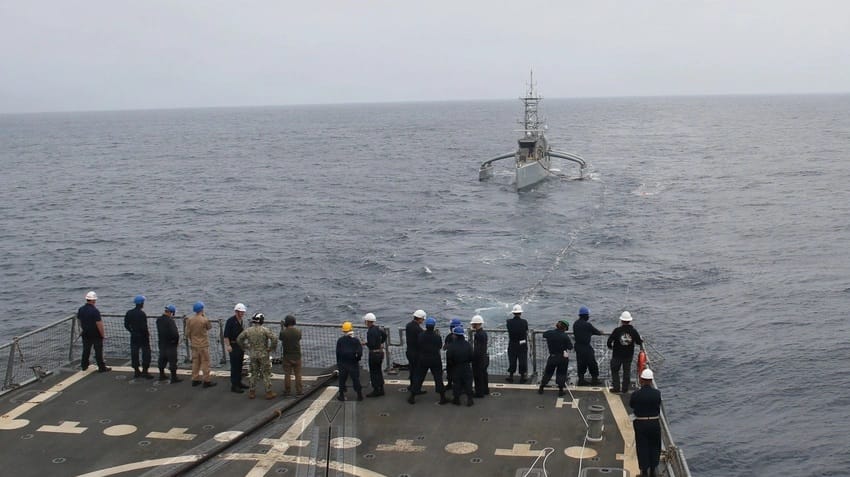
The U.S. Navy has confirmed that a midsize unmanned surface vessel has sailed with the USS Theodore Roosevelt Carrier Strike Group, currently under way in the Pacific. It is the first time that a deployed CSG has been accompanied by an unmanned vessel too large to stow on a ship.
Roosevelt got under way from San Diego on October 8, but preparations for integrating the USV into its escort force have been going on for some time. In September, the service released imagery of the destroyer USS Chafee practicing an astern refueling operation with the prototype USV Seahawk.
Seahawk predates the drone-vessel designs now in production for the Navy's MUSV program. The prototype dates back to 2017, when the Navy awarded Leidos a contract to upgrade its existing Sea Hunter design using lessons learned from early trials. Leidos kept the trimaran hull form, but re-engineered the vessel's systems for minimal human intervention at sea, hoping to achieve truly unmanned, self-navigating operations.
“We didn’t just put an autonomous navigation system onto an existing ship,” said defense executive Dan Brintzinghoffer, Leidos' Vice President for Maritime Solutions at the time of the USV's delivery(now with Austal USA). “Every mechanical and electrical system on Seahawk has unique configurations designed to run for months at a time without maintenance or a crew.”
As delivered in 2021, Seahawk was an unarmed vessel, intended primarily to carry surveillance equipment and a sonar system for tracking submarines. Details of its configuration for the Roosevelt Carrier Strike Group deployment were not released; Acting Secretary of the Navy Hung Cao suggested that it would be a useful addition.
"This is a first carrier strike group to ever deploy with a large-size unmanned surface vessel, and this is a force multiplier. Imagine having more guns out there," Cao said at a U.S. Army conference this week.
Cao also noted that the U.S. Navy had used unmanned underwater vehicles (UUVs) to demine the Strait of Hormuz, without exposing its mine countermeasures ships and crews to the risk of Iranian attack. In the early months of the conflict, experienced analysts suggested that the mines could not be removed without first neutralizing Iran's many threats to surface vessels. Cao confirmed that the demining would have been impossible in a contested area without using underwater drones.
War in Yemen Now Impacting the Whole Gulf Region
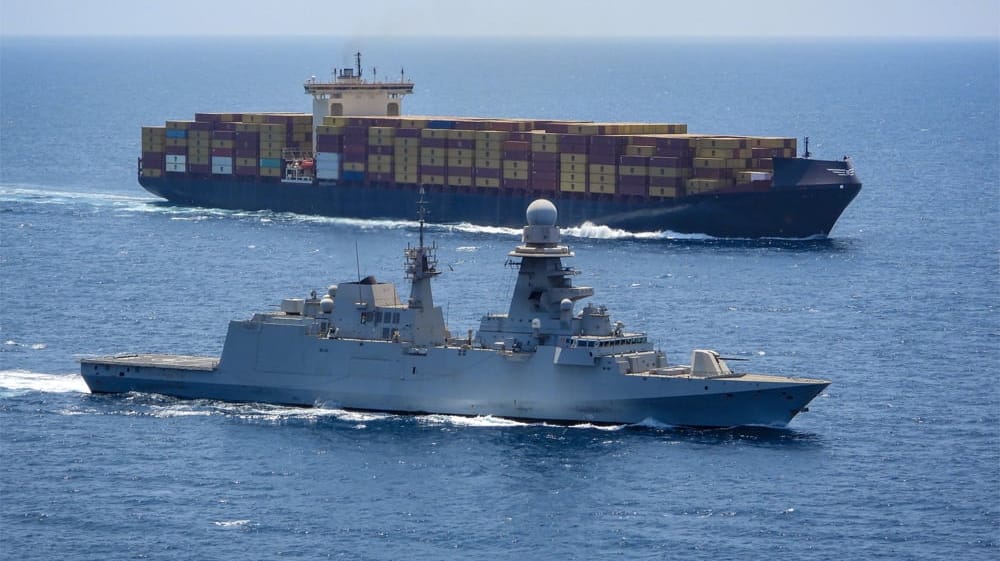
EUNAVFOR Aspides continues its close protection efforts (Aspides)
The Houthis have intensified their attacks on the forces of Yemen’s Internationally Recognized Government (IRG) over the last week but have also widened their campaign by mounting very damaging attacks on infrastructure in Saudi Arabia.
Targeting of civilian airports in Saudi Arabia, which has led to the temporary closure of Riyadh International Airport, places further pressure on transport routes into and out of Saudi Arabia, which have also been exacerbated by continued drone and missile attacks on oil pipelines and port infrastructure on Saudi Arabia’s west coast. These attacks threaten wider commercial interests than just those of Saudi Arabia itself, which has prompted offers of additional support from Saudi allies – but not yet of offensive capability, which would be sufficient to alter the course of the war in Yemen itself.
Within Yemen, the most intense fighting has been concentrated around Taiz, held by the IRG and now under effective siege, but which so far has resisted Houthi incursions into the city itself. A major element of the Houthi campaign has been a persistent psychological warfare attack. But inhabitants of Taiz are resistant, having no tribal or religious connections to the Houthis, who are seen despite the propaganda as alien invaders.
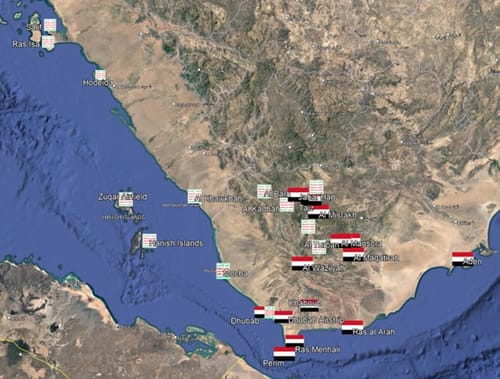
Houthi and Yemeni Government positions in SW Yemen as reflected in reporting on October 16. (Google Earth/CJRC)
On the south-west coast, now that the situation has somewhat settled, it appears that the IRG counterattack to recapture ground lost earlier in the month to the Houthis was not as successful as advertised earlier. The IRG appears to have made a tenuous repossession of the Ras Menhali peninsula overlooking the Bab el-Mandeb strait at its narrowest, and probably has reclaimed Perim Island as well. But the IRG has not as yet recovered the coastal towns of Dhubab or Mocha, let alone gotten anywhere close to Hodeida.
The Houthis have also retained their capture of the Hanish Islands, which gives them an enhanced ability to threaten shipping in the lower Red Sea using both drones and speedboats – a capability which they are not exploiting for the moment, but will likely do so once they have consolidated any gains they are making in the current war. They also retain the capability to import materials through their ports of Hodeida, Ras Isa and Salif.
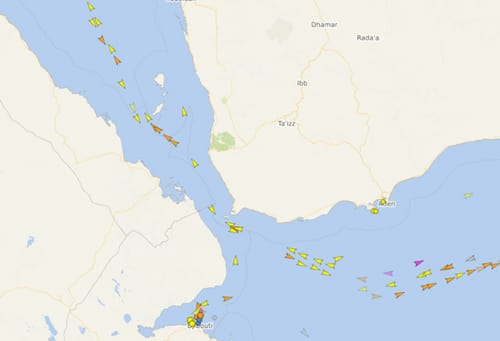
Traffic through the Bab el-Mandeb on October 16 looks thinner than at the same time last week (VesselFinder)
The unsettled situation in the southern Red Sea has seen forces that hitherto suppressed the threat of piracy withdrawing from the area. Hitherto, the coastal patrol forces of the National Resistance Forces, operating from Mocha in particular, made regular seizures of material being imported by the Houthis, making circuitous use of routes from Iran and smuggler networks operating from both sides of the southern Red Sea. The same smugglers come from the community, which inclines towards piracy when times are hard, and security forces are not active. Some elements of the National Resistance Force coastal units, which used to patrol these waters, survived and are now being incorporated into the Yemeni Coast Guard based in Aden. They have lost a lot of their radar and surveillance equipment when Mocha was captured by the Houthis, but at least the remnants are now consolidating within the single Yemeni Coast Guard structure rather than being split between two separate chains of command.
The European Union’s Operations Aspides and Atalanta, the only naval coalitions currently providing support to merchantmen transiting the Bab el-Mandeb, are on alert for an increase in piracy, and recently deterred an attempted pirate seizure of St Vincent & Grenadines-flagged cargo ship MV Glamor (IMO 9177961). The Spanish flagship of the Aspides force is the Santa María Class frigate ESPS Numancia (F83), with the flotilla recently having included three FREMM frigates, the Italian Navy’s ITS Carlo Bergamini (F590) and ITS Luigi Rizzo (F595), and the French Navy’s FS Languedoc (D653). Support was provided by a maritime surveillance aircraft. On October 1, the Languedoc engaged and destroyed a Houthi drone in the Bab el-Mandeb using its OTO Melara 76 mm gun. The drone had been threatening the CMA CGM container ship CMA CGM Champs Elysees (IMO 9839131) and another containership belonging to MSC.
Australia Investigates Hidden Camera Found in Women’s Bathroom on Navy Ship
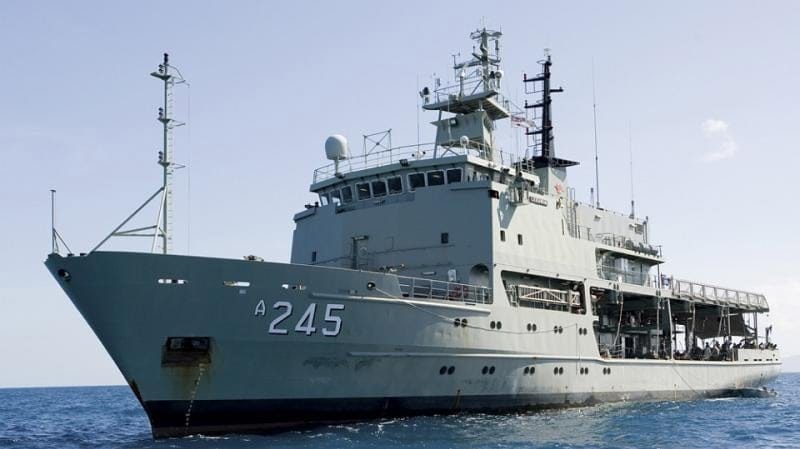
HMAS Leeuwin is a hydrographic survey vessel for the Australian Defence Force (ADF)
The Australian Defence Force is reporting that a person of interest has been identified and is cooperating with its investigation into a hidden camera that was found aboard one of its vessels. The camera located in a women’s bathroom on HMAS Leeuwin has turned into a national embarrassment and is being treated as an act of sexual violence.
The video recording device was discovered aboard HMAS Leeuwin on October 11 while the ship was at its berth in Cairns, Queensland. The device had been planted in the shower facilities of female sailors.
The Australian Defence Force, which described the discovery of the device as the “most despicable betrayal of trust,” said the ship’s program had been altered to enable a rapid and rigorous investigation by the Joint Military Police Unit working with civilian authorities. The Warrant Officer of the Navy was also in Cairns to support the ship’s company.
Commissioned in 2000, the 71-meter HMAS Leeuwin is the lead ship of the Leeuwin-class of hydrographic survey vessels. The ship, which can accommodate 46 crew, is mainly deployed for hydrographic duties, although at times she’s called to carry out border protection operations.
Together with her sister ship Melville, Leeuwin is equipped with multi-beam echo sounders and the ability to support a helicopter, and carry three nine-meter survey motor boats, all for survey operations. The surveys are designed to make the passage of vessels safer and help to protect Australia's ocean environment.
Vice Admiral Matt Buckley, the Chief of the Navy, said, “The location of the recording device is the most despicable betrayal of trust and is fundamentally misaligned with the Navy’s values.”
“You have my assurance and commitment that we will tackle this act of sexual violence with all of our energy. Any perpetrator will be held to account. Further, you should all know that eradicating sexual violence in our workplace is fundamental to the fighting efficiency of our Navy,” he said.
The Navy reports it is also undertaking an audit of all its bathrooms across the fleet.
South Korean Yard Completes Repairs for USNS Amelia Earhart
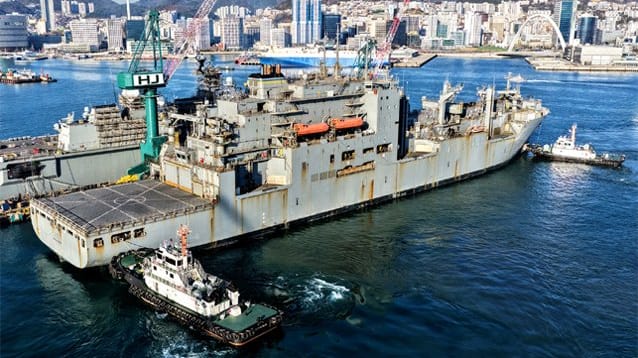
USNS Amelia Earhart seen arriving in Korean in January 2026 (HJ Heavy Industries)
South Korea’s HJ Heavy Industries completed a larger-than-planned overhaul and repair project for the Military Sealift Command supply ship USNS Amelia Earhart and redelivered the ship to the U.S. Navy. The project is in keeping with the U.S. Navy’s “Indo-Pacific Maintenance Capability Enhancement” policy, which is designed to undertake maintenance and overhaul work in the region to reduce the vessel’s time away from service and out of the region, while also reducing the amount of work on the already stretched shipyard facilities in the United States.
While the U.S. had already sent several other ships from the Lewis and Clark dry cargo ship class for maintenance in South Korea, this project was the first time that a mid-sized Korean yard had won and successfully undertaken one of these projects. HJ Heavy Industries had assembled a team with other suppliers for the project, enabling it to compete with Korea’s largest shipbuilders. In the past, Hanwha Ocean and HD Hyundai had won the first overhaul assignments from the United States.
USS Amelia Earhart is a 40,000-ton logistics support ship. It was placed in service in 2008. The ship measures 210 meters (689 feet) in length. It supplies up to 6,000 tons of ammunition, food, and cargo, as well as 2,400 tons of fuel to support the ships of the U.S. Navy.
The contract for the vessel’s overhaul was awarded in December 2025, and it arrived at the Yeongdo Shipyard in Busan, South Korea, in January. It originally called for a three-month overhaul period.
HJ Heavy Industries reports it undertook an inspection as part of the planned maintenance of the hull, major systems, and equipment. Numerous “defects” that were not included in the original contract, however, were identified, and HJ Heavy Industries also proposed improvements to the plan. The U.S. Navy accepted the proposal, and as a result, the scope was extended by six months.
The handover was completed on October 14. The U.S. Navy provided a letter of appreciation to the yard and commended it for the work completed on the ship.
HJ Heavy Industries looks to build on the success of the first project. It is targeting follow-up orders.
Since starting the policy of forward deployment repairs, the Navy and Military Sealift Command have conducted overhauls in South Korea, India, and Japan. They have also sent warships for maintenance in Japan instead of the normal policy of rotating them back to the United States. The U.S. recently also placed one of its guided-missile destroyers, USS Arleigh Burke, in a dry dock in Spain for maintenance, the first time the Forward Deployed European fleet had used a commercial shipyard for regular maintenance work.
IEA: Russian Diesel Deal Won't Change Tight Global Energy Market
A refinery in Moscow burns after a Ukrainian drone strike, June 2026 (Russian social media)
The tight global market for diesel fuel is likely to extend well into 2027, according to the latest analysis from the International Energy Agency, meaning that record prices may be here to stay through at least the first quarter of 2027 - and maybe longer, depending upon the conflicts in the Mideast and Ukraine.
The disruption at the Strait of Hormuz, attacks on refineries in the GCC states, and Ukraine's concerted campaign of strikes on Russian energy infrastructure have all put downward pressure on diesel export volume. Increased exports from the U.S. Gulf Coast and (recently) China have helped offset the drop - but overall, the net global supply of diesel and gasoil has fallen by about 1.7 million barrels per day, according to the IEA. Demand for diesel is also down year-over-year, but only by about 0.75 million bpd in the third quarter.
That picture could worsen in coming months because of deteriorating economics for refiners outside of the United States. The price of oil and the cost of tanker charters are both very high, and the net cost for making and shipping diesel is approaching unfavorable levels for some refiners in Asia and Europe. IEA forecasts that if their margins drop further, some of these overseas refiners could decide to make run cuts as a business decision, further tightening the market for middle distillates.
The supply-demand mismatch means high prices. Diesel hit the $220 per barrel mark in the U.S. and in Europe last month, setting records, and average diesel retail prices in the American market are still about 75 percent more than they were this time last year. That added cost trickles down into inflation across all sectors, since diesel is the mobile energy supply of choice for trucking, construction, industry and agriculture.
The shortfall in refinery output also requires suppliers to draw down on inventory. Global stocks of gasoil are down by five percent since before the conflict, according to IEA.
Russian refineries are too damaged by previous Ukrainian strikes to make up the gap in the near term, IEA found, despite the White House's announced intention to bring more Russian diesel fuel to market.
"The gasoil market balance will remain tight well into 2027 and is dependent on a recovery of product supply from the Middle East. Failing this, further demand reductions and the heavy economic costs these will entail may be needed to balance markets," IEA concluded.
Arrests in Norway Reveal Fraud and Bribery for NATO Ship Supply Contracts
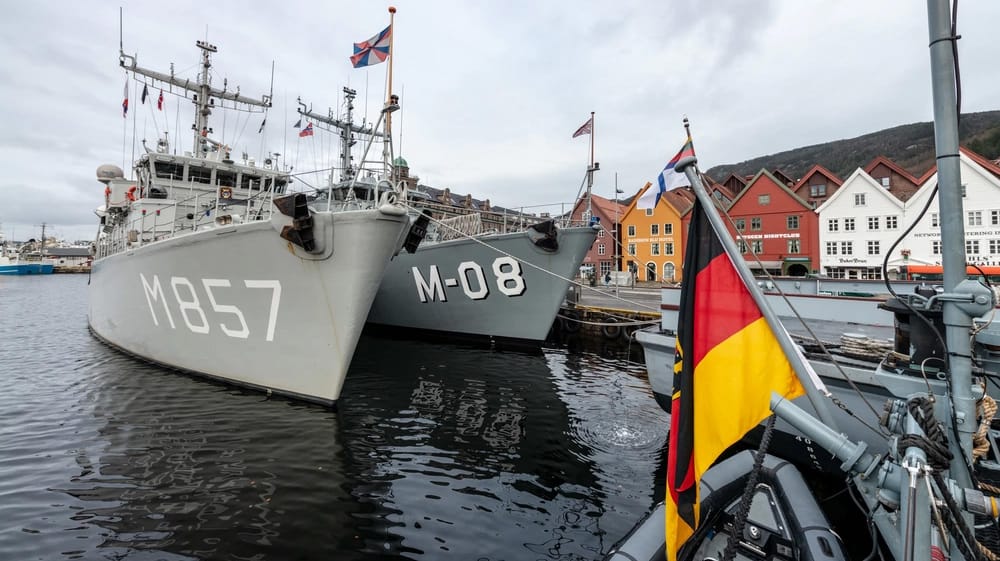
NATO Mine Counter Measure Group 1 (SNMG1) vessels, HNLMS Makkum (M857) LVNS Rusins (M08) FGS Homburg (M1069) and LNS Kursis (M54) berthed in Bergen (USN)
A wide-sweeping probe reaching from Norway to Germany and Romania has revealed a scheme of fraud and bribery for contracts to supply NATO ships. The first arrests were made on Wednesday in Bergen, Norway, with officials saying the scheme ran for at least four years and that they estimate the total losses are more than €1 million (US$1.12 million).
The investigation began in April 2025 and was coordinated by Eurojust, the European Union Agency for Criminal Justice Cooperation, along with anti-corruption and prosecutor’s offices in Norway, Germany, Romania, and the United Kingdom. Eurojust reports the cross-border investigation is into alleged fraudulent invoices submitted to the NATO Support and Procurement Agency (NSPA). The agency handles logistical support for military equipment and services, including the husbandry services that provide shore-based support to NATO warships.
The Norwegian authority Økokrim said it believes the scheme ran for several years, between 2021 and 2025. It included over-invoicing NSPA for services provided to NATO ships in Norwegian ports, including Bergen.
The fraud allegations Eurojust reports include bribery of foreign officials done by a suspected company through an intermediary, in return for favored support with their contractual dealings with NSPA.
The cooperating agencies staged simultaneous raids in Norway, Germany, and Romania on Wednesday, searching homes and businesses. Økokrim reported that five individuals were taken into custody in the Bergen area. They have been charged with aggravated fraud against NSPA, or aiding and abetting such fraud.
“Defence sector budgets are increasing worldwide, which entails an increased risk of economic crime,” said Marianne Bender, Senior Public Prosecutor at Økokrim. “It will take time to investigate this case as the charges cover several years and involve a very large number of ship calls.”
The officials said the searches in Germany and Romania involved several companies linked to the same serious fraud. NSPA also noted that the investigation had already led to earlier law enforcement actions in 2024 and 2025, without providing details.
NSPA said it had established a first-of-its-kind investigative capability in 2023, and since then has strengthened and matured this function into an Office of Investigations equipped to detect and combat fraud and corruption, designed to better safeguard the integrity of NATO-related procurement processes.
The officials said that this case demonstrates how NSPA’s identification of wrongdoings, combined with swift collaboration with national law enforcement, delivers tangible outcomes, including suspensions, debarments and arrests.
“While it is disheartening to unearth evidence of corrupt practices, these law enforcement actions reflect an investigations system that produces results and upholds the integrity of the agency’s procurement processes,” said NSPA.
The case harkens back to the well-known “Fat Leonard” scandal in the United States, in which a Malaysian defense contractor, Leonard Glenn Francis (aka "Fat Leonard"), and his Singapore-based company, Glenn Defense Marine Asia, bribed U.S. Navy officers to win lucrative husbandry contracts and reportedly bilked the U.S. Navy out of more than $35 million. Francis was known for his lavish entertaining and gifts to the Navy officers, including everything from luxury hotel stays to prostitutes, to get inside information on the Navy’s vessel service plans. Francis was finally sentenced to jail in the United States in 2024, after having briefly fled to Venezuela.
Storm Drives Another War Damaged Tanker Ashore in Turkey
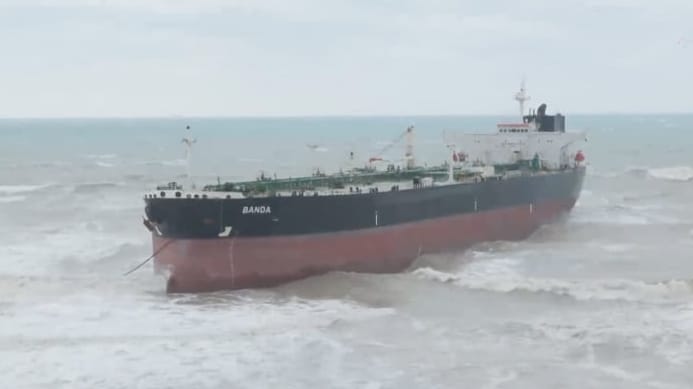
Tanker damaged by an attack by Ukraine has now grounded in Turkey (Turkish TV)
Turkish officials are responding to the second grounding this week of a tanker during strong storms that have moved across the region. Both of the vessels are war casualties struck by Ukraine during the Black Sea offensive and brought to Turkey.
The Liberian-flagged tanker Banda was driven ashore near Sariyer, in the northern sections of Istanbul along the Black Sea. The Turkish Coast Guard reports it responded to the vessel, which lost control due to the strong winds and rough seas in the area.
Unlike the product tanker Grace Romavictor (49,990 dwt), which was caught in the waves and winds and ended up ashore in the Cilingoz Nature Park, northwest of Istanbul, the Banda is not abandoned. The reports said there are six Turkish crewmembers aboard the Banda. The Coast Guard confirmed that they were in good condition, and they anticipate the vessel will be pulled off the beach after the storm subsides.
The Security Service of Ukraine had targeted the Banda (105,576 dwt) on July 14 while it was approximately 70 miles southwest of Novorossiysk. It was empty, approaching the terminal to load a cargo of crude oil. Ukraine asserted that the tanker had transported Russian crude oil from the ports of Ust-Luga, Kerch, Novorossiysk, and Nakhodka.
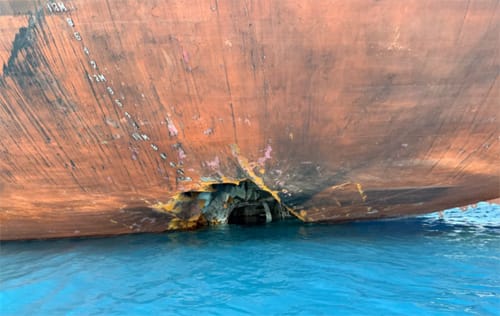
Damage after the Ukrainian drone strike (Tsavliris Group)
According to details released by the salvage company Tsavliris Group, the vessel was struck near the stern, which caused a heavy explosion and a fire. It said there was also water ingress that flooded the engine room and left the vessel blacked out.
Tsavliris sent a rescue tug and a salvage team that began towing the tanker on July 17 and boarded it to effect repairs starting on July 22. It reports the tanker was stabilized, a portable generator was placed aboard, and repairs were made in the accommodation block for the crew. Tsavliris delivered the tanker into a Turkish anchorage on August 19.
It is unclear if the tanker was struck a second time. Turkish authorities are indicating it was struck on September 2, but did not provide any details on the incident.
NATO Discusses Black Sea After More Vessel Strikes Leave Seven Crew Missing
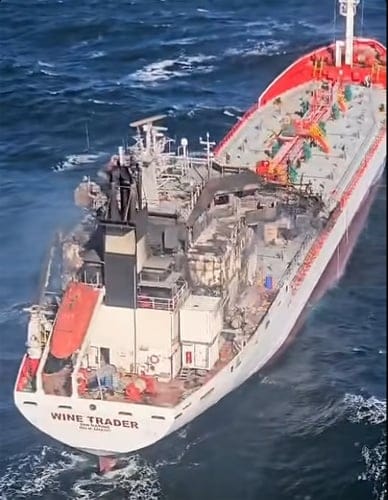
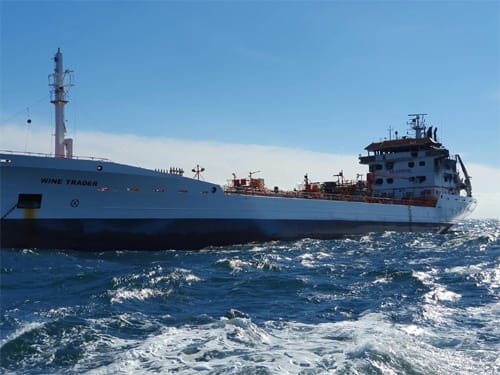
Product tanker Wine Trader was one of two vessels struck off Romania (Interior Ministry of Romania)
Romanian authorities are reporting an ongoing search and rescue effort in the Black Sea after two small product tankers were struck. Seven crewmembers from a San Marino-registered product tanker were reported missing while five others were evacuated. A second vessel reported no injuries and was said to be making its way to port under its own power as the increasing strikes are being discussed by NATO.
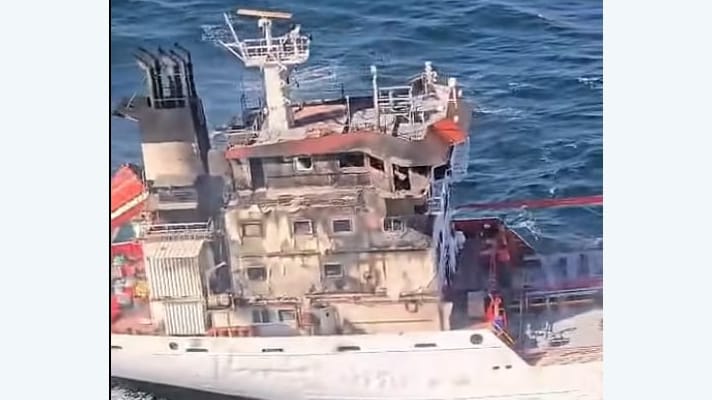
The Maritime Coordination Center of the Romanian Naval Authority received the emergency call from the product tanker Wine Trader (6,259 dwt) at around 0700 on October 15. The vessel said it had been struck, and the crew was attempting to fight a fire. The first strike occurred in the area of the accommodation block and left several crewmembers unaccounted for and made a search difficult due to the intensity of the fire.
A later report from the San Marino authorities said the captain reported the vessel was struck a second and possibly a third time. Damage to the water supply for the firefighting system forced them to suspend the efforts and evacuate.
Romania was organizing a search for the missing crewmembers (Interior Ministry of Romania)
The evacuation, however, was complicated by bad weather and high seas. A Romanian helicopter hoisted the injured crewmembers from the deck of the Wine Trader. Initial reports said there were four survivors, but the helicopter reported locating a fifth survivor. One person had suffered scalp burns, and another had mild smoke inhalation.
A second helicopter team was dispatched to the vessel and was planning to board it to search for possible additional survivors. Seven crewmembers were listed as missing. The nationalities of the crew were reported as Beninese, Croatian, and Bosnian.
The vessel, built in 1989, was reported to be holding off approximately 13 nautical miles off Romania and the Salina Canal. It was empty, with reports saying it was scheduled to load vegetable seed oil from Moldova.
The vessel’s flag state, San Marino, issued an alert for the Black Sea and Sea of Azov saying, “The administration strongly recommends avoiding transit through the high-risk areas until further notice. Companies are urged to carefully assess the need for any voyage and consider alternative routes wherever practicable.”
Hours earlier on Wednesday evening, a Comoros-flagged chemical tanker, Yara J (10,000 dwt), reported it was also struck while anchored off Salina. Romania’s rescue agency ARSVOM reported that it dispatched a SAR vessel to the ship, but later reports said the crew was uninjured and the ship was making its way to Constanta. It is managed from Turkey with a crew of 17 from Syria, India, and Iran.
Reports from Romania said these attacks were the first time a drone had hit a ship inside Romania’s territorial waters. The past strikes were reported to have been further offshore in the EEZ.
Romanian President Nicu?or Dan cautioned that they need all the facts about what happened. He said there would be a response from Romania.
Separately, the Russian Ministry of Defense reported it had struck two more cargo ships, it said, that were approaching the Odesa area. It repeated its consistent claim that the vessels were transporting military supplies to Ukraine. No further details were released on the attacks, but Reuters is identifying two vessels that were struck as a Marshall Islands-flagged Greek bulker Sea Destiny (82,172 dwt) and a Tanzania-flagged product tanker Dania J. (3585 dwt) managed from the UAE. There was no information on the level of damage to the vessels.
The strikes came as NATO was conducting a scheduled meeting of the leaders in Brussels. Bulgaria’s president had said they would be raising the issue at the meeting after four vessels were struck off its coast in the past week, killing more than 20 seafarers.
NATO Secretary General Mark Rutte released a statement saying he had met with the leaders of Romania and Bulgaria to discuss the situation in the Black Sea. He reported, “NATO has strengthened our posture along the eastern flank, including with increasing counter-drone capabilities. NATO will continue to work closely with our Allies in the Black Sea, adjusting our deterrence and defiance posture as needed.”
Media reports said Romania would be discussing with Bulgaria and NATO the potential of invoking Article 4, a mutual defense clause in the NATO charter that says an attack on one nation is an attack on all NATO members.
Bulgaria and Romania Continue Black Sea Searches After Attacks
Teams were planning to search the Wine Trader for the missing crewmembers (AARSVOM)
Search and rescue and salvage efforts are continuing in both the Bulgarian and Romanian zones of the Black Sea after the attacks earlier this week on commercial ships. Weather conditions have been hampering the operations, but both countries are searching for further evidence from the attacks, while Bulgaria confirmed it has also officially asked NATO to increase its deployment to strengthen security in the region and for commercial shipping.
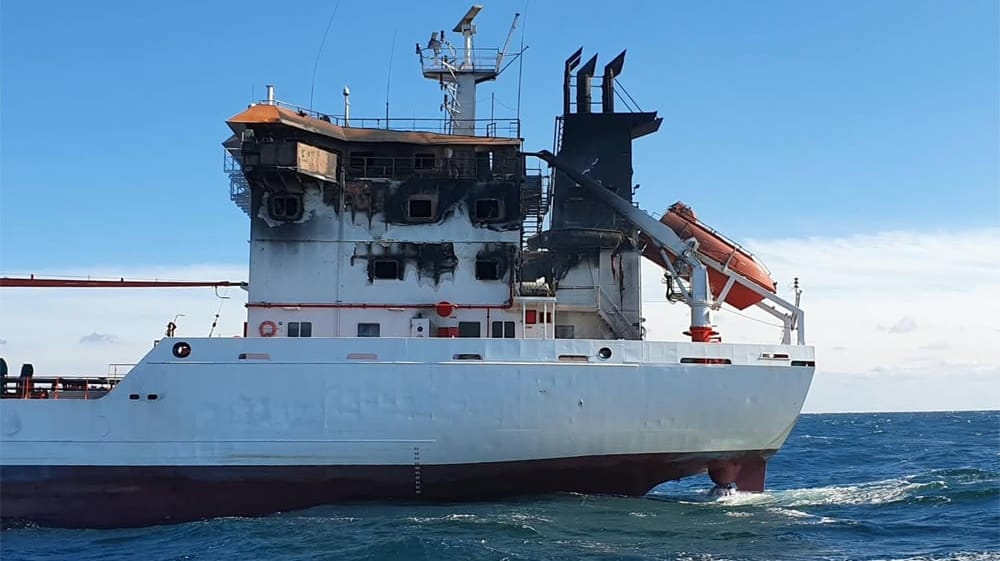
Romania dispatched teams both aboard a helicopter and a patrol boat to return to the damaged product tanker Wine Trader. The abandoned vessel remains anchored approximately 12 nautical miles off the coast of Romania near the Salina Canal after it was struck by one or more drones early on Thursday. Five of the crewmembers were rescued and taken for medical treatment in Romania, while seven seafarers are still missing after the attack.
The plan called for a team of four aboard a helicopter to board the ship and resume the search for the missing individuals. The crew of the ship said they had not been able to enter the accommodations area due to the intensity of the fire. The helicopter team was also going to do a reconnaissance flyover.
The patrol boat FIFI MAI 0101, which participated in the rescue, was returning to the location on Friday with 13 rescuers aboard. They were going to conduct reconnaissance in the area and also planned to board the vessel.
Strong winds and rough seas were reportedly challenging the search operation. The goal remains focused on the recovery of the missing crewmembers.
Wine Trader is anchored off Romania (ARSVOM)
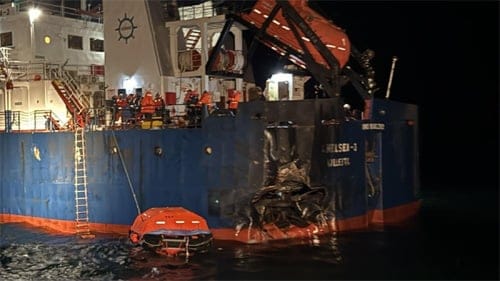
Also on Friday, Bulgaria dispatched a tug in an effort to stop the Chelsea-3, a cargo ship that was struck at around 01:15 on October 13, while sailing about 16 nautical miles east of Byala. The Border Police rescued the crew from the ship, but according to reports, the vessel is drifting. It has now entered the 12-mile zone east of Primorsk. The winds and heavy seas in the region are pushing the vessel toward the south.
The tug Aliot was dispatched with the goal of towing the cargo ship to Burgas. However, it returned to port on Friday afternoon, reporting that the strong winds and deteriorating sea conditions had prevented it from securing the vessel and beginning the tow. Bulgarian officials said they would make another attempt when the weather conditions improved.
Once the vessel is brought into the anchorage at Burgas, they plan a thorough search of the vessel. They are looking for fragments of the drone that struck the ship to make a definitive identification. Last week, Bulgarian forces searched another of the damaged vessels but reported they were unable to find identifying fragments from the drone that struck the ship.
Damage sustained by the Chelsea-3 seen during the evacuation (Bulgaria Interior Ministry)
Bulgaria’s Defense Minister Dimitar Stoyanov, however, told reporters on Friday that Bulgaria has proceeded with a formal request to NATO. He said in a letter sent to the Secretary-General and the Supreme Allied Commander, they have requested deploying combat aircraft and anti-drone systems, potentially with additional troops, to strengthen Bulgaria’s defense capabilities and increase protection for commercial shipping.