It’s possible that I shall make an ass of myself. But in that case one can always get out of it with a little dialectic. I have, of course, so worded my proposition as to be right either way (K.Marx, Letter to F.Engels on the Indian Mutiny)
Monday, May 26, 2025
France sees immigration shift as more educated Africans arrive than Europeans
More immigrants coming to France have degrees – and most now come from Africa rather than the rest of Europe, new figures from the country’s statistics bureau show.
Issued on: 23/05/2025 -
France is seeing a rise in immigration from Africa, with more newcomers holding university degrees, according to the national statistics office. AP - Thibault Camus
Insee, France’s national statistics agency, examined migration trends between 2006 and 2023. The number of people moving to France rose steadily in that period – from 234,000 in 2006 to 347,000 in 2023.
The research also found that for the first time, Africa has overtaken Europe as the main region of origin for people immigrating to France – with 45 percent of new arrivals in 2023 coming from African countries.
Half of those were from the Maghreb – North African countries such as Algeria, Morocco and Tunisia. The rest were mostly from the Comoros, Côte d’Ivoire and Senegal.
European immigration, once dominant, has fallen sharply.
Insee data shows that in 2006, 44 percent of immigrants came from Europe. By 2023, that number had dropped to 28 percent.
There has also been a slight shift in the gender balance, with Insee finding that women made up 53 percent of new arrivals in 2006. In 2023, they made up 51 percent.
The biggest change observed was in education levels. Among immigrants aged 25 and over, 52 percent had a diploma in 2023 – up from 41 percent in 2006.
The share of those arriving without any qualifications also fell, dropping from 30 percent in 2003 to 22 percent in 2023. Insee included the 2003 figure to provide a longer-term comparison beyond the 2006 baseline used elsewhere in the study.
The strongest gains were seen among African immigrants.
In 2006, fewer than one in three held a higher education diploma. By 2023, that figure had risen to one in two.
One in three immigrants was able to find work within a year of arriving in France. Europeans were the most likely to enter the workforce quickly, with more than half employed within 12 months of arrival.
French journalists call on France to help evacuate collaborators from Gaza
Several French journalist associations are calling on the French government to help the evacuation of Palestinian journalists, fixers and drivers who have been covering or helping to cover the war in Gaza for the past 18 months.
French news organisations have relied on local journalists and support staff for reporting from Gaza, which has been under bombardment from Israel since Hamas attacked Israel on 7 October 2023, killing over 1,200 people and abducting over 250.
Local journalists “keep you informed about the ongoing horror in the territory, while the Israeli government has constantly hindered coverage of the war by the international press by denying access to the Gaza Strip”, the statement continues.
The journalist associations have called on the French government to help evacuate the employees, much like it did for Afghan interpreters and other support staff for the French army.
The journalists are in particular danger now that Israeli Prime Minister Benyamin Netanyahu has threatened to take control of Gaza, the journalist associations warn.
"Our colleagues and their families are in mortal danger," the statement reads.
Namibia to hold first commemoration of German genocide this week Namibia this week will hold its first national commemoration for victims of mass killings by German occupiers in what is widely recognised as the first genocide of the 20th century, the government said.
Colonial-era German troops massacred tens of thousands of indigenous Herero and Nama people who rebelled against their rule in the southern African country between 1904 and 1908.
Namibia was known from 1884 to 1915 as German South West Africa, or Deutsch-Südwestafrika in German – part of the German empire on the continent and which included Togoland in West Africa, German Kamerun in central Africa, and German East Africa (the area now made up of Tanzania, Burundi and Rwanda).
Genocide Remembrance Day will be celebrated on 28 May in the gardens of Namibia's parliament and feature a candlelight vigil and minute of silence, according to a government programme released Monday.
The day has been declared a national holiday in Namibia and members of the diplomatic community are expected at the event, where President Netumbo Nandi-Ndaitwah will deliver a keynote address.
The commemorations will then be held annually to mark "the beginning of a national journey of healing", the government said, adding that it "serves as a moment of national reflection and mourning".
The date of 28 May was chosen as it was the day in 1907 when German authorities ordered the closure of concentration camps following international criticism over the brutal conditions and high death rates. First genocide of the 20th century
Germany recognised only in 2021 that its settlers had committed genocide, after discussions started in 2015.
Berlin has not issued a formal apology or offered reparations, but in 2021 pledged more than one billion euros in development aid over 30 years. Namibia rejected the proposal and negotiations are continuing.
Germany ruled German South West Africa as a colony with settlers taking local women, land and cattle, which led the Herero tribe to launch a revolt in January 1904. More than 100 German civilians were killed over several days. The smaller Nama tribe joined the uprising in 1905.
The settler community was very small, only a few thousand, and Germany feared that it had lost its deterrence vis-à-vis the natives.
The Germans responded ruthlessly, killing an estimated 60,000 Herero and 10,000 Nama people. Hundreds were also beheaded after their deaths and their skulls handed to researchers in Berlin for experiments attempting to prove the racial superiority of whites over blacks.
Germany was forced out of the colony in 1915. Namibia passed to South African rule, and only gained independence in 1990.
The events are now recognised by historians as the first genocide of the twentieth century.
How 184 random citizens helped shape France’s debate on assisted dying
French MPs will on Tuesday vote on two landmark bills on palliative care and assisted dying. They're the result of months of debate shaped by a rare democratic experiment that brought together 184 randomly selected citizens to grapple with one of society’s most intimate and divisive questions: how should we die?
Members of the Citizens' Convention on end of life care at the CESE in Paris, mark the end of four months of discussions on the divisive issue of assisted dying, April 2023. KATRIN BAUMANN 2023
Marc-Olivier Strauss-Kahn was on a high-speed train in November 2022 when his phone rang. The 71-year-old retired economist had no idea he was about to join what he would later describe as "the best social experience of my life".
The caller invited him to join France's citizens' convention on end-of-life care – President Emmanuel Macron's bid to involve the public in a national conversation about assisted dying.
France’s current 2016 law allows for “deep and continuous sedation" for terminally ill patients, but assisted suicide – where a patient takes a lethal drug themselves – and euthanasia – where a third party administers it – remain illegal.
The convention was asked to answer one question: “Is the way we accompany those approaching the end of life adapted to the different situations which emerge, or do we need to introduce changes?”
Strauss-Kahn was curious to explore a topic that concerns everyone. “We’re all going to die at some stage,” he says.
He was also intrigued by the novel format. “How can you make so many people work together when they don’t know each other and they have so many different backgrounds?”
What followed was an intensive four-month process spanning 27 days of deliberation across nine weekends – backed up by online chats and virtual meetings. The participants – diverse in age, gender, region, and education level – were united by their willingness to engage.
"I met people that I might never have met or talked to before," the retired economist and senior civil servant explains. He sat alongside people who "had difficulties understanding all the words" and needed help with some concepts.
Rather than creating division, the range of backgrounds became a strength. “The importance, the intimacy of the topic helped us to respect the views of the other, because there is no right or wrong,” he says. Listen to a conversation with Marc-Olivier Strauss-Kahn in the Spotlight on France\
Another participant was 35-year-old Soline Castel, who runs a day centre for people with mental disabilities in rural Sarthe. Unlike Strauss-Kahn, who came in broadly in favour of assisted dying, Castel’s family background meant she leaned more towards opposing it.
Still, she was determined not to make up her mind in advance. "I let myself be guided by the convention to form an opinion," she says.
Over the four months, the 184 participants sat through 60 hearings with health professionals, philosophers, lawyers and religious figures. They also heard from terminally ill patients and workers in palliative care.
By the end, their positions had crystallised in opposite directions. Strauss-Kahn became more supportive of assisted dying, calling it "the ultimate freedom".
His conviction was strengthened by discovering the "many obstacles to be overcome", including a lack of medicine, knowledge and information, and poor training for healthcare professionals.
"I have to confess that several times I cried," Strauss-Kahn admits, reflecting on the testimonies he heard.
He remembers a particularly striking moment during a hearing with religious leaders from six different faiths, who all referred to the commandments "you shall not kill" and "you shall not steal".
"A philosopher said in response: 'When it's your own money, you are not robbing yourself; when it's your own life you're not killing. It's your own liberty to decide what you want.' That helped me understand better the differences of views."
Castel, however, emerged "firmly opposed to any form of active assistance in dying", believing it would be impossible to guarantee protection for vulnerable people.
"It's extremely difficult to put sufficient safeguards in place to guarantee the safety of my fellow citizens, especially those who may be vulnerable," she explains. "I work in the field of disability, and I'm also thinking of the elderly."
Castel is not Catholic and belives faith should not influence a country's laws. But she said the testimonies raised serious concerns about subtle pressure on elderly people from their families. They may have been influenced, she says, "but no one will know".
Despite the 2016 law, palliative care is not widely available in France, with residents in 26 of its 101 administrative departments having no access to palliative care at all. Castel argues that if the existing law were properly applied, most cases would be resolved.
"Studies have shown that people who ask for help dying often do so because they are alone or in pain," Castel says. These two factors can be resolved, she adds, while conceding there are also rare cases where no pain relief is possible.
A large majority – 95 percent – backed expanded palliative care. Some 76 percent supported medical assistance in dying, but only as a last resort and in strictly defined cases. Those in the 23 percent minority who opposed any form of assisted dying were given equal time to speak – a courtesy that stood in stark contrast to debates in parliament.
"At the same time, the so-called representative democracy, our elected members in parliament, were shouting and the contrast made us very proud of our respect for each other," Strauss-Kahn notes.
He says the convention has already had an impact. A 10-year strategy for palliative care is being implemented, with €1 billion to be invested. Arguments from the citizen panel – both for and against assisted dying – are now often cited by MPs and in the media.
In a country like France, where political compromise is rare, the convention showed that deliberative democracy can handle divisive issues with nuance and respect.
Rather than seeking false consensus, the participants focused on clearly stating the arguments on both sides.
"We realised it was better to clarify any consensus, express the arguments for and against and assess how many were in favour," Strauss-Kahn says. "We're living through a crisis of representative democracy and the idea is not to replace representative democracy by deliberative democracy, but just to involve the citizens more as a complementary approach."
Castel says of her minority stance: "I really felt I'd been heard. The arguments of those who were against were said, reiterated and written down."
Strauss-Kahn and Castel are now part of a broader group known as "The 184", created after the convention to promote deliberative democracy and better end-of-life care. Although they disagree on assisted dying, they continue to work together to ensure the convention's work stays part of the national debate.
The idea was also to ensure a life after the assembly. "I like to say that we thought about end of life but not the end of life of the convention," Strauss-Kahn says. "For some people it really was a form of social inclusion."
They are also advising the next citizens’ assembly – which will focus on school hours and children’s wellbeing – on what could be improved.
Strauss-Kahn says they are trying to improve ties with parliament, since some MPs viewed the convention as a threat. He also warns about the need to fight misinformation.
"Some were saying that up to a million people would be able to access assisted dying, this is false. We encourage the new convention to do fact-checking from the very beginning."
Whether France's lawmakers follow the convention's recommendations or not remains to be seen, but both Strauss-Kahn and Castel are convinced the process was important.
Strauss-Kahn encourages anyone who can to take part.
"If there's a phone call that is not clearly a commercial, take it and try to participate because it's a unique chance in your life," he says.
Trump’s backing for Nippon’s U.S. Steel bid leaves key questions unanswered
An employee enters Nippon Steel's plant in Kashima, Japan on Dec. 6, 2024. (Ayaka McGill / AP Photo)
U.S. President Donald Trump’s comments supporting Nippon Steel’s $14.9 billion bid for U.S. Steel has left lingering questions about the scope of the deal and its costs for the Japanese firm, leading to muted gains for its shares on Monday.
As part of the deal announced on Friday, Trump said in a post on Truth Social that the “planned partnership” between the two companies will create at least 70,000 jobs and add $14 billion to the U.S. economy, and then said on Sunday that the United States will have control over U.S. Steel as part of the partnership.
It is still unclear whether “partnership” refers to the full acquisition of U.S. Steel that Nippon Steel has been pursuing. The White House did not respond to questions about the announcement on Friday.
Speaking at a media briefing on Monday, Japan’s Chief Cabinet Secretary Yoshimasa Hayashi said the government will make efforts to facilitate communication among the relevant parties regarding Nippon Steel’s bid.
Shares of Nippon, the world’s fourth-largest steelmaker, rose as much as 7.4 per cent to 3,081 yen ($21.55) in Tokyo, but then erased a chunk of the gains to be up 1.7 per cent by mid-afternoon trade.
A merger would create the world’s third-largest steel producer by volume, after China’s Baowu Steel Group and Luxembourg-based ArcelorMittal, according to World Steel Association data.
by Jeff Mason and Steve Holland
Canada needs to boost productivity ($URPLUS VALUE)
The Canadian flag flies atop the Peace Tower on Parliament Hill in Ottawa, Wednesday, Oct. 30, 2024. (THE CANADIAN PRESS/Sean Kilpatrick)
OTTAWA — A new report by the OECD says Canada needs to boost productivity and housing affordability to strengthen growth as it faces trade uncertainty and U.S. tariffs that are taking a bite out of the economic outlook.
The latest OECD Economic Survey of Canada says government spending and interest rate cuts may be required if the economy deteriorates significantly, provided tariff-related inflationary pressures remain under control.
The report says the Canadian economy has been resilient, but per capita GDP growth has been weak, particularly compared with the U.S.
It says structural policy reforms should focus on improving productivity, housing affordability and climate adaptation.
It added that reducing internal trade barriers and improving recognition of qualifications across provinces to lower internal barriers to labour mobility can help strengthen productivity.
The report projected GDP growth for Canada falling from 1.5 per cent in 2024 to one per cent in 2025 and 1.1 per cent in 2026.
This report by The Canadian Press was first published May 26, 2025.
The Canadian Press
Canadian government has to allow home prices to fall to make housing more affordable, experts say
New single family houses billed as estate cottages and townhouses under construction are seen in an aerial view, in Delta, B.C., on Monday, Aug. 12, 2024. THE CANADIAN PRESS/Darryl Dyck
OTTAWA — Housing experts are pushing back against a federal cabinet minister’s recent claim that home prices don’t need to go down in order to restore housing affordability.
Gregor Robertson, the former mayor of Vancouver who was elected to the House of Commons in April, sparked the debate after he was sworn in as housing minister earlier this, when a reporter asked him whether he thinks home prices need to fall.
Robertson added that Canada lacks affordable housing and championed Ottawa’s efforts to build out the supply of homes priced below market rates.
Mike Moffatt, founding director of the Missing Middle Institute, had a different answer when asked whether housing can be made more affordable for the average Canadian without a drop in market values.
“The short answer is no. It’s simply not possible to restore broad-based affordability to the middle class without prices going down,” he said.
Moffatt crunched the numbers last month on how long it would take for housing to return to 2005 levels of affordability if the average home price holds steady while wages grow at a nominal pace of three per cent annually.
Across Canada, he said, it would take 18 years to return to more affordable home price-to-income ratios — while in Ontario and British Columbia it would take roughly 25 years.
In B.C. and Ontario, Moffatt said, wages and home prices have become so detached from one another that it’s not “realistic” to rely on wage growth to catch up to housing costs.
While Moffatt said he welcomes policies that encourage more housing for vulnerable Canadians and those experiencing homelessness, efforts to build more below-market housing units won’t address the “middle-class housing crisis.”
Days after Robertson weighed in, Prime Minister Mark Carney was asked the same question. Rather than offering a yes-or-no answer, he asserted instead that he wants “home prices to be more affordable for Canadians.”
He cited Liberal election campaign pledges to drop the GST on new homes and offer incentives to municipalities to cut development charges in half.
The Liberals are looking to lower the cost of homebuilding with the aim of doubling the pace of housing starts in Canada. The government wants to scale up the use of prefabricated parts and other technological advances to streamline housing development.
Carney said that this boost in supply would “make home prices much lower than they otherwise would be.”
Moffatt said he agrees that lowering the cost of homebuilding would help to make homes more affordable.
In fact, he said, if the cost of building doesn’t go down and if home prices stagnate or decline, development will immediately cease to be profitable for builders, causing housing starts to dry up.
“I think that should be the primary focus of all three orders of government … figuring out how we can reduce the cost of home construction in order to create affordability and to lower prices,” he said.
Concordia University economist Moshe Lander agrees with Moffatt that home prices must come down if the government hopes to see broad affordability restored to the market over the next generation.
But he also questions whether the federal government should be the arbiter of housing affordability in the first place, given that so many of the political decisions are out of its control.
Lifting regulatory barriers to boosting supply is largely a matter for provincial and municipal governments, as are efforts to encourage more students to develop skills in the trades.
“And so for the federal government to say, ‘We’re going to try and incentivize this,’ I think they’re going miss the mark in whatever they’re trying to do because really, at the end of the day, it’s not their issue,” Lander said.
Lander said he also understands why politicians of all stripes are reluctant to come out in favour of lowering home prices.
Any explicit government effort to bring down housing prices down would be seen as an attack on homeowners’ equity — an asset many use to fund retirements or other long-term savings as they pay off their mortgages.
“Homeowners will not accept it,” Lander said. “And you risk alienating a very sizable and influential voting bloc.”
At the local level, he said, politicians tend to seek the support of homeowners because — unlike renters — they tend to stay put in a riding or district.
Lander said that most efforts to win renters’ votes tend to be “tepid” at best and “counterproductive” at worst. Policies that target the demand-side of the equation — helping Canadians become homeowners — tend to put upward pressure on home prices at the same time, he said.
Lander said part of the path to affordable housing has to be a shift away from the narrative that Canadians have been fed for generations — that home ownership is a lofty goal to aspire to and renters are “second-class citizens.”
“I don’t think that we’re being clear with society that this is what that might look like,” he said.
This report by The Canadian Press was first published May 23, 2025.
Craig Lord, The Canadian Press
CRIMINAL MONOPOLY CAPITALI$M
Judge approves $500M settlement in Loblaw, George Weston bread price-fixing case
A worker re-stocks shelves in the bakery and bread aisle at an Atlantic Superstore grocery in Halifax, Friday, Jan. 28, 2022. THE CANADIAN PRESS/Kelly Clark
Some Canadian shoppers may soon receive cash from a class-action lawsuit that accused Loblaw Cos. Ltd. and its parent company George Weston Ltd. of engaging in an industry-wide scheme to fix the price of bread.
Ontario Superior Court Judge Ed Morgan approved a $500-million settlement in the case on May 7, saying the money put forward by the grocery companies was “an excellent and fair result for all concerned.”
“It is in the best interests of the class as a whole,” he said in a written decision. “In my view, it falls squarely within the zone of reasonableness.”
The settlement he approved includes a combined $404 million to be paid by Loblaw and George Weston. The remaining $96 million is accounted for through a gift card program Loblaw began in 2018 and ran through 2019 in hopes of making amends with customers who paid about $1.50 more per loaf of bread.
Once legal fees and other court expenses are paid, 78 per cent of the funds will be allocated to shoppers in Ontario with the remaining amount headed for people in Quebec.
Customers who bought bread between January 2001 and December 2021 and did not previously take a gift card from Loblaw will eventually receive up to $25.
If there is still money left over after that distribution, funds will be divided among anyone who claimed the gift card.
Morgan’s decision ends one chapter in a saga that has lobbed allegations at the country’s biggest grocers, including Metro, Sobeys, Walmart Canada, Canada Bread and Giant Tiger.
While these players have denied their participation in an alleged scheme to co-ordinate the price of bread back to 2001, Loblaw and George Weston told the Competition Bureau they were part of the practice in 2015. Their admission wasn’t publicized until 2017.
They then offered a $25 gift card to try to compensate customers, but shoppers weren’t appeased and in December 2019, a Quebec class action was filed against them and the other grocers. A Quebec court will hear arguments around whether to accept the Loblaw and George Weston settlement on June 16.
The Ontario class action was filed by Strosberg Wingfield Sasso LLP in December 2021 but only reached its $500 million settlement last year.
“The parties do not have to do much to convince me that the litigation has been hard fought on all sides,” Judge Morgan said in his decision.
Asked for comment on the settlement’s approval, Loblaw spokesperson Catherine Thomas pointed the Canadian Press to a 2024 statement that said, “we sincerely apologize” for involvement in the arrangement and “have taken a number of steps since that time to ensure this doesn’t happen again.”
“We know we have more to do to regain the trust of our customers and we’re committed to doing that,” the statement said.
A George Weston spokesperson did not immediately respond to a request for comment.
The agreement they put forward resolves all national bread price-fixing claims they faced or could face and includes assurances that they will co-operate with claims being pursued against the remaining grocers who did not offer a settlement.
The offer Loblaw and George Weston made garnered four objections and 475 opt-outs, which Judge Morgan said “are very small numbers in view of the estimated 20 million-plus class members.”
No one who objected to the settlement appeared in court to explain their views, but a review of their written submissions showed they were fighting the settlement because they would like more money, Morgan said.
“None of the objectors chose to speak at the hearing of the settlement motion, but a review of their written objections indicates that they have no principled grounds for objecting to the settlement other than that they would like more money,” Morgan wrote.
“While I sympathize with that sentiment, I am not in a position to compel that the settlement fund be increased, nor am I inclined to reject the settlement based on a small handful of class members who would like more.”
This report by The Canadian Press was first published May 26, 2025.
Companies in this story: (TSX:L, TSX:WN)
Tara Deschamps, The Canadian Press
Volvo Cars to slash 3,000 jobs in white-collar cutback
Published: May 26, 2025
The Volvo logo on the front grille is shown in Miami. (AP / Alan Diaz)
STOCKHOLM — Sweden’s Volvo Cars will cut 3,000 mostly white-collar jobs as part of a restructuring announced last month as it grapples with high costs, a slowdown in electric vehicle demand and trade uncertainty, it said on Monday.
The layoffs represent around 15 per cent of the company’s office staff, with close to three-quarters of job losses expected to occur in Sweden and the rest in the company’s global operation, Volvo Cars said in a statement.
With most of its production based in Europe and China, Volvo Cars is more exposed to new U.S. tariffs than many of its European rivals, and has said it could become impossible to export its most affordable cars to the United States.
The group, which is majority-owned by China’s Geely Holding GEELY.UL, on April 29 unveiled a program to slash costs by 18 billion Swedish crowns ($1.9 billion) and hit the brakes on investments, warning that redundancies were inevitable. In the first quarter, the auto maker had 43,500 full-time employees and 3,000 staffing agency personnel, according to its earnings report. White-collar staff make up more than 40 per cent of its workforce.
“The automotive industry is in the middle of a challenging period. To address this, we must improve our cash flow generation and structurally lower our costs,” CEO Hakan Samuelsson said.
The group withdrew its financial guidance as it announced its cost cuts last month, pointing to unpredictable markets amid weaker consumer confidence and trade tariffs causing turmoil in the global auto industry.
On Friday U.S. President Donald Trump threatened to impose a 50 per cent tariff on imports from the European Union from June 1, but on Monday he backed away from that date, restoring a July 9 deadline to allow for talks between Washington and Brussels.
Volvo Cars’ shares were up 3.7 per cent at 1145 GMT on Monday to 18.20 crowns, with most of the rise coming before the layoff announcement. They are still down 24 per cent year-to-date.
Reporting by Anna Ringstrom and Marie Mannes, editing by Terje Solsvik and Jan Harvey
Big-name department and drug stores circling Hudson’s Bay employees, soon to be without work
Shoppers enter the Hudson's Bay store in downtown Calgary, Alta., Thursday, March 20, 2025. THE CANADIAN PRESS/Jeff McIntosh TORONTO — Big-name department and drug stores are circling the more than 9,300 Hudson’s Bay and Saks Fifth Avenue Canada workers who will soon be out of a job.
Luxury retailer Holt Renfrew told The Canadian Press it’s added dozens of former Bay and Saks staff to its store teams, “with more still to come.”
“While our turnover rate is amongst the lowest it’s been, we’ve been committed to helping our HBC and Saks colleagues with any opportunities we can provide,” spokesperson Adam Grachnik said in an email.
Meanwhile, talent acquisition staff at Shoppers Drug Mart and Rexall appear to be working social media channels, hoping to lure in Bay and Saks employees.
Canada’s oldest company filed for creditor protection in March, and the company has been winding down. Following months of liquidation sales, all 96 of the Bay and its sister Saks stores will shutter at the end of May.
While some workers will presumably retire or abandon the retail world altogether, experts say others are likely to be scooped up by just about any retailer you can think of.
“Any of the great brands out there that are looking for good people are reaching out to them,” said Lanita Layton, a luxury and retail consultant who was once a vice-president at Holt Renfrew.
She imagines Bay and Saks workers would be a great get for La Maison Simons, which is due to hire hundreds of staff members when it opens two Toronto department stores later this year, but also thinks they could slide right in at home goods shops like Crate and Barrel or Williams Sonoma.
The workers are a fit for so many places because many have worked on commission, so they know how to sell, and they also have a deep knowledge of the Canadian marketplace and the products and customers that fill it.
Some may even have a “hidden gem” — contact info for regular shoppers they would have served at the Bay’s upscale Room business or the designer Saks department.
“Every retailer is looking to maintain and grow their customer base, so if they’ve got somebody they could potentially hire that has that already, that is really, really important,” Layton said.
Bringing experienced staff onto a new team is also a savings, said Lauren Burrows, a senior manager of retail strategy at Accenture, who imagines luxury businesses, small boutiques and grocers will vie for Bay workers.
She estimates it costs on average between $3,000 to $4,000 to recruit, interview and hire an employee, train them and then cope with their initial, lower productivity while they adjust to the quirks and cadences of the job.
Once they’re in the job, retention becomes a key issue because retail roles are known for having higher than usual turnover, she said.
But Layton points out many Bay employees spent decades at the department store and worked in difficult-to-fill roles like visual merchandisers — highlighting trends, customer demographics and brand partnerships at the store.
Another treasure the Bay and Saks had were their beauty departments, which Holt Renfrew admitted it’s already poached from.
Layton figured Sephora would do the same because it’s been expanding and it’s easy to transition workers from one beauty brand to another.
“If they’re makeup artists in one, they could be a makeup artist in another without blinking,” Layton said.
“If they’re switching from a Tom Ford counter to Lancôme or vice versa, it’s just learning the nature of that brand, but that doesn’t take anybody long when they’re professionals in that area already.”
The leap may also be easy for some staff headed to Canadian Tire. The retailer is on track to purchase the Bay name, its stripes motif, its coat of arms and its brands for $30 million.
While the company did not comment on whether it was seeking Bay hires, Layton figures they’d be logical additions because they know the intricacies of the intellectual property Canadian Tire wants to acquire.
Bay staff would also be experts in product development, logistics, data analysis and inventory management, making them useful throughout the industry.
Because the retail world can be so “complex” and Bay employees have run a company even in the face of upheaval, Burrows said any business undergoing transformation would want them.
“Having folks who have been through that and can really start day one, hit the ground running and add value right away... is amazing,” she said.
This report by The Canadian Press was first published May 26, 2025.
Companies in this story: (TSX:CTC.A)
Tara Deschamps, The Canadian Press
Trump sets out aim to quadruple US nuclear capacity
Saturday, 24 May 2025
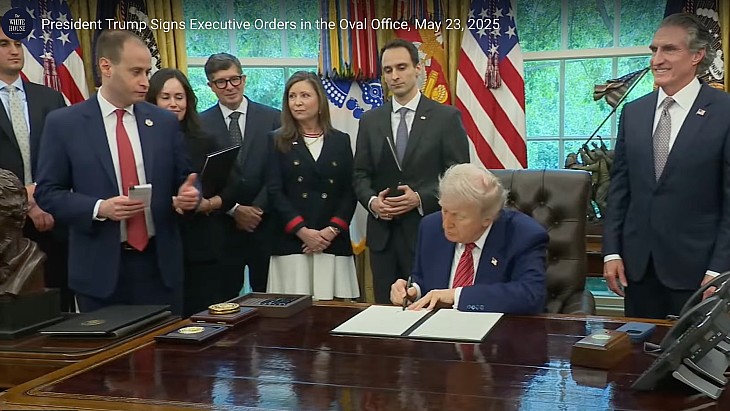
US President Donald Trump has signed a series of executive orders titled Reinvigorating the Nuclear Industrial Base, Reforming Nuclear Reactor Testing at the Department of Energy and Ordering the Reform of the Nuclear Regulatory Commission with the goal of "re-establishing the United States as the global leader in nuclear energy".
(Image: The White House)
The aim is to increase US nuclear energy capacity from 100GW to 400GW by 2050, including the Department of Energy (DOE) prioritising work "with the nuclear energy industry to facilitate 5 gigawatt of power uprates to existing nuclear reactors and have 10 new large reactors with complete designs under construction by 2030".
Among the measures included are a reorganisation and cuts to the Nuclear Regulatory Commission and an order for licence decisions on the construction and operation of new reactors to be taken within a maximum 18 months.
The president was joined in the Oval Office on Friday afternoon for the announcements by representatives from the US nuclear industry and Secretary of the Interior Doug Burgum, who is Chairman of the National Energy Dominance Council, and Secretary of Defense Pete Hegseth.
A White House statement summarising the impact of the orders, said: "Today's executive orders allow for reactor design testing at DOE labs, clear the way for construction on federal lands to protect national and economic security, and remove regulatory barriers by requiring the Nuclear Regulatory Commission to issue timely licensing decisions."
'Reinvigorating the Nuclear Industrial Base'
The executive order Reinvigorating the Nuclear Industrial Base's purpose is described as: "The United States originally pioneered nuclear energy technology during a time of great peril. We now face a new set of challenges, including a global race to dominate in artificial intelligence, a growing need for energy independence, and access to uninterruptible power supplies for national security ... as American deployment of advanced reactor designs has waned, 87 percent of nuclear reactors installed worldwide since 2017 are based on designs from two foreign countries. At the same time, the Nation’s nuclear fuel cycle infrastructure has severely atrophied, leaving the United States heavily dependent on foreign sources of uranium as well as uranium enrichment and conversion services. These trends cannot continue.
"Swift and decisive action is required to jumpstart America’s nuclear energy industrial base and ensure our national and economic security by increasing fuel availability and production, securing civil nuclear supply chains, improving the efficiency with which advanced nuclear reactors are licensed, and preparing our workforce to establish America’s energy dominance and accelerate our path towards a more secure and independent energy future."
It aims to strengthen the domestic fuel cycle with a report required within 240 days to "recommended national policy to support the management of spent nuclear fuel and high-level waste and the development and deployment of advanced fuel cycle capabilities to establish a safe, secure, and sustainable long-term fuel cycle". This includes "recommendations for the efficient use of the uranium, plutonium, and other products recovered through recycling and reprocessing; recommendations for the efficient disposal of the wastes generated by recycling or reprocessing through a permanent disposal pathway; a recommended process for evaluating, prior to disposal, nuclear waste materials for isotopes of value to national security, or medical, industrial, and scientific sectors".
It also calls for a programme "to develop methods and technologies to transport, domestically and overseas, used and unused advanced nuclear fuels and advanced nuclear reactors containing such fuels in a safe, secure, and environmentally sound manner, including any legislation required to support this initiative" and within 120 days the Energy Secretary "shall develop a plan to expand domestic uranium conversion capacity and expand enrichment capabilities sufficient to meet projected civilian and defense reactor needs for low enriched uranium (LEU), high enriched uranium (HEU) and high assay, low enriched uranium (HALEU), subject to retention of such stockpiles as are necessary for tritium production, naval propulsion, and nuclear weapons".
There will also be an end to the general "surplus plutonium dilute and dispose" programme and instead a programme will be established to dispose of surplus plutonium by processing and making it available to industry in a form that can be utilised for the fabrication of fuel for advanced nuclear technologies, the order says.
There will also be energy-defence department work to "assess the feasibility of restarting or repurposing closed nuclear power plants as energy hubs for military microgrid support, consistent with applicable law, focusing initially on installations with insufficient power resilience or grid fragility".
There is also a section on expanding the nuclear energy workforce, saying that "within 120 days of the date of this order, the Secretary of Labor and the Secretary of Education shall seek to increase participation in nuclear energy-related Registered Apprenticeships and Career and Technical Education programs".
Reforming Nuclear Reactor Testing at the Department of Energy
The Reforming Nuclear Reactor Testing at the Department of Energy executive order says "commercial deployment of new nuclear technologies has all but stopped. The Idaho National Laboratory has principal responsibility for constructing and testing new reactor designs; it concluded construction of new reactors in the 1970s. Our proud history of innovation has succumbed to overregulated complacency".
It adds "the United States needs a reliable, diversified, and affordable supply of energy to drive development of advanced technologies, manufacturing, transportation, agriculture, and defense industries, and to sustain modern life and national security. Nuclear energy both is vital to this effort and has never held so much promise ... advanced reactors - including microreactors, small modular reactors, and Generation IV and Generation III+ reactors - have revolutionary potential. They will open a range of new applications to support data centers, microchip manufacturing, petrochemical production, healthcare, desalination, hydrogen production, and other industries".
It says that "within 90 days of the date of this order, the Secretary shall take appropriate action to revise the regulations, guidance, and procedures and practices of the Department, the National Laboratories, and any other entity under the Department’s jurisdiction to significantly expedite the review, approval, and deployment of advanced reactors under the Department’s jurisdiction. The Secretary shall ensure that the Department’s expedited procedures enable qualified test reactors to be safely operational at Department-owned or Department-controlled facilities within 2 years following the submission of a substantially complete application".
There will also be a pilot programme established for reactor construction and operation outside of the National Laboratories, with the goal of three reactors reaching criticality by 4 July 2026.
There will also be action taken "consistent with applicable law" to "use all available authorities to eliminate or expedite the Department’s environmental reviews for authorizations, permits, approvals, leases, and any other activity requested by an applicant or potential applicant".
Ordering the Reform of the Nuclear Regulatory Commission
The executive order Ordering the Reform of the Nuclear Regulatory Commission says that between 1954 and 1978 the US "authorised the construction of 133 since-completed civilian nuclear reactors at 81 plants. Since 1978, the Nuclear Regulatory Commission (NRC) has authorized only a fraction of that number; of these, only two reactors have entered into commercial operation".
The order says that "instead of efficiently promoting safe, abundant nuclear energy, the NRC has instead tried to insulate Americans from the most remote risks without appropriate regard for the severe domestic and geopolitical costs of such risk aversion".
It proposes that the NRC working with the Department of Government Efficiency "reorganize the NRC to promote the expeditious processing of license applications and the adoption of innovative technology. The NRC shall undertake reductions in force in conjunction with this reorganization". It proposes fixed deadlines for its evaluation and approval of licences, including "a deadline of no more than 18 months for final decision on an application to construct and operate a new reactor of any type, commencing with the first required step in the regulatory process, and a deadline of no more than 1 year for final decision on an application to continue operating an existing reactor of any type, commencing with the first required step in the regulatory process".
Answering questions from reporters after signing the orders. President Trump said that nuclear was "safe and clean" and said the country aimed to build small modular reactors but "we'll build the big ones too ... I think we're going to be second to none because we are starting very strong. But it's time for nuclear and we're going to do it very big".
Among those attending the Oval Office event was Nuclear Energy Institute (NEI) President and CEO Maria Korsnick who thanked the president for "leaning in" to support and bring attention to commercial nuclear energy.
And in a statement after the signings event, an NEI spokesperson said: "We appreciate the Administration’s ongoing actions to preserve existing nuclear plants and usher in the deployment of next generation nuclear. Policies to strengthen nuclear are essential to bolstering our national security and meeting our energy goals. We look forward to working with the Administration and other stakeholders to ensure the implementation of the orders will help us build a reliable, affordable, and increasingly clean energy system."