Saturday, March 07, 2026


Middle East Conflict Poised to Benefit U.S. Chemical Manufacturers

  • Goldman Sachs analysts project that US chemical manufacturers will benefit from Middle East energy disruptions and rising oil prices because their operations are insulated by a reliance on relatively cheaper domestic natural gas.

  • The increase in oil prices raises the cost of naphtha, squeezing the margins of naphtha-based chemical competitors in Europe and Asia, which in turn widens the U.S. chemical industry's margin advantage.

  • Disruptions in the Middle East region are expected to tighten the global supply of competing chemical products, creating increased volume and export opportunities for US producers.

Bloomberg News headlines indicate that Iraq has begun shutting down oil output at Rumaila, the world's largest "supergiant" oil field, while other Gulf states have idled some of the world's largest refineries and major energy hubs following Iranian drone strikes. This signals that a massive energy disruption is set to hit global energy markets as the Strait of Hormuz remains paralyzed.

Goldman analysts led by Duffy Fischer have released a note assessing whether U.S. chemical manufacturers have exposure to Middle East energy disruptions. They find that "U.S. companies are likely to be net beneficiaries" of the Middle East conflict and the resulting energy disruptions.

Fischer pointed out that as oil prices rise, naphtha-based competitors in Europe and Asia are squeezed, while U.S. chemical makers that rely more on natural gas are relatively insulated due to domestic production. That, in turn, widens the U.S. margin advantage.

These U.S. chemical manufacturers use raw materials such as natural gas, crude oil liquids, salt, sulfur, and other minerals to produce products like:

  • basic chemicals: ethylene, propylene, methanol, chlorine, ammonia
  • plastics/resins: polyethylene, PVC, polyurethane inputs
  • fertilizers: nitrogen, phosphate products
  • industrial chemicals: solvents, coatings, acids, adhesives
  • specialty chemicals: ingredients used in electronics, autos, construction, packaging, and consumer goods

Fischer explained:

The oil to gas ratio is a large driver of U.S. chemical production profitability. With oil prices increasing (see our Commodity team's note and podcast), this will push up the price of naphtha, which is likely to increase the cost of European and Asian feedstocks. Since many naphtha crackers are currently near breakeven levels, that should force them to raise prices. This should lead the spot and export prices higher for U.S. product. The result would be an increase in U.S. margins as their natural gas feedstocks are not likely to be impacted. Lastly, while the industry believed that the March PE contract prices would roll flat, the events would significantly increase the possibility of U.S. producers achieving pricing in March.

Related: Magnet Wars: How the U.S. Plans to Break China’s Grip on Rare Earths

Next, the analysts assess whether U.S. chemical manufacturers have exposure to the Middle East. They point out that Middle East disruptions would benefit U.S. chemical manufacturers.

Here's how:

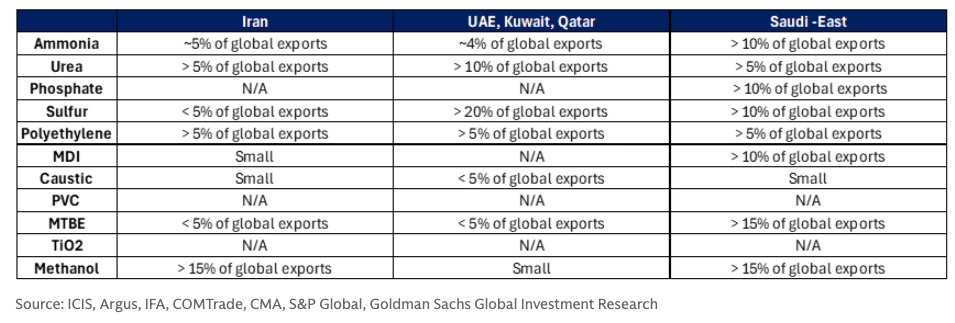
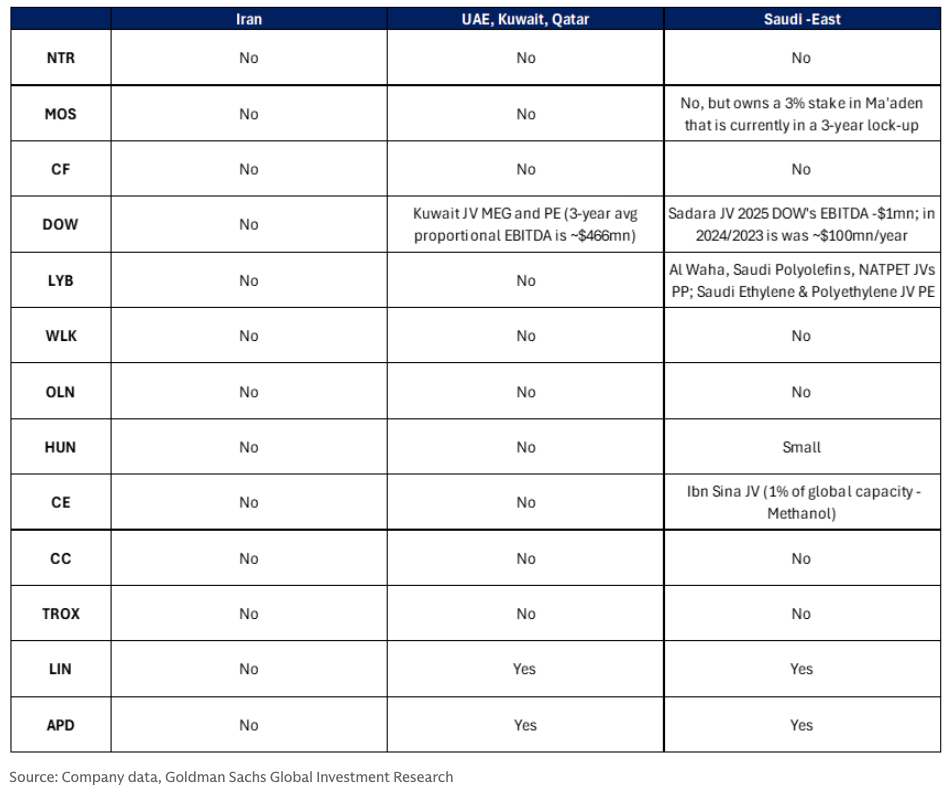
Significant amounts of competing chemical products are produced in the affected Middle East region. If this product is offline or is not able to ship then that would start to tighten global supply-demand and open up more volume opportunities for US producers. We look at three buckets of production (Iranian, UAE/Kuwait/Qatar, and Eastern Saudi Arabian). The impact on Iranian production is unclear and ships carrying production from Eastern Saudi Arabia, UAE, Kuwait, and Qatar through the Straight of Hormuz appear to be disrupted. Exhibit 1 shows the greatest impact to the least for impacted chemical chains: Nitrogen, Sulfur, Methanol, MTBE, Phosphate, Polyethylene, MDI, TiO2, Chlorovinyls. While U.S. companies are likely to be net beneficiaries, there are some U.S. companies with assets in the region that may see negative impacts. Barring any U.S. assets being kinetically impacted, the net should be positive for all U.S. chemical companies.

Exposure:

Regional Exports by Chemical Chain as a % of Global Exports
Company Asset Exposure to the Middle East
By Zerohedge

Iran Conflict Could Turn Canada Into the Market’s Most Reliable Oil Supplier

Oil prices surged for a second day running on Tuesday as global markets brace for a prolonged conflict in the Middle East. On Monday, Iran’s Islamic Revolutionary Guard Corps (IRGC) officially declared the Strait of Hormuz "closed," warning that any vessel attempting to pass will be attacked or "set ablaze". While the U.S. Central Command (CENTCOM) maintains the waterway is not formally closed, traffic has dropped by approximately 70-80%, with major global shippers, including Maersk, Hapag-Lloyd, and MSC, suspending all crossings.

Brent crude for April delivery gained nearly 5% on Tuesday, reaching $85 earlier in the day, marking the first time it has traded above the pivotal $80 per barrel mark since July 2024, while the corresponding WTI gained less than a percentage point on the geopolitical tailwinds. 

Long-suffering oil and gas bulls are finally enjoying some reprieve, with U.S. energy stocks leading all 11 sectors of the U.S. market: the sector’s favorite benchmark, State Street Energy Select Sector SPDR ETF (NYSEARCA:XLE), is now up ~24% in the year-to-date, incomparable to the -1.0% return by the S&P 500.

However, some experts have argued that the Middle East debacle’s impact on energy markets is more favorable to Canada than it is to the United States. According to Eric Nuttall, senior portfolio manager at Toronto-based Ninepoint Partners, the Middle East conflict is a “massive opportunity” for Canada, which can position itself as a stable and secure supplier of oil.

Nuttall argues, as reported by Bloomberg, that Canada is uniquely positioned as a stable and secure energy supplier with decades of inventory in the oil sands and the Clearwater formation. The Clearwater Formation in Alberta, Canada, holds vast, high-viscosity heavy oil and bitumen reserves, with estimated in-place volumes exceeding 70 billion barrels in the Cold Lake area alone. Production is expected to grow, with estimates that it could hit nearly 400,000 bbl/d by 2031.

Nuttall has characterized the sudden loss of Iranian supply and the closure of the Strait as a"worst-case scenario" for investors and a historic event whereby the market’s tendency to immediately sell any spikes in oil prices may not apply. 

And in the meantime, Nuttall says he has been actively adding Canadian energy stocks to his portfolio, noting that current equity prices do not yet reflect the increased importance of "security of supply." The asset manager has called on the Canadian Parliament to approve new export pipelines, including a one-million-barrel-per-day project, in a bid to address the global supply-demand mismatch.

Here are our top 3 Canadian Oil & Gas stocks for 2026.

#1. Peyto Exploration & Development Corp.

       Market Cap: $3.9B

       Forward Dividend Yield: 5.19%

       52-Week Share Returns: 87.1%

Peyto Exploration & Development Corp. (OTCPK:PEYUF) focuses on the exploration, development, and production of unconventional natural gas, oil and natural gas liquids. Operating in Alberta’s Deep Basin, the company is known for a low-cost structure, utilizing integrated infrastructure to maximize profitability.

Peyto is considered a strong investment due to its position as one of Canada's lowest-cost natural gas producers, offering high-margin production, a sustainable dividend yield and significant growth potential driven by LNG expansion. With the expansion of LNG Canada and global demand for cleaner energy, Peyto is positioned to benefit from increased, higher-priced natural gas exports. The shares have been on a tear, thanks to strong bottom-line growth: In Q3 2025, Peyto reported a 29% increase in funds from operations, showcasing strong operational execution and hedging strategies.

#2. Cenovus Energy

       Market Cap: $42.B

       Forward Dividend Yield: 2.6%

       52-Week Share Returns: 79.8%

Cenovus Energy (NYSE:CVE) is a Calgary-based, integrated oil and natural gas company that operates across the full energy value chain in Canada, the U.S., and the Asia Pacific region. Key activities include oil sands development, conventional oil and natural gas production, upgrading, refining, and marketing of crude oil and products.

Related: Magnet Wars: How the U.S. Plans to Break China’s Grip on Rare Earths

 CVE is a "Moderate Buy" going by technical indicators and moving averages. However, the company's fundamentals also qualify it as a Buy candidate driven by strong operational performance and debt reduction. The company reported record oil sands production in Q4 2025 and expects a 4% year-over-year production increase in 2026. The $8.6 billion acquisition of MEG Energy is expected to deliver $150 million in annual synergies in 2026, growing to over $400 million by 2028.

#3. Suncor Energy

       Market Cap: $68.6B

       Forward Dividend Yield: 3.0%

       52-Week Share Returns: 61.1%

Suncor Energy (NYSE:SU) is a leading Canadian integrated energy company that specializes in

producing oil from oil sands, offshore and conventional exploration, petroleum refining, and marketing products under the Petro-Canada brand. Based in Calgary, Alberta, the company operates major oil sands mining and in-situ assets, including refineries across North America, and is expanding into lower-carbon power.

If you are seeking a reliable, income-generating energy stock with high cash flow and a solid track record of capital returns, Suncor remains a top contender in the Canadian energy sector. Suncor’s integrated business model (oil sands + refining + retail) provides a hedge against oil price volatility. The company is actively reducing share count through buybacks (up to 10% by March 2027) and has increased its dividend.

By Alex Kimani for Oilprice.com

Friday, March 06, 2026


Pan American’s largest silver mine just got bigger


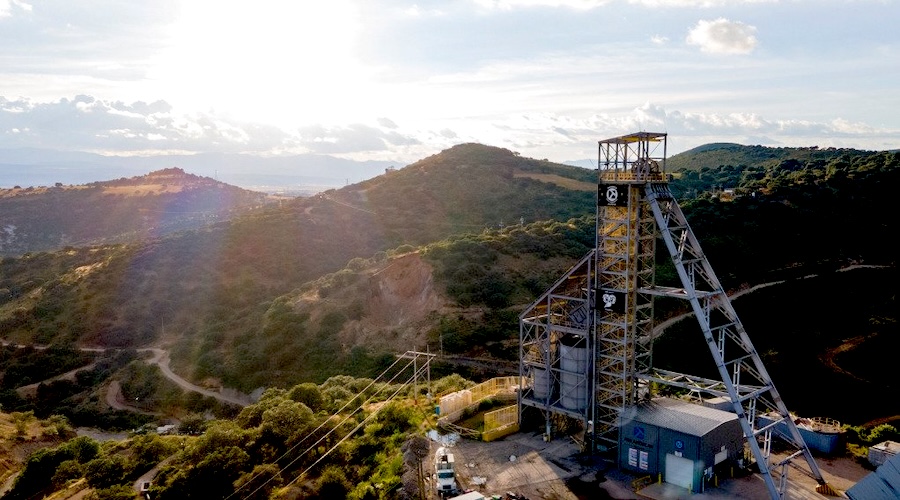
La Colorada. (Image courtesy of Pan American Silver.)

Pan American Silver (TSX, NYSE: PAAS) has discovered at least four new high-grade veins at its La Colorada silver mine in Zacatecas, Mexico, following a recent exploration campaign.

Drilling in the southeastern and eastern Candelaria zones identified the Filomena, Nicolasa, Bernardina and Josefina veins, along with associated contact-related replacement mineralization, the company said. Approximately 40% of drill holes from the campaign returned silver assays exceeding 1,000 g/t.

Emerson said the high-grade intercepts indicate potential to expand mineral resources at the operation. Pan American expects to incorporate the new drilling data into its mineral reserve and mineral resource update scheduled for the end of June.

The discoveries also support Pan American’s revised strategy for a phased development plan at La Colorada focused on higher-grade zones within both the vein system and the skarn deposit.

The company continues to invest in Mexico despite it operates in an increasingly volatile environment. At least 22 states experienced unrest following the death of drug cartel leader Nemesio Oseguera last month.

Recent cartel-linked incidents — including the late January abduction of 10 Vizsla Silver (TSX, NYSE: VZLA) workers and the killing of some of them — highlight the strategic importance of Mexico’s mining industry, particularly for silver, TD Cowen mining analysts said in a February report.

Relative calm has since returned after authorities deployed soldiers and National Guard personnel to restore order, but tensions remain elevated, according to British security risk management firm MS Risk.

Top silver miner

Pan American Silver ranks among the leading silver and gold producers in the Americas, with operations in Canada, Mexico, Peru, Brazil, Bolivia, Chile and Argentina. The company also holds a 44% joint venture interest in the Juanicipio mine in Mexico and owns the Escobal mine in Guatemala, which remains on care and maintenance, along with several exploration and development projects across the region.

The company recently met its full-year 2025 production guidance, delivering a record 22.8 million ounces of silver, including 7.3 million ounces in the fourth quarter as operations strengthened across its portfolio.

Teck charges Korea Zinc more for silver and germanium


Credit: Korea Zinc

Canadian miner Teck Resources agreed with Korea Zinc Co. to sell its zinc concentrates at a slightly higher processing fee in 2026, while charging more on silver and germanium after a surge in prices for both metals.

The treatment charge that Korea Zinc will receive for smelting semi-processed ores known as concentrates rose to $85 a ton this year, according to three people familiar with the matter, who asked not to be identified due to the commercial sensitivity of the matter.

That’s a small rebound from this year’s $80-a-ton fee, which was the lowest benchmark level for the zinc industry in more than 50 years. Low processing fees tend to hit zinc smelters hard, as treatment charges have historically accounted for about a third of their revenues.

Still, Korea Zinc registered record profits in 2025, thanks to a stellar rally in prices for silver and other minor metals, which are also contained in the concentrates it buys from Teck and other miners. Revenues from those byproducts surpassed its zinc revenues in 2025, as silver prices rallied 150% over the course of the year.

Germanium plays a crucial role in defense systems and other advanced technologies, and prices have surged since China placed export controls on it and other critical minerals starting in 2023. It rallied 75% last year.

Korea Zinc is one of the biggest producers of critical minerals outside China, and it plans to start germanium production at a new plant from 2028. It also supplies 5% of the world’s silver, and many of its byproducts originate from Teck’s Red Dog project in Alaska, which is the world’s biggest zinc-lead mine. Red Dog’s output can’t currently be sold on competitive terms in China due to tariffs on incoming US goods.

Miners offer smelters concessions on pricing to cover the cost of recovering zinc, silver and other metals, but in this year’s deal Teck and Korea Zinc agreed to lower the content threshold at which silver will become payable, one of the people said.

That will boost Teck’s share of revenues from the silver it produces, and for the first time the Canadian miner will also charge for the germanium contained in its concentrates, the person said.

Teck declined to comment. Korea Zinc did not respond to requests for comment.

(By Julian Luk)

Pentagon sought fresh supply of 13 critical minerals day before Iran attack

Stock image.

The US military asked mining companies on Friday to help boost domestic supplies of 13 critical minerals used to make semiconductors, weapons and other products, a ​document reviewed by Reuters showed.

The request, the day before the US and Israel launched strikes on Iran, is ‌the latest example in recent weeks of Washington’s push for more access to the materials used widely in warfare.

The Pentagon asked members of the Defense Industrial Base Consortium (DIBC), a group of more than 1,500 companies, universities and others that supply the military, for proposals to be submitted ​by March 20 for projects that could mine, process or recycle select minerals, the document showed.

There was no ​immediate indication whether the timing was intentionally coordinated to coincide with the start of the ⁠strikes on Iran.

The list of 13 minerals sought includes arsenic, bismuth, gadolinium, germanium, graphite, hafnium, nickel, samarium, tungsten, vanadium, ​ytterbium, yttrium and zirconium.

The US is reliant on imports for most of the 13. China is a dominant global producer of all ​of them.

The Pentagon asked for detailed information on the costs, including labor and material, needed to build a mine or processing facility. Projects could be awarded development funds ranging from $100 million to over $500 million, according to the request.

The document did not specify why only those ​13 minerals were chosen. Some — including germanium, graphite and yttrium — have been subject to export restrictions by China, the top ​global producer.

Yttrium shortages, especially, have set off alarm bells throughout the aerospace industry. One of the 17 rare earths, yttrium is used ‌in coatings ⁠that keep engines and turbines from melting at high temperatures. Without regular application of these coatings, engines cannot be used.

Nickel is a widely traded metal and Indonesia is the top global producer. Yet Jakarta has been throttling exports of the metal used widely in stainless steel and battery production.

The White House, DIBC and Pentagon did not immediately respond to requests ​for comment.

Latest request

DIBC’s request is ​just the latest attempt by ⁠the Trump administration to increase US supply of key critical minerals. China has been using its market control as diplomatic leverage in ongoing trade disputes with Washington.

Last month, Trump officials ​launched a $12 billion minerals stockpile backed by the US Export-Import Bank and proposed a preferential minerals ​trading bloc ⁠with more than 50 allies.

That trading bloc would aim to use reference prices for minerals derived in part by a Pentagon-created artificial intelligence programReuters reported last week.

The administration has also taken equity stakes in rare earths miner MP Materials, Lithium Americas, and copper-and-cobalt developer Trilogy ⁠Metals.

Separately on ​Wednesday, the Defense Logistics Agency, which buys a range of goods ​for the US military, asked for information from miners on potentially acquiring lithium, chromium and tellurium for military stockpiles.

(By Ernest Scheyder, ​Jarrett Renshaw and Polina Devitt; Editing by Veronica Brown, Chizu Nomiyama, Peter Graff and Diane Craft)

US Antimony receives $27M Defense Production Act funding


Screenshot of US Antimony’s corporate presentation video. Credit: United States Antimony | X

The US Defense Department, in alignment with the Trump administration’s critical minerals strategy, has made a $27 million investment into United States Antimony (NYSE-A: UAMY).

The funds would allow the company to enhance, innovate and expand domestic extraction, processing, and refinement of antimony, a statement released by the now-called Department of War said.

The US government considers antimony as a mineral that’s critical to its economic and national security, for its uses in many modern industrial applications.

At the moment, the Texas-based US Antimony is the only fully integrated producer of this mineral outside of China and Russia, operating a large smelting facility in Montana capable of producing 5 million lb. of metals.

“For too long, DOW has depended on overseas sources for its critical mineral production,” Mike Cadenazzi, Assistant Secretary of War for Industrial Base Policy, said. “This investment will address risk in one of our most critical munitions and materials supply chains.”

Funds for expansion, exploration

US Antimony is expected to use the funds to modernize and expand its existing Montana facility to increase its capacity to refine and produce antimony necessary for flame retardants, batteries, munitions, and other defense applications.

The investment is also intended to support the company’s plans to establish domestic antimony excavation and extraction in Alaska, where it has assembled a 35,000-acre land package comprising over 120 mining claims.

By securing domestic feedstock, US Antimony has positioned itself to enable full vertical integration across the supply chain from ore extraction to mid-stream floatation capabilities to finished antimony products, it said.

Shares of US Antimony were little moved on Thursday. Trading at $9.70 apiece in New York, the company has a market capitalization of approximately $1.37 billion.

The $27 million investment would come from the Defense Production Act (DPA) Title III funds, part of the Ukraine Supplemental Appropriations Act of 2022. It is one of three investments made by the DPA Purchases Office since the beginning of fiscal 2026

Deployment of the funds was initially targeted for last year but was delayed due to the US government shutdown, the longest in history.


US Defense Department seeks information to expand metal stockpiles


Aerial view of the US Department of Defense. Stock image.

The US Defense Department is seeking information for the potential stockpiling of five critical minerals, as the country steps up efforts to reduce risks in the supply chain and bolster domestic feedstock.

The Defense Logistics Agency on Wednesday issued notices seeking information for lithium, nickel, tin, chromium and tellurium respectively, including details of interested vendors, products specifications, sources of materials and market conditions, according to notices published on the website Wednesday. The DLA is responsible for managing the National Defense Stockpile, which secures metals for US military needs.

The Pentagon’s requests came as the procurement of metals has become a political priority for the US in order to slash reliance on Chinese supplies. Most recently, the White House announced Project Vault, a $12 billion stockpiling initiative for the private sector.

The agency said it is making inquiries ahead of the potential acquisition for 550 tons of lithium carbonate, 3,500 tons of nickel, 1,978 tons of London Metal Exchange-grade tin, 37 tons of tellurium and 4,500 short tons of chromium. It also made inquiries about the reprocessing or remelting of 1,978 tons of tin ingots affected by so-called tin pest, a phenomenon where the metal degrades into a powdered form in cold temperatures. That amount of tin would cost nearly $100 million, based on LME prices.

The DLA said the notices are for planning purposes only and the deadline to submit the responses is by March 19, adding that companies responded should not expect to receive feedback regarding submissions.

(By Annie Lee)

Critical minerals drive new commodity supercycle: Sprott


Copper, uranium and other strategic metals lead resource markets. (Stock image by agnormark.)

Governments and investors are increasingly treating critical materials such as copper and uranium as strategic assets, helping drive what Sprott says could be the early stages of a new commodity bull market.

Commodity markets entered 2026 with renewed momentum as resource equities broke above long-term trading ranges after years of underrepresentation in global portfolios. According to a Sprott report released this week, the emerging cycle differs sharply from past booms, with structural forces such as deglobalization, fiscal expansion and rising geopolitical tensions reshaping demand for raw materials. 

Rather than mirroring the China-driven construction boom of 2000–2014 or the inflation-led rally of the 1970s, the emerging cycle is being powered by investment in electricity systems, digital infrastructure and energy security. 

Governments are increasingly prioritizing control over critical supply chains, pushing materials tied to electrification, defence and advanced infrastructure into strategic territory.

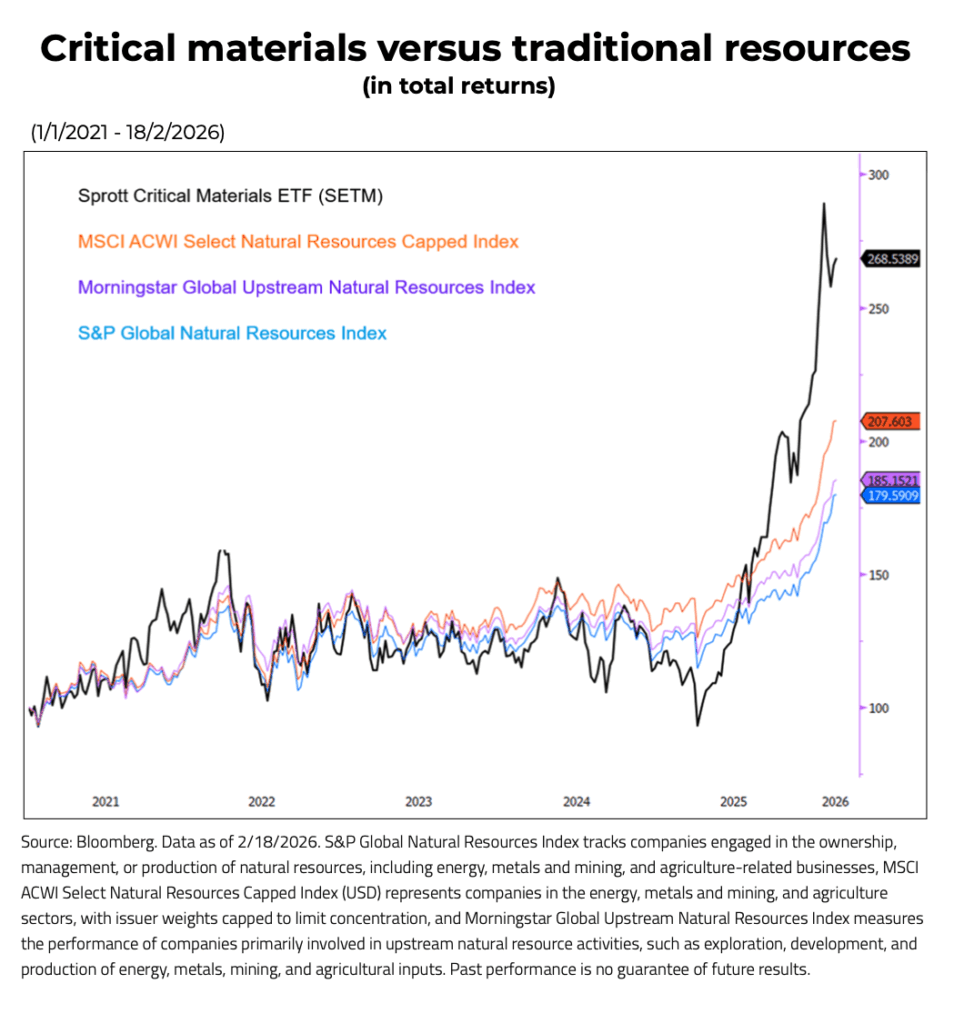
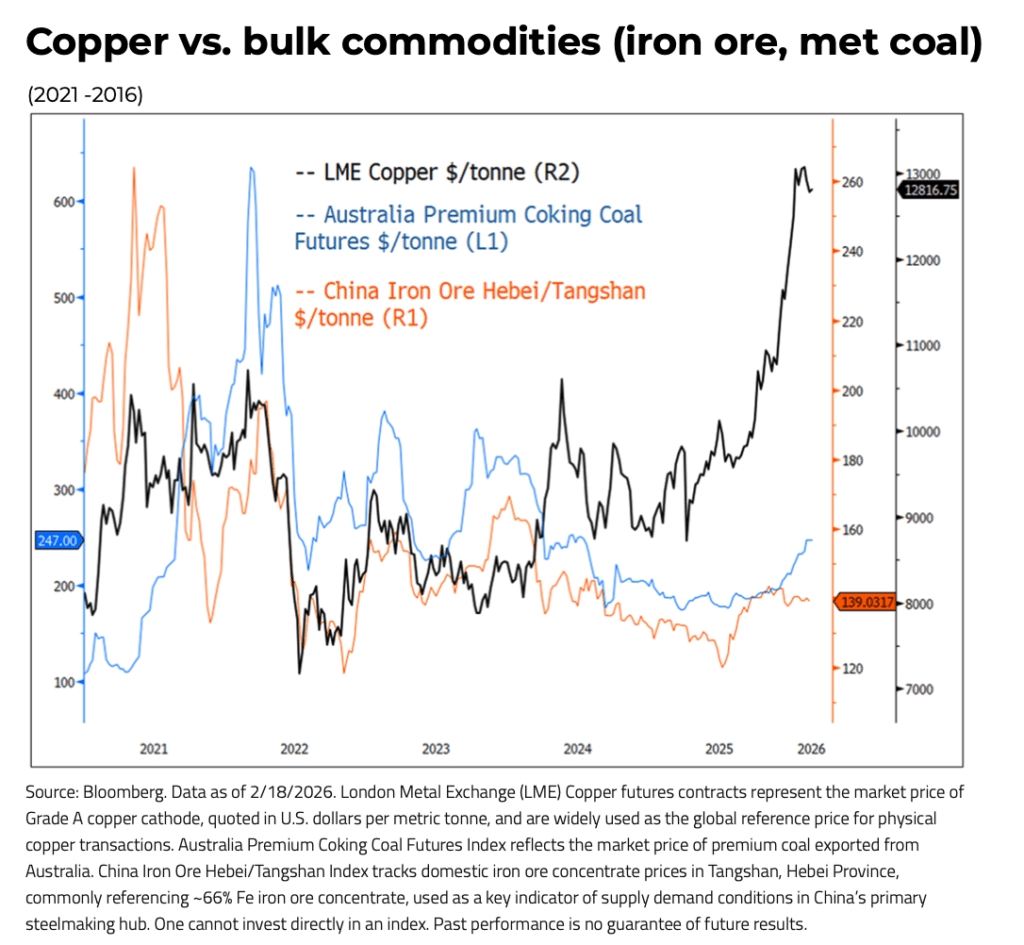
Within the broader resource sector, performance has begun to diverge sharply. Materials tied directly to electrification, power generation and energy security are outperforming traditional bulk commodities that dominated earlier cycles. 

The report highlights that the Sprott Critical Materials ETF (SETM) has significantly outperformed broader natural resource benchmarks since April 2025, underscoring growing investor focus on metals essential to modern infrastructure.

Copper sits at the centre of this shift., helping tighten its supply-demand balance relative to construction-focused bulk commodities. According to Sprott, copper-focused producers have increasingly outperformed large diversified miners whose earnings remain more closely tied to iron ore and other bulks.

Uranium over oil

Energy markets show a similar divergence. Oil markets still face ample supply and a long-term decline in consumption intensity relative to global GDP. Uranium, by contrast, is entering the cycle with constrained supply and strengthening demand as countries revisit nuclear power.

Sprott says the renewed interest in nuclear energy is driven primarily by energy security rather than environmental policy. Governments are extending reactor lifespans, planning new capacity and rebuilding long-term uranium contract coverage on the back of rising geopolitical tensions.

Beyond copper and uranium, the firm sees favourable fundamentals for other critical materials including lithium, rare earth elements and silver. Lithium and rare earths are essential for batteries and high-efficiency motors, while silver benefits from both industrial demand and its role as a monetary metal.

The report argues that critical minerals are increasingly being valued not only by traditional supply-demand dynamics but also by their strategic importance to national security and technological infrastructure.

Despite the shift, many resource allocations still emphasize broad exposure to sectors that dominated earlier cycles, such as chemicals, forest products and agriculture. Sprott says this lag in recognition is typical in the early stages of commodity bull markets.

The firm expects investment in power generation, electricity grids, data centres and mineral supply chains to drive demand over a multi-year horizon. At the same time, long project lead times and a decade of underinvestment in new supply could keep markets tight.

Targeted exposure to critical minerals may therefore offer stronger returns than broad commodity allocations, Sprott says. The firm highlights investment vehicles such as the Sprott Critical Materials ETF (NASDAQ: SETM), which focuses on companies deriving at least 50% of revenue or assets from critical materials, and the actively managed Sprott Active Metals & Miners ETF (NYSE: METL).

While volatility remains likely, Sprott believes the structural forces reshaping the global economy could support sustained outperformance for select commodities and mining companies tied to electrification and energy security.

Cove Capital, Saudi conglomerate to collaborate on critical minerals


Stock image.

US-based private investment firm Cove Capital LLC has partnered with Saudi industrial conglomerate Tariq Abdel Hadi Abdullah Al-Qahtani & Brothers Company (AHQ) on the joint development of critical minerals assets.

A memorandum of understanding (MOU) was signed on Thursday establishing the framework for collaboration to identify, evaluate, acquire, finance and operate critical minerals projects globally.

The partnership is intended to strengthen secure, allied-aligned supply chains serving both the US and Saudi Arabia, while advancing broader bilateral industrial cooperation, the companies said in a statement.

Specifically, Cove Capital and AHQ will jointly evaluate upstream and midstream critical minerals assets, form project-level joint ventures or special purpose vehicles, and develop downstream refining, processing and manufacturing capacity in both regions.

They will also explore the establishment of a dedicated critical minerals investment fund focused on deploying capital into strategic mining assets and advanced processing technologies.

The collaboration aligns with Saudi Arabia’s Vision 2030 objectives to expand its mining sector, localize industrial capacity and position the Kingdom as a global hub for minerals processing. It also aligns with ongoing US initiatives to strengthen domestic and allied supply chains for critical minerals that are foundational to national defense and economic resilience.

Under the agreement, the parties intend to pursue diversified financing structures, including participation from Saudi institutional and sovereign capital, engagement with US development finance institutions, potential alignment with the recently announced $12 billion US critical minerals stockpile initiative.

A joint steering committee will be established to review opportunities and oversee coordination, with specific projects to be governed by definitive agreements executed separately, the companies said.

“This MOU represents a meaningful step in aligning US and Saudi industrial capabilities around critical minerals that underpin modern defense systems, advanced manufacturing, and emerging technologies. AHQ brings significant industrial strength and regional leadership,” Pini Althaus, chairman and CEO of Cove Capital, commented.

Founded in 2015, Cove Capital is focused on identifying and investing in critical minerals assets across the globe. To date, it has established a large presence in Central Asia through a 70% ownership in a tungsten mining joint venture in Kazakhstan.

“Critical minerals are central to the Kingdom’s industrial transformation and to global economic stability. In Cove Capital, we are partnering with what we view as the leading US critical minerals investment and development group, given its track record of advancing world-class projects,” Abdulmalik Tariq Alqahtani, chief executive of AHQ, added.

USA Rare Earth to buy remaining Round Top stake for $73M 


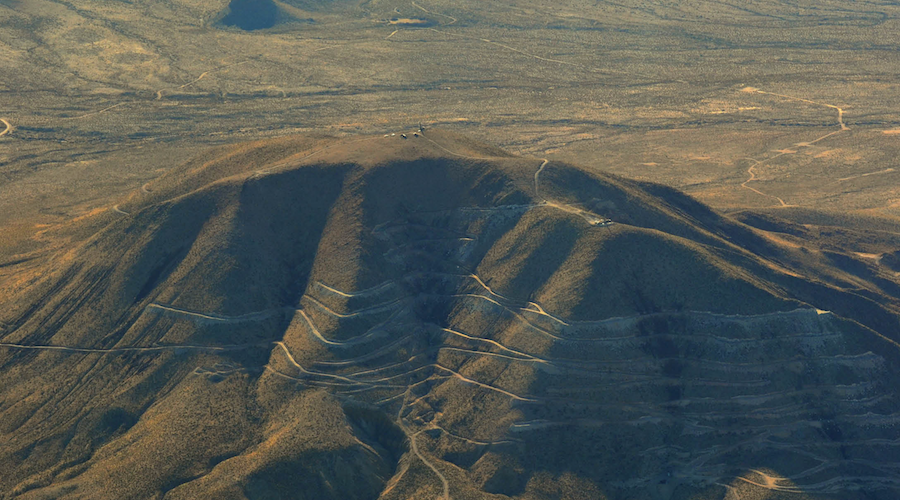
Round Top rare earths deposit in Texas. (Image courtesy of Texas Mineral Resources.)

USA Rare Earth (Nasdaq: USAR) will acquire the remaining minority interest in the Round Top rare earth deposit in Texas in a $73 million all-stock deal, securing full control of a key US source of critical minerals.

The Oklahoma-based company is purchasing all outstanding shares of Texas Mineral Resources (OTCMKTS: TMRC) for about 3.8 million shares of USA Rare Earth common stock. 

Shares of USA Rare Earth rose about 1% in pre-market trading following the announcement.

The deal will make USA Rare Earth the sole operator of the Round Top project, which the company says is the largest known US source of heavy rare earth elements, as well as gallium and beryllium.

“This acquisition secures a vital pillar in our strategy to build the world’s leading globally integrated, non-China critical mineral technology platform,” USA Rare Earth CEO Barbara Humpton said in a statement.

USA Rare Earth has accelerated its development timeline for the Texas project as demand for domestic critical minerals grows. Last year, the company said it expected commercial production to begin in late 2028, two years earlier than its previous target, citing faster progress at its processing facilities and rising US demand.

In January, the US Commerce Department agreed to support a $1.6 billion debt-and-equity financing package in exchange for a 10% stake in the company. The funding is intended to help build the Texas mine and a magnet manufacturing facility aimed at supplying the defence and high-tech sectors.

Mine-to-magnet

The push aligns with broader US policy efforts to expand domestic critical mineral production and reduce reliance on China, which dominates the global supply chain. President Donald Trump invoked emergency powers last year to accelerate development of US-based critical mineral resources.

USA Rare Earth describes itself as a mine-to-magnet solution designed to challenge China’s grip on the permanent magnet supply chain. Under its Accelerated Mining Plan, the company expects to extract nearly 40,000 tonnes per day of rare earth and critical mineral feedstock by 2030.

The boards of both companies have approved the transaction, which is expected to close in the third quarter.