How a British Archaeologist's Discovery of an Ancient Port Site Helped Bridge Gaps in South India's History
Sowmiya Ashok
10/Jan/2026
THE WIRE
INDIA
In North India, there was a gap of 1,000 years or more between the end of the IVC and the beginning of the Persian Empire around 600 bce. In South India, the problem was even more far-ranging, as it was unclear exactly what occurred before the Greco–Roman interactions of the first century ce.
In North India, there was a gap of 1,000 years or more between the end of the IVC and the beginning of the Persian Empire around 600 bce. In South India, the problem was even more far-ranging, as it was unclear exactly what occurred before the Greco–Roman interactions of the first century ce.
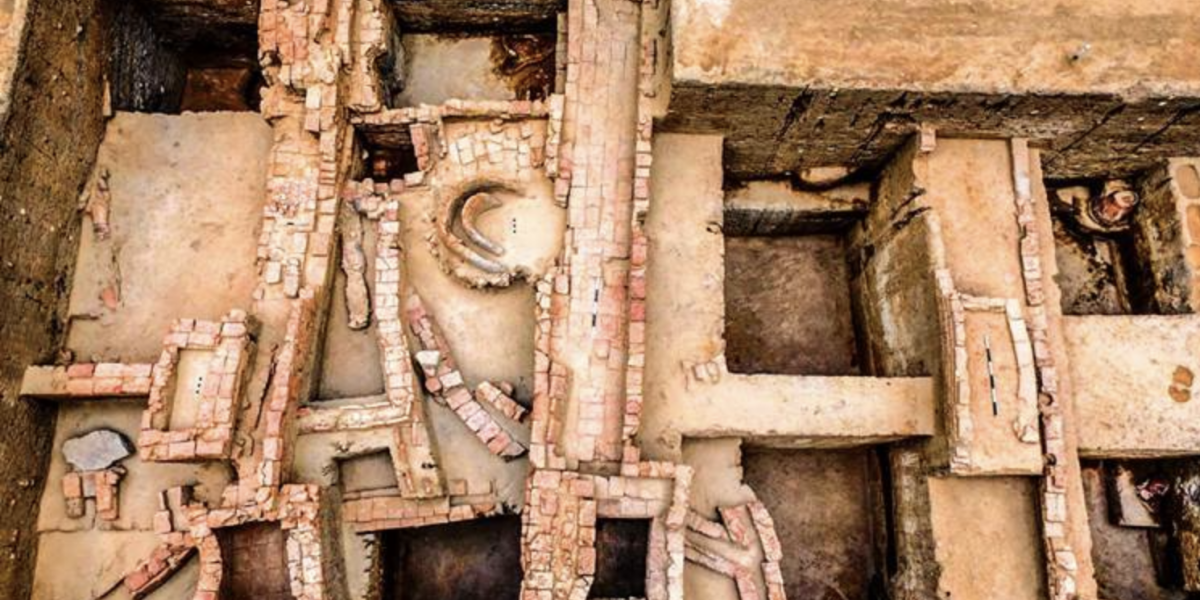
Exposed brick walls at Keeladi site. Photo: keeladimuseum.tn.
In 1945, British archaeologist Mortimer Wheeler discovered an ancient port site, Arikamedu, when he sank a trowel 20 kilometres outside present-day Puducherry. I had first heard of Wheeler through Tamil cinema. His reel version appeared in the opening scenes of the Kamal Haasan–starrer Hey Ram, telling Haasan and Shahrukh Khan to pack up the dig since Partition was imminent. After serving in World War II, Wheeler was appointed Director-General of Archaeology in the Government of India, serving from 1944 to 1947. He identified two major problems in historical knowledge in the subcontinent. In North India, there was a gap of 1,000 years or more between the end of the IVC and the beginning of the Persian Empire around 600 bce.
In South India, the problem was even more far-ranging, as it was unclear exactly what occurred before the Greco–Roman interactions of the first century ce. Wheeler aimed to bridge these gaps in the sequence of cultures between Protohistory (3000 bce to 600 bce), the period between prehistory and written history, and the Early History of India (600 bce to 300 bce). Much of archaeology serves to fill such cultural gaps, showing the baton passing as one culture evolved into another, or how migration occasionally disrupted existing cultures.
Wheeler’s choice of sites in India and his interpretation were informed by his educational background in classics and his experience excavating Romano–British sites in Wales and England. He sought to establish a chronological framework for the entire country. Between 1945 and 1947, he helped define a sequence of South Indian cultures, comprising a stone axe culture, megalithic settlements, and local Andhra cultures, and pottery featuring Mediterranean designs. Wheeler discovered this pottery in Arikamedu. In a museum in Pondicherry, now Puducherry, he had noticed the remains of a Roman amphora – a tall Greco–Roman jug with two handles and a narrow neck – which sparked his interest.
The Dig: Keeladi and the Politics of India’s Past, by Sowmiya Ashok, Published by John Murray, December 2025.
At Arikamedu, Wheeler excavated along the banks of the Ariyankuppam River’s mouth, where it opened into the Bay of Bengal, uncovering fragments of amphorae and a bright red, polished pottery called Arretine ware. He compared these finds with references in classical literary accounts such as the Periplus Maris Erythraei, a logbook maintained by sailors where they recorded a ship’s itinerary and impressions they had of the ports they visited. Wheeler concluded that Arikamedu had been an Indo-Roman port thriving during the first two centuries ce, a timeline later revised by subsequent excavators to the second to the third centuries bce. Scholars who followed Wheeler to the site discovered that the Romans had reached Pattanam in Kerala, navigated around Sri Lanka, and arrived on India’s east coast. They left intriguing traces, such as amphora jars that likely transported fish sauce and wine.
Wheeler’s discovery also validated a line of inquiry that had long fascinated Tamil intellectuals: could classical literary accounts provide clues to the locations of material remains? By sequencing Roman ceramics, amphorae, and Arretine ware and correlating them with literary sources Wheeler proposed that Arikamedu was indeed an Indo-Roman trading station.
Arikamedu was once a vibrant port city, manufacturing a wide range of textiles, including muslin cloth, as well as delicate terracotta objects, jewellery made of beads and semi-precious stones, glass, and gold. One of the earliest finds was an intaglio reported to bear a portrait of Augustus, which led to further excavations revealing an unfinished intaglio of a cupid and a bird, thought to have been completed in India by Greco–Roman artisans.
By the time Wheeler excavated at Arikamedu, he had perfected a scientific way of digging a trench, named after him. The Wheeler Method allowed archaeologists to understand both the horizontal layout and the vertical timelines of ancient settlements. Under this method, the site was divided into squares resembling grids. Some squares were left unexcavated, forming vertical walls of earth known as balks, which revealed the story of time in the soil layers. Even today, archaeologists across sites in India and Tamil Nadu continue to use this method, digging a series of squares within a large grid, allowing for a freestanding wall of earth that exposes the stratigraphy of ancient settlements.
At the Government Museum, Puducherry, I had seen some of the Arikamedu finds behind poorly maintained display cases. Amongst them were beads. Arikamedu was the birthplace of the glass bead industry, which supplied much of the Old World with monochrome Indo–Pacific beads for over 2,000 years. These were small, angular glass beads. The bead makers eventually relocated from Arikamedu to other sites in Sri Lanka, Malaysia, Vietnam, and Thailand, continuing their craft.
This is an excerpt from Sowmiya Ashok’s The Dig: Keeladi and the Politics of India’s Past.

No comments:
Post a Comment