Trump’s director of National Intelligence used to warn against “regime change wars.” Now she’s enabling one.
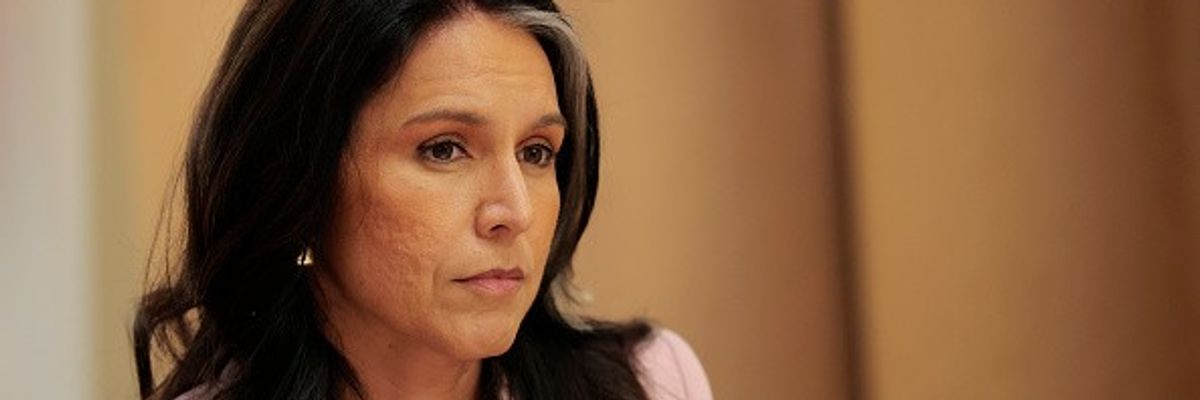
Director of National Intelligence Tulsi Gabbard listens during a Cabinet meeting at the White House on April 10, 2025.
(Photo by Anna Moneymaker/Getty Images)
Ann Wright
Jan 05, 2026
Common Dreams
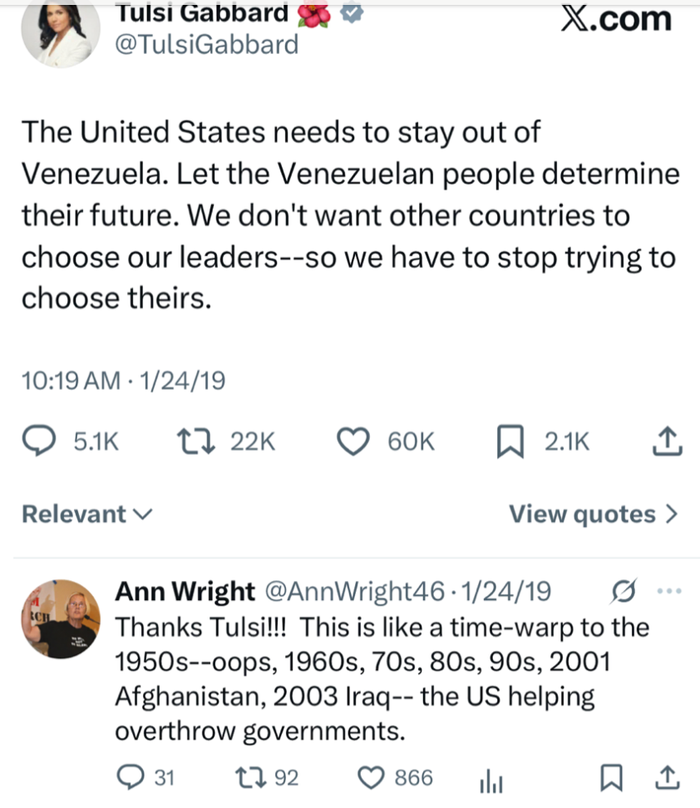
Seven years ago, US Congresswoman Tulsi Gabbard wrote in 2019 on Twitter: “The United States needs to stay out of Venezuela. Let the Venezuelan people determine their future. We don’t other countries to choose our leaders—so we have to stop trying to choose theirs.”
Now as director of National Intelligence in the Trump administration, Tulsi Gabbard is a key part of the US overthrow of the Venezuelan government and the kidnapping of the Venezuelan president and his wife and the deaths of at least 40 persons in Venezuela.
During her 2018 Congressional reelection campaign, she warned of “regime change wars:” “Every dollar spent on interventionist regime change wars is a dollar not spent on education, healthcare, infrastructure, and a myriad of other needs desperately needed right here at home.”
“We are spending trillions of dollars on unnecessary interventionist wars that do not serve the interests of the American people—money that should be spent on investing in infrastructure, affordable housing, education, healthcare, and other priorities here at home,” Gabbard said in 2018.
In 2019, Gabbard said: “Leaders in this country from both political parties looking around the world and picking and choosing which bad dictator they want to overthrow.... Sending our military into harm’s way and then trying to export some American model of democracy that may or may not be welcome by the people in those countries, and it’s proven to have been a failure.”
As far as other countries interfering in the choice of their leaders, the president who nominated her to be the director of National Intelligence proudly states that his endorsement of a candidate in the presidential election in Honduras helped a right-wing candidate get elected in a still contested election, as well as candidates in Chile and Argentina. So much for not choosing leaders of other countries.
In a 2019 interview with NPR, Gabbard said: “I think that the outsized power that the political parties hold can often be used in the wrong way to squelch our democracy and dissenting voices even within our own party.” But, she said, she has never considered leaving the Democratic Party… until she did for President Donald Trump’s party, which is doing the same.
What happened to Tulsi Gabbard and her principles?
Our work is licensed under Creative Commons (CC BY-NC-ND 3.0). Feel free to republish and share widely.
Ann Wright
Ann Wright is a 29 year US Army/Army Reserves veteran who retired as a Colonel and a former US diplomat who resigned in March 2003 in opposition to the war on Iraq. She served in Nicaragua, Grenada, Somalia, Uzbekistan, Kyrgyzstan, Sierra Leone, Micronesia and Mongolia. In December 2001 she was on the small team that reopened the US Embassy in Kabul, Afghanistan. She is the co-author of the book "Dissent: Voices of Conscience."
Full Bio >
Seven years ago, US Congresswoman Tulsi Gabbard wrote in 2019 on Twitter: “The United States needs to stay out of Venezuela. Let the Venezuelan people determine their future. We don’t other countries to choose our leaders—so we have to stop trying to choose theirs.”
Now as director of National Intelligence in the Trump administration, Tulsi Gabbard is a key part of the US overthrow of the Venezuelan government and the kidnapping of the Venezuelan president and his wife and the deaths of at least 40 persons in Venezuela.
During her 2018 Congressional reelection campaign, she warned of “regime change wars:” “Every dollar spent on interventionist regime change wars is a dollar not spent on education, healthcare, infrastructure, and a myriad of other needs desperately needed right here at home.”
“We are spending trillions of dollars on unnecessary interventionist wars that do not serve the interests of the American people—money that should be spent on investing in infrastructure, affordable housing, education, healthcare, and other priorities here at home,” Gabbard said in 2018.
In 2019, Gabbard said: “Leaders in this country from both political parties looking around the world and picking and choosing which bad dictator they want to overthrow.... Sending our military into harm’s way and then trying to export some American model of democracy that may or may not be welcome by the people in those countries, and it’s proven to have been a failure.”
As far as other countries interfering in the choice of their leaders, the president who nominated her to be the director of National Intelligence proudly states that his endorsement of a candidate in the presidential election in Honduras helped a right-wing candidate get elected in a still contested election, as well as candidates in Chile and Argentina. So much for not choosing leaders of other countries.
In a 2019 interview with NPR, Gabbard said: “I think that the outsized power that the political parties hold can often be used in the wrong way to squelch our democracy and dissenting voices even within our own party.” But, she said, she has never considered leaving the Democratic Party… until she did for President Donald Trump’s party, which is doing the same.
What happened to Tulsi Gabbard and her principles?
Our work is licensed under Creative Commons (CC BY-NC-ND 3.0). Feel free to republish and share widely.
Ann Wright
Ann Wright is a 29 year US Army/Army Reserves veteran who retired as a Colonel and a former US diplomat who resigned in March 2003 in opposition to the war on Iraq. She served in Nicaragua, Grenada, Somalia, Uzbekistan, Kyrgyzstan, Sierra Leone, Micronesia and Mongolia. In December 2001 she was on the small team that reopened the US Embassy in Kabul, Afghanistan. She is the co-author of the book "Dissent: Voices of Conscience."
Full Bio >

No comments:
Post a Comment