
By AFP
\January 5, 2026

People walk past a mural depicting now ousted Venezuelan president Nicolas Maduro near the National Assembly in Caracas - Copyright AFP Juan BARRETO
Shaun TANDON
President Donald Trump says the United States is “in charge” of Venezuela. But for now, that seems to mean keeping the country’s government set up much like it was before.
Trump on Saturday ordered an audacious, deadly assault on Caracas in which US forces snatched Venezuela’s leftist leader Nicolas Maduro and took him to face charges in New York.
In his extensive comments since then, Trump said that the United States temporarily “is going to run the country,” which has 30 million people and an economy in tatters for years.
The preparation for such a massive undertaking appears to be little or non-existent, with the US embassy in Caracas shuttered, no US forces known to be on the ground and Trump vaguely saying that his own cabinet will call the shots.
Even the 2003 invasion of Iraq, in which the United States was widely criticized for the ensuing chaos, had far more planning, with president George W. Bush installing what he called a Coalition Provisional Authority to run the country.
Trump said Venezuelans would be “taken care of” but said little on what they can expect.
Instead, Trump said the priority was to benefit US oil companies in Venezuela, which has the world’s proven reserves and had become a crucial supplier to Cuba, a longtime US target, as well as leading US competitor China.
To achieve its ends, Trump said the United States is claiming cooperation with Delcy Rodriguez, who was Maduro’s vice president — and Trump publicly threatened another US attack if she does not do the US bidding.
Secretary of State Marco Rubio, clarifying Trump’s remarks in an interview with NBC News’ “Meet the Press,” said: “It’s not running — it’s running policy.”
Rubio, a Cuban-American and sworn enemy of the hemisphere’s leftists, had long branded Maduro as illegitimate and championed the opposition, which said it won 2024 elections.
But Trump brushed aside opposition leader Maria Corina Machado, the winner of the latest Nobel Peace Prize, and Rubio said the United States was focused on “our national interest.”
– ‘Vassal state’? –
Trump said that Machado is a “very nice woman” but does not command the “respect” to run the country.
Mark Jones, a Latin America expert at Rice University, said Trump saw lower risks to working with Rodriguez.
“The only way Machado could enter the presidential palace and run the country would be with a massive US military presence, which would be very bloody, would be unlikely to be successful and would create massive domestic problems for Trump,” who ran as a non-interventionist, Jones said.
Rodriguez, who had been reported to have been in contact with the Trump administration well before Saturday’s attack, initially gave a fiery speech calling Maduro the legitimate president but quickly changed her tone and promised cooperation.
Ryan Berg, director of the Americas program at the Center for Strategic and International Relations, expected Rodriguez to struggle to find the right balance.
“On the one hand, she needs to be outraged that this happened,” Berg said.
“At the same time, she needs to be open to pushing pro-US policies that are going to be very difficult for her regime to swallow, given that they have a 27-year history of seeing the United States as the greatest enemy.”
Jones said that Rodriguez had been vice president precisely because Maduro did not see her as holding enough leverage internally to pose a threat.
To steer Venezuela, the United States therefore will also need the support of other key figures such as Vladimir Padrino Lopez, who controls the powerful military, Jones said.
Some US demands, such as controlling drug trafficking, could be easy for Rodriguez, Jones said.
But other demands, such as breaking with Cuba, would be much harder sells for elements of a government rooted in leftist firebrand Hugo Chavez’s “Bolivarian Revolution.”
“That group is going to resist with all its might, because the idea of Venezuela becoming some vassal state ot the United States is pretty much the antithesis of the Bolivarian Revolution,” Jones said.
Military remains loyal after Maduro ouster, Venezuelan exiles say
By AFP
January 5, 2026

A Venezuelan former military officer spoke to AFP in northern Colombia on condition of anonymity - Copyright AFP Annela NIAMOLO
David SALAZAR
Real change has not come to Venezuela despite Nicolas Maduro’s ouster as president and the armed forces remain loyal to the regime: that was the blunt assessment Monday of former security operatives living in exile.
Last weekend, from the Colombian-Venezuelan border, Williams Cancino watched the spectacular US snatch-and-grab of his ex-boss and president.
He hoped it could be the beginning of freedom for Venezuela, after a quarter century of repression, economic depression and one-party rule.
But if things are to really change, first “a new high command is needed” in the country’s powerful security services, he told AFP on Monday.
“The top brass are totally loyal to the regime,” said Cancino, who until his defection in 2019 was an officer in Venezuela’s police and the Special Action Forces, which are often used to crack down on dissent.
Through flawed elections and mass protests, they helped Maduro’s government to survive.
When contacted by AFP, several Venezuelan former soldiers and police officers — branded as traitors by their government — shared the view that many of the same people still control Venezuela, despite a dramatic change at the top.
Much power appears to remain in the hands of Interior Minister Diosdado Cabello and Defense Minister Vladimir Padrino — both wanted by US authorities.
The military, and even Maduro’s own son, have pledged loyalty to new interim leader Delcy Rodriguez, Maduro’s former vice president and close confidant.
“Currently, the armed forces’ leadership is nothing more than an appendage of a dictatorial regime,” said one former colonel who spoke to AFP on condition of anonymity.
With Maduro out of the country, he believes “the high command” should “step aside”.
Cleberth Delgado, a former detective, is also skeptical about a transition in Venezuela while commanders loyal to Rodriguez remain in their posts.
In constant contact with former comrades, many ex-officers say they are preparing to return to Venezuela, with the goal of taking over roles from the current military leadership.
“We are waiting for the right moment to support the new government,” one that is elected at the polls, Delgado said. But so far, there is little sign that it will happen.
Even US Secretary of State Marco Rubio, who has spent his political career campaigning for democracy in Cuba and elsewhere in Latin America, said elections were not the priority in Venezuela.
US President Donald Trump has outright dismissed the idea that Nobel Peace Prize laureate and opposition figurehead Maria Corina Machado could lead the country.
While some former officers still speak of change by force, Cancino hopes his former comrades will do the right thing.
“We don’t want conflict, and much less a civil war. We don’t want to face off against brothers.”
This brutal and incoherent Trump action bodes ill for the whole world
Robert Reich
January 5, 2026
RAW STORY
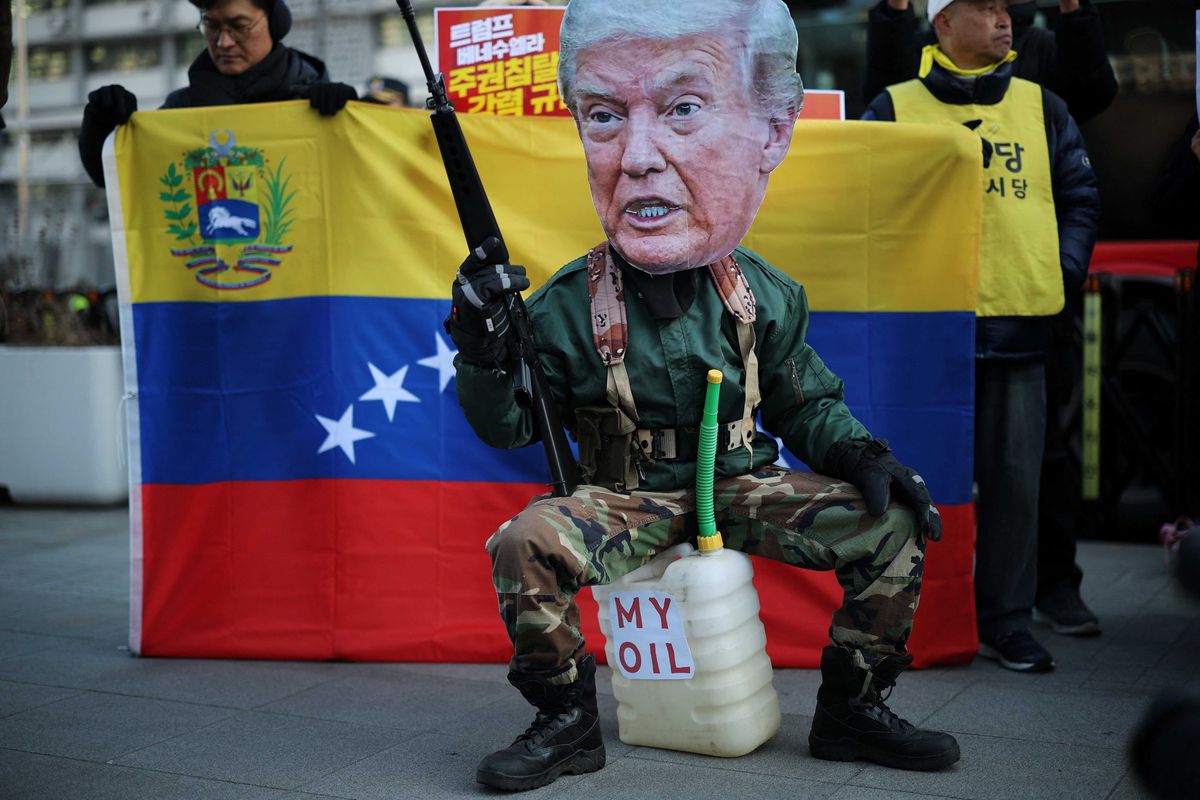
An activist during an anti-Trump rally in central Seoul, South Korea. REUTERS/Kim Hong-Ji
The story of what’s happening in Venezuela is unfolding quickly and big questions are mounting. The immediate danger in Venezuela (and potentially in Colombia and Cuba) is chaos
Asked who’s in charge of Venezuela, Trump answered: “We’re in charge.”
What the hell does this bluster really mean?
U.S. troops are not prepared to occupy Venezuela. Trying to do so would be a disaster.
Maduro’s system of oppression is still entrenched there. It includes the national guard, the army, the national police, the intelligence service, and the Colombian guerrilla group ELN. All remain intact.
Maduro’s top lieutenants also remain, including several who were involved in his alleged crimes. Not to mention his thugs and narco-traffickers who have been controlling Venezuela through violent repression and stolen elections.
Venezuela has roughly 28 million people. There’s no way to determine the emerging balance of power between pro- and anti-Maduro camps, but it’s a safe bet that any power void is likely to be filled with violence.
On Sunday, Secretary of State Marco Rubio spoke of “coercing” the Venezuelan government to make policy changes over its oil reserves, rather than “running” the country: American forces will prevent oil tankers from entering and leaving Venezuela until the government opens up the state-controlled oil industry to foreign investment — presumably giving priority to American companies.
But since August, America has had an arsenal of warships, jet fighters, and some 15,000 troops on Venezuela’s doorstep, which hasn’t stopped oil shipments. How big must the arsenal be to do the job? How long will it remain there? At what cost? Will we bomb Russian or Chinese tankers coming into or out of Venezuela?
Rubio emphasized that “the national interest of the United States … is No. 1.” But what exactly is the “national interest” of the United States here? Big Oil? Chevron has been in Venezuela for years. Do we declare victory when Exxon-Mobil is there, too? Do we insist that Venezuela not charge America oil companies any extraction fees? How profitable must Big Oil’s extractions of oil from Venezuela become before Trump is satisfied?
Rubio says Trump hasn’t ruled out troops on the ground. But does anyone remember what happened in Iraq after the U.S. invasion there? Libya? Syria? Hello? How many failed states do we need to create before we understand their danger to the stability of an entire region of the globe?
Meanwhile, the Trump regime is fanning the flames of anti-Americanism, both in Venezuela and elsewhere in Latin America.
Asked tonight whether the United States would conduct an operation against Colombia, Trump said, “it sounds good to me.” He also suggested Mexico could be another target, saying the Mexican cartels are “very strong,” drugs are “pouring” through the country, and “we’re gonna have to do something.” As to Cuba, it “looks like it is ready to fall.”
He didn’t even stop with Latin America. Trump made clear he also wants to take control of Greenland. “We need Greenland from the standpoint of national security and the European Union needs us to have it and they know that,” he told reporters on Air Force One.
This is nuts. Trump is already on his way to destroying the rule of law in America. Now he’s destroying the rules-based system of international law and diplomacy that the United States created in the wake of the horrors of World War II.
“America is respected again,” he gloated in his address to the nation on Dec. 9. For Trump, “respect” means the power to bully, regardless of law. “Our nation is strong, and America is BACK.”
Wrong. What’s back is lawless gunboat diplomacy.Robert Reich is an emeritus professor of public policy at Berkeley and former secretary of labor. His writings can be found at https://robertreich.substack.com/.
Robert Reich's new memoir, Coming Up Short, can be found wherever you buy books. You can also support local bookstores nationally by ordering the book at bookshop.org
Trump's 'assault on Venezuela' is 'opening move' to take down major rival: analysis
Ewan Gleadow
January 6, 2026
Writing in The Guardian, Owen Jones suggested the strike on Venezuela earlier this week, and subsequent capture of President Nicolás Maduro, is part of a longer game plan which would see Trump stand off against China. The major trade rival has become a growing concern for the Trump administration, with Jones citing a growing trade industry between China and Latin America as a reason the president may be keen to take action in the Western Hemisphere.
Jones wrote, "And, crucially, China – the main US rival – has grown in power across the continent. The two-way goods trade between China and Latin America was 259 times larger in 2023 than it was in 1990."
"China is now the continent’s second largest trading partner, behind only the US. At the end of the cold war, it did not even make the top 10. Trump’s assault on Venezuela is just the opening move in an attempt to reverse all of this."
Jones would also suggest that the "domination" of the US in the last three decades has been challenged as a result of this trade agreement between major rival China and Latin America. It appears Trump is now trying to present himself as someone without "bluster" as was the case for his first term.
"The experience of Trump’s first term has led too many to conclude that the strongman in the White House was all bluster," Jones wrote. "Then, he reached an accommodation with the traditional Republican elite."
"The unwritten bargain was simple: deliver tax cuts and deregulation, and he could vent endlessly on social media. Second-term Trump is a full-fat far-right regime."
The strike on Venezuela could embolden Trump to take further action, with the president reigniting his interest in buying out or taking over Greenland as a US territory. Jones suggested that, should the US seize Greenland, it would be no different from Russia annexing parts of Ukraine.
Jones wrote, "But a US seizure of Danish sovereign territory would surely spell the end of Nato, founded on the principle of collective defence. Denmark’s land would be stolen no less blatantly than Russia’s devouring of Ukraine. Whatever muted noises have emerged from London, Paris or Berlin, the western alliance would be finished."
Ewan Gleadow
January 6, 2026
RAW STORY
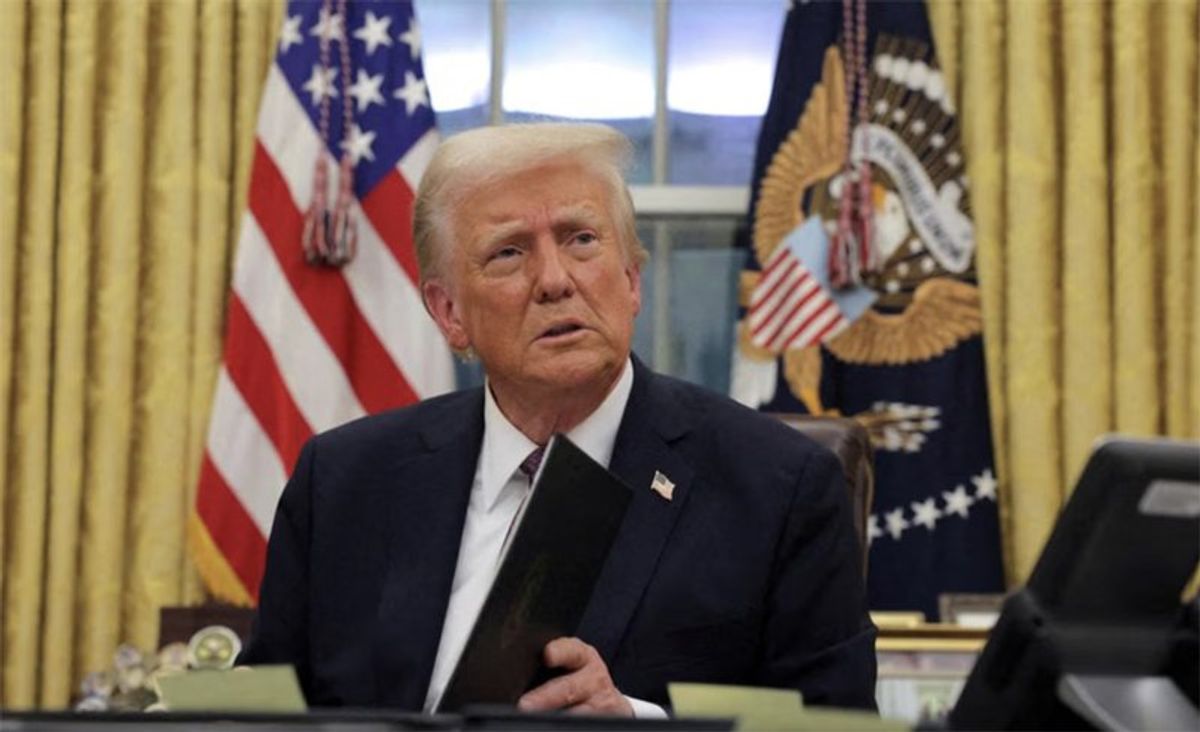
Donald Trump (Photo via Reuters)
An attack on Venezuela orchestrated by Donald Trump's administration is the "opening move" to a much larger rival, a political commentator has claimed.
Donald Trump (Photo via Reuters)
An attack on Venezuela orchestrated by Donald Trump's administration is the "opening move" to a much larger rival, a political commentator has claimed.
Writing in The Guardian, Owen Jones suggested the strike on Venezuela earlier this week, and subsequent capture of President Nicolás Maduro, is part of a longer game plan which would see Trump stand off against China. The major trade rival has become a growing concern for the Trump administration, with Jones citing a growing trade industry between China and Latin America as a reason the president may be keen to take action in the Western Hemisphere.
Jones wrote, "And, crucially, China – the main US rival – has grown in power across the continent. The two-way goods trade between China and Latin America was 259 times larger in 2023 than it was in 1990."
"China is now the continent’s second largest trading partner, behind only the US. At the end of the cold war, it did not even make the top 10. Trump’s assault on Venezuela is just the opening move in an attempt to reverse all of this."
Jones would also suggest that the "domination" of the US in the last three decades has been challenged as a result of this trade agreement between major rival China and Latin America. It appears Trump is now trying to present himself as someone without "bluster" as was the case for his first term.
"The experience of Trump’s first term has led too many to conclude that the strongman in the White House was all bluster," Jones wrote. "Then, he reached an accommodation with the traditional Republican elite."
"The unwritten bargain was simple: deliver tax cuts and deregulation, and he could vent endlessly on social media. Second-term Trump is a full-fat far-right regime."
The strike on Venezuela could embolden Trump to take further action, with the president reigniting his interest in buying out or taking over Greenland as a US territory. Jones suggested that, should the US seize Greenland, it would be no different from Russia annexing parts of Ukraine.
Jones wrote, "But a US seizure of Danish sovereign territory would surely spell the end of Nato, founded on the principle of collective defence. Denmark’s land would be stolen no less blatantly than Russia’s devouring of Ukraine. Whatever muted noises have emerged from London, Paris or Berlin, the western alliance would be finished."
‘Nobody is going to run home’: Venezuelan diaspora in wait-and-see mode
By AFP
Clearing bomb wreckage, Venezuelan mourns aunt killed in US raidBy AFP
January 6, 2026

Many exiled Venezuelans wept for joy at the US ouster and capture of former president Nicolas Maduro - Copyright Agence Kampuchea Press (AKP)/AFP Handout
Clare BYRNE
“A new dawn for Venezuela” is how a top US diplomat described the future awaiting the Caribbean country after Saturday’s capture of president Nicolas Maduro by US special forces in a raid on Caracas.
But for some of the eight million Venezuelans who fled the country over the past decade of economic ruin and repression, the joy at seeing Maduro hauled before a New York court on Monday was tempered by the knowledge that his henchmen remain at the helm.
News of Maduro’s demise initially triggered scenes of jubilation among the diaspora.
Several people choked up as they recalled the hardship they fled, and the family they left behind, over the course of his increasingly despotic rule.
But while many said they dreamed about returning to their homeland, they made it clear they had no plans to pack their bags just yet.
Most cited the country’s tattered economy as a reason to keep working abroad and sending home remittances.
Some also spoke of their fear of Venezuela’s security apparatus, pointing to the paramilitaries who roamed the streets of Caracas on Saturday to crack down on anyone rejoicing over Maduro’s ouster.
“There has been no change of regime in Venezuela, there is no transition,” said Ligia Bolivar, a Venezuelan sociologist and rights activist living in Colombia since 2019.
“In these circumstances nobody is going to run home,” she told AFP.
Standing outside the Venezuelan consulate in Bogota, where he was waiting to renew his passport on Monday, Alejandro Solorzano, 35, echoed that view.
“Everything remains the same,” he said, referring to US President Donald Trump’s decision to work with Maduro’s administration rather than the democratic opposition.
Maduro’s former deputy Delcy Rodriguez was sworn in as acting president on Monday, becoming the interim head of an administration that still includes hardline Interior Minister Diosdado Cabello and powerful Defense Minister Vladimir Padrino Lopez.
Cabello in particular is a figure of dread for many Venezuelans, after commandeering a crackdown on post-election protests in 2024 in which some 2,400 people were arrested.
Many Venezuelans were particularly shocked by Trump’s decision to sideline opposition leader Maria Corina Machado, a Nobel Peace Prize laureate, from the transition.
The European Union on Monday demanded that any transition include Machado and her replacement candidate in the 2024 elections Maduro is accused of stealing, Edmundo Gonzalez Urrutia.
Andrea, a 47-year-old immigration advisor living in Buenos Aires, argued, however, that Machado’s hour had not yet come.
“Until Trump sees that the situation is under control, until he has all these criminals by the balls, he won’t be able to put Maria Corina in charge. Because that would be throwing her to the wolves,” she said.
– ‘No other way’ –
Luis Peche, a political analyst who survived a gun attack in Bogota last year suspected of being a political hit, also argued in favor of a negotiated transition.
“We have to see this as a process,” Peche told AFP, referring to Venezuela’s transition.
“You still need part of the state apparatus to remain,” he said.
Tamara Suju, a leading Venezuelan rights expert based in Spain, said that keeping the same tainted cast in charge was a necessary evil — in the short term.
“They are the ones with whom the Trump administration is negotiating the transition because there is no other way to do it,” she told Spain’s esRadio, predicting they would eventually be forced by Washington to fall on their swords.
Edwin Reyes, a 46-year-old window installer living in Colombia for the past eight years, said that once Venezuela was “completely free” he would consider a move back.
“We’ve waited so long, another four or five months won’t hurt.”
Many exiled Venezuelans wept for joy at the US ouster and capture of former president Nicolas Maduro - Copyright Agence Kampuchea Press (AKP)/AFP Handout
Clare BYRNE
“A new dawn for Venezuela” is how a top US diplomat described the future awaiting the Caribbean country after Saturday’s capture of president Nicolas Maduro by US special forces in a raid on Caracas.
But for some of the eight million Venezuelans who fled the country over the past decade of economic ruin and repression, the joy at seeing Maduro hauled before a New York court on Monday was tempered by the knowledge that his henchmen remain at the helm.
News of Maduro’s demise initially triggered scenes of jubilation among the diaspora.
Several people choked up as they recalled the hardship they fled, and the family they left behind, over the course of his increasingly despotic rule.
But while many said they dreamed about returning to their homeland, they made it clear they had no plans to pack their bags just yet.
Most cited the country’s tattered economy as a reason to keep working abroad and sending home remittances.
Some also spoke of their fear of Venezuela’s security apparatus, pointing to the paramilitaries who roamed the streets of Caracas on Saturday to crack down on anyone rejoicing over Maduro’s ouster.
“There has been no change of regime in Venezuela, there is no transition,” said Ligia Bolivar, a Venezuelan sociologist and rights activist living in Colombia since 2019.
“In these circumstances nobody is going to run home,” she told AFP.
Standing outside the Venezuelan consulate in Bogota, where he was waiting to renew his passport on Monday, Alejandro Solorzano, 35, echoed that view.
“Everything remains the same,” he said, referring to US President Donald Trump’s decision to work with Maduro’s administration rather than the democratic opposition.
Maduro’s former deputy Delcy Rodriguez was sworn in as acting president on Monday, becoming the interim head of an administration that still includes hardline Interior Minister Diosdado Cabello and powerful Defense Minister Vladimir Padrino Lopez.
Cabello in particular is a figure of dread for many Venezuelans, after commandeering a crackdown on post-election protests in 2024 in which some 2,400 people were arrested.
Many Venezuelans were particularly shocked by Trump’s decision to sideline opposition leader Maria Corina Machado, a Nobel Peace Prize laureate, from the transition.
The European Union on Monday demanded that any transition include Machado and her replacement candidate in the 2024 elections Maduro is accused of stealing, Edmundo Gonzalez Urrutia.
Andrea, a 47-year-old immigration advisor living in Buenos Aires, argued, however, that Machado’s hour had not yet come.
“Until Trump sees that the situation is under control, until he has all these criminals by the balls, he won’t be able to put Maria Corina in charge. Because that would be throwing her to the wolves,” she said.
– ‘No other way’ –
Luis Peche, a political analyst who survived a gun attack in Bogota last year suspected of being a political hit, also argued in favor of a negotiated transition.
“We have to see this as a process,” Peche told AFP, referring to Venezuela’s transition.
“You still need part of the state apparatus to remain,” he said.
Tamara Suju, a leading Venezuelan rights expert based in Spain, said that keeping the same tainted cast in charge was a necessary evil — in the short term.
“They are the ones with whom the Trump administration is negotiating the transition because there is no other way to do it,” she told Spain’s esRadio, predicting they would eventually be forced by Washington to fall on their swords.
Edwin Reyes, a 46-year-old window installer living in Colombia for the past eight years, said that once Venezuela was “completely free” he would consider a move back.
“We’ve waited so long, another four or five months won’t hurt.”
ByAFP
PublishedJanuary 5, 2026

Several apartments in La Guaira state were damaged in the US bombings - Copyright AFP Federico PARRA
Andrea TOSTA
Wilman Gonzalez picked through the wreckage of his home as he described how a bombing killed his 78-year-old aunt Rosa during the US raids that toppled Venezuela’s president.
A jagged hole gaped in the apartment wall, through which Gonzalez said he pulled his aunt after the blast early Saturday in the port city of La Guaira.
A projectile hit the apartment building during airstrikes that led to the capture of leftist leader Nicolas Maduro by US forces in the nearby capital Caracas.
Rosa Gonzalez, a lawyer who had lived with her nephew Wilman, a retiree of 62, suffered a trauma to the chest that left her struggling to breathe and with pain in her arm.
“She didn’t die here, she died at the hospital,” said Wilman, still in shock, his right eye bruised and stitched.
He said he was looking at his cell phone when the blast hurled him through the air.
“It was so immense,” he told AFP, that “the front door flew off, the wooden door flew off, and slammed me against the wall.”
Rosa was asleep in another room.
“We took her to the little hospital and they gave her oxygen. But she couldn’t bear the pain” and died, he said.
– Mourners at coffin –
Police initially took Rosa’s body away for an autopsy. Then on Monday, family and friends came to mourn in silence in a small chapel, where her wooden coffin lay half-open.
“She was a very simple, very kind woman, with lots of friends,” said her brother Jose Luis Gonzalez, 82, the only one still alive of five siblings.
“A tragedy like this should never have happened in Venezuela, in such a quiet town.”
The faded blue facade of Wilman Gonzalez’s public housing block, named simply Building 12, was devastated by the projectile.
Doors and walls lay demolished, shattered glass everywhere.
Neighbors picked up small metal fragments of the projectile from Wilman’s living room. Authorities took away the larger pieces.
After the blast, “I thought I was dead,” Wilman recalled. “God, forgive my sins.”
He complained of having received scant help from the government.
Wilman wandered among the remnants of his home, picking up pieces of wood, staring at them and throwing them back down.
With a screwdriver in hand, he checked if a closet could be salvaged — but everything was useless.
Neighbors recovered pots, blenders, documents and window frames.
“I’ve seen this on TV. Palestine, Iraq, all those people. Not here,” he said.
– Tears and trauma –
The impact damaged eight of the 16 apartments in the building.
In the apartment of his 80-year-old mother Tibisay, Cesar Diaz gathered documents and stuffed them into a dirty woven bag.
A neighbor, 48-year-old firefighter Jesus Linares, recounted how he saved Tibisay in the chaos.
He showed the faded sheet he used to stop her head bleeding before rushing her to the hospital.
“These were her little shoes,” he said incredulously, pointing to a lone plastic sandal.
Diaz, 59, was sweating and still in shock as he spoke to AFP.
“Wow! What a huge thing to happen right here, in my mother’s house,” he said.
“It will traumatize her… It’s hard to come here and not see her sitting in her chair,” he added, on the verge of tears.
With what little composure he had left in the aftermath of the bombing, Linares helped Tibisay and got his own 85-year-old mother and 16-year-old daughter out too.
“I tried to focus as if it were an earthquake: stay calm and focus on their lives and help them.”
Three decades of service as a firefighter prepared Linares to “save lives,” he said.
“This time, what I had to do was rescue myself and my family.”
Police took away the projectile, but authorities have yet to provide help, the building residents said.

No comments:
Post a Comment