
The long-term consequences of US actions in Venezuela demolish laws which hold together the United States and the international order. This is not Pax Americana. It is Pox Americana from War-a-Iago.
by Dennis Kucinich | Jan 5, 2026 | ANTIWAR.COM
Reprinted with permission from The Kucinich Report.
This Administration, elected with a promise to end forever wars, has since taken America to war against Iran, Iraq, Yemen, Syria, Somalia and Nigeria, while funding genocide against Gazans.
It has invaded Venezuela, kidnapped its President, Nicholas Moduro, and his wife; pledged to “run” the county, and to appropriate (steal) Venezuela’s extensive oil reserves. Venezuela spent approximately $ ZERO for its defense in 2024.
This is not Pax Americana. It is Pox Americana from War-a-Iago.
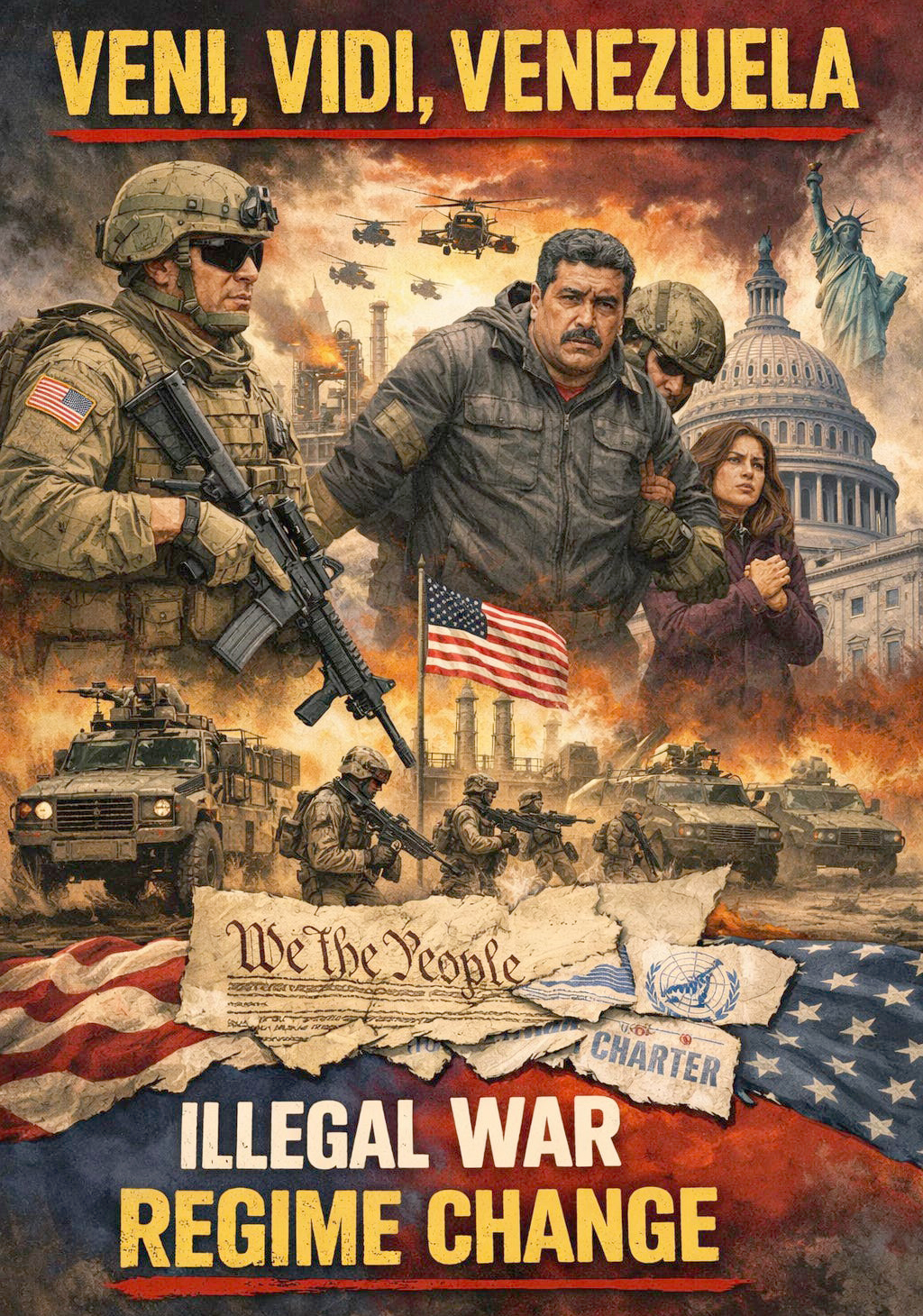
As a Member of House of Representatives, I challenged in court and in Congress President Clinton over Serbia, President Bush over Iraq and President Obama over Libya, each time working with members of both political parties to take action to insist on Congress’ co-equality, and its constitutional responsibility to decide when America should offer the treasure of our youth and our precious financial resources to be taken from peace to war.
Even a remote possibility of U.S. ground troops being sent to invade and occupy Venezuela ought to shock America’s moribund peace movement into action.
The long-term consequences of U.S. actions in Venezuela demolish laws which hold together the United States, and the International legal order.
This is not academic. The U.S. Constitution and the UN Charter must not become confetti showering an authoritarian fantasy victory parade.
What the Administration has done in smashing the US Constitution and international law is to unravel generations of painstaking work to try to limit war. Instead, it has set the stage for a war of all against all.
Our vainglorious leaders’ unseemly bravado about the precision operation for Venezuelan regime change, bespeaks a pathological consequence-free mindset: Aggression in its effrontery inviting every manner of retribution upon Americans everywhere.
A government that abandons its ideals, its Constitution, its laws, its freedoms, its commitments, its promises in search of global empire and booty will bring our nation to ruin, leaving America in debt, depression and danger.
We had a glimmer of what we may further expect domestically, notwithstanding court disapproval, with the President’s digression from his celebration of the takeover of Venezuela to extolling the glories of federal troops’ enforcement of law in American cities, in clear violation of the Posse Comitatus Act, a nineteenth century law which limits the use of federal troops for domestic purposes.
Our Constitution holds America together with principles of cohesion, coherence, common sense and liberty. It is not to be nullified by self-aggrandizing social media posts.
The Administration, dispensing with all pretense, now exercises a “War Department,” with a TRILLION-DOLLAR war budget, while trillions of military spending dollars remain unaccounted, and America’s leaders afflicted with a crass messianism informed not by 19th century imperialism, but 11th century crusading of like against unlike.
This is not the Will of a Heavenly God being fulfilled but a venal desire for more earthly power.
Furthermore, knocking over the government of Venezuela which, to reitterate, spent approximately ZERO for its defense in 2024 and then declaring the gambit to be one of the greatest military operations since WWII, is a violation of the English language which imposes limits on hyperbole — or should.
Here are the US laws that this Administration violated in its January 3, 2026 attack:
The U.S. Constitution: Article I, Section 8 grants Congress the sole power to declare war. The attack on Venezuela was an carefully contrived Act of War. Period. The invasion of Venezuela and the abduction of President Maduro was in planning stages for several months, according to General Caine who was tasked with overseeing the attack. Congress was deliberately circumvented.
The War Powers Resolution: Requires the President to notify Congress within 48 hours of military action and sets time limits for withdrawal, unless an AUMF (Authorization for Use of Military Force) or Declaration of War is passed. The President has noted that ”boots were on the ground” for the attack on Venezuela and has left open the possibility of US troops being sent for the second stage of the invasion.
The Neutrality Act: Prohibits the US government from engaging in or supporting unauthorized military actions against countries not at war with the U.S. Venezuela was not at war with the US.
The Foreign Assistance Act: Forbids U.S. assistance to governments or groups involved in coups or military overthrows.
The Arms Export Control Act: Forbids U.S. weapons being used in unauthorized acts of aggression.
Inside the Chamber of the House of Representatives, the most famous law givers in history, in bas relief, frame the rectangular chamber as sentinels, evoking the primacy of law in our national experience. Today, U.S. law is reduced yet again to whim, capris and corrupt motives.
America is in a Constitutional crisis.
Congress has a responsibility to our Constitution, to its constituents and to the world, to call out this Administration for its calculated, gross violations of the Constitution and U.S.law, and for making Americans less secure financially and at risk physically due to its wanton, illegal practice of war.
Congress must insist on enforcement of the War Powers Act and also ensure that the Administration acts within the bounds of international law.
If I were in Congress, I would put forth legislation to cut off funds for any military action not expressly approved by Congress and then go to federal court to obtain enforcement, if the Administration defies Congress.
Congress must reclaim its Constitutional authority in the process of checks and balances, or the Republic is lost.
Dennis J. Kucinich served sixteen years in the United States Congress and twice ran for President of the United States on a platform of peace, truth, and constitutional integrity. He led the opposition to the Iraq War and introduced Articles of Impeachment against President George W. Bush and Vice President Dick Cheney for misleading the nation into war.
Trump, Venezuela and the Roosevelt Corollary
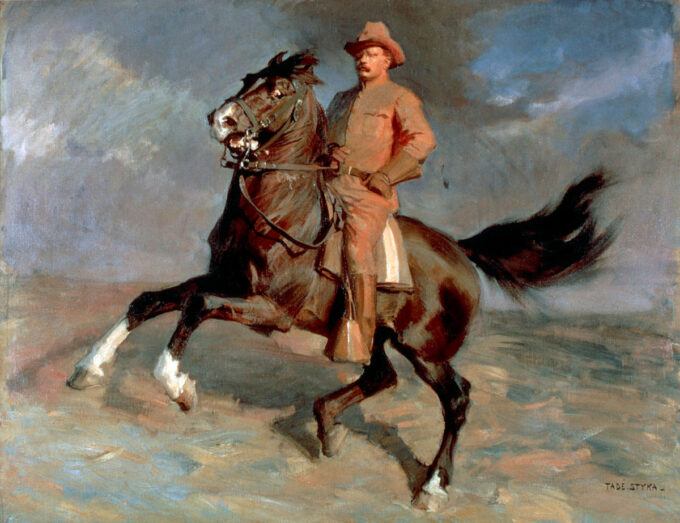
Painting by Polish artist Tadé Styka circa 1909 – Public Domain
Theodore Roosevelt was one of our most interesting and progressive presidents. Donald Trump is uninteresting and uninterested to the extreme and is a political obscurantist. Nevertheless, Trump’s illegal invasion of Venezuela will ineluctably link him with Roosevelt and the Roosevelt Corollary from 1904.
U.S. citizens are generally familiar with the Monroe Doctrine of 1823, particularly in the wake of the Cuban Missile Crisis of 1962. Soviet leader Nikita Khrushchev underestimated President John F. Kennedy’s willingness to deny the deployment of strategic weaponry in the Western Hemisphere.
But the Roosevelt Corollary is far less familiar to Americans. The Venezuelan affair in the winter of 1903-1904 marked a European intervention in the New World in order to collect enormous debts that a Venezuelan dictator, Cipriano Castro, had accumulated. President Roosevelt’s corollary to the Monroe Doctrine established the United States as an international police power in the Western Hemisphere, entitled to permit military intervention in South America if its nations mismanaged its finances or internal affairs in a way that invited European intervention.
The Roosevelt Corollary led to greater U.S. intervention, including military action in Cuba, Haiti, and Nicaragua, and fostered resentment and anti-American sentiment throughout the region. The corollary transformed the Monroe Doctrine from a stance of keeping European powers out to an active U.S. role in maintaining order and economic stability in the Americas.
Trump’s intervention in Venezuela last week will lead to greater anti-Americanism throughout the region, and provide greater justification to Vladimir Putin and Xi Jinping for their own regional goals in Eastern Europe and the Indo-Pacific, respectively.
Trump’s imperial intervention is in step with the sordid U.S. and CIA history of regime change the world over. Interventions in Iran, Guatemala, the Congo, and Chile led to instability and violence as far more vicious leaders took over the reins of government. Long-term intervention and occupations in Vietnam, Iraq, and Afghanistan were losing ventures, marked by the loss of blood and treasure. Libya has not recovered from the U.S. and NATO intervention fifteen years ago. Numerous efforts by several U.S. presidents to conduct regime change in Cuba were marked by failure.
This history points to the likelihood of greater failure in Venezuela, particularly in view of Trump’s threat to assume long-term control of Venezuela, placing control in the hands of National Security Adviser and Secretary of State Marco Rubio as well as Secretary of Defense Pete Hegseth. The inability of Rubio and Hegseth to manage the national security agenda of the United States doesn’t inspire confidence in the future management of Venezuela’s complex domestic environment.
Nevertheless, the mainstream media seem to have no problems with Trump’s jingoism to advance America’s national security. Several days before the invasion, the New York Times dropped a long lead editorial titled “This May Be Our Last Chance to Get It Right in Venezuela,” which endorsed roles for the “authorities of the intelligence community and the Treasury and Justice Department” to “take charge of security in Venezuela.” And before the dust has settled in Venezuela, a Washington Post editorial has termed the invasion a “major victory for American interests.” The Post praised the fact that Nicolas Maduro will now spend the “rest of his life in a humane American prison.”
Naked Imperialism in Venezuela
January 6, 2026
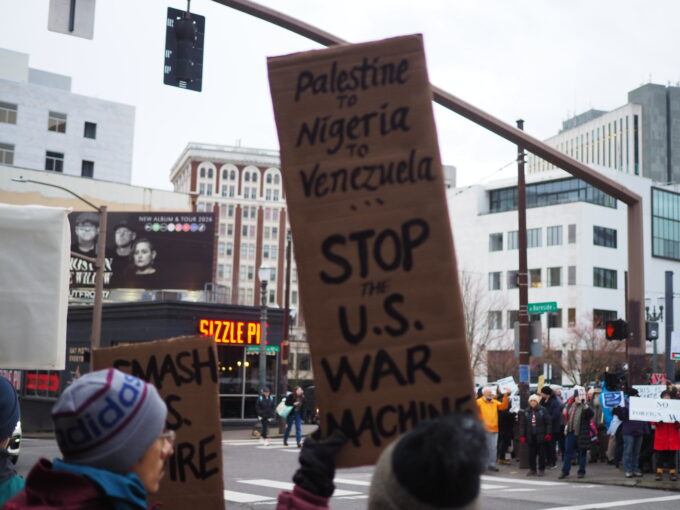
Photograph by Nathaniel St. Clair
Over the weekend, the Trump administration fast-tracked its efforts to oust Venezuelan president Nicolás Maduro, the successor of Hugo Chávez and his policies of nationalizing key industries and pushing out most U.S. companies. The U.S. government conducted a bombing raid in Caracas, with a swift operation to capture Maduro and his wife, transporting them to New York, where they face federal charges that include using Venezuela’s government to run a narco-terrorism conspiracy.
Venezuela is well-known as the home of the world’s largest known oil reserves. In its Annual Statistical Bulletin for 2025, the Organization of Petroleum Exporting Countries (OPEC) reported that the country had more than 303 billion barrels in reserves. The U.S. Energy Information Administration’s report on the country notes, “Most of Venezuela’s proven oil reserves are extra-heavy crude oil from the Orinoco Belt,” and several recent estimates say that the total oil in place in this region exceeds 1 trillion barrels. Still, industry insiders say that the raw numbers associated with the Orinoco Belt’s vast wells of oil, both oil in place and oil regarded as technically accessible and recoverable, can be misleading given other important factors. The oil in the Orinoco region is thick and viscous, difficult to extract and producing a lower yield of usable finished product. Many in U.S. policy and business circles believe that such difficulties can be overcome with the proper levels of investment and needed updates to the industry’s infrastructure and technologies in Venezuela. As Reuters reports, “[O]utput has plummeted over the past decades amid mismanagement and a lack of investment from foreign firms after Venezuela nationalized oil operations in the 2000s that included the assets of Exxon Mobil and ConocoPhillips.”
Trump has never been a peace president or a principled opponent of aggressive war and imperial looting. His crude rhetoric, with its open acknowledgement of Venezuela’s oil riches, merely removes the polite, decorous language we’ve come to expect from our political figureheads. The U.S. government is not pursuing a new logic or discarding old values. It is reinstating our political-economic system’s commitment to imperialism and extraction, only without any pretense to humanitarian motivations or democracy-building. If the past several years have taught us anything politically, it is that the old categories of identity and ideological narrative are no longer capable of assuaging people’s fears or satisfying their need for answers. The new moment in American politics perhaps admits the tried-and-true old strategy: the strength of the United States, even economically and culturally, is at bottom military strength, and our ability to live the way we do here is a function of occupation and extraction, not “free trade.” More than any other individual today, Marco Rubio represents the relationship between the Washington consensus on foreign policy and the approach of Donald Trump, assuming there is a coherent approach to speak of. Both of these schools believe with religious passion that the United States should and indeed must dominate the world militarily and economically. Both have adopted and implemented a view of the supposed rules-based international order that permits the U.S. to aggress against sovereign states with impunity.
If this is a mask-off moment for many Americans, then at least they now know the stakes. They are beginning to see what the critics of our government’s lawless aggression and naked imperialism have been pointing out for decades and longer. Trump’s unapologetic aggression has given Americans an opportunity to better understand our history: this episode is part of a pattern whereby the U.S. either invades a country or supports in one or another way the ouster of democratically elected leaders, to install dictators who will be friendly to US geopolitical interests and to American companies. Americans should not be surprised that Congress was not notified prior to the weekend’s attacks on Venezuela’s sovereignty. The executive branch has attacked and invaded dozens of sovereign countries without Congressional authorization in the 80 or so years since World War II. Our government long ago stopped respecting either the Constitution or international law in its foreign policy decisions.
Many of our elites were surprised and outraged to learn that Trump currently has no plan of putting María Corina Machado in the Miraflores Palace. But this reflects a point that anti-imperialists often make to deaf ears in Washington: when the political-economic superstructure is founded on illegal wars and scaled resource theft, you get authoritarians and strongmen, not liberal ideals. This is a structural phenomenon that doesn’t depend on how polite elites feel about their own politics; it is a product of war and empire. American liberals rooting for Machado seem to know very little about the person they’re supporting, as usual. Machado is a vocal and consistent supporter of Israel’s genocidal regime, even calling for her country’s embassy to be moved to Jerusalem. The Chávez and Maduro governments severed diplomatic relations and official ties with Israel due to the country’s apartheid regime and brutal occupation of Palestinian territory. This decision has been enormously popular among Venezuelans, as the global community increasingly understands the criminality of the U.S. and Israel. Machado recently spoke to Benjamin Netanyahu, currently a fugitive from justice, to express her support. Meanwhile, Israeli officials have praised Washington’s coup in Venezuela, seeing the opportunity to place an ally, perhaps Machado, into power.
The American media and our major universities and think tanks routinely present celebrity opposition figures like Machado using washed-out, meaningless happy words indicating to us that they are “pro-democracy” or supportive of liberal freedoms in some vague sense. But their actual policy agendas and real-world alliances and loyalties are systematically and purposely obscured. This is to say that in our media system, there is often a wide gulf between the TV characters as shown and written and the real people connected with the world’s worst offenders in war-profiteering, stealing natural resources, and destroying the local environment. So we get a sanitized morality play in which the West are the good guys, promoting liberal democracy, and the rest of the world is backwards and authoritarian. Yet it is the United States that has started the vast majority of illegal wars in recent memory, and its domestic policies have long violated the most basic principles of human rights law. This warped morality play, scripted and televised, is how it’s possible to have a person like Machado treated as some great champion of freedom, even as she heaps praise on the Israeli government as it tears the Gaza Strip to shreds, as its leader is indicted by the International Criminal Court, as the entire world raises its voice against this genocide, with the exception perhaps of a tiny and shrinking group of thugs in Washington, London, Tel Aviv and several embarrassed European capitals.
Again, the illusions are gone now. “The West” is implicated in the worst crimes of our generation, with or without Donald Trump. U.S. wars have murdered and displaced millions of people and transferred trillions of dollars of wealth to warmongers and powerful industries connected with the U.S. government. Our culture and discourse never deal with the dissonance, because what matters is one’s capacity to conform their statements and actions with the will of Washington, with the strategic priorities and interests of the United States. Beyond any country’s domestic politics, both the U.S. and the European Union blessed this in advance by maintaining the official position that Maduro’s government is illegitimate. During an appearance on BBC News back in December, Machado’s friend, the Venezuelan politician Leopoldo López, called openly for Washington’s military to coup his own country. He foreshadowed Trump’s coup by stating that there were options to remove Maduro “without collateral damage.”
Time will tell. As many of you remember, the U.S. government deployed many of Trump’s economic arguments in the lead up to the Iraq war: the country will become prosperous and free, and the resources will pay for the U.S. investment and more. It is long past the time for Americans of all political stripes and teams to put aside identitarian stories and look hard at what the Washington duopoly has been doing since long before any of us were born. Amongst the left in Latin America, there is much less confusion about the meaning of the moment. The reason people like Maduro are politically viable in the first place is because Venezuelans are rightly sick of US bullying and meddling in South America and in Latin America more generally. Venezuelans do not see their country’s oil as belonging to American companies like Chevron. The emancipatory movements of the world will correctly see this moment of open aggression and colonial logic as an opportunity to mobilize and organize. That is the silver lining: the illusion of U.S. government legitimacy is finally gone.
The truth is that the U.S. and its allies have long been the world’s greatest violators of international law, whether contained in treaties like the UN Charter or accepted customary principles. We have staged coups in between 20 and 30 countries since the end of WWII, engaged in a consistent pattern of strategies to serve particular industries and economic interests, and to install authoritarian governments who will not question our prerogatives. The relative merits of this strategy to one side, many of us in the anti-war, anti-empire, and anti-nuclear movements have been waiting for a time when we would be able to have an honest conversation about the strategy with our liberal friends and allies. It may be that the time is now, as Trump’s “Donroe Doctrine” opens a new era of unhinged American empire.
Venal Reactions: US Allies Validate Maduro’s Abduction
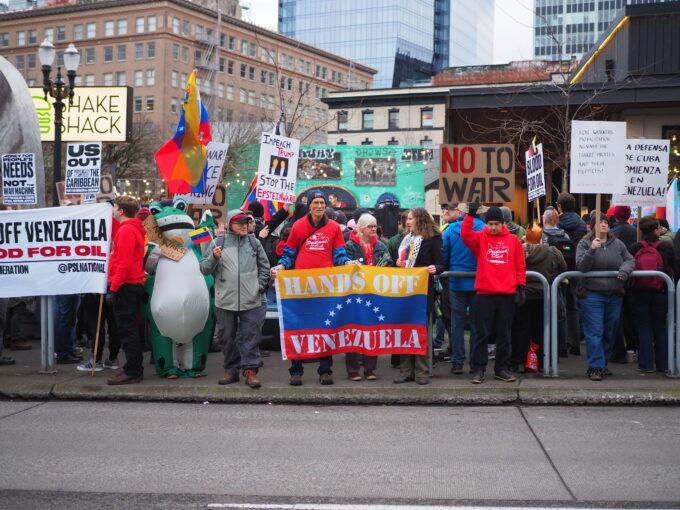
Photograph by Nathaniel St. Clair
On the surface, abducting a Head of State is a piratical act eschewed by States. A Head of State enjoys absolute immunity from foreign criminal jurisdiction, known as ratione personae, at least till the term of office concludes. The International Court of Justice was clear enough about this principle in the 2002 Arrest Warrant Case, holding that high ranked government officials such as a foreign minister are granted immunity under customary international law to enable the effective performance of their functions “on behalf of their respective States.”
That said, international law has been modified on this score by the jurisdiction of the International Criminal Court, whose founding Rome Statute stipulates that the official standing of a serving Head of State is no exemption from criminal responsibility. The effectiveness of this principle lies in the cooperation of State parties, something distinctly unforthcoming regarding certain serving leaders. (Israeli Prime Minister Benjamin Netanyahu springs to mind.)
US domestic law puts all of this to side with the highwayman logic of the Ker-Frisbie doctrine. Decided in Ker v Illinois in 1886, the decision overlooks the way, lawful or otherwise, a defendant is apprehended, even if outside the jurisdiction. Once American soil is reached, judicial proceedings can commence without challenge. The US Department of Justice has further attempted to puncture ancient notions of diplomatic immunity by recategorizing (how else?) the standing of a leader – in this case Venezuela’s Nicolás Maduro – as nothing more than a narco-terrorist. Maduro was seized, explains US Secretary of State Marco Rubio, as part of a law enforcement operation.
In addition to being a violation of the leadership immunity principle, the January 3 kidnapping of Maduro and his wife by US forces was an audacious breach of the sovereignty guarantee under Article 2 of the United Nations Charter. Operation Absolute Resolve involved 150 aircraft, strikes on military infrastructure including surface-to-air missile and communication systems, and various depots. The security fantasists from the White House to the State Department treated Venezuela as not merely a dangerous narco-state but one hosting undesirable foreign elements, but it has never posed a military threat to the US homeland.
In the face of such unalloyed aggression – a crime against peace, if you will – the response from Washington’s allies has been feeble and worse. This is made all the more grotesque for their claims to purity when it comes to defending Western civilisation against the perceived ogres and bogeymen of international relations: Russia and China.
From the United Kingdom, Prime Minister Keir Starmer could not have been clearer about his contempt for the processes of international law. “The UK has long supported a transition of power in Venezuela,” he declared in his January 3 statement. “We regarded Maduro as an illegitimate President and we shed no tears about the end of his regime.” Having given a coating of legitimacy to the banditry of the Trump administration, he could still claim to “support” international law. His government would “discuss the evolving situation with US counterparts in the days ahead as we seek a safe and peaceful transition to a legitimate government that reflects the will of the Venezuelan people.” Certainly, judging from this, the will of President Donald Trump.
An official statement from the European Union released by its high representative, Kaja Kallas, was even more mealy-mouthed: “The EU has repeatedly stated that Nicolás Maduro lacks the legitimacy of a democratically elected president and has advocated for a Venezuelan-led peaceful transition to democracy in the country, respectful of its sovereignty.”
The tactic here involves soiling the subject before paying some false respect for such concepts as democracy and sovereignty. We can do without Maduro, and won’t miss him, but make some modest effort to respect some cardinal virtues when disposing of him. All those involved should show “restraint […] to avoid escalation and to ensure a peaceful resolution of the crisis.”
The arrogance of this position is underlined by the concession to diplomacy’s importance and the role of dialogue, when there has been no dialogue or diplomacy to speak of. “We are in close contact with the United States, as well as regional and international partners to support and facilitate dialogue with all parties involved, leading to a negotiated, democratic, inclusive and peaceful resolution to the crisis, led by Venezuelans.”
From the Canadian Minister for Foreign Affairs, Anita Anand, there was not a whisper of Maduro’s abduction, or the US breach of the UN Charter. The phantom conveniently called the Venezuelan People stood as an alibi for lawbreaking, for they had a “desire to live in a peaceful and democratic society.” And there was the familiar call “on all parties to exercise restraint and uphold international law”, marvellous piffle in the face of illegal abductions.
Australian Prime Minister Anthony Albanese did little to improve upon the weak formula in his shabby statement, similarly skipping over the violations of the UN Charter and Maduro’s abduction. “We urge all parties to support dialogue and diplomacy in order to secure regional stability and prevent escalation.” A bland acknowledgement of “the need to respect democratic principles, human rights and fundamental freedoms” is made, along with the risible reference to supporting “international law and a peaceful, democratic transition in Venezuela that reflects the will of the Venezuelan people.”
Who, then, are these idealised people? Presumably these Venezuelans are the vetted ones, sanitised with the seal of approval, untainted by silly notions of revolution and the poverty reduction measures initially implemented by the government of Hugo Chávez. But if EU officials and other states friendly to Washington thought that a Venezuelan appropriately representative of the People’s Will might be the opposition figure and travesty of a Nobel laureate, María Corina Machado, Trump had other ideas. To date the Maduro loyalist Vice President Delcy Rodríguez, has caught his fickle eye. “I think,” he said with blunt machismo, “it would be very tough for [Machado] to be the leader. She doesn’t have the support within or the respect within the country. She’s a very nice woman, but she doesn’t have the respect”. The Venezuelan people’s choice will be, putting democracy and dialogue to one side, the same as Trump’s.

Late Friday night into early Saturday, I watched the news and scrolled through social media as reports of explosions in Caracas began to spread. I went to sleep unaware of what the morning would bring. Hours later, bleary-eyed and half-blind without my glasses, I woke to headlines announcing that the Trump administration had captured and arrested Venezuelan President Nicolás Maduro in what it called “Operation Absolute Resolve,” transporting him to New York to face narco-trafficking charges. Maduro’s sudden removal is being celebrated by Venezuelans abroad and met with a mix of relief and unease inside the country. But beyond those reactions lies a far more troubling implication: Venezuela will not be the end.
And I mean that in multiple senses, domestic and international alike. Donald Trump has made it abundantly clear that he intends to operate above the law. Under U.S. law, Congress authorizes war, not the president acting unilaterally. For those who insist that Saturday’s operation was not an act of war, international law is far less forgiving. The forcible capture of the head of another state constitutes a use of force prohibited under Article 2(4) of the United Nations Charter, which bars the threat or use of force against the territorial integrity or political independence of any state. Recognition disputes do not create legal loopholes. Even if the administration claims Maduro was not the legitimate president, customary international law, the principle of sovereign equality, and the doctrine of non-intervention make clear that sovereignty cannot be violated absent self-defense or explicit authorization by the UN Security Council, neither of which applies here.
The United States has a long and troubled history of interventions abroad, but this action is unprecedented, especially given that Trump recently pardoned Juan Orlando Hernández in early December of 2025, the former president of Honduras who had been serving a U.S. federal sentence after being convicted of conspiring with major drug traffickers and using the Honduran state apparatus to facilitate the flow of cocaine into the United States. That the same administration now claims moral and legal authority to abduct the sitting leader of another country on narco-trafficking grounds is a contradiction so stark it should set off alarm bells across the international system.
This move comes from an administration that has repeatedly flouted the Constitution and the rule of law, deporting individuals in defiance of federal court orders and judicial stays, undermining asylum and due-process protections, and openly attacking judges who rule against it. It has dismantled or hollowed out federal agencies without congressional authorization, sidelining career civil servants through mass firings and loyalty tests, reviving efforts to reclassify thousands of federal workers to strip them of civil-service protections, and purging inspectors general charged with oversight and accountability.
The administration has deployed federal forces and the National Guard in ways that raised serious legal questions about the limits of executive authority, while engaging in blatant nepotism by elevating family members and close political allies into positions of influence. All of this has unfolded alongside the routine use of the presidency as a vehicle for personal and family enrichment, from steering government business toward Trump-owned properties to leveraging public office for private financial and political gain.
What still haunts me is the Vanity Fair article, a two-part profile by journalist and author Chris Whipple titled “Susie Wiles, JD Vance, and the ‘Junkyard Dogs’: The White House Chief of Staff on Trump’s Second Term.” Published in mid-December 2025, it was based on 11 on-the-record interviews with Trump’s chief of staff, Susie Wiles. The article was widely laughed off across social media as comedy, a knowing nod to truths many of us already sensed, its characters caricatured and cast aside in jest, but in retrospect it reads less like insider gossip and more like a warning flare. Wiles states plainly that Donald Trump operates with the belief that there is nothing he cannot do. Nothing. Zero. Nothing. A sitting president who believes there are no limits is not projecting strength. He is advertising danger, lawlessness, and impunity.
For Donald Trump and the cabal of wealthy patrons, both inside and outside his cabinet, the very idea of accountability feels foreign, a belief that by nearly every measure has been reinforced rather than challenged. But recognizing that reality means confronting another one. Venezuela will not be the end, not by a long shot. Whenever Trump needs a quick political win to satisfy his demand for ego and legitimacy, whether foreign or domestic, he has shown he will take it by any means necessary. Logic, strategy, vision, and responsible statecraft be damned. This is, after all, the same man who pressured a governor to “find” votes to overturn the 2020 election, conduct detailed in damning evidence and reinforced by Special Counsel Jack Smith’s recent congressional testimony, and who has consistently sought to deflect scrutiny from unresolved questions surrounding the Jeffrey Epstein files. There are several recent incidents that lay bare this irrational and impulsive governing style, including the rush to frame overseas violence as political theater rather than sober diplomacy and hollow gestures at home dressed up as patriotism, such as the much-publicized $1,776 bonuses supposedly derived from tariffs and issued to military members, later revealed to be repackaged housing allowances they were already entitled to receive. Each episode follows the same script: spectacle over substance, symbolism over strategy, distraction in place of accountability.
We do not need a history lesson or another ritual invocation of past horrors. The writing is already on the wall: we know what happens when autocrats go unchecked, and when imperial ambitions inevitably collide with reality.
How and whether our elected officials, and Americans at large, respond now will determine what comes next. Maybe it is Greenland. Maybe Mexico. Maybe Canada. Perhaps there really is a third term after all, or the arrest of political opponents and dissenters. Why not? The law no longer appears to function as a bulwark, a barrier, or a meaningful deterrent for this administration and its whims.
Some members of Congress across the aisle have begun expressing concern after the administration’s operation to capture Maduro, with debate largely tracking partisan lines. Democrats have raised objections with little emphasis on accountability, amounting to more performative bluster than consequence. Republicans have largely supported the operation, often to placate Trump and advance their own ambitions, though a smaller number have questioned how it aligns with the president’s professed “America First” agenda. Still others, exhausted by the daily chaos, are choosing to exit Congress rather than confront the consequences of speaking out.
Nonetheless, without real accountability, Venezuela will not be the last episode of lawlessness and chaos we witness. And without any desire to sound hyperbolic or paranoid, what comes next may be far more sinister.
Jared O. Bell, PhD, syndicated with PeaceVoice, is a former U.S. diplomat and scholar of human rights and transitional justice, dedicated to advancing global equity and systemic reform.
Sleepless Again: Or What the World of Yesterday Says About Trump’s Attack on Venezuela and the World of Today
January 6, 2026
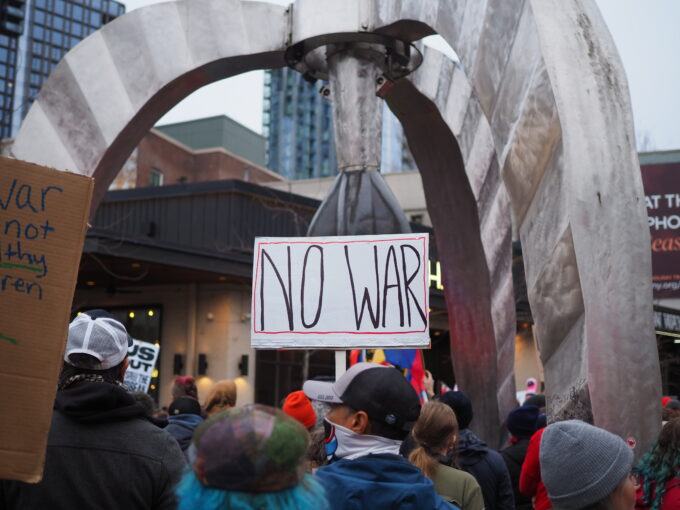
Photograph by Nathaniel St. Clair
“[…] our universe had become accustomed to inhumanity, to lawlessness, and brutality as never in centuries before.”
– Stefan Zweig, The World of Yesterday
Things don’t happen randomly. The shocking news of Donald Trump’s attack on Venezuela broke on the 101stanniversary of Benito Mussolini’s announcement to the Italian parliament accepting full responsibility for blackshirt violence and declaring himself dictator of Italy. That gesture—greeted by applause, complicit silence, and opportunistic support—ushered in fascism, the Spanish Civil War, and the Second World War. History isn’t a machine, automatically repeating itself, but it does rhyme, as Mark Twain is said to have commented. And sometimes it rhymes in macabre ways.
Stefan Zweig was one of the first to see this. In his 1914 essay “The Sleepless World” published in the collection Messages from a Lost World: Europe on the Brink and composed before and during the Second World War, he describes a civilisation that can’t sleep because it no longer trusts itself. This insomnia isn’t a malady of individuals but a symptom of systemic collapse. The world can’t sleep when violence ceases to be the exception to become method, and when lying ceases to be an aberration to become state policy.
In The World of Yesterday, written in exile and posthumously published in 1942, Zweig develops this insight into his testimony and bequest, with a book that is an ethical autopsy of the liberal, cosmopolitan, and humanist Europe which naively believed that technical progress would automatically lead to moral progress. He describes how aggrieved nationalism, the cult of power, and contempt for truth pave the way for fascism, not as an accident but as the logical product of an epoch.
Zweig knew that fascism doesn’t start with bombs. It starts with applause. It doesn’t begin with extermination camps. It begins with legitimation of exception, of “necessary” violence, and of the convenient lie.
It’s not impossible to see how all this is at work in today’s world, even when we’re stunned like a deer in headlights.
Donald Trump’s attack on Venezuela, announced, commended, and legitimised in public statements made by none other than Trump himself, opens up a new level of global lawlessness. An attack on a sovereign Latin American nation, the sequestering of its president and his wife, references to “our” oil, and the demand for political submission now called “transition”, undisguisedly reveal, now it’s dispensing with old rhetorical scruples, how the imperial logic has never ceased to operate.
Any moralistic touch of words like “dictatorship”, “freedom”, and “democracy” is sugaring the pill. The focus isn’t hidden: Venezuelan oil, the world’s largest reserves. As in other times, “democracy” is invoked only if it coincides with the empire’s economic interests. Otherwise, it is unceremoniously junked.
US hypocrisy isn’t episodic but structural. The country that calls itself the world’s greatest democracy has constructed its hegemony by installing and supporting dictatorships, sponsoring and funding coups, underpinning authoritarian regimes, making deals with all sorts of criminals as long as they serve its policy and, right now, complicity in genocide. Venezuela fits the pattern as just one more chapter in a long history of colonial and neocolonial pillage.
In this context, the granting of the Nobel Peace Prize to María Corina Machado has played a decisive symbolic role. By awarding a person who presents herself as an alternative to the elected Venezuelan government and who publicly expresses her gratitude to Trump for helping her to gain such distinguished recognition, the Nobel Foundation made its contribution to international endorsement of the attack. The Prize, far from fostering peace, once again paves the way for war, as happens so often when supposedly peace-loving institutions, wittingly or unwittingly go along with the logic of power.
With characteristic perverse petulance, Trump lobbied for months to be given the Nobel Prize and when it went to an opposition leader of one of his top black-list countries, he claimed that Machado said she was accepting it in his honour because he was the one who really deserved it. But Trump is the world leader with a National Security Strategy that clearly says there are no allies now, but only interests so, after his attack on Venezuela he threw Machado to the wolves, saying she doesn’t have the “respect” of her country to govern. So he says he will “run” Venezuela with his own henchmen, apparently including US secretary of state, Marco Rubio, defence secretary, Pete Hegseth, and the joint chiefs of staff chair, Gen Dan “Razin” Caine. This isn’t mere bravado but a naked expression of the lesson learned from Mussolini, that violence doesn’t always need to be justified. It only has to be announced.
In Latin America, those applauding his coup are no surprise. In Brazil, far-right governors of several states—Ratinho Jr. (Paraná), Ronaldo Caiado (Goiás), Romeu Zema (Minas Gerais), and Tarcísio de Freitas (São Paulo)—flunkies of empire, did what was expected of them and, in their particular nauseating style, rushed to applaud their fellow criminal.
In their states they understand these things. Their police, militias, and thugs kill poor Black people in slums, landless workers, and Indigenous people, while in their self-made cesspools they prattle about “freedom” and “democracy” even though liberal verbiage can’t cover up the everyday practice of murder.
Of these Four Horsemen, Tarcísio de Freitas, the worst of the bearers of pestilence, is a military man trained in the culture of the coup d’etat, an unscrupulous, profiteering governor, up to his neck in corruption schemes based on privatisation of public assets in São Paulo, a sadist who publicly celebrates police killings, and open admirer of torturers of Brazil’s military dictatorship. This man offers to help the US with the “transition to democracy in Venezuela”.
In online sites, today’s platform-states underpinning contemporary falsolatry and plundering neocolonialism, Brazil’s sleazy far-right yes-men are having a field day applauding what mainstream media outlets are describing as Trump’s “audacious” commandeering of Venezuela. Indifferent when their own people are massacred, they rejoice in this latest attempt to humiliate a kindred country.
Stefan Zweig would immediately recognise the situation. He knew that fascism never requires intelligence but only blind emotional loyalty. It doesn’t demand truth but only belief. It doesn’t want learning but only rancour. The world is again sleepless because it is now seeing—too late—that barbarism doesn’t gatecrash. It’s invited.
The same old fascists.
The same vicious fools with no regard for human life.
The same vassals who’ve learned and remember nothing.
The same coup-plotting trash dressed up as leaders.
We can’t recover the world of yesterday, that’s for sure. And today’s insomnia doesn’t let us dream. But we must stay alert and ready for action to defend, in any way we can, true democracy, the sovereignty of peoples, and solidarity. Or, in other words, liberty, equality, and fraternity.
Venezuela and Congress’s Duty to Act
Image by Elijah Mears.
The elements behind Trump’s war on Venezuela are fourfold.
They center on the theft of Venezuela’s oil; the removal of Cuba’s primary lifeline; the protection of the dollar-based petrodollar; and Trump’s desperate need to deflect attention from the deepening quagmire that is the Epstein scandal.
And the ultimate question they raise is: will his blatantly illegal violation of U.S. and international law finally result in the impeachment and removal of Trump from the White House or the 2026 mid-term elections lead to an end of his destructive control of the U.S. government.
The lethal litany of reasons for Trump’s invasion is led by the U.S. seeking Venezuela’s huge reserves of oil—it supposedly has 303 billion barrels compared to the U.S. with but 45. After Venezuela is Saudi Arabia with 267 and Iran with 208 and then the list drops by 100.
“Venezuela unilaterally seized and sold American oil, American assets and American platform, costing us billions and billions of dollars,” said Trump after the U.S. struck Venezuela and captured its president, Nicolas Maduro, and his wife, and flew them to New York to be tried on drug charges. Venezuela “did this a while ago, but we never had a president that did anything about it. They took all of our property….The socialist regime stole it from us during those previous administrations.”
“Seizing a nation’s oil provides no legal basis for waging war or committing murder,” said David Swanson, executive director of the organization World BEYOND War as he announced a “Global Day of Action on January 17” named “No War on Venezuela.”
Swanson said: “We need to be protesting at every U.S. embassy the world over, at every state and local government in the United States, and in Washington D.C. in a manner to prevent the functioning of the Monrovian [for Monroe Doctrine] mafia.”
Swanson also said: “We can call it refreshing and exciting that Trump makes no pretense about hiding this motive. But ugly reasons for crimes don’t legalize them any more than beautiful ones.”
U.S. Senator Chris Van Hollen, a Maryland Democrat, on the “Face the Nation” TV program Sunday said that “you don’t invade a country to grab their resources….This, from the beginning, has been about getting rid of Maduro, grabbing Venezuela’s oil for American oil companies and Trump’s billionaire buddies. That’s what this is about. That’s why Donald Trump spent so much time yesterday talking about oil….They took out the leader, and now they’re demanding access to Venezuela’s oil. That’s what this has been about. I mean, Donald Trump, you know, claimed that he’d been against the war in Iraq from the beginning. That wasn’t true, but what we do know is he said, well, having gone into Iraq, we should have gotten their oil….I think it’s outrageous that the president of the United States puts American lives at risk so big American oil companies and his billionaire buddies can profit.”
As to eliminating the flow of oil from Venezuela to Cuba, this represents a high priority for the U.S. and especially Trump and Marco Rubio, his secretary of state and also national security advisor from a family that are exiles from Cuba.
As NBC News reported Sunday: “Just one day after the U.S. conducted a military operation that led to the capture of Venezuelan leader Nicolas Maduro and his wife, Secretary of State Marco Rubio reiterated a warning to Cuba, telling NBC News’ ‘Meet the Press’ that he thinks “they’re in a lot of trouble.”
“I’m not going to talk to you about what our future steps are going to be and our policies are going to be right now in this regard, Rubio said. But I don’t think it’s any mystery that we are not big bans of the Cuban regime, who, by the way, are the ones that were propping up Maduro.”
“Rubio’s latest remarks come after he and President Donald Trump signaled at a new conference Saturday that the administration could begin targeting Cuba’s government next, with the secretary of state issuing a stern warning to Cuban officials: ‘If I lived in Havana and I was in the government, I’d be concerned.’”
Then there is keeping the petrodollar U.S. dollar-based. “The Minority Report” ran a piece Sunday on Substack headed: “The Real Reason Why the U.S. Overthrew Venezuela. And why it all started in China in November 2025.”
The article explained:
“In November 2025, something extraordinary happened in Hong Kong that most people missed entirely….Chinese bonds began trading at ‘lower yields’ than United States Treasury bonds….In the hierarchy of global finance, this is roughly equivalent to a challenger brand outselling Coca-Cola at a higher price. It simply doesn’t happen. Until it did. One month later, the United States began mobilizing for potential intervention in Venezuela.”
“If you think these events are unrelated, you’re missing the most important geopolitical story of our generation. This is about the slow-motion collapse of the architecture that has supported American power for half a century: the dollar’s role as the world’s dominant reserve currency. And Venezuela, improbably, has become ground zero in the fight to preserve it….”
“Since the 1944 Bretton Woods agreement, and especially after the 1973 arrangement with Saudi Arabia that created the ‘petrodollar,’ the U.S, dollar has functioned as the world’s primary reserve currency. This status grants the United States an almost supernatural economic power. When you need dollars to buy oil, settle international debts, or participate in global trade, you create automatic demand for American currency…. More importantly, dollar dominance became America’s most powerful geopolitical weapon. Control the dollar system, and you control access to the global economy. Step out of line, and the United States can cut you off from SWIFT (the international banking communication network), freeze your reserves held in dollars, or impose sanctions that amount to economic excommunication….”
“Which brings us, inexorably, to Venezuela. On the surface, American interest in this South American nation might seem driven by concerns about authoritarianism or humanitarian crisis. Dig deeper, and you’ll find something more fundamental: Venezuela represents an existential threat to the petrodollar system, and by extension, to American global power itself.”
“Venezuela possesses the world’s largest proven oil reserves; 303 billion barrels….And since 2018, Venezuela has sold 100% of its oil exports to China, with transactions settled in yuan, not dollars. Moreover, Venezuela became an official BRICS+ partner nation in 2024, gaining access to the bloc’s alternative payment systems, development financing, and diplomatic protection.”
“Here’s what makes this particularly dangerous from Washington’s perspective: Venezuela isn’t just surviving outside the dollar system; it’s functioning. Despite what the U.S. Treasury Department characterizes as ‘unprecedented sanctions,’ Venezuela has maintained oil production, secured financing, and sustained trade relationships. It’s become a living, breathing advertisement that the dollar system is optional, not mandatory….”
“The timing of U.S. military mobilization; just one month after China’s Hong Kong bond proved the viability of dollar alternatives; is no accident. It’s the empire’s immune system responding to a pathogen it recognizes as lethal.”
Then there’s the “wag the dog” factor: Trump seeking to divert public attention from further disclosures about the Jeffrey Epstein scandal involving him—and doing it with military action. This message about the Venezuela situation and how people should “never underestimate what Trump will do to draw to draw attention from Jeffrey Epstein” is being delivered by the long-time Democratic political strategist James Carville.
“Wag the Dog” was the 1997 film, a political satire, centering on a spin doctor and a Hollywood producer fabricating a war in Albania to distract voters from a presidential sex scandal.
A corollary of that is the claim Saturday by former U.S. Transportation Secretary Peter Buttigieg on X about: “An unpopular president—failing on the economy and losing his grip on power at home—decides to launch a war for regime change abroad. The American people don’t want to ‘run’ a foreign country while our leaders fail to improve life in this one.”
Meanwhile, in an article in The New York Times, White House correspondents David E. Sanger and Tyler Page wrote about how Saturday Trump said that the U.S. planned to “’run’ Venezuela for an unspecified period, issuing orders to its government and exploiting its vast oil reserves.”
They wrote that Trump’s “actions on Saturday cast America back to a past era of gunboat diplomacy, when the United States used its military to grab territory and resources for its own benefit. A year ago this week, he openly mused, also at Mar-a-Lago, about making Canada, Greenland and Panama parts of the United States. Now, after hanging in the White House a portrait of William McKinley, the tariff-loving president who presided over the military seizure of the Philippines, Guam and Puerto Rico, Mr. Trump said it was well within the rights of the United States to wrest from Venezuela resources that he believes had been wrongly taken from the hands of American corporations. The U.S. operation, in seeking to assert control over a vast Latin American nation, has little precedent in recent decades, recalling the U.S. military efforts of the 19th and early 20th centuries in Mexico, Nicaragua and other countries.”
Meanwhile, the New York Review of Books published a piece Saturday by David Cole headed “Trump’s War” with a subhead: “The invasion of Venezuela is not law enforcement; it is imperialism, pure and simple.”
It began: “’It was a brilliant operation, actually.’ So claimed Donald Trump early this morning in a phone call with The New York Times about the US military’s overnight invasion and bombing of Venezuela, culminating in the abduction of Venezuelan president Nicolás Maduro and his wife, who have been brought to New York to face an indictment for drug smuggling.”
“It was an illegal operation, actually. Illegal on so many fronts that it can be challenging to keep them straight. First, and most importantly, it violates the bedrock rule of international law, which prohibits nations from attacking other sovereign states except when authorized by the UN itself or when acting in self-defense. Trump has invoked self-defense for all his aggressive actions against Venezuela, from summarily executing at least 115 people in unprovoked assaults from the air on boats alleged to be carrying drugs in international waters, to destroying a loading dock in the country itself and, now, bombing Caracas and abducting Maduro. The basis for that claim, Trump insists, is that Maduro has facilitated the smuggling of drugs into the United States, and that those drugs in turn kill thousands of Americans each year. But self-defense applies only in response to an actual or imminent armed attack, and whatever else drug smuggling might be, it is not even conceivably an armed attack. (According to US records, moreover, Venezuela is not even a source of fentanyl, the lethal drug that has been the agent of many of those overdose deaths and that Trump recently labeled a ‘weapon of mass destruction.” It mostly comes from Mexico.) Quite simply, Venezuela has not attacked the United States. The only nation with a self-defense justification here is Venezuela.”
The piece continued: “The attack also violated the U.S. Constitution, which gives Congress, not the president, the power to declare war and authorize the use of military force. The only situation in which presidents can constitutionally conduct unilateral military action is, again, in self-defense against an ongoing or imminent armed attack. The Venezuelan operation also violated the War Powers Resolution, which requires the president to notify Congress before introducing troops into any situation of ongoing or imminent hostilities.”
The question for the Congress, the people of the United States and the world now becomes: will this violation of all tenets of U.S. and international law finally lead to the removal of this madman from the White House?
by Ron Paul | Jan 5, 2026 | ANTIWAR.COM
As was the case the morning after “Shock and Awe” signaled the start of the Iraq war, many are cheering the US military raid on Venezuela and capture of its president, Nicolas Maduro. Overwhelming US military power – and likely some bribed Venezuelan officials – ensured that the operation was swift and dramatic.
This was not a war, we were told. It was just a surgical operation to remove a criminal dictator and restore democracy to the country. American oil companies would soon get even richer exploiting the country’s vast oil reserves. This time it will be different!
If all of this sounds familiar that’s because it is the same narrative used each time the US has launched a “regime change” operation this century.
The Iraq war would be a “cake walk,” they swore. Skeptics were ridiculed. The staged demolition of the Saddam Hussein statue in Baghdad marked the triumph of that short US military operation.
The “liberation” of Iraq was to be the first domino in the coming revolution throughout the Middle East, we were promised. Just weeks into the operation, then-President George W. Bush landed on an aircraft carrier with a huge “Mission Accomplished” banner behind him.
Then everything fell apart. The US could not “run” Iraq. It could only use brutal force – and torture – to give the impression that we would soon turn the corner. Victory was at hand. Just send more troops and spend a little more money.
But none of it did the trick. None of it worked.
In the end, the US sunk trillions into the failed “nation-building” operation in Iraq and upwards of a million people died including thousands of US troops.
And here we go again.
Despite being elected on promises of “no new wars” and “no nation-building,” President Trump used military force against Venezuela, kidnapped the country’s president, and declared that “we” would be running the country from now on.
After the operation in Venezuela, President Trump took a “Mission Accomplished” victory lap of his own in a press conference where he declared that US oil companies would return to Venezuela under US protection and that we would “run” Venezuela for the time being.
“The oil companies are going to spend money… we are going to get reimbursed,” he said.
But there’s more to come.
President Trump’s Venezuela raid and kidnapping occurred just as Israeli prime minister Netanyahu was departing the country. According to press reports, Netanyahu was in town to persuade President Trump to send the US military back into Iran. Israeli officials have openly stated that the US operation in Venezuela is the warm-up for the next round of US “regime change” – in Iran.
Warmongering US Senator Lindsey Graham has taken to the television news programs to urge President Trump to continue on to Cuba and then Iran. President Trump seemed to agree, stating that, “we have to do it again. We can do it again, too. Nobody can stop us.”
Venezuela was just another neocon operation. First comes propaganda demonizing the country and its leadership. Then comes saber-rattling and threats of war. The operation is launched and the “objectives” are quickly reached. Or so they claim. But then it all falls apart. We become poorer as the special interests get richer. And those we claim to be liberating suffer worse than under the previous regime.
Will we ever learn?
Corporations Are Ready to Cash In on Venezuela
Source: Jacobin A Final Toast – by Mr. Fish
Just weeks before the American military operation in Venezuela to capture President Nicolás Maduro, the US energy giant Halliburton filed an unusual lawsuit in international court claiming the Venezuelan government owed them damages for US sanctions against the country.
A separate case against Venezuela is also being pursued by another fossil fuel giant whose board includes an oil magnate whose family has delivered large financial contributions to Republicans and conservative causes. One family member poured tens of thousands of dollars into a political committee focused on reelecting President Donald Trump in 2024.
Such companies with pending claims could now be among the first in line to receive a massive windfall from a new Trump-installed Venezuelan government that is willing to funnel the South American country’s cash to corporate plaintiffs.
Shortly after the US military operation on January 3, Trump declared that the United States would “run” Venezuela, along with making investments in the country’s oil and gas infrastructure and selling state-run oil assets. Venezuela is home to the largest oil reserves in the world, representing about 17 percent of the world’s global supply, though much of the country’s reserves remain untapped.
In all, Venezuela is facing nine pending cases launched by investors and major corporations alleging financial damages related to the country’s nationalization of state industries, international sanctions, and political instability. The country has settled dozens more in recent decades.
These cases are arbitrated within the World Bank’s International Centre for Settlement of Investment Disputes, a governing body that has been widely criticized for prioritizing investors’ interests over those of sovereign states, and particularly those of developing nations. In 17 percent of such cases, the host country has been forced to settle.
A US-backed Venezuelan government could settle those cases or fail to adequately argue their side in court, using Venezuela’s resources to award companies with hundreds of millions in damages.
Halliburton’s case seeks damages for the roughly $200 million in losses it allegedly incurred between 2016 and 2020 as it began to cease operations in the country to comply with the US sanctions first imposed in 2005 and escalated in 2017 and 2020. But Halliburton is blaming Venezuela’s domestic instability for those losses and demanding the country now pay up.
Such a legal argument is reportedly rare in arbitration courts, and some financial analysts argued the move indicated that Halliburton potentially expected a military operation in Venezuela to install a more friendly government willing to cut a deal to make them whole. GOP allies have directly cited Halliburton as one of the energy companies that could invest in Venezuela to “rebuild their country” after regime change, as Trump’s former US secretary of state Mike Pompeo told Fox News in December.
In a separate case filed in the World Bank’s arbitration courts, natural gas conglomerate the Williams Companies is seeking damages over a disputed contract and Venezuela’s nationalization of fossil fuel infrastructure in the early 2000s.
Williams’s board includes Scott Sheffield, whose family has donated more than $6 million over the last fifteen years, mostly to conservative causes and Republican candidates. That includes $165,200 worth of donations in 2024 from Sheffield’s son Bryan to the Republican National Committee, according to Federal Election Commission data compiled by the watchdog group Public Citizen. Those donations were earmarked for the “Trump 47 Committee,” a joint fundraising committee to support Trump’s 2024 campaign.
Other companies with pending cases against Venezuela for nationalizing their assets and causing other business disruptions include the food giant Kellogg’s, the cement and construction firm Holcim Group, packaging conglomerate Smurfit, and Gold Reserve, a mining conglomerate whose largest investors include a trio of US investment firms.
The Irish company Smurfit, which is publicly traded on the New York Stock Exchange, won a $469 million arbitration case against Venezuela last year over the company’s 2018 seizure of its assets in the country and has since filed for additional damages.
For years, US and other Western firms have sued the Venezuelan government in international arbitration courts for expropriated property and unpaid debts.
In 2019, the US oil and gas giant ConocoPhillips won nearly $9 billion in the World Bank’s arbitration court after Venezuela’s former president, Hugo Chávez, nationalized the company’s oil assets nearly eighteen years earlier. And in 2021, Koch Industries won a $444 million case against the country for the expropriation of its fertilizer business by Chávez in 2010.
Halliburton’s arbitration case, however, involves a different argument. The company’s exit from the market was the direct result of US sanctions imposed on Venezuela in 2017 and 2020, not state nationalization. According to the Global Arbitration Review’s summary of the filing, Halliburton blames both US sanctions and Venezuelan policy failures for the financial losses it incurred but is suing only Venezuela for damages.
“Halliburton also notes that changes in the Venezuelan government’s exchange rate and U.S. sanctions further complicated the viability of its operations in the country,” reads the review of the legal brief. Although Venezuela withdrew from the international treaty that enforces the World Bank’s arbitration rules in 2012, the country has still been forced to participate in these cases and abide by the court’s rulings.
An energy service company, Halliburton operates oil drilling infrastructure around the world, including the Deepwater Horizon offshore drilling rig that led to the fatal and environmentally catastrophic 2010 Gulf of Mexico oil spill. Since the 1940s, the company has been involved in extracting Venezuela’s massive oil reserves.
Halliburton has previously benefited from US regime-change efforts. In 2003, Vice President Dick Cheney, the company’s former CEO, helped launch the Iraq War. After the country’s military-backed regime change, Cheney’s onetime employer secured lucrative contracts with the new US occupying force to administer the country’s energy production.

Just weeks before the American military operation in Venezuela to capture President Nicolás Maduro, the US energy giant Halliburton filed an unusual lawsuit in international court claiming the Venezuelan government owed them damages for US sanctions against the country.
A separate case against Venezuela is also being pursued by another fossil fuel giant whose board includes an oil magnate whose family has delivered large financial contributions to Republicans and conservative causes. One family member poured tens of thousands of dollars into a political committee focused on reelecting President Donald Trump in 2024.
Such companies with pending claims could now be among the first in line to receive a massive windfall from a new Trump-installed Venezuelan government that is willing to funnel the South American country’s cash to corporate plaintiffs.
Shortly after the US military operation on January 3, Trump declared that the United States would “run” Venezuela, along with making investments in the country’s oil and gas infrastructure and selling state-run oil assets. Venezuela is home to the largest oil reserves in the world, representing about 17 percent of the world’s global supply, though much of the country’s reserves remain untapped.
In all, Venezuela is facing nine pending cases launched by investors and major corporations alleging financial damages related to the country’s nationalization of state industries, international sanctions, and political instability. The country has settled dozens more in recent decades.
These cases are arbitrated within the World Bank’s International Centre for Settlement of Investment Disputes, a governing body that has been widely criticized for prioritizing investors’ interests over those of sovereign states, and particularly those of developing nations. In 17 percent of such cases, the host country has been forced to settle.
A US-backed Venezuelan government could settle those cases or fail to adequately argue their side in court, using Venezuela’s resources to award companies with hundreds of millions in damages.
Halliburton’s case seeks damages for the roughly $200 million in losses it allegedly incurred between 2016 and 2020 as it began to cease operations in the country to comply with the US sanctions first imposed in 2005 and escalated in 2017 and 2020. But Halliburton is blaming Venezuela’s domestic instability for those losses and demanding the country now pay up.
Such a legal argument is reportedly rare in arbitration courts, and some financial analysts argued the move indicated that Halliburton potentially expected a military operation in Venezuela to install a more friendly government willing to cut a deal to make them whole. GOP allies have directly cited Halliburton as one of the energy companies that could invest in Venezuela to “rebuild their country” after regime change, as Trump’s former US secretary of state Mike Pompeo told Fox News in December.
In a separate case filed in the World Bank’s arbitration courts, natural gas conglomerate the Williams Companies is seeking damages over a disputed contract and Venezuela’s nationalization of fossil fuel infrastructure in the early 2000s.
Williams’s board includes Scott Sheffield, whose family has donated more than $6 million over the last fifteen years, mostly to conservative causes and Republican candidates. That includes $165,200 worth of donations in 2024 from Sheffield’s son Bryan to the Republican National Committee, according to Federal Election Commission data compiled by the watchdog group Public Citizen. Those donations were earmarked for the “Trump 47 Committee,” a joint fundraising committee to support Trump’s 2024 campaign.
Other companies with pending cases against Venezuela for nationalizing their assets and causing other business disruptions include the food giant Kellogg’s, the cement and construction firm Holcim Group, packaging conglomerate Smurfit, and Gold Reserve, a mining conglomerate whose largest investors include a trio of US investment firms.
The Irish company Smurfit, which is publicly traded on the New York Stock Exchange, won a $469 million arbitration case against Venezuela last year over the company’s 2018 seizure of its assets in the country and has since filed for additional damages.
For years, US and other Western firms have sued the Venezuelan government in international arbitration courts for expropriated property and unpaid debts.
In 2019, the US oil and gas giant ConocoPhillips won nearly $9 billion in the World Bank’s arbitration court after Venezuela’s former president, Hugo Chávez, nationalized the company’s oil assets nearly eighteen years earlier. And in 2021, Koch Industries won a $444 million case against the country for the expropriation of its fertilizer business by Chávez in 2010.
Halliburton’s arbitration case, however, involves a different argument. The company’s exit from the market was the direct result of US sanctions imposed on Venezuela in 2017 and 2020, not state nationalization. According to the Global Arbitration Review’s summary of the filing, Halliburton blames both US sanctions and Venezuelan policy failures for the financial losses it incurred but is suing only Venezuela for damages.
“Halliburton also notes that changes in the Venezuelan government’s exchange rate and U.S. sanctions further complicated the viability of its operations in the country,” reads the review of the legal brief. Although Venezuela withdrew from the international treaty that enforces the World Bank’s arbitration rules in 2012, the country has still been forced to participate in these cases and abide by the court’s rulings.
An energy service company, Halliburton operates oil drilling infrastructure around the world, including the Deepwater Horizon offshore drilling rig that led to the fatal and environmentally catastrophic 2010 Gulf of Mexico oil spill. Since the 1940s, the company has been involved in extracting Venezuela’s massive oil reserves.
Halliburton has previously benefited from US regime-change efforts. In 2003, Vice President Dick Cheney, the company’s former CEO, helped launch the Iraq War. After the country’s military-backed regime change, Cheney’s onetime employer secured lucrative contracts with the new US occupying force to administer the country’s energy production.
Venezuela: The United States Against the Sovereignty of Nations
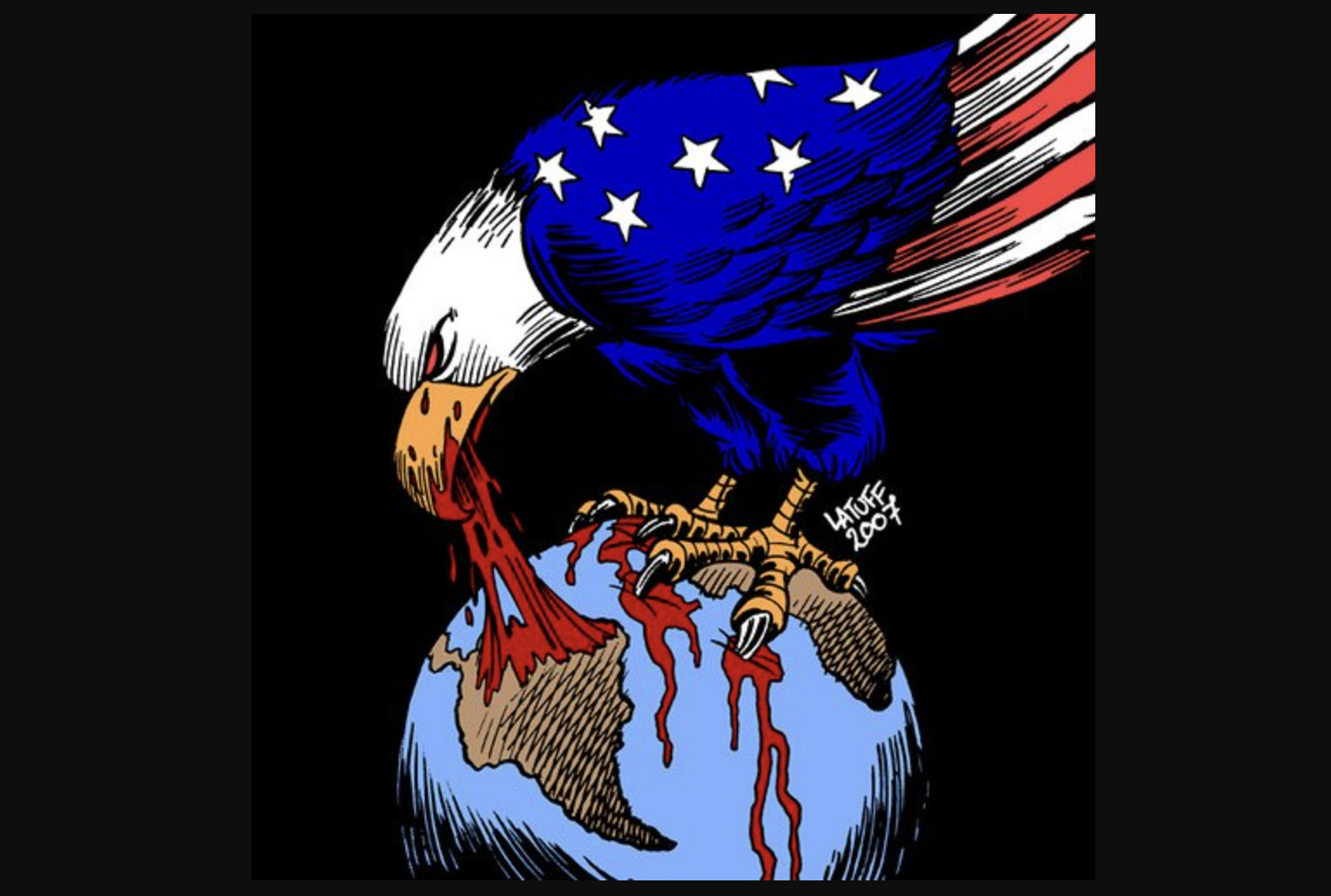
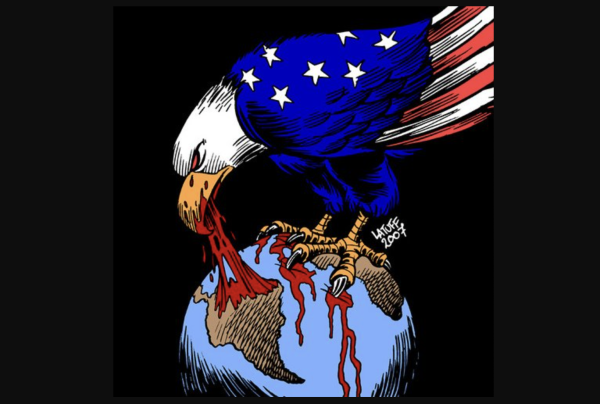 Art by Latuff | Image source: @outsidersesp/X
On January 3, 2026, at two o’clock in the morning, the United States declared war on Venezuela by bombing several strategic sectors of the capital and kidnapping the elected president, Nicolás Maduro. The latter, the victim of a betrayal at the highest level, was captured by elite troops from U.S. Special Forces during an operation that lasted barely half an hour. He was transferred to New York, accompanied by his wife, Cilia Flores, who was also seized during Operation Absolute Resolve.
This blatant act of aggression against Venezuela’s sovereignty violates the most basic rules of international law, in particular Article 1 of the United Nations Charter, which states that member states must “maintain international peace and security,” “suppress acts of aggression,” and preserve “respect for the principle of equal rights of peoples.” Article 2, which prohibits any “threat or use of force against the territorial integrity or political independence of any state,” has likewise been rendered meaningless.
The military venture launched by the Trump administration, which constitutes an act of war under the law of armed conflict in the Geneva Conventions, also contravenes the Constitution of the United States, which specifies in Article I, Section 8 that only Congress has the power to declare war. By evading this legal obligation, the U.S. president flouts the legislation of his own country and demonstrates his contempt for the rule of law, preferring instead the law of the strongest.
The pretext used to justify this extremely serious action — namely the alleged involvement of President Maduro in drug trafficking — does not withstand even the most superficial analysis. First, according to the Drug Enforcement Administration, Venezuela is not a drug-producing country but merely a transit nation through which only a marginal share of cocaine shipments bound for the United States passes — roughly 8 percent. Second, Washington has provided no evidence whatsoever to demonstrate the Venezuelan government’s involvement in such a network. Finally, in December 2025, Trump pardoned former Honduran president Juan Orlando Hernández, who had been sentenced by U.S. courts to forty-five years in prison for exporting 400 tons of cocaine to the United States, revealing the deceptive nature of the accusation.
In reality, the United States is determined to seize Venezuela’s oil, as the country holds the world’s largest reserves. Since Hugo Chávez came to power in 1999, Caracas has regained control of its natural resources, redistributing wealth more equitably while developing trade relations with other emerging powers, primarily China. Determined to overthrow the Bolivarian government, Washington has imposed harsh economic sanctions on Venezuela for more than a decade.
In recent months, the Trump administration has imposed an oil blockade, illegally seizing several vessels and millions of barrels of oil. Added to this is the deployment of a major U.S. military armada off the Venezuelan coast — an aircraft carrier, seven warships, more than a hundred fighter jets, and 15,000 troops — which has carried out repeated illegal attacks on civilian vessels in the Caribbean Sea, along with extrajudicial executions. It was this show of unprecedented force that made Maduro’s abduction possible.
President Trump, who has reactivated the Monroe Doctrine — supplemented with the “Trump Corollary” and rebranded as the “Donroe Doctrine” — has clearly expressed his desire to “restore American preeminence.” In a return to unapologetic imperialism, he has emphasized that the American continent is the United States’ exclusive sphere of influence. He has also declared that the era of sovereign equality among states is over for Latin America, and that the continent’s resources must be directed first and foremost toward U.S. strategic interests.
As for Venezuela’s future, the Trump administration has openly laid out its predatory intentions: “We are going to run the country until we can carry out a safe transition. We are going to bring in our very large corporations.” As for Venezuelan oil, it is said to be the “property” of the United States: “We built Venezuela’s oil industry with American talent, determination, and skills, and the socialist regime stole it from us.” These statements sum up the imperial logic underlying this military intervention.
From the international community, countries such as China, Russia, Brazil, Mexico, Chile, Cuba, Spain, Uruguay, and Colombia have condemned the U.S.-orchestrated military aggression against Venezuela and its president. For their part, the European Union, France, and Italy, among others, have instead refused to condemn this flagrant violation of international law and have even supported this show of force — revealing to the world their duplicity and submission. The contrast between these reactions highlights the deep geopolitical fracture of the present moment.
One thing is certain: the international order born after 1945 has been definitively buried, replaced by the law of the strongest, which now stands as the implicit norm of international relations.
On January 3, 2026, at two o’clock in the morning, the United States declared war on Venezuela by bombing several strategic sectors of the capital and kidnapping the elected president, Nicolás Maduro. The latter, the victim of a betrayal at the highest level, was captured by elite troops from U.S. Special Forces during an operation that lasted barely half an hour. He was transferred to New York, accompanied by his wife, Cilia Flores, who was also seized during Operation Absolute Resolve.
This blatant act of aggression against Venezuela’s sovereignty violates the most basic rules of international law, in particular Article 1 of the United Nations Charter, which states that member states must “maintain international peace and security,” “suppress acts of aggression,” and preserve “respect for the principle of equal rights of peoples.” Article 2, which prohibits any “threat or use of force against the territorial integrity or political independence of any state,” has likewise been rendered meaningless.
The military venture launched by the Trump administration, which constitutes an act of war under the law of armed conflict in the Geneva Conventions, also contravenes the Constitution of the United States, which specifies in Article I, Section 8 that only Congress has the power to declare war. By evading this legal obligation, the U.S. president flouts the legislation of his own country and demonstrates his contempt for the rule of law, preferring instead the law of the strongest.
The pretext used to justify this extremely serious action — namely the alleged involvement of President Maduro in drug trafficking — does not withstand even the most superficial analysis. First, according to the Drug Enforcement Administration, Venezuela is not a drug-producing country but merely a transit nation through which only a marginal share of cocaine shipments bound for the United States passes — roughly 8 percent. Second, Washington has provided no evidence whatsoever to demonstrate the Venezuelan government’s involvement in such a network. Finally, in December 2025, Trump pardoned former Honduran president Juan Orlando Hernández, who had been sentenced by U.S. courts to forty-five years in prison for exporting 400 tons of cocaine to the United States, revealing the deceptive nature of the accusation.
In reality, the United States is determined to seize Venezuela’s oil, as the country holds the world’s largest reserves. Since Hugo Chávez came to power in 1999, Caracas has regained control of its natural resources, redistributing wealth more equitably while developing trade relations with other emerging powers, primarily China. Determined to overthrow the Bolivarian government, Washington has imposed harsh economic sanctions on Venezuela for more than a decade.
In recent months, the Trump administration has imposed an oil blockade, illegally seizing several vessels and millions of barrels of oil. Added to this is the deployment of a major U.S. military armada off the Venezuelan coast — an aircraft carrier, seven warships, more than a hundred fighter jets, and 15,000 troops — which has carried out repeated illegal attacks on civilian vessels in the Caribbean Sea, along with extrajudicial executions. It was this show of unprecedented force that made Maduro’s abduction possible.
President Trump, who has reactivated the Monroe Doctrine — supplemented with the “Trump Corollary” and rebranded as the “Donroe Doctrine” — has clearly expressed his desire to “restore American preeminence.” In a return to unapologetic imperialism, he has emphasized that the American continent is the United States’ exclusive sphere of influence. He has also declared that the era of sovereign equality among states is over for Latin America, and that the continent’s resources must be directed first and foremost toward U.S. strategic interests.
As for Venezuela’s future, the Trump administration has openly laid out its predatory intentions: “We are going to run the country until we can carry out a safe transition. We are going to bring in our very large corporations.” As for Venezuelan oil, it is said to be the “property” of the United States: “We built Venezuela’s oil industry with American talent, determination, and skills, and the socialist regime stole it from us.” These statements sum up the imperial logic underlying this military intervention.
From the international community, countries such as China, Russia, Brazil, Mexico, Chile, Cuba, Spain, Uruguay, and Colombia have condemned the U.S.-orchestrated military aggression against Venezuela and its president. For their part, the European Union, France, and Italy, among others, have instead refused to condemn this flagrant violation of international law and have even supported this show of force — revealing to the world their duplicity and submission. The contrast between these reactions highlights the deep geopolitical fracture of the present moment.
One thing is certain: the international order born after 1945 has been definitively buried, replaced by the law of the strongest, which now stands as the implicit norm of international relations.

Venezuela: President Trump Emerges ‘Victorious’ from his Litter Box
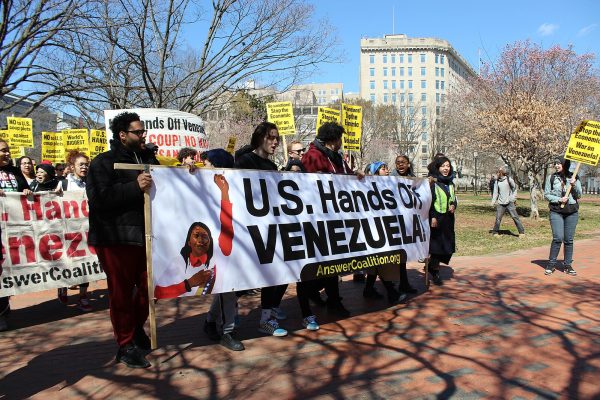 Hands Off Venezuela March | Image credit: Elvert Barnes via wikimedia commons, This file is licensed under the Creative Commons Attribution-Share Alike 2.0 Generic license.
KEY TAKEAWAYS
- Trump’s foreign policy consists in dramatic entry, leaving early and the problem unsolved, theatrical cover-up, and premature victory declaration, akin to a cat’s litter box routine —seen in Gaza ceasefire failure, China trade war obsolescence, and Iran’s ‘obliterated’ nuclear program leading to potential Round Two against Iran. And now, Venezuela.
- In Venezuela, the U.S. kidnapped Maduro but achieved no regime change; government continues under VP Delcy Rodríguez. Trump threatens further action, claims US will ‘run Venezuela for the foreseeable future’, amid unfeasibility of full occupation.
- The operation was a blatant breach of international law; no UN resolution or self-defence justification. Trump invokes the Monroe Doctrine for the U.S.’ ‘pre-eminence’ in the Western Hemisphere, but contradicts this by resuming and often escalating global interference. Oil as key motive; potential for Venezuela to become Trump’s ‘forever war’. Risks to Greenland, Global South decoupling, and escalating global disorder.
- EU monitors passively, risks undermining Ukraine stance; Greek PM Mitsotakis supports invasion, disregards legality despite Greece’s reliance on international law against Türkiye.
This Time, Merely Exiting the Litter Box Won’t Cut it
The year 2026 commenced with a new war: the U.S.’ invasion of Venezuela and kidnapping of its head of state. Donald J. Trump’s foreign policy bears a striking resemblance to how cats defecate. Our feline overlords arrive with great ceremony, scratch the ground as if preparing something momentous, deposit a small but pungent offering, and then expend most of their energy theatrically covering it up — only to stroll away, tail high, declaring victory and proclaiming that the job is done. Just like President Trump’s declarations of victory, what remains is neither resolved nor improved, merely obscured, destined to resurface the moment anyone else enters the room; plus, it doesn’t smell well. The performance matters far more than the aftermath left for others to clean up. Before Venezuela, there was Gaza and the wider Middle East. Trump emerged victorious from his litter box and proclaimed a ceasefire that was never upheld and a peace plan that shall never materialise; Israel is continuing with what the International Court of Justice is currently adjudicating as genocide, Hamas is in no mood for disarming, and PM Netanyahu is overtly preparing for Round Two with Iran, while Lebanon is further destabilised. Second, the China trade war, the tariffs, and the so-called “Liberation Day”; this has become obsolete so quickly we have almost forgotten about it. Third, the “obliteration” of Iran’s nuclear program, allegedly removing the raison d’être of American military activity against Iran in its totality. Now, PM Netanyahu and President Trump publicly discuss Round Two, even though sterling and total victory had been declared in the summer. The same litter box methodology is now being used with regard to Venezuela, performatively declaring finality where none exists.
For starters, up to the time of this writing there was no regime change in Venezuela, but continuity of government. Venezuela (and inter alia Iran, by the way) is not a personal or dynastic regime whose collapse hinges on a single individual (Nicolás Maduro), as in North Korea or, historically, Qaddafi’s Libya. Power is embedded in institutions, security services, party structures, and international patronage networks. In the same way that kidnapping Chancellor Merz will not make Germany’s political system and governance melt away, removing the figurehead does not dissolve the system, hence the governance of Venezuela merely goes on under Vice-President Delcy Rodríguez, a long-time Chavista insider. President Trump noted that this was the first strike and that he hopes a second one won’t be necessary, and that Rodriguez should ‘do what’s right’, i.e. the U.S.’ bidding, otherwise ‘she is going to pay a very big price, probably bigger than Maduro’ — put differently, Trump threatens to revisit the litterbox. Of course, Trump also said his administration ‘will run Venezuela’, for a time, out of Washington —which is demonstrably unfeasible, while Venezuela is currently run by the Maduro government without Maduro rather than by the U.S. and Trump’s lieutenants— and that Rodriguez has already agreed to do his bidding, which she publicly denied. All this very much looks like a performative grand gesture; rhetorically convince the Venezuelans that it’s all over, in the hope that it will be magically over. Yet what will happen if this does not come to pass? Will the ‘Peace President’ militarily invade Venezuela, a country of 912,050 km2 and over 31 million population? Or will more sand be added to the litter box, in the hope that the world forgets, as it has indeed forgotten Trump’s tariff ‘Liberation Day’ and trade war with China? It might very well be that we are witnessing the very beginning, rather than the grand finale, of the Venezuelan saga — and the worst-case scenario for the U.S. is that this could end up to be Trump’s very own ‘Ukraine’, ‘Iraq’, ‘Afghanistan’, or even ‘Vietnam’.
Furthermore, we are invited to believe that the same American armed forces which utterly failed to defeat the Houthis twice, once under Biden and once under Trump, have now pulled Nicolás Maduro’s kidnapping off at minimal resistance within a couple of hours. More details will eventually surface on whether some kind of backroom deal was in the mix.
International Law, Europe, Monroe Doctrine, and Greenland
There is hardly any point anymore in pointing out that this was a blatant violation of international law, most obviously article 2 par. 4 of the UN charter stating that ‘all members shall refrain in their international relations from the threat or use of force against the territorial integrity or political independence of any state, or in any other manner inconsistent with the Purposes of the United Nations’ — and that there is absolutely no way to frame the U.S.’ extraterritorial abduction of a head of state as legal. Needless to say, there was neither a UN Security Council resolution here, nor a plausible American self-defence against armed aggression threatening its sovereignty — much less a plausible and legal Responsibility to Protect. It is important to note that the international system’s subjects are the states, with their sovereignties sacrosanct and without differentiation between liberal democracies, other types of democracies, dictatorships, authoritarian regimes, and so on — hence every state has a seat at the United Nations irrespective of its government. In this context, what one thinks of Nicolás Maduro is utterly irrelevant in the face of the use of force against Venezuela’s sovereignty. The flagrant irony here is that Trump is invoking, or prompts others to invoke, precisely the earlier American ideological framings he had pledged to annihilate: the liberal international relations theory and the ‘rules-based international order’ (in lieu of international law) that primarily distinguishes between ‘democracies’ and ‘autocracies’. Given that Venezuela is framed as belonging in the latter (even if Trump himself insists on the illegality of the 46th Presidency of the United States), removing a ‘dictator’ is projected as right and proper.
This was a talking point the European Commission only was too eager to adopt — despite the obvious fact that its whole argumentation vis-à-vis the Ukraine war was precisely the opposite for almost four years. (It is worth noting that Minister of Foreign Affairs of Ukraine Andrii Sybiha also approved of the invasion of the sovereign country of Venezuela, in what constitutes a bitter irony.) The fact that so many European officials issued statements along the lines of ‘we are closely monitoring the situation in Venezuela’ has already prompted an internet joke: ‘Europeans are at previously unforeseen levels of monitoring the situation’. Professor of EU Law Alberto Alemanno has aptly put Europe’s dilemma on Venezuela as follows: ‘if Europe acquiesces in U.S. actions against the Maduro regime, it risks weakening the legal principles that underpin its opposition to Russia’s invasion of Ukraine. If it condemns those actions, however, Europe risks alienating its primary security guarantor and straining transatlantic unity at a moment when collective defence against Russia is especially critical. This dilemma exists only because international law has been applied inconsistently for decades. Europe must now choose between legal principle and strategic necessity, a choice that reveals whether the so called “rules-based order” ever had genuine normative content or was always just a legitimizing discourse for Western hegemony.’ In other words, the EU once again bites the dust.
President Trump, however, has already signalled that Greenland is next, since the U.S. ‘needs Greenland for national security’; Greenland, of course, is autonomous territory belonging to the Kingdom of Denmark, an EU member state. It remains to be seen how the European Commission squares that circle.
Removing ‘a dictator who oppresses his people’, in Secretary of State Marco Rubio’s words, is only one rationale given among many; Secretary of War Pete Hegseth said that it’s about drugs that pose an imminent threat, as President Trump was claiming all along — but it is also President Trump that explicitly said ‘it’s all about the oil’. After all, Donald J. Trump had publicly written back in 2013 that ‘I still can’t believe we left Iraq without the oil’, and now says ‘the oil is ours’ with regard to Venezuela. Truth be told, the oil vector is quite explicitly foreshadowed in the new National Security Strategy: ‘the Western Hemisphere is home to many strategic resources that America should partner with regional allies to develop’. And, in theory, controlling Venezuela’s oil might be thought of as the U.S.’s ‘insurance policy’ for a planned attack on Iran, anticipating that the Strait of Hormuz could be closed, necessitating an alternative oil source (on which timescale?). Yet aside from the fact that Venezuela is currently not governed by the U.S. but by the Maduro government sans Maduro, even if Trump’s plan materialises Venezuelan oil and reserves are not to be instantly and magically translated into American revenues — while the U.S. midterms are due this coming November.
Analysts are quick to point out that what we are witnessing is the Monroe doctrine, i.e. what the new National Security Strategy terms ‘the Trump Corollary to the Monroe Doctrine’. According to it, the U.S. will ‘restore American pre-eminence in the Western Hemisphere’ and ‘deny non-Hemispheric competitors the ability to position forces or other threatening capabilities, or to own or control strategically vital assets, in [the Western] Hemisphere’ — i.e., the Americas north and south, since the Western Hemisphere begins from Greenwich westwards, with most of Europe and Africa as well as all of Asia being in the Eastern Hemisphere. The idea here is that the U.S. will have the rest of the Western Hemisphere (North America, Central America, Latin America, Greenland) as its backyard without Great Power competition in situ, and that it shall allow other Great Powers to have their ‘backyards’ as well.
Even if other Great Powers were to acquiesce to this plan —which they are not doing, if we are to judge by China’s response to the National Security Strategy, and to remember that Latin America’s Brazil is the ‘B’ in ‘BRICS+’—, the fundamental problem here is that you can’t have your cake and eat it too. The United States want to focus on ‘their’ hemisphere with a ‘Monroe Doctrine with a Trump Corollary’, but at the same time they are participating in the Ukraine war, meddling in the Middle East/Western Asia in countless ways starting with their very special relationship with Israel, massively arming Taiwan after the publication of the new National Security, intervening in Africa, and so on. There is no ‘deal’ to be made between Great Powers in which you get your half of the world and retain the right to intervene in the other half of the world.
How all this unfolds remains to be seen — from Venezuela’s fate onwards to the turbulences to the international system and order, Greenland, the EU’s oscillations, the Global South’s new incentives to decouple from the U.S., and so on, including the frequency with which President Trump will feel the need to visit his litter box, cover a quick, uninviting and ill-advised initiative with sand, and proclaim victory in exiting the litter box. At some point, however, all this is destined to hit the fan; there is simply no visible scenario in which order, i.e. peace, prevails.
The Greeks Invented Words like Democracy, Sycophancy, and Hypocrisy
While most European leaders were busy declaring that they are merely monitoring the situation in Venezuela, (at least) one leader stood out, unflinchingly supporting and indeed celebrating the use of force against a state’s sovereignty and underscoring that international legality is not relevant to the discussion at the present moment: PM Kyriakos Mitsotakis of my native Greece, with the following statement: ‘Nicholas Maduro presided over a brutal and repressive dictatorship that brought about unimaginable suffering on the Venezuelan people. The end of his regime offers new hope for the country. This is not the time to comment on the legality of the recent actions’. The wider context of that last phrase is that Greece consistently invokes international law with overabundant frequency, due to the continuing partial occupation of Cyprus by Türkiye and to Greece’s disputes with Türkiye, not to mention Greece’s public rationale for its support for Ukraine and for ‘being at war’ with Russia due to the priority of international law, hence the statement is startling indeed. Trita Parsi of the Quincy Institute commented on the Greek PM’s statement: ‘Calling Europe’s official reactions farcical would be unjustifiably kind.’ It goes without saying that the irony was not lost to Turkish commentators, such as Ragıp Soylu stating that ‘Mitsotakis is now fully on board of Netanyahu line of foreign policy. He doesn’t even pay the lip service to the international law, on the contrary, he completely disregards it. Why do you then constantly complain about Turkey’s “violation of international law”?’, or to a Turkish X account’s response to the Greek PM: ‘Great news! It sounds like Greek PM Mitsotakis won’t be complaining about the legality of Turkish actions in the Aegean, Thrace, Cyprus, etc. Greece doesn’t care about int’l law anymore.’ The PM’s statement engendered ire across the political spectrum, including from the former Greek PM with Nea Dimokratia Antonis Samaras.Yet it doesn’t end there. A top Nea Dimokratia politician, member of parliament since 2007, and six-time cabinet minister with Nea Dimokratia, lawyer Makis Voridis, doubled down on PM Mitsotakis’ disregard for international law and support for President Trump by making it further explicit; moreover, in his statement he quite obviously conflates ‘the Western world’ with the ‘Western hemisphere’. Greece, however, finds itself in the Eastern hemisphere — as does the whole of the European Union with the exception of Spain and Portugal, since the Western hemisphere ‘starts’ from Greenwich, London westwards. It seems that a sizable slice of the fate of Greeks is entrusted to top politicians who literally do not know which hemisphere their country finds itself in — in a globe of, naturally, two hemispheres, meaning that even by cluelessly guessing you would get that one right 50% of the time. What could possibly go wrong?

KEY TAKEAWAYS
- Trump’s foreign policy consists in dramatic entry, leaving early and the problem unsolved, theatrical cover-up, and premature victory declaration, akin to a cat’s litter box routine —seen in Gaza ceasefire failure, China trade war obsolescence, and Iran’s ‘obliterated’ nuclear program leading to potential Round Two against Iran. And now, Venezuela.
- In Venezuela, the U.S. kidnapped Maduro but achieved no regime change; government continues under VP Delcy Rodríguez. Trump threatens further action, claims US will ‘run Venezuela for the foreseeable future’, amid unfeasibility of full occupation.
- The operation was a blatant breach of international law; no UN resolution or self-defence justification. Trump invokes the Monroe Doctrine for the U.S.’ ‘pre-eminence’ in the Western Hemisphere, but contradicts this by resuming and often escalating global interference. Oil as key motive; potential for Venezuela to become Trump’s ‘forever war’. Risks to Greenland, Global South decoupling, and escalating global disorder.
- EU monitors passively, risks undermining Ukraine stance; Greek PM Mitsotakis supports invasion, disregards legality despite Greece’s reliance on international law against Türkiye.
This Time, Merely Exiting the Litter Box Won’t Cut it
The year 2026 commenced with a new war: the U.S.’ invasion of Venezuela and kidnapping of its head of state. Donald J. Trump’s foreign policy bears a striking resemblance to how cats defecate. Our feline overlords arrive with great ceremony, scratch the ground as if preparing something momentous, deposit a small but pungent offering, and then expend most of their energy theatrically covering it up — only to stroll away, tail high, declaring victory and proclaiming that the job is done. Just like President Trump’s declarations of victory, what remains is neither resolved nor improved, merely obscured, destined to resurface the moment anyone else enters the room; plus, it doesn’t smell well. The performance matters far more than the aftermath left for others to clean up. Before Venezuela, there was Gaza and the wider Middle East. Trump emerged victorious from his litter box and proclaimed a ceasefire that was never upheld and a peace plan that shall never materialise; Israel is continuing with what the International Court of Justice is currently adjudicating as genocide, Hamas is in no mood for disarming, and PM Netanyahu is overtly preparing for Round Two with Iran, while Lebanon is further destabilised. Second, the China trade war, the tariffs, and the so-called “Liberation Day”; this has become obsolete so quickly we have almost forgotten about it. Third, the “obliteration” of Iran’s nuclear program, allegedly removing the raison d’être of American military activity against Iran in its totality. Now, PM Netanyahu and President Trump publicly discuss Round Two, even though sterling and total victory had been declared in the summer. The same litter box methodology is now being used with regard to Venezuela, performatively declaring finality where none exists.
For starters, up to the time of this writing there was no regime change in Venezuela, but continuity of government. Venezuela (and inter alia Iran, by the way) is not a personal or dynastic regime whose collapse hinges on a single individual (Nicolás Maduro), as in North Korea or, historically, Qaddafi’s Libya. Power is embedded in institutions, security services, party structures, and international patronage networks. In the same way that kidnapping Chancellor Merz will not make Germany’s political system and governance melt away, removing the figurehead does not dissolve the system, hence the governance of Venezuela merely goes on under Vice-President Delcy Rodríguez, a long-time Chavista insider. President Trump noted that this was the first strike and that he hopes a second one won’t be necessary, and that Rodriguez should ‘do what’s right’, i.e. the U.S.’ bidding, otherwise ‘she is going to pay a very big price, probably bigger than Maduro’ — put differently, Trump threatens to revisit the litterbox. Of course, Trump also said his administration ‘will run Venezuela’, for a time, out of Washington —which is demonstrably unfeasible, while Venezuela is currently run by the Maduro government without Maduro rather than by the U.S. and Trump’s lieutenants— and that Rodriguez has already agreed to do his bidding, which she publicly denied. All this very much looks like a performative grand gesture; rhetorically convince the Venezuelans that it’s all over, in the hope that it will be magically over. Yet what will happen if this does not come to pass? Will the ‘Peace President’ militarily invade Venezuela, a country of 912,050 km2 and over 31 million population? Or will more sand be added to the litter box, in the hope that the world forgets, as it has indeed forgotten Trump’s tariff ‘Liberation Day’ and trade war with China? It might very well be that we are witnessing the very beginning, rather than the grand finale, of the Venezuelan saga — and the worst-case scenario for the U.S. is that this could end up to be Trump’s very own ‘Ukraine’, ‘Iraq’, ‘Afghanistan’, or even ‘Vietnam’.
Furthermore, we are invited to believe that the same American armed forces which utterly failed to defeat the Houthis twice, once under Biden and once under Trump, have now pulled Nicolás Maduro’s kidnapping off at minimal resistance within a couple of hours. More details will eventually surface on whether some kind of backroom deal was in the mix.
International Law, Europe, Monroe Doctrine, and Greenland
There is hardly any point anymore in pointing out that this was a blatant violation of international law, most obviously article 2 par. 4 of the UN charter stating that ‘all members shall refrain in their international relations from the threat or use of force against the territorial integrity or political independence of any state, or in any other manner inconsistent with the Purposes of the United Nations’ — and that there is absolutely no way to frame the U.S.’ extraterritorial abduction of a head of state as legal. Needless to say, there was neither a UN Security Council resolution here, nor a plausible American self-defence against armed aggression threatening its sovereignty — much less a plausible and legal Responsibility to Protect. It is important to note that the international system’s subjects are the states, with their sovereignties sacrosanct and without differentiation between liberal democracies, other types of democracies, dictatorships, authoritarian regimes, and so on — hence every state has a seat at the United Nations irrespective of its government. In this context, what one thinks of Nicolás Maduro is utterly irrelevant in the face of the use of force against Venezuela’s sovereignty. The flagrant irony here is that Trump is invoking, or prompts others to invoke, precisely the earlier American ideological framings he had pledged to annihilate: the liberal international relations theory and the ‘rules-based international order’ (in lieu of international law) that primarily distinguishes between ‘democracies’ and ‘autocracies’. Given that Venezuela is framed as belonging in the latter (even if Trump himself insists on the illegality of the 46th Presidency of the United States), removing a ‘dictator’ is projected as right and proper.
This was a talking point the European Commission only was too eager to adopt — despite the obvious fact that its whole argumentation vis-à-vis the Ukraine war was precisely the opposite for almost four years. (It is worth noting that Minister of Foreign Affairs of Ukraine Andrii Sybiha also approved of the invasion of the sovereign country of Venezuela, in what constitutes a bitter irony.) The fact that so many European officials issued statements along the lines of ‘we are closely monitoring the situation in Venezuela’ has already prompted an internet joke: ‘Europeans are at previously unforeseen levels of monitoring the situation’. Professor of EU Law Alberto Alemanno has aptly put Europe’s dilemma on Venezuela as follows: ‘if Europe acquiesces in U.S. actions against the Maduro regime, it risks weakening the legal principles that underpin its opposition to Russia’s invasion of Ukraine. If it condemns those actions, however, Europe risks alienating its primary security guarantor and straining transatlantic unity at a moment when collective defence against Russia is especially critical. This dilemma exists only because international law has been applied inconsistently for decades. Europe must now choose between legal principle and strategic necessity, a choice that reveals whether the so called “rules-based order” ever had genuine normative content or was always just a legitimizing discourse for Western hegemony.’ In other words, the EU once again bites the dust.
President Trump, however, has already signalled that Greenland is next, since the U.S. ‘needs Greenland for national security’; Greenland, of course, is autonomous territory belonging to the Kingdom of Denmark, an EU member state. It remains to be seen how the European Commission squares that circle.
Removing ‘a dictator who oppresses his people’, in Secretary of State Marco Rubio’s words, is only one rationale given among many; Secretary of War Pete Hegseth said that it’s about drugs that pose an imminent threat, as President Trump was claiming all along — but it is also President Trump that explicitly said ‘it’s all about the oil’. After all, Donald J. Trump had publicly written back in 2013 that ‘I still can’t believe we left Iraq without the oil’, and now says ‘the oil is ours’ with regard to Venezuela. Truth be told, the oil vector is quite explicitly foreshadowed in the new National Security Strategy: ‘the Western Hemisphere is home to many strategic resources that America should partner with regional allies to develop’. And, in theory, controlling Venezuela’s oil might be thought of as the U.S.’s ‘insurance policy’ for a planned attack on Iran, anticipating that the Strait of Hormuz could be closed, necessitating an alternative oil source (on which timescale?). Yet aside from the fact that Venezuela is currently not governed by the U.S. but by the Maduro government sans Maduro, even if Trump’s plan materialises Venezuelan oil and reserves are not to be instantly and magically translated into American revenues — while the U.S. midterms are due this coming November.
Analysts are quick to point out that what we are witnessing is the Monroe doctrine, i.e. what the new National Security Strategy terms ‘the Trump Corollary to the Monroe Doctrine’. According to it, the U.S. will ‘restore American pre-eminence in the Western Hemisphere’ and ‘deny non-Hemispheric competitors the ability to position forces or other threatening capabilities, or to own or control strategically vital assets, in [the Western] Hemisphere’ — i.e., the Americas north and south, since the Western Hemisphere begins from Greenwich westwards, with most of Europe and Africa as well as all of Asia being in the Eastern Hemisphere. The idea here is that the U.S. will have the rest of the Western Hemisphere (North America, Central America, Latin America, Greenland) as its backyard without Great Power competition in situ, and that it shall allow other Great Powers to have their ‘backyards’ as well.
Even if other Great Powers were to acquiesce to this plan —which they are not doing, if we are to judge by China’s response to the National Security Strategy, and to remember that Latin America’s Brazil is the ‘B’ in ‘BRICS+’—, the fundamental problem here is that you can’t have your cake and eat it too. The United States want to focus on ‘their’ hemisphere with a ‘Monroe Doctrine with a Trump Corollary’, but at the same time they are participating in the Ukraine war, meddling in the Middle East/Western Asia in countless ways starting with their very special relationship with Israel, massively arming Taiwan after the publication of the new National Security, intervening in Africa, and so on. There is no ‘deal’ to be made between Great Powers in which you get your half of the world and retain the right to intervene in the other half of the world.
How all this unfolds remains to be seen — from Venezuela’s fate onwards to the turbulences to the international system and order, Greenland, the EU’s oscillations, the Global South’s new incentives to decouple from the U.S., and so on, including the frequency with which President Trump will feel the need to visit his litter box, cover a quick, uninviting and ill-advised initiative with sand, and proclaim victory in exiting the litter box. At some point, however, all this is destined to hit the fan; there is simply no visible scenario in which order, i.e. peace, prevails.
The Greeks Invented Words like Democracy, Sycophancy, and Hypocrisy
While most European leaders were busy declaring that they are merely monitoring the situation in Venezuela, (at least) one leader stood out, unflinchingly supporting and indeed celebrating the use of force against a state’s sovereignty and underscoring that international legality is not relevant to the discussion at the present moment: PM Kyriakos Mitsotakis of my native Greece, with the following statement: ‘Nicholas Maduro presided over a brutal and repressive dictatorship that brought about unimaginable suffering on the Venezuelan people. The end of his regime offers new hope for the country. This is not the time to comment on the legality of the recent actions’. The wider context of that last phrase is that Greece consistently invokes international law with overabundant frequency, due to the continuing partial occupation of Cyprus by Türkiye and to Greece’s disputes with Türkiye, not to mention Greece’s public rationale for its support for Ukraine and for ‘being at war’ with Russia due to the priority of international law, hence the statement is startling indeed. Trita Parsi of the Quincy Institute commented on the Greek PM’s statement: ‘Calling Europe’s official reactions farcical would be unjustifiably kind.’ It goes without saying that the irony was not lost to Turkish commentators, such as Ragıp Soylu stating that ‘Mitsotakis is now fully on board of Netanyahu line of foreign policy. He doesn’t even pay the lip service to the international law, on the contrary, he completely disregards it. Why do you then constantly complain about Turkey’s “violation of international law”?’, or to a Turkish X account’s response to the Greek PM: ‘Great news! It sounds like Greek PM Mitsotakis won’t be complaining about the legality of Turkish actions in the Aegean, Thrace, Cyprus, etc. Greece doesn’t care about int’l law anymore.’ The PM’s statement engendered ire across the political spectrum, including from the former Greek PM with Nea Dimokratia Antonis Samaras.Yet it doesn’t end there. A top Nea Dimokratia politician, member of parliament since 2007, and six-time cabinet minister with Nea Dimokratia, lawyer Makis Voridis, doubled down on PM Mitsotakis’ disregard for international law and support for President Trump by making it further explicit; moreover, in his statement he quite obviously conflates ‘the Western world’ with the ‘Western hemisphere’. Greece, however, finds itself in the Eastern hemisphere — as does the whole of the European Union with the exception of Spain and Portugal, since the Western hemisphere ‘starts’ from Greenwich, London westwards. It seems that a sizable slice of the fate of Greeks is entrusted to top politicians who literally do not know which hemisphere their country finds itself in — in a globe of, naturally, two hemispheres, meaning that even by cluelessly guessing you would get that one right 50% of the time. What could possibly go wrong?
Criminal Attacks by a Criminal Empire
There is only one word to describe the US attacks on Venezuela. That word is criminal. It is the only word that describes the act of invading another nation and kidnapping its president. Of course, it is also a word that describes the essential nature of the US empire—an empire currently run by a band of psychopaths whose actions are only outdone by their equally psychotic comrades in Tel Aviv. Let’s be clear, Donal Trump may have pulled the trigger so to speak, but Washington has been pointing a loaded gun at Venezuela since its people elected Hugo Chavez in 1998. By electing Chavez, the Venezuelan popular majority instituted a process that redistributed wealth inside the country, bringing popular education and free health care to the millions of Venezuelans previously denied these human rights. Human rights which are under serious attack in the heart of the US empire as I write, by the way.
This attack, and any further military action by the US against Venezuela must be opposed by those around the world who care about peace. If those who support a more peaceful version of the US Empire in the mainstream parties oppose this escalation, they should speak up in Congress, the media and in the streets. Those on the Left who disagree with Maduro for reasons real or manufactured by the consent organs of the Empire need to set those concerns aside and oppose these attacks. Folks whose concerns tend towards the concerns of family and their home should resolve to voice their opposition to a White House whose go-to solution is murder, war and repression. Already, those with loved ones in the US military—from the Air Force to the Air Guard, the Marines to the Coast Guard—have seen them sent to kill people in Venezuela, Iran, Palestine and the Caribbean (for starters). Here in Vermont, where I live, the skies above my home no longer resound with the inhuman noise of the F-35s that are based five miles away; those planes and their crews are now involved in attacking Venezuelans just minding their own business. The basing of the planes in Vermont was supported by its entire Congressional delegation including Bernie Sanders. The Guard spokespeople and their hacks in the media called the planes’ deafening sound the “sound of freedom.” I can assure, that’s not what the Venezuelans are calling that noise. The last seventy years of history makes it clear that the only freedom the US military brings is the freedom to exploit the country being invaded. The Empire’s “sound of freedom” is the sound of death and repression to those who bear the brunt of its bombs, its troops, and its economic strangulation.
Let’s be clear. Although it is the Trump White House that has launched this attack on Venezuela and apparently kidnapped its president, these actions are the result of an ongoing bipartisan assault on Venezuela. Bill Clinton began the attacks in 1998, mostly keeping his opposition to words and providing money to the wealthy comprador right-wing opposition in Venezuela. His wife Hilary accepted a million-dollar donation to her presidential campaign in 2015 from Gustavo Cisneros, a leading figure in Venezuela’s far-right politics. In 2002, the George W. Bush administration helped fund and plan a coup attempt that ultimately failed despite Washington’s immediate support for the coup plotters. After Hugo Chavez died in 2013 and Maduro was elected, Barack Obama intensified the sanctions against the government in Caracas and in 2015, labeled Venezuela as a clear and present danger. Donald Trump continued the threats and sanctions against Venezuela, as did Joe Biden (although his administration did make a short-lived deal to purchase gas from the country. Meanwhile, Washington’s sanctions intensified economic problems being experienced by the Venezuelan people. One might say the sanctions were the straw that broke the camel’s back. Despite the hardships, Venezuela persevered, refocusing its efforts on organizing responses to the US offensive by working towards self-sufficiency. Trump pulled the trigger, but every administration that preceded his provided ammunition and paved the way for Trump’s illegal and immoral assault.
While the main focus of this short piece is the attacks on Venezuela, it is essential that we pay attention to what’s going on elsewhere in the world. Trump had the US military attack Nigeria on Christmas Day; he has once again threatened Iran and the US recently approved millions more dollars in arms shipments to Israel, which continues to murder Palestinians in Gaza and the West Bank, while also bombing Lebanon and Syria. It’s been a long time since the world was so close to a global conflict. Indeed, it seems reasonable to say that the last time we stood so close to world war was when Hitler’s armies invaded its neighbors to the east. His actions were considered rash and dangerous when they happened. One can say the same about the actions of Donald Trump today.
There is only one word to describe the US attacks on Venezuela. That word is criminal. It is the only word that describes the act of invading another nation and kidnapping its president. Of course, it is also a word that describes the essential nature of the US empire—an empire currently run by a band of psychopaths whose actions are only outdone by their equally psychotic comrades in Tel Aviv. Let’s be clear, Donal Trump may have pulled the trigger so to speak, but Washington has been pointing a loaded gun at Venezuela since its people elected Hugo Chavez in 1998. By electing Chavez, the Venezuelan popular majority instituted a process that redistributed wealth inside the country, bringing popular education and free health care to the millions of Venezuelans previously denied these human rights. Human rights which are under serious attack in the heart of the US empire as I write, by the way.
This attack, and any further military action by the US against Venezuela must be opposed by those around the world who care about peace. If those who support a more peaceful version of the US Empire in the mainstream parties oppose this escalation, they should speak up in Congress, the media and in the streets. Those on the Left who disagree with Maduro for reasons real or manufactured by the consent organs of the Empire need to set those concerns aside and oppose these attacks. Folks whose concerns tend towards the concerns of family and their home should resolve to voice their opposition to a White House whose go-to solution is murder, war and repression. Already, those with loved ones in the US military—from the Air Force to the Air Guard, the Marines to the Coast Guard—have seen them sent to kill people in Venezuela, Iran, Palestine and the Caribbean (for starters). Here in Vermont, where I live, the skies above my home no longer resound with the inhuman noise of the F-35s that are based five miles away; those planes and their crews are now involved in attacking Venezuelans just minding their own business. The basing of the planes in Vermont was supported by its entire Congressional delegation including Bernie Sanders. The Guard spokespeople and their hacks in the media called the planes’ deafening sound the “sound of freedom.” I can assure, that’s not what the Venezuelans are calling that noise. The last seventy years of history makes it clear that the only freedom the US military brings is the freedom to exploit the country being invaded. The Empire’s “sound of freedom” is the sound of death and repression to those who bear the brunt of its bombs, its troops, and its economic strangulation.
Let’s be clear. Although it is the Trump White House that has launched this attack on Venezuela and apparently kidnapped its president, these actions are the result of an ongoing bipartisan assault on Venezuela. Bill Clinton began the attacks in 1998, mostly keeping his opposition to words and providing money to the wealthy comprador right-wing opposition in Venezuela. His wife Hilary accepted a million-dollar donation to her presidential campaign in 2015 from Gustavo Cisneros, a leading figure in Venezuela’s far-right politics. In 2002, the George W. Bush administration helped fund and plan a coup attempt that ultimately failed despite Washington’s immediate support for the coup plotters. After Hugo Chavez died in 2013 and Maduro was elected, Barack Obama intensified the sanctions against the government in Caracas and in 2015, labeled Venezuela as a clear and present danger. Donald Trump continued the threats and sanctions against Venezuela, as did Joe Biden (although his administration did make a short-lived deal to purchase gas from the country. Meanwhile, Washington’s sanctions intensified economic problems being experienced by the Venezuelan people. One might say the sanctions were the straw that broke the camel’s back. Despite the hardships, Venezuela persevered, refocusing its efforts on organizing responses to the US offensive by working towards self-sufficiency. Trump pulled the trigger, but every administration that preceded his provided ammunition and paved the way for Trump’s illegal and immoral assault.
While the main focus of this short piece is the attacks on Venezuela, it is essential that we pay attention to what’s going on elsewhere in the world. Trump had the US military attack Nigeria on Christmas Day; he has once again threatened Iran and the US recently approved millions more dollars in arms shipments to Israel, which continues to murder Palestinians in Gaza and the West Bank, while also bombing Lebanon and Syria. It’s been a long time since the world was so close to a global conflict. Indeed, it seems reasonable to say that the last time we stood so close to world war was when Hitler’s armies invaded its neighbors to the east. His actions were considered rash and dangerous when they happened. One can say the same about the actions of Donald Trump today.

On Saturday, the Trump administration captured the incumbent president of Venezuela. It is its latest violation, a “supreme international crime” as Nuremberg prosecutors would put it.
by Dan Steinbock | Jan 5, 2026 | ANTIWAR.COM
It was no minor event. The U.S. military’s operation was months in-the-making and involved more than 150 aircraft and drones, integrated space and cyber effects, multiple intelligence agencies and law enforcement personnel, according to Chairman of the Joint Chiefs of Staff Gen. Dan Caine.
The operation involved multiple explosions and low-flying aircraft. The Venezuelan government described it an “imperialist attack.” U.S. forces located Maduro and his wife, Cilia Flores, in a heavily guarded residence within the Fort Tiuna military installation, and captured them from their bedroom.
U.S. President Donald Trump announced that Maduro and his wife were taken by helicopter to the USS Iwo Jima warship and transported to New York. Meanwhile, the U.S. Department of Justice unsealed an indictment against Maduro and his wife on four serious charges, including conspiracy in narco-terrorism and cocaine importation, possession of machine-guns and destructive devices, and conspiracy to possess machine-guns and destructive devices against the U.S.
The U.S. has for years considered Maduro an illegitimate leader and had offered a $50 million reward for information leading to his arrest. Maduro has consistently denied all allegations, calling the charges a U.S. conspiracy to justify regime change.
A grave violation of rules-based international law
The U.S. capture of Venezuelan President Nicolás Maduro and the associated military operation were widely condemned by legal experts and several nations as a violation of international law, specifically the UN Charter, which prohibits the use of force against the territorial integrity or political independence of another state.
A unilateral military operation by one state to seize a sitting leader in another country is illegal. Critics of the U.S. action, including the foreign ministries of China, France, Mexico, and Russia, have already cited violations of key UN Charter principles.
Article 2(4) requires member states to refrain from the threat or use of force against the territorial integrity or political independence of any other state. Military force can generally only be used in self-defense (Article 51) or with authorization from the UN Security Council, neither of which occurred in this case.
Nor was there any authorization by the Congress, which the Trump administration simply ignored.
The capture is considered a grave violation of Venezuela’s sovereignty, as it involved uninvited military action on Venezuelan soil.
Undermining weak signs of recovery
As a result of two decades of increasing economic coercion by the U.S. government and the escalation of maximum pressure by the Trump administrations, Venezuela’s economy is today highly fragile.
There have been some promising signs, due to oil-driven growth and a slowdown in hyperinflation, thanks to the eased sanctions, mainly by the Biden administration.
Nonetheless, Venezuela remains plagued by deep structural issues, extreme poverty, very low minimum wages, high inflation, and severe deterioration in services, as U.S. economic pressure has overshadowed all stabilization efforts.
Oil revenue that is crucial for recovery production remains far below past levels. Since Venezuelan economy heavily relies on oil, U.S. sanctions have sought to undermine the efforts by the state oil company Petróleos de Venezuela SA (PDVSA) to fund most government revenue.
The Maduro government implemented reforms (dollarization, private sector easing) slowed hyperinflation and fostered growth (5% in 2023).
In view of the Trump administration, economic stabilization would reinforce the current status quo. Hence, the need for destabilization.
It’s about the control of oil and gas
The oil sector’s deterioration is the primary driver of the broader economic plunge in Venezuela, with exports dwindling despite vast potential.
Thanks to the escalatory measures by the U.S., Venezuela’s oil production has collapsed from over 3 million barrels per day (bpd) to around 1 million bpd or less, due to lack of investment and decaying infrastructure. Mismanagement in the sector is a reality, but it is hard to see how Venezuela could manage its oil amid continuous attacks by the world’s greatest military power.
By severely penalizing government revenue, these U.S. efforts represent a long war against Venezuelan people and their living standards.
The extraction of extra-heavy crude oil requires a higher level of technical expertise, which international oil companies possess but their involvement has been limited by international sanctions.
Venezuela has the world’s largest proven crude oil reserves with some 303 billion barrels, accounting for 17% of global reserves. Most of its proven oil reserves are extra-heavy crude oil from the Orinoco Belt.
Yet, despite the sizeable reserves, Venezuela produced barely 0.8% of total global crude oil in 2023.
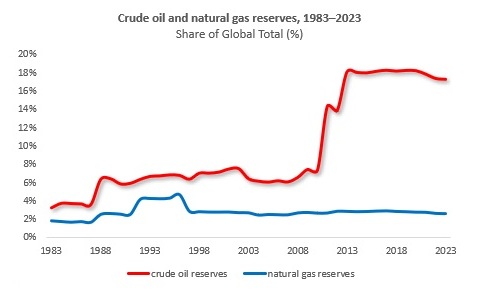
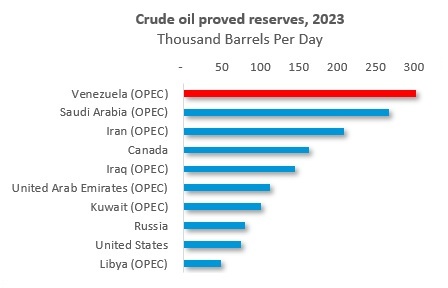
Source: US EIA, author
“We’re going to have our very large United States oil companies, the biggest anywhere in the world, go in, spend billions of dollars, fix the badly broken infrastructure and start making money for the country,” Trump said in a public address.
The simple reality is, as Trump acknowledged, that the U.S. will look to tap Venezuelan oil reserves.
Future scenarios
President Trump said in a press conference that the U.S. would “run” Venezuela on a temporary basis during the transition, and “get the oil flowing.” In reality, the power vacuum left by Maduro’s capture creates several potential paths forward for Venezuela.
Managed transition. According to Venezuela’s constitution, Vice President Delcy Rodríguez, a key member of Maduro’s United Socialist Party of Venezuela (PSUV) would assume power and call for new elections within 30 days. In the process, the Trump administration is likely to want the opposition candidate, such as Edmundo González, recognized as the legitimate winner of the contested 2024 election to take office. However, the key role in this scenario is predicated on the reactions of the socialist government and the military.
Consolidation of pro-Maduro power. The pro-Maduro elite and military leaders, many of whom are under U.S. sanctions thus facing potential prosecution, will seek to maintain control. In this scenario, a high-ranking military official or a civilian head from within the ruling socialist party could replace Maduro and ensure continuation of the current government and its control over the state and oil industry. It could result in new U.S. attacks and repression in Venezuela.
Internal conflict. The power vacuum could also lead to infighting among military factions or between different elite groups. The outcome could be widespread instability, popular unrest, and potentially an internal armed conflict involving pro-government armed groups and opposition forces, or even a full military takeover. These scenarios could instigate new U.S. attacks.
In this early stage, the Trump administration’s goal has been to insulate Maduro from Venezuela and a murky judicial process that will destabilize Venezuela. The latter will then serve as a pretext for covert efforts to implant a pro-U.S. leadership or to drive the country to a civil war.
Although the US government has asserted that its actions are justified under domestic law and presidential authority, the overwhelming international legal opinion is that the use of military force to seize a leader on foreign territory constitutes an illegal “kidnapping” and a clear violation of international law and the UN Charter.
International law vs imperial plunder
Through the 20th century, the U.S. has been heavily involved in numerous interventions and coups to influence or overthrow foreign governments, particularly in Latin America and the Middle East, usually for political or economic reasons. These actions, such as the 1953 Iranian coup d’état or interventions in various Latin American countries under the Roosevelt Corollary, often resulted in the removal or exile of the sitting leader.
The dark history of external interventions, often involving subsequent terror and repression, insurgence and counter-insurgence and decades of instability, has featured repeated efforts at regime change or capturing specific individuals. These include the arrest of Manuel Noriega (Panama, 1989), targeted strikes and regime change attempts (Iraq, Libya and Yemen, 2000s and 2010s), the recent bombing of Iran, Nigeria and the logistical and financial support of Israel’s bombing of and genocidal atrocities in Gaza.
By contrast, international law is built on principles of sovereignty and non-interference, which make direct, peacetime attacks on foreign sovereigns highly controversial breaches of international peace.
Until his death at the age of 103, Benjamin Ferencz, the last Nuremberg prosecutor, consistently argued that unauthorized U.S. military actions, like the 2020 killing of the Iranian commander Qasem Soleimani and the Iraq War, violated international law.
Ferencz believed that wars of aggression, as defined by the Nuremberg Principles, are the “supreme international crime,” and leaders who initiate them should face international prosecution. In this view, the standards set at Nuremberg apply to all nations, including the U.S., and failure to apply them means that “law has lost its meaning.”
That’s the crossroads where we stand today. A world where international law is devoid of meaning and a pretext for imperial plunder – and a world where international law ensures the continuance of human civilization.
The original version was published by Informed Comment (US) on January 5, 2026.
Dr. Dan Steinbock is an internationally recognized visionary of the multipolar world and the founder of Difference Group. He has served at the India, China and America Institute (US), Shanghai Institutes for International Studies (China) and the EU Center (Singapore). For more, see https://www.differencegroup.net
On Seeing the Photo of Nicolás Maduro Aboard the U.S.S. Iwo Jima
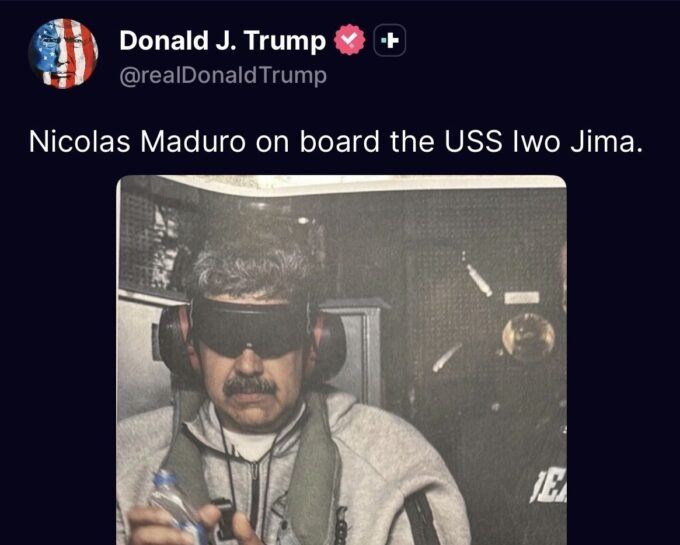
Screenshot from Truth Social
Authenticating a photograph
On Sunday, Jan 4, a day after the U.S. abduction of Venezuelan President Nicolás Maduro from his compound in Caracas, The New York Times published a short piece about their decision to publish, the day before, a photograph of the prisoner on board the U.S.S. Iwo Jima. The column was written by Meaghan Looram, director of photography at the Times, beneath the headline: “How The Times Assessed That Photo From Trump of Maduro in Handcuffs.” The subhead read: “Hours after President Trump announced that the United States had seized Nicolás Maduro, various photos that appeared to show the captured Venezuelan leader hit the internet.” The column is part of an occasional series, rubricked above the headline, “Times Insider.” (Another in the series appeared on Jan. 5, headlined: “Behind the Scenes of Our Nicolás Maduro Front Page.”)
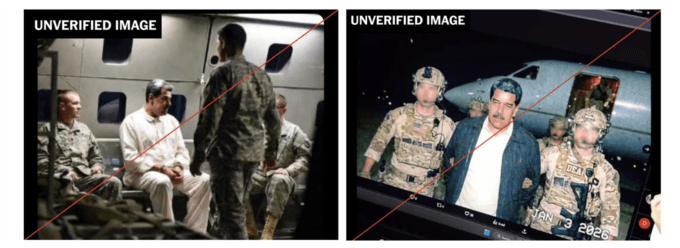
Pair of photos published, Jan. 4 in The New York Times, said to be available from multiple, unidentified online sources.
Looram explained that in the hours after Maduro’s snatching, two photos appeared on multiple websites purporting to show the Venezuelan president in custody. The veracity of neither was certain, she wrote, and the Times has no foolproof way of determining if a photo is taken from life or is AI generated. Editors chose not to publish either, for reasons briefly outlined by Looram.
The first photograph shows Maduro seated and handcuffed in front. He’s surround by three, U.S. servicemen (two seated, one standing) wearing jungle camouflage, in what appears to be an aircraft. Timesanalysts, according to Looram, were suspicious of the two rows of windows, unknown in any aircraft they could identify. They might also have been put off by Maduro’s white suit. It’s a liqui liqui, considered the national, formal menswear in Venezuela and Colombia, consisting of a white, shirt-like jacket with Nehru-style rounded collar and matching trousers. Judging from published photographs, Maduro wears them sometimes but prefers an all-black version – he may feel it projects a tougher, more anti-imperialist look. I’d be surprised if the first thing he did when he when he heard U.S. troops blasting into his compound at 2:30 a.m. was change into a liqui liqui.
The second photo shows the Venezuelan president being escorted away from an airplane by two, DEA agents in desert camouflage. His hands this time are behind his back, presumably handcuffed, and he’s wearing a blue, probably denim jacket over an open necked white shirt. The Times said little about the photo except to note that Maduro’s outfit is different from the previous photograph. It’s possible he was given the blue jacket for warmth prior to deplaning, but there are other anomalies. His white shirt appears to have no buttons—he’d never be able to pull it over his head. Thus, there’s good reason to believe one, if not both photos are bogus; the Times was correct to be suspicious.
The newspaper’s decision to to publish the third photo – the one supplied by Trump himself from his Truth Social account was the correct one, though Looram’s discussion of it was inadequate to say the least. She started off well, noting the strangeness of the photo: It’s of poor quality, possibly taken from a printout or screen. Second, it was obviously cropped, probably all around. That suggests it could have been taken long before the events, with dispositive evidence of its inauthenticity removed. But Times editors reasoned that even if it was fake, Trump’s endorsement of it was newsworthy. If it turned out to be bogus, in other words, the U.S. president would be the fool, not the Times. It could be argued, against this, that complicity with a liar can’t be counted as journalistic virtue, but given worldwide interest in the subject, the decision to publish was reasonable. By all accounts, the photograph is indeed authentic, and a slightly bigger one has been published elsewhere, including in Counterpunch.
But how do we explain the U.S. paper of record’s failure to discuss the content of the photograph? Surely a photograph of a foreign president, handcuffed, blindfolded, wearing earmuffs to block sound and holding a water bottle, is unusual and worthy of commentary. The only explanation for silence is that editors or staff at The New York Times are still wedded to the quaint notion that the U.S. does not routinely torture, abuse, humiliate or intimidate prisoners in its charge.
Blindfolds, intimidation, sensory deprivation and other abuse
The use of blindfolds and earmuffs to transport Maduro can’t be justified on national security grounds. Did they fear Maduro calling his generals on a cellphone to report his latitude and longitude so they could attempt an ocean rescue? Did they think he’d ever be in a position to reveal the secret assets and vulnerabilities of the battle-tested Wasp Class, Iwo Jima amphibious assault ship? The reason sensory deprivation devices were used was to intimidate, disorient, and otherwise induce in Maduro a sense of helplessness and distress. This is a form of “touchless torture” proscribed by the U.N. Convention Against Torture (Articles 1 and 16) as interpreted by the U.N. Committee Against Torture through its Istanbul Protocol:
Deprivation of normal sensory stimulation, such as sound, light, sense of time, isolation, manipulation of brightness of the cell, abuse of physiological needs, restriction of sleep, food, water, toilet facilities, bathing, motor activities, medical care, social contacts, isolation within prison, loss of contact with the outside world (victims are often kept in isolation in order to prevent bonding and mutual identification and to encourage traumatic bonding with the torturer.)
Spranager, Wisdom Conquering Ignorance, c. 1600. New York, Metropolitan Museum of Art; Artist unknown, Cesare Ripa, Iconologia, of uytbeeldingen des verstands, Amsterdam, 1644.
The iconography of sensory deprivation – especially blindness, deafness and bound hands – has a long history. They are associated with ignorance and moral failure. In about 1600, the Netherlandish artist, Bartholomeus Spranger engraved Wisdom Conquers Ignorance. It shows a helmeted goddess, Minerva crushing Ignorance beneath her feet. The benighted figure has closed eyes, bound hands and donkey’s ears. In Cesare Ripa’s popular emblem book, Iconologia (1593) “Ignorance” or “Error” is shown as a blindfolded man, feeling his way through a landscape with a long staff.
In an etching from 1799, the Spanish artist, Francisco Goya pilloried the blindness, ignorance, greed and uselessness of the Spanish nobility by showing two men with eyes shut, ears closed (with locks), arms restricted by coats of arms, and hands encumbered by useless tools, in one case a rosary and in the other a ceremonial sword. A personied figure of Ignorance, blindfolded and with donkey’s ears, feeds the two men gruel, as if they were children in a highchair.
Francisco Goya, “Los Chinchillas,” Los Caprichos, 1799, New York, Metropolitan Museum of Art.
Blindfolds for Goya are also associated with executions. In his series Los Desastres de la Guerra (The Disasters of War), he illustrated atrocities committed by the invading French during the Peninsular War (1808-14). In an etching titled “Y no hai remedio” (“There is no help”), he shows executed, or soon-to-be-executed Spanish men in blindfolds. The political vacuum in Latin America caused by the Peninsular War in Spain, directly led to a declaration of Venezuelan independence in 1811 (the first Spanish colony to do so) and a series of subsequent pitched battles and guerrilla wars. If you are a Latin American patriot like Maduro, schooled in what former socialist president Hugo Chavez called the “Bolivarian Revolution,” a blindfold signals the likelihood you will be executed.
Francisco Goya, “Y no hai remedio” (“And there is no help”). Plate 15 from Los Desastres de la Guerra (The Disasters of War), c. 1810.
The U.S. has long used hooding, blindfolds, earmuffs and other forms of sensory deprivation as a means of torture and intimidation. Hooding was used on prisoners at Abu Ghraib prison in Iraq, and hoods, blindfolds, and earmuffs on prisoners sent to Guantanamo Bay in Cuba. The treatment is considered by interrogators to be a way of inducing learned helplessness and making prisoners more compliant during interrogation. Even the water bottle that Maduro holds in his hands in the photograph serves a U.S. purpose – it’s intended simultaneously to persuade the prisoner of his own dependence on the Americans, and to tell a global audience he’s being treated humanely.
Maduro’s fate and ours
The conditions in which Maduro and his wife, Cilia Flores are being held, and the nature of their interrogation at the Metropolitan Detention Center in Brooklyn are unknown. Though the jail, according to the Legal Aid Society has a “documented history of violence, medical neglect, and human and civil rights violations,” it may be difficult for officers and officials to abuse their prisoners without information getting out. What we can be certain of – based upon the photographs above, and subsequent images of Maduro being escorted off his plane and doing a “perp walk” – is that his public appearances will be choreographed to diminish his stature and weaken his resistance. At stake is the freedom of Maduro and Flores, the integrity of the U.S. criminal justice system, the independence of other Latin American states, the international rule of law (what’s left of it), the success or failure of American neo-imperialism, and the fate of U.S. capitalist democracy.

No comments:
Post a Comment