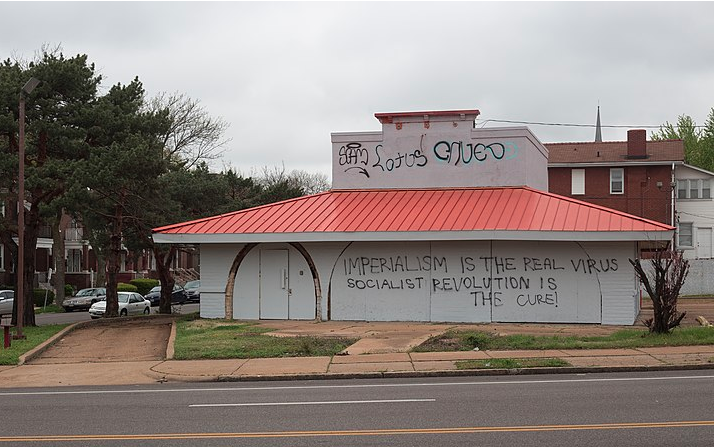
The United States did not invent the concept of bombing civilians – that tradition originated with the Luftwaffe of Herman Goering and Erhard Milch that bombed Guernica during the Spanish Civil War. The US, however, has built an empire on the foundation of terrorism from the sky. Psychologically and metaphorically, the obliteration of unarmed civilians with the most technically sophisticated weapons of science recapitulates the narrative of colonialism. The Spanish Empire employed the serendipitous blessing of “Guns, Germs and Steel” to erase indigenous cultures in the “new world.” Empires unleash the cutting edge of military technology on exponentially weaker targets. Colonial structures imploded after WW II, when empires suddenly could no longer restrain exploited populations, but US military spending now threatens to achieve such overwhelming force that the tentative gains of liberation movements now face new waves of imperial aggression.
I sometimes think of Gaza as a concept rather than a place, a thing that can be moved around the globe through time and space like a green, yellow or red square on a Rubik’s Cube. For example, consider the Warsaw Ghetto – Gaza’s most obvious prototype – where a population of “sub-humans,” crammed into a crowded holding pen, will be systemically ravaged by disease, starvation and arbitrary violence. A train-ride to gassing facilities in nearby Treblinka awaits Germany’s scapegoated victims. The money, property and possessions of Warsaw’s “cargo” (so labeled by Treblinka commandant, Franz Stangl) will wind up being laundered in Swiss banks. Genocide almost always affixes itself to profit. Assembly-line mass slaughter welds murderous passion with calculating, bureaucratic means of wealth extraction. The “dentists” of Treblinka (a few select targets for genocide are kept alive for a few days, in order to pull gold teeth from the gaping mouths of the dead, and place them in buckets to be handed over to their racial masters) wander back and forth over mountains of corpses. This last gruesome task of wealth appropriation at Treblinka resembles the final stages of meat production, where the guts and waste from assembly line slaughter are slopped into vats to make hot dogs and pet food. Efficiency, more than hatred, informs the methods of colonial plunder. Treblinka, for its time, killed with unprecedented technical sophistication.
The victims in Gaza have not been slaughtered solely out of impulsive rage – they have the misfortune of existing on valuable land. History might easily be imagined as the study of moments in which life has been exchanged for cash. Murdered victims of colonial plunder own land, modest wealth or personal possessions. While genocides have often occurred beneath the veil of war, the Gazan genocide might be the first such event to masquerade as war. Gazans do not die in gas chambers or mass shootings. They are not strangled in nooses, nor are they clubbed to death, burned in religious rituals or paired with executioners in any formal sense, but, rather, die (predominantly) via bombing raids and artillery shelling. There has never been a more expensive way to eliminate hundreds of thousands of people. The Gazan extermination facility has cost the US some estimated $21 billion dollars while the Nazis killed a comparable number of victims at Treblinka using requisitioned rolling stock and six carbon monoxide generating engines. The Gazan experiment, whatever the increased expense, allows for a more palatable public explanation – all deaths are labelled as “collateral damage.” The orgy of civilian bombing in Gaza may lead one to think that western civilization has plunged off of a moral cliff, but, oddly, no historical atrocity has ever laid bare the soul of imperialism with such vivid clarity. The crimes of imperialism accumulate in direct proportion to the levels of military inequity. On a planet that suffers from relentlessly increasing wealth inequality, an overlooked process of arms inequality creates new risks. Once poor and indigenous cultures lose the ability to defend themselves, we reach the basic conditions conducive to genocide.
“Cortés The Killer“ may be remembered as a 16th century explorer, but he and his contemporary conquistadors “discovered” the moral vacuum of genocidal profiteering. If the Warsaw Ghetto is the modern prototype for Gaza, The Spanish Conquistadors established the archetypal themes for colonial extraction. This mandate to murder originated with a vastly superior arsenal of weaponry featuring armored cavalry, gun technology, Cannon fire, steel lances, steel swords, and highly evolved military strategies.
While we often think of armed conquest as involving arduous battles between evenly matched armies, colonial exploitation pits nations with massively mobilized forces against those that have little or no means to defend themselves. A modern, updated example of colonial conquest juxtaposes the Venezuelan military that has virtually no military budget at all against the attacking US military that aspires to raise annual military spending to a staggering 1.5 trillion dollars by 2027. Between 2020 and 2023, the nation of Venezuela spent, on average, $3.29 million dollars annually on their military. This inconceivable statistic has gotten no media focus. Compare the Venezuelan army with my home town, Northampton, Massachusetts, that spends about $6 million per year on its police force. You are not misunderstanding me – small town Northampton’s police force gets twice the funding of the Venezuelan military.
We ought to recognize that Donald Trump’s bombing of Caracas and abduction of Nicolás Maduro follows the protocol of imperial expansion established by Hernán Cortés almost to the letter. Recall that Cortés and his forces abducted the Aztec Ruler, Montezuma a half a millennia ago. Hernán Cortés and his fellow conquistadors acted out a human drama based on the two basic contingencies that animate imperialism: 1) a ruling class desire to appropriate land and extract riches. 2) an enormous discrepancy in military development. However, military adventures reflect a larger context than mere technological advantage. The policy of stealing land and resources from militarily outmatched indigenous populations required the financial mechanisms of capital.
This blog post at the climate divestment website “Bankgreen,” tells the familiar story like this:
“Cortés was not a rich man and could not directly pay the soldiers he required for his expedition. Instead, he sold equity; that is, portions of the expedition’s eventual profits to men (equity holders) willing to join. These “equity holders’‘ then owned pieces of paper (stock certificates) that they could trade among themselves or sell to anyone else who was willing to buy. As the profits of conquests (or companies) grow, the value of a stock certificate tends to grow with them, at a rate of around 4% to 8% per year.
If the expedition went bankrupt, the equity holders would get nothing. But in return, Cortés would be obliged to obey his equity holders, even if they voted to do something radical, like forbid the slaughter of random natives on the street. This is still how many early-stage businesses, operations, and ventures are financed today.”
While “Bankgreen” attempts to pressure financial structures to support climate goals, the suggestion that Cortes might have been restrained by equity holders misses the essential psychology of colonialism. Colonialism cannot exist without racism – the notion that “savages, vermin, bacilli and sub-humans” deserve to be treated with consummate cruelty. The conquistadors operating in the West Indies performed rituals of colonial cruelty described by 16th century Spanish clergyman and human rights champion, Bartholome de las Casas, in this eyewitness description:
“They forced their way into native settlements, slaughtering everyone they found there, including small children, old men, pregnant women, and even women who had just given birth. They hacked them to pieces, slicing open their bellies with their swords as though they were so many sheep herded into a pen. They even laid wagers on whether they could manage to slice a man in two at a stroke, or cut an individual’s head from his body, or disembowel him with a single blow of their axes. They grabbed suckling infants by the feet and, ripping them from their mothers’ breasts, dashed them headlong against the rocks. Others, laughing and joking all the while, threw them over their shoulders into a river, shouting: ‘Wriggle, you little perisher.’ They slaughtered anyone and everyone in their path, on occasion running through a mother and her baby with a single thrust of their swords. They spared no one, erecting especially wide gibbets on which they could string their victims up with their feet just off the ground and then burn them alive thirteen at a time, in honour of our Saviour and the twelve Apostles, or tie dry straw to their bodies and set fire to it. Some they chose to keep alive and simply cut their wrists, leaving their hands dangling, saying to them: ‘Take this letter’ – meaning that their sorry condition would act as a warning to those hiding in the hills. The way they normally dealt with the native leaders and nobles was to tie them to a kind of griddle consisting of sticks resting on pitchforks driven into the ground and then grill them over a slow fire, with the result that they howled in agony and despair as they died a lingering death.”
David Stannard asserts, in his book, “American Holocaust,” that the death toll of indigenous people from Columbian times to now should be set at 100 million people. He argues that some 95% of the pre-Columbian indigenous population had been murdered. The US took over much of the Spanish Empire via warfare some two centuries ago, absorbing large territories formerly belonging to Mexico, pilfering tribal lands and massacring and marginalizing indigenous populations. The US has used Latin America as a primary source for extraction, sometimes utilizing troops directly, but more frequently manipulating coups against leftist leaders and supporting corporate friendly military figures. The Guatemalan Genocide (1960-1996) carried out against the Mayan population followed CIA instigated regime change. When we brace ourselves for a renewed US assault against Latin America, we should be cautious about centering the narrative around Trump’s fascism – the historical roots of US atrocities south of the border have deep antecedents.
Trump’s adventures in Venezuela, his sanctions against Brazil in support of the fascist, Jair Bolsonaro, his threats toward Cuba, Columbia and Panama ought to be viewed through the lens of Gaza. Gaza is an ongoing experiment in the most extreme forms of extraction. In a world that has seen colonialism fail in a series of futile wars, Gaza ought to be viewed as imperialism’s belated counterattack. Hitler’s genocide against the Jews drew inspiration from US policy toward racial outcasts, and now Gaza reenacts the evisceration of the Jews of the Warsaw Ghetto. Gaza shows us the worst intentions of the US military machine. Our “Masters of War” have discovered that unwanted populations can be concentrated and impersonally obliterated from the sky. US/Israeli strategy combines the bombing of Vietnam and the fierce population compression of the Warsaw Ghetto, where almost half a million people were shoe horned into an area just over a square mile. The Warsaw Ghetto population density was over ten times more tightly packed than that of present day Tokyo’s most crowded districts. We now see, in the Salvadoran Concentration Camp Industry, the strategy of crowding unwanted people in tight spaces.
While Gaza is the current target of US military technology, Trump’s absurdly expanding military spending, his monomaniacal hatred of Latino refugees, and his interest in overtly enacting Latin American regime change, points to the looming darkness of a gathering genocide. Almost every grim prediction of Trump’s assault on human rights has proven to be an understatement. I have argued even before Trump regained power, that the icon of US fascism had genocidal intentions. It is clear to me that last year I did not see how dire the predicament was, not just for migrants residing in the US, but for all of Latin America. Only our escalating civil disobedience can rescue Latin America from act two of what David Stannard deemed an, “American Holocaust.” While people around the country justly protest the murderous policies of ICE, the entire military machine must be targeted. Every means of non-violent resistance will need to be mobilized – strikes, boycotts, occupying munitions factories, blocking traffic, getting arrested – everything. The Venezuelan bombing and invasion ought to be viewed as a warm up act for something much worse.
Phil Wilson writes the blog Nobody’s Voice.

No comments:
Post a Comment