As the Status Quo Shatters, Afrofuturists’ Visions Offer a Way Forward
Afrofuturism takes us to strange futures. In its kaleidoscope lens, the future is a canvas to imagine free Black life.
By Nicholas Powers ,
February 25, 2026
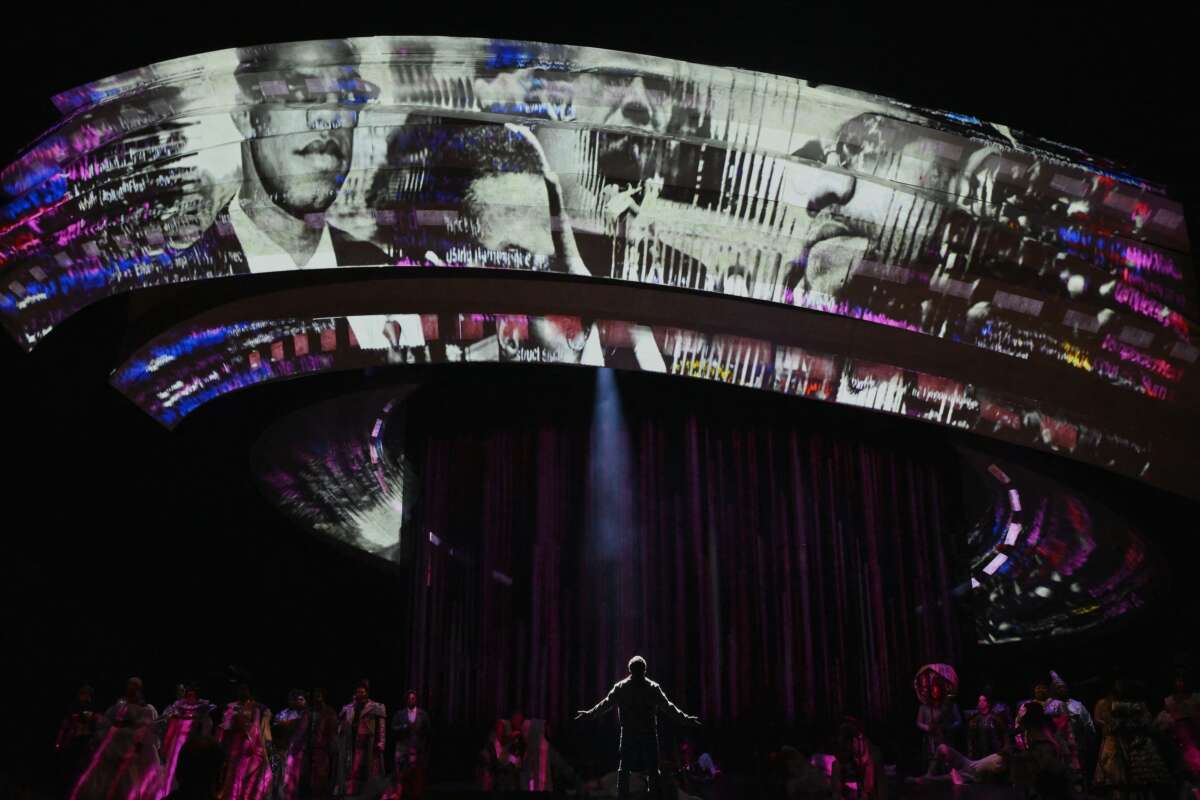
Performers take part in a dress rehearsal of X: The Life and Times of Malcolm X at the Metropolitan Opera in New York City, on October 31, 2023. This musical biography of civil rights leader Malcolm X infuses history with Afrofuturism, and first premiered in the mid-1980s to favorable reviews from critics, but went unrevived for decades, with just a few stagings over nearly 40 years.
ANGELA WEISS / AFP via Getty Images
Years ago, I stood at the Black Fist statue, and felt the heaviness of George Floyd’s death. I also felt hope from the protests in his name. The corner of 38th St. and Chicago Ave. in Minneapolis was liberated by the people into an art-filled, open space. The joy was electric. Maybe, I thought, maybe this is a glimpse of a Black future.
Now, nearly six years after Floyd’s murder, the state violence that took his life has expanded its targets to include white protesters, journalists, and politicians. Two new memorials have been built in Minneapolis. One is for Renee Nicole Good, a lesbian mother and poet, and another for Alex Pretti, a nurse. Both were killed by Immigration and Customs Enforcement (ICE) agents.
Right-wing state violence, on every level, is trying to stomp out the vision of a multiracial, pluralistic democracy and replace it with plans for a white ethnostate. If the right wing wins, its victory will come at a cost. The United States will likely implode. Already, millions of people in the U.S. have lost faith in the rule of law, a faith that was shaky to begin with. Already, the U.S. has transformed into an early-stage authoritarian state with President Donald Trump threatening the integrity of the midterm elections.
In the face of increasing right-wing violence and national implosion, Black America has to ask questions: What does freedom look like after the U.S.? How does the Black freedom struggle reimagine the “promised land”? Black writers have long mapped alternative futures that led away from the “American Dream.” Some are Pan-African. Some envision a worker’s democracy. Some articulate a new religion of change. What they share in common is a vision for a Black future free of racism that builds community on the lessons learned from surviving slavery. It is a vision of a new world struggling to be born from the ruins of this one.

Black History Has the Power to Ignite Movements. That’s Why the Right Fears It.
The administration’s preemptive assault on history is a desperate attempt to stop new social movements from starting.By Nicholas Powers , Truthout November 29, 2025
A Burning House
“I will fucking kill you,” the Indianapolis cop told 17-year-old Black teen Trevion Taylor, dragging him from his car. The young man’s eyes filled with fear. He and his friends were at an anti-ICE rally when police stopped them, claiming they “smelled weed.” The cop’s casual threatening of Taylor’s life is just one example of the current widespread increase in state violence. This growing violence includes ICE killings of migrants and protesters.
Today it is ICE or police. Yesterday it was the FBI’s COINTELPRO or the National Guard killing student protesters at Kent State. When the people mobilize to protect their rights or each other, they are killed. The tear gas used looks like smoke from a nation on fire.
Right-wing state violence is trying to stomp out the vision of a multiracial, pluralistic democracy and replace it with plans for a white ethnostate.
“I suspect [we’re] integrating into a burning house,” Martin Luther King Jr. told fellow civil rights activist Harry Belafonte in 1968. Belafonte recalled King’s warning at a 2005 town hall with Barack Obama and Hilary Clinton. In the decades since, the flames have risen higher and higher. They rose during the Reagan era. They rise higher in the Trump era. The right has been so intent on destroying the seeds of diversity and tolerance planted by the civil rights movement that it is willing to destroy the U.S. and rule over its ashes.
Right now, we face a political crisis. President Trump wants to “nationalize” the midterm elections. He sent the FBI to raid a Georgia voting center and take ballots and records. He transformed ICE into a paramilitary force and more than doubled its personnel from 10,000 to 22,000, luring new recruits by using white supremacist ads. Trump has called Democrats “traitors,” threatened to kill them, and labeled “antifa” a terrorist threat. Meanwhile, Steve Bannon, Trump’s former strategist, has urged him to use ICE to “surround the polls” in order to stop Democrats from “stealing the election.” There’s a very real constitutional fight ahead.
Right now, Black America is in the crosshairs. Trump waited for Black History Month to unleash a racist video of the Obamas portrayed as monkeys. This follows his executive order to cut diversity, equity, and inclusion programs and the “Department of Government Efficiency” cuts that led to a dramatic increase in Black women’s unemployment, with nearly 300,000 losing work. Overlap that data with the 25 percent of Black families with single mothers, and it becomes clear that these actions will push whole families and neighborhoods toward collapse. In October 2025, the Supreme Court heard a case that could disembowel the Voting Rights Act. For now, the court dodged on fully ending it — currently, the case is being actively reviewed, which means the Voting Rights Act is on a knife’s edge. Then, on February 13, Trump said on Truth Social he will issue an executive order mandating voter ID for the midterms. What we see is only the visible part of the larger Project 2025 agenda that also includes rigging the census to undercount Black people, eliminating student loan forgiveness, ending federal consent decrees, shifting oversight of housing programs to the states, and giving a free hand to polluters to poison Black communities.
Black America is in the crosshairs. Trump waited for Black History Month to unleash a racist video of the Obamas portrayed as monkeys.
In the years to come, Trump’s wacky handling of the economy is poised to put the U.S.’s decline into hyper-speed. The disingenuously named Big Beautiful Bill is projected to increase the federal debt by $3.4 trillion over the next decade while cutting health care for 10 million people and starving millions more. Sen. Bernie Sanders (I-Vermont) cited a study that found 51,000 will die annually because of these policy chances. What’s more, U.S. allies like Canada are openly saying that U.S. hegemony is over, and their governments intend to make trade deals with China. The inevitable decline of the dollar as the global reserve currency threatens to lead to deep cuts to social services to pay interest on the U.S. debt. Politicians may then print money, which could accelerate hyperinflation and financial collapse. Oh, yes, add to that the massive layoffs as businesses adopt AI. MS NOW analyst Chris Hayes said, “The project of the Big Tech oligarch billionaires is to do to white-collar workers what globalization and deindustrialization did to blue-collar workers.”
Here is the burning house that King predicted nearly 60 years ago. The U.S. threatens to become a charred hollow shell. Black people are stranded in a jobless nation run on algorithms. The government cannot afford welfare or social services. Its elections are rigged. The police are militarized, and you and everyone you know are under AI-enhanced state surveillance. You can be thrown into one of the new, high-tech detention sites for protesting. The American Dream, which has always been mostly fiction, is officially dead.
Carrying the Cross
So how did we get here? How did the “promised land” become a burning house? Maybe because the very idea was a dead end.
“Even though we face the difficulties of today and tomorrow, I still have a dream,” MLK Jr. intoned at the 1963 March on Washington. “It is a dream deeply rooted in the American Dream.” His words washed over the massive crowd. Yet in his beautiful vision was a trap.
Much of Black America chose integration as the dominant strategy for freedom. Many chose the Bible, the Declaration of Independence, and the Constitution. Sometimes, segments of Black America chose to adapt to and even adopt white culture. All this is understandable for a people stolen from their homes and enslaved in a strange land. Imagine stumbling from a slave ship, blinking in the sun, rubbing red welts from chains. You are forced to an auction block. People buy you. At night, you look at the stars and know your family is gone forever. You see other slaves whipped and killed by the Christian owner who prays to Jesus. Maybe if you pray to Jesus too, the Christian will treat like you like a human being.
Much of Black America chose integration because of being a terrorized people who hoped to achieve safety by adopting the symbols and culture of white America. We see this in the internalized racism expressed by Phillis Wheatley, the first published Black American poet of modern times, who wrote in 1773, “Remember Christians, Negros Black as Cain / May be refined, and join the angelic train.”
Seventy-nine years later, after the American Revolution, in 1852, just shy of the Civil War, Frederick Douglass gave his speech, “What to the Slave Is the 4th of July,” where he said, “your celebration is a sham; your boasted liberty, an unholy license; your national greatness, swelling vanity; your sounds of rejoicing are empty and heartless.” In his speech, we see Black leveraging of national symbols to force empathy.
Meanwhile, in a 1926 essay titled, “The Negro Artist and the Racial Mountain,” Harlem Renaissance poet Langston Hughes wrote on “this urge within the race toward whiteness … and to be as little Negro and as much American as possible.” Again, an artist tells us the terrible cost of being American. The price of integration was internalized racism, classism, and nationalism.
In the 250 years since the Declaration of Independence was signed in 1776, Black America grew from approximately 500,000 to now 42 million. It has also grown apart. Integration sped up a serious class division that is now agonized over by academic Henry Louis Gates Jr. and that was made into a comedy skit by Chris Rock in his 1996 “N***as vs. Black People.” The giant split between the upper-class Black elite and the poor and working classes enables the Democratic Party to use the Black freedom struggle like a poker chip.
The civil rights movement’s legacy is exhausted. President Obama’s election was sold to us as King’s dream come true. It wasn’t. Obama waxed poetic on King, saying in 2009, “One of my favorite expressions was Dr. King’s expression that the arc of the moral universe is long but it bends toward justice.” This from a man who killed 3,797 people with drones, including 324 civilians, and bragged, saying, “Turns out I’m really good at killing people.” He deported more than 3 million people. His housing policy destroyed Black wealth by saving banks rather than homeowners. He was willing to gut Social Security in a “grand bargain” with Republicans. He and the utter failure of Sen. Kamala Harris’s campaign are the nails in the coffin of the hollow version of Black history.
I’ve Known Rivers
“I’ve known rivers ancient as the world and older than the flow of human / blood in human veins” Langston Hughes wrote in his 1921 poem “The Negro Speaks of Rivers.” I read it at the African Burial Ground in New York, and the imagery resonated in the hushed air. Free and enslaved Africans were buried here before the United States was a nation. We came to pay respect to the ancestors. The act made one thing clear: Black history did not begin in the U.S. and it will not end here.
Our ancestors lost everything but not their humanity. They were sold and bought but were never objects. They had a vision of freedom that arced over their lives into ours today.
Not all of Black America saw the U.S. as the promised land — it had two main alternate visions. One looked to the past to recreate a golden age in Africa. The other gazed into Afrofuturism. For a long time, more people were drawn toward the first vision, advocating for a Pan-African right of return. This vision flickered in the Black antebellum folklore of slaves who remembered their true language and flew home to Africa. The story was richly sung by Paul Robeson. Versions of it were passed down through generations. You hear it in the speeches of Marcus Garvey. You hear this vision in Malcolm X’s call to form a Black nation with the U.S. by “any means necessary.” And most recently we “flew” home during the Black Panther movies. I remember cheers when T’Challa arrived in Wakanda and the holographic curtain was pulled back to reveal a glittering high-tech and free African city.
The dream of return can reinforce integration if it just serves as a catch-basin for our rage at fighting racism while integrating. James Baldwin pointed out that whole ways of thinking would have to change in order for Black separatism to become reality. In his famous 1963 essay, “The Fire Next Time,” Baldwin was driven home after meeting with the Nation of Islam’s leader Minister Elijah Muhammad. He questioned his driver, “How we were — Negroes — to get this land?” Quietly, Baldwin thought, “I was thinking, your entire frame of reference will have to change, and you will be forced to surrender many things that you know scarcely know you have.”
The other vision, Afrofuturism, instead takes us to strange futures. It is rooted in the arts — from the jazz explorations of Sun Ra’s 1974 film Space Is the Place, to the eclectic works of Janelle Monae. It comes in the novels of Samuel Delany and Octavia Butler. Its themes were crystallized in Mark Dery’s 1993 essay, “Black to the Future” that coined the term “Afrofuturism.” In its kaleidoscope lens, the future is a canvas to imagine free Black life: Free from white supremacy. Free from capitalism. Free from racial romanticism. Free from homophobia and binary thinking. Everything and anything is questioned — even old dreams of liberation, like the American Dream.
In Afrofuturism, one work stands out: Octavia Butler’s 1993 novel Parable of the Sower. Imagine the U.S. has collapsed. Global warming has set the land on fire. Pyromaniac junkies loot and burn. In this hellscape, the protagonist, a Black teen named Lauren, develops a hyper-empathy that gives her a near-telepathic ability to feel others’ feelings. After her gated community is ransacked, she and a small band strike out in search of safety. Lauren develops a religion called Earthseed that celebrates change, saying, “All that you touch You Change. All that you Change Changes you. The only lasting truth Is Change.” Earthseed is a fusion of the ancient Greek philosopher Heraclitus’s ideas of endless flux (hence his saying, “You never step into the same river twice”) and MLK Jr.’s concept of “soul force,” or using nonviolent resistance to transform violence into mutual recognition of each other’s humanity. The novel ends with Lauren’s religion spreading in the ruins of the U.S.
When I returned to the African Burial Ground, I brought Parable of the Sower, as if to measure its message against the nightmare our ancestors endured. Is Afrofuturism a way forward? Does our imagination honor their lives? I stood where they were buried, and asked: What does home mean now? Is there a promised land left?
I believe there is. Our ancestors lost everything but not their humanity. They were sold and bought but were never objects. They had a vision of freedom that arced over their lives into ours today. We are more precious than any nation or religion. We are a river flowing from the beginning of humanity to its end. It’s time to wash away the old dream and imagine new ones. It’s time for a new Black future.
This article is licensed under Creative Commons (CC BY-NC-ND 4.0), and you are free to share and republish under the terms of the license.
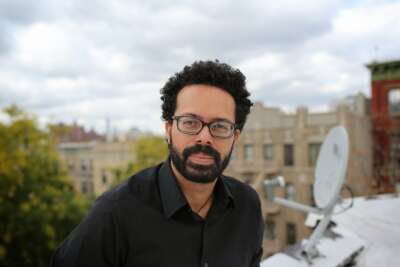
Nicholas Powers
Nicholas Powers is the author of Thirst, a political vampire novel; The Ground Below Zero: 9/11 to Burning Man, New Orleans to Darfur, Haiti to Occupy Wall Street; and most recently, Black Psychedelic Revolution. He has been writing for Truthout since 2011. His article, “Killing the Future: The Theft of Black Life” in the Truthout anthology Who Do You Serve, Who Do You Protect? coalesces his years of reporting on police brutality.

No comments:
Post a Comment