“I will continue to work for the freedom of the Palestinian people,” says Mohsen Mahdawi.
By Amy Goodman ,
February 20, 2026
An immigration judge has blocked the Trump administration from deporting Mohsen Mahdawi, a Columbia University graduate and green card holder who was detained last April at what he thought was a citizenship interview. Mahdawi grew up in a refugee camp in the occupied West Bank and was an outspoken critic of Israel’s genocide in Gaza while attending Columbia. He spent two weeks in ICE custody before a federal judge ordered his release. Mahdawi’s case is part of a broader pattern of the Trump administration targeting international students for expressing solidarity with Palestinians and demanding divestment from the Israeli government.
Mahdawi says even though immigration judges are part of the executive branch, the Trump administration clearly “violated the rules of law” in targeting him. “The harder they come on me, the more energy and power I will have, and I will continue to work for the freedom of the Palestinian people and the right of return and equal rights and human rights for Palestinians.”
TRANSCRIPT
This is a rush transcript. Copy may not be in its final form
AMY GOODMAN: “People Have the Power” by Patti Smith joined by Michael Stipe performing at Democracy Now!’s 20th anniversary. On Monday night we will be streaming our 30th anniversary celebration with Michael Stipe and Angela Davis, with Wynton Marsalis and Maria Ressa, also with the Palestinian Pulitzer Prize-winning poet Mosab Abu Toha and many others. Go to Democracynow.org for that livestream.
This is Democracy Now!, Democracynow.org. I’m Amy Goodman. An immigration judge has blocked the Trump administration from deporting Mohsen Mahdawi, a graduate student at Columbia University who was detained last April for his outspoken support for Palestinian rights. Mohsen is a green card holder who grew up in a refugee camp in the occupied West Bank. At Columbia, he served as co-president of the Palestinian Students Union and served as president of the Buddhist Association.
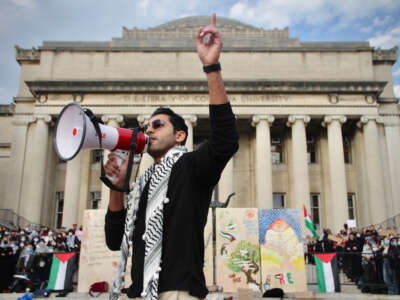
Activist Mohsen Mahdawi Freed From Prison After Judge Orders His Release
“I am saying it clear and loud to President Trump and his Cabinet: I am not afraid of you,” he said after his release. By Sharon Zhang , Truthout April 30, 2025
Last April, masked and hooded ICE agents detained him when he appeared for what he believed would be a naturalization interview in Vermont. He spent two weeks in ICE custody before federal Judge Geoffrey Crawford ordered his release. At the time, Judge Crawford wrote, “Our nation has seen times like this before, especially during the Red Scare and Palmer Raids of 1919-1920 and during the McCarthy period in the 1950’s.”
Mohsen is just one of many international students targeted by the Trump administration solely for expressing solidarity with Palestinians and opposing the Israeli war on Gaza. Mohsen Mahdawi joins us now. Mohsen, welcome back to Democracy Now! We spoke to you right after you were released from jail. It was right before graduation at Columbia, at the reception in front of SIPA, the School of International Affairs where you are now a graduate student. Can you talk about the significance of this immigration judge’s ruling?
MOHSEN MAHDAWI: Thank you for having me, Amy. This is very significant and actually it’s unprecedented considering all of the cases that were brought forward against students for deportation, student activists. What Judge Nina Froes has done, she has actually taken a very brave and courageous step towards justice by holding the rule of the law.
Even though this immigration court is under the executive branch, still the judge has found that the document which was used, which was the memo by Marco Rubio, was unauthenticated. And the hope that this same finding will apply on other students and based on this determination of the case was done without prejudice.
Now, I have to share with you, Amy, that we also have to consider the many different circumstances. The first step that allowed me to get here was to not be deported, to not be transferred from Vermont to Louisiana, which allowed me to be freed on bail by Judge Geoffrey Crawford. And then to be able to be heard in this immigration court which is in Massachusetts rather than one that is in Louisiana. So that gives you hope that there are judges who still hold integrity and refuse to sell their souls to Trump’s administration.
AMY GOODMAN: For people who don’t understand how the system works, explain the difference between an immigration judge and a federal judge. You have cases in both courts.
MOHSEN MAHDAWI: Correct. And I hope my lawyers would not be angry at me, because I am not a lawyer, but my understanding that technically—and actually it’s part of the vision of this country to have checks and balances, and federal courts are part of the checks and balances. This actually has been designed and envisioned by Alexander Hamilton, one of the founding fathers. And the idea is to separate the executive branch from the judicial branch.
AMY GOODMAN: It’s interesting that this is an immigration judge who is under the executive branch.
MOHSEN MAHDAWI: That’s exactly right. So even though the immigration judge is bounded by the executive branch, the immigration judge has to go through the rules and the rules of law, and based on those rules of law, what the Trump administration has done, in fact, they have violated the rules of law. And that’s why the case was terminated.
AMY GOODMAN: This was your message to Trump after you were released from an ICE jail in Vermont last year following more than two weeks in custody.
MOHSEN MAHDAWI: And I am saying it clear and loud to President Trump and his cabinet—I am not afraid of you.
AMY GOODMAN: Talk about that moment as you say you are “not afraid of you” and what it meant to be released and what it meant after you had gone for your naturalization hearing, for these federal immigration agents to move in on you when you had been told to come for the hearing.
MOHSEN MAHDAWI: By this time, I would imagine that it’s becoming very clear to the American people and to the rest of the world that this administration’s mentality, the Trump administration, is to intimidate people, to scare people, and to make an example of people like me so others would not actually dare to raise their voice and to share their truth. And what I meant to say, actually, why I wanted to say that I am not afraid—because if I am afraid, I would lose sight. And I would lose not only sight; vision and imagination.
AMY GOODMAN: Mohsen, we just have a minute. You were raised in a refugee camp in the occupied West Bank. You are a permanent U.S. resident. You enrolled in Colombia University to study philosophy where you are also president of the Columbia University Buddhist Association. How has your faith and upbringing in the occupied West Bank guided your activism and your stance today?
MOHSEN MAHDAWI: Amy, I have to share—because of one minute—I have to share with you that I was attacked and other students were attacked not merely for protesting. The media has missed the point. They started saying the pro-Palestine protests or the Palestinian movement. The movement had an actual goal, an objective, and that is divestment—divestment, boycott, and sanctions—because this is the only way that we can bring peace and justice in a nonviolent and peaceful way. And we do it with love, compassion, and empathy.
That is why the Trump Administration gets so scared of people like me who organize, and are still organizing, because I will not be deterred and I will not actually give up to their exhaustion tactics. The harder they come on me, the more energy and power I will have, and I will continue to work for the freedom of the Palestinian people and the right of return and equal rights and human rights for Palestinians.
AMY GOODMAN: Mohsen Mahdawi, graduate student at Columbia University, thank you so much for being with us. I’m Amy Goodman.

No comments:
Post a Comment