As the anti-immigrant Reform UK Party has risen in the polls, the Labour Party has co-opted some of its toxic policies.
February 6, 2026
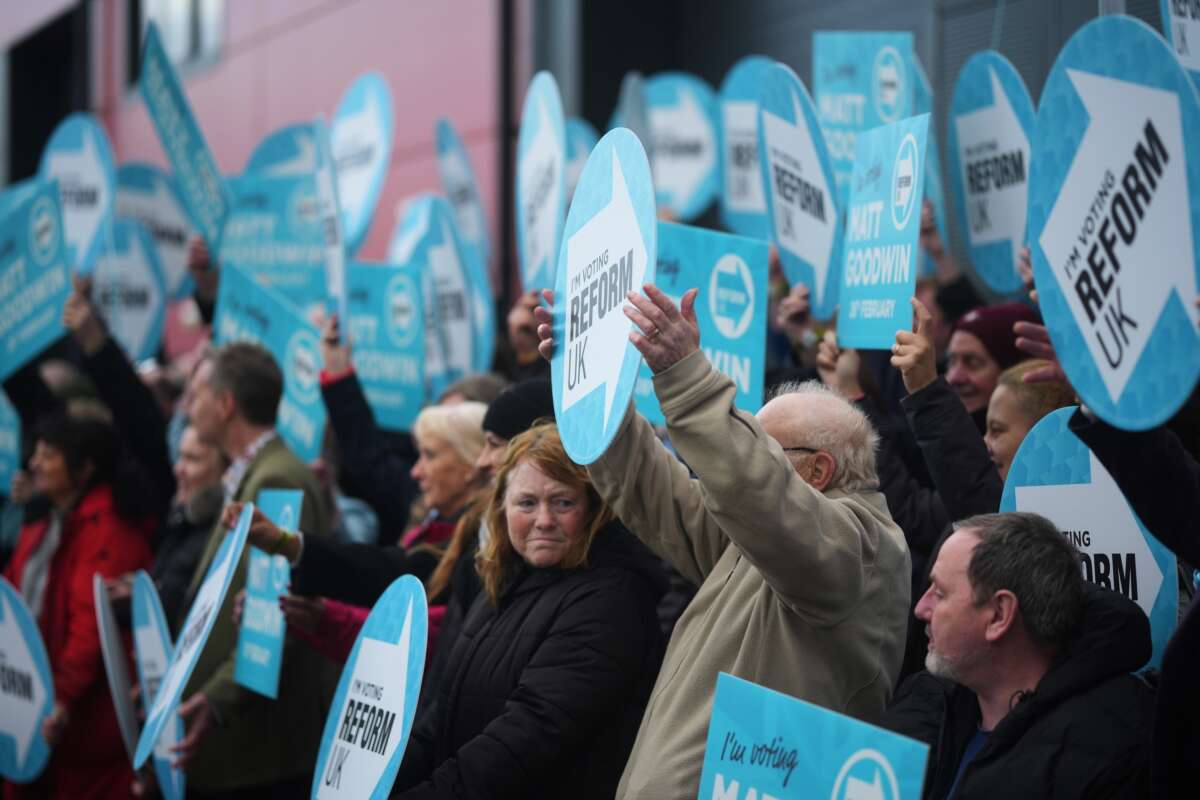
Reform U.K. supporters are seen as they open their campaign headquarters on February 5, 2026, in Denton, England.
Christopher Furlong / Getty Images
In recent months, as the anti-immigrant Reform U.K. Party surged to the top of the polls, the U.K.’s Labour government has sought to make it harder for immigrants to get “indefinite leave to remain” — essentially a British version of the U.S. green card — as well as restrict access to benefits for immigrants.
Currently, immigrants can seek “indefinite leave to remain” after five years in the country. Now, the Labour government’s plan is to double that wait time to 10 years. It has also proposed making refugees wait 20 years for citizenship; seizing the assets of asylum seekers; and curbing family reunification.
The Labour Party’s strategy, pushed by Home Secretary Shabana Mahmood, is to take the wind out of the Reform U.K. Party’s sails by co-opting some of its more toxic policies around immigration, even if the impact is to drive away needed workers, in health care and other industries, who can more easily get residency rights in other countries in Europe and beyond.
There is scant evidence that this anti-immigration strategy is actually working to Labour’s political advantage. True, polls show that Reform U.K. seems to have peaked in mid-2025, and that in recent months its support has begun to ebb — as outsider parties normally do in the U.K. system. Yet, it still is polling significantly ahead of Labour. And, come the general election, it will almost certainly receive a massive propaganda assist from the Trump administration in the U.S., which makes no secret of its loathing of European social democratic governments and which has explicitly allied with Reform U.K. in its aspirations to deport immigrants from the U.K. in much the same way that Donald Trump is currently removing them wholesale from the United States.
In recent months, as the anti-immigrant Reform U.K. Party surged to the top of the polls, the U.K.’s Labour government has sought to make it harder for immigrants to get “indefinite leave to remain” — essentially a British version of the U.S. green card — as well as restrict access to benefits for immigrants.
Currently, immigrants can seek “indefinite leave to remain” after five years in the country. Now, the Labour government’s plan is to double that wait time to 10 years. It has also proposed making refugees wait 20 years for citizenship; seizing the assets of asylum seekers; and curbing family reunification.
The Labour Party’s strategy, pushed by Home Secretary Shabana Mahmood, is to take the wind out of the Reform U.K. Party’s sails by co-opting some of its more toxic policies around immigration, even if the impact is to drive away needed workers, in health care and other industries, who can more easily get residency rights in other countries in Europe and beyond.
There is scant evidence that this anti-immigration strategy is actually working to Labour’s political advantage. True, polls show that Reform U.K. seems to have peaked in mid-2025, and that in recent months its support has begun to ebb — as outsider parties normally do in the U.K. system. Yet, it still is polling significantly ahead of Labour. And, come the general election, it will almost certainly receive a massive propaganda assist from the Trump administration in the U.S., which makes no secret of its loathing of European social democratic governments and which has explicitly allied with Reform U.K. in its aspirations to deport immigrants from the U.K. in much the same way that Donald Trump is currently removing them wholesale from the United States.

Op-Ed |
Why Is New UK Prime Minister Seeking Immigration Advice From Italy’s Far Right?
Keir Starmer of the Labour Party has looked to Giorgia Meloni, who has unleashed draconian measures against migrants. By Sasha Abramsky , Truthout September 24, 2024
In fact, if the general election were held tomorrow, the Reform U.K. Party could conceivably end up with the most members of parliament, putting it in pole-position to form a coalition government. Meanwhile, the Labour Party, which came to power a couple years ago with one of the largest parliamentary majorities in British history, faces something approaching an electoral wipeout. Modeling suggests the party could lose more than 80 percent of its seats.
If the general election were held tomorrow, the Reform U.K. Party could conceivably end up with the most members of parliament.
Astoundingly, Prime Minister Keir Starmer’s approval rating is, in some polls, at only 15 percent, making him far more unpopular than any other party leader in the U.K., including the notoriously polarizing Reform U.K. leader Nigel Farage. (You know you’re in trouble when your polling numbers make Joe Biden, after his June 2024 debate debacle, look like a paragon of popularity.)
Many voters in the U.K. are going to get a test run on May 7, when they will be electing local council members as well as members of the devolved Welsh and Scottish parliaments (polling suggests the Labour Party could fall to third place in Wales). Voters’ decisions this May could be a bellwether for the general election that is set to take place in three months. Despite elections for more than 600 council positions being delayed due to a reorganization of local government in many parts of England, more than 4,200 council members will be elected that day, including in London and many of the other large metropolitan areas in the southeast of the country, as well as in parts of the industrial Midlands and the north of England. In cities such as Newcastle, in the north, the city council of which is currently controlled by Labour but the population of which remains skeptical of Europe and hostile to large-scale immigration, voters are likely to express their discontent with the Labour Party by turning toward Reform U.K. Elsewhere, Liberal Democrats and Greens could pick up disillusioned Labour voters, as could Jeremy Corbyn’s new “Your Party,” which is wooing left-wing Labour stalwarts turned off by Starmer’s leadership.
Immigration will likely play an outsized roll in the local elections. Since the COVID pandemic, the number of asylum applications in the U.K. has grown rapidly, reaching 100,000 per year from a previous average of less than 40,000. About half of these applicants enter the country “irregularly,” oftentimes taking small boats across the English Channel. The government has put thousands of these asylum seekers up in hotels as their cases are processed — and hard-right political groups have, in recent years, held protests, many of them violent, outside of these shelters.
At the same time as asylum claims have increased, overall migration rates into the U.K. have actually been falling in recent years…. Among Reform U.K. Party voters, 80 percent erroneously believe that immigration is on the rise.
But at the same time as asylum claims have increased, overall migration rates into the U.K. have actually been falling in recent years. That is a reality that a majority of U.K. voters, absorbing huge amounts of misinformation via social media and other rumor mills, are unaware of. Fully two-thirds of U.K. voters tell pollsters they believe that immigration rates are increasing. Among Reform U.K. Party voters, 80 percent erroneously believe that immigration is on the rise. Because of this, the governing Labour Party has decided its best bet to remain in power is to mimic at least some of Reform U.K.’s policy positions. It’s a similar tack-to-the-right on immigration that the Biden administration attempted in its last year in office; it didn’t play out so well for Biden and there’s precious little evidence the strategy is working for Starmer.
As in the United States, the increase in asylum applications has fueled a more general surge of anti-immigrant sentiment, the beneficiaries of which are hard-right political movements, from Trump’s MAGA movement to the anti-immigrant Reform U.K. Party. Last September, the hard-right provocateur Tommy Robinson helped organize a massive anti-immigrant demonstration, titled “Unite the Kingdom,” in the center of London. More than 100,000 people attended.
“Tackling immigration” is now seen as the most important issue facing the country, with 23 percent of voters telling pollsters that that should be the government’s number one priority, far ahead of the 16 percent who say that cost of living should be the government’s main focus. By contrast, only 5 percent list the National Health Service and 3 percent opt for tackling climate change.
Starmer’s efforts to control the narrative through embracing ever-tougher anti-immigrant measures clearly haven’t worked. They have, instead, simply added fuel to the fire and further empowered Farage’s Reform U.K. Party. It is a peculiar combination of opportunism and political ineptness, and one that will likely hand the Labour Party a drubbing in the local elections this May. Should that happen, it will become a near-certainty that Starmer will face a challenge to his leadership from within his own party before the year is out.
This article is licensed under Creative Commons (CC BY-NC-ND 4.0), and you are free to share and republish under the terms of the license.

Sasha Abramsky is a freelance journalist and a part-time lecturer at the University of California at Davis. Abramsky’s latest book, American Carnage: How Trump, Musk, and DOGE Butchered the US Government, is available for pre-order now and will be released in January. His work has appeared in numerous publications, including The Nation, The Atlantic Monthly, New York Magazine, The Village Voice and Rolling Stone. He also writes a weekly political column. Originally from England, with a bachelor’s in politics, philosophy and economics from Oxford University and a master’s degree from the Columbia University Graduate School of Journalism, he now lives in Sacramento, California.

No comments:
Post a Comment