China prepares for future Moon mission with new crew launch
Issued on: 25/05/2026 - FRANCE24
China has successfully launched and docked the Shenzhou 23 spacecraft with its Tiangong Space Station, marking a major step forward in the country’s space ambitions. The new crew will begin a mission that includes preparations for future lunar landings, advanced scientific experiments, and China’s first planned year-long stay in orbit.
What is China’s Shenzhou-23 mission? Inside the year-long space experiment
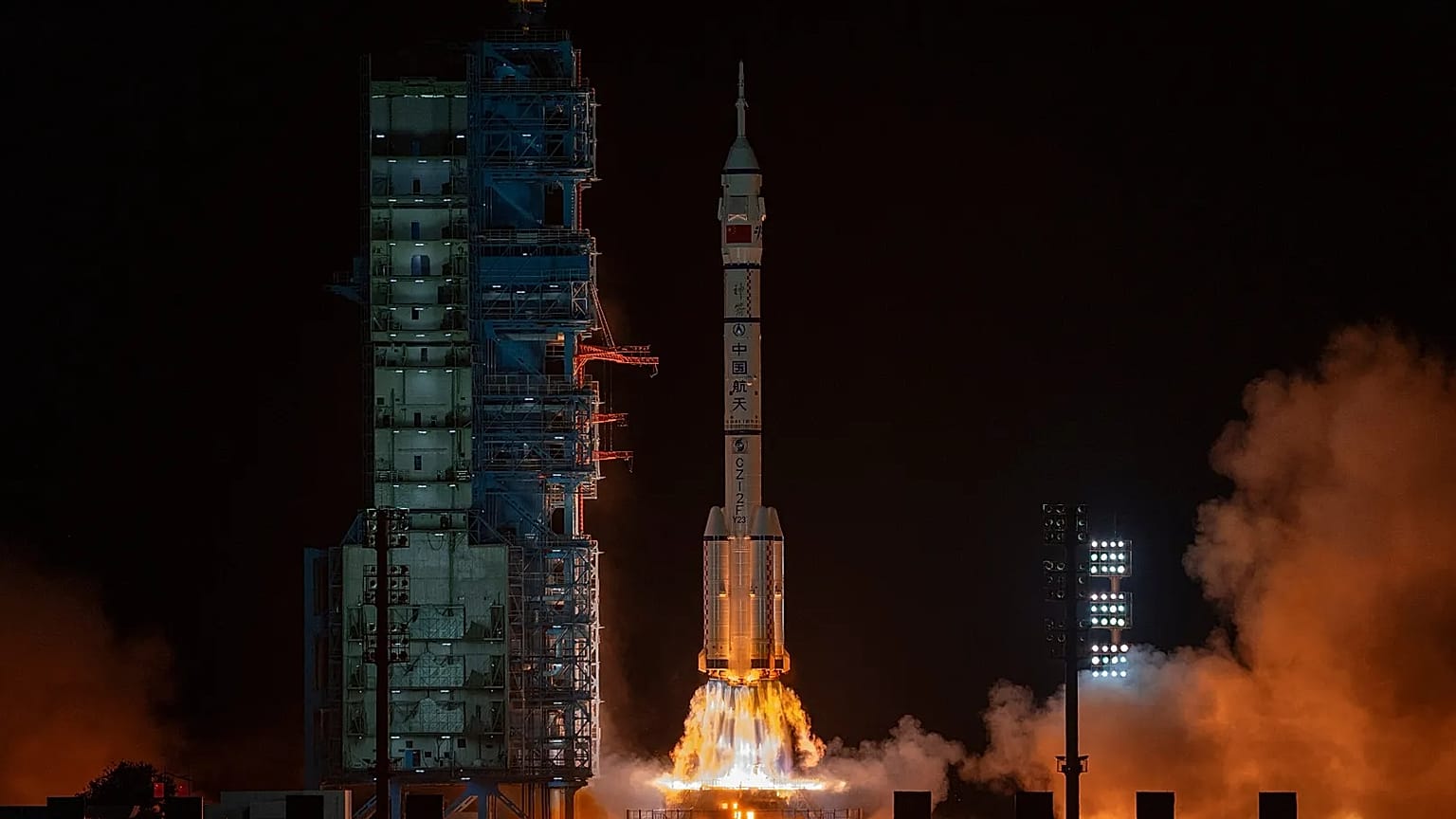
The astronauts will be testing how a year in space affects their body and will be conducting more than 100 experiments, like growing embryos and rice.
Over the weekend, China launched the Shenzhen-23 mission to its space station with three astronauts, including one who is set to stay in space for a year.
The spacecraft blasted off from the Jiuquan Satellite Launch Centre in China’s northwestern Gobi Desert with three astronauts onboard: commander Zhu Yangzhu, Zhang Zhiyuan, and Lai Ka-ying.
The astronauts will be conducting dozens of experiments while in space, including an in-orbit rotation with the crew of Shenzhou-21, the mission before them that has been at the Tiangong space station for more than 200 days.
This latest mission comes as China gears up for its first crewed lunar landing by 2030. Here’s what to expect from this latest mission.
Studying the impact of a year in space on the human body
One of the astronauts on the Shenzhou-23 crew will carry out a one-year in-orbit experiment, according to Chinese media.
The longest single mission to date by a Chinese astronaut was on the previous mission, the Shenzhou-21 crew, who have already spent 204 days in orbit. The world’s longest single space mission is 437 days, held by Russian astronaut Valeri Polyakov.
During the year-long mission, China is starting its first human body research programme, which will collect health data from the astronaut to prepare for future missions that will go further in space.
That data will be used to upgrade medical and protective systems within the spacecraft, officials said.
The astronaut’s mission is to “explore human adaptability and performance limits” in long-duration spaceflight environments, state media reported.
Growing embryos in space
While in orbit, the crew will conduct more than 100 scientific experiments, including an “artificial embryos” experiment to see whether new life can grow in space.
The astronauts will be using zebrafish and mouse embryos to establish what state media describes as an “space embryonic research system”, which will see whether different types of animals, such as those with no spines and mammals, can grow in space.
Chinese scientists are also sending rice seeds to the space station and growing them in orbit. The goal is to see how living in space affects plants over multiple generations.
For the first time, they plan to grow two generations of rice entirely in space. Scientists want to learn whether long-term exposure to microgravity changes the rice genetically or affects its stability.
The astronauts will also run biology experiments to study how microgravity affects the human body, especially how fat is processed in liver cells. State media reports that this research could help prevent fatty liver disease during longer space missions
Plant seeds will also be exposed to radiation outside the spacecraft for up to five months to see how radiation adapts their growth in space.
The crew will also be doing support work, such as moving cargo and conducting space walks during their time in space.

No comments:
Post a Comment