
Trump Sanctions on Cuba’s Oil Company Expected to Worsen Humanitarian Crisis
“The US regime’s secretary of state, driven by ambitions of conquest, presidential aspirations, and the vengeful sentiments of the elitist clique that propelled his political career, now further tightens the economic and energy stranglehold against Cuba,” said the island’s foreign minister.
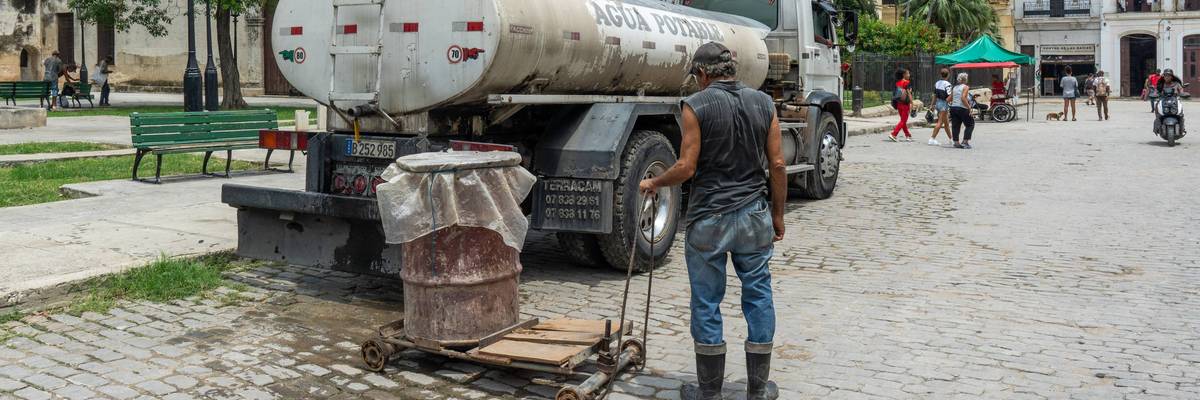
Residents collect water from tanker trucks as power outages and rolling blackouts disrupt pumping systems, limiting access to running water, in Havana, Cuba, on June 4, 2026.
(Photo by Magdalena Chodownik/Anadolu via Getty Images)
Jessica Corbett
Jun 11, 2026
COMMON DREAMS
Amid mounting global calls for President Donald Trump to end his administration’s “economic genocide” in Cuba, US Secretary of State Marco Rubio on Thursday announced sanctions against the state-owned oil and gas company, a move expected to worsen the island’s fuel shortage and related humanitarian crisis.
Trump, in recent months, has repeatedly threatened to “take” Cuba and ramped up the 65-year US embargo against the country, including by imposing an oil blockade—disrupting food supplies, healthcare, education, transportation, and more—and issuing a May executive order that Rubio cited in his statement about the sanctions against Union Cuba-Petroleo (CUPET).
Rubio, the son of Cuban immigrants and a longtime advocate of regime change on the island, claimed Thursday “that like every resource on the island, energy has long been weaponized by Cuba’s communist government as a tool of both repression and self-serving regime kleptocracy.”
“While the Cuban people have suffered fuel shortages and blackouts because of decades of under-investment in critical infrastructure,” Rubio continued, “Cuba’s communist leaders have diverted energy resources to line their own pockets: reselling countless barrels of scarce energy on the secondary market, hoarding energy supplies for its military, intelligence, and repressive forces, and rationing energy as a tool of social control.”
Warning of the new sanctions’ likely impact, William LeoGrande, a Cuba expert at American University in the United States, told The Associated Press: “It appears that they’re all in on strangling the Cuban economy... Their policy is a contradiction. They claim they don’t want to create a humanitarian crisis, although that’s exactly what they’re doing.”
As some Florida Republicans in Congress celebrated the secretary of state’s announcement, Cuban officials fired back, with Bruno Rodríguez, Cuba’s foreign affairs minister, taking aim at Rubio in a social media post.
“The US regime’s secretary of state, driven by ambitions of conquest, presidential aspirations, and the vengeful sentiments of the elitist clique that propelled his political career, now further tightens the economic and energy stranglehold against Cuba,” he wrote in Spanish. “To justify it, he does not resort to excuses prepared by his State Department, but to the usual crude lies, the most aggressive, uncouth, and rabid among Cuba’s enemies.”
Ernesto Soberón, Cuba’s permanent representative to the United Nations, accused Rubio of “peddling crude lies” while the US ambassador to the UN, Mike Waltz, “mindlessly parrots the claim that the blockade does not exist and is, therefore, not primarily responsible for the suffering of the Cuban people.”
“The cynicism of top US officials knows no bounds,” Soberón said. “Stop the collective punishment of the Cuban people.”
This week alone, UN High Commissioner for Human Rights Volker Türk, the International Association of Democratic Lawyers, and thousands of Italian medical professionals have spoken out against the US blockade of Cuba.
“The fuel restrictions imposed since early 2026 and recent tightening of extraterritorial sanctions, taken together, are directly harming Cubans, especially the most vulnerable,” said Türk. “Children are dying because doctors lack access to essential medical supplies and medicines. This is unacceptable. These sanctions must be lifted immediately.”
The Trump administration’s targeting of CUPET came a week after it sanctioned Cuban President Miguel Díaz-Canel, his wife, and three other individuals.
“We just want them to be a nicely run country,” Trump told journalists in the Oval Office last week, when asked whether those sanctions were meant to accelerate Cuba’s collapse. “The country is starving, and it’s got no energy, it’s got no oil, it’s got no money, it’s got nothing. It’s got a beautiful piece of land. You could have beautiful resorts.”
Trump said that Cuba had already “sort of collapsed” and “we’re going to handle that as soon as we’ve finished” military operations in Iran. He added, “I like to do one thing at a time.”
Earlier this week, Elena Gutiérrez, a Mexican American activist at Global Exchange, wrote for Foreign Policy In Focus about returning from three trips to the island this year “with my heart a little more broken, but also with a stronger conviction that we need to defend Cuba.”
“But can US citizens truly stop the madness their own empire imposes on them and on the rest of the world? Let us hope so, because only the people of the United States—and no one else—can carry out the transformations their own country needs,” according to Gutiérrez. “Only then will Cuba, the United States, Mexico, and the rest of the world be free.”
“The US regime’s secretary of state, driven by ambitions of conquest, presidential aspirations, and the vengeful sentiments of the elitist clique that propelled his political career, now further tightens the economic and energy stranglehold against Cuba,” said the island’s foreign minister.
Residents collect water from tanker trucks as power outages and rolling blackouts disrupt pumping systems, limiting access to running water, in Havana, Cuba, on June 4, 2026.
(Photo by Magdalena Chodownik/Anadolu via Getty Images)
Jessica Corbett
Jun 11, 2026
COMMON DREAMS
Amid mounting global calls for President Donald Trump to end his administration’s “economic genocide” in Cuba, US Secretary of State Marco Rubio on Thursday announced sanctions against the state-owned oil and gas company, a move expected to worsen the island’s fuel shortage and related humanitarian crisis.
Trump, in recent months, has repeatedly threatened to “take” Cuba and ramped up the 65-year US embargo against the country, including by imposing an oil blockade—disrupting food supplies, healthcare, education, transportation, and more—and issuing a May executive order that Rubio cited in his statement about the sanctions against Union Cuba-Petroleo (CUPET).
Rubio, the son of Cuban immigrants and a longtime advocate of regime change on the island, claimed Thursday “that like every resource on the island, energy has long been weaponized by Cuba’s communist government as a tool of both repression and self-serving regime kleptocracy.”
“While the Cuban people have suffered fuel shortages and blackouts because of decades of under-investment in critical infrastructure,” Rubio continued, “Cuba’s communist leaders have diverted energy resources to line their own pockets: reselling countless barrels of scarce energy on the secondary market, hoarding energy supplies for its military, intelligence, and repressive forces, and rationing energy as a tool of social control.”
Warning of the new sanctions’ likely impact, William LeoGrande, a Cuba expert at American University in the United States, told The Associated Press: “It appears that they’re all in on strangling the Cuban economy... Their policy is a contradiction. They claim they don’t want to create a humanitarian crisis, although that’s exactly what they’re doing.”
As some Florida Republicans in Congress celebrated the secretary of state’s announcement, Cuban officials fired back, with Bruno Rodríguez, Cuba’s foreign affairs minister, taking aim at Rubio in a social media post.
“The US regime’s secretary of state, driven by ambitions of conquest, presidential aspirations, and the vengeful sentiments of the elitist clique that propelled his political career, now further tightens the economic and energy stranglehold against Cuba,” he wrote in Spanish. “To justify it, he does not resort to excuses prepared by his State Department, but to the usual crude lies, the most aggressive, uncouth, and rabid among Cuba’s enemies.”
Ernesto Soberón, Cuba’s permanent representative to the United Nations, accused Rubio of “peddling crude lies” while the US ambassador to the UN, Mike Waltz, “mindlessly parrots the claim that the blockade does not exist and is, therefore, not primarily responsible for the suffering of the Cuban people.”
“The cynicism of top US officials knows no bounds,” Soberón said. “Stop the collective punishment of the Cuban people.”
This week alone, UN High Commissioner for Human Rights Volker Türk, the International Association of Democratic Lawyers, and thousands of Italian medical professionals have spoken out against the US blockade of Cuba.
“The fuel restrictions imposed since early 2026 and recent tightening of extraterritorial sanctions, taken together, are directly harming Cubans, especially the most vulnerable,” said Türk. “Children are dying because doctors lack access to essential medical supplies and medicines. This is unacceptable. These sanctions must be lifted immediately.”
The Trump administration’s targeting of CUPET came a week after it sanctioned Cuban President Miguel Díaz-Canel, his wife, and three other individuals.
“We just want them to be a nicely run country,” Trump told journalists in the Oval Office last week, when asked whether those sanctions were meant to accelerate Cuba’s collapse. “The country is starving, and it’s got no energy, it’s got no oil, it’s got no money, it’s got nothing. It’s got a beautiful piece of land. You could have beautiful resorts.”
Trump said that Cuba had already “sort of collapsed” and “we’re going to handle that as soon as we’ve finished” military operations in Iran. He added, “I like to do one thing at a time.”
Earlier this week, Elena Gutiérrez, a Mexican American activist at Global Exchange, wrote for Foreign Policy In Focus about returning from three trips to the island this year “with my heart a little more broken, but also with a stronger conviction that we need to defend Cuba.”
“But can US citizens truly stop the madness their own empire imposes on them and on the rest of the world? Let us hope so, because only the people of the United States—and no one else—can carry out the transformations their own country needs,” according to Gutiérrez. “Only then will Cuba, the United States, Mexico, and the rest of the world be free.”
Today, the United States has the opportunity to prove to itself and to the world that the mistakes committed by its government do not reflect the desires of the US people.

Protesters demand that the Biden administration take immediate action to reverse the actions taken by the Trump administration to deepen the economic war against Cuba.
(Photo by Michael Siluk/Education Images/Universal Images Group via Getty Images)
Elena Gutiérrez
Jun 11, 2026
Foreign Policy In Focus
Since January 2026, when the intensification of US policies aimed at suffocating the Cuban people began, I have had the opportunity to travel to the island three times. Each time I return with my heart a little more broken, but also with a stronger conviction that we need to defend Cuba.
As a Mexican, I have received, on behalf of my compatriots, thousands of expressions of gratitude and hugs that the Cuban people send to the Mexican people. Every time I am there, I speak about the empathy and understanding we have toward Cuba, about the great efforts ordinary Mexicans make to bring a few kilos of rice to collection centers. And when I listen to Cubans, I learn a little more about the deep history that unites us.
Since January 2026, when the intensification of US policies aimed at suffocating the Cuban people began, I have had the opportunity to travel to the island three times. Each time I return with my heart a little more broken, but also with a stronger conviction that we need to defend Cuba.
As a Mexican, I have received, on behalf of my compatriots, thousands of expressions of gratitude and hugs that the Cuban people send to the Mexican people. Every time I am there, I speak about the empathy and understanding we have toward Cuba, about the great efforts ordinary Mexicans make to bring a few kilos of rice to collection centers. And when I listen to Cubans, I learn a little more about the deep history that unites us.
But as a Mexican American and a binational activist, I also carry the weight of understanding the average US citizen. After many years of living in the United States, I continue to be surprised by how deeply the dream of democracy lives within people there, despite the fact that the country has been experiencing a deepening democratic crisis for years.
The deprivation imposed by Washington on the Cuban people for decades is now being reflected within the very core of the empire itself. It is suffered not only by migrants, Native Americans, Black communities, and the historically oppressed. Today, that same yoke has reached a white middle class that is beginning to feel the collapse of freedoms originally created for them.
Only the people of the United States—and no one else—can carry out the transformations their own country needs.
Fortunately, people in the United States can learn much here from Latin America—and Cuba in particular. They can learn from the region’s long history of struggle against Washington’s domination—and from the long construction of democratic processes from below that go far beyond just elections.
The resilience and social fabric the Cuban people have built are unique, just as unique as the oppression caused by the blockade the US government has maintained for all these decades. The United States needs public healthcare, free access to university education, and affordable housing. It needs to stop investing the billions it spends on war and instead invest that money in its own people. Cuba has done that.
The dream of democracy in any country is built beyond the ballot box alone, through projects that people themselves embrace and carry out. Today, the United States has the opportunity to prove to itself and to the world that the mistakes committed by its government do not reflect the desires of the US people. Today, as C. Wright Mills said 60 years ago, “Cuba’s voice must be heard in the United States, because the United States is too powerful and its responsibilities to the world and to itself are too great for its people not to hear the voices coming from the hungry world.”
The United States is preparing for another electoral cycle while its policies of war and interventionism throughout the Global South get reaffirmed.
At the same time, the island of 10 million inhabitants is preparing to continue resisting in the face of the possibility of an attack. In Cuba’s “Family Guide for Protection in Case of Military Aggression,” one can read recommendations for what to pack in a backpack: identification, a radio, candles, food, medicine, and toys to help distract children.
A recently published poll by the Center for Economic Policy Research (CEPR), a think tank based in Washington, DC, reveals that more than 60% of US citizens oppose a war with Cuba. At the same time, solidarity networks with Cuba in the United States—which have existed since the beginning of the blockade—are reactivating with renewed strength.
But can US citizens truly stop the madness their own empire imposes on them and on the rest of the world? Let us hope so, because only the people of the United States—and no one else—can carry out the transformations their own country needs. Only then will Cuba, the United States, Mexico, and the rest of the world be free.
© 2023 Foreign Policy In Focus
Elena Gutiérrez
Elena Gutiérrez is Global Exchange’s Mexico-US program director.
Full Bio >


No comments:
Post a Comment