AI Companies Look to the Ocean as a Place to Put Data Centers
[By Nir Kshetri]
The artificial intelligence boom is driving unprecedented demand for data centers, raising concerns about their growing energy consumption, water use and carbon footprint. These challenges are making companies look beyond traditional land-based data centers.
Some developers are now exploring the ocean as a new location for AI infrastructure in the hopes that underwater data centers could improve energy use and cooling efficiency while using less fresh water and land area than onshore buildings.
My research focuses on the societal, organizational and environmental implications of emerging technologies, particularly artificial intelligence and the digital infrastructure – including data centers – that supports its development and deployment. I see underwater data centers as a promising new approach for supporting the growth of AI.
But moving servers into the ocean does not make other underlying environmental challenges such as energy consumption and carbon emissions disappear. And it creates new concerns about harm to the marine environment, as well as questions about how these data centers can be regulated – and how companies can maintain and expand them if needed. Whether underwater data centers can become sustainable alternatives to traditional data centers depends on solving these economic, technical and environmental problems.
The rise of ocean-based AI infrastructure
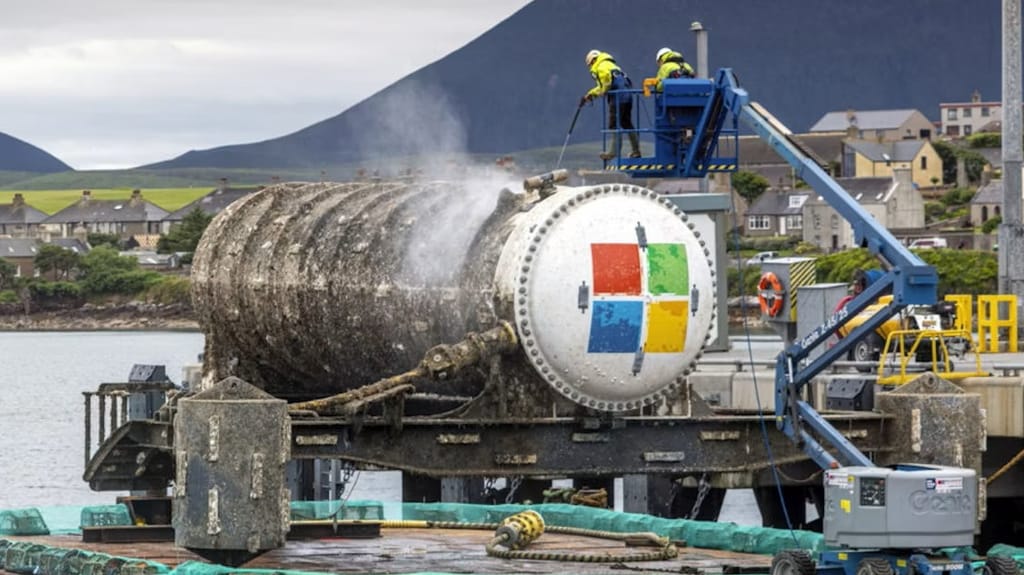
In 2015, Microsoft launched a research project to explore the feasibility, benefits and challenges of underwater data centers. Part of that effort included setting up a waterproof data center on the seafloor near Scotland’s Orkney Islands in 2018. It contained 864 servers and was connected to shore by an underwater cable.
After two years, Microsoft reported that the servers in the underwater data center failed at about one-eighth the rate of servers in comparable land-based data centers. The company is still studying the possible reasons but hypothesizes that in a sealed underwater environment the equipment is less exposed to oxygen, humidity and temperature fluctuations – as well as less jostling from people working to replace broken components.
However, Microsoft ended the project in 2024 and chose not to build more underwater data centers. The company didn’t say why, but others’ analyses suggest the reasons could include regulatory concerns, including the need for environmental permits, as well as a desire for faster upgrades and replacements for the computer equipment inside.
Instead the company has focused on land-based data centers, which can be larger and easier to expand, and also easier to access to repair or replace equipment.
Others have moved ahead, though. China built what may be the world’s first wind-powered underwater data center in Shanghai. The facility launched in June 2025 and began full commercial operations in May 2026.
The US$226 million project uses seawater as a coolant rather than have to refrigerate fresh water, reducing the electricity required to cool the computers. It uses at least 30% less electricity than traditional data centers, and offshore wind turbines reduce reliance on fossil fuels and cut the data center’s carbon emissions.
Japan is testing a different approach: Data centers housed in containers on floating platforms at sea can use seawater for cooling, have unobstructed conditions for solar panels and wind turbines, and reduce demand for land. In 2025, a data center in shipping containers opened on a floating platform near Yokohama. Its power comes from solar panels installed on the same floating platform, with batteries providing energy storage. The test will continue through March 2027.
Singapore is also moving toward commercial-scale floating data centers. In 2026, infrastructure company Keppel began building a four-story floating data center, scheduled to open in 2028. The project will use seawater for cooling, reducing reliance on treated water and improving cooling efficiency. And the fact that it floats means it won’t take up any of Singapore’s limited land availability.
In 2025, Ulsan, South Korea, began planning an underwater data center that could house more than 100,000 servers and use 30% less power than land-based centers by using seawater for cooling.
In Maine, DeepGreen Western Passage has proposed a submersible AI data center in the Bay of Fundy, powered by tidal turbines designed to harness the area’s strong tidal currents.
Land-based data centers could also take advantage of seawater cooling. In Portugal, the SIN01 AI data center in Sines uses seawater from the Atlantic to cool its servers before returning it to the ocean.
The promise of ocean-based data centers
These various approaches offer ways to reduce demand for grid-supplied electricity for powering data centers’ computers and cooling equipment, as well as using less fresh water.
The distance from people’s homes could also be an advantage for data centers in or on the ocean. A Gallup poll in March 2026 found that 70% of Americans oppose building AI data centers in their communities. However, more than half of the world’s population lives within 120 miles of a coast. Underwater could be another way to keep data centers physically close to users for speedy service.
Maintenance, though, is a major challenge. If a computer fails underwater, it cannot be repaired or replaced on site. The entire sealed data center module may need to be brought to the surface, even if just one computer needs work.
Can the ocean sustain AI?
The main environmental concern about ocean-based data centers involves the seawater used for cooling. Discharging warm or hot water can potentially affect oxygen levels, pH and marine life in the surrounding waters.
That heat is already apparent at the few seaborne data centers now operating. HiCloud, the engineering contractor for China’s Hainan underwater data center, has reported a temperature increase of less than 1 degree Celsius (1.8 degrees Fahrenheit) in the seawater near the facility. SIN01 in Sines, Portugal, also returns seawater about 1 C warmer.
Many marine species depend on stable water temperatures for breeding, feeding and migration, raising concerns that heat released by multiple underwater data centers could create localized thermal pollution and alter marine ecosystems. And the ocean is already under pressure. UNESCO, the United Nations agency for international cooperation, including in conservation, estimates that about 60% of marine ecosystems are already degraded or used unsustainably.
The ocean is already warming along with the atmosphere, without additional waste heat from data centers. That additional heat is already threatening coral reef and mangrove ecosystems, seagrasses and other aspects of the marine food web. As that warming continues, ocean waters will be less useful for cooling electronic equipment in some regions.
Underwater data centers could help AI grow while easing some of the pressure on land, energy and water. But the real test is whether the ocean can become AI’s next computing frontier without becoming its next environmental problem.
Nir Kshetri is the Charles A. Hayes Distinguished Professor at the University of North Carolina-Greensboro and a research fellow at Kobe University, Japan.
This article appears courtesy of The Conversation and may be found in its original form here.

The opinions expressed herein are the author's and not necessarily those of The Maritime Executive.
ClassNK Launches 'Survey Compass,' AI Assistant for Surveys
ClassNK introduces an AI tool to enhance survey operations for shipowners and management companies.
[By ClassNK]
ClassNK has launched ‘Survey Compass,’ an AI assistant that supports shipowners and ship management companies in their survey-related operations.
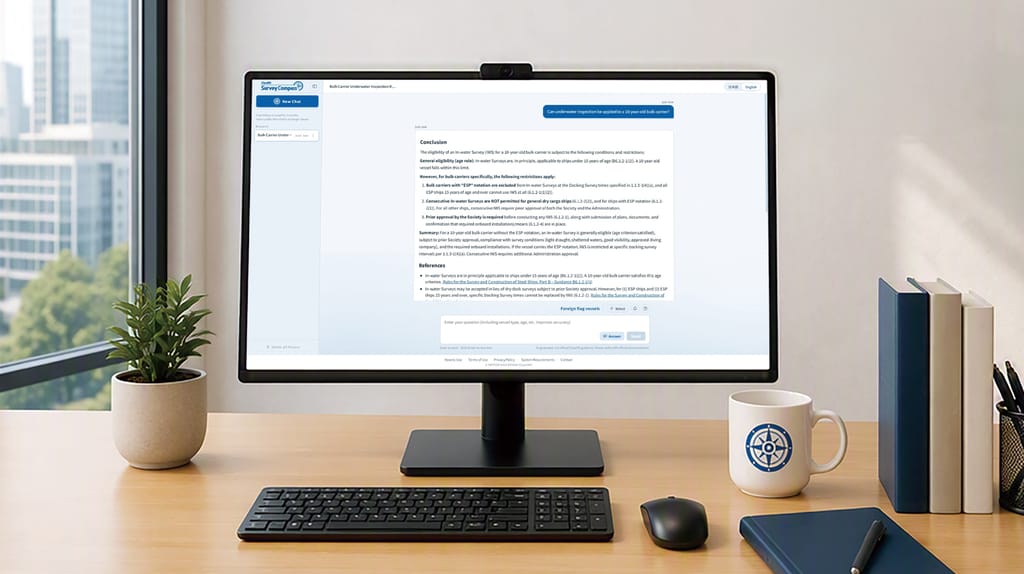
Survey Compass is an AI assistant that responds in natural language to questions on classification survey matters faced by shipowners and ship management companies. Users can quickly confirm the information they need together with its supporting sources, thereby improving the efficiency of survey preparation and response work and reducing their workload. This initial release marks the first step toward ClassNK’s vision of a digital service platform for ships in service. ClassNK will continue to expand and enhance Survey Compass together with our customers, incorporating feedback and requests gathered through its practical use.
Survey Compass is available on ‘ClassNK Customer Hub - Ship in Service -’ (hereinafter ‘CCH SiS’), a web portal service for shipowners and ship management companies.
In the maritime industry, regulations, particularly those related to environmental compliance, are becoming increasingly complex, requiring shipowners and ship management companies to manage a growing number of requirements and an ever-expanding volume of information. Against this backdrop, personnel responsible for survey-related matters are often required to identify the applicable requirements within a limited timeframe. To provide prompt and accurate responses to the classification survey-related inquiries received daily from shipowners and ship management companies, ClassNK has developed Survey Compass, an AI assistant specialized in classification survey support.
Survey Compass accepts questions in natural language, directly searches classification survey-related documents, and presents a concise summary together with links to the underlying information sources. Because information related to classification surveys and ship management is closely tied to the safe operation of vessels, a high level of accuracy and reliability is required.
For this reason, Survey Compass adopts a retrieval-based approach that generates answers based on relevant source documents, reducing the risk of AI-generated inaccuracies. Through this approach, it aims to serve as a trustworthy AI assistant that users can rely on with confidence.
By providing links to the source documents used to generate each answer, Survey Compass enables users to review the original references directly and make informed professional judgments. In the first version, the service will start by covering Part B of the Rules for the Survey and Construction of Steel Ships, the Guidance for Undergoing Surveys, and Technical Information.
Based on feedback and usage during the beta phase, ClassNK will continue to enhance Survey Compass by expanding the range of covered documents, including international conventions and flag State requirements, and by linking with vessel-specific data to provide more context-aware support. Through these enhancements, Survey Compass will evolve to better support users in their day-to-day operations. Going forward, ClassNK will continue to expand services through ClassNK Customer Hub to support the digitalization and operational efficiency of shipowners and ship management companies.
Customers using NK-SHIPS can log in to the web service portal on the ClassNK website with their existing account and access Survey Compass via the link to 'ClassNK web service portal.'
The products and services herein described in this press release are not endorsed by The Maritime Executive.

No comments:
Post a Comment