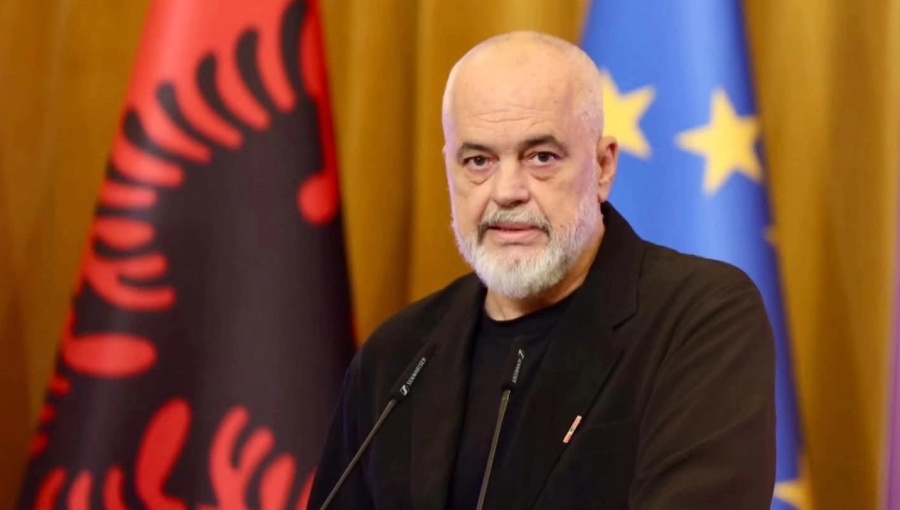
Albanian Prime Minister Edi Rama has refused to resign after over a week of daily violent protests, and several months of peaceful demonstrations. Student demonstrators are demanding he step down, but recent Balkan history shows street movements rarely topple entrenched leaders on their own.
Student demonstrations over university conditions and the cost of education turned violent in Tirana on October 13, when protesters threw stones and petrol bombs at the education ministry and set fires at government buildings. Police chief Skender Hita said 71 officers had been injured in three days of clashes, and the Bank of Albania had to reassure depositors after bank branches and cash machines were attacked.
The student protests follow the months-long demonstrations dubbed the "Flamingo Revolution", which began at the end of May over a luxury resort near the Vjosa-Narta wetlands linked to Jared Kushner, the son-in-law of US President Donald Trump. The movement, which passed 100 days in September, morphed from issue-based demonstrations to the expression of broader grievances with the way Albania is governed. Rama's resignation and a transitional government were among its central demands.
The wave of protests present the biggest sustained challenge to Rama since he took office in 2013, and erupted only 17 months after his Socialist Party won a fourth consecutive term in the May 2025 election.
Rama's neighbours offer him precedents in both directions. Protest movements in North Macedonia and Serbia have each forced a prime minister out, but in neither case did the street alone end the ruling party's hold on power, and the region's other long-serving leaders left office through elections or the courts rather than under pressure from crowds.
Colourful Revolution
The Colourful Revolution in what is now North Macedonia is the region's clearest case of protests ending a long rule, though it took more than two years. Nikola Gruevski, prime minister since 2006, stepped down in January 2016 under the EU- and US-brokered Przino agreement that followed mass protests over a wiretapping scandal in 2015.
The movement got its name in April 2016, when demonstrators threw paint at public buildings after then president Gjorge Ivanov pardoned 56 politicians, most of them from Gruevski's VMRO-DPMNE. Under domestic and international pressure Ivanov began withdrawing the pardons weeks later. VMRO-DPMNE still came first in the December 2016 election, and the Social Democrats' Zoran Zaev only formed a government in May 2017.
Gruevski was later convicted and fled a prison sentence to Hungary, where he was granted asylum. VMRO-DPMNE returned to power in 2024, following widespread frustration with the Social Democrats' failures on tackling corruption and other issues.
Serbia goes to the polls
Protests in Serbia were triggered the collapse of a concrete canopy at Novi Sad railway station on November 1, 2024, which killed 16 people. Prime minister Milos Vucevic resigned on January 28, 2025, but the student-led movement kept up its pressure on President Aleksandar Vucic for almost two more years.
Vucic eventually answered by calling a snap election for October 25, more than a year early, then resigned as president in late September to lead his Serbian Progressive Party's (SNS's) list as its candidate for prime minister. The government announced almost €1bn in one-off payments to pensioners and welfare recipients before the vote.
The election will test whether the protest movement has the ability to take on the long-ruling SNS in the ballot box. Polls have been mixed: the student list overtook the ruling party in a June poll, but a Faktor Plus survey published in September put the Vucic-led list on 48.6% against 37.1% for the students, and the pollster said the ruling party could win an absolute majority. However, things changed again in October, with the latest poll published on October 20 by the New Serbian Political Thought (NSPM) research institute showing the student-backed electoral list would win 44.5% of votes among decided voters, ahead of Vucic's ruling coalition on 42.7%.
Leaving without the crowds
The protests that followed the Novi Sad tragedy demonstrated more sticking power than other protest movements targeting Vucic's governments including the Don't Drown Belgrade protests against the Belgrade Waterfront development, symbolised by a yellow duck.
There have also been mass protests in other Balkan countries that have failed to dislodge established leaders.
Among the region's other long-serving leaders, Milo Djukanovic, who ran Montenegro as prime minister or president for more than 30 years, lost power at the polls: his Democratic Party of Socialists lost the 2020 parliamentary election, and newcomer Jakov Milatovic beat him in the presidential runoff in April 2023.
In Kosovo, president Hashim Thaci resigned on November 5, 2020 when the war crimes indictment against him at the Hague-based Kosovo Specialist Chambers was confirmed. Thaci and other former Kosovo Liberation Army (KLA) leaders were recently sentenced for war crimes.
Rama's options
Rama holds a fresh mandate and a parliamentary majority, and has framed staying on as a duty to finish EU accession talks. “My responsibility is to listen to legitimate concerns, address them and keep Albania moving forward,” he told Reuters in a written statement, saying that stepping back would betray the mandate voters gave him to conclude the negotiations.
The accession process a strong card for the charismatic Albanian politician. European Commission President Ursula von der Leyen called Albania one of the frontrunners during a visit to Tirana on October 1. However, the protests are being closely watched, and the EU delegation in Tirana has called for an investigation into allegations of excessive police force.
Unlike the crowds in Skopje in 2016, Albania's protesters reject the traditional opposition as well as the government, chanting for both Rama and opposition leader Sali Berisha to be jailed, which leaves no obvious party to channel their demands into an election. Still, the Serbian example shows how a student-led movement can translate into an electoral force.
That leaves him three broad paths. He can sit the protests out and rely on his majority, as Vucic did for most of the past two years. He can make concessions on the issues that set them off, as his government did in June when it suspended the Sazan island project after an EU warning, though Rama said in September that the Zvernec development could bring in more than €4bn. Or he can take the question to voters early, Vucic's gamble, whose outcome Albania will be able to judge after October 25.


No comments:
Post a Comment