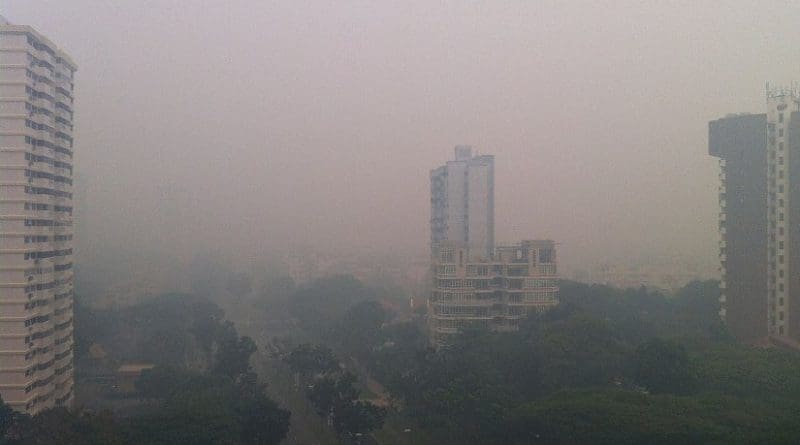
Haze in Singapore. File Photo by Wolcott, Wikipedia Commons.
October 24, 2026
By Collins Chong Yew Keat
Key Takeaways:
October 24, 2026
By Collins Chong Yew Keat
Key Takeaways:
The article argues that ASEAN’s longstanding frameworks on transboundary haze, including the 2002 Agreement on Transboundary Haze Pollution and successive roadmaps, have produced little practical impact despite repeated large-scale fires, such as the 1997–98 and 2015 events that burned millions of hectares and caused multi-billion-dollar losses.
It attributes the persistent failures to economic incentives for land clearing, weak local enforcement, ASEAN’s lack of sanctioning power, and the principle of non-interference that favors closed-door consensus over accountability.
The author concludes that ASEAN can serve only as a coordinator and technical supporter, and that lasting prevention requires member governments to enforce domestic laws, share transparent data, strengthen corporate accountability, and prioritize peatland and forest management.
Every few years the same grey settles over the region, and almost identical script is repeated, where concerns are raised and actions are promised, but impact has been scarce. When domestic or bilateral actions are limited, ASEAN is seen as the convenient platform to be seen where at least efforts are made to address the long held conundrum.
But this risks the mechanism being used as a feel good factor, without the real structural and systemic changes and solutions needed. ASEAN has failed on the issue of haze, but other pressing and long held crises have also faced the same roadblock and impasse by the structural limitations of ASEAN.
Slowly, it has become a convenient and safe platform that lets governments show something is being done, but true efficacy has been limited.The central problem in Jakarta is the gap between political commitment, emergency action and real enforcement capacity.
The bigger question is how and why fires of this scale keep returning when the risks have been identified.In 1997–98, nearly 100,000 square kilometres burned, with losses estimated at about US$9 billion. The next big one was in 2015, where 2.6 million hectares burned at a cost of US$16.1 billion.
This year, Reuters has called this as Indonesia’s most intense El Niño-fuelled fire season in more than a decade.
The underlying causes have repeatedly been identified as clearing land by burning, the poor management of peatland, the economic interests of plantations, and weak oversight and enforcement at the local level. While El Niño did worsen the situation, it cannot be singled out as the sole convenient reason to set aside human and institutional responsibility.
As long as the priority is confined to emergency response rather than structural reform and prevention, the problem will persist.
Frameworks without implementation
ASEAN has been creating frameworks for cooperation, including the ASEAN Agreement on Transboundary Haze Pollution signed in 2002 and the haze-free roadmap for 2016–2020 and a second plan for 2023–2030. However, impact has been almost non-existent, and it looks better on paper than on the ground.
A three-pronged structural weakness explains this. First, the root causes of the haze are rooted in economic structures and land use, with large commercial interests at stake. Second, the capacity and the will to enforce laws differ between the central government, local administrations and enforcement agencies. Third, ASEAN itself has no enforcement power to penalise or to enforce the rules.
The Agreement has real diplomatic, political and institutional value but almost non-existent enforcement capacity, with no dedicated enforcement court and no power to sanction a member.
Hence, an agreement without clear accountability and consequences will risk being seen as a mere symbol of commitment, and it has been resting heavily on the will of the members to act.
The principle of non-interference further compelled this. The culture of consensus and the reluctance to cause diplomatic tension have pushed ASEAN to lean toward closed-door negotiation rather than open pressure.
The strategic dilemma is to keep harmony between governments or to apply more effective pressure for regional public health. ASEAN is not a supranational body that can act on members, and remains too focused on preserving government-to-government relations, where accountability too often is neglected.
The most effective pressure would be a combination of both preventive actions at the ground level, and to combine firmer bilateral diplomacy, transparent data, and the use of domestic legal instruments.
Acknowledge Shortcomings
What ASEAN must avoid is to become a comfortable diplomatic channel for soothing public criticism without any change in policy or effective enforcement.
ASEAN must first acknowledge the limits of its existing mechanisms and the structural ingrained limitations.
A four-pronged mechanism must then be in place. First, to strengthen transparent and accurate data sharing, including concession maps, ownership information and hotspot data. Second, to shape faster emergency protocols with clear response-time targets for exchanging information and considering assistance. Third, enhance corporate accountability and domestic enforcement through joint investigations. Fourth, to make peatland and forest management the main long-term priority for prevention. Fifth, to restructure the whole concept of commercial interest and the practice of slash and burn through both educational and enforcement led prevention measures both at the ground level and at the highest commercial accountability and deterrence, with costs involved.
ASEAN cannot be the only answer to this crisis, as its structure and mandate do not allow it to become an effective and capable long term regional enforcement body. Ultimate responsibility must eventually return to member governments and their domestic legal frameworks. ASEAN can function as a coordinator and provider of technical support, but it cannot substitute for national responsibility.
About Collins Chong Yew Keat
Collins Chong Yew Keat has been serving in University of Malaya, the top university in Malaysia for more than 9 years. His areas of interests include strategic and security studies, American foreign policy and power analysis and has published various publications on numerous platforms including books and chapter articles. He is also a regular contributor in providing op-eds for both the local and international media on various contemporary global issues and regional affairs since 2007.
View all posts by Collins Chong Yew Keat →

No comments:
Post a Comment