
A growing number of EU leaders are questioning whether Europe can keep paying for Ukraine's war, as Kyiv faces a €70bn funding gap for 2027 and the bloc's largest economies struggle with rising debt.
Belgian Prime Minister Bart De Wever has repeated calls he first made in a March interview with Belgian daily L'Echo for the EU to normalise relations with Russia and negotiate an end to the war, arguing that Europe could not end the conflict militarily or economically without full US backing.
De Wever's argument is finding more company as the bill grows. Belgium, which holds most of Russia's frozen central bank assets at Euroclear, led opposition last December to the reparations loan that would have lent them to Ukraine. EU leaders did not agree to use the assets and instead approved a €90bn loan to Kyiv, financed through joint EU borrowing. At the Brussels summit on October 15-16 De Wever again refused to discuss using the assets before the war ends, and Czech Prime Minister Andrej Babis said Czechia would not guarantee EU borrowing for Ukraine in the bloc's next Multiannual Financial Framework (MFF) seven-year budget.
Slovak Prime Minister Robert Fico said on October 17 that Slovakia would not take part in funding Ukraine's €70bn request for 2027, Mezha reported, and claimed that Hungarian Prime Minister Peter Magyar had taken the same line. Fico complained that the summit had spent too little time on peace initiatives. The camp arguing for talks with Moscow was for years led by Magyar's predecessor, Viktor Orban, almost alone.
Ukrainian President Volodymyr Zelenskiy told the summit the war would cost Ukraine €155bn next year. The leaders asked the European Commission to come up with a plan to cover the gap, but left open who pays. The Commission is expected to set out its options in November. If they include fresh joint borrowing it would be only the third time the EU has issued common debt on this scale, after the 2020 pandemic recovery fund and the current Ukraine loan, and several capitals oppose it.
The money is getting harder to find. Italy, France and Belgium all carry public debt above 100% of GDP, and France, Belgium and Poland have run deficits of more than 5% of GDP over the past year, according to Eurostat data.
France is in the worst political shape. Nearly 2,400 people were arrested and about 1,000 police officers injured in nationwide riots on October 17 that grew out of student protests over school and university underfunding and were joined by groups opposed to austerity and higher living costs.
But social unrest if rising across Europe as the dysfunctional European economy slides towards crisis. Experts say that France in particular will need a Greek-style ECB bailout soon if it can’t cut its budget deficit which is currently over 5% of GDP – well in excess of the EU’s own Excessive Deficit of 3% of GDP, mandated by the EU foundation treaty.
President Emmanuel Macron addressed the nation on October 18, condemning those who "destroyed, smashed, and looted".
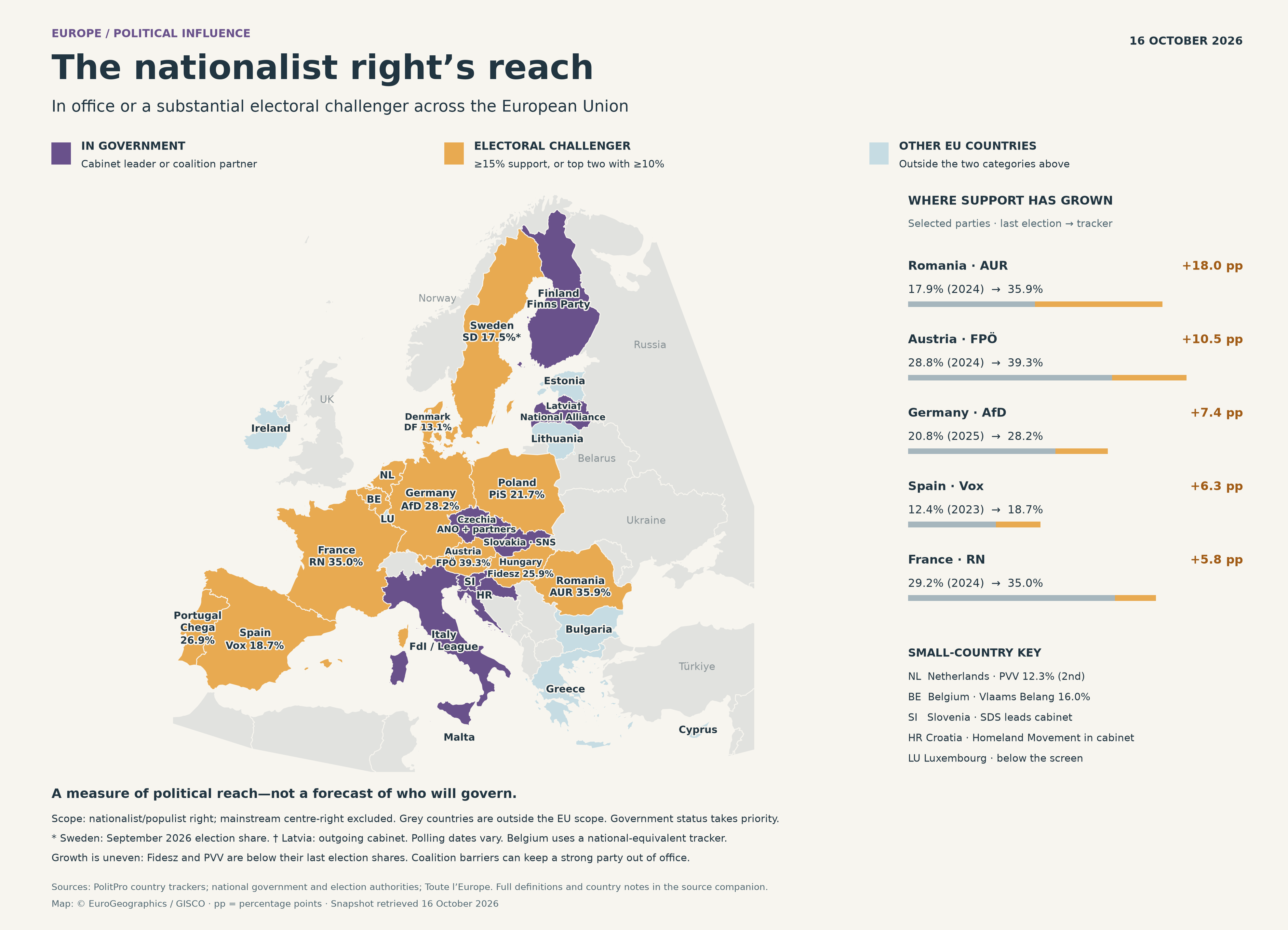
The deteriorating situation is also driving the rise of the nationalistic popular far-right parties across the continent, including France where, head of National Rally far-right party, Marine Le Pen looks like a shoo-in for the next presidential elections.
Energy is the other pressure. Europe has lost cheap Russian pipeline gas, the closure of the Strait of Hormuz has cut off Qatari LNG, and Germany's industrial model of importing cheap Russian energy and exporting high-value manufactures has broken down. The US is adding to the pull: Trump envoys Steve Witkoff and Jared Kushner have pressed Ukraine and European governments to accept a restart of Russian gas transit through Ukraine as part of a peace deal, The New York Times reported, a proposal Berlin has rejected.

No comments:
Post a Comment