Showing posts sorted by relevance for query AFRICA. Sort by date Show all posts

Tuesday, July 08, 2025

Countering China’s Expansionism: 
Japan-India Synergy in Africa Amidst US Aid Retrenchment

FPRI
JULY 7, 2025

Introduction

The Japan-India-Africa Business Forum, held on February 26, 2025, marked a strategic step in strengthening the India-Japan partnership, reflecting a shared commitment to fostering collaboration and promoting economic growth in Africa and beyond. Convened by Japan’s Ministry of Economy, Trade and Industry and Nikkei, this forum comes at a critical juncture when the United States is retreating from its aid diplomacy, while China continues to leverage strategic and extractive financing to entrench economic dependencies and expand its Sino-centric world order. This shift challenges the liberal rules-based order by promoting a power-based system, with Africa as a key geopolitical arena.

To understand why Africa is central to these competing geopolitical and economic visions, we can apply Rufus Miles’ statement: “Where one stands depends on where one sits.” Africa sits at the crossroads of the global power system, giving it strategic leverage in shaping the current international order — politically, economically, militarily, strategically, environmentally, and developmentally. It provides Africa with the action space to be part of any agenda on security, peace, and development. However, Africa’s capacity and ability to influence global affairs depend on how effectively it engages with major powers and develops a comprehensive, coherent strategy that enables African states and institutions to coordinate policies, enhance economic resilience, and improve the livelihoods of African people.

What Africa needs is a transparent and responsive partnership that acts as an enabler for sustainable growth and development — one that aligns with African priorities and needs. Such a partnership must be constructive and inclusive, working alongside like-minded reliable nations while promoting openness and transparency to ensure clarity in intent and action. A secure and stable Africa is not only vital for the continent’s sustainable development but also essential for global peace and security, aligning with India and Japan’s shared vision of a free, open, and rules-based international order.

Africa is extremely important for maintaining and strengthening a free and open international order based on the rule of law, as its 54 countries collectively account for more than a quarter of UN members. Furthermore, as the world’s second-largest continent, Africa spans 43 million km², covering one-fifth of the Earth’s total surface. Its coastline, including its islands, stretches over 26,000 nautical miles, with 38 African nations classified as either coastal or island states. This vast maritime and territorial expanse further amplifies Africa’s geopolitical significance, making it a focal point in the India-Japan strategy to counter China’s extractive expansionism amidst the retraction of US aid.


China’s Extractive Expansionism Amidst US Aid Retrenchment

China’s flagship One Belt, One Road initiative, which is not popularly known as the Belt and Road Initiative (BRI) represents Beijing’s grand strategy to create a Sino-centric world order by expanding China’s sphere of influence, particularly in Africa. Through the BRI, China aims to fosters closer economic integration with countries across the globe, aligning their interests with Beijing’s long-term strategic goals. The initiative enables Chinese state-owned enterprises to export industrial overcapacity — notably in cement, steel, and construction — while simultaneously creating investment opportunities for its vast financial reserves and securing employment for Chinese workers.

However, China’s engagement in Africa is not merely political or economic; it is deeply strategic and extractive. Beijing’s polarizing financing model—marked by predatory lending and debt-trap diplomacy—has created long-term economic dependencies, giving China significant leverage over policy decisions in African states. This approach allows Beijing to expand its hegemonic influence in Africa’s resource-rich regions while justifying its permanent military presence in the Indian Ocean Region to which it has no direct access, through infrastructure projects, port acquisitions, and its military base in Djibouti — China’s first overseas military installation.

China’s Expanding Economic Footprint in Africa

China has emerged as Africa’s largest trading partner and creditor, with bilateral trade surpassing $295 billion in 2024 — a figure greater than the combined India-Africa ($100 billion), US-Africa ($71.6 billion), and Japan-Africa ($24 billion) trade. Beijing’s predatory lending and development finance from 2000 to 2022 amounted to an estimated $170.08 billion, of which $134.01 billion came from Chinese development finance institutions — the China Development Bank (CDB) and the Export-Import Bank of China (CHEXIM). These funds were primarily directed toward energy, mining, transport, information technology, financial services, industry, trade, and services, fueling Beijing’s strategic ambitions. Additionally, during the 2023 China-Africa Forum, China pledged $51 billion in loans, investments, and aid to Africa, further deepening economic dependencies.

As an infrastructure-deficient continent, Africa relies heavily on external collaboration to develop its infrastructure. China has capitalized on this need, becoming the largest foreign investor in African infrastructure, significantly outpacing the US, India, Japan, and Europe. In 2022, 31 percent of all major African infrastructure projects (valued at $50 million or more) were undertaken by Chinese firms, compared to just 12 percent by Western firms. Chinese companies have become a one-stop solution for African needs — providing labor, materials, technology, and financial resources, all originating from China. Through the BRI, China has rapidly constructed railways, highways, hydroelectric dams, bridges, and ports, gaining strategic control over Africa’s transportation, energy, manufacturing, industrial parks, healthcare, trade, e-commerce, and legal and commercial sectors. In Sub-Saharan Africa alone, Chinese investments in infrastructure totaled $155 billion over the past two years, providing Beijing with substantial leverage over African governments. Over the past three decades, China has completely reversed Western dominance in African infrastructure — where once the US and European firms controlled 85 percent of contracts, China now leads in construction and multiple other sectors.

China’s role in Africa’s maritime connectivity and critical infrastructure is particularly striking. Chinese state-owned firms are active in 78 ports across 32 African countries as builders, financiers, or operators — a larger presence than anywhere else in the world. China’s economic engagement with Africa has yielded significant returns, particularly in port infrastructure investments. The African Continental Free Trade Area (AfCFTA), on the other hand, creates a single market projected to grow to 1.7 billion people and $6.7 trillion in consumer and business spending by 2030, offering a massive market base for Chinese goods. Furthermore, for every $1 invested in African ports, China reportedly gains as much as $13 in trade revenues, reinforcing China’s neo-colonial presence in Africa as it continues to drain the continent’s wealth. This underscores Africa’s strategic importance in Beijing’s grand strategy, as many of these ports are dual-use facilities capable of supporting Chinese naval operations when required, providing Beijing with strategic depth in a region where its core interests are concentrated. Thus, China’s economic expansion in Africa is not purely commercial and transactional — it is deeply strategic. By controlling Africa’s critical infrastructure, energy systems, and extractive industries, Beijing secures long-term access to raw materials, safeguards its trade routes, and legitimizes its growing military presence in the Indian Ocean Region.

The Impact of US Aid Retrenchment under Trump 2.0

The announcement by the Trump 2.0 administration of an 83 percent cut in American aid on March 10 will significantly impact many African countries, particularly in Sub-Saharan Africa, which is the largest recipient of American aid funds after Ukraine, receiving 40 percent of total aid. These funds are critical for various sectors essential to the continent’s prosperity and development, with five major priorities: education, food security, humanitarian aid, health, and economic development.

Historically, the United States was one of Africa’s primary trade and investment partners. However, Washington’s gradual disengagement will create space for China — which had faced economic headwinds slowing its African engagement in recent years — to regain lost ground and fill the vacuum. In 2021, total US foreign direct investment in Africa stood at just $44.8 billion, dwarfed by Chinese investments. While China actively strengthens its presence, the Trump administration’s decision to withdraw aid will further alienate African nations, eroding support for the liberal rules-based international order and reinforcing China’s influence. The impact of US aid retrenchment will be particularly felt in strategically positioned countries like Sudan, Ethiopia, Somalia, Uganda, the Democratic Republic of Congo, Tanzania, South Africa, and Mozambique, creating tailwinds for Beijing’s deeper engagement in Africa. Washington’s aid withdrawal strategy is counterproductive, as it pushes African nations closer to China, undermining US strategic interests on the continent.

However, all is not well with Beijing’s African adventures. Growing discontent over poor-quality infrastructure, lack of transparency, and exploitative practices has led to increasing criticism and even contract cancellations by African governments. Several African nations have raised concerns about shoddy construction, lack of local employment, and opaque contract terms associated with Chinese projects. Many of these projects suffer from corruption, substandard work, and hidden financial conditions, raising alarms about their long-term viability. In a notable legal case, on February 11, 2022, South Africa’s Department of Employment and Labor filed a case against China’s Huawei Technologies for failing to comply with the country’s Employment Equity Policy. This reflects broader concerns across Africa about Chinese firms prioritizing Chinese labor over local employment, thereby undermining economic benefits for host nations.

Despite these criticisms, China’s financial footprint in Africa remains extensive. Between 2000 and 2019, China signed 1,141 loan agreements worth $153 billion with African governments and state-owned enterprises. These loans, often tied to resource-backed lending and opaque contractual terms, have contributed to Africa’s growing debt distress and increased China’s leverage over key African economies.

As China’s predatory economic model faces growing resistance, Africa’s need for responsive, transparent, and sustainable partnerships prioritizing African needs becomes even more pressing. This further underscores the urgency for like-minded partners such as India and Japan to step in, offering an alternative that prioritizes mutual growth, capacity building, and economic self-sufficiency for African nations.

Japan-India-Africa Business Forum: A Timely Initiative

The Japan-India-Africa Business Forum is a timely initiative, especially considering the lackluster traction of the Asia-Africa Growth Corridor, which was initiated by India and Japan in November 2016. The convening of this forum renews the shared commitment to promoting development and economic growth in Africa and beyond. It will help deconflict initiatives and avoid fragmentation of efforts by like-minded, reliable, and responsible partners working toward the shared goal of a rules-based international order. By pooling public- and private-sector resources, Japan and India can fully utilize the enormous growth potential of African markets.

As the Global South emerges as the future driver of economic growth, with Africa at its core, it is imperative that India and Japan ensure that Africa’s priorities, aspirations, and interests are fully represented on the global stage. New Delhi has consistently “championed this cause, whether through the Voice of the Global South Summits, its G20 Presidency — where it successfully secured full membership for the African Union in the G20, or through platforms like the Forum for India-Pacific Islands Cooperation (FIPIC) and the India-Africa Forum Summit (IAFS).”

Similarly, Japan has engaged with Africa through multiple platforms, including the Japan-Africa Public-Private Economic Forum and Japan’s Partnership for Business Development in Africa. At the G7 Hiroshima Summit in May 2023, G7 leaders reaffirmed their commitment to strengthening partnerships with African countries, pledging continued support for peace, stability, and prosperity on the continent. To gain African support, Japan and India must actively contribute to Africa’s peace and prosperity through aid, investment, and military support.

Japan’s Engagement with Africa

Since hosting the first Tokyo International Conference on African Development (TICAD) in 1993, Japan has focused on encouraging economic development across the continent, particularly in sub-Saharan Africa. At the 8th TICAD, Japan has announced its intention to invest $30 billion in public and private financial investment over the next three years into Africa to strengthen a free and open international economic system, green growth, healthcare, education, climate, conflict prevention, and democratization. Over the past 30 years, Japan has cultivated strong diplomatic and economic ties with African nations, positioning itself as a partner in maintaining a free and open international order based on the rule of law.

However, Japan’s Official Development Assistance to Africa is declining due to its aging population, fiscal constraints, and economic stagnation. With gross public debt at 261 percent of GDP in 2022, it is virtually impossible for Japan to increase assistance to African countries at levels that compete with China’s growing presence. Recognizing this, the Japanese government has shifted its African diplomacy toward partnered engagement, where public- and private-sector investment from partner countries contributes to sustained economic growth and quality infrastructure exports in the targeted region, in this case Africa.

India’s Deep-Rooted Engagement with Africa

India’s engagement with Africa dates back centuries, with deep-rooted historical and trade linkages. India’s interaction with Africa is guided by the Kampala Principles enunciated by Prime Minister Narendra Modi in 2018, which emphasize a shared vision of prosperity and universal values of liberty, dignity, equality, and opportunity for all. Towards this end, India’s constructive maritime policy of Security and Growth for All in the Region (SAGAR) advances a holistic and inclusive security and development framework that will act as an enabler for sustained growth and peace. This approach aims to build capabilities and enhance security in Africa’s maritime neighborhood and beyond. In this regard, India has taken proactive steps in strengthening Africa’s defense capabilities through initiatives such as the India–Africa Defence Ministers Conclave, the Africa-India Field Training Exercise, and the gifting of military assets and training of African personnel. Beyond defense and security, India has also prioritized capacity building and human resource development as a core aspect of its Africa engagement through programs such as the Indian Technical and Economic Cooperation Program, the Pan-African e-Network Project, and the High-Impact Community Development Projects. Moreover, in 2019 India launched e-VidyaBharti and e-ArogyaBharti, providing high-quality virtual education and medical services to African partners, catering to their educational and healthcare needs.

India is also Africa’s fourth-largest trading partner, with bilateral trade reaching nearly $100 billion and growing steadily. India has made a significant commitment of over $12 billion in concessional credit to develop Africa’s infrastructure, aimed at enhancing connectivity. To date, India has completed more than 200 projects across the continent, spanning railways, power generation, agriculture, water supply, and industrial infrastructure, contributing to local employment and long-term economic growth. India’s development projects in drinking water, rural solar electrification, power plants, cement and textile factories, technology parks, and railway infrastructure have transformed African communities and remain critical pillars of India’s engagement with Africa.

Conclusion

In today’s geopolitical context, countering authoritarianism and power-based systems that challenge the liberal rules-based order requires responsible and reliable partners to join forces. Amidst the vacuum left by US aid withdrawal, China has gained ample space to create a polarized, dependent, and Sino-centric regional order — one in which it dictates the terms of engagement and monopolizes Africa’s trade, politics, security, and digital corridors. This not only undermines liberal interests but also erodes Africa’s autonomy, fostering unsustainable dependencies. As Africa is central to China’s expansionist strategy — serving as both a resource hub and a geopolitical gateway to a Sino-centric world order — it is critical for India and Japan to step in.

India and Japan can play a transformative role in Africa by counterbalancing these trends through a model based on sustainability, transparency, and mutual growth. By combining Japanese technology, investment, and expertise with India’s soft power, industrial base, and digital capabilities, and Africa’s vast talent pool and consumer market, the three regions can create a mutually beneficial framework that fosters and preserves the rules-based order. A key aspect of this partnership would be strengthening resilient supply chains in critical and emerging sectors such as renewable energy, digital infrastructure, and advanced manufacturing. These efforts would not only transform lives and livelihoods but also reinforce Africa’s economic sovereignty and long-term stability.

As Africa’s growth and prosperity will benefit not only its people but also broader geopolitical stability, economic progress, and global security, India and Japan — through their complementary strengths — are well-positioned to support the continent’s development in a sustainable and inclusive manner. This forum, therefore, marks the beginning of a new chapter — one that corrects the shortcomings of the Asia-Africa Growth Corridor and sets a precedent for two nations working together to engage with an entire continent. This unique and ambitious model offers a fresh approach to economic and strategic partnerships, reinforcing the vision of a free, open, and inclusive Indo-Pacific and Africa. It transcends geographical boundaries, promotes a rules-based order, and provides a viable alternative to China’s growing dominance in Africa.

Ultimately, filling the vacuum left by US aid retrenchment is not just an economic necessity — it is a strategic imperative in safeguarding Africa’s sovereignty and global stability. Through sustainable financing, capacity building, and responsible investments, India and Japan must work together to ensure Africa’s future is defined by self-reliance and shared prosperity, rather than dependency and coercion.

Image credit: Chinese President Xi Jinping and South African President Cyril Ramaphosa attend the 2018 Beijing Summit Of The Forum On China-Africa Cooperation – Round Table Conference at the Great Hall of the People in Beijing, China September 4, 2018. Lintao Zhang/Pool via REUTERS


Thursday, January 26, 2023

GLOBALIZATION IS FORDISM

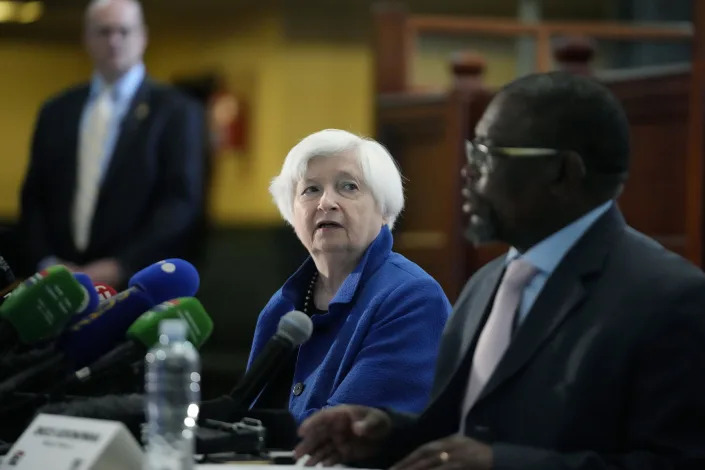
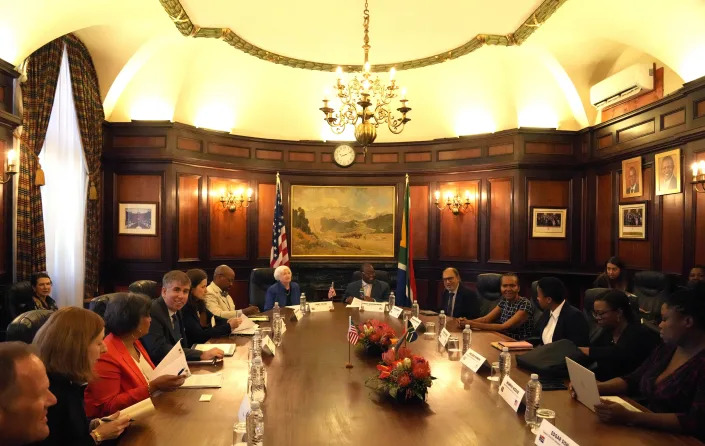
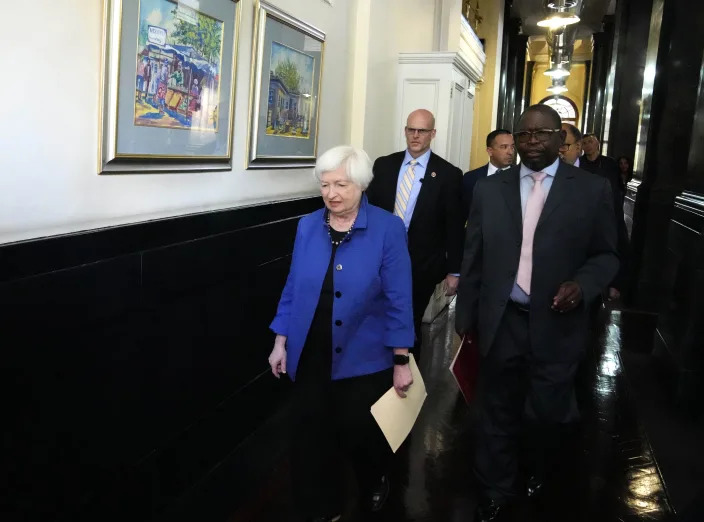
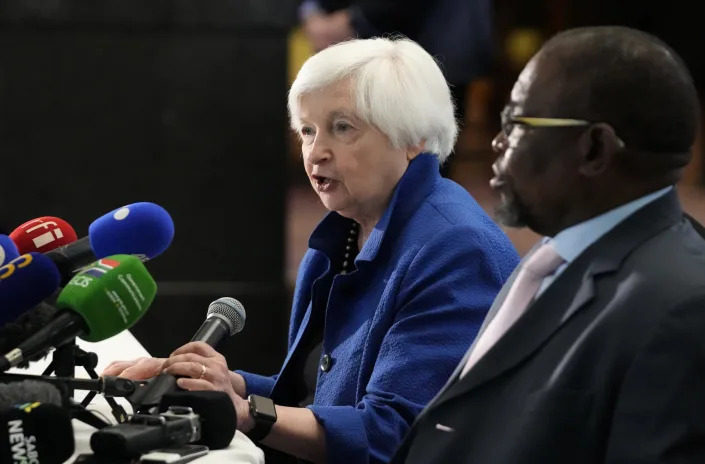
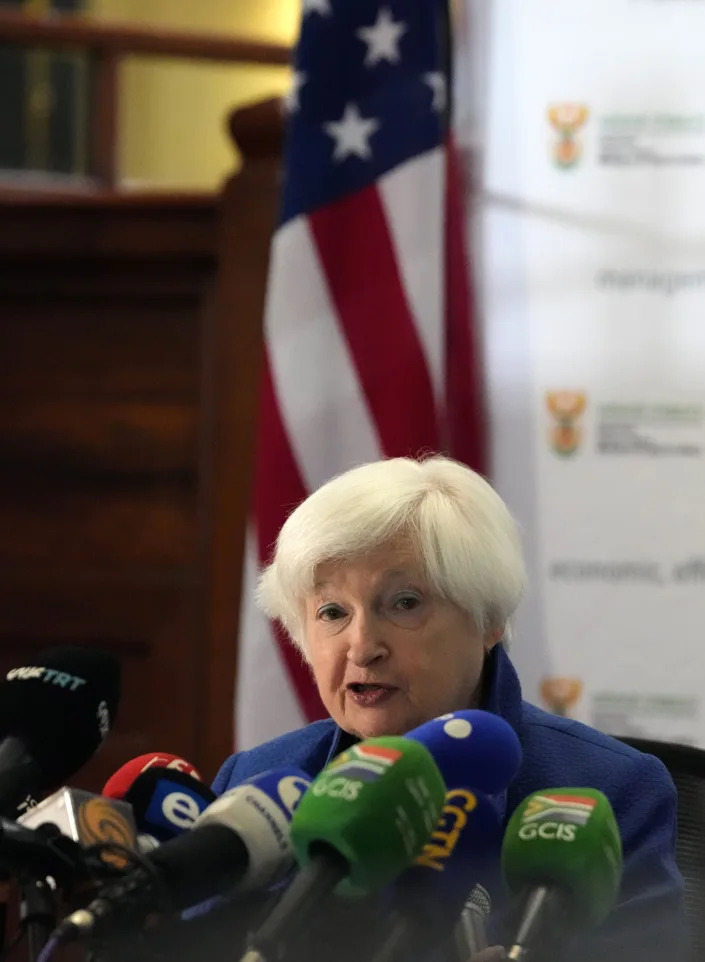
Yellen lauds Ford's 100-year history in South Africa, flags more investments


U.S. Treasury Secretary Janet Yellen visits South Africa

Thu, January 26, 2023
By Andrea Shalal

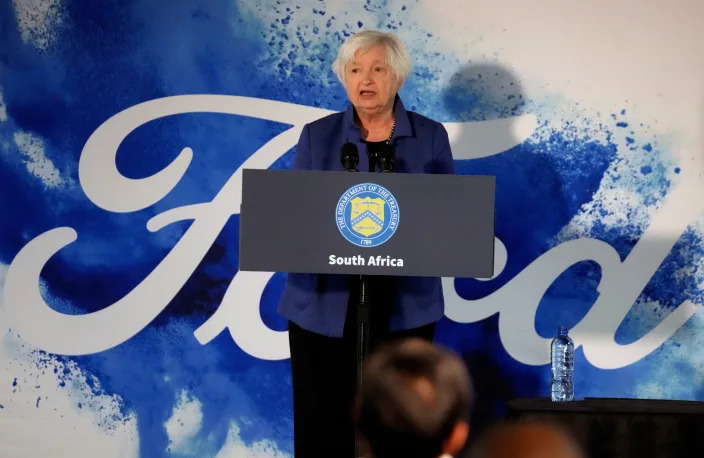
SILVERTON, South Africa (Reuters) - U.S. Treasury Secretary Janet Yellen on Thursday lauded the Ford Motor Co's 100-year history of assembling vehicles in South Africa and underscored Washington's resolve to expand trade ties with countries that it "can count on," including South Africa.

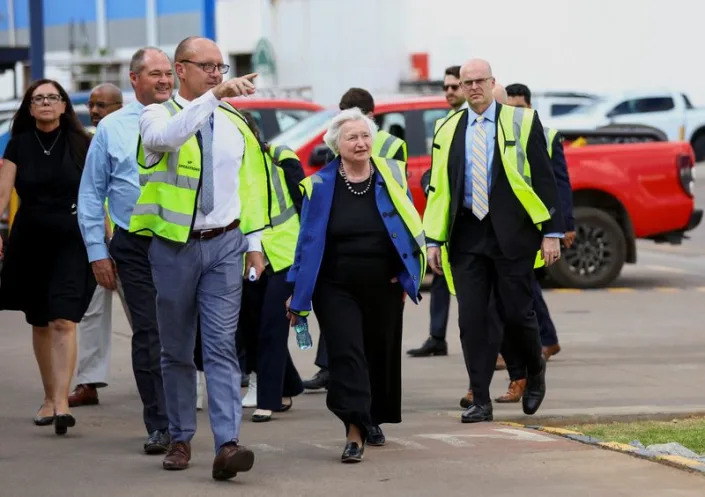
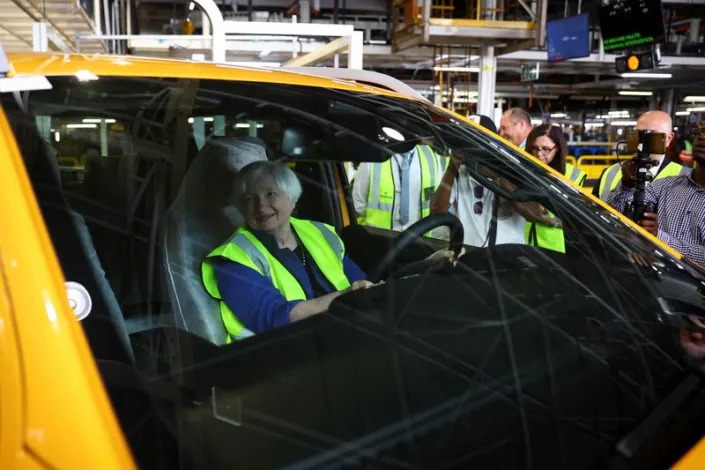
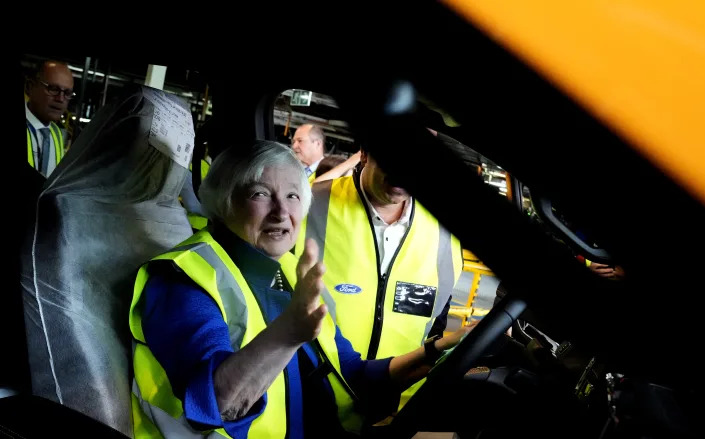
Yellen spoke after touring Ford's plant in Silverton, a suburb of Pretoria, where she got behind the wheel of bright yellow new Ranger pickup truck and spoke with workers and company officials. This is the third leg of her three-country trip across the African continent that is aimed at expanding U.S. economic ties and countering China's influence on the continent.

The plant, which employs 4,000 people, is an example of how deeper ties between the United States and Africa could produce good jobs and boost economic growth for both sides, Yellen told workers and company officials.

"Africa will shape the future of the global economy," she said. "We know that a thriving Africa is in the interest of the United States. A thriving Africa means a larger market for our goods and services. It means more investment opportunities for our businesses."

About 600 U.S. companies operate in South Africa, employing about 220,000 people and generating revenue equivalent to about 10% of South Africa's entire gross domestic product, U.S. Ambassador to South Africa Reuben Brigety said at the event.

Ford, a major U.S. investor in South Africa, is investing $1 billion to expand output at the plant there by 20%, adding 1,200 new jobs, and aims to develop a freight rail link with a seaport 700 miles (1,126.54 km) away.

Yellen said other U.S. companies, including Cisco, General Electric, and Visa also planned big investments, attracted by expanding markets fueled by a demographic boom that will see Africa account for a quarter of the world’s population by 2050.

The U.S. Treasury chief said South Africa had been the biggest beneficiary of the African Growth and Opportunity Act, which grants eligible Sub-Saharan countries duty-free access to the U.S. market, but did not spell out what would happen when the legislation expires in 2025.

Yellen said South Africa also had a role to play in U.S. efforts to shift supply chains away from over-reliance on China and other non-market economies to more like-minded countries, an approach she has dubbed "friendshoring."

As in her comments to South Africa's finance minister earlier on Thursday, Yellen did not address South Africa's refusal to take sides over Russia's war in Ukraine or Washington's concern over military exercises it plans with China and Russia.

The massive economic disruptions caused by the COVID-19 pandemic and Russia's war against Ukraine underscored the need for resilient supply chains, she said.

"We are addressing the over-concentration of the production of critical goods in certain markets — particularly those that may not share our economic values," Yellen said. "To do so, we are deepening economic integration with the many countries that we can count on. That includes our many trusted trading partners on this continent — like South Africa."

(Reporting by Andrea Shalal; Editing by Tomasz Janowski)

Yellen says Africa to shape world economy as US reengages


MOGOMOTSI MAGOME and GERALD IMRAY
Thu, January 26, 2023 

PRETORIA, South Africa (AP) — U.S. Treasury Secretary Janet Yellen watched Ford cars and pickup trucks being assembled at a plant in South Africa on Thursday, citing it as an example of cooperation between Washington and Africa as she begins the Biden administration's big push to reengage with a continent that has 1.3 billion people and an abundance of economic potential.

“The United States’ strategy towards Africa is centered around a simple recognition that Africa will shape the future of the global economy,” Yellen said at the Ford plant in the suburb of Silverton in the South African capital, Pretoria.

“We know that a thriving Africa is in the interest of the United States. A thriving Africa means a large market for our goods and services. It means more investment opportunities for our businesses like this Ford plant, which can create jobs in Africa and customers for American businesses.”

The 76-year-old Yellen, smiling widely, got behind the wheel of one of the shining new vehicles at one point, and gripped the steering wheel firmly with both hands.


Yellen is nearing the end of a three-country tour of Africa that began in Senegal on the continent's west coast and also took in Zambia. Her visit is the start of the Biden administration's efforts to rebuild ties with Africa in the light of China's rapidly increasing economic presence on the world's second-largest continent, and Russia's military and diplomatic foothold in parts of it.

South Africa, Africa's most developed economy and pivotal to the U.S. plan, has deep ties with both Russia and China, and raised concern at the White House when it announced last week it would host Russian and Chinese warships next month and take part in joint naval drills with them off its east coast. Russian Foreign Minister Sergey Lavrov made an official visit to South Africa on Monday, a day before Yellen touched down.

Yellen has avoided mentioning the naval drills during her trip, or South Africa's neutral stance over the war in Ukraine and decision not to side with the West in condemning Russia. She did say Russia's invasion is to blame for increasing some of Africa’s problems.

“Russia’s brutal war against Ukraine has raised energy prices and exacerbated food insecurity,” she said.

Africa is the world's largest single trade area by number of countries. It has a young population, a burgeoning middle class and is expected to be home to one quarter of the world's population by 2050.

It also has a myriad of problems, and Yellen focused on one of them earlier Thursday when she held morning talks with South African Finance Minister Enoch Godongwana. The talks partly dealt, Yellen said, with transitioning South Africa from its heavy reliance on coal to greener energy sources.

South Africa relies on coal-fired plants to generate about 80% of its electricity. As well as being a huge polluter, the coal plants have proved unable to meet the country's needs. South Africa is currently embroiled in an electricity crisis, with scheduled rolling blackouts hitting businesses and households and its 60 million people for up to 10 hours a day because of diesel shortages and breakdowns at the state-owned electricity provider’s aging coal plants.

South Africa plans to reduce its reliance on coal to 59% of its electricity production by 2030 and is targeting zero carbon emissions by 2050. The U.S. and other Western nations have committed to help, pledging $8.5 billion in loans to fund South Africa's energy transition.

"South Africa is the first country with a just energy transition partnership to which the United States was proud to commit as a partner,” Yellen said. “This partnership represents South Africa’s bold first step towards expanding electricity access and reliability and creating a low-carbon and climate-resistant economy.”

Yellen's mission to promote American investment and ties comes in the face of China overtaking the U.S. in foreign direct investment in Africa. Trade between Africa and China surged to $254 billion in 2021, up about 35%.

Yellen's trip kicked off U.S. efforts to recover lost ground, while the U.S. ambassador to the United Nations, Linda Thomas-Greenfield, is also on a tour to Africa, and President Joe Biden has said he intends to visit this year, as does Vice President Kamala Harris.

The Biden administration's plans were largely laid out at the U.S.-Africa Leaders Summit in Washington in December, when U.S. Deputy Commerce Secretary Don Graves said, “We took our eye off the ball so to speak (in Africa), and U.S. investors and companies are having to play catch-up.”

Before his meeting with Yellen on Thursday, Godongwana said that the U.S. still ranks among South Africa’s top trading partners.

“My hope is that this may continue,” he said.

___

Gerald Imray reported from Cape Town.


U.S. Treasury Secretary Janet Yellen looks into the interior of newly build vehicle during her tour at the Ford Assembling Plant in Pretoria, South Africa, Thursday, Jan. 26, 2023.
 (AP Photo/Themba Hadebe)

Saturday, October 21, 2023

South Africa and Canada: Fostering Business Connections and Collaborations

By: Kester Kenn Klomegah
Date: October 18, 2023

The 17th Toronto Global Forum was held under the theme ‘Fostering Economic Resilience’ from 11-13 October 2023 in Toronto Canada. According to reports, the forum gathered over 170 speakers and more than 3000 attendees from all over the world. The central themes at the Toronto Global Forum revolved around the following pillars: Global Economy, Infrastructure, Finance, Innovation, Energy and Sustainable Development.

Through its ability to foster connections and collaboration, the Toronto Global Forum stands as an exceptional and distinctive platform bringing together decision makers from all spheres of society to tackle the most pressing issues of the changing times. From its launch in 2006 that included only a small number of sessions condensed into one day, the Toronto Global Forum has grown to a fully packed three-day event that has gained international recognition.

Brand South Africa in collaboration with the South African High Commission in Canada, and the Development Bank of South Africa (DBSA) represented South Africa at the 17th Edition of The Toronto Global Forum. The overall aim of South Africa’s participation is to promote South Africa’s green economy as an investment destination for North American Institutional Investors.

South Africa continues to stand at the forefront of influencing the global agenda on investing in the global green economy as a pathway to sustainable development. The delegation actively participated in a panel discussion on 13 October 2023, which focused on giving an overview of South Africa as an investment destination for major infrastructure and decarbonised/green projects.

After the three-day forum, Kester Kenn Klomegah from Modern Diplomacy had an indepth discussion with Lefentse Nokaneng, General Manager for Research at Brand South Africa, over aspects of the current bilateral relations between South Africa and Canada. Here are the interview excerpts:

Q: After participating in the business forum in Toronto, what are the popular sentiments about exploring business and investment with Canadians?

Lefentse Nokaneng: South Africa’s participation at the Toronto Global Forum is part of Brand South Africa’s mandate to leverage global platforms such as these to promote South Africa as a favourable trade and investment destination.

South Africa and Canada have maintained bilateral relations since the advent of democracy in South Africa with increasing trade between the two countries. One positive sentiment about exploring business and investment with Canada is that it is a stable and prosperous country with a strong economy and diverse business opportunities. While Canadians, in turn, have shown deep interest in South Africa as an emerging market with abundant natural resources and a diversified economy which serves as a gateway into the African Continental Free Trade Agreement Area (AfCFTA). South Africa’s infrastructure drive and transition into a green economy offers investment opportunities for Canadian Pension Fund Managers.

Q: By the way, how do you estimate the economic and investment potentials in Canada for the Republic of South Africa, and possibly southern African region?

Lefentse Nokaneng: Being one of the most diverse and largest economies in Africa, South Africa stands as a key market for Canadian goods and services on the continent. In 2022, the bilateral merchandise trade between Canada and South Africa reached US$2.77 billion. This trade comprised $473.3 million in exports from Canada and US$2.3 billion in imports from South Africa. In consultation with the Business Council of Canada, we project that export opportunities for Canada in Africa could reach US$6.6 billion by 2030. This would represent a US$4.1 billion increase in Canada’s export performance from the recorded average of US$2.5 billion over the 2016-2018 period.

Canada is an investor in South Africa. Canadian investments focus on the mineral and mining sector, as well as transportation, food processing, hospitality, and information and communication technologies. South Africa’s infrastructure investment drive and Just Energy Transition represents an opportunity for Canada to increase its investment in South Africa.

Q: What steps have, both Canada and South Africa, taken taken previously to forge economic cooperation? Have that changed in tapping the existing opportunities for cooperation with South Africa?

Lefentse Nokaneng: The scope of bilateral relations between Canada and South Africa is extensive with cooperation extending into the areas of foreign policy, development, energy, science and technology, agriculture, mining and mineral resources/equipment, education, arts and culture, and transport.

Canada and South Africa hold strategic annual bilateral consultations that review the work of working groups that cover the topics listed above, which cover issues as diverse as foreign policy, trade and investment, innovation, science and technology, the environment and climate change.

Bilateral cooperation between Canada and South Africa is coordinated within the framework of a Declaration of Intent on Strengthened Cooperation, which was signed in 2003 and laid the foundation for the Annual Consultations (AC). The AC is co-chaired by the Director-General of International Relations and Cooperation and the Deputy Minister of Global Affairs respectively.

Concerted dialogue occurs with Canada’s High Commission in South Africa directed towards deepening the relationship between Canada and South Africa, especially around economic diplomacy. It is conceded on both sides that there is a need for a ‘reset’ of the relationship.

It is expected that Canada’s Africa Engagement Framework will inform its economic engagement strategy with Africa. The Canadians have been paying particular attention to the African Continental Free Trade Agreement Area (AfCFTA) and will seek to benefit from the AfCFTA as a means to diversify its trade away from the United States and China.

Q: Can we also talk a bit about Canada’s tourism to South Africa despite the geographical distance? And finally what potentials are there to develop this sphere of business especially with the changing global situation?

Lefentse Nokaneng: Globally tourism has grappled with recovery post-Covid 19. We have witnessed an 82% increase in tourist arrivals from Canada. In 2022, tourist arrival numbers from Canada were 18,000 and in 2023 this grew to 34,000. While the recorded growth is significant, it still represents only half of the tourist visitors from the United States to South Africa. This signals that there is still much work to be done to attract more visitors from Canada. Those that have visited South Africa love its beautiful scenery, cultural experiences, favourable weather and South African’s affordability as a tourist destination.

Canadian passport holders are able to travel visa free to South Africa for up to 90 days on business and we intend to capitalise on that to drive increased tourism into South Africa for those seeking to come to the country for business and leisure – Bleisure travel.


Kester Kenn Klomegah
MD Africa Editor Kester Kenn Klomegah is an independent researcher and writer on African affairs in the EurAsian region and former Soviet republics. He wrote previously for African Press Agency, African Executive and Inter Press Service. Earlier, he had worked for The Moscow Times, a reputable English newspaper. Klomegah taught part-time at the Moscow Institute of Modern Journalism. He studied international journalism and mass communication, and later spent a year at the Moscow State Institute of International Relations. He co-authored a book “AIDS/HIV and Men: Taking Risk or Taking Responsibility” published by the London-based Panos Institute. In 2004 and again in 2009, he won the Golden Word Prize for a series of analytical articles on Russia's economic cooperation with African countries.

Tuesday, June 17, 2025

Sahel

Tuaregs in Mali and Burkina file ICC complaint against armies, Russian allies

Tuareg associations in Mali and Burkina Faso have filed a complaint with the International Criminal Court against their nations' armies and the Russian paramilitary group, Africa Corps(FORMERLY WAGNER GROUP)


Issued on: 16/06/2025 -


A view of the International Criminal Court (ICC) in The Hague, Netherlands, on 26 June 2024. © Peter Dejong / AP


Several Tuareg community organisations filed a complaint with the office of the Prosecutor of the International Criminal Court (ICC) in The Hague on Sunday, according to RFI's correspondent.

The complaint targets the Malian Armed Forces (FAMA), the Burkinabe Forces, and Russian mercenaries from the Africa Corps, which recently replaced the Wagner group in Africa.

The charities Imouhagh International, Kel Akal, Diaspora of the United States, and the Azawad Solidarity Association accuse them of crimes against humanity and war crimes.


Serious crimes


The groups say the crimes against humanity and war crimes reported to the prosecutor of the ICC have been committed in Mali and Burkina Faso since 2022.

They include murders, arbitrary arrests, enforced disappearances, looting, and torture, including the discovery in April in Kwala, Mali, of 60 bodies of civilians, visibly tortured, according to these organisations.

They point to the use of mercenaries from Africa Corps – the former Wagner – in the repressive operations carried out by the armies of both countries.


Mali's first case

The ICC had already opened an investigation into crimes committed in Mali, following the occupation of Timbuktu in 2012, at the time at the government's own request.

But the departure of French and UN forces - in 2022 and 2024 - has made the court's operations on the ground very difficult.

To investigate the crimes committed in Burkina Faso, the prosecutor would need to secure approval from the ICC judges, unless the Burkinabe government decides to refer the case itself.

With this complaint lodged in The Hague, the four plaintiff organisations say they intend to make "a major political and legal statement" to enable Sahelian victims to obtain "recognition, justice and reparation."


Wagner vs Africa Corps: The future of Russian paramilitaries in Mali

As mercenaries leave Mali, experts say that remaining Kremlin-controlled Africa Corps is more than just ‘Wagner rebranded’.

An undated photograph handed out by French military shows Russian mercenaries in northern Mali [French Army via AP]


By Niko Vorobyov
Published 16 Jun 2025
AL  JAZEERA

This month, the Russian mercenary outfit Wagner Group announced its total withdrawal from Mali, claiming it had completed its mission after three and a half years of operations in the West African country.

For years, Wagner had been battling rebels and armed groups on behalf of the Malian government, as well as asserting Russia’s interests in the Sahel.

Recommended Stories


But as Wagner leaves, security advisers from the Africa Corps, a Kremlin-controlled paramilitary group, will remain in their place, ensuring a lingering presence of Russian forces.

So, what does this change mean for Mali, and is there a difference between the two Russian paramilitary groups and their mission in Africa?
An ‘anti-Western coalition’?

Mali’s government has, for decades, been embroiled in a conflict with ethnic Tuareg separatists in the Sahara Desert, as well as fighters affiliated with ISIL (ISIS) and al-Qaeda.

Previously, French forces assisted the Malian government, but they withdrew after a military coup in 2021. The latest round of fighting erupted in 2023 when Bamako’s military government mounted a new offensive against the rebels.

“The Malian junta invited Wagner and Russia to support them in Mali – this really stemmed from frustration with the [military] support provided by France and other Western partners,” Flore Berger, a senior analyst at the Global Initiative’s North Africa and Sahel Observatory, told Al Jazeera.

“They felt that, despite years of help, the security situation hadn’t improved, and Western countries kept pressuring them to return to civilian rule, organise elections, etc. Russia, through Wagner, on the other hand, offered support without those conditions. It was seen as a more respectful and reliable partner that wouldn’t interfere in Mali’s political choices.”

“Long story short, they break up, and Mali kicks out the French troops … The deployment in Mali was pretty opportunistic, upstaging the West; it was a big black eye for France.”

An undated photograph released in April 2022 by France’s military shows Russian mercenaries boarding a helicopter in northern Mali [French Army via AP]

While Moscow maintained an active presence in Africa during the Cold War, its footprint diminished in the post-communist collapse of the 1990s as Russia dealt with its own problems. But it has been revived in recent years, as President Vladimir Putin has sought a more assertive role on the world stage.

“The original push into Africa largely came through Wagner,” said John Lechner, author of Death Is Our Business: Russian Mercenaries And The New Era Of Private Warfare.

“Over time, as the programme became successful … the interest within the Kremlin more broadly grew, especially after the full-scale war in Ukraine in 2022, when it was a useful narrative that not only is Russia not isolated, but there are African countries that continue to seek its assistance.”

Experts say mercenaries have been a tool of Russian interests in Africa, capitalising on discontent with the former colonial and neocolonial powers, as well as offering security in exchange for resources, especially in the Central African Republic. This was less so in Mali, however, where, despite some small-scale gold mining operations, some Wagnerites were so hard-pressed for cash they were purportedly pictured selling discount canned sardines at local markets. There, the priority was seemingly more about Russian influence over the Sahel.

“Now, it is exclusively a question of geopolitics, ousting the collective West from Africa, creating an anti-Western coalition,” explained Sergey Eledinov, a former Russian peacekeeper turned independent Africa specialist based in Dakar, Senegal.


The Ukraine factor


Last year saw another foreign player appear in the Malian conflict.

A contingent of Wagner and Malian troops was ambushed by Tuareg rebels in Tinzaouaten, near the Algerian border, in July, claiming the lives of 84 Russian mercenaries and 47 Malian soldiers, including Nikita Fedyanin, a blogger behind the Wagner-linked Telegram channel, Grey Zone.

Ukraine’s spy agency, the GUR, admitted it provided crucial intelligence to the rebels against Russia. There were also reports that Ukrainians taught the rebels how to operate drones.

In response, Mali broke off diplomatic relations with Ukraine.

“We’re not really sure if it’s still ongoing,” Nossiter said about Ukraine’s support.

“At the time, there were reports that other Ukrainian allies were pressuring Ukrainians not to do that,” he explained, noting that the perceived “close ties between the jihadist groups and some of the separatists” may have made Kyiv’s Western backers nervous.

People gather near a makeshift memorial in Moscow, Russia, to pay tribute to Wagner fighters killed in Mali by northern Tuareg rebels in 2024 [File: Yulia Morozova/Reuters]

Now, given recent upsetting defeats against Malian and Russian troops, and the intensifying violence in northern Mali, it’s questionable to many whether Wagner’s mission was a success.

“The biggest crowning victory of the Malian military in the last couple of years was retaking this town, Kidal [in 2023], which was a long-time separatist stronghold,” Nossiter said. “It’s the kind of victory people point to and say: without Wagner, it wouldn’t have been possible.”

But at the same time, insecurity continues to be a major challenge, the Sahel researcher emphasised.

“The jihadists, just in the last two weeks, have attacked three major Malian military camps. They also attacked the city of Timbuktu, and they put an IED [improvised explosive device] at a joint Malian-Wagner training camp just outside of the capital city of Bamako,” he said.

Meanwhile, the mercenaries have been accused of the deliberate deaths and disappearances of civilians in their counter-rebellion campaign. In February, a Tuareg convoy returning from a wedding reportedly came under fire from Wagner and Malian forces, killing at least 20 civilians, including children and elderly people.

“Overall, the Russian presence has helped the junta stay in power and appear strong, but it hasn’t solved the deeper security problems, and it’s led to more isolation from the West and international aid,” added Berger.

The Russian position has also been weakened by developments elsewhere.

“Russia’s position has become more precarious following the collapse of key logistics hubs in Syria, specifically the Tartous port and Khmeimim airbase, after the downfall of its protege Bashar al-Assad,” noted Alessandro Arduino, author of Money for Mayhem: Mercenaries, Private Military Companies, Drones, and the Future of War.

More than just ‘Wagner rebranded’

In 2023, then-Wagner boss Yevgeny Prigozhin mutinied against the Russian military leadership before he subsequently perished in a suspicious plane crash in August that year. Fearing another uprising, the Kremlin reined in Wagner and other paramilitaries, which have since been more tightly integrated into the command structure and the Africa Corps rose to prominence.

According to Eledinov, this sparked some tension.

“Some of the Wagner fighters went over to the Africa Corps, but most of them stayed to serve in the assault squads,” he said.

“After the death of Prigozhin, the majority of fighters and commanders did not want to go over to the Africa Corps, as a result of which the Wagner assault squads remained in Mali to this day. I assume that now they had no choice [but to withdraw].”

A view shows a makeshift memorial for Yevgeny Prigozhin, the founder of the Wagner mercenary group, who died in 2023 [File: Anton Vaganov/Reuters]

While there’s substantial overlap between the two paramilitary groups, with some estimates claiming 70-80 percent of Africa Corps personnel being Wagner veterans, they are different organisations.

“A lot of reporting on this – especially in the early months after Africa Corps was first announced – assumed that Africa Corps and Wagner were the same thing, and that AC was just Wagner ‘rebranded’,” said Julia Stanyard, another analyst at the Global Initiative.

“In fact, they are separate entities. Africa Corps is more closely managed by the Russian Ministry of Defence and [Russia’s military intelligence agency], the GRU, than Wagner ever was. However, they do have similarities, and many of those recruited to Africa Corps, including many of their commanding officers, are former Wagner mercenaries.”

While Wagner actively engaged on the battlefield, the Africa Corps is set to serve in a more advisory capacity.

“Even after the death of Prigozhin and his mutiny, the Russian government is formalising its presence in the Sahel,” Lechner observed.

“It will be interesting to see how, now that Africa Corps is fully taking over the mission, to what extent Russia’s military presence will have a different character within Mali. The Wagner units were extremely aggressive, operationally very often independent, often going out in direct combat on their own without even being accompanied by [Malian soldiers]. Africa Corps has been designed as more of a training mission, a force that is supposed to protect fixed assets. And it will probably be more bureaucratic because it’s part of the MOD and risk-averse.”

Although Wagner served Russian interests, as mercenaries, they still allowed the Kremlin plausible deniability.

“If earlier, everyone understood that Wagner was Russia, but formally, it was a private company, now, it is entirely Russia. And accordingly, Russia bears much more responsibility [for] all the ensuing consequences, namely purges of civilians, looting and so on,” said Eledinov.

“There is no military resolution to this conflict by force. Without negotiations, it only escalates the degree of the conflict.”

AL  JAZEERA


Wagner Out, Africa Corps In: Africa File, June 12, 2025


To receive the weekly Africa File and daily Congo War Security Review via email, please subscribe here. Follow CTP on XLinkedIn, and BlueSky.

Authors: Liam Karr and Kathryn Tyson

Key Takeaways:

  • Russia. The Russian Wagner Group formally withdrew from Mali, as the Kremlin continues to transition control of its military operations in Africa to the Ministry of Defense–backed Africa Corps. The shift to more overt Russian state military involvement in Africa creates myriad domestic and geopolitical risks for the Kremlin. Russia may accordingly adapt its engagement in Africa to the detriment of its current and prospective partnerships.
  • Somalia. Al Shabaab seized more territory, as it continues its offensive to reconnect its support zones in central and southern Somalia. The offensive threatens to destabilize Mogadishu and undo gains made during the US-backed Somali counterterrorism offensive in 2022. The recent killing of a senior al Shabaab commander will likely disrupt the group’s operations temporarily but is unlikely to have a meaningful effect beyond the short term.

Assessments

Russia

Author: Liam Karr

The Wagner Group announced on June 6 that it had left Mali, signaling the formal transition of the Russian military presence in Mali to the Russian Ministry of Defense (MOD)–backed Africa Corps. Wagner announced on its official Telegram that its troops would return home and that its mission in Mali was accomplished.[1] Wagner’s claim of mission accomplished is at odds with the fact that the Malian junta has continued to lose control over its national territory since Wagner arrived in late 2021. Wagner did help the Malian junta make key gains against non-jihadist Tuareg separatist rebels in northern Mali, including the regional capital Kidal.[2] But al Qaeda- and IS-affiliated insurgents are stronger than ever, and Wagner failed to defeat the Tuareg rebels after it suffered massive losses near the Algerian border in July 2024.[3] The rebels have since rekindled their historic partnership with al Qaeda’s Sahelian affiliate Jama’at Nusrat al Islam wa al Muslimeen (JNIM), creating a more united front against the Malian government in northern Mali.[4] The Malian government has backed local agreements between JNIM and local communities in central Mali—one of the first places that Wagner deployed and regularly operated—and JNIM attacked the Malian capital for the first time in nearly a decade in 2024.[5]

Wagner’s withdrawal is part of the Kremlin’s plan to consolidate the Russian military presence in Mali—and Africa writ large—under the MOD-backed Africa Corps. Africa Corps announced on June 6 that it would remain in Mali despite Wagner’s withdrawal.[6] Africa Corps is itself part of an effort that the Institute for the Study of War (ISW) assesses aims to centralize Russian state control over informal volunteer-based units, such as the Wagner Group.[7]

The Russian MOD has worked to subsume Wagner’s operations in Mali and across the globe since the Wagner mutiny in June 2023 and the subsequent death of Wagner Group founder Yevgeny Prigozhin in August 2023. The Kremlin faced pushback from Malian authorities and the thousands of Wagner fighters in the country who were hesitant to subordinate themselves to the MOD.[8] The MOD reached an internal “power-sharing” compromise in early 2024, which gave the MOD a limited degree of control over the Wagner Group deployment in Mali but ultimately led to little tangible change.[9] French media and Kremlin-linked Russian milbloggers reported in early 2025 that Africa Corps would replace Wagner in Mali after the previous contract for Russian forces in Mali expired in February 2025.[10] The Kremlin has increased military equipment shipments to Mali intended for Africa Corps since December 2024 and Africa Corps recruitment in early 2025 as part of this effort.[11] Russian insider sources reported in mid-May that Wagner deployments would formally end in June-July 2025.[12]

Figure 1. Russian Military Positions in the Sahel


Source: Liam Karr; West Africa Maps.

The MOD is also trying to transition from Wagner to Africa Corps in the Central African Republic (CAR)—the last bastion of Wagner operations in Africa. Russian Deputy Defense Minister Yunus-Bek Yevkurov visited the CAR and Mali during a regional tour in March. Jeune Afrique reported in March that Yevkurov had already been negotiating with Central African authorities to replace Wagner with Africa Corps for “several months.”[13] Central African President Faustin-Archange Touadéra maintained demands to retain key Wagner advisers and keep Wagner’s role as his personal bodyguard service, however, during talks with Russian President Vladimir Putin in Moscow in January 2025.[14] The Kremlin has struggled equally to directly co-opt Wagner personnel. Wagner members in the CAR were not required to sign new contracts with the MOD after the creation of Africa Corps in 2024 as they were in every other African country.[15] Veteran Wagner Group personnel still maintain the most influential contact with Touadéra and control Russia’s lucrative wood and gold trade operations in the CAR.[16]

The transition from Wagner to Africa Corps may uproot elite connections that Wagner personnel had developed with their African counterparts. The Russian government viewed Wagner’s handling of proxy forces and partnerships as a major asset.[17] African partners, especially elites, in the CAR and Mali developed close relationships with Wagner commanders and pushed against discarding Wagner due to these personal ties.[18] These ties helped Wagner gain entry to both countries and cultivate business and political influence. Wagner’s ties have been crucial at the local level as well; the group operates alongside local militias in some areas. Wagner-linked Telegram chats claim that 70-80 percent of Africa Corps is comprised of former Wagner members, signaling that the Kremlin has sought to retain these ties and experience among the more rank-and-file.[19]

More direct MOD involvement allows the Kremlin to better align its military presence in Africa with its strategic priorities. Russia has long been interested in increasing its influence in Chad to supplant France in the region and to exploit Chad’s strategic location in the central Sahel. The Wagner Group had previously sought to do so by supporting Chadian rebels.[20] The Kremlin reset relations with former junta leader and now President Mahamat Déby in 2024, however, and is seeking to increase ties with the regime directly.[21] Chad asked France and the United States to withdraw their forces later in 2024 and has shown an openness to the Russian-backed Sahelian juntas.[22]

Russia has sought a Red Sea naval base in Sudan for more than a decade.[23] The Wagner Group initially sought to support this goal, as well as its own business aims, through ties to the Rapid Support Forces (RSF).[24] Wagner continued supporting the RSF in the early stages of the Sudanese civil war in 2023.[25] The Kremlin, however, began supporting the opposing Sudanese Armed Forces (SAF) in 2024—who control Sudan’s coastline and have since captured Khartoum—in exchange for promises of a Russian naval base.[26] There has been no indication that Wagner has continued supporting the RSF since the beginning of 2024.

Figure 2. Africa Corps Logistics Network in Africa


Source: Liam Karr.

Russia is considering building a military base in the CAR, which would bolster its strategic depth in Africa and serve as a rear hub for its operations across Africa. CAR officials have sought a permanent Russian base capable of housing up to 10,000 soldiers since at least 2019 as a security guarantee against any potential rebel resurgence.[27] The CAR is not strategically located, which has led the Kremlin to ignore this ask and even consider withdrawing forces from the CAR altogether.[28] Russian officials throughout 2025 have signaled an openness to this base and increasing the number of forces in the CAR, however, as part of ongoing negotiations with the Central African government to allow a greater Africa Corps presence in the country.[29] French magazine Jeune Afrique reported that Russia has accelerated talks for a base in the CAR since the fall of the Bashar al Assad regime in Syria to strengthen the self-sufficiency of its Africa network alongside other logistic hubs such as Libya or Russian plans for Sudan.[30]

More public MOD involvement in Africa means that the Kremlin can no longer use Wagner’s ambiguous status to distance itself from Russian operations in Africa, making the Kremlin more vulnerable to domestic and geopolitical blowback for its activities. The Kremlin used Wagner’s status as a private military company to gloss over military setbacks suffered in Africa despite directly funding and supporting the group’s operations. Wagner’s legal gray status as a private military company helped the Kremlin obscure contractor deaths as opposed to Russian servicemember deaths.[31] The Kremlin regularly used Wagner as a scapegoat when things went wrong. For example, debacles such as the Tinzaouten ambush in northern Mali that killed up to 84 Russian soldiers in 2024 and the failed deployment into Mozambique in 2019-20 were passed as Wagner failures—not Russian failures.[32]

The transition from Wagner to Africa Corps will likely drive the Kremlin to more openly acknowledge Russian casualties and setbacks suffered in Africa, which would be domestically unpopular. Russian recruitment officials have told Russian media that Africa Corps recruits are entitled to some state benefits, such as additional one-time payments for having children and compensation for being wounded or killed.[33] Casualty compensation means that the Kremlin cannot obscure casualties suffered in Africa because it will have to report casualties to the affected families. Such casualties are widely unpopular among the Russian public, with affected families often questioning what their family members are fighting and dying for.[34]

The responsibility for Russian operations in Africa will now land squarely with the Kremlin, which will become a direct referendum on the Russian state as a security partner. This shift is an opportunity for the Kremlin to achieve one of its long-term strategic goals to position itself as a revitalized great power and global military force. This opportunity also carries clear risk, however. Failures and setbacks will be a public humiliation for the Kremlin, opening Russia to many of the same risks that the United States has faced in its counterinsurgency partnerships. Such setbacks can range from tactical defeats to more strategic defeats, such as the US experience with the fall of Kabul.

African countries will equally understand that their decisions directly affect the Kremlin’s international image and can use this factor to their advantage. The situation may incentivize current or prospective partners to more openly “shop the market” and play Russia off potential competitors, as African leaders frequently do with the West.[35] For example, the Central African government contacted US security contractors in late 2023, which helped revive the Kremlin’s waning interest in the country.[36]

Russia may change its strategic and operational behavior in Africa to mitigate the possible dangers of more visible Kremlin involvement in Africa operations. Such shifts would likely create another set of risks, however, which could limit Russian defense partnerships and their value for the Kremlin and African partners. The risk to Russian prestige may lead Russia to get more deeply entrenched in long-term conflicts to “save face,” which would ensnare the Kremlin in its own series of “forever wars.” Wagner was more immune to such long-term entanglements and even abruptly withdrew from places, such as Mozambique, when the benefits outweighed the costs.[37] Africa Corps cannot abandon the Sahelian regimes or let the security situation seriously deteriorate without making the Kremlin look like a bad partner, however. There is no clear end to this commitment, given the lack of signs that the Sahelian regimes and their Russian partners can defeat the continually strengthening Sahelian Salafi-jihadi insurgency. The CAR has lobbied Russia to establish a base in the CAR partly due to the belief that a base would ensure Russia’s long-term engagement in the country. These missions will be domestically unpopular and a resource drain for the Kremlin. Such resources include weapons systems, such as small numbers of T-72 tanks and electronic warfare systems deployed in Mali, that are needed at scale in Ukraine.[38]

Russian forces may become more conflict- and casualty-averse, which would change how Russia engages with current or prospective African partners. High casualties would be both domestically unpopular and possibly damage Russian prestige, although some partner states view Russian casualties as a positive signal that Russian forces are willing to take risks. Other Russian private military companies that are part of Africa Corps additionally have much less practical experience with combat operations than Wagner and have focused instead on more casualty-averse functions, such as training.[39] Russia becoming more casualty-averse would influence Russian strategic behavior, as it more carefully chooses its partners and avoids large-scale counterinsurgency missions like those that Wagner undertook in the CAR and Mali. Russian forces could also become more casualty-averse in already-existing deployments, which would change how or whether Russian forces participate in some campaigns and operations in places like the CAR, Libya, and Mali.

The Kremlin may also become more risk-averse in Libya and Mali to support Russian objectives to maintain a strong partnership with Algeria. Algeria has maintained a close relationship with Russia that includes significant defense ties and cooperation in international institutions that dates back to the Soviet Union and has persisted after Russia invaded Ukraine in March 2022.[40] Algeria has signaled increasingly, however, that it views Russia’s activity in the neighboring Sahel and Libya as a threat to Algerian and regional stability.[41] Algeria has sought greater cooperation with Europe and the United States directly and indirectly in reaction to Russia’s invasion of Ukraine and destabilizing activity around Algeria in Africa. Algerian and US military engagement reached a new peak in early 2025 after the two countries signed a wide-reaching memorandum of understanding and elevated discussions between top military leaders.[42]

African partners, in turn, may be less interested in working with Russia if it becomes more casualty- and risk-averse. Wagner’s willingness to sustain casualties and engage in geopolitically risky campaigns was a key comparative advantage for African partners.[43] Wagner’s foray into northern Mali was one of its only major achievements in Mali, and its support for the Libyan National Army in Libya enabled one of the biggest offensives in the Libyan civil war in the past decade.[44] Russian forces will be a lesser-equipped, lesser-trained, and worse-behaved version of Western partner forces if they shift to more non-combat roles and are less willing to support risky campaigns. These shortcomings limit Russia’s appeal to prospective partners and could lead current partners to explore additional options. Russia will continue to be a popular tool for African countries seeking to balance against perceived Western neocolonialism, authoritarians who want to consolidate political control, and militaries who are unable to get weapons from the West due to democracy and human rights concerns. The People’s Republic of China, the Gulf states, Iran, and Turkey, however, can all fill these needs to varying degrees, however, meaning Russia still lacks a clear comparative advantage.[45]

The Kremlin may have given final control of Africa Corps to a Russian oligarch instead of the MOD, but the ownership situation is unlikely to significantly alter the various risks that the Kremlin faces. ISW assessed on June 11 that the Kremlin may have given control of Africa Corps to Russian billionaire Gennady Timchenko.[46] ISW cited Russian insider sources who claimed that the Russian Main Military Intelligence Directorate (GRU), which is the part of the MOD tasked with overseeing Africa Corps, failed to meet the Kremlin’s deadlines to develop Africa Corps.[47] CTP and ISW reported throughout 2024 that Africa Corps faced significant recruiting shortages, which impacted its ability to expand operations in partner countries like Burkina Faso and Niger.[48] The struggle to secure buy-in from former Wagner members and African partner countries impacted its ability to consolidate Wagner operations in the CAR and Mali. The insider source claimed that Timchenko and his designated commander—former convict Konstantin Mirzayants—used these failures to supplant the GRU.[49] Africa Corps recruiting has notably surged in early 2025, which aligns with the general timeline of this internal power struggle.[50]

The Kremlin will still face many of the same risks with Africa Corps replacing Wagner, regardless of who controls the group. The MOD has at the very least retained administrative control over Africa Corps, clearly linking the Russian state to the project. Timchenko is also reportedly trying to regain Putin's favor.[51] This internal political dynamic makes Timchenko more likely to clearly align with the Kremlin’s strategic priorities and avoid humiliating blunders that would damage Russian prestige. Prigozhin’s demise also serves as a stark warning against running afoul of the Kremlin. Timchenko’s ownership of Africa Corps would likely keep Russian engagement more personality-dominated, however, as it was during the Wagner Group era. This feature will keep Russian engagement fluid and responsive and allow Africa Corps to more quickly capitalize on opportunities as they arise.

Somalia

Author: Kathryn Tyson

Contributor: Liam Karr

Al Shabaab captured two key areas in central Somalia as it continues its 2025 offensive to reestablish support zones there and connect them to its center of gravity in southern Somalia. Al Shabaab captured El Hareeri, Hiraan region, on June 11 following a six-day battle between Somali security forces and al Shabaab for the town.[52]  El Hareeri sits on a network of roads that connects to key areas in central Somalia, including Moqokori and Mahas--the last Somali-controlled towns in the southeastern Hiraan region. Al Shabaab forces advanced within 45 miles of both towns from the east, west, and south by mid-April, and unspecified local security officials told Somali media in June that al Shabaab aimed to capture the towns.[53]

Al Shabaab also captured Hawadley, which lies approximately 39 miles north of Mogadishu, on June 3.[54] Hawadley is located in the Shabelle River valley along a major north-south road between the district capital Bal’ad and Jowhar--the regional capital of Middle Shabelle and capital of Hirshabelle state. Al Shabaab already infiltrated parts of the Shabelle River valley north and south of Jowhar to relink its support zones in central and southern Somalia in March.[55] The valley is also a possible staging ground for al Shabaab attacks on the main highway connecting Mogadishu and central Somalia or Mogadishu directly. Al Shabaab’s capture of Hawadley threatens to entrench an al Shabaab support zone in the valley. Seasonal rains reportedly flooded Hawadley in early June, howver, which may prevent al Shabaab from moving effectively in and out of the town in the short term.[56]

Figure 3. Al Shabaab’s Area of Operations in Central Somalia


Source: Kathryn Tyson; Liam Karr; Armed Conflict Location and Event Data.

Al Shabaab has captured several operationally critical areas of central Somalia since it launched an offensive in the region in early 2025. These gains have enabled the group to reconnect its support zones in southern and central Somalia for the first time since 2022 and create a buffer for the group‘s key control zones in the neighboring Galgadud region. Al Shabaab’s gains include the recapture of Adan Yabal, which was al Shabaab’s administrative headquarters in central Somalia for over a decade before Somali forces captured the town in December 2022.[57]

The Somali National Army (SNA) killed a regional al Shabaab commander in central Somalia region, which may temporarily disrupt al Shabaab planning and logistics for its ongoing offensive in central Somalia.[58]The SNA launched airstrikes in El Hareeri, Hiraan region, that killed al Shabaab commander Nur Abdi Roble, also known as Nuunuule, on June 6.[59] The airstrike also killed a logistics head for al Shabaab’s combat units and a senior field commander.[60] Roble had been a member of al Shabaab for 17 years and served as the regional commander for al Shabaab operations in Mudug, Galgaduud, Hiraan, and Middle Shabelle regions, according to the Somali government.[61] Roble reportedly organized a complex attack targeting the SNA in Cowsweyne in August 2023 that killed dozens of soldiers.[62] The attack led Somali forces to retreat from several towns in previously captured areas and resulted in the collapse of the government’s frontline in southern Galmudug.[63]

The killing of Roble is highly unlikely to disrupt al Shabaab’s operations in central Somalia in the long term, however. Al Shabaab’s hierarchical but decentralized command structure gives the group flexibility to replace even senior leaders within days or weeks.[64] Al Shabaab named a new leader for the group five days after a US airstrike killed al Shabaab’s late leader Ahmed Godane in September 2014, for example.[65]

Figure 4. Al Shabaab’s Area of Operations


Source: Kathryn Tyson.

The al Shabaab offensive in central Somalia threatens to inflict a strategic setback on the Somali Federal Government (SFG) by undoing gains made during the US-backed Somali counterterrorism offensive in 2022. These losses would undermine the SFG’s domestic and international credibility in its ability to eventually retake its national territory from al Shabaab. Many of Somalia’s international partners praised the 2022 offensive as the first Somali-led counterterrorism offensive to retake significant territory from al Shabaab.[66]  The offensive stalled in 2023, however, and the SFG’s clan-based coalition began to collapse in 2024 due to domestic and regional political issues.[67] The offensive benefited from al Shabaab’s missteps that alienated locals in the area, the Somali president’s clan ties in the area, and the prevalence of strong clan militias in the area.[68] The SFG was unable to consolidate its gains despite these favorable conditions, which are not present in al Shabaab’s center of gravity in southern Somalia.

Africa File Data Cutoff: June 12, 2025, at 10 a.m.

The Critical Threats Project’s Africa File provides regular analysis and assessments of major developments regarding state and nonstate actors’ activities in Africa that undermine regional stability and threaten US personnel and interests.


[1] https://apnews.com/article/mali-wagner-russia-withdraws-b29349be737cbc14dfc435b3536711eb

[2] https://www.bbc.com/news/world-africa-67418482

[3] https://www.bbc.com/news/articles/cq5xvl1111yo; https://www.criticalthreats.org/analysis/africa-file-june-5-2025-jnim-offensive-sahel-islamic-state-somalia-is-central-africa-uganda-is-mozambique-threatens-us-and-western-lng#Sahel; https://www.criticalthreats.org/analysis/salafi-jihadi-areas-of-operation-in-the-sahel;

[4] https://www.jeuneafrique.com/1690778/politique/mali-les-jihadistes-du-jnim-et-les-rebelles-du-fla-vont-ils-sallier; https://www.france24.com/fr/vid%C3%A9o/20250303-mali-des-n%C3%A9gociations-en-cours-entre-touaregs-et-jnim

[5] https://www.rfi.fr/fr/afrique/20250403-mali-les-dessous-de-la-lev%C3%A9e-du-blocus-jihadiste-de-boni; https://www.dw.com/fr/au-mali-le-blocus-l%C3%A9r%C3%A9-lev%C3%A9/a-71290420; https://x.com/Walid_Leberbere/status/1909546669269541124; https://x.com/Walid_Leberbere/status/1909554161298841719

[6] https://apnews.com/article/mali-wagner-russia-withdraws-b29349be737cbc14dfc435b3536711eb

[7] https://www.understandingwar.org/backgrounder/russian-force-generation-and-technological-adaptations-update-may-21-2025

[8] https://therussiaprogram.org/wagners_future; https://www.jeuneafrique.com/1649876/politique/de-wagner-a-africa-corps-au-mali-les-putschistes-jouent-a-la-roulette-russe

[9] https://therussiaprogram.org/wagners_future; https://www.pism.pl/webroot/upload/files/Raport/PISM%20Report%20Africa%20Corps_.pdf; https://foreignpolicy.com/2024/02/07/africa-corps-wagner-group-russia-africa-burkina-faso; https://www.jeuneafrique.com/1649876/politique/de-wagner-a-africa-corps-au-mali-les-putschistes-jouent-a-la-roulette-russe

[10] https://www.jeuneafrique.com/1649876/politique/de-wagner-a-africa-corps-au-mali-les-putschistes-jouent-a-la-roulette-russe; https://t.me/rybar/67262

[11] https://understandingwar.org/backgrounder/russian-force-generation-and-technological-adaptations-update-may-21-2025

[12] https://www.understandingwar.org/backgrounder/russian-force-generation-and-technological-adaptations-update-may-14-2025https://t.me/rucriminalinfo/1183

[13] https://www.jeuneafrique.com/1664812/politique/comment-la-russie-veut-imposer-africa-corps-a-touadera

[14] https://www.jeuneafrique.com/1651488/politique/comment-touadera-et-poutine-negocient-le-passage-de-wagner-a-africa-corps

[15] https://www.pism.pl/webroot/upload/files/Raport/PISM%20Report%20Africa%20Corps_.pdf

[16] https://www.jeuneafrique.com/1664812/politique/comment-la-russie-veut-imposer-africa-corps-a-touadera

[17] https://therussiaprogram.org/wagner_1209

[18] https://therussiaprogram.org/wagners_future; https://www.jeuneafrique.com/1649876/politique/de-wagner-a-africa-corps-au-mali-les-putschistes-jouent-a-la-roulette-russe; https://www.jeuneafrique.com/1651488/politique/comment-touadera-et-poutine-negocient-le-passage-de-wagner-a-africa-corps; https://www.jeuneafrique.com/1612421/politique/en-centrafrique-qui-est-dmitri-podolsky-le-nouveau-conseiller-russe-de-touadera; https://www.jeuneafrique.com/1574689/politique/de-bangui-a-douala-comment-lex-groupe-wagner-continue-detendre-sa-toile; https://www.pism.pl/webroot/upload/files/Raport/PISM%20Report%20Africa%20Corps_.pdf

[19] https://www.reuters.com/world/europe/russia-says-plan-boost-role-africa-includes-sensitive-security-ties-2025-06-09

[20] https://www.newarab.com/analysis/how-russia-could-capitalise-chads-instability; https://www.france24.com/en/live-news/20210923-chad-fm-warns-against-russian-interference; https://www.wsj.com/articles/u-s-intelligence-points-to-wagner-plot-against-key-western-ally-in-africa-29867547

[21] https://www.barrons.com/news/leader-of-france-allied-chad-hails-ties-with-putin-in-moscow-adf49145; https://www.france24.com/en/tv-shows/eye-on-africa/20240606-russia-s-lavrov-wraps-up-africa-tour-in-chad

[22] https://www.reuters.com/world/africa/chads-deby-says-military-pact-with-france-was-outdated-2024-12-02; https://x.com/fabsenbln/status/1928892334558654714; https://www.rfi.fr/fr/afrique/20250505-l-influenceur-anti-occidental-kemi-seba-au-tchad-une-pr%C3%A9sence-qui-fait-pol%C3%A9mique; https://www.criticalthreats.org/analysis/africa-file-april-18-2024-chad-is-the-kremlins-next-target-in-the-sahel-al-qaedas-sahelian-affiliate-weaponizes-drones#Chad

[23] https://rusi.org/explore-our-research/publications/commentary/russias-port-sudan-naval-base-power-play-red-sea; https://gulfif.org/slow-but-persistent-russias-overseas-basing-strategy-in-the-red-sea-and-the-gulf-of-aden; https://www.institute.global/insights/geopolitics-and-security/security-soft-power-and-regime-support-spheres-russian-influence-africa#conclusion-and-recommendations

[24] https://www.theguardian.com/global-development/2020/feb/10/militia-strike-gold-to-cast-a-shadow-over-sudans-hopes-of-prosperity; https://www.bbc.com/news/world-africa-48987901; https://www.csis.org/analysis/how-does-conflict-sudan-affect-russia-and-wagner-group; https://www.nytimes.com/2022/06/05/world/africa/wagner-russia-sudan-gold-putin.html;

[25] https://www.telegraph.co.uk/world-news/2024/09/14/uae-wagner-group-fighters-weapons-sudanese-civil-war

[26] https://sudantribune.com/article285164; https://www.reuters.com/world/russia-sudan-agree-red-sea-naval-base-sudanese-foreign-minister-says-2025-02-12; https://www.criticalthreats.org/analysis/africa-file-special-edition-external-meddling-for-the-red-sea-exacerbates-conflicts-in-the-horn-of-africa#Sudan

[27] https://www.pism.pl/webroot/upload/files/Raport/PISM%20Report%20Africa%20Corps_.pdf; https://www.aljazeera dot com/features/2022/5/20/the-curious-case-of-russias-romance-in-central-african-republic

[28] https://therussiaprogram.org/wagner_1209

[29] https://t.me/MID_Russia/59916; https://www.jeuneafrique.com/1664812/politique/comment-la-russie-veut-imposer-africa-corps-a-touadera

[30] https://www.jeuneafrique.com/1651488/politique/comment-touadera-et-poutine-negocient-le-passage-de-wagner-a-africa-corps

[31] https://therussiaprogram.org/wagner_1209

[32] https://www.pism.pl/webroot/upload/files/Raport/PISM%20Report%20Africa%20Corps_.pdf; https://apnews.com/article/mali-wagner-russia-sahel-tuareg-extremism-conflict-949c217b99f4f2cbf07805345f399273; https://www.nytimes.com/2024/11/01/world/africa/russia-wagner-mercenaries-mali.html

[33] https://www dot tatar-inform.ru/news/elitnoe-podrazdelenie-na-straze-interesov-rodiny-kogo-vozmut-v-afrikanskii-korpus-5977066

[34] https://www.nytimes.com/2024/11/01/world/africa/russia-wagner-mercenaries-mali.html

[35] https://www.bbc.com/news/articles/cx2kr40nlkpo; https://apnews.com/article/new-cold-war-africa-2835929157959a9ef276290c8c9ecfa1; https://apnews.com/article/central-african-republic-russia-africa-wagner-bancroft-f0b9e7705713768f4676c2588c0e0200

[36] https://www.jeuneafrique.com/1531224/politique/touadera-wagner-et-bancroft-nouvelle-guerre-froide-a-bangui; https://www.rfi.fr/en/africa/20231230-car-in-talks-with-us-security-firm-as-west-eyes-wagner-s-ground-in-africa; https://www.dw.com/en/us-firm-bancroft-eyes-wagner-groups-influence-in-car/a-67886088; https://jamestown.org/program/wagners-influence-in-central-african-republic-wanes-as-american-pmc-enters-the-scene

[37] https://oxfordpoliticalreview.com/2023/03/06/when-private-military-operations-fail-the-case-of-mozambique

[38] https://apnews.com/article/russia-africa-weaponry-ships-mali-ukraine-f3383b5bbc8120b445d3df9062bf7f14

[39] https://therussiaprogram.org/wagner_1209

[40] https://mecouncil.org/publication/algerian-russian-relations-military-cooperation; https://www.washingtoninstitute.org/policy-analysis/algeria-russia-relations-after-ukraine-invasion

[41] https://www.rusi.org/explore-our-research/publications/commentary/mercenary-politics-algerias-response-wagner-mali; https://www.newarab.com/news/algeria-and-russia-seek-mend-ties-after-wagner-attacks; https://www.lefigaro.fr/international/abdelmadjid-tebboune-il-est-urgent-d-ouvrir-une-nouvelle-ere-des-relations-franco-algeriennes-20221229; https://www.slate.fr/story/267038/presence-groupe-paramilitaire-wagner-afrique-algerie-menace-diplomatie-russie-niger-mali-libye-soudan-geopolitique; https://www.dzair-tube dot dz/en/algeria-demands-justice-for-civilian-casualties-in-mali-urges-international-accountability; https://www.newarab.com/news/algeria-calls-unsc-halt-mercenary-activities-mali

[42] https://dz.usembassy.gov/africom-commander-signs-memorandum-of-understanding-with-algerian-ministry-of-national-defense; https://defensescoop.com/2025/01/29/us-algeria-defense-cooperation-mou-agreement-to-expand-military-cooperation; https://www.jcs.mil/Media/News/News-Display/Article/4051976/readout-of-chairman-of-the-joint-chiefs-of-staff-gen-cq-brown-jrs-phone-call-wi

[43] https://therussiaprogram.org/wagner_1209

[44] https://www.rfi.fr/fr/podcasts/le-grand-invit%C3%A9-afrique/20250611-mali-quand-on-fait-la-balance-l-action-de-wagner-est-mitig%C3%A9e-voire-n%C3%A9gative; https://www.bbc.com/news/world-africa-58009514

[45] https://adf-magazine.com/2024/07/china-becomes-africas-top-weapons-supplier-but-motive-and-quality-stir-debate; https://africacenter.org/spotlight/militarization-china-africa-policy; https://www.ispionline.it/en/publication/chinas-expanding-security-footprint-in-africa-from-arms-transfers-to-military-cooperation-184841; https://www.criticalthreats.org/analysis/africa-file-may-8-2025-rsf-drone-strikes-port-sudan-iran-exports-regime-security-burkina-faso#Iran; https://www.ispionline.it/en/publication/the-uaes-rising-military-role-in-africa-defending-interests-advancing-influence-172825; https://www.military dot africa/2025/04/beyond-weapons-turkeys-expanding-defence-industry-footprint-in-africa

[46] https://understandingwar.org/backgrounder/russian-force-generation-and-technological-adaptations-update-june-11-2025

[47] https://www.understandingwar.org/backgrounder/russian-offensive-campaign-assessment-april-15-2024; https://understandingwar.org/backgrounder/russian-force-generation-and-technological-adaptations-update-june-11-2025

[48] https://www.criticalthreats.org/analysis/africa-file-special-edition-russias-africa-corps-arrives-in-niger-whats-next; https://www.criticalthreats.org/analysis/africa-file-august-2-2024-russian-blunder-in-mali-is-and-jnim-wreak-havoc-in-niger-jnims-border-havens-threaten-togo#Mali; https://t.me/rybar/59081; https://static.rusi.org/SR-Russian-Unconventional-Weapons-final-web.pdf; https://x.com/ChrisO_wiki/status/1780140057124364713

[49] https://t.me/rucriminalinfo/1906

[50] https://www.understandingwar.org/backgrounder/russian-force-generation-and-technological-adaptations-update-may-14-2025https://t.me/rucriminalinfo/1183

[51] https://t.me/rucriminalinfo/1906

[52] https://garoweonline.com/en/news/somalia/al-shabaab-pushes-to-regain-foothold-in-central-somalia-amid-fierce-clashes; https://x.com/AAGA_CAWLAN101/status/1931159006095036471; https://x.com/AAGA_CAWLAN101/status/1932872346702074023 

[53] https://garoweonline.com/en/news/somalia/al-shabaab-pushes-to-regain-foothold-in-central-somalia-amid-fierce-clashes

[54] https://hornobserver.com/articles/3351/Chaos-and-Looting-Follow-AU-Burundian-Forces-Withdrawal-in-Somalias-Xawaadley-Allowing-Al-Shabaab-Takeover; https://somaliguardian.com/news/somalia-news/al-shabaab-seizes-strategic-somali-town-after-au-troops-withdraw/

[55] https://x.com/HarunMaruf/status/1904879820661547107

[56] https://hornobserver.com/articles/3351/Chaos-and-Looting-Follow-AU-Burundian-Forces-Withdrawal-in-Somalias-Xawaadley-Allowing-Al-Shabaab-Takeover

[57] https://www.voanews.com/a/somali-army-dislodges-al-shabab-from-key-stronghold-/6864706.html; https://www.crisisgroup.org/crisiswatch/january-alerts-and-december-trends-2022  

[58] https://www.bbc.com/somali/articles/c8e6nnern52o; https://x.com/SONNALIVE/status/1931372667241709712

[59] https://www.bbc.com/somali/articles/c8e6nnern52o; https://x.com/HarunMaruf/status/1931377733189116141

[60] https://shabellemedia.com/over-40-al-shabaab-leaders-and-militants-killed-in-targeted-operation-nisa/;

[61] https://x.com/SONNALIVE/status/1931372667241709712

[62] https://www.voanews.com/a/somali-soldiers-killed-as-au-forces-start-second-round-of-troop-drawdown-/7275141.html; https://x.com/HarunMaruf/status/1931377733189116141

[63] https://www.voanews.com/a/7245333.html; https://ctc.westpoint.edu/somalias-stalled-offensive-against-al-shabaab-taking-stock-of-obstacles/ 

[64] https://ctc.westpoint.edu/the-general-directorate-of-provinces-managing-the-islamic-states-global-network

[65] https://edition.cnn.com/2014/09/06/world/africa/somalia-godane-high-alert; https://www.bbc.com/news/world-africa-29093200

[66] https://www.voanews.com/a/pentagon-chief-on-africa-tour-focusing-on-defense-issues/7281765.html; https://www.defense.gov/News/News-Stories/Article/Article/3435055/somali-president-austin-discuss-future-partnership-during-pentagon-meeting

[67] https://ctc.westpoint.edu/somalias-stalled-offensive-against-al-shabaab-taking-stock-of-obstacles

[68] https://www.crisisgroup.org/africa/horn-africa/somalia/b187-sustaining-gains-somalias-offensive-against-al-shabaab; https://ctc.westpoint.edu/can-somalias-new-offensive-defeat-al-shabaab


Revisiting Russian “Africa Corps’” Organizational Structure
FMSO


Russian Deputy Defence Minister Yunus-Bek Yevkurov (left) is heading the newly formed Africa Corps, which under his leadership is set to become a key entity through which the Russian state will project power in West Africa.

“The Africa Corps represents the new incarnation of Russian military influence in Africa.”

Following the death of Russian Wagner Group founder, Yevgeny Prigozhin, in a suspicious airplane crash near Moscow in 2023, reports have emerged that his successor is Russian Deputy Defense Minister, General Yunus-Bek Evkurov.[i] However, in Africa, the mercenary company’s operation is rebranding as “Africa Corps” whereas the company’s operations elsewhere in the world seem to be retaining the Wagner brand. This new branding may help the company avoid the stigma of its Wagner predecessors for war crimes and smuggling and reduce international pressure against the company in Africa.

The excerpted French-language article in the Chadian publication, alwihdainfo.com, is an African perspective of the differences between Russia’s Africa Corps[ii] and its predecessor Wagner Group. The article acknowledges that Africa Corps is the successor to Wagner Group with important differences. First, it notes that Africa Corps is intended to legitimize the Russian military influence on the African continent while competing with the diminishing presence of the U.S. and European powers. Second, Africa Corps may have a smaller footprint than Wagner in Africa. For example, the article mentions it operates only in Libya, inheriting Wagner’s main bases and most of Wagner’s fighters; Burkina Faso; Mali; Central African Republic and Niger. According to the article, Libya’s position on the Mediterranean Sea facilitates military supply lines and the movement of Africa Corps personnel into Africa. The previous iteration of Wagner had also operated extensively in Sudan and, to a lesser extent, elsewhere in Eastern Africa, including Mozambique and Madagascar.[iii]

Another difference highlighted in the article relates to the way that Africa Corps will operate. Africa Corps is now focusing on providing military support to African countries through instructors, weapons, and developing counter-terrorism strategies with host nations in cooperation with the Russian Ministry of Defense. In contrast, Wagner soldiers directly participated in missions against terrorist or insurgent groups and functioned separate from, albeit in support of, the Russian government. The article indicates that the new Africa Corps will be more sustainable than the previous Wagner Group because of Africa Corps’ formal integration with the Russian state, and the ministry of defense. Further the ministry’s commitment to Africa Corps indicates that Russia is serious about its geopolitical ambitions in West Africa and Africa Corps’ impact on the region will not be fleeting. At a time when Western influence and partnerships with West African states are waning, Africa Corps is becoming the entity through which Russia will reassert itself.

Sources:

Source: “De ‘Wagner’ à ‘Africa Corps’: la Russie toujours présente au Sahel (From ‘Wagner’ to ‘Africa Corps’: Russia always is present in the Sahel),” alwihdainfo.com (French-language Chadian publication with a reputation for independent reporting and being critical of the government), 3 May 2024. https://www.alwihdainfo.com/De-Wagner-a-Africa-Corps-la-Russie-toujours-presente-au-Sahel_a132053.html

Recently, many people have been curious about the difference between the Russian paramilitary group “Wagner” and the “Africa Corps”, which newly appeared on the African scene and which was also founded in Russia to be deployed in African countries. In this analysis, we will seek to explain the difference between the two organizations, how and where they operate, and what their ambitions are in Africa.

Africa Corps is a Russian military company that was created in early 2024 as a replacement for the Wagner Group. This organization reflects Russia’s desire to extend its military influence on the African continent and to provide legitimacy to its official and public presence in the face of the European and American presence. Africa Corps is deployed in 5 countries: Libya, Burkina Faso, Mali, Central African Republic and Niger. Libya represents the core of the corps due to the previous activity of Wagner elements in the city of Tripoli…. Another factor in the choice of Libya as the headquarters of this corps is its strategic geographical location due to its connection with the Mediterranean coast, which ensures military supply lines and movement of corps members to other countries The Africa Corps’ modus operandi is entirely dependent on providing military support to African countries such as instructors and weapons. The company also is concerns with the development of strategies in cooperation with the Ministry of Defense, such as is the case in Mali and Niger… In short, the Africa Corps represents the new incarnation of Russian military influence in Africa.

Notes:

[ii] Since the death of Russian Wagner Group founder and CEO, Yevgeny Prigozhin, in a suspicious airplane crash near Moscow in 2023, reports have emerged that his successor is Russian Deputy Defense Minister, General Yunus-Bek Evkurov. For a profile of Evkurov, which argues that he “has the full backing of Russia’s military establishment and will not have to beg for ammunition or restrict himself to the use of contractors and mercenaries,” see: Andrew McGregor, “Yunus-Bek Yevkurov: A Profile of Russia’s New Ingush African Corps Leader,” Militant Leadership Monitor, Volume: 15 Issue: 3, 18 April 2024. (URL?) The article notes that under Yevkurov “the Africa Corps will have greater access to resources, but will be expected to be self-sufficient in many ways. This means Wagner-style associations with business interests will likely continue, although disentangling these interests from the Wagner network will be challenging.” In addition, it asserts that “Improving battlefield performance will be a priority for Yevkurov. Thus far, Russian fighters have not proven any more effective in eliminating Sahelian terrorist formations than their French predecessors.”

[iii] See, for example, Brian Katz, Seth G. Jones, Catrina Doxsee, Nicholas Harrington, “Moscow’s Mercenary Wars: The Expansion of Russian Private Military Companies, CSIS, September 2020, https://russianpmcs.csis.org/

Image Information:
Image: Russian Deputy Defence Minister Yunus-Bek Yevkurov (left) is heading the newly formed Africa Corps, which under his leadership is set to become a key entity through which the Russian state will project power in West Africa.
Source:kremlin.ru,

Russia’s Africa Corps – more than old wine in a new bottle

Reorganising Wagner as Africa Corps enables Russia to expand its Africa strategy through direct state means.


Published on 07 March 2024 in ISS Today
By Nicodemus Minde
Researcher, East Africa Peace and Security Governance, ISS Nairobi


The Russian military company Wagner appears to have been renamed the Africa Corps by Moscow, and brought under the control of Russia’s Defence Ministry. What does the government takeover of the company mean for security in Africa?

Russia’s economic, diplomatic and military interests in Africa have been increasing in the past few years. And while Russia-Africa summits enable the country to wield diplomatic support, Moscow understands this charm offensive isn’t enough to compete with its big power rivals – the United States (US) and China.

Since 2017, Russia has used Wagner as a low-cost strategy to increase its foothold in Africa. One focus for Wagner operations was the Sahel – a mineral-rich region rife with violent extremism, localised conflicts and military coups; and more recently, a battleground between global powers.

Recent military coups in the Sahel belt soured relations between some Sahelian states and the West. Taking advantage of the situation, the Kremlin has endeared itself to Mali and Burkina Faso’s military juntas.

Wagner’s former leader Yevgeny Prigozhin was Russia’s main man in Africa. A month before he died in a plane crash on 23 August 2023, Prigozhin was spotted at the Russia-Africa summit in St Petersburg – indicating Moscow’s use of the mercenary group for its military influence in Africa.

Moscow understands that a charm offensive isn’t enough to compete with its big power rivals

After his death, there were questions about Wagner’s future and its presence in Africa. Wagner had morphed into a unique entity under the leadership of Prigozhin and Dmitry Utkin (who died in the same plane crash). It had spread its operations to the Middle East (Syria), Latin America (Venezuela), and Africa (Central African Republic, Mali, Sudan, Libya, Mozambique, and Madagascar).

The Kremlin maintained a policy of deliberate ambiguity, refusing to admit its association with Wagner. But after Prigozhin’s death, President Vladimir Putin admitted his government had funded the paramilitary group.

Russia’s move to create the Africa Corps can be analysed from two possibly overlapping perspectives. First, by controlling Africa Corps, Moscow could be trying to avoid past mistakes. Wagner’s autonomy and power led to a supremacy battle between Prigozhin and senior Russian defence officials, which boiled over in an unsuccessful insurrection that saw Wagner soldiers marching on Moscow in June 2023.

Second, aligning Africa Corps’ operations with Russia’s foreign policy, security interests and international commitments could be part of the country’s long-term military strategy in Africa. As a unit reporting to the Defence Ministry, Africa Corps could theoretically be held accountable by Russia for violations committed during military operations. Recurring allegations of atrocities in Central and Northern Mali have tarnished Russia’s reputation over the years.

The Kremlin has shown interest in filling the vacuum left by France and its Western allies in the Sahel following the recent military coups. Antipathy towards France and the West has seemingly been among the drivers of the military coups, so Russia sees the Sahel as a region ripe to expert its foothold using the Africa Corps.

Using Africa Corps, Russia could present itself as a security ally and guarantor for Sahelian states

Meanwhile, Sahelian states that have experienced coups in the past few years have all shown great admiration for Moscow. Putin met and held talks with Burkina Faso’s interim leader Ibrahim Traoré during the July 2023 Russia-Africa summit. Russia’s Deputy Defence Minister Yunus-bek Yevkurov visited Libya in August and Niger in December, before travelling to Mali. On 24 January 2024, Putin met Mahamat Idriss Déby, Chad’s military leader who took power in a 2021 soft coup.

On the same day, Africa Corps’ operations first appeared on a Telegram channel covering the arrival of a 100-strong Russian contingent in Ouagadougou, capital of Burkina Faso. The troops were there to protect Traoré from apparent terrorist threats.

Even before this public report, Africa Corps had apparently begun to subsume Wagner’s operations in the Sahel and beyond, re-engaging with countries where Wagner had contracts. Mali, Libya and Burkina Faso have already signed agreements with the Russian Defence Ministry, and CAR is currently negotiating with Russia’s government to build a military base.

In September 2023, Burkina Faso, Mali and Niger announced they had formed the Alliance of Sahel States. This was in response to the threat of an Economic Community of West African States (ECOWAS) intervention following Niger’s 26 July military coup. In late January this year, the three states announced their withdrawal from ECOWAS.

Russia may try to expand its influence by bringing Chad closer to the Burkina Faso-Mali-Niger triad

Although Russia’s role in their withdrawal is unclear, European Union foreign policy chief Josep Borrell hinted at Russia’s involvement: ‘It is very significant that these three states, all of them with military dictatorships, decided to leave the regional body ... at the same time that we see the Russian influence increase.’ Borrell said these developments created a ‘new geopolitical configuration’ in the Sahel.

Now that Burkina Faso, Mali and Niger have exited ECOWAS and formed the Alliance of Sahel States, Russia – through the Africa Corps – will likely present itself as a security ally and guarantor for the three states. How this plays out for each of the countries may differ. Niger’s continued commitment to security cooperation with the US, notably through its drone base in Agadez, makes this prospect unlikely in the short term.

Nevertheless, following Déby’s January trip to meet Putin in Moscow, Russia may try to expand its influence in the region by bringing Chad – which still has close relations with France – closer to the Burkina Faso-Mali-Niger triad.

The rebranded Africa Corps allows Russia to expand its influence on the continent through direct state means. With continued instability in the Sahel and the ECOWAS exits, Russia will likely be an attractive security ally. While Africa Corps appears to be the sharp end of Russia’s security strategy in the turbulent Sahel region, its long-term goal will undoubtedly be to expand its influence across Africa.

Exclusive rights to re-publish ISS Today articles have been given to Daily Maverick in South Africa and Premium Times in Nigeria. For media based outside South Africa and Nigeria that want to re-publish articles, or for queries about our re-publishing policy, email us.