Showing posts sorted by relevance for query CETA. Sort by date Show all posts

Friday, October 02, 2020

CANADIAN

Farmers fume over CETA failings

FALSE PROMISE OF FREE TRADE

By Ed White WESTERN PRODUCER
Published: October 1, 2020

Exporters say a combination of unreasonable EU regulations, obstruction by EU officials and rogue behaviour by EU member states such as Italy have stopped expected gains for Canadian farmers. 

Agricultural exporters are fuming over the failings of the Canada-European Union trade deal, which has achieved virtually little for Canadian farmers.

Yet EU ag exporters have seen their food sales to Canada soar, unaffected by the vexatious measures Canadian exporters believe the EU imposes to prevent reciprocal access. The situation has a wide swath of trade interests demanding the federal government act.


“Something more has to be done. Their efforts to date have not been sufficient, clearly,” said Erin Gowriluk, the executive director of the Grain Growers of Canada, which represents most of Canada’s farmers of free market crops and livestock.

“Canada is going to have to begin to assert itself in the global marketplace. It’s going to have to do that through example.”

The third anniversary of the signing of the CETA (the Canada-EU deal born in 2017) brought positive and celebratory statements from both European and Canadian government officials, but agricultural exporters and those championing their cause saw the anniversary as a key moment to denounce the reality of the deal.

In the past three years every significant agricultural export from Canada — pork, beef, grains, oilseeds — has faced continued non-tariff barriers, and some have even been increased.

“It’s been three years. It’s been long enough,” said an exasperated Claire Citeau, the executive director of the Canadian Agri-Food Trade Alliance, which brings together most of Canada’s agriculture and food exporters, including the GGC.

“It’s time to now really do something about it because it’s an agreement that continues to hold so much promise for Canadian agri-food exporters, yet continues to fall short.”


Exporters say a combination of unreasonable EU regulations, obstruction by EU officials and rogue behaviour by EU member states such as Italy have stopped expected gains for Canadian farmers.

While there is annoyance with the EU over the perception of bad-faith trade relations with Canada from the exporters, their bone to pick today is with the federal government’s seeming disengagement from the situation.

“It lacks a sense of urgency,” said Gowriluk.

“This needs to be seen as an urgent issue that needs to be resolved.”

The exporters received a high-level vote of support from a non-partisan group of five premiers, who issued a strongly worded letter to federal ministers involved with trade and agriculture, and to the prime minister himself.


“We have held up our part of the bargain. The EU must do the same and be held accountable to its trade commitments,” says the letter, signed by former conservative premiers Jean Charest, Brad Wall and Ed Stelmach, former Liberal premier Kathleen Wynne and former NDP premier Gary Doer.

“We believe you should raise these issues directly with EU leaders including the leaders of relevant EU member states…. Now more than ever, the EU needs to show its relevance in the global economy by championing the core issues that will help ensure the global economy recovers from one of the gravest economic threats the world has ever known.

“If the EU cannot implement and enforce agreements it has negotiated, its authority and credibility as a negotiating partner will be severely undermined. This is also true for Canada.”

Canada’s premiers were important players in the discussions leading up to the CETA. Charest, in particular, has played a key role in broadening trade ties between Canada and many places, including Europe and the eastern U.S. states below his home province of Quebec.

There is little proof that the EU is deliberately frustrating attempts of Canadian agricultural goods.

Yet in commodity after commodity, export hopes have been frustrated by various challenges.

Canola producers have been faced with nebulous “sustainability” standards that have practically stymied most food grade exports.

Beef and pork exports, expected to make major gains once CETA was approved, have stagnated, wrestling with an array of EU regulations that affect both on-farm production and slaughter plant operations in Canada.

Canadian crops face numerous challenges with almost-impossible-to-meet tolerances on some pesticides and other products, so that most trade is strangled.

Subsidized EU sugar makes Canadian foods including non-subsidized sugar prohibitively expensive.

And Italy has imposed country-of-origin labelling on Canadian durum, in defiance of the EU’s own laws, strangling access to its markets.

While each situation is unique, when put together they create among the exporters a perception that the EU has a goal of restricting market access in contravention of the CETA.

“The problem is not with the CETA itself but (with) the European Union’s refusal to solve the issues that will enable our trade and more trade for Canadian agri-food exporters,” said Citeau.

“The content (of CETA) is good… but today the EU is not abiding by commitments to remove technical barriers.”

The exporters said they were impressed by the Trudeau government’s resolute action in renegotiating a new NAFTA deal and sticking up for Canada’s exporters, despite heated words and actions from the U.S. administration. That’s the sort of approach it is demanding Canada take with the EU.

The premiers’ letter also praises the work done in renewing NAFTA, and calls upon the government to ensure CETA is respected, or risk jeopardizing Canada’s ability to trade even withnations with which it has deals. They want the issue raised at a high-profile gathering: the next G7 summit.

“The past few years have shown us just how harmful it is when trade agreements and rules are ignored or disavowed,” they said.

“We urge you to continue to stand up for Canada’s agri-food exporters by making sure these issues are at the top of the agenda when you meet with your EU counterparts and with the leaders of EU member states."

Federal government stays positive about EU trade


By Ed White
Published: October 1, 2020


On the EU Delegation to Canada’s website are stories and videos such as “Spotlight on CETA success stories – Vancouver.” | Screencap via eeas.europa.eu


Canada’s government leaders are maintaining a cautiously optimistic tone in describing the Canada-European Union trade deal, despite frustrations from vexed Canadian exporters.

But while remaining positive and constructive in tone, federal cabinet ministers have repeatedly encouraged European leaders and officials to fix the chronic problems that have stymied Canadian hopes for improved agricultural trade.

“CETA (Comprehensive and Economic Trade Agreement) marked a new chapter in the relationship between the European Union and Canada and is delivering unparalleled opportunities for Canadians and our businesses,” said Ryan Nearing, the press secretary to International Trade Minister Mary Ng, on Sept. 25, a few days after the third anniversary of the deal.


The frustrations of agri-food exporters are well known and “our government is actively working to resolve challenges such as the non-tariff barriers posed by EU regulations in agriculture and food. Minister Ng has raised this issue with her EU counterparts numerous times, including in many discussions with former EU Trade Commissioner Phil Hogan.”

The problems have also been regularly acknowledged by federal Agriculture Minister Marie-Claude Bibeau, as recently as a Sept. 25 appearance at an online agriculture summit.

Canadian farmers should be benefitting from CETA, “which is not the case yet.”


The CETA was a hallmark achievement of both the Stephen Harper Conservative government, which negotiated the deal, and the Justin Trudeau Liberal government, which saw it finalized, approved in Canada and shepherded through the EU’s byzantine political, bureaucratic and national governments system.

One of the chief gains hoped for was increased exports of pork and beef, as well as better protection for crops and foods that had regularly faced political challenges. The CETA created resolution systems designed to keep politics out of regulatory issue.

However, Canada’s agri-food exports to the EU have stagnated since the agreement came into force. EU exports to Canada, however, have surged.


Exporters have not accused the government of ignoring the issue, since it has been often raised.

Indeed, on May 15 Global Affairs Canada issued a news release detailing Ng’s meeting with the EU’s Hogan in which it explicitly referred to Canadian frustrations.

“Minister Ng impressed the need for Canada and the EU to work together to ensure Canadian businesses and workers, specifically our farmers, producers and manufacturers, benefit from the agreement,” reads the release.

“She underscored the importance of improving EU market access for Canadian agricultural products through the removal of technical barriers to trade. She also emphasized the need to accelerate the accreditation of Canadian conformity assessment bodies responsible for the certification of Canadian goods to EU requirements.”

The EU faced a number of challenges from groups within member states when CETA was negotiated, and the approval process was tortuous.

Since it has come into force, the EU has pointed to the deal as evidence of its desire to be a global free-trader.

It has also, similar to the Canadian government, celebrated the deal’s successes.

On the EU Delegation to Canada’s website are stories and videos such as “Spotlight on CETA success stories – Vancouver.”

That positive tone is typical in its approach.

Canada and the EU work closely on numerous issues of international trade, including trying to protect and bolster the World Trade Organization and the rules-based trading order.

Canada’s agri-food exporters and a group of former premiers believe the federal government needs to make a bigger issue out of the current challenges because the situation is not an improvement on the pre-CETA situation. They have suggested an upcoming G7 meeting at which this could be discussed.

Wednesday, November 06, 2024


Refugee children with mental health issues can benefit from innovative telephone therapy, new research suggests


University of Surrey


Refugee children with mental health issues can benefit from innovative telephone therapy, new research suggests  

Telephone therapy delivered to refugee children results in a significant drop in mental health symptoms and a far higher completion rate of treatment compared with in-person therapy, according to a first-of-its-kind led by the University of Surrey.  

In a pilot randomised controlled trial (RCT) involving 20 refugee children in the Beqa'a region of Lebanon, 10 received in-person treatment as usual (TaU)  and 10 received telephone therapy delivered by local trained lay counsellors, both provided by Médecins du Monde. At the beginning of each treatment session, children's symptoms were assessed with a questionnaire. 

The findings show that there was a strong and consistent decline in mental health symptoms in the group receiving telephone therapy over the course of treatment. Importantly, 60% of this group completed a full course of treatment, with 90% overall receiving some treatment, compared to no children completing treatment in the TaU group and only 60% receiving some treatment. 

Professor Michael Pluess, co-lead of the study and professor of developmental psychology at the University of Surrey, says:  

"The number of forcibly displaced persons due to war and emergencies is rising and refugee children are often left with severe trauma. We need innovative solutions to provide much-needed therapy in humanitarian settings and make treatment as widely accessible as possible. Our findings suggest that telephone-delivered therapy could be an effective form of treatment." 

In Lebanon, which has hosted large numbers of Syrian refugees since the start of the civil war in Syria in 2011, there is very limited mental health care provision. However, most refugee families own mobile phones, which provide a more accessible means to deliver treatment. The research team sought to establish whether an adapted telephone therapy programme could be effective in reducing mental health symptoms in refugee children compared with in-person treatment. 

The study recruited children aged 8–17 years old from Syrian refugee families living in tented settlements in the Beqa'a region of Lebanon, with consent taken from the parent or primary caregiver and the child. All children met diagnostic criteria for common mental health disorders, including depression, anxiety and post-traumatic stress disorder.  

The team used the Common Elements Treatment Approach (CETA), a proven cognitive behavioural therapy programme, and adapted it for phone delivery (t-CETA) with the help of locally trained lay counsellors. In phase one, the original CETA manual was modified for t-CETA, tested and refined with 23 children, with 13 receiving face-to-face CETA and 10 receiving t-CETA. Phase two then piloted this adapted approach in the RCT with a different group of 20 children. 

In addition to the key findings, the delivery of t-CETA improved access to treatment, as families did not have to travel to clinics or fit the treatment around working hours. It also demonstrated that local lay counsellors can be successfully trained to deliver t-CETA under the supervision of experienced clinicians. 

The team experienced some challenges when recruiting participants to the study, including families being unable to attend the in-person appointments, perceived stigma of accessing mental health services, and a lack of understanding around what treatment involves. As a result, the sample size was smaller than anticipated; however, the success of the study indicates that t-CETA is a promising, and scalable, treatment option. 

Professor Michael Pluess says:  

"Our study highlights the importance of making mental health services more accessible and culturally relevant in countries where there are barriers to receiving therapy. Despite evidence of mental health problems among refugee children and their families, most individuals do not seek treatment. The results of our trial are an important first step in finding a solution, with a larger trial needed to confirm the positive effects." 


The study has been published in the journal Conflict and Health


[ENDS] 

Friday, October 02, 2020


CETA trade deal: Three years later, Canadian agriculture still dissatisfied

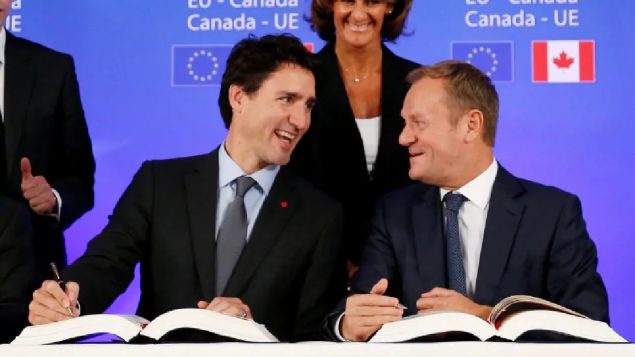
Prime Minister Justin Trudeau and European Council President Donald Tusk signed the Comprehensive Economic and Trade Agreement in Brussels in 2016. Most of its measures were provisionally applied in 2017 as the 28 member states of the EU.began to ratify the deal. Canada's agriculture sector says it hasn't lived up to expectations and blames the EU (Francois Lenoir/Reuters)

In 2017 the Comprehensive Economic Trade Agreement was negotiated and signed into force with great satisfaction by Canada’s Trudeau government to improve trade between Canada nad the European Union, notably in the agricultural sector.

It was supposed to be advantageous for both Canada and the European Union.  A year later there were already rumblings in Canadian agriculture and by 2019 the Canadian Agri-food Trade Alliance (CAFTA) was saying the deal had not only not increased Canadian exports but in fact had hurt the sector.

The group said since CETA. the agriculture sector had lost about 10 per cent of its exports to Europe while imports from Europe had increased by the same amount meaning about a $3.5 billion trade imbalance.

Now one year later CAFTA wrote a letter to the EU Directorate of Trade staing its concerns about the deal writing “to express our serious concern over the lack of commitment the European Union (EU) is demonstrating to adhere to the spirit of the Comprehensive Economic and Trade Agreement (CETA)”.

The letter goes on to criticise the EU saying  the deal has harmed Canada, ” because of a wide range of technical barriers and trade distorting measures that were to be lowered or eliminated altogether through CETA continue to block access to the EU market for Canadian products. The reluctance from the EU Commission and EU member states to abide by the spirit of the CETA and remove these barriers has been disappointing and surprising given the EU’s own focus on ensuring its trade agreements are put into practice and enforced properly”.

In addtion this week no less than five former Premiers have written a joint letter to Prime Minister Trudeau. The five former Premiers include those of Alberta, Saskatchewan, Manitoba, Ontario, and Quebec,

The say the deal was to “increase Canada’s exports by nearly $1.5 billion annually. The pact also included commitments to resolve issues related to technical barriers to trade, sanitary and phytosanitary provisions and other non-tariff barriers”

It goes on to say, “CETA has now been in force for three years and it has failed to deliver on its promises for Canada’s agri-food exporters. This outcomes results from the EU Commission and EU member states continuing to impose a wide range of trade barriers for pork, beef, canola, sugar and grains, or failing to reduce those that were to be lowered or eliminated altogether through CETA

The letter goes on to urge the Prime Minister to raise concerns about what are seen as ongoing barriers and restrictions hurting Canadian agricultural exports concluding with “. In the weeks ahead, we urge you to take up these issues with your counterparts as one of your top foreign policy priorities.

additional information – sources

Wednesday, March 20, 2024

France faces high-risk vote on EU-Canada free trade deal

Paris (AFP) – The French government on Thursday faces a risky vote on a controversial trade deal between the EU and Canada in the Senate where an unlikely alliance between left and right hopes to torpedo the pact.

Issued on: 19/03/2024 
Some senators want to inflict a defeat on the government over the trade deal
 © Thomas COEX / AFP

The Comprehensive Economic and Trade Agreement (CETA) has been in force provisionally since 2017, but requires ratification in all European Union member countries to take full effect.

President Emmanuel Macron and his centrist parliamentary allies managed to get the deal approved in the National Assembly in 2019 by a slim margin, but backing by the upper house -- where they are in a clear minority -- is needed for ratification.

The French Communist party placed the treaty on Thursday's Senate agenda, with the stated aim of getting it defeated.

Accusing the government of treating parliament "like a doormat", Communist senator Fabien Gay announced "a political thunderclap" for Thursday.

In a rare temporary alliance, the leadership of the conservative Les Republicains (LR) party, which has a majority in the Senate, has also signalled its opposition to the trade pact.

"We need free-trade agreements, but not at the expense of our sovereignty, especially for food," said Bruno Retailleau, LR's leader in the Senate.

Like all EU trade deals, CETA was negotiated by the EU Commission, but also needs approval from each EU member.

Seventeen of them have ratified the deal, with the process in 10 countries -- including France -- still ongoing. Britain ratified the deal when it was still in the EU.

Cyprus's parliament is the only one to have rejected the agreement outright, over a controversy about a geographical indication for halloumi cheese.

But under EU rules, such a vote only impacts CETA's application if a government officially notifies the EU of the rejection, which Cyprus has not done. Instead, it plans to re-submit the proposal later.

If CETA is rejected in the French Senate, Macron would be expected to do the same.
'A warning shot'

The government has, meanwhile, accused the opposition of weaponising CETA ahead of June European elections seen as a key test of Macron's popularity.

"Let's not be naive," quipped Macron's minister for foreign trade, Franck Riester, saying the trade deal was being "instrumentalised in the middle of the European election campaign".

While the French government defends CETA, there is also plenty of opposition, notably around food safety, with critics pointing to Canada's laxer approach to genetically-modified organisms, hormones, pesticides and herbicides, and lower standards on animal welfare compared to the EU.

CETA has sparked protests across the EU, including in Germany 
© John MACDOUGALL / AFP

There have been angry demonstrations in several EU countries against the deal, including by climate activists.

Criticism has also come from farmers and industrial sectors, notably over access to the Canadian market, and regulations.

"Farming in central Canada is completely industrial and operates without any rules," said LR senator and professional farmer Laurent Duplomb, saying he hoped to "fire a warning shot" in the direction of the EU.

Meanwhile, senators have reported receiving an unusual amount of attention from companies, associations, the government and the Canadian embassy all hoping to sway them.

"I have never seen this much lobbying before a Senate vote," said one member of the upper house who declined to be identified.

Although a no-vote would not in itself kill CETA, the French government worries about the impact of any rejection.

"We have to be careful not to send a negative signal concerning an agreement that produces benefits," said a government source, on condition of anonymity.

The trade deal's backers say French exports to Canada increased by 33 percent between 2017 and 2023, while imports rose 35 percent, thanks to the agreement.

Wine and dairy producers are among the main beneficiaries, the government says.

© 2024 AFP

Wednesday, September 21, 2022

Five years into Canada-Europe trade deal, full ratification not guaranteed

A dispute over how corporations can sue governments remains unresolved

OTTAWA — Canada’s trade deal with the European Union has been operating in draft mode for five years as of Wednesday, raising doubts it will ever be formally implemented.


A dispute over how corporations can sue governments remains unresolved. Yet Canadian trade experts say the deal remains a major win in an era of supply-chain shocks and pushback against globalization.


The Comprehensive Economic and Trade Agreement, known as CETA, came into force provisionally on Sept. 21, 2017, with the signatures of the European Commission and the Canadian government.

Since then, Canada-EU trade has risen 33 per cent, amounting to $100 billion in goods and services last year.

It’s meant more exports of everything from seafood to automotive parts to Europe, which has boosted its pharmaceutical and meat exports to Canada.

Yet the deal isn’t legally in place until all 27 members of the bloc individually ratify the deal.

Lawrence Herman, a Toronto trade lawyer, said key parts of the deal around tariffs, digital commerce and public procurement are in place.

“It is in effect in every real way,” Herman said in an interview Tuesday from France.

“I don't think CETA will ever be officially ratified.”

The most contentious issue surrounds which mechanisms countries can use to seek compensation and rectify disagreements with national, state and provincial governments, known as investor-state dispute settlements.

The idea is for a neutral mechanism to hear out complaints beyond courts, which could be influenced by national governments.

Labour and environmental activists have argued this gives up sovereignty of everything from consumer protection to worker safety.

A German senior court in February rejected arguments that this provision undermines the country’s constitution, but the clause remains controversial in Germany, which is among the 12 countries that haven’t ratified CETA.

Herman said in many of those countries, opposition is only getting stronger. “I just don't see it ever coming into force definitively,” he said.

Jason Langrish, head of the Canada Europe Roundtable for Business, agrees.

“There's a good chance it just sort of sits in this limbo,” said Langrish, who worked on CETA’s precursor as part of Canada’s delegation to the European Union, and helped represent industry groups in the CETA negotiations.

“The investor-state (tribunal) has been blown out of proportion,” he argued.

Trade Minister Mary Ng was unavailable for an interview Tuesday as she was travelling abroad.

But her office pointed out that Canada and EU countries will appoint members of the proposed tribunal, who will be "subject to rigorous ethical commitments, as well as a robust appellate mechanism."

"This agreement is giving Canadian farmers, producers, processors and exporters preferential access to more than half-a-billion consumers across the EU," said spokesman Chris Zhou.

Langrish said CETA’s main success has been to formalize rules around the large amount of trade the two parties were already doing, making Canada less reliant on the United States.

“As (U.S. President Donald) Trump came and went and protectionism became the order of the day, and we had all these difficulties with China, it was nice to have that relationship with Europe as a bit of a hedge,” he said.

“It sent a signal to the business communities in Canada and the EU, that they were both committed to each other and wanted to make this work as a long-term partnership.”

Langrish said trends in offshoring, immigration and automation have made it harder for politicians to sell trade deals, which themselves are becoming more complex.

That's because countries have already inked deals on getting goods across borders with lower taxes. That has meant modern trade negotiations involve more complex topics, such as technology regulations, labour qualifications and competition rules.

“The big-bang era of trade deals is over,” said Langrish.

CETA has been in the works since 2004, with the Harper government signing the initial agreement in 2014.

In 2016, ratification talks collapsed during a regional dispute in Belgium.

At that time, former trade minister Chrystia Freeland walked out of negotiations, giving an emotional interview in which she held back tears. The interview got attention across the continent, and talks went back on track within days.

European Commission President Ursula von der Leyen is headed to Canada this month. Her visit was postponed after the death of Queen Elizabeth delayed various international meetings.

This report by The Canadian Press was first published Sept. 21, 2022.

Dylan Robertson, The Canadian Press

Friday, October 02, 2020

FRANCE 
Peasant unions unanimous against free trade

by Bhavi Mandalia
September 30, 2020

In recent days, criticism against the free trade agreements signed between the European Commission and Canada, then with the Mercosur countries, has become increasingly fierce in France. Very critical of the economic and ecological consequences of the agreement between Europe and Mercosur, the report of the Commission chaired by Stéphan Ambec and submitted to Prime Minister Jean Castex on September 18, prompted the reaction of many peasant trade unionists as well as certain professionals of the meat industry in France. In a joint press release, the FNSEA and the Young Farmers union say they are “comforted by the Ambec report which confirms that the enormous difference in terms of production standards would lead to unfair competition for certain key sectors of European production. The conclusion is simple, the import of agricultural products from Mercosur would jeopardize the viability of entire sections of French agriculture, ”believe these two unions.
For a differential treatment of the agricultural sector


In another paragraph of their joint press release we can read this: “it is the very concept of free trade agreements that must be reviewed to promote regulated trade, differential treatment of the agricultural sector and allow all countries of the world solidarity in food sovereignty ”. The FNSEA has not always used this language in the past. We can therefore think that the experience of the peasant world in recent years has also made the union activists of the specialized associations of the FNSEA reflect in the various production sectors.

The second union in the country with electoral influence, the Rural Coordination delivers its findings through the voice of its president Bernard Lannes: “The EU-Mercosur agreement provides for increasing imports of meat, sugar and soybeans from the Mercosur countries. , the production of which is industrializing strongly due to the aggressive orientation towards exports ”. Opposite, he continues, “peasants in Europe face significant challenges in producing food in a way that respects the climate and animal welfare, which leads to increased costs for farms. However, the increasing and unskilled imports from Mercosur countries intensify the pressure on costs for farming families and European peasants ”. Like the FNSEA and the JA, the Rural Coordination is opposed to the ratification of this agreement, which is also the case for the Confédération paysanne and MODEF from the start.

Suspend the provisional application of CETA

The FNSEA specialized union in the production of beef cattle, the National Bovine Federation (FNB) believes in a press release that “an immediate halt must be given to this free trade policy!” Whatever the commercial issues, the EU must no longer authorize the importation of products that do not strictly meet European production standards (…) The provisional application of CETA must therefore be suspended. The agreement with Mercosur must be rejected from the first stage of ratification, i.e. the vote for its signature by the Member States, in the Council of the EU, which the former European Commissioner for Commerce had announced for the month of October, ”recalls the FNB.

Irish national Phil Hogan had become commissioner in charge of trade in the new commission after having been an incompetent commissioner in charge of agriculture in that chaired by the Luxembourger Jean-Claude Juncker. In August he was led to hand in his resignation to Ursula Von der Leyen after attending a gala dinner for 80 people in Dublin in contradiction with the sanitary rules of the moment.
France must reject these two agreements

Farmers and their unions are not alone in opposing these free trade agreements. The Cattle and Meat inter-profession known by the acronym “Interbev” writes this in a recent press release: “on reading the report on CETA, the inter-professional organization considers unacceptable the many failures highlighted by the European Commission on the systems of Canadian meat traceability. It is clear that this system of traceability and control of meat exported by Canada to the European Union does not guarantee to date that these meats are hormone-free and anabolic-free ”.

While the Senate has just been partly renewed, it now has solid arguments for not ratifying CETA, this free trade agreement signed between Europe and Canada and approved in 2019 by a vote of the Assembly. national when the LaREM group was still in the majority.

Gerard Le Puill


Tuesday, December 31, 2024

EULOGIES

Farewell Jimmy Carter


 December 31, 2024
Facebook

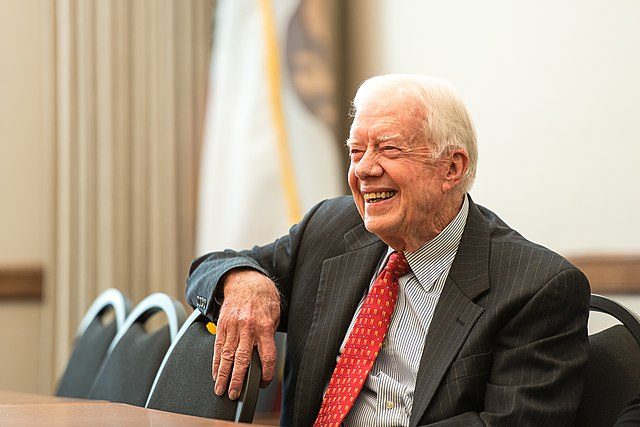
Photograph Source: Commonwealth Club – CC BY 2.0

After 100 years among us, Jimmy Carter is gone. Like a lot of people, I’m playing Ramblin’ Man in his memory tonight.

Saying good-bye to Jimmy Carter is complicated as Dickey Bett’s guitar. All complications considered, Jimmy was my favorite U.S. President during my lifetime. Nobody’s perfect, and a U.S. President’s imperfections are bound to cause immense death and destruction, as did Carter’s. Nevertheless, among modern American War Criminals-in-Chiefs, JC was relatively benign.

By the time Jimmy Carter took office, I’d spent a good portion of my youth protesting a crooked President (it’s all relative among Presidential criminals, but at the time, Dick Nixon was considered to be almost as ridiculous, nefarious and felonious as… Trump?), a horrific war (Vietnam) and the imperialist, capitalist system in general. I must confess I did this mainly because I longed to make out on a motorcycle with Che Guevara (or some facsimile, since he was dead), but also because I was vaguely aware the “system” sucked.

But in Jimmy Carter’s victory, I felt a surge of hope for America’s future, my future. I was just graduating from Yale, which had devolved from a progressive, antiwar academic haven personified by the Reverend William Sloane Coffininto a hotbed of Young Republicans creaming in their chinos over a cowboy California Governor whose gleaming Hollywood smile made me want to toss my scones all over my typewriter (yep, those were ancient times). So, I was grateful to see a Democrat in the White House who wasn’t LBJ. Would the future be bright with Jimmy?

With one foot still in the hippie “living-off-the-land” life (while the other was kicking through the big oak doors of the Ivy League), I liked that our new Prez was a peanut farmer. As I was dating an engineering student, I thought it was cool this farmer was also an engineer, albeit nuclear. Nuclear? Yikes! I was just starting to join the “No Nukes!” protests, and hoped (against hope) that his scientific expertise—not to mention his experience “saving” a Canadian nuclear reactor from a meltdown—would make him less pro-nuke than other politicians.

Nukes aside, I figured JC couldn’t be much worse than Tricky Dick or LBJ, and nothing was bringing back the glory of JFK, which really wasn’t all that glorious for Marilyn Monroe, among others.  I saw Gerald Ford merely as a transitional figure, though I later learned he was actually one of our best Presidents, mainly because he didn’t do much besides fall down a few times and try to heal the nation from Tricky Dick’s violation. Oh, and then there was that semi-secret endorsement of Indonesia’s genocidal invasion of East Timor.

I thought it was a good sign when in 1977 on his first day in office, Jimmy Carter granted amnesty to any draft resister (or dodger).

The fact that Carter was a devout “Christian” (JC loves JC) didn’t bother me because, at the time, I associated Christianity with the Reverend Coffin, the Berrigan Brothers and other antiwar Christians. Aside from a squawk or two from Anita Bryant and a young Jerry Falwell, Sr. (who was old even when he was young), the Church hadn’t quite turned hard Right… yet.

I appreciated this devout Christian President admitting in Playboy that he had committed “adultery in his heart.” Even before I studied sexology, I knew most people fantasized about all kinds of things, and I applauded a politician who was honest about it. That’s another thing: Jimmy didn’t seem like “a politician.” He certainly was one, but he had an aura of sincerity that is rare in politics, and it stayed with him until the end.

Being somewhat open about his sexual fantasies—even in Playboy magazine—must have been good for Jimmy’s sex life. Indeed, he was very happily married to Rosalyn Carter (1927-2023), his beloved Steel Magnolia, for 77 years, the longest marriage of any U.S. president.

When asked if winning a Nobel Peace Prize or becoming President was the most exciting thing that happened to him, Jimmy replied, “When Rosalynn said she’d marry me—I think that was the most exciting thing… Rosalynn was my equal partner in everything.” Gotta love a hubby like that.

Jimmy’s final farewell to his Rosalyn, read by their daughter Amy as Jimmy lay in a suit and tie on his hospital bed, had me—and countless other hopeful romantics sharing in this remarkable expression of intimacy from our devices—in tears. That scene, now a memory, moves me even more today, as I caretake my own beloved husband Max after his stroke.

However, I must admit, my affection for Jimmy Carter stems from the fact he gave me a job, and was a pretty good boss, as bosses go.

Getting a government job was never on my professional wish list. Actually, I wasn’t eager to go into any *profession,* partly because I was too lazy to get up and put on my jeans and tie-dyed T shirt for a 10am class, so how was I going to force myself into a power suit for a 7am power breakfast?

Nevertheless, there I was, six months into the Carter administration, graduating Yale with (almost worthless) honors, watching my classmates go off to Wall Street, law school, med school, other higher education or expensive parent-paid years abroad, and I just didn’t know what to do with myself (confession: I still don’t). I was pretty good at playing the game known as “school,” and I liked it well enough. However, I was starting to get (to use a much-maligned term) “woke” to the fact that I was not just learning, but also being subtly yet firmly indoctrinated into the same war-making system I was protesting. So, I decided to take a few years “off” before submitting (yes, higher education is like BDSM submission with all the restraints, punishments, protocols and pain) to more schooling.

Also, I was broke. And my voluminous student loans, on top of rent, on top of my fun-but-low-income lifestyle, was not putting money in my fledgling Bank of New Haven account.

So, I got a job working for Jimmy Carter, one of those government jobs I thought I’d despise, but it turned out to be one of my greatest jobs ever. Sometimes I even had to be at “work” by 7am(!), but never in a power suit. More likely tights, a leotard and maybe a mask. What kind of job did I have?

I was a New Haven City Mime.

Stop laughing! I’ve already heard all the stupid mime jokes you can muster, and I am the first to admit, mimes can range from mildly annoying to downright nauseating, even when they’re good, and I wasn’t that good. Let’s just say, I was no Marcel Marceau—who actually performed for a smiling Jimmy Carter and bemused Rosalyn and Amy—and Marcel was not as good as the master Jean-Louis Barrault (check out his moves in Children of Paradise). However, I was decent—I’d taken a few mime classes as a Theater major at Yale and mimed a bit in a Commedia Del’arte troupe of Yale grads and dropouts—or at least good enough to ace an audition for performing artists in the CETA(Comprehensive Employment & Training Act) program, which had been signed into law by Nixon (even the worst Presidents do some good), but ramped up to its highest levels under Carter. So, I was hired as a CETA City Mime.

Are you laughing even harder now? Many people (especially Reagan Republicans) found my job as a CETA City Mime to be the epitome of frivolous government, but not the sad citizens I made smile as they trudged across the New Haven Green, nor the tunnel-visioned commuters that broadened their perspectives through my silliness, nor the sick, the disabled and the seniors I distracted from their pain, nor the “inner city” students I taught to dramatize their feelings and ideas, some of whom went on to make movies, music and other forms of art, some of it great art.

I never met Jimmy, but I did a little goofy miming for his Veep’s wife, the Second Lady, Joan Mondale, at the Wisconsin Mime Festival, which she graciously tolerated as the cameras clicked away, splashing our cheer all over the papers.

Moreover, I was no longer broke.

So, Jimmy Carter gave me a job—a pretty damn wonderful, fun, sexy, creative, meaningful and (I think) helpful-to-the-community job… with health benefits! And I thank him for that. It was my first job as an artist, and I held onto it until Rhinestone Cowboy Reagan rode in and shot CETA dead as he shot dead or crippled many government programs, like Welfare, Social Security, Medicaid, Food Stamps, and federal education, while beefing up the U.S. military and cutting taxes for the rich.

Carter presided over an ostensibly peaceful time when Americans were in the grip of the “Vietnam Syndrome.” It was a good grip; at least, it felt pretty good to a peacenik like me (though it enraged the war profiteers), since this reluctance seemed to keep us out of war.  I say “seemed” because, little did I know that, while I was pretending to climb through imaginary windows as a CETA City Mime on the New Haven Green, assuming my country was truly “at peace,” my boss President Jimmy Carter’s militantly anti-Communist National Security Advisor, Zbignew Brzezinski (“Morning Joe” Mika’s dad), was laying the military groundwork for 9/11.

9/11? If I’d known what was happening, it would have made my head spin (which would have been a neat mime trick). Quite honestly, it still does. In an effort to “undermine” the Soviet Union, President Carter, under Dr. Brzezinski’s earnest Trilateral guidance, armed and trained the ultra-religious Afghan Mujahideen against the Soviet-backed Democratic Republic of Afghanistan and ultimately, Soviet occupation troops during the Soviet-Afghan war. One of the leaders of these Mujahideen, who later devolved into the religo-fascist Taliban, was a young Saudi millionaire named Osama bin Laden.

I observed the news with some interest, since I had just come back from a hippie trip through Afghanistan and fallen in love with the people and the roughly beautiful land. Years later, I was crushed to see the great Bamian Buddhasof Afghanistan—one of which I had climbed to the top—demolished by the Taliban. Then we got 9/11 and Bush’s War on Terrah… a Neocon nightmare, the seeds of which were planted by that seed-planting peanut farmer, my CETA GodFather, Jimmy Carter.

At least, he tried to make peace in the Middle East (sort of), bringing Egyptian President Anwar Sadat and Israeli Prime Minister Menachem Begin to Camp David for a handshake. I was never a Zionist; I’d even made out (on a motorcycle!) with a handsome Palestinian (who looked a little like Che Guevara) on my Jewish youth group’s trip to Israel, for which I got into big trouble. But I appreciated Carter’s efforts, which miraculously stood the test of time, though Israel’s current genocide is fraying them.

But this farewell is not an analysis or overview of Carter’s policies. I was too busy miming to pay serious attention to them.

I did notice that Jimmy had some intriguing relatives. Sometimes my mime job involved roller-skating, so I thought it was cool that his daughter Amy Carter essentially roller-skated through the White House, and then I thought she was super-cool when I learned she became an anti-apartheid, anti-imperialism activist with my Yippie hero, Abbie Hoffman, post-Presidency. Jimmy Carter’s brother, Billy, liked beer (some might say too much), but he actually handled his Billy Beer better than Washington’s current most prominent beer-lover Brett Kavanaugh.  Jimmy’s sister, Ruth Carter Stapleton ministered to Larry Flynt when my old buddy Paul Krassner was editor of Hustler. Good times.

Though Nixon signed the Environmental Protection Act (score one more for Tricky Dick), Jimmy Carter established the Alaska National Interest Lands Conservation Act, tripling the size of the nation’s Wilderness Preservation System and doubling the size of the National Park System. He also had solar panels installed in the White House in 1979. Ronald Reagan removed them in 1986. Apparently, undermining Carter in both major and minor ways was a Reagan obsession.

The White House solar panels were essentially reinstalled in the early 2000s. What does that say about the two Presidents?

Unlike most high-level politicians of the 1970s, Jimmy seemed to genuinely enjoy the music of the times, and being a Georgian, he especially liked the Allman Brothers. In fact, he was friends with the band, and even said they “helped him win the White House,” because they played several concerts for him on the campaign trail.

Carter loved the blues, so of course, he’d have a little malaise. I remember his “Malaise” speech, how everybody—especially the Skull and Boners and other young Republicans that seemed to surround me—declared it just awful. I remember feeling a little self-conscious because I’d actually connected with that speech. I remember thinking that I understood the creeping “crisis of confidence in America,” because I was feeling it, and I was glad to have a President who dare to speak about it, even if he sounded like a depressed patient in one of those encounter group therapy sessions so popular back then.

Unsurprisingly, most Americans went along with my Young Republican colleagues, and declared the speech to be “politically tone-deaf,” sending Jimmy Carter into freefall. Then Iran fell to the Ayatollahs, Brzezinski’s preposterous hostage rescue attempt failed disastrously (for which Carter took responsibility), and Cowboy Reagan made a dirty deal on the down-low for the Iranians to hold onto the American hostages until he won the Presidency.

Then soon enough, both Jimmy Carter and I were out of our jobs.

What a stark contrast between Jimmy Carter, the relatively honest, slightly depressed, seemingly sincere Democrat who took responsibility for his mistakes and worked selflessly into his 90s, and Ronald Reagan, the fake sunshine cowboy Republican who spouted apple pie platitudes, never took responsibility for anything and slipped into senility before the end of his presidency.

Was Jimmy Carter a good president? It’s complicated. What’s certain is that he was a great former president.

He has gone on many post-presidential peace missions, supported Civil Rights and picked up a hammer to build homes for the poor through Habitat for Humanity in 1984, and kept doing it until he was 95. He received the Nobel Peace Prize in 2002, but then so have many war criminals. Though Carter’s award “for his decades of untiring effort to find peaceful solutions to international conflicts, to advance democracy and human rights, and to promote economic and social development” somehow seems more sincere than most.

Over this past year and a half, I’ve often wondered what Jimmy Carter would have said about Israel’s current genocide. I can’t help but believe that he would have injected a dose of compassion for Palestine that we just don’t see these days from high-level American politicians, let alone Presidents, current or former.

So after a century of JC on Earth, like a lot of people, I’m listen to those Ramblin’ Man lyrics that so fit the occasion:

When it’s time for leavin’ I hope you understand that I was born a Ramblin’ Man

Whether he’s with Rosalyn, Jesus, or becoming one with that rich Georgia peanut-growing soil, farewell Jimmy Carter.

Susan Block, Ph.D., a.k.a. “Dr. Suzy,” is a world renowned LA sex therapist, author of The Bonobo Way: The Evolution of Peace through Pleasure and horny housewife, occasionally seen on HBO and other channels. For information and speaking engagements, call 626-461-5950. Email her at drsusanblock@gmail.com  


Spiritual Politics

How Jimmy Carter created the religious right

(RNS) — He threatened the GOP's Southern strategy.


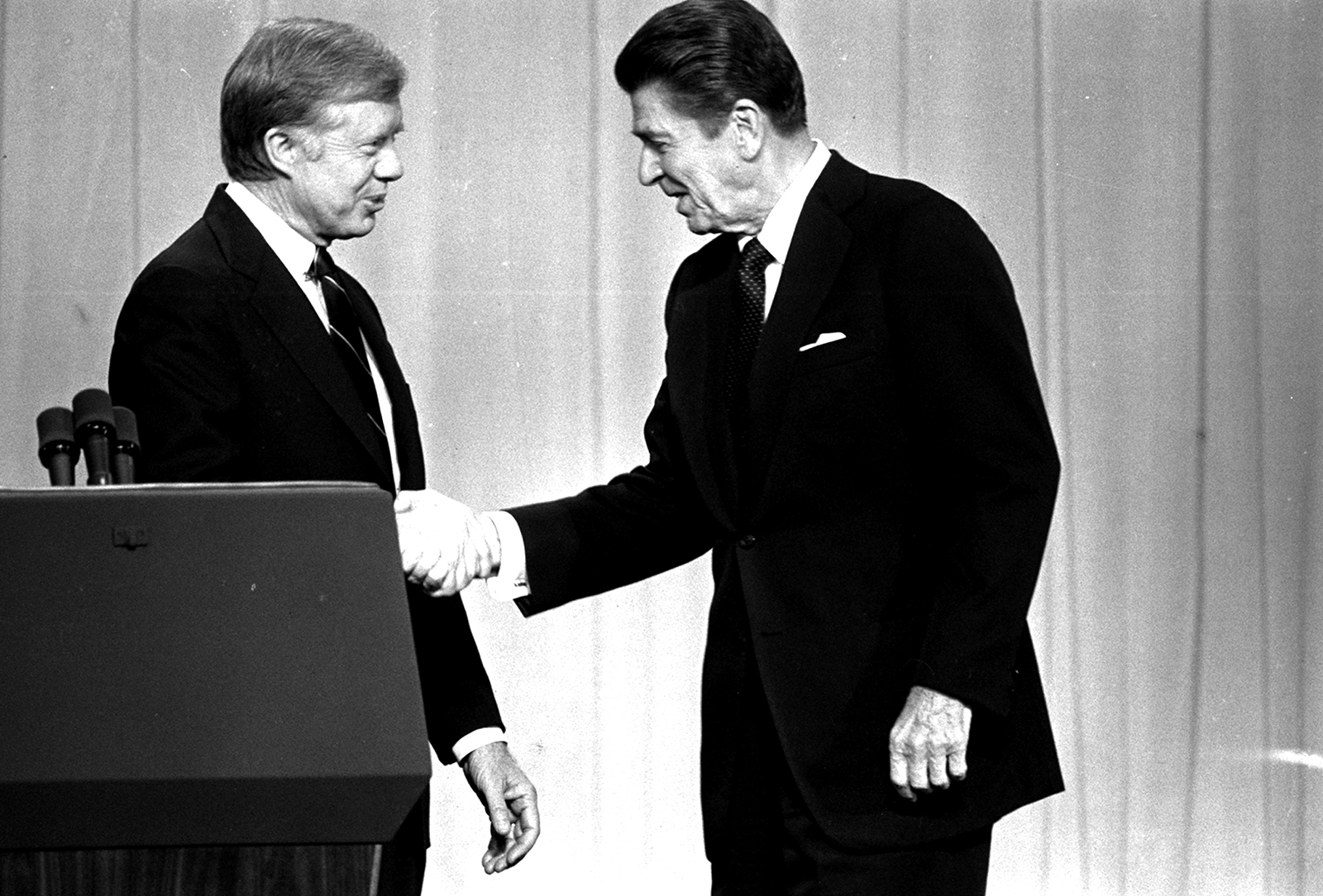
FILE - In this Oct. 28, 1980 file photo, President Jimmy Carter, left, and Republican presidential candidate Ronald Reagan shake hands in Cleveland, Ohio, before debating before a nationwide television audience. (AP Photo/staff, file)

Mark Silk
December 30, 2024

(RNS) — Amid the many accolades and occasional brickbats now raining down on the late Jimmy Carter, let us note that the most consequential legacy of his one-term presidency is the religious right, the longest-lasting political movement in American history.

How so?

Winning the highest office in the land in 1976, Carter represented a mortal threat to the Republican Party’s strategy of making the increasingly populous South the engine of a new, nationwide GOP majority. Raised Southern Baptist on a peanut farm in southwest Georgia, he used religio-regional pride to recall white Southerners to the national Democratic fold. Where the last Democratic president, Lyndon Johnson, had lost all five Deep South states from South Carolina to Louisiana 12 years earlier, the former governor of Georgia won every state of the old Confederacy except Virginia.


Carter’s personal religious identity was more complicated than you might have thought from Newsweek’s famous “Born Again!” cover story, which christened 1976 as “the year of the evangelical.” As described by Jonathan Alter in his fine biography, Carter had no sudden come-to-Jesus moment as a youth, but rather, in middle age, a growth in Christian commitment derived from reading the theologian Reinhold Niebuhr, doing mission work and reflecting on his own spiritual state.

No liberal, the moderately progressive positions Carter took on issues such as abortion and women’s rights were in line with the moderate progressivism of the Southern Baptist Convention of the 1970s. That, however, was about to change.

In 1979, conservative leaders in the SBC mobilized their forces, electing one of their own as president and setting in motion a full takeover of the denomination. The following year, some of the same leaders joined forces with Republican operatives to mobilize evangelicals against Democrats in general and Jimmy Carter in particular. For if the Southern strategy was to be kept intact, Carter had to be discredited and defeated.

In June, after being chosen as the conservatives’ second SBC president, Oklahoma pastor Bailey Smith showed up at the White House and denounced Carter as a “secular humanist.” A month after being anointed Republican presidential candidate, Ronald Reagan showed up at Reunion Arena in Dallas and addressed the National Affairs Briefing, a gathering at which one prominent pastor after another summoned evangelical attendees to political engagement.

“I know this is a non-partisan gathering, and so I know that you can’t endorse me, but … I want you to know that I endorse you and what you are doing,” Reagan said with a straight face, before urging the crowd to get out and vote for their values.


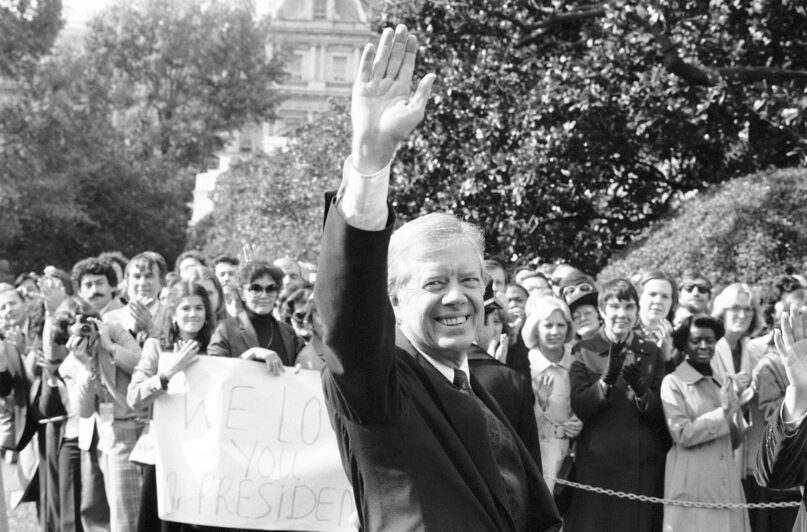
FILE – U.S. President Jimmy Carter waves as staff holds up sign proclaiming “We Love you Mr. President” in Washington, Nov. 5, 1980, as the president walks to the helicopter for a trip to Camp David, Md., after losing the 1980 election to Ronald Reagan. (AP Photo, File)

In November, Carter went down to defeat, the victim of persistent inflation, the Iranian hostage situation — and of evangelicals turning against one of their own. Returning to Georgia, he established the Carter Center in Atlanta as a place to promote good things around the world, wielded a hammer helping Habitat for Humanity build houses for poor people in America and teaching Sunday school at his small church in Plains. In 2000, he announced he was no longer a member of the SBC.


As for the religious right, it took off from the Carter years, remaking the Republican Party’s social policy agenda, reconstituting its demographic base and establishing religiosity as a central feature of American political behavior. It largely succeeded in advancing the Southern strategy it was designed to rescue and, having undergone some subtle and some not-so-subtle transformations, persists to this day.

Whether it would have come into existence in the absence of Jimmy Carter’s presidency is a nice question — one that, like all historical counterfactuals, cannot be conclusively answered. My guess is that something like it would have emerged but that it would have been smaller and weaker, less consequential and less enduring. And the country would be better off.


Opinion

Jimmy Carter rid the presidency of lies. His fellow evangelicals? Not so much.

(RNS) — One of the many paradoxes surrounding Carter’s presidency is that he was unable to fend off the deception of fellow evangelicals, including Jerry Falwell and Billy Graham.


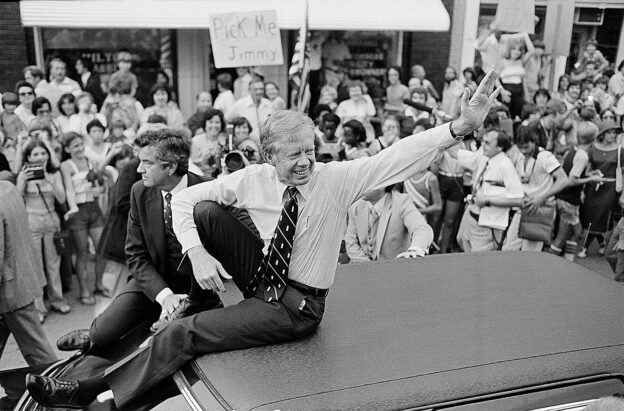
In this July 31, 1979, file photo, President Jimmy Carter waves from the roof of his car along the parade route through Bardstown, Kentucky. 
(AP Photo/Bob Daugherty, FIle)

Randall Balmer
December 29, 2024

(RNS) — Jimmy Carter’s improbable ascent to the White House in 1976 was abetted in no small measure by his probity and his evangelical rectitude. Indeed, it is nearly impossible to imagine Carter, the one-term governor of Georgia, winning the presidency had it not been for the culture of corruption that had surrounded the Oval Office. Lyndon Johnson had lied to Americans about Vietnam, and Richard Nixon had lied about, well, just about everything.

Carter’s pledge that he would “never knowingly lie” to the American people struck a chord, and although Carter’s term as president is generally regarded as something less than unalloyed success, no one — not even his legion of detractors — has credibly accused him of misleading the American people during his time in office. Put another way, Carter, whatever his shortcomings as president, redeemed the presidency from the culture of deceit so abundantly evident during the Nixon administration.

But one of the many paradoxes surrounding Carter’s presidency is that he was unable to fend off the deception of his fellow evangelicals, including a couple of preachers named Jerry Falwell and Billy Graham. Their duplicity may not have been responsible for Carter’s political demise, but it certainly contributed.

The roots of the religious right lie in the cancellation of the tax-exempt status of Bob Jones University, a fundamentalist school in South Carolina. On the basis of Title VI of the Civil Rights Act of 1964, the Internal Revenue Service ruled that any institution that engaged in racial segregation or discrimination was not — by definition — a charitable institution and therefore it was not entitled to tax-exempt status.


RELATED: Jimmy Carter, beloved Sunday school teacher, ex-president, dead at 100

After a district court upheld the IRS in 1970, Nixon instructed the agency to deny applications from “segregation academies,” many of them church-related schools. In the most famous case, the IRS, after years of warnings, finally revoked the tax exemption of Bob Jones University on Jan. 19, 1976, thereby provoking an outcry from politically conservative evangelical leaders. “In some states,” Falwell famously complained, “it’s easier to open a massage parlor than to open the doors of a Christian school.” (Falwell had opened the doors of his own segregation academy, Lynchburg Christian School, in 1967.)


As the religious right geared up to oppose Carter’s reelection in 1980, evangelical leaders repeatedly blasted Carter for denying tax exemptions to segregated religious schools, what they characterized as “government intrusion into private education.” But their ire was misdirected. The IRS policy was formulated during the Nixon administration, and Bob Jones University lost its tax exemption on Jan. 19, 1976, when Gerald Ford was president; Carter was inaugurated a year and a day later. That day was, in fact, an important day for Carter, but not because he was in any way responsible for rescinding Bob Jones University’s tax exemption. Carter won the Iowa precinct caucuses that day, his first major step toward capturing the Democratic presidential nomination.

Politically conservative evangelical leaders, however, intent as they were to turn Carter out of office, shrugged away the niceties of facts. They persisted in blaming Carter for the IRS action, even though Carter had nothing whatsoever to do with it.

Several evangelical preachers also engaged personally in activities that pushed the bounds of credibility. In January 1980, as Carter faced reelection, he recognized (belatedly) that his support among evangelicals, who had helped propel him to the White House four years earlier, had ebbed. In an attempt to rebuild that support, Carter addressed the National Religious Broadcasters, meeting in Washington, D.C., and then invited key evangelical leaders to the White House for breakfast the following morning, Jan. 22, 1980.

Carter thought — inaccurately, it turned out — that he could placate them with bromides about faith or religious freedom, but these leaders of the religious right were more interested in talking about social issues like abortion and gay rights.


Following the meeting, Falwell began recounting to various audiences and political rallies across the country how he had asked Carter why “practicing homosexuals” served on the White House staff. Carter, according to Falwell, replied, “I am president of all the American people and I believe I should represent everyone.” Falwell’s rejoinder: “Why don’t you have some murderers and bank robbers and so forth to represent?”


The Rev. Jerry Falwell addresses a 1983 prayer breakfast for Christians and Jews in Washington. RNS file photo

As a tape recording of the White House gathering demonstrated, however, the president made no such comment. Falwell, in fact, had fabricated the entire exchange in an apparent attempt to discredit Carter in the eyes of evangelicals.

If Falwell was guilty of deceit to advance his political ends, Billy Graham, the most famous and most respected evangelical of the 20th century, was disingenuous, if not duplicitous. On Sept. 12, 1980, less than two months before the election, Graham called Paul Laxalt, chair of Ronald Reagan’s presidential campaign, and offered to help any way he could short of a political endorsement. Eleven days later Graham sent a letter to Robert Maddox, Carter’s religious liaison, insisting that he, Graham, was “staying out of” the campaign.

Even earlier, Graham and Bill Bright, head of Campus Crusade for Christ, had convened a gathering of evangelical preachers in Dallas for “a special time of prayer” to discuss how to dislodge Carter from the White House. Just weeks prior to that gathering, Maddox had visited Graham at his home in Montreat, North Carolina, and reported that Graham “supports the President wholeheartedly.”

Graham’s actions were eerily reminiscent of his comportment 20 years earlier during the presidential campaign between Richard Nixon and John F. Kennedy. On Aug. 10, 1960, Graham sent a letter to Kennedy, the Democratic nominee and a Roman Catholic, pledging that he would not raise the “religious issue” during the campaign. Eight days later Graham convened a gathering of Protestant ministers in Montreux, Switzerland, to discuss how they could deny Kennedy’s election in November.


Later in the same campaign Graham visited Henry Luce at the Time & Life Building and, according to Graham’s autobiography, said, “I want to help Nixon without blatantly endorsing him.” Graham drafted an article praising Nixon that stopped just short of a full endorsement. Luce was prepared to run it in Life magazine but pulled it at the last minute.
RELATED: When Carter ran for president, advisers worried Christian faith would be a liability

Graham’s desire to thwart the candidacy of a Roman Catholic in 1960 may be understandable, especially at a time (before Vatican II) of heightened suspicions between Protestants and Catholics. But on the face of it Graham’s opposition to Carter, a fellow Southern Baptist and evangelical Christian, is mystifying. One can only assume that for Graham, as well as for Falwell and other leaders of the religious right, politics trumped piety. Both preachers were willing to engage in deception in order to advance their political goals.

Jimmy Carter may have reversed the culture of deceit that had infected the presidency during the administrations of Johnson and Nixon, but he was unable to stanch the duplicity of his fellow evangelicals. Carter’s pledge to “never knowingly lie” set a standard for the presidency, but it was a standard that some of his evangelical political adversaries failed to match.

(Randall Balmer, an Episcopal priest and John Phillips Professor in Religion at Dartmouth College, is the author of “Redeemer: The Life of Jimmy Carter.” The views expressed in this commentary do not necessarily reflect those of RNS.)


Opinion

President Carter showed us faith and Democracy can go hand in hand

(RNS) — Carter, a deeply faithful man, played a role in advancing equality, including making my marriage possible.


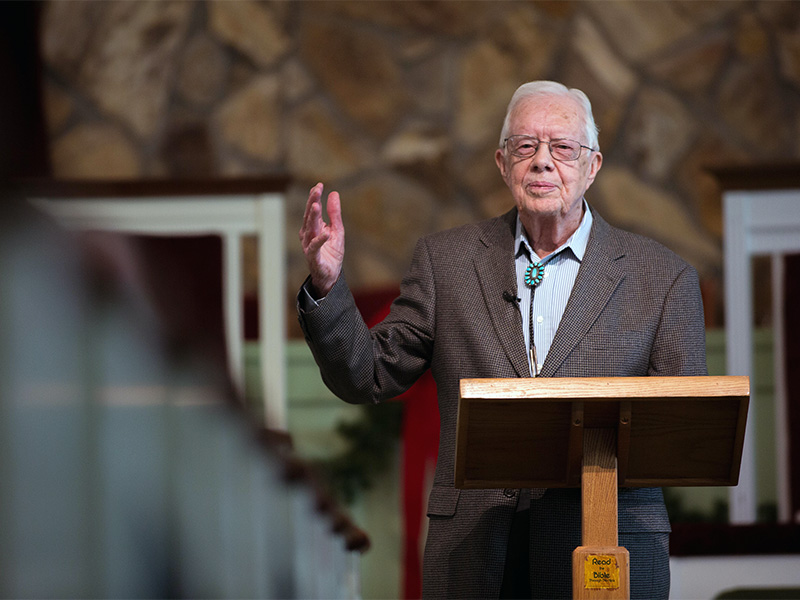
Former President Jimmy Carter teaches during Sunday school class at Maranatha Baptist Church in Plains, Georgia, on Dec. 13, 2015. (AP Photo/Branden Camp)
Paul Brandeis Raushenbush
December 30, 2024


(RNS) — As we reflect on the passing of President Jimmy Carter at the age of 100, we should honor one of the core throughlines of his incredible life: his faith. As a Baptist minister myself, I particularly want to celebrate how President Carter carried himself as a person with deeply held religious convictions, while leading a diverse democracy in which people of all faiths and backgrounds deserve equal dignity and treatment under the law.

I had the privilege of interviewing President Carter several times on the role religion played in his life and work. Having interviewed many leaders, Carter was one of the most intelligent and formidable people I’ve ever spoken to. I remember trembling a bit when I asked the first question: If he was comfortable with the title of “Sunday school teacher.”

He responded without hesitation, recounting how he started teaching Sunday school at age 18 at the Naval Academy Chapel — even leading services while at sea. During his presidency, he taught Sunday school 14 times at a nearby church, and, at the time of my interview in 2012, he had just completed his 650th lesson at Maranatha Baptist Church. “So, you might say I have been a Sunday school teacher all my life.”

Carter was arguably the most religious president in the era since World War II. Yet, he was careful of how his faith featured in his official role. One of his most important religious influences was the towering evangelical force of the Rev. Billy Graham. Yet, President Carter never invited Graham to have services in the White House, explaining, “I believed what my father taught me about the separation of church and state, so I didn’t think it was appropriate. He was injured a little bit, until I explained it to him.”

Carter understood the importance of honoring the separation of church and state. He saw how religion could inspire good works and movements for justice and peace without being imposed on others. “I think you can apply the principles of your faith in your service to the public, but you should not use your political authority to extoll your own faith at the expense of others … I don’t think the President of the United States should extoll Christianity if he happens to be a Christian at the expense of Judaism, Islam or other faiths.”

One instance where Carter called upon his faith was at the Camp David Accords in 1978 with Menachem Begin of Israel and Anwar Sadat of Egypt. He made sure rooms were set aside for Muslims, Jews and Christians to pray throughout the process. “The Muslims used it on Friday, the Jews on Saturday, and the Christians on Sunday. We were very assiduous in our worship,” Carter said.


Egyptian President Anwar Sadat, left, U.S. President Jimmy Carter, center, and Israeli Prime Minister Menachem Begin clasp hands on the north lawn of the White House after signing the peace treaty between Egypt and Israel, March 26, 1979, in Washington. (AP Photo/ Bob Daugherty, File)

Later, Carter became a model of what a person can do in life after the presidency. He founded the Carter Center, which focuses on election monitoring, peace negotiations and fighting some of the world’s worst diseases. This work was a continuation of his commitment to public service, driven by the principles of his faith.

When Carter released his book on the Bible, I warned him I’d be asking tough questions — about the compatibility of religion and science, the role of women, interfaith relations and more. He answered with grace and reason. Then, I asked a more personal question, as a Baptist minister and a gay man at that time in a relationship with my partner for over 10 years.


It was 2012 at the time of the interview, and marriage equality was still a few years away. Public opinion was deeply divided on the rights of gay people, and Christians offered some of the most virulent condemnation for people like me. So I said to the Sunday school teacher, military vet and former president, “A lot of people point to the Bible for reasons why gay people should not be in the church. What do you think the Bible says?”

Carter’s response was profound: “Homosexuality was well known in the ancient world, well before Christ was born, and Jesus never said a word about homosexuality. In all of his teachings about multiple things — he never said that gay people should be condemned. Jesus would not be against marriage between any two people if they were genuinely in love.”


Hearing this from Carter was deeply moving. His words resonated and were quoted widely. His acceptance was unbelievable to some and even resulted in fact-checking sites reviewing and referencing my interview with him. There is a deeply ingrained misconception that religious people are by definition conservative, ignoring the countless examples of religious leaders who have propelled our nation forward. Carter, a deeply faithful man and influential example, played a role in advancing equality, including making my marriage and the opportunity to raise children possible.

We find ourselves in a perilous moment, as those who champion Christian nationalism seek to dominate our politics, government and society. President Carter understood this threat all too well, noting that “the alliance between ultra-right wing religious believers and the Republican Party seems to be permanent.”

Perhaps President Carter’s most enduring lesson both as a Sunday school teacher and political leader was the model he offered of deep faith rooted in tolerance, compassion and equality. To truly honor his achievements and legacy, we must safeguard religious liberty and civil rights, not just for a few, but for all.

(Rev. Paul Brandeis Raushenbush is the president and CEO of Interfaith Alliance. The views expressed in this commentary do not necessarily reflect those of Religion News
 Service.)


Carter, in death, becomes symbol of lost political 'decency' in U.S.

Agence France-Presse
December 31, 2024 6:37AM ET

A mural in memory of Jimmy Carter is painted on a storefront at the Jimmy Carter National Historic Park in Plains, Georgia, on December 30, 2024 (Alex Wroblewski/AFP)

by Aurélia END

The death of Jimmy Carter has brought to the fore a defining characteristic of the late US president's life: his "decency," seen as a product of a bygone era in today's caustic political environment.

Joe Biden on Monday repeated the word three times while speaking to reporters about his late White House predecessor.

Biden, who will be replaced in the White House by Donald Trump on January 20, added: "Can you imagine Jimmy Carter referring to someone by the way they look or the way they talk?"

Despite the struggles he faced during his single term in office -- from economic malaise to the Iran hostage crisis -- Carter has emerged as a nostalgic figure.

He spent his years after the White House advocating for global democracy, fighting neglected public health scourges and teaching Sunday school.


"He was an utterly honest, transparent and healing presence in the White House, which was just what the US needed after the Watergate scandal" under Richard Nixon, Barbara Perry, a professor specializing in the history of US presidents, told AFP.

Eulogies "tell us as much about ourselves as they do about the person being contemplated and commemorated," historian Jon Meacham told broadcaster MSNBC.

"Carter is a sad but illuminating instance of someone who -- while imperfect -- believed in the centrality of character... at a moment in American politics where character is not at the forefront of most people's minds."

Born in rural Plains, Georgia, he died in the same house he and his wife -- who he was married to for 77 years -- bought in 1961.

And his modest lifestyle served as an inspiration to many Americans -- even if other presidents didn't join in themselves.

To name a few: allegations of John F. Kennedy's extramarital trysts, Bill Clinton's affair with a White House intern, and Donald Trump's well-documented sex scandals have "lowered all such standards in American politics," Perry said.

"Americans have become immune to ethical standards in political life."

Even those who have stayed clean from personal scandal, such as Barack Obama or George W. Bush, have little in common with the modest lifestyle and outspoken advocacy of Carter's post-presidency.


- Religious, southern, Democrat -

Carter has received an outpouring of condolences upon his death at age 100 on Sunday.

"It's kind of a stark reminder of how few people there are now with honesty and integrity," Jay Landers, visiting Plains on Monday, told an AFP reporter.

"Just look at" Trump in contrast, he said.


The former -- and now incoming -- Republican president has been found liable for sexual assault, once mocked a reporter with a physical disability and infamously bragged about groping women by the genitals.

Yet he returns to power in large part due to the conservative and religious right.

Carter's relationship with Christianity, meanwhile, points toward a different era.

Carter, a Democrat, was an evangelical -- a denomination now associated with the country's right wing.

The Sunday school teacher also won swaths of the south -- a bastion today of religious conservatism and Republican politics.

Conservative Republican Senator Chuck Grassley noted Carter's faith on Sunday when he said that, though they were "bit" by a "different political bug," they had much in common, including "love of the Lord."

The fractious divides that Carter seems to have transcended, however, have long existed.

Carter himself warned of the nation's "crisis of confidence" in a 1979 speech, sapping "the very heart and soul and spirit of our national will."

His warnings sound like they could have been issued about modern political life, telling Americans they were "at a turning point in our history."

"We can see this crisis in the growing doubt about the meaning of our own lives and in the loss of a unity of purpose for our nation," he said.


That path, he warned, "leads to fragmentation and self-interest... It is a certain route to failure."

© Agence France-Presse