U.S. Budget Deficit Set to Rise Again Amid Trump Tariffs and Tax Cuts

- U.S. oil production is plateauing near record highs, making a 3 million b/d increase by 2028 increasingly unlikely.
- The CBO projects rising deficits and debt despite tariff revenues, driven by tax cuts, entitlement costs, and surging interest payments.
- Republicans dispute CBO assumptions, arguing stronger economic growth could narrow the fiscal gap more than forecast.
Last year, U.S. Treasury Secretary Scott Bessent set a target to cut the U.S. federal budget deficit to just 3% of GDP by the end of President Donald Trump’s second term. The deficit reduction was a key component of his "3-3-3" economic plan, with the other two being achieving 3% real GDP growth and increasing energy production by 3 million barrels a day by 2028. The plan relies on spending constraints, regulatory reforms, and tariff revenue to narrow the deficit.
With Trump now completing the first year of his second term, energy and economic experts have weighed in, and they’re warning that Bessent could miss some of his targets by a wide margin.
First off, U.S. oil production is unlikely to increase by 3 million barrels by the end of Trump’s second term. U.S. shale oil production is currently shifting from rapid expansion to an "undulating plateau" near record levels of 13.6 million barrels per day (b/d). While production remains historically high, growth has slowed due to increased capital discipline, depleted inventories, rising costs, and lower oil prices.
Indeed, there are growing signs that low oil prices will force some U.S. producers to curtail production: Last month, shale drilling pioneer Continental Resources suspended drilling in North Dakota's Bakken shale for the first time in decades, with billionaire founder Harold Hamm decrying low oil prices, "This will be the first time in over 30 years that Harold Hamm has not had an operation with drilling rigs in North Dakota," Hamm told Bloomberg in an interview, "There's no need to drill it when margins are basically gone.”
According to BloombergNEF, the Bakken is viewed as a bellwether for the U.S. shale sector, with the basin currently having a breakeven price of $58/bbl to cover costs. This implies that the current WTI crude price of $62.4 per barrel offers razor-thin margins for producers. U.S. oil output is projected to decline slightly in 2026 due to lower oil prices that reduce drilling incentives, slowing activity even as technology improves. Lower prices make some wells uneconomical, leading companies to scale back drilling, with gains in areas like the Permian Basin unable to fully offset losses elsewhere.
Second, the Congressional Budget Office (CBO) has projected that the U.S. fiscal gap will continue to widen over the next decade thanks to generous tax cuts by the Trump administration, tariffs, high interest costs, and increased spending on mandatory programs.
According to the CBO, the U.S. budget deficit for fiscal year 2026--Trump’s first full year in office--will climb to $1.853 trillion from $1.775 trillion, or 5.8% of GDP.
However, the deficit-to-GDP ratio will hit 6.7% by 2036, well above the 50-year average of 3.8%. Cumulative deficits over the next decade are projected at $24.4 trillion, with debt held by the public expected to reach 120% of GDP by 2036.
The 2025 reconciliation act, aka the "One Big Beautiful Bill," is estimated to add $4.7 trillion to deficits through 2035 due to permanent tax cut extensions and increased defense spending. Net interest outlays are the fastest-growing category of spending, projected to surpass $1 trillion in 2026 and double to $2.1 trillion by 2036.
Rising costs for Social Security and Medicare for an aging population continue to drive mandatory spending upward. The CBO has warned that the Highway Trust Fund could be exhausted by 2028, followed by the Social Security retirement trust fund in 2032. On the flipside, new tariffs that were introduced in 2025 are projected to generate approximately $3 trillion in revenue over ten years, partially mitigating the deficit increases caused by other policies.
The CBO is a nonpartisan federal agency within the legislative branch that provides independent, objective economic and budgetary analysis to Congress. Established in 1974, it acts as the official "scorekeeper" for Congress, producing cost estimates for legislation and projecting federal revenue and spending to help lawmakers manage the budget. However, Republican politicians have frequently criticized the CBO as being biased toward the political left because its economic models and "scores" (cost estimates) frequently contradict Republican fiscal projections, particularly regarding tax cuts, healthcare, and deficit spending.
Republican lawmakers and conservative groups argue that its methodologies are flawed, too conservative on growth, and favor the expansion of government programs. Republicans argue the CBO fails to accurately account for the economic growth generated by tax cuts, resulting in overestimations of the deficit impact of their proposals.
A major point of contention is the CBO's reliance on "static" scoring, which often ignores macroeconomic effects (like increased investment) that Republican lawmakers believe would make their tax cuts pay for themselves. Republicans favor "dynamic" scoring, which they argue better reflects reality.
"CBO will always predict a dark future when Republicans propose tax relief – but the reality is never so dire," Rep. Jason Smith, the U.S. representative for Missouri's 8th congressional district, declared last year. "The CBO assumes long-term GDP growth of an anemic 1.8% and that is absurd," said White House press secretary Karoline Leavitt. "The American economy is going to boom like never before after the 'One Big, Beautiful Bill' is passed."
That said, U.S. economic growth is projected to remain resilient in the current year. After declining by an annualized 0.6% in the first quarter of 2025, real GDP expanded by a much-improved 3.8% in the second quarter and a robust 4.4% in the third quarter, marking the largest quarterly increases since the third quarter of 2023. Goldman Sachs has forecast that GDP will grow by 2.5% in the current year, exceeding the consensus of 2.1%.
By Alex Kimani for Oilprice.com
U.S. Container Imports Expected to Fall in First Half of 2026
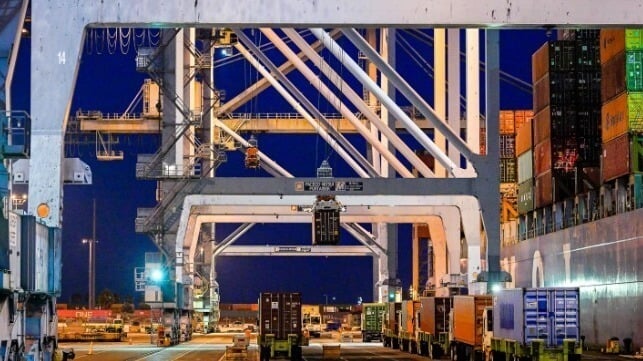
While there appear to be signs of a normalization in the U.S. container import flows and less impact from frontloading, the expectations are that volumes will continue to fall at least through the first four months of 2026. Uncertainty about the U.S.’s tariffs, policy issues, and geopolitical developments all continue to weigh on the outlook for trade.
Both the National Retail Federation and Descartes Global are pointing to a weak start to 2026 import volumes. Descartes calculates that January container volumes were at a total of 2.3 million TEU, which was up more than 90,000 TEU versus December, but down nearly seven percent versus a year ago. Last year, importers were believed to be frontloading ahead of the return of Donald Trump to the White House.
The retail trade association is forecasting January’s retail import figure at 2.11 million TEU, which it says is down more than five percent from a year ago. It suggests that the month-over-month increase was importers advancing orders to get ahead of the Lunar New Year holiday, which begins next week, and when factories across Asia will be closed.
Analysts have forecast that carriers would take between 10 and 14 percent of capacity out of the market around the Lunar New Year. The major lines typically begin blanking sailings from their schedules around the holiday and afterward and are further encouraged this year, with freight rates already weak.
Imports from China specifically were down nearly 23 percent in January 2026, according to Descartes. It notes that China accounted for a third of U.S. trade but believes the tariff policies and uncertainties are showing in the current levels of imports.
“With tariffs still a matter of debate in the courts and in Congress, their effect on imports is being clearly seen,” said Jonathan Gold, the NRF Vice President for Supply Chain and Customs Policy. “The situation underscores the need for clear and predictable trade policies that support supply chain certainty and reliability, business planning, and consumer affordability.”
The NRF reiterated its earlier projections that imports will show significant year-over-year declines during the first half of 2026. It projects container volumes under two million TEU per month until April. For the first half, it projects a total of 12.27 million TEU, which would be down two percent from 2025.
The first improvements, however, could begin in May 2026, a year after Trump’s so-called “Liberation Day,” when the tariff levels were first rolled out. Retailers and other shippers rushed to get their goods into the U.S. ahead of the policies or during some of the pause windows created as tariff negotiations were proceeding.
Descartes, however, also highlights that with the lack of a decision from the U.S. Supreme Court on the tariffs, “policy uncertainty for importers remains elevated, with no near-term change to tariff conditions.” The Trump administration has also threatened new moves if the U.S. Supreme Court strikes down its current tariff policies.

No comments:
Post a Comment