South America seen as West’s safest minerals bet: report

South America is emerging as the most stable and politically viable option for Western countries trying to rebalance critical mineral supply chains away from China, according to new research from Verisk Maplecroft.
The study comes as the United States and its allies intensify efforts to secure supplies of lithium, copper, cobalt, nickel, graphite and rare earth elements, driven by concerns over technology dependence, supply-chain resilience and geopolitics.
Recent moves include US plans to expand strategic stockpiles and a 55-country push to establish a preferential critical minerals trade bloc.
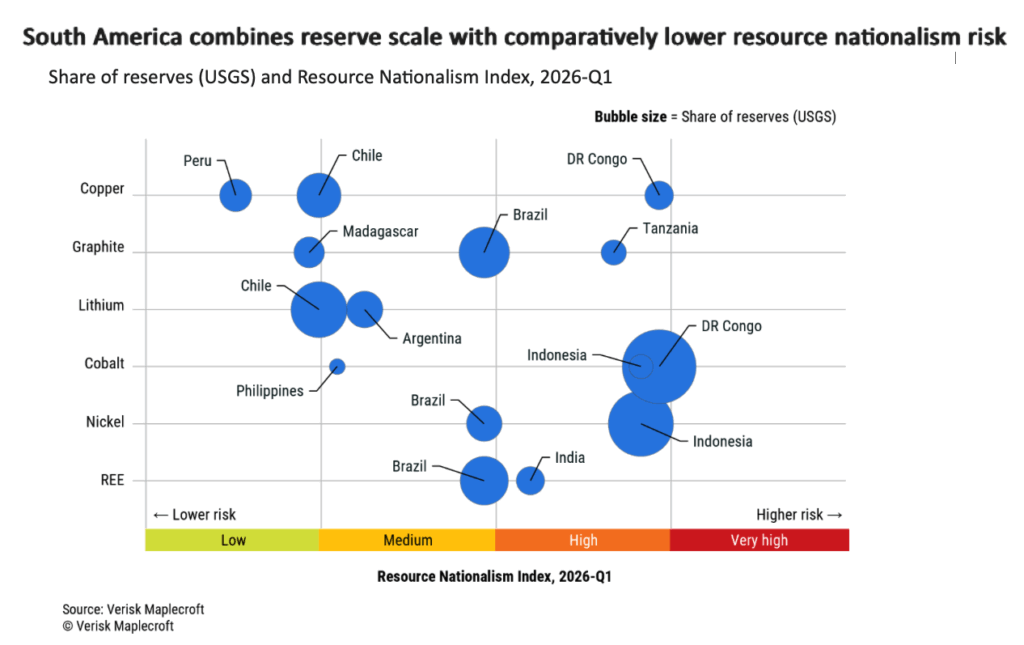
Verisk Maplecroft assessed 10 emerging markets with major reserves using its Resource Nationalism Index and Political Risk Data, finding that Argentina, Brazil, Chile and Peru stand out for combining large resource endowments with comparatively moderate levels of state intervention and political risk. Other countries in the analysis included DR Congo, India, Indonesia, Madagascar, the Philippines and Tanzania.
Low-risk Andes
Most South American producers do not rank among the world’s highest-risk jurisdictions for resource nationalism. Peru, Chile and Argentina are among the strongest performers globally, while DR Congo, Indonesia and Tanzania sit within the top 20 most exposed countries out of 198 assessed.
“What differentiates South America is not the scale of reserves, but the distribution of risk,” Jimena Blanco, Verisk Maplecroft’s chief analyst, said. “Producers consistently combine large endowments of tech-critical minerals with comparatively moderate levels of resource nationalism and political risk.”
The firm rates the region’s overall risk-adjusted opportunity as distinctly favourable, although it cautions that exposure to higher-risk jurisdictions will remain unavoidable for certain minerals.
This is already reflected in recent Western initiatives, such as the EU’s free trade agreement with India, partly tied to rare earth ambitions, and the US Strategic Minerals Cooperation Framework with DRC launched in December 2025.
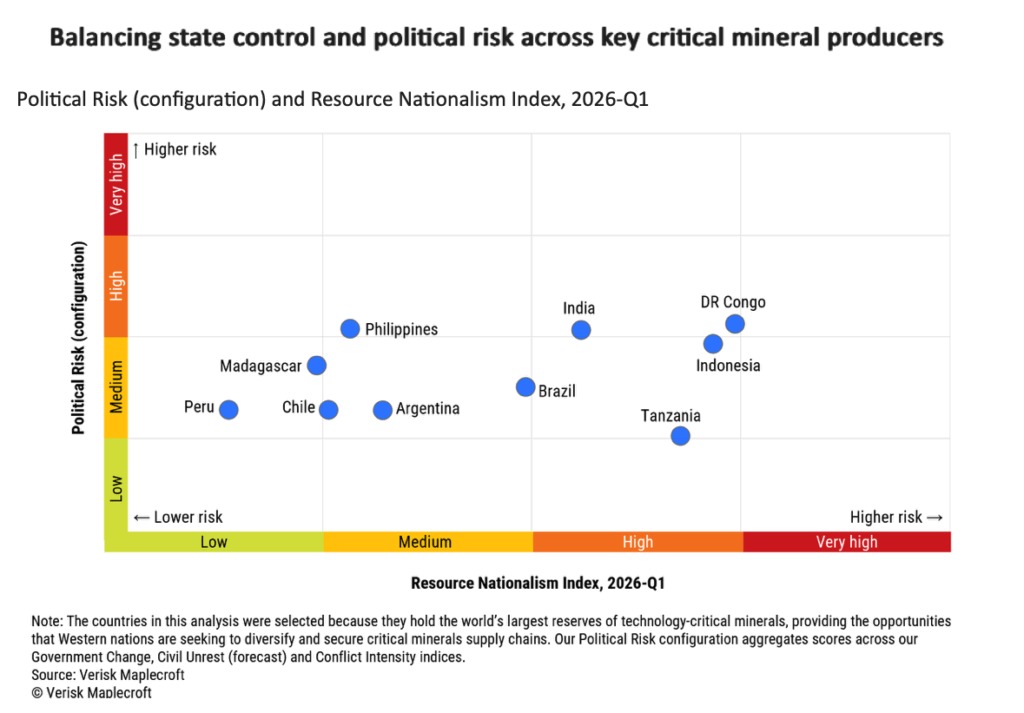
When political instability is considered alongside state intervention, many countries with major critical mineral reserves still fall into a medium-risk category, suggesting relatively supportive conditions for long-term investment. However, some producers combine high political volatility with assertive government control, increasing the likelihood of export restrictions, state ownership or domestic value-addition requirements.
India’s rare earth policies, as well as conditions in DR Congo and Indonesia, highlight this dynamic. The findings suggest that while Western governments cannot fully avoid higher-risk suppliers, South America offers a comparatively stable anchor in an otherwise constrained global landscape.
West-friendly tilt
The research also challenges assumptions about geopolitical alignment. Using its Geopolitical Alignment Tool, which tracks factors such as UN voting, trade agreements and security ties, Verisk Maplecroft found that most of the 10 countries analyzed sit on the pro-Western or neutral end of the spectrum.
Argentina and the Philippines rank as close US allies, while Chile, Madagascar and India show strategic alignment. Peru and Indonesia are broadly neutral. Only Brazil, Tanzania and DR Congo tilt further away from Washington, largely due to stronger ties with US rivals.
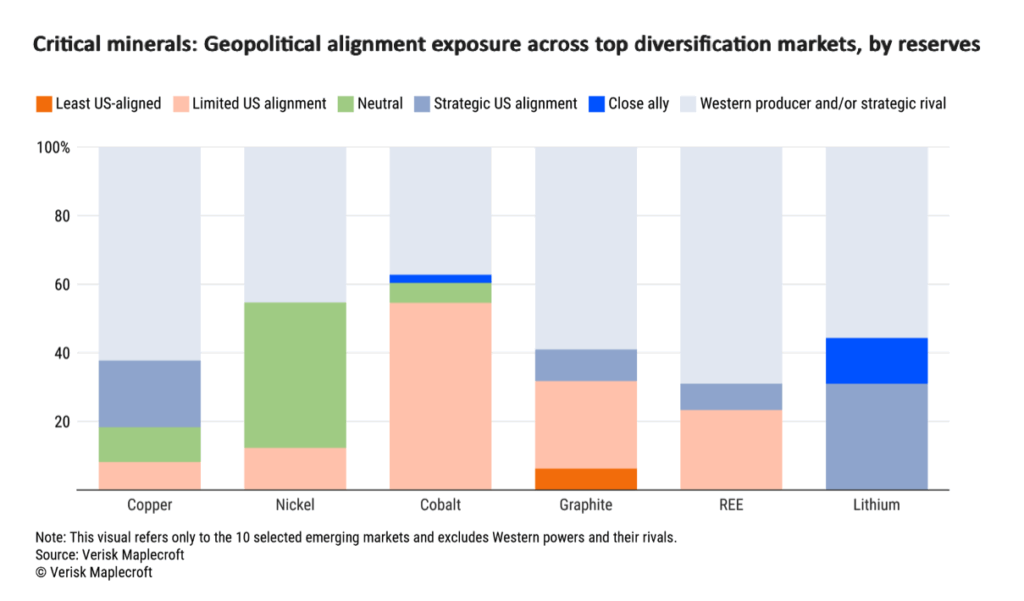
According to the report, the overlap between sizeable reserves, manageable political risk and favourable geopolitical alignment makes South America central to Western diversification strategies.
“Securing tech-critical minerals is no longer just an economic challenge,” Blanco said. “The race will be won not by eliminating risk, but by managing it better than competitors.”
How Argentina’s Lithium and Uranium Boom Could Undermine Its Energy Sovereignty
- Argentina’s lithium and uranium reserves are attracting intense interest from global powers amid the accelerating energy transition.
- President Milei’s pro-market reforms and alignment with the United States are reviving growth but stirring fears of resource extraction without domestic value creation.
- Public concern is growing that foreign-led mining and nuclear deals could weaken energy sovereignty and leave lasting environmental and health costs.
Argentina is home to an enormous wealth of critical natural resources that are becoming increasingly in demand as the global energy transition continues to pick up pace. But while Argentina’s potential geopolitical advantages open new avenues for economic growth, they also come with major potential trade-offs for energy sovereignty as the world’s superpowers intensely pursue the nation’s riches of lithium and uranium.
Argentina’s economy is finally on an upswing after decades of painful decline. This change is in large part thanks to the radical cuts of right-wing President Javier Milei, who was elected to office in 2023. But while Milei’s aggressive financial reforms are having some positive impacts on the economy, his approach has been highly controversial in Argentina and on an international scale.
Part of Milei’s strategy is a close alignment with the Trump administration. As a part of this shift, he has shown a renewed willingness to work with the United States and other international partners as part of his new nuclear plan. Milei has avowed that his nation is an “unconditional ally of the US” and Argentina was the very first partner nation to sign up for the Trump administration’s Foundational Infrastructure for Responsible Use of Small Modular Reactor Technology (FIRST) Program.
But while Milei is cozying up to the United States, many of his constituents are expressing major reservations about a development pathway that might allow other nations to extract resources and leave locals to clean up the potentially hazardous mining sites. Past uranium extraction in the countryside has left locals beset with high occurrences of cancer and skin diseases, though no official studies have been done to confirm the connection of the uranium mine to the rise of these illnesses. As a result, communities living near uranium deposits are wary of similar future endeavors.
Moreover, Argentina has plenty of need for its own uranium. Some argue that the nation’s uranium should be reserved for its own nuclear reactors, as the country has enough proven reserves to fill its own demand for 70 years. This approach could meet dual needs for energy security and sovereignty. But while the country could potentially build up a robust nuclear energy program with local nuclear fuel supply chains – a major asset in a playing field currently dominated by Russian and Chinese interests – Argentina remains dependent on oil and gas for 80 percent of its energy.
“Argentina doesn’t have extra uranium,” Diego Hurtado, ex-president of Argentina's nuclear regulatory authority, recently told The Guardian. “Exporting uranium isn’t an Argentine nuclear plan; it’s banana republic-style mining: ‘I’ll sell you raw materials so you can use them to generate employment and industrial capacity in your country instead of here.’”
Argentina has faced a similar dilemma concerning the country’s rich lithium deposits. While the Biden administration was eager to ink deals with Argentina to supply the “white gold” that is essential to clean energy manufacturing including EV batteries, energy storage, and solar panels, Argentinian leaders were loath to sign off on major U.S.-backed projects at the time.
Instead of exporting raw lithium for the benefit of U.S.-based value chains, Argentinian leadership expressed the desire to develop lithium supply chains locally where they can more meaningfully benefit the long-suffering national economy. “Adding value is central for us,” Argentina Mining Undersecretary Fernanda Avila told Bloomberg in 2023. “We know the industry today is growing and there’s a lot of pressure and price volatility. But it’s about making the most of this window of opportunity, not just by shipping out lithium carbonate.”
However, things have changed dramatically since 2023 in both the United States and Argentina, and dealmaking is now taking center stage between the two countries. So far, the new liberalization of trade has been a boon to the Argentinian economy, but it also opens the nation to some serious risks. Argentina has long relied on tariffs to protect local value chains, and slashing those is opening up the market to a flood of cheap U.S. and Chinese goods that Argentinian producers just can’t compete with.
And when it comes to the energy sector, many Argentinians are worried that energy sovereignty is on the line. They want to see their own nuclear sector flourish, not watch their resources flow into northern grids with little to show for it but environmental degradation and increased public health concerns.
By Haley Zaremba for Oilprice.com

No comments:
Post a Comment