It’s possible that I shall make an ass of myself. But in that case one can always get out of it with a little dialectic. I have, of course, so worded my proposition as to be right either way (K.Marx, Letter to F.Engels on the Indian Mutiny)
Thursday, February 12, 2026
Trump Disavows Oil Executive’s Role in Venezuela Talks
President Donald Trump on Thursday rejected any suggestion that a private U.S. oil executive is shaping Washington’s approach to Venezuela, stepping into a sensitive debate over who gets influence in the future of the world’s largest stranded crude reserves.
In a post on Truth Social, Trump said Florida fuel trader Harry Sargeant III has no authority to act on behalf of the United States and that only State Department-approved officials conduct diplomacy with Caracas. He described current relations with Venezuela as strong and credited Secretary of State Marco Rubio and other officials managing those contacts.
The statement follows reports that Sargeant had shared ideas with administration figures about how American companies might re-enter Venezuela’s oil sector, which has been crippled by years of sanctions, underinvestment, and economic collapse. Any easing of restrictions could determine whether U.S. operators regain a foothold in a country that holds roughly 300 billion barrels of proven crude reserves.
Sargeant has worked in Venezuela’s oil business since the 1980s through companies tied to heavy crude and asphalt markets, including investments in local oil fields. He built much of his career trading fuel in sanctioned or politically restricted jurisdictions, an experience that placed him close to the intersection of energy commerce and U.S. foreign policy.
People familiar with recent discussions said Sargeant spoke with U.S. officials about rebuilding Venezuela’s oil infrastructure and the conditions required for renewed American investment. He has said he holds no formal advisory position.
In early 2025, Sargeant helped arrange talks between a U.S. envoy and Venezuelan officials covering migration, detained Americans, and the status of licenses allowing limited U.S. oil operations. For oil markets, the message signals that any expansion of U.S. activity in Venezuela will remain tightly controlled and politically managed, which could temper expectations for a rapid reopening of the country’s constrained crude sector.
By Julianne Geiger for Oilprice.com
Venezuela’s Return Won’t Dethrone Latin America’s Oil Leaders
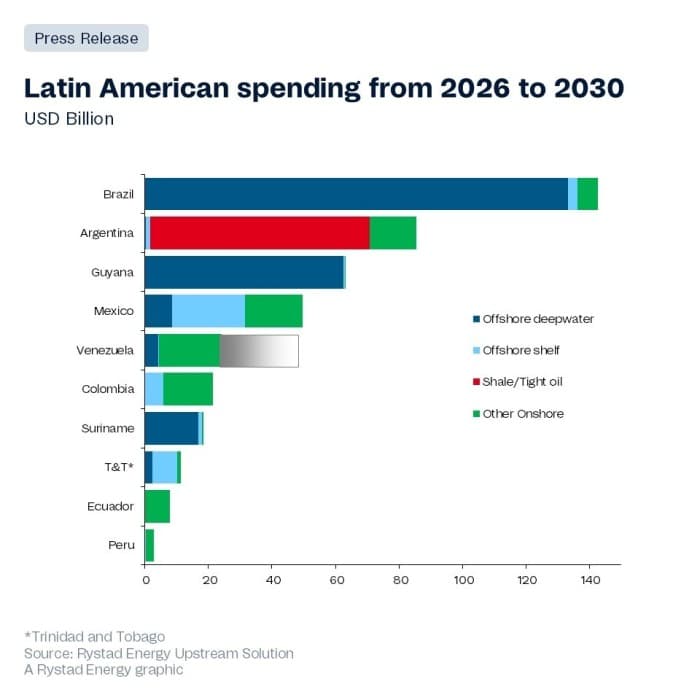
Argentina, Guyana, and Brazil are set to add more than 700,000 bpd in 2026, consolidating their position as Latin America’s oil growth engines.
Venezuela may add short-term supply, but legal risk, heavy crude, and infrastructure decay limit long-term capital reallocation.
Investment is concentrating on shale, pre-salt, and deepwater projects with resilient economics, signaling a fragmented regional oil future.
Argentina, Guyana, and Brazil are poised to lead Latin American oil production growth in 2026, even though the possible return of Venezuelan barrels poses questions for the region’s long-term capital expenditure strategy. While the supermajors continue to flag Venezuela as difficult to underwrite on a long-term basis, traders and players like Trafigura and Hillcorp are increasingly drawn to near-term, structured opportunities in the country, signaling a possible rebalancing of portfolios. Although legal uncertainties persist and institutional legitimacy remains thin, recent reforms, such as the lifting of sanctions and the overhaul of Venezuela’s hydrocarbons law, reinforce US efforts to market Venezuelan barrels. Rystad Energy analysis estimates that flagship projects in Argentina, Guyana and Brazil, which are expected to add more than 700,000 barrels per day (bpd) of oil production this year, will continue to outcompete Venezuela through at least 2030. In the short term, 300,000 bpd of Venezuelan supply could be added to the market, but the likelihood of shifting investment from current Latin American powerhouses to beleaguered Venezuelan infrastructure amid an uncertain business environment remains limited.
A Venezuelan oil industry makeover will be costly and lengthy, with the big three in the region – Argentina, Guyana and Brazil – remaining largely indifferent to the estimated, near-term return of Venezuelan crude. Oversupply, whether from Venezuelan or even Iranian barrels, is what is truly testing the financial resilience of operators who would otherwise gain from a revived oil industry in the Bolivarian Republic.
Radhika Bansal, Vice President, Oil & Gas Research, Rystad Energy
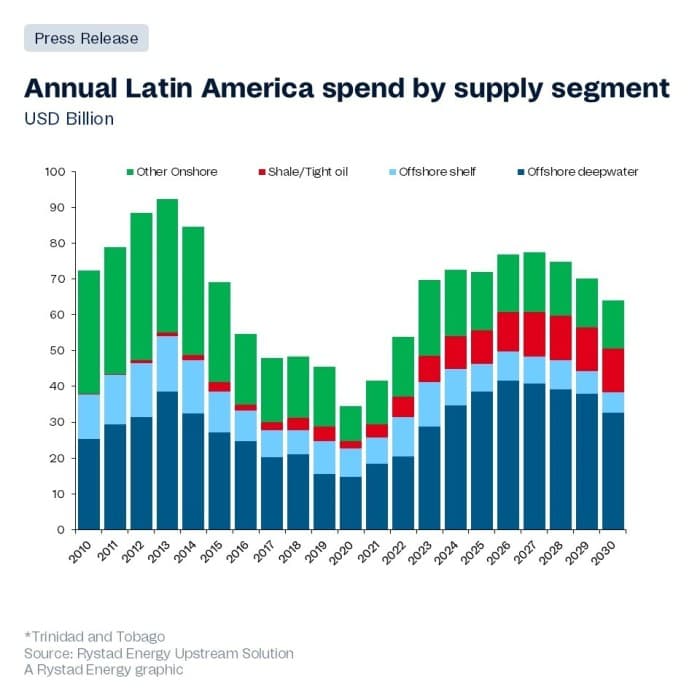
While overall investment in Latin America is expected to increase in 2026, the total volume of conventional reserves put into production will be 45% smaller than last year, signaling a consolidation of investment on projects with nearly guaranteed return on investment (ROI). Final investment decisions (FIDs) were significantly lower in the region last year, and 2026 is expected to be no different. Investment flows will be heavily routed toward greenfield projects in Guyana and Suriname, while Argentina is slated to lead the brownfield investment charge as Vaca Muerta production aggressively ramps up.
Overall, the region’s oil production forecast is expected to exceed 8.8 million bpd this year, driving the majority of non-OPEC+ supply growth and underscoring Latin America no longer moving as a single oil region, with multiple players falling behind as the ‘big three’ dictate its future. Brazil will remain the primary growth engine of 2026, with forecast production exceeding 4.2 million bpd, underpinned by the scale, resilience and cost competitiveness of its pre-salt developments. Brazil’s production growth this year is tied to new floating production, storage and offloading (FPSO) vessel ramp-ups and start-ups.
The true driver of accelerated investment in the region, however, is its shale sector, which is expected to grow from $9.4 billion in 2025 to nearly $11 billion this year, all from Argentina. Additionally, the offshore deepwater sector is expected to drum up $42 billion in investment in 2026, up 7.7% from the previous year. This trajectory has been anchored by strong fundamentals for Vaca Muerta shale and resilient barrels on the pre-salt and on new frontiers in Guyana and Suriname.
As for Venezuela, interest from smaller players is supported by license-enabled access that lowers upfront capital costs, in addition to securing heavy crude feedstock for US Gulf Coast refiners at attractive prices, and the ability for traders to manage the logistics, blending and licensing constraints required to sell Venezuelan barrels. However, projects with long lead times and heavy upfront investments, like offshore Brazil, Guyana and Suriname, remain economically viable in current oil price variations and are anchored by competitive breakeven prices, making these short-term shifts toward Venezuela less consequential. The Vaca Muerta play, although a shorter cycle shale development, has committed to building new infrastructure, so it should also react to Venezuela’s potential comeback with resilience amid declining prices.
Supposing oil demand stays resilient through 2035, and the impact of years-long underinvestment is fully felt, Venezuelan barrels would become far more relevant. If the industry starts making more long term, economically rational choices now, Venezuelan oil production could make sense in a higher oil price environment. However, more attractive barrels will still be at play, with Venezuela’s extra-heavy, emissions-intensive oil posing persistent challenges.
Radhika Bansal, Vice President, Oil & Gas Research
Outside of the big three and in the near term, countries geographically closer to Venezuela may develop a different relationship in an open exploration and production (E&P) market. Trinidad and Tobago, for example, has opportunities to bring Venezuelan offshore gas to supply their liquefied natural gas (LNG) trains. Colombia, on the other hand, could see more competition for capital given the country has little remaining opportunities for oil developments. Colombia could even face labor competition, given the revamp of Venezuela's production would require a specialized workforce available in their neighbor country.
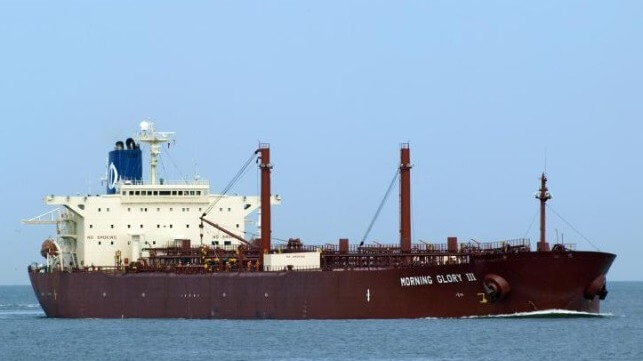
With the resumption of Venezuela's oil trade under U.S. management, shipments from state oil company PDVSA have resumed, including some shipments aboard the same shadow fleet tankers that have carried Venezuelan cargoes for years. Under new orders, some of these vessels are now visiting ports with more stringent PSC inspection regimes, and at least two aging tankers have been detained in Caribbean jurisdictions.
The Caribbean MOU on Port State Control (CMOU) reports that the small tankers Morning Sun and Regina have been detained in Dutch-affiliated jurisdictions, the former in St. Eustatius and the latter in Curacao. NRC, which first reported the development, says that both tankers were involved in delivering Venezuelan oil; Regina had previously carried at least one oil cargo associated with the joint Trafigura-U.S. marketing arrangement, according to the local government.
The detention of Regina could be a setback for Curacao, which wants to become a trading hub for newly-legitimate Venezuelan oil. Curacao prime minister Gilmar Pisas personally welcomed Regina's arrival on the tanker's first visit to the island, reflecting the value that his administration places on the Venezuelan oil trade. But if the jurisdiction's inspectors strictly enforce regulations, many aging shadow fleet vessels will not be able to call at its oil terminal.
Regina's problems extend beyond the usual PSC deficiencies. She arrived falsely flying the flag of East Timor, which does not have an international shipping registry. East Timor has previously asked port states to investigate vessels claiming to fly its flag. An investigation into the circumstances of the vessel's condition and flagging is under way.
Meanwhile, in St. Eustatius, Dutch officials have detained the product tanker Morning Sun for inspection deficiencies. Morning Sun is a 1996-built tanker declaring the flag of Panama; her last PSC inspection outside of Venezuela was in 2018, and the record shows that inspectors found issues with her fire doors, fire pump, and hatchway watertightness, among other items. The officials in St. Eustatius confirmed to NRC that on this inspection, they found too many deficiencies to allow the ship to sail.
Tankers from the "clean," non-shadow fleet have begun calling in Venezuela at scale, arriving on charters for American and European buyers. The experience of Morning Sun and Regina could accelerate Venezuela's transition to the use of tanker tonnage that can pass muster in a Western seaport, rather than aging shadow fleet vessels that make STS transfers in low-enforcement jurisdictions.


No comments:
Post a Comment