Showing posts sorted by date for query WCC. Sort by relevance Show all posts

Friday, September 26, 2025

Researchers find benefit in routine asthma screening in communities with high asthma prevalence


Study findings will be presented during the American Academy of Pediatrics 2025 National Conference & Exhibition


American Academy of Pediatrics


DENVER —Researchers were able to identify more patients with asthma in specific communities by screening all children during routine wellness visits and asking about potential home environmental triggers, according to new research.

The authors of an abstract, “Screening for Asthma and Related Environmental Risks in a High-Risk Pediatric Populations: A Descriptive Analysis of Universal Screening,” will present their findings during the American Academy of Pediatrics 2025 National Conference & Exhibition at the Colorado Convention Center Sept. 26-30.

Authors identified a community that already showed a high prevalence of asthma cases and started universally screening all pediatric patients.

“Although common in children and with significant morbidity, asthma is highly treatable if diagnosed early and approached with a holistic lens that includes identifying and addressing environmental triggers,” said study author Karen Ganacias, MD, MPH, MedStar Health pediatrician and assistant professor of pediatrics at Georgetown University School of Medicine. “In populations with high asthma prevalence, routine screening for asthma symptoms and modifiable home environmental triggers can be an important first step to improving outcomes and decreasing disparities.”

Asthma is often underdiagnosed, particularly in children, and ongoing research is being conducted to identify environmental triggers in the home, such as mold, rodents or roaches.

The MedStar Health Kids Medical Mobile Clinic (KMMC) designed and integrated an Asthma Risk and Control Screen (ARCS) that evaluated 650 children ages two and older who had at least one well child visit between January 2021 and December 2024. Of that, 35% of individuals with no previous diagnosis of asthma reported at least one asthma risk factor, and 24% of those individuals were subsequently diagnosed with asthma based on further clinical findings.

Those who screened as positive for asthma reported coughing or shortness of breath at night, previous use of an inhaler, or exercise intolerance due to difficulty with breathing.

The study also found a high prevalence of poor housing quality in children in this population, about 41%, even higher, at 52%, for those that screened positive on the asthma symptom screen. The clinic has since developed a partnership with a home visiting program to remediate environmental triggers for children with asthma, as well as a medical-legal partnership to help advocate for safe and healthy housing.  

The authors observe that children with asthma are more likely to miss school days, participate less in activities and sports, and have irregular sleep.

“Asthma is often diagnosed late or not at all because parents may not think of certain symptoms such as night-time cough or needing to stop activity to catch your breath, as being related to asthma,” said study author Janine A. Rethy, MD, MPH, division chief of Community Pediatrics at MedStar Health and associate professor at Georgetown University School of Medicine.

“There are also many environmental triggers in the home that may contribute to these symptoms and which a pediatrician should know about to help understand triggers and incorporate into a treatment plan. This study can open the conversation for screening for asthma and related environmental triggers for all children, especially when there is a high prevalence of asthma in the community.”

The authors did not receive financial support for this research.

Dr. Ganacias will present the research from noon- 1 p.m. MDT Monday, Sep. 29, 2025, during the session hosted by the Council on Environmental Health and Climate Change Program in the Colorado Convention Center, Four Seasons Ballroom 1 & 2. To request an interview with the authors, contact Brendan Mcnamara at Brendan.T.Mcnamara@medstar.net.

In addition, Dr. Ganacias will be among highlighted abstract authors who will give a brief presentation and be available for interviews during a press conference from noon-1:30 p.m. MDT Saturday, Sept. 27, in the National Conference Press Room, CCC 705/707. During the meeting, you may reach AAP media relations staff at 303-228-8338.

Please note: only the abstract is being presented at the meeting. In some cases, the researcher may have more data available to share with media, or may be preparing a longer article for submission to a journal. 


# # #


The American Academy of Pediatrics is an organization of 67,000 primary care pediatricians, pediatric medical subspecialists and pediatric surgical specialists dedicated to the health, safety and well-being of infants, children, adolescents and young adults. For more information, visit www.aap.org. Reporters can access the meeting program and other relevant meeting information through the AAP meeting website at http://www.aapexperience.org/


Program Name: 2025 Call for Abstracts

Submission Type: Council on Environmental Health and Climate Change

Abstract Title: Screening for Asthma and Related Environmental Risks in a High-Risk Pediatric Populations: A Descriptive Analysis of Universal Screening

Karen Ganacias

Washington, DC, United States

Asthma remains a significant cause of morbidity, health care utilization and cost in the United States and is associated with long term health outcomes. 1,2, Early recognition and intervention of asthma exacerbations are crucial to prevent the progression of asthma to severe stages.3 However, asthma is often underdiagnosed, particularly in children, and ongoing research is being conducted to identify predictive symptoms and factors for identifying children at risk for asthma. 3 In addition, environmental exposures that could trigger asthma-like symptoms in pediatric populations needs to be further investigated.4 The Kids Medical Mobile Clinic (KMMC) designed and integrated an Asthma Risk and Control Screen (ARCS) to identify patterns of symptoms associated with potential undiagnosed asthma in an urban patient population with known high prevalence.4,5,6 Home environmental risk is assessed using a question included in the KMMC Social Determinant of Health Screening, universally administered at each WCC. The objective of this study is to assess the prevalence of previously unrecognized asthma and to identify associated home environment risks.

The ARCS was integrated into universal screening on the web-based TONIC platform in January 2021. The study included unique children 2 years and above who had at least one WCC between January 2021 and December 2024. For ARCS, a positive screen included reporting coughing or shortness of breath at night, previous use of an inhaler, and exercise intolerance due to difficulty with breathing. Asthma diagnoses were based on ICD-10 codes in the chart either prior to or on/after date of the ARCS. The home environment screen is positive if answered “yes” or “maybe” to having seen mold, bugs, mice, rats, peeling paint or water leaking.

650 unique individuals completed the ARCS. 17.7% had a previous ICD10-diagnosis of asthma. 35% of individuals with no previous diagnosis of asthma reported at least one asthma risk factor. 24% of those individuals were subsequently diagnosed with asthma based on further clinical findings, which represented 7.8% of children screened. 38% of those individuals who had a prior diagnosis of asthma also reported yes to home environment risks. 52% of those individuals who reported asthma symptoms, but did not have a diagnosis of asthma reported yes to poor housing quality (Table 1).

Routine screening for asthma symptoms in a population with high prevalence can improve diagnoses. There is a high prevalence of poor housing quality in children with asthma, even higher with underdiagnosed asthma. Early diagnosis and appropriate management, that also addresses environmental triggers is needed for optimal treatment of high-risk populations. In answer to this, our team has developed a collaborative partnership with a community organization that does home-visiting, environmental evaluations and provides education, mold and pest remediation and advocacy.

Table 1Results of universal screening for asthma symptoms and poor housing quality in a population with high prevalence


Wednesday, September 24, 2025

Thinking Beyond the Bars: How Higher Education Helped Me Develop Confidence in Myself and Rediscover My Humanity


Ambitious young people are told that a college degree is necessary to launch a successful career. For me — a “lifer” taking courses from my cell in a state prison — higher education isn’t about job preparation but rediscovering my humanity, about learning to think beyond the bars.

I’m not the first person to discover the power of education while incarcerated, but I feel a responsibility to tell this story, not only to reach other prisoners but for all the people who feel left behind by educational institutions. There have been a lot of obstacles between me and higher education — times I didn’t believe in myself and times when institutions didn’t believe in people like me — but I have learned that no one has to settle for that.

Let me start with a stereotype of young Black men — that they think excelling in school is for nerds, not for tough guys on the street. That doesn’t describe all Black boys, of course, but it was true of the guys I ran with. I had loved learning when I was younger, but a combination of institutional failures and peer pressure knocked me off that path. I regret giving up so easily, which was reinforced by a school system that didn’t seem to care much about Black children. I ended up in that “school-to-prison pipeline” for the poor and marginalized.

A series of bad choices as a young adult led to my current residence in the Washington Corrections Center, serving a life-without-parole sentence. While incarcerated, I became a “better late than never” enthusiast for higher education.

But the prison system hasn’t made that easy. The tough-on-crime politics of the 1990s produced the federal Violent Crime Control and Law Enforcement Act in 1994, which eliminated almost all financial aid to prisoners. (It was only in 2023 that prisoners once again became eligible for Pell Grants.)

In 1995, Washington state passed a law that prohibited public funding to support higher education for prisoners beyond adult basic education and the General Education Diploma (GED). Prisoners who had been sentenced to life without the possibility of parole were denied access to more than one post-secondary degree, unless it was pre-vocational or vocational training was needed for their work in prison. The legislation was supposed to eliminate “unnecessary” spending by the Department of Corrections. (That law was partially repealed in 2017, allowing some funding up to two-year degrees.)

Tough-on-crime laws — including “Three Strikes, You’re Out” and “Hard Time for Armed Crime” — led to larger prison populations in Washington state and around the country. Access to education was not a priority, and budget cuts after the 2008 recession led the Department of Corrections to prioritize education for prisoners with less than seven years on their sentence. The rest of us were out of luck.

Don’t ask me to explain how that fits with the rehabilitation mission of prisons — people who are incarcerated know the gap between that rhetoric and the reality of warehousing prisoners. That’s why incarcerated people have done much of the work themselves, one of the most exciting aspects of my experience.

My introduction into higher education began in 2015 through my experience with the TEACH program (Taking Education and Creating History) at Clallam Bay Corrections Center, another prison where I was incarcerated. TEACH was created in 2013 by the Black Prisoners Caucus to address the educational disparities that exist within the prison system for minority, long-term, and undocumented prisoners.

That experience helped me rediscover my humanity.

At that facility, we had a healthy working relationship with prison officials, who gave us classroom space. Through TEACH, we were able to develop and facilitate the courses we needed. We understood that the educational system had left most of us behind, and I learned that some of us came with life experiences and credibility that some of the most decorated professionals did not have.

But we couldn’t deepen our knowledge from experience without help. TEACH leaders established a relationship with Peninsula College and Seattle Central College. For me, getting ready for college-level study took some work.

Before I could start taking college courses, I needed to earn certificates in college-prep math and anger management. After the completion of those two nine-week courses, I took African American studies, a parenting class, and college-prep writing. Then I felt ready to take my first college course through Seattle Central. That sociology class required a lot of writing, which was intimidating at first, but I loved what I was learning, and that course showed me that my experience was shaped by larger social forces.

At the beginning of my college journey, I was uncertain of my ability, an insecurity rooted in so many bad experiences in school. But TEACH had helped me believe in myself, teaching me not to accept the limits of the bars I lived behind, and eventually I was able to start giving back to the program. I was given a chance to facilitate the stress and anger-reduction class I had taken, which led to me joining the program’s board at Clallam Bay. After being transferred to Washington Corrections Center, I was elected vice chair of the program when it was brought to that prison in 2018.

As I worked with the program, I learned my experience was not unusual.

I talked with Taking Education and Creating History) at Clallam Bay Corrections Center a prisoner-student who went on to create and facilitate a sound and song-production course at WCC, which taught prisoners to play and create songs on a keyboard. He said that initially he wasn’t sure he could teach a class, let alone one that he created. TEACH helped him gain the confidence he needed, encouraging him to teach the course the way he thought best. More prisoners sought his expertise, deepening his confidence.

Dwuan Conroy, another TEACH student, said that in addition to the direct benefits for him, the funding for this program took the burden off his wife and family to pay for his education. And when he is released, his enhanced ability to set goals and meet deadlines means that he’ll have a chance at better paying jobs. And, he said, it shows his family that he is making the changes needed to be a better man.

Unfortunately, six months later Mullin-Coston’s sound course was canceled, because it was “not serving a facility need.” That is an example of short-sighted decision-making. If we care about rehabilitation, any learning that creates a positive environment and promotes healthy interactions among prisoners should be seen as a crucial facility need.

The COVID pandemic also created obstacles, shutting down the WCC TEACH partnership with Centralia College and Seattle Central. Conroy was enrolled in courses in biology, anthropology, and English, but lockdowns meant that formal classes were canceled. With little help available from teachers and staff, he said, the prisoner-students relied on each other to finish courses.

“It was these interactions with other prisoners that helped me through the course work despite my learning disabilities,” Conroy said. ”Knowing I had others around in TEACH that could help me through it and not judge, that empowered me to continue my focus during such a difficult time.”

Once the college’s staff members where allowed back into the prison, it was clear that our peer-support work had been crucial in keeping us on track, and 10 students graduated in the fall of 2023.

Taxpayers and politicians who prioritize punishment over rehabilitation may not care about how education enhances prisoners’ mental health and intellectual development. Once again, that’s short-sighted, because education also reduces recidivism. For every dollar spent on education programs, four dollars are saved on re-incarceration costs. One study showed that prisoners who complete some high school courses have a recidivism rate of 55 percent. Vocational training cuts recidivism to 30 percent, an associate degree to 13.7 percent, and a bachelor’s degree to 5.6 percent. A master’s degree brings the recidivism rate down to zero,

Prison education is not a frivolous expense for society but instead an essential investment in human beings. Education reduces conflict among prisoners. Communities are safer when educated and empowered prisoners return home.

As for me, I need two classes to earn my associate degree, after which I want to pursue a bachelor’s degree in behavioral health, and perhaps a master’s degree someday. I still live behind bars. But developing my mind has helped me find the humanity in myself and see more clearly the humanity in others as well.FacebookTwitterReddit

Darrell Jackson is a member of the Black Prisoners Caucus, Co-Chair of T.E.A.C.H (Taking Education and Creating History), and a writer through Empowerment Avenue. He is a student, mentor, and social justice advocate, who is currently serving a life without the possibility of parole sentence at Washington Corrections Center in Shelton, Washington. He can be contacted at securustech.net. Darrell Jackson#329268 and can be found on X @DKJackson20. Read other articles by Darrell.


Suspending Courses, Washing Delicates, and Baking: A University Justifies Harming Staff
and Students

These people are a charming, lynch worthy bunch. In claiming they are short of cash, the managerial dunderheads at the University of Technology Sydney thought it prudent to throw A$4.8 million at the tax consultants KPMG to design what it calls the Operational Sustainability Initiative (OSI). The linking of these three words alone suggests that something sinister and inhumane is afoot, a program closer to an assassination or disposal program than a sensible readjustment. Indeed, the OSI became the subject of a “notice to give information” in June from Safework NSW, accusing the university of “wilful and negligent mismanagement” of the restructuring undertaking “despite full knowledge that the process is causing significant psychological harm to staff, including documented instances of suicidal ideation, anxiety, and depression.”

The university, as reported in The Australian Financial Review in May, was hoping to give a savage pruning to the institution’s budget to the value of A$100 million. This initially involved the sacking of 400 staff members, a proposal cooked up even as five senior UTS executives travelled to the United States on an alumni trip worth A$140,000. That financially minded paper also wondered why UTS ended up using KPMG “instead of its own staff to design this plan” in an adventurously asinine contract stuffed with such terms as “leveraging solutions”, “acceleration of value”, and “decision trees”. (Meaningless terms suggest a mind without meaning.) KPMG crows in convoluted ecstasy about a “six-layer framework for target operating model design”. No wonder the technocrats were so wooed by it all.

The suggested program from the firm was ordinary and, as with most products arising from such an organisation, prosaic. It could have just as easily been done by clumsy butchers with a plagiarised MBA. KPMG produced spreadsheets dealing with courses and subjects that might be offered in future, which ones deserved to be confined to oblivion and what areas of research warranted interest as opposed to those that did not. Just to confirm the firm’s almost awe-inspiring lack of expertise, it was also called upon to examine “current and future state teaching capacity”.

Part of the tool kit of advice developed by KPMG to staff most likely heading for the chop developed into a ragbag of nonsense and piffle: to stay mentally sound, best wash delicates with your hands. Try to take up baking, because that is what a disturbed mind awaiting imminent suffering needs. Keep a gratitude journal. Make sure to brush and floss your teeth, because you obviously did not do that before a consultancy firm hired by a university told you to do.

There is every reason to suppose that ChatGPT could have come up with the same, risible nonsense, saving the shameful creeps in management some cash. But sound reasoning is not a prerequisite to those rising up the greasy towers of technocracy in learning institutions, let alone any other institution. Incompetence is often essential, while talent and ethical worth are impediments best done away with.

The vice-chancellor of the university is very much short of parfit, though sports the name Andrew Parfitt. He is adamant that no decisions have been made on job losses or the discontinuing of any courses which, knowing the pattern of university practices, is precisely the opposite of what will happen. “The temporary suspension is aimed at prospective new students for 2026.” This is the sort of shoddy reasoning we have come to expect from the vice-chancellorship and any number of university proconsuls and viceroys that suck the lifeblood out of education. Ella Haid, spokesperson of the UTS Students Association General Councillor and Stop the Cuts UTS, is hard to fault in her assessment on this: “We should be clear that management is doing this because they’re pursuing a hefty financial surplus. They’ve no interest in seeking student or staff consultation on this major restructure.”

The response from UTS to reports, notably by the ABC, was one of dastardly fudging, oily manoeuvring and sickly denial. Rather than admitting to blunder, organisational insensitivity, and being outed, it attacked the national broadcaster for its reporting in a statement. “We are disappointed that the ABC reported that these comprehensive support initiatives were only rolled out as a result of their reporting.”

The reports, claimed the university, had ignored context. “By focusing on just six dot points from a single article on an external wellbeing hub comprising extensive, differentiated resources, the ABC chose to portray this as being representative of the tone, intent and totality of support provided to UTS employees.”

The parasitic problems associated with university management have become critically colossal. Being unable to exist without attachment to the authentic university, that pulsing, thriving organism of cerebration sustained by students and research, the leadership of such bodies continues to make decisions that harm academic staff and any chance of a rich learning experience for students. (A survey from the National Tertiary Education Union of 380 respondents from UTS found that 35% had experienced high levels of psychological distress from the OSI endeavour.)

That harm is then justified through cringeworthy programs of “wellbeing” and assistance, their very existence intended to exonerate the misdeeds of culprits who shamelessly engender an environment of emotional and intellectual terrorism. They create the bullets, use them, and drag out the psychological bandaging to conceal the wounds.

Should courage ever be mustered by cowed academics and the atomised student body, the cosmos of the vice-chancellor and those complicit in sustaining it can finally be terminated with little sorrow and much relish.

Binoy Kampmark was a Commonwealth Scholar at Selwyn College, Cambridge. He lectures at RMIT University, Melbourne. Email: bkampmark@gmail.comRead other articles by Binoy.

Tuesday, September 02, 2025

Govt gestures leave roots of Indonesia protests intact

Jakarta (AFP) – Government gestures to calm deadly protests in Indonesia have done little to address the economic inequality and hardship fuelling the unrest, leaving deep resentment to linger and flare up again, experts say.


Issued on: 02/09/2025-RFI

Demonstrators set alight banners as they shout slogans during a protest demanding police reform in Indonesia © Timur Matahari / AFP

The country's worst violence in decades left at least six people dead and 20 missing, with rallies over lavish perks for lawmakers descending into angry riots against police after officers were filmed running over a young delivery driver.

Southeast Asia's biggest economy recorded a surge in growth in the second quarter of the year on the back of manufacturing and export demand, which President Prabowo Subianto hailed, but everyday Indonesians are not seeing the data reflected in their wallets.

Instead they view a corrupt political class enriching itself and failing to listen to the public, while inequality grows between the rich and the poor, experts said.

"This is caused by economic issues. Some economic policies left the public quite annoyed or even angry," said Nailul Huda, economist at the Center of Economics and Law Studies (CELIOS).


"If economic growth is true, it will be felt by the lower-class society. Terminations are everywhere, and layoffs have increased up to 30 percent, which is quite high," he added.

Lavish benefits for lawmakers including a $3,000 housing allowance, which is nearly 10 times the minimum wage in the capital Jakarta, stirred the initial anger in protests last week before the driver's death.

University students block a road during a demonstration in Indonesia
 © DEVI RAHMAN / AFP


The protests made Prabowo and parliament leaders U-turn and offer to revoke some perks, including issuing a moratorium on overseas visits.

But their moves have likely not gone far enough to address the underlying grievances of the wider public.

"The government appears insensitive to these concerns," said Nailul. "This has become the root of the administration's problems over the past four days."

Rising anger against the elite has manifested itself in looting, including the homes of several politicians.

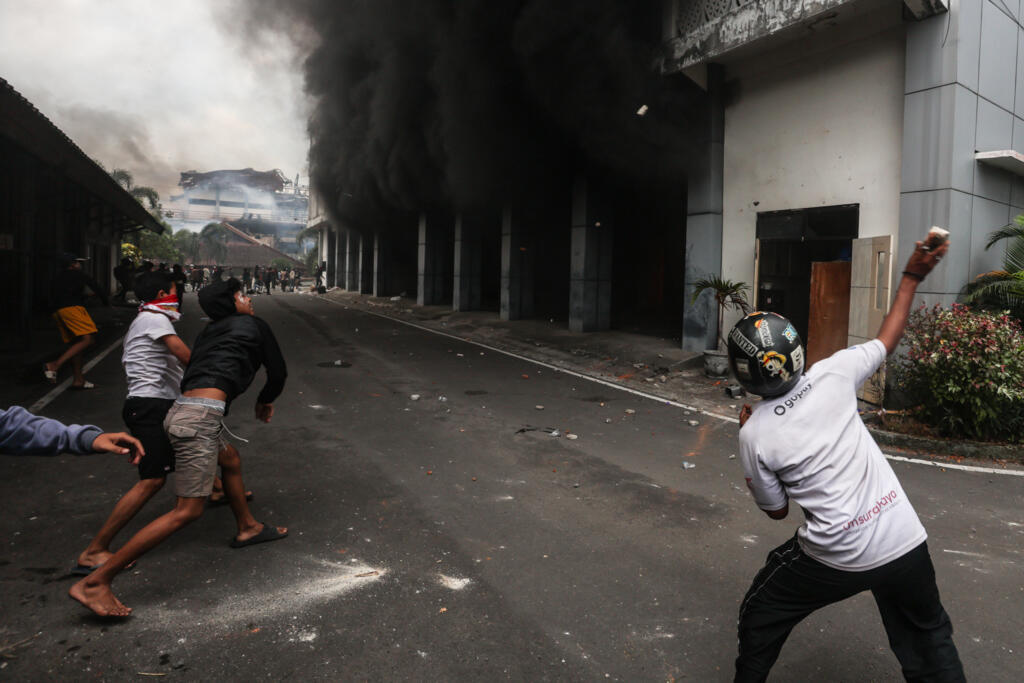
It has not been confined to capital Jakarta either, with local and provincial council buildings set on fire or attacked with rocks and Molotov cocktails in cities across the country.

'Govt fails to deliver'


Prabowo had already faced smaller protests in February over widespread budget cuts to fund populist policies, including a billion-dollar free meal programme and new sovereign wealth fund Danantara.

"The budgets that were supposed to be utilised by other sectors are being diverted to popular programmes which most likely still have many problems," said Jahen Fachrul Rezki, an economic researcher at the University of Indonesia.

Around 42,000 people were also laid off between January and June, a 32 percent rise on last year, according to the Ministry of Manpower.

"It might be true that our economy is expanding, but who's benefiting from the growth? Probably just capital owners," Jahen said.

A cost-of-living crisis is being felt by many as the country struggles with a shrinking middle class and slower income growth compared to rising prices because of inflation, according to Jahen.

"The government claimed that we have an increase of rice supply, but it is not reflected in the price," he said.

According to Statistics Indonesia on Monday, the price of the staple good increased by more than six percent on last year.

The number of people living below the poverty line in metropolitan Jakarta -- a megalopolis of around 11 million people -- was up from 362,000 in 2019 to 449,000 as of September 2024, government data says.

"The government initially promised during the campaign that there would be job opportunities, education, and no more layoffs," said Nailul. "But the government fails to deliver."

'A matter of time'


One of Prabowo's early moves was to announce Indonesia would hike its value-added tax to 12 percent, before reversing after a backlash and saying it would only apply to luxury goods.

Protesters throw stones at a local council building on Lombok island 
© STR / AFP


"It is neither feasible nor wise for the government to raise VAT rates when people's purchasing power is declining," said Nailul.

The death of the delivery driver, Affan Kurniawan, also stoked anger because workers like him have faced bigger pay deductions and longer working hours due to the economic situation.

Such conditions mean many Indonesians will still feel the economic pain in the coming months, leaving the door open for fresh protests.

"The protests on the streets probably will come down in the next few days, but it's just a matter of time until public anger resurfaces again," said Ray Rangkuti, political analyst at think tank Lingkar Madani.

"Because we're not addressing the issues, we're just covering them up," Rangkuti added.

© 2025 AFP


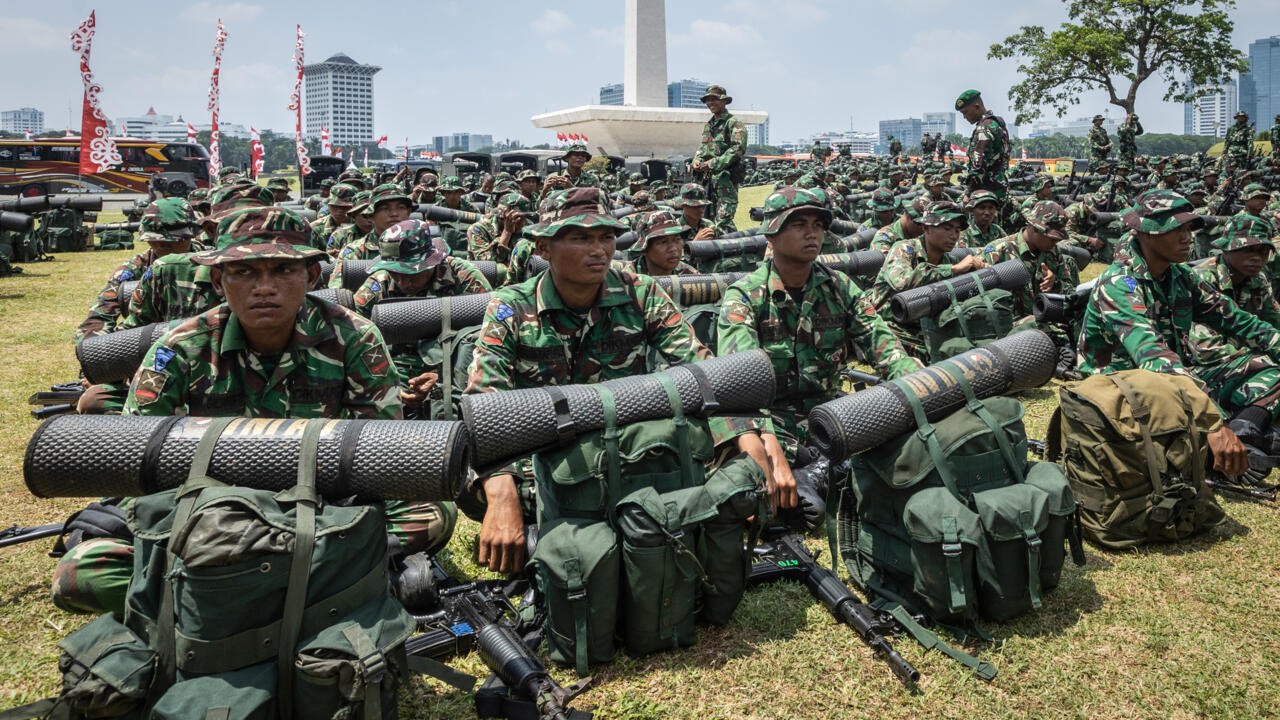
Military deployed in Indonesia's capital as thousands protest lavish perks for lawmakers

The military were deployed in Indonesia's capital, Jakarta, on Monday as thousands of demonstrators took to the streets across the country to take part in increasingly volatile protests against lavish housing allowances for MPs. Six people have been killed since the demonstrations began over a week ago, with protestors calling for parliamentary reform.


Issued on: 01/09/2025 -
By: FRANCE 24


Indonesian soldiers wait for orders in Jakarta as hundreds protested outside parliament.
 © Kristianto Purnomo, AFP

Thousands rallied across Indonesia Monday as the military was deployed in the capital after six people were killed in nationwide protests sparked by anger over lavish perks for lawmakers.

At least 500 protesters gathered outside the nation's parliament in Jakarta, watched by soldiers and police throughout the day, before dissipating after President Prabowo Subianto warned protests should end by sundown.

But elsewhere protests were more volatile. In Gorontalo city on Sulawesi island protesters clashed with police, who responded with tear gas and water cannon, according to an AFP journalist. In Bandung on the main island Java, protesters hurled Molotov cocktails and firecrackers at the provincial council building.

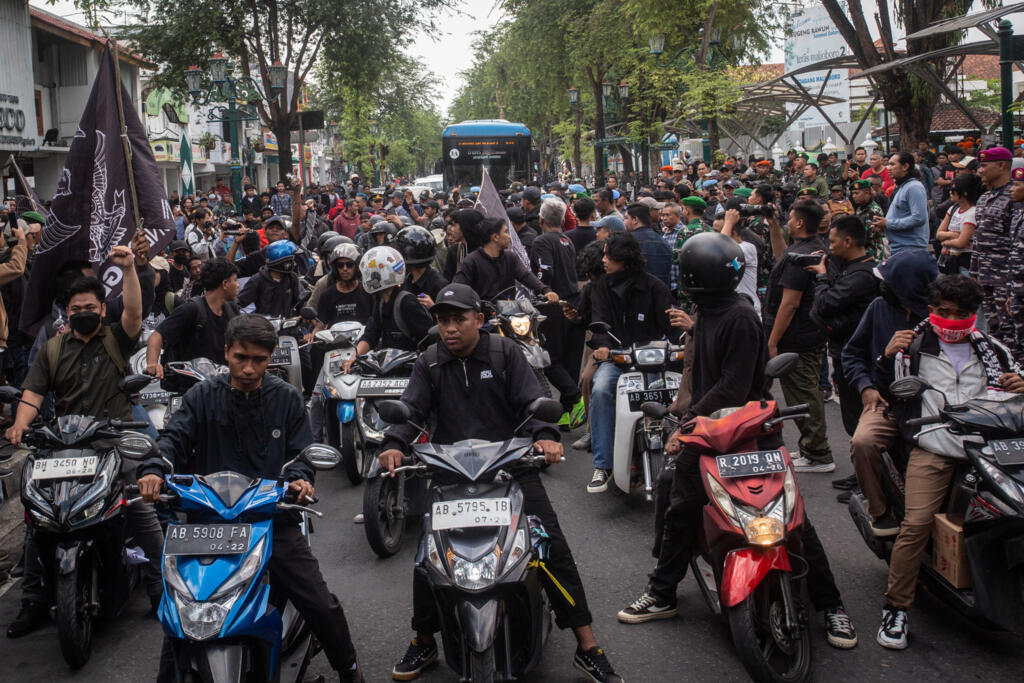
Thousands more rallied in Palembang on Sumatra island and hundreds gathered separately in Banjarmasin on Borneo island, Yogyakarta on the main island of Java and Makassar on Sulawesi, according to AFP journalists around the country.

"Our main goal is to reform the parliament," protester and university student Nafta Keisya Kemalia, 20, told AFP outside parliament before the protest ended.

"Do they want to wait until we have a martial law?"

The deadly protests, which began last week over MP housing allowances nearly 10 times the minimum wage in Jakarta, have forced President Prabowo Subianto and parliament leaders to make a U-turn over the perks.

Demonstrations began peacefully, but turned violent against the nation's elite paramilitary police unit after footage showed one of its teams running over 21-year-old delivery driver Affan Kurniawan late Thursday.

Protests have since spread from Jakarta to other major cities, in the worst unrest since Prabowo took power less than a year ago.

Police set up checkpoints across the capital on Monday, while officers and the military conducted city-wide patrols and deployed snipers in key locations, while the usually traffic-clogged streets were quieter than usual.

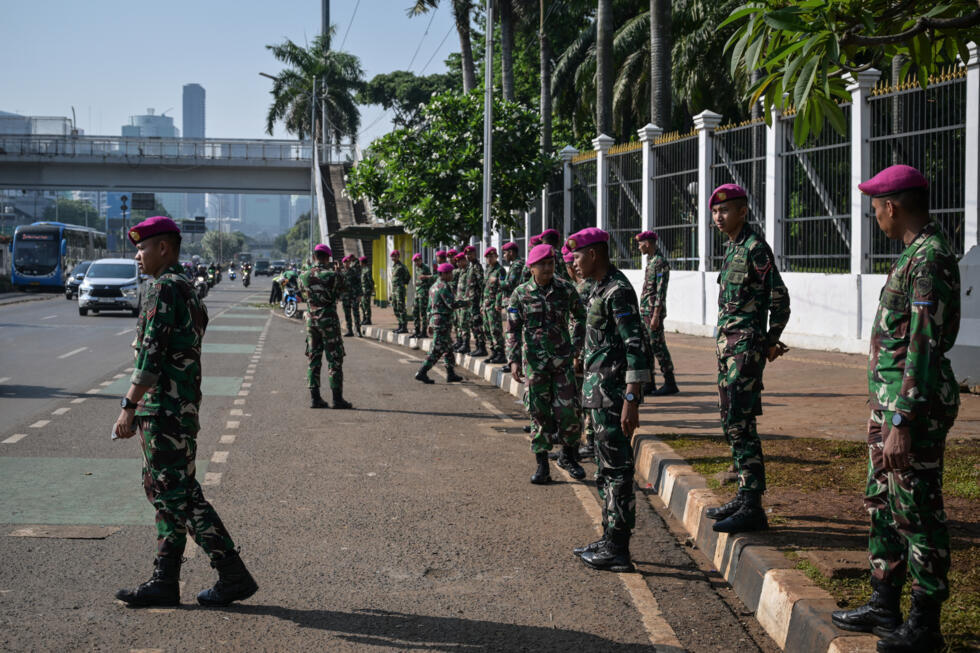
Marines secure positions along a street outside the parliament in Jakarta
 © Bay Ismoyo, AFP

At least one group, the Alliance of Indonesian Women, said late Sunday it had cancelled its planned protest because of heightened security.

Schools and universities in Jakarta were holding classes online until at least Tuesday, and civil servants based in the city were asked to work from home.

On Monday Prabowo paid a visit to injured police at a hospital where he criticised protesters.

"The law states that if you want to demonstrate, you must ask for permission, and permission must be granted, and it must end at 6pm," he said.
Looting

Experts said Prabowo's U-turn in a speech on Sunday and parliament's gesture to revoke some lawmaker perks may not be enough to dispel the unrest.

"The Indonesian government is a mess. The cabinet and parliament will not listen to the people's pleas," 60-year-old snack seller Suwardi, who like many Indonesians goes by one name, told AFP near parliament.

A car burns after being set ablaze during a protest against the Mobile Brigade Corps, or 'Brimob' in Jakarta. © Aditya Aji, AFP


"We have always been lied to."

The Indonesian stock index fell more than 3 percent at the open on Monday after the weekend unrest rattled markets.

Deep-rooted anger against police drove protests on Friday after footage of the van hitting Affan went viral. Seven officers were detained for investigation.

On Monday Agus Wijayanto, head of the accountability bureau at the National Police, told reporters an investigation had found criminal acts committed by two officers – the driver of the van and the officer next to him.

They "could be dishonourably discharged", said Agus.

The crisis has prompted Prabowo to cancel a trip to China this week for a military parade commemorating the end of World War II.


Protests have spread beyond Jakarta to cities across Java and other islands.
 © Juni Kriswanto, AFP

In recent days the finance minister's house was pillaged and several lawmakers have reportedly had their houses ransacked.

At least three people were killed after a fire Friday started by protesters at a council building in the eastern city of Makassar, while a fourth was killed by a mob in the city in a case of mistaken identity. Another confirmed victim was a student in Yogyakarta, who died in clashes.

In anticipation of further unrest, TikTok on Saturday suspended its live feature for "a few days" in Indonesia, where it has more than 100 million users.

(FRANCE 24 with AFP)


Prabowo: Stop State Violence, Revoke Parliamentarians’ Facilities and Allowances, End Repression Against Mass Action, Provide Justice for Victims

Statement of Position by the Indonesian Women’s Alliance (API)


Sunday 31 August 2025, by Indonesian Women’s Alliance (API)


The death of Affan Kurniawan, an online motorcycle taxi driver who participated in mass action and was run over by security apparatus vehicles, cannot be viewed as an isolated incident. This event is part of the face of systematic state violence; the apparatus is used to silence the people’s voices with impunity that continues to be allowed.


Today’s wave of popular anger is an accumulation of disgust over reckless policies and the arrogance of state officials. Basic commodity prices are rising, taxes are increasingly strangling, unemployment queues continue to grow, mass redundancies, seizure of customary lands, children victims of MBG poisoning. [1] When the people bear the suffering caused by the state, instead of showing empathy, DPR [2] members who are supposedly people’s representatives, together with officials, are instead having lavish parties in luxury, enjoying allowances, facilities, and soaring salaries. Not only that, the DPR and government also give awards to relatives and colleagues, even allowing officials to hold concurrent positions as BUMN [3] commissioners with abundant facilities.

In the field, people who dare to voice their disappointment and anger are instead faced with brutal repression from the state apparatus. Hundreds of people are arbitrarily arrested, beaten, and treated inhumanely. Tear gas is fired indiscriminately, even directed at places of worship and medical teams carrying out humanitarian duties. This situation not only threatens the safety of action participants, but also shows how the apparatus abandons its basic obligation to protect civilians. Women and students who are at the forefront of action are also not spared from violence; they experience intimidation, beatings, and discriminatory treatment simply for daring to express their opinions. All these repressive actions confirm that the state prefers the path of violence rather than opening democratic dialogue space.

The face of state violence is also visible in many regions: the transfer of Papuan political prisoners to Makassar, [4] agrarian and natural resource conflicts in Rempang, [5] Sulawesi, North Maluku, to the expanding military territory in civilian areas. The state chooses a violent approach rather than opening dialogue space with the people.

This reflects the characteristics of Prabowo’s government which is very militaristic, anti-women, and not pro-people. Prabowo [6] as the person responsible for governance perpetuates a culture of violence by adding battalions, kodams, [7] kodims, [8] and so forth to build defensive fortifications to crush people’s resistance demanding justice and to smooth the way for National Strategic Projects. Prabowo, with his empty efficiency rhetoric, chooses to suppress budgets related to people’s welfare and instead increases allowances for the DPR that does not perform its duties properly. When people protest, Prabowo is busy distributing honorary stars including to former corruption convicts.

This condition is a political and humanitarian crisis! The state that should protect is instead harming. The DPR that should represent and voice the people’s interests has instead become part of the oppression machine. Indonesian democracy is increasingly wounded!

Today the state is no longer ashamed to display the silencing of democracy. Sadistic and brutal repression is carried out openly, targeting people who voice loud rejection of discriminatory policies. The state continues to widen the gap of social and economic inequality with various policies that are not pro-people and have adverse impacts on the lives of women, disability groups, indigenous peoples, and vulnerable groups.

Therefore the Indonesian Women’s Alliance demands:

Prabowo must be held responsible for all violence against the people!
Justice for Affan Kurniawan and all victims of apparatus violence.
Remove the National Police Chief and Regional Police Chiefs for failing to make POLRI [9] an institution to perform the function of maintaining public security and order, enforcing law and maintaining protection and service to the community.
Release the names of apparatus perpetrators, monitor the legal process to completion, and stop impunity for human rights violators.
Comprehensive Police reform.
Eliminate the militaristic culture full of violence.
Stop the use of weapons, tear gas, war equipment and other tools against the people.
Stop the use of violence or unfounded arrests against mass action, students, women, indigenous peoples and vulnerable groups.
Revoke excessive facilities and allowances for DPR and state officials.
Revoke special facilities for DPR and state officials.
Open dialogue space by meeting and accommodating people’s voices in all regions.
Dismiss DPR members who do not carry out the constitutional mandate.
Reform taxation policies.
Stop tax increases that increasingly burden the people without considering the socio-economic conditions of society, especially vulnerable groups.
Open transparency to the public on the use of state budget allocation from taxes.
Stop oligarchy and the practice of holding multiple positions.
Reject the practice of state officials holding concurrent positions in BUMN.
Create a transparency portal so the public can monitor officials’ salaries and allowances.
Stop repression and open democratic space.
Support media independence to report facts without intervention.
Stop blocking and wiretapping on communication platforms and social media.
Stop criminalisation and violence against people who dare to speak out.
Evaluate government programmes and performance as well as ministry bureaucracy that does not side with the people, is not thorough in realising pro-people policies, does not function in preventing human rights violations that are actually committed by state institutions whilst consuming the state budget.

Therefore We, the Indonesian Women’s Alliance, state our position:

Demanding President Prabowo Subianto’s responsibility for the continuing state violence.
Strongly condemning repressive actions by the apparatus and demanding full justice for victims.
Urging the DPR as servants of the people to work according to the constitutional mandate, not to enrich themselves with excessive allowances and facilities.
Rejecting problematic programmes and projects that drain the APBN [10] without providing real benefits to the people.
Rejecting impunity and bringing to justice perpetrators of Human Rights violations.
Demanding unconditional release for mass action participants detained throughout Indonesia.

Together with the Indonesian Women’s Alliance:

Aliansi Perempuan Bangkit
Aneta-Papua
Artsforwomen Indonesia
Arus Pelangi
Asosiasi LBH APIK Indonesia
Betina issue (North Sulawesi)
Cakra Wikara Indonesia
Emancipate Indonesia
FAMM Indonesia
Federasi Serikat Buruh Persatuan Indonesia (FSBPI)
FeminisThemis
Forum Pengada Layanan
FPPI
Gema Alam NTB
Girl, No Abuse – Makassar
Y2F Media
WCC Puantara
ICJR
Ikatan Pemuda Tionghoa Banten
INFID
Institut KAPAL Perempuan
Jaringan Advokasi Nasional Pekerja Rumah Tangga (JALA PRT)
Jaringan Akademisi GERAK Perempuan
JASS
Kaoem Telapak
Kartini Manakarra
Kelas Muda
Koalisi Perempuan Indonesia
Koalisi Perempuan untuk Kepemimpinan (KPuK)
Kolektif Semai
Komunitas Empu Fesyen Berkelanjutan
Komunitas Feminis Gaia, Yogyakarta
Konsorsium PERMAMPU – Sumatera
Konde.c0
LBH APIK Jakarta
LBH Kalbar
Migrant CARE
Muslimah Reformis, Tangsel
OPSI
Peace Women Across the Globe network
Pamflet Generasi
Perempuan Mahardhika
Perempuan Mahardhika Palu
Perempuan Melawan (Aliansi Tolak Reklamasi Manado Utara)
Perempuan Solipetra (Petani Penggarap Kalasey Dua) North Sulawesi
Perhimpunan Jiwa Sehat
Perhimpunan Rahima
Perkumpulan DAMAR Perempuan Lampung
Perkumpulan Gemawan
Perkumpunan Kecapi Batara Indonesia
Perkumpulan Lintas Feminis Jakarta
Perkumpulan Samsara
Perkumpulan Sawit Watch
PHD PEREMPUAN AMAN LouBawe
Proklamasi Anak Indonesia
Rifka Annisa WCC Yogyakarta
Rumah Pengetahuan Amartya
Save All Women and Girls (SAWG)
Second Chance
Serikat Buruh Industri Perawatan Taiwan (SBIPT)
Serikat Buruh Migran Indonesia
Serikat Pekerja Kampus (SPK)
Solidaritas Feminis West Papua
Solidaritas Perempuan
Serikat Pekerja Kampus
Support Group and Resource Center on Sexuality Studies (SGRC) Indonesia
Suara Ibu Indonesia
Lembaga Pengembangan Sumber Daya Mitra (LPSDM NTB)
OPSI
Warga Humanis
Women’s March Jakarta 2025
YAPPIKA
Yayasan Gemilang Sehat Indonesia
Yayasan IPAS Indonesia
Yayasan Kalyanamitra
Yayasan Keadilan dan Perdamaian Indonesia
Yayasan Kesehatan Perempuan
Yayasan Penabulu
Yayasan Srikandi Sejati (YSS)

Contact persons:

Nabila – 0896-9368-0646
De – 0851-5875-5180
Ajeng – 0811-1313-760

29 August 2025

Source: Perempuan Mahardhika by Wendy Lim.

P.S.


If you like this article or have found it useful, please consider donating towards the work of International Viewpoint. Simply follow this link: Donate then enter an amount of your choice. One-off donations are very welcome. But regular donations by standing order are also vital to our continuing functioning. See the last paragraph of this article for our bank account details and take out a standing order. Thanks.

Attached documentsprabowo-stop-state-violence-revoke-parliamentarians_a9149.pdf (PDF - 935 KiB)
Extraction PDF [->article9149]

Footnotes


[1] MBG refers to the mass food poisoning incident that affected schoolchildren in Indonesia.


[2] DPR (Dewan Perwakilan Rakyat) is Indonesia’s House of Representatives, the lower house of parliament.


[3] BUMN (Badan Usaha Milik Negara) are state-owned enterprises.


[4] Papua refers to Indonesia’s easternmost provinces, where there has been ongoing separatist conflict and human rights concerns.


[5] Rempang is an island in the Riau Islands province where there have been disputes over development projects affecting local communities.


[6] Prabowo Subianto Djojohadikusumo[a] (is an Indonesian politician, businessman and military officer, president of Indonesia since 2024.


[7] Kodam (Komando Daerah Militer) are regional military commands.


[8] Kodim (Komando Distrik Militer) are district military commands


[9] POLRI (Kepolisian Negara Republik Indonesia) is the Indonesian National Police


[10] APBN (Anggaran Pendapatan dan Belanja Negara) is Indonesia’s national budget


Indonesian Women’s Alliance (API)


International Viewpoint is published under the responsibility of the Bureau of the Fourth International. Signed articles do not necessarily reflect editorial policy. Articles can be reprinted with acknowledgement, and a live link if possible.

Friday, August 29, 2025

How Western Media Helped Turn Israel’s Genocide Into ‘Fake News’

Israel's intent to annihilate Gaza would have been clear much sooner had we listened to Palestinian journalists, rather than the evasions and equivocations of the BBC


by  | Aug 27, 2025 |

First published by Middle East Eye

Israel’s justification for the mass slaughter of Gaza’s people and their starvation – now officially confirmed as a famine engineered by Israel – was built on a parade of easily discredited lies from the start: of beheaded infants, of babies in ovens, of mass rape.

It should surprise no one that Israel continued advancing similarly outrageous lies as it set about – as all genocidal regimes must do – dismantling the most basic infrastructure of survival for Gaza’s population.

It cut off humanitarian aid delivered by the United Nations agency Unrwa, and destroyed the enclave’s hospitals, while killing, jailing and torturing its medical personnel.

Israel claimed it had documents proving the UN was a front for Hamas – documents it never produced. Meanwhile, all 36 of Gaza’s hospitals have been attacked – attacks whose implicit rationale was that they were built atop Hamas “command and control centres”, though those centres have never been found.

Expanding this narrative, Israel rounded up and jailed the enclave’s leading doctors, who had been working round the clock to treat the endless tide of maimed men, women and children, as supposed “Hamas operatives” in disguise.

Also as any genocidal regime must do – especially one that wishes to uphold the pretence that it is a democracy with the world’s “most moral army” – Israel laboured tirelessly to cast a pall of darkness over its atrocities.

It blocked western journalists from accessing Gaza, and then picked off Palestinian journalists in the enclave one by one, until more than 200 had been assassinated, 11 in the past couple of weeks alone, including contributors to Middle East Eye and Al Jazeera. Others have been forced to flee to safety abroad.

The western press corps, which barely raised a peep about its exclusion for most of the past 22 months of genocide, collectively shrugged its shoulders as its colleagues in Gaza were slowly exterminated. Nothing to see here.

That was until this month, when Israel celebrated an air strike that killed six Palestinian journalists, including the entire five-person team covering Gaza City for Al Jazeera.

The strike’s timing was extremely fortuitous. Israel is calling up 60,000 troops for a last push into the remains of Gaza City, where around one million Palestinians – half of them children – are holed up, being starved to death.

Those civilians will either be killed or rounded up into a concentration camp Israel is calling a “humanitarian city”, close to the border with Egypt. There, they will await their ultimate expulsion – possibly to South Sudan, a failed state where Israel provided the arms that fuelled civil war and violence.

Campaign of vilification

Israel justified its murder of Al Jazeera’s crew on the grounds that one among them, Anas al-Sharif, a Pulitzer Prize-winning reporter, was secretly a “Hamas terrorist”.

The claim was no less preposterous than the excuses Israel has been using to rationalise its exclusion of aid workers, and its killing and jailing of hundreds of Gaza’s medical staff.

Gaza’s doctors – overwhelmed every day for nearly two years with numbers of dead and wounded more normally associated with major natural disasters, and in conditions where they are denied basic medicines and equipment – supposedly had enough time on their hands to spend it colluding with Hamas fighters. Or so Israel would have us believe.

Sharif, we are told, similarly found time between breaks from his 22-month, frantic reporting schedule – much of it on camera – to serve as a Hamas commander “directing rocket attacks on Israeli civilians”.

Presumably, he had superhuman powers that meant he could survive on no sleep for two years and, like a quantum particle, be in two different places at the same time.

We now know exactly where this ridiculous story originated: from something Israel calls its “Legitimisation Cell”. The intelligence unit’s name, which was surely never supposed to come to light, is the give-away. Its job has been to legitimise Israel’s atrocities with stories vilifying its victims and thereby making the genocide more palatable to Israeli and western audiences.

The Israeli news website +972 exposed the cell within days of Sharif’s killing this month, reporting that it was formed after 7 October 2023 – the day Hamas and other groups broke out of their Gaza prison camp, spreading carnage, following 17 years of a brutal siege.

The Legitimisation Cell’s central purpose has been to help Israel plant stories in the western media portraying Gaza’s hospitals as hotbeds of terrorism, and its journalists as “undercover Hamas operatives”.

Fabricated evidence

Drawing on three Israeli intelligence sources, +972 reported that Israel’s motive in creating the Legtimisation Cell was not security-related, but driven purely by propaganda needs – or what is known in Israel as “hasbara”.

The cell was reportedly desperate to find a link – any link – between a handful of journalists in Gaza and Hamas, in order to sow doubt in the minds of western audiences, to justify killing the enclave’s press corps and stop them exposing Israeli atrocities.

Precisely echoing the long-time warnings of Israel’s critics, these intelligence officials told +972 that the cell’s work was viewed as being “vital to allowing Israel to prolong the war”. The aim was to stop popular opposition in the West to the genocide growing to the point where it might force western capitals – Israel’s patrons – to pull the plug on Israel’s killing machine.

Another source added: “The idea was to [allow the Israeli military to] operate without pressure, so countries like America wouldn’t stop supplying weapons.”

According to these sources, Israeli officials were so keen to get their genocide-prolonging messaging out to western audiences that they “cut corners” – a polite way, it seems, to indicate that they simply fabricated evidence.

After Al Jazeera reporter Ismail al-Ghoul and his camera operator were killed in July 2024, Israel cited a 2021 document allegedly found on a “Hamas computer” to argue that he was a “military wing operative”, and that he had taken part in the 7 October 2023 attack on Israel.

Yet the supposed document states that Ghoul received his military rank in 2007, when he was 10 years old.

In Sharif’s case, he was accused in advance. In October 2024, Israel claimed that he and five other Al Jazeera journalists secretly belonged to the military wings of Hamas or Islamic Jihad. In March, one of them, Hossam Shabat, was assassinated.

The ‘fake news’ scam

It was not just Al Jazeera journalists on the ground in Gaza who were being maligned. Addicted to its extravagant lies, Israel claimed that the Doha-based channel itself was taking editorial directives from Hamas.

Months into Israel’s genocide, Israeli Prime Minister Benjamin Netanyahu had crafted an evidence-free narrative that Al Jazeera was a “terrorist channel” that “actively participated in the October 7 massacre”.

That provided the cover story for Israel to outlaw Al Jazeera last year, shuttering its operations in illegally occupied East Jerusalem and, since September, in the West Bank.

There was a direct parallel with Israel’s strategy against Unrwa, weaponising the grossest of lies to evict it from Gaza, and leaving the people there prey to Israeli soldiers and an Israeli and US-backed mercenary group, the misnamed Gaza Humanitarian Foundation (GHF).

The GHF’s game plan has been to terrorise the population away from so-called “aid hubs” with lethal gunfire. That has allowed Israel’s starvation campaign – for which Netanyahu is sought by the International Criminal Court – to continue, paradoxically, under cover of a supposed humanitarian initiative.

Since July, the Committee to Protect Journalists had been warning that Sharif’s life was in imminent danger and that he was being “targeted by an Israeli military smear campaign, which he believes is a precursor to his assassination”.

Israel’s true concerns were highlighted last month by army spokesperson Avichay Adraee, who accused Sharif’s reporting from Gaza City of blackening Israel’s image by promoting “Hamas’s false starvation campaign”.

Adraee argued that Sharif was a part of “Hamas’s military machine” for reporting on the same escalating famine that the UN, World Health Organisation and major human rights groups have been warning of for months – and which the Integrated Food Security Phase Classification (IPC) announced last week was now at the highest level of famine.

In the same way that Israel has engineered Gaza’s famine by vilifying and excluding UN aid agencies, it is preventing proper coverage of the famine by vilifying and assassinating Palestinian journalists. On Monday, Israel bombed Nasser Hospital in Khan Younis, killing 21 people, including five journalists who worked with Middle East Eye and the Reuters and AP news agencies, among other outlets.

Tall tales of ties to Hamas serve a similar purpose in both cases. If western publics can be made to suspect that Palestinian journalists are reporting under Hamas’ direction, then coverage of Israeli atrocities can be dismissed as “fake news” – and the genocide prolonged yet further, even as images of emaciated children fill our screens.

Question of ‘proportion’

In executing Sharif, Israel claimed it had proof he was an “active Hamas terrorist” and “head of a cell in their rocket brigade”. But even the documents it released – none of which has been made available for independent verification – showed him being recruited in 2013 and leaving the group in 2017.

Even if these claims were accepted as true – which, given Israel’s long and consistent record of lying, would be foolhardy in the extreme – they suggest Sharif had not been involved with Hamas for eight years before he was targeted by Israel.

In other words, even according to the fanciful “evidence” supplied by Israel’s Legitimisation Cell, Sharif enjoyed civilian status when Israel murdered him and five other journalists next to him. The strike on the journalists’ tent was therefore a flagrant war crime.

But while Israeli mendacity is entirely to be expected – after all, it is the whole purpose of its official hasbara industry – what astonishes most is the western media’s continuing connivance in promoting Israel’s litany of lies.

Germany’s most popular paper, Bild, published a front page that might as well have been written by the Israeli military: “Terrorist disguised as a journalist killed in Gaza.” No claim, no quote marks. Just a statement of fact.

The UK media was little better, with most outlets prominently featuring Israel’s unevidenced “legitimisation” smears of Sharif in headlines and coverage.

Astonishingly, BBC coverage on its flagship News at Ten swallowed whole Israel’s framing of Sharif as a legitimate target – as well as uncritically peddling the presumption that Israel was targeting him and him alone.

It posed this obscene, highly slanted question: “There’s the question of proportionality. Is it justified to kill five journalists when you were only targeting one?”

The “proportionate” framing takes it as read that Israel had a right to respond with lethal force to an inciting cause – Sharif’s presumed terrorist links – and asks only whether that inciting cause justified the scale of Israel’s lethal response.

Israel could not have hoped for more. In line with the work of the Legitimisation Cell, it had shifted BBC News away from reporting an Israeli war crime against journalists, and redirected it into a debate about whether its act was measured or wise.

Tables turned

Piers Morgan, whose hugely popular online show Uncensored has been one of the main debating platforms where Israel’s supporters and critics clash, illustrates how easily Israel is allowed to shape the narrative.

Morgan perfectly illustrates the way in which western journalists willingly accept racist assumptions about non-western journalists, even when they appear to be challenging those assumptions.

Shortly after Sharif’s murder, Morgan invited on Jamal Elshayyal, the director of Al Jazeera’s programme 360. He had to go head-to-head with Jotam Confino, a journalist who once worked for the Israeli TV channel i24 News, which was central to spreading Israel’s “beheaded babies” deception, and now writes for right-wing, and fervently pro-Israel, publications such as the Telegraph and the New York Sun.

Confino’s role in the debate was to bolster Israeli talking points about suspicions that Sharif was a Hamas terrorist. Elshayyal countered by listing Israel’s decades-long record of assassinating journalists who embarrass it, especially Palestinians. He noted Israel’s infamous execution of Palestinian American journalist Shireen Abu Akleh in 2022, and the subsequent exposure of its serial lies designed to obscure its role in her murder.

He also highlighted the wider dangers to the safety of journalists from colluding in vilification campaigns like the one against Sharif, premised on the idea that assassination is warranted for journalists who hold political views their executioners dislike.

Predictably, this argument passed right over Morgan’s head.

Confronted by the absence of any evidence for Sharif being a Hamas cell commander, Confino switched his attack to wider claims that the Al Jazeera journalist might have been sympathetic to Hamas.

But he did not stop there. He turned his sights on Elshayyal, arguing that he was in no position to defend Sharif, as he had expressed anti-Israel views on social media.

Extraordinarily, Morgan then joined Confino in interrogating Elshayyal on his political views – demanding that he condemn Hamas for its 7 October 2023 attack. Notably, no demand was made of Confino to condemn Israel for its far graver genocide.

Implicit in this deeply disturbing – and racist – exchange was the assumption that Arab journalists must demonstrate their ideological bona fides to western journalists before their views, and lives, count.

Elshayyal was there to defend not only Sharif, but the right of journalists to report freely without threat of assassination, whatever their politics. Instead, he found himself forced to defend his right to participate in the debate, based on his own political positions.

A show, hosted by a leading British journalist, that should have clearly denounced the Israeli war crime of systematically murdering journalists in Gaza quickly got sidetracked into a witch hunt against journalists critical of Israel.

Expendable lives

The context that has been missing from western coverage is this: Israel has killed more than 240 Palestinian journalists in Gaza over the past two years – more than all the journalists killed in both World Wars, the Korean War, the Vietnam War, the wars in the former Yugoslavia, and the Afghanistan War combined.

This is a pattern – a glaring one – but seemingly one to which western journalists are entirely blind, even as Israel continues to bar them from reporting in Gaza, nearly two years into its genocide.

Irene Khan, the UN special rapporteur on freedom of opinion and expression, recently observed that Israel is “running a very carefully planned, targeted programme of assassination to remove any kind of independent reporting on Gaza”.

The western media’s indulgence of Israel’s bare-faced lies is not just an abandonment of the fundamentals of journalistic ethics. It also puts a target on the backs of all journalists still reporting in Gaza.

It sends a message to Israel that their lives are seen as expendable; that even the flimsiest of excuses for murdering them will be treated seriously.

What is even more perverse is that western journalists are themselves normalising a precedent that poses the gravest of threats, both to their own lives from rogue states and to the future of war reporting.

Pattern of lies

Israel’s “legitimisation” narratives work only because of the receptivity of western journalists to these disinformation campaigns – and the priming of western audiences to similarly accept them.

They work because a deep-seated racism has been cultivated in us, generation after generation, by the West’s political and media classes.

Israel established its Legitimisation Cell only because it knows how easy it is to exploit western fears. It presents its case through western spokespeople – speaking fluently in the native tongues of audiences – who tap into long-established colonial anxieties of “barbarians at the gate” and threats to “western civilisation”.

Nonetheless, as the slaughter by Israel has dragged on, month after horrifying month, western publics have gradually found it harder and harder to buy into these narratives.

The longer Israel’s carpet bombing of Gaza and mass starvation of its population has continued, the harder it has been to hide Israel’s pattern of lies – and an ever-emerging bigger picture that suggests not a war of “self-defence”, but one of genocidal ambitions.

The shocking images of emaciated children, after months of Israel openly confessing it is starving Gaza’s population, tell their own story – one so glaring that it should not have needed an official confirmation from the IPC.

Last week, +972 revealed that, contrary to months of Israeli claims that most of the dead in Gaza are Hamas fighters, the Israeli military’s own figures show that, in fact, more than four out of five are civilians.

That ratio is clearly intentional. In an audio recording recently leaked to Israel’s Channel 12, Major General Aharon Haliva, who led Israeli military intelligence in its first six months responding to Hamas’s 7 October 2023 attack, can be heard saying that killing tens of thousands of Palestinians is “necessary for future generations”.

He added: “For every one person [killed] on October 7, 50 Palestinians must die. It doesn’t matter now if they are children.”

In other words, from the outset, the Israeli military’s goal was to commit indiscriminate mass murder to force Palestinians into permanent quiescence, to accept their indefinite servitude.

Increasingly, as audiences see images of Gaza’s wholesale destruction, and learn of the eradication of its hospitals and the Israeli-engineered famine there, they cannot help but question how the death count has barely risen over the past year.

Israel’s claim that the 62,000 death toll is inflated by a Hamas-controlled health ministry sounds preposterous. Israel has destroyed Gaza’s government offices, leaving them largely unable to count the dead.

Most audiences are starting to suspect, in line with experts, that the true number of dead is likely to be in the hundreds of thousands.

All of this would have been clear much sooner had we been readier to listen to Palestinian journalists, rather than the evasions and equivocations of the BBC and Piers Morgan.

They and the rest of the western press corps have been integral to Israel’s “legitimising” of its genocide. Western journalists have proved to be entirely unreliable arbiters of truth in Gaza.

But the genocide offers a more general lesson about what counts as news at home and abroad; about who is allowed to shape the news and why.

The obscuring of the Gaza genocide – and of western collusion in it – provides a snapshot in high definition of the racist, colonial agendas that dominate what we call news.

Are we ready to learn that lesson?

Jonathan Cook is the author of three books on the Israeli-Palestinian conflict, and a winner of the Martha Gellhorn Special Prize for Journalism. His website and blog can be found at www.jonathan-cook.net.

The Case for Palestine


The best reference for understanding the Palestine-Israel crisis is a book by Dan Kovalik. The Case for Palestine: Why It Matters and Why You Should Care is a carefully researched, meticulously documented, scholarly analysis of the longstanding confrontation, presenting a detailed account of the conflict’s history.
I confront the bottomless depths of despair and uncontrollable weeping when I think about the horrors currently unfolding in Gaza. Therefore, I’ll try to keep this brief, without avoiding the ugly realities of the barbaric campaign by Israel to ethnically cleanse “Greater Israel” of the Palestinian people.

Zionist propaganda — which is all we get from mainstream Western media — would have us believe that the Israeli destruction of Gaza is a reaction to the terrorist acts of Hamas on October 7, 2023. History didn’t start on that date. The Hamas attack on Israel was a reaction to the brutality and oppression of the Palestinian people by Israel without pause for 75 years.

It began in 1948 with what the Palestinians call the ‘Nakba’. Translation: the Catastrophe. For decades prior to 1948, Zionists had been buying up land in Palestine. “[But] by 1948, the Jewish settlers constituted only one-third of the population of Palestine (and the vast majority of these were European settlers who were newcomers immigrating after 1917) and owned less than 6 percent of the land. And yet, the United Nations, in General Assembly Resolution 181 — the result of the intense lobbying by the Zionists as well as the guilt the Europeans rightly felt from the Holocaust — allocated 56 percent of the land, and the very best land, for the creation of the new Jewish state.”

Now it was time for the settlers to get serious about taking over the region. The Nakba was the way. Palestinians were thrown off the land they had owned and occupied for centuries. 800,000 were quickly uprooted, and 532 Palestinian villages were destroyed. The indigenous population was sent packing. Killings and rape occurred not infrequently. This was the beginning of the terror campaign by Israel with the explicit intention of cleansing Palestine of its native population.

What has happened since, including the October 7 reaction by Hamas, is the direct consequence of this policy. Israel’s intent to drive the Palestinians from their homeland and create a purely Jewish Greater Israel has now expanded into a full-blown genocide.

Gaza Destruction_120_.jpg
It is very difficult to determine the exact number of casualties — which include women and children — resulting from Israel’s unrelenting bombardment of Gaza, and the military operation daily unfolding there. Official numbers of dead are compiled from those delivered to the morgue. But tens of thousands are buried under the rubble, unaccounted for. Additionally, people are dying every day from starvation and lack of medical treatment. Israel has barred food and other aid from entering the conflict zone.
But the official number of deaths, as I’m writing this, exceeds 58,000.

The real death toll, by some estimates, is more than three times that, or nearly 8 percent of Gaza’s pre-October 7th population.

A substantial number of Israeli citizens make no secret of the fact that they consider the Palestinians sub-human, insects, mere animals, and their presence in Greater Israel is not welcome. They are to be eliminated by whatever method is required. The Israeli Defense Forces (IDF) have herded Palestinians into “safe” tent encampments, then bombed them in their tents. The IDF attacks schools, mosques, and has destroyed every hospital in Gaza. Hundreds of videos are circulating social media showing children mangled, mutilated, or in advanced stages of starvation; whole families killed by the bombing; horrifying scenes reminiscent of the Holocaust which Jews are so fond of citing as evidence of their own victimhood, of people being burned alive, victims of incendiary weaponry dropped on the homes and apartments of innocent civilians; journalists, doctors and other medical professionals, and aid workers, have been targeted for assassination.

None of this is rumor or propaganda. Hundreds of credible eyewitnesses have fully corroborated it — many of them working for humanitarian organizations and human rights groups, including UNICEF, WHO, United Nations Relief and Works Agency for Palestine Refugees (UNRWA), the World Food Programme, the Red Cross, the Red Crescent, Doctors Without Borders, and Amnesty International.
Francesca Albanese, the United Nations Special Rapporteur on the occupied Palestinian territories, has spoken out, and her message is loud and clear: Israel’s assault on Gaza is the “shame of the century”.

The latest Israeli gambit is to announce the availability of food, drive the food truck to a designated spot, and, when emaciated, desperate Palestinians show up for what scraps they can get, to gun them down in cold blood. Mercenaries from the U.S. are participating in this.

The horror show in Gaza is being referred to as the first genocide in history to be televised. Just a few clicks on a computer mouse or swipes on your smartphone, and you can watch the slaughter unfold as it happens.

As a relevant aside, Israelis are at the same time continuing their longstanding efforts to rid the West Bank of Palestinians, demolishing homes and entire communities, evicting Palestinians from property they’ve owned for generations. Forcing Palestinians to leave and stealing their land has always been the official policy of Israel, though it has for decades been hidden under a shroud of hypocritical blather. The apartheid state established by Israel in the West Bank has made life miserable, often completely intolerable for Palestinians.

Make no mistake about it …

The U.S. is fully complicit in this savagery. The pro-Zionist Congress, administration, and mainstream media all parrot the Israeli propaganda claim that the slaughter of the Palestinian people and wholesale destruction of Gaza reflect Israel’s “right to defend itself”. Anyone who has the integrity and basic decency to object to the carnage inflicted by the IDF is subject to penalties and prosecution. The U.S. is providing all the weaponry Israel is using in its genocidal campaign. From October 7, the date of Hamas’ attack on Israel, till January of this year, $22 billion in military equipment and ordnance has been given to Israel by America. The U.S. military also provides logistical support, conducts rigorous surveillance, and shares intelligence data, which facilitates identifying targets for bombing and Israeli troop assaults.

President Trump has even explicitly stated his full, unwavering support for the entirety of Israel’s agenda, specifically stipulating relocating the Palestinians from Gaza.

This is by far the cruelest, sickest, most inhumane, barbaric, and criminal official action by state actors — in this case, Israel and the U.S. — I’ve witnessed in my lifetime. That the U.S. is not fully, unhesitatingly, forcefully condemning it is disheartening and distressing. That, in fact, our tax dollars as U.S. citizens are being used literally to pay for a campaign engineered to uproot and destroy a people is appalling and unconscionable.

As U.S. citizens, we’re paying the tab for a genocide.

As U.S. citizens, we all bear the shame for this new holocaust.

As U.S. citizens, it’s our duty to remove from power any individual who supports such heinous war crimes and any foreign entity or leader who is responsible for this monstrous slaughter.

As U.S. citizens, it’s up to us to reclaim our country and demand America return to the values we believe reflect the true goodness, courage, and moral character of everyday citizens.

[ This is an excerpt from my upcoming book, “America’s Hijacked Peace Dividend”, available late October or November at fine bookstores across the globe. ]


John Rachel has a B.A. in Philosophy, has traveled extensively, is a songwriter, music producer, neo-Marxist, and a bipolar humanist. He has written eight novels and three political non-fiction books. His most recent polemic is The Peace Dividend: The Most Controversial Proposal in the History of the World. His political articles have appeared at many alternative media outlets. He is now somewhat rooted in a small traditional farming village in Japan near Osaka, where he proudly tends his small but promising vegetable garden. Scribo ergo sumRead other articles by John, or visit John's website.


A Palestinian Mother and Son Starve with

Dignity


Like the Virgin Mary, Rawan Aljuaidi speaks with dignity, each word chaste and carefully chosen; only facts and intention are allowed when spoken.

Can you do a story about my infant son, Aboud? He suffers from malnutrition.

I’ve known Rawan for almost eighteen months, and this is the first time she’s asked me to write a story for her. Most refugees beg for help, pleading as if their lives depend on it. Maybe that’s because their lives do depend on it. But Rawan waits patiently like an elder, even though she’s only twenty-eight years old. And that’s fitting, because our online fundraising group functions like a tribal council, where members of a global village come together to weigh in on matters of life and death.

Yes, I can do a story.

After I give Rawan a list of questions for her to answer, she ends our messaging politely like she always does: Thank you for reaching out and for your willingness to hear our story from Gaza—a story that is often silenced, misunderstood, or ignored. I’ll try to tell you everything with honesty, though sometimes words fail to capture the pain we carry.

Such a tone comes naturally to Rawan. I’ve been helping her with the intricacies of communicating with humanitarian aid organizations and native English speakers since we first met. But the dignity she speaks with is all her own; it’s not something that can be taught. She fits perfectly into our ancestral council of spiritually minded Americans who follow a Sufi path and appreciate the grace of a humble woman.

Rawan exists in a world shaped by war and genocide; the monsters fighting to control the hearts and minds of innocent people just like us. In between the bombs and bullets, she scrounges for money, hoping to collect enough to get a temporary wi-fi card. Contact with the outside world is a piece of heaven for Rawan; it gives her time to dream of better days and the privilege of listening to something other than the ongoing destruction of her homeland.

Death is Rawan’s constant companion as she explains the fate of her family: My sister-in-law’s husband left to run errands…and never came back—he just disappeared. No one knows what happened to him. My cousin’s husband was killed by an airstrike while trying to fetch water for his family. At least we had a body to bury. My aunt had severe dysentery, and with no medicine or IVs at the hospitals, her body couldn’t rehydrate. We watched her fade day by day until she took her last breath in our overcrowded tent. No help to summon. No hope for miracles. That’s how people die in Gaza.

But Rawan doesn’t run away. Like Hans Christian Anderson’s Steadfast Tin Soldier, she stands still, facing adversity even though it may all end in a fiery explosion. That’s the price one pays for loyalty and courage. So, with her delicate paper heart charred and torn, Rawan perseveres, making diamonds out of dust; creating a child, where before there was only barrenness.

I was pregnant with my son Aboud during the first year of the war, carrying my baby while bombs fell all around us. There were days I didn’t know if either of us would survive—not because of a direct hit by a bomb or missile, but because there was no food, no water, no shelter, and no medical care.

As the war raged on, my belly grew, and my clothes no longer fit. So I wore old, tattered, loose-fitting dresses donated by relatives or kind neighbors in the camps. I had no options, no alternatives. I was simply trying to cover my body with whatever was available.

I went into labor on a chilly night in December 2024 as warplanes bombed the world around me. I reached Al-Awda Hospital in Nuseirat, not knowing whether my baby or I would come out alive. Near the entrance: rubble, shards of glass, and wounded souls lay scattered across the asphalt. Inside: darkness and chaos, screams an omnipresent sound. Doctors rushed through narrow hallways, no medical equipment to be found. No delivery room. No bed. No medicine. No privacy. No comfort. And with the power out, no light. Only pain and the will to survive. I gave birth sitting on a plastic chair.

Aboud didn’t get neonatal care after birth. I simply left the hospital with him. No check-ups, no diapers, no infant formula. It costs four hundred dollars a month for diapers, which we can’t afford. Often, I keep him in the same diaper for long hours. I know it’s wrong. I know it’s harmful. But I have no choice. Now I have a plastic reusable diaper that I fill with rags. I wash them in brackish water every day.

Aboud was born into a world that doesn’t welcome babies. His first clothes were, like my maternity garments, pieces donated by friends and relatives. That winter, I dressed him in whatever would keep him warm. He’s never known the touch of clean, soft baby clothes since the day he was born. And now that he’s growing, nothing fits.

I still try to breastfeed my son, but my body is too weak. I live off flour, salt, and sorrow. I weighed 70 kg before October 7th, but only 55 kg now. How can I produce milk when I don’t have enough to eat? Formula, when it’s available, costs around $100 per can. Aboud is slowly starving, and all I can offer him is my arms…and my tears. I try to feed him bits of mashed lentils or bread, but it’s not nearly enough for a growing seven-month-old infant. His body is already showing signs of malnutrition, and I fear for what that means long-term. He’s just a baby, and I already feel like I’ve failed him.

Recently, I carried my little boy to the clinic… holding him close to my chest, as if I could shield him from the truth I feared. The doctor measured the upper part of his tiny arm, paused for a moment, and looked at me with eyes that said more than words. “His mid-upper arm circumference has decreased by 4 millimeters… the malnutrition is worsening.” Just 4 millimeters! It might seem small, but in our world it’s the difference between hope and despair.

Then she looked at me again and said: “You too… you’re losing weight. Your body is weakening.” I stood there in silence, trying to find the words to explain how I give up my meals so that Aboud can eat. How I’ve learned to hide my hunger—but I can’t silence his cries.

The doctor handed me a long list: vitamins, therapeutic peanut butter, nutritional supplements… All things my child desperately needs to regain his strength. But I cannot afford such things. I have nothing. Nothing but my body, and the exhaustion of a mother trying to remain standing for her son. I haven’t even had a taste of sugar since the day Aboud was born. 

Basic things like eating, sleeping, and bathing become immense challenges. After our home was bombed, we moved again and again. Now, we live in the fragments of a house in northwestern Gaza. There’s no water, no electricity, and no doors—only a leaky ceiling held up by bullet holes and battered walls. There are twenty of us left: my baby, my husband Ahmed, and I, plus my in-laws: Ahmed’s parents, his siblings, and their children. We sleep on the floor. We huddle underneath thin blankets. With all the smoke, dust, and smoldering debris, we can’t breathe, and we can’t keep clean. We share whatever bread we can find. We grow hungry together.

They show aid on the news channels, but it’s just a performance. Aid doesn’t reach us. It doesn’t touch our lives. It exists only in press releases. How can you eat a press release? How can you drink a politician’s speech? What U.N. resolutions heal the wounded? What reaches us is hunger, cold, and pain.

Sometimes, when I look around, I feel like we are no longer seen as humans. And yet, we are just like you—we dream of peace, we long for normal lives. But we are being starved and buried in silence. We are not asking for political change—not even for justice anymore. We’re simply asking to live. To feed our children. To survive another day.

Before October 7th, I was happy. I was a pharmacist and studying for a Master’s degree in Public Health. I came from a family of teachers and medical professionals. My husband was a lawyer who helped families—often for free. He ran a barbershop in his spare time, just for the joy of bringing a smile to someone’s face. Now it’s all gone—the pharmacy, the law office, and the barbershop. Only memories remain.

Rawan’s grace reminds me of Siddhartha, from Herman Hesse’s novel of the same name.

Siddhartha does nothing; he waits, he thinks, he fasts,
but he goes through the affairs of the world like a stone through water,
without doing anything, without bestirring himself;
he is drawn and lets himself fall.

Likewise, Rawan waits for our weekly meeting without complaint. She prepares her words thoughtfully. She eats only one meal a day. Who are we to compare ourselves to her? Who among us has waited for hours to fetch brackish water to wash diapers with? Who among us has tried to translate one’s words into a foreign language as bombs land nearby? Who among us has starved themselves to keep their child alive?

Rawan does what she’s called upon as a mother to do. And we, those who listen to her every week, are blessed with her presence, for it is Rawan who leads us through the genocide. It is Rawan who is a role model for those seeking to love thy neighbor.

One of our fellow Americans, named Sue, wrote this about her experiences with Rawan:

Eloquent, poignant, evocative, and touching…it feels like her words reach through the screen and go straight to my heart.

I know what it is like to be a young mother of an infant for the first time, caring for a helpless and infinitely precious innocent being who needs so much love and attention. Then add a war and a genocide. It’s unimaginable. Yet Rawan squarely faces all her tragedies, such as losing her milk supply as she starves, then losing access to baby formula, and now watching her baby sicken and waste away from malnutrition. Even in her pain, she persists in holding unwavering love for her baby, soothing him as he cries, taking him to the hospital under fire, and using all her wits to find him food, medicine, and shelter.

Rawan is so heartfelt that I find it easy to connect with her across the oceans between us. She is never impolite, she addresses us as friends, she works with her limited English to communicate the hardships she endures, and seems endlessly patient even as she insists upon survival and her need for help.

Rawan welcomes my words of compassion and care, and replies with “I love you,” a phrase laden with emotion and shaped by memory. Meeting Rawan has been, for me, the heart of sincerity. She has taught me how simple it can be to love her, as a sister on the path, as a friend holding her hand, as a mother holding her heart. Despite how painful it is to hear her suffering, I feel honored to know Rawan and support her. Truly, it is Rawan who has given me so much.

But such epiphanies can’t be savored for long. Aboud is sick again. Malnutrition has caught up to him. Rawan sends me a video of his current state. His skin is covered in a rash, he has a fever, he’s coughing, he’s crying, he’s vomiting, and he has diarrhea. I suspect that, if he weren’t malnourished, he wouldn’t be ill. But he is, and none of the hospitals, medical clinics, or pharmacies have any of the medications he needs. Death is one step closer, and Rawan is worried:

I returned from the hospital today carrying my little boy in my arms—holding him with fear, love, and trembling hands, as if I were carrying the last thread of life itself. I watch him closely, waiting for a miracle.

Eros Salvatore is a writer and filmmaker living in Bellingham, Washington. They have been published in the journals Anti-Heroin Chic and The Blue Nib among others, and have shown two short films in festivals. They have a BA from Humboldt State University, and a foster daughter who grew up under the Taliban in a tribal area of Pakistan. Read other articles by Eros, or visit Eros's website.


Western Christendom Fails the Test


Our churches seem quite unconcerned about saving the Christian presence in the Holy Land.

They have watched the horror in Gaza day after day for nearly 23 months and the brutal military occupation of the Holy Land for over 7 decades. They surely know about Israel’s Zionist-driven ambition to destroy the lives of the Palestinian people and seize their homeland, “the very place where Jesus Christ walked upon the earth and where walls now separate families and the children of God — Christian, Muslim and Jew — in a deepening cycle of violence, humiliation and despair”.

It is 20 years since the Patriarch and Local Heads of Churches issued their ‘Jerusalem Declaration on Christian Zionism’, which stated: “We categorically reject Christian Zionist doctrines as false teaching that corrupts the biblical message of love, justice and reconciliation…. We further reject the alliance of Christian Zionist leaders and organizations with the governments of Israel and the United States that are imposing their domination over Palestine.” And they condemned Zionism for advancing racial exclusivity and perpetual war.

Then, in 2007, came the ‘Amman Imperatives’ from the World Council of Churches (WCC), insisting that “the Churches are part of the conflict, because the Churches cannot remain silent while there is still suffering”. The WCC spouted fine words about UN resolutions and Geneva conventions being the basis for peace and how Palestinians had the right of self-determination, Israel and Palestine were both entitled to security, Jerusalem needed to be a shared city for the two peoples and three religions, etc, etc. But what meaningful steps have the WCC, especially its Western Christendom branch, taken over the last 18 years? And what about all those positive-sounding imperatives – “enough is enough”, “no more words without deeds”, “it is time for action”, and so forth?

In 2009, we had the ‘Kairos Document’ calling itself “a cry of hope in the absence of all hope” and saying they had “reached a dead end” in the tragedy of the Palestinian people. It complained that the decision-makers were simply managing the crisis rather than seriously trying to resolve it.

Kairos told the international community bluntly to stop practising double standards and start implementing international resolutions.

More recently (2017), an open letter from The National Coalition of Christian Organizations in Palestine to the WCC warned: “This is no time for shallow diplomacy, Christians…. Things are beyond urgent. We are on the verge of a catastrophic collapse. As a Palestinian Christian community, this could be our last opportunity to save the Christian presence in this land.”

Our churches have been watching the catastrophic collapse in real time. The Holy Land – the wellspring of Christian faith – is being stolen from under their noses. Yet the General Synod – the Church of England’s ‘parliament’ – remains silent, repeatedly delaying a motion calling for support for their Muslim and Christian brothers and sisters in Palestine. I’m told it has been put back again until February 2026, the fifth Synod meeting since that fateful day on 7 October.

Meanwhile, twenty-six bishops sit in our Parliament at Westminster while the genocidal slaughter continues. Is 23 long months of unspeakable evil and devastation not enough to prod them into action? What have they achieved? And where do the other UK churches stand on this never-ending horror show?

Put to the test, Western Christendom, like our political elite, has failed. What would Christ say?


Stuart Littlewood, after working on jet fighters in the RAF, became an industrial marketeer in oil, electronics and manufacturing, and with innovation and product development consultancies. He also served as a Cambridgeshire county councillor and a member of the Police Authority. He is an Associate of the Royal Photographic Society and has produced two photo-documentary books including Radio Free Palestine (with foreword by Jeff Halper). Now retired, he campaigns on various issues, especially the Palestinians' struggle for freedom. Read other articles by Stuart, or visit Stuart's website.


When the ‘Saints’ Come Marching In


They say that timing is everything. It is especially important when your last shreds of decency are fast disappearing down the drain, and you are desperate to give the appearance of wanting to salvage some claim to moral standing despite the overwhelming evidence that demonstrates unequivocally the futility of such an endeavour.

Or, at least, that is what the Australian government and the governments of some of the other staunch supporters of Israel seem to think.

I refer, of course, to the recent spate of recognitions of a Palestinian state – or the intention so to do – made by the governments of Australia, France, and the UK. That is, the very same governments that, from the inception, have been among those who have supported Israel’s brutal campaign of ‘self-defence’ against Palestine with one or more of weapons and spare parts, intelligence, propaganda, and the suppression of pro-Palestinian and anti-Israeli sentiment at home.

Perhaps as compensation for the fighter aircraft spare parts that it has exported to Israel – which its defence minister implausibly claims to be a ‘separate issue’ (from weapons) – since October 2023, Australia has also allocated AUD$110 million to humanitarian assistance to Gaza. Is this some bizarre, macabre attempt at balancing the books of justice, an adjustment to corporate image?

The announcements regarding the Palestinian state come as the killing of Palestinians continues unabated and as Israel is putting the finishing touches to its plans to occupy Gaza, to seize Gaza City, and forcibly displace its million or so inhabitants, many of whom have had this done to them several times before. Announcements that amount to saying, ‘We recognise or intend to recognise a Palestinian state just as Gaza is about to be occupied, as what is left of its people are exterminated or expelled, and as the rubble of what remains of its infrastructure is pounded into a fine dust.’

So what else can we infer from these last-minute statements about Palestinian statehood?

First, Israeli business as usual vis-à-vis Palestine is unlikely to be affected by them. At this late stage, Israel will not be stopped in its tracks in its aim to rid Palestine of its pesky inhabitants. The backing of the Godfather in Washington, D.C., will guarantee that. Indeed, the Israeli security cabinet has recently approved the takeover of Gaza City.

Second, it is surely just as clear that the governments of Australia, the UK, and France have not suddenly developed a sense of compassion and empathy. To this point, the unfolding genocide (a word that is too extreme for their delicate sensibilities) in Gaza – with a death toll now likely to exceed 500,000 – appears to have been acceptable to them.

We should not be surprised by any of this, as all three countries have substantial pedigrees of colonialism and racism, exemplified by revered political figures like Winston Churchill, who in 1937 had this to say about the Palestinians and other indigenous peoples (from Arundhati Roy, 2004, p. 24-25):

I do not agree that the dog in a manger has the final right to the manger, even though he may have lain there for a very long time. I do not admit that right. I do not admit, for instance, that a great wrong has been done to the Red Indians by America, or the black people of Australia. I do not admit that a wrong has been done to these people by the fact that a stronger race, a higher-grade race, a more worldly-wise race, to put it that way, has come in and taken their place.

As we have suggested elsewhere, while perhaps not stated in such an unambiguous and ‘confronting’ way (as they would say in the leafy suburbs of Melbourne or Adelaide), these beliefs are still very much alive and well in Australia and the former colonial powers. The foreign policy ‘altruism’ of these countries has been fashioned accordingly.

But how does Netanyahu’s public dressing down of Albanese fit into the picture? Is it simply another piece of political theatre – of the nod, nod, wink, wink kind? Being among the small fry supporters (one whose prime ministers’ names barely register in the place that matters most) of the US and Israel has its downsides. Yours is a minor – Falstaffian – role, one that makes you a convenient and expendable target for the slings and arrows of the friend you are said to have betrayed.

It is a role that Australia has grown accustomed to, having been an obedient bit player in many of the US Empire’s adventures (killing sprees) abroad, which, since 9/11, have produced between 4.5 and 4.7 million direct and indirect deaths. Australia has been a willing ally and accomplice – for example, in the ‘spillover’ of the Vietnam war to Cambodia and Laos, the slaughter in Iraq (where sanctions alone are said to have resulted in the deaths of half a million children), in Afghanistan (about 200,000), and in Indonesia during Suharto’s pogrom against alleged communists and their sympathisers where at least another half a million people were killed.

In relation to the latter, the Australian prime minister of the time, Harold Holt, famously (dismissively) said to a US audience: ‘with five hundred thousand to one million communist sympathisers knocked off, I think it is safe to assume that a reorientation has taken place.’

For loyal gang members of the imperialist enterprise, this is standard behaviour.

To return then to our opening question, we can only assume that these last-minute announcements about a Palestinian state by Australia, the UK, and France are window dressing, a way of mitigating or avoiding accountability for what is a fait accompli, and a way of giving some credence to the Palestinian Authority and thereby undermining Palestinian self-determination. As always, the motives are largely self-interest-driven.

It is as if these sham and puny protests on behalf of Palestine by this suddenly – miraculously – evangelical band of erstwhile Israeli apologists are the death knell of the Palestinian state rather than a precursor to its liberation.

After all, history shows that when this particular band of ‘saints’ comes marching in, you can be pretty sure that no good will come of it.


Peter Blunt is Honorary Professor, School of Business, University of New South Wales (Canberra), Australia. He has held tenured full professorships of management in universities in Australia, Norway, and the UK, and has worked as a consultant in development assistance in 40 countries, including more than three years with the World Bank in Jakarta, Indonesia. His commissioned publications on governance and public sector management informed UNDP policy on these matters and his books include the standard works on organisation and management in Africa and, most recently, (with Cecilia Escobar and Vlassis Missos) The Political Economy of Bilateral Aid: Implications for Global Development (Routledge, 2023) and The Political Economy of Dissent: A Research Companion (Routledge, forthcoming 2026). Read other articles by Peter.

Those Who Condemn Hamas Lack 


Empathy And Humility


Whenever I see someone going out of their way to denounce the Palestinian resistance while expressing some vaguely pro-Palestine sentiment, I take it as an admission that they aren’t capable of basic human empathy. They look at October 7 and think, “I can’t imagine myself doing that,” and conclude from this that the perpetrators of October 7 must be worse people than they are.

They stop their examination there. They never ask themselves what it would have been like to live the life of a young man who ended up joining Hamas. They never ask themselves what it would have been like to live one’s entire life in a giant concentration camp under the thumb of a genocidal apartheid state that routinely murders and abuses one’s countrymen. They simply look at the actions of October 7 from the prism of their own experience as a comfortable Western suburbanite on the other side of the world and think, “I would never conduct such an attack; I am much too virtuous and compassionate.”

No, you’re just too comfortable and coddled, and you’re too much of an emotional infant to consciously put yourself in someone else’s shoes. Any one of us who lived their life in Gaza would have experienced the effects of the tyranny and abusiveness of the Israeli regime, and our worldview would have been shaped accordingly. You would come to hate those who hate you. If they were sufficiently abusive toward you and your loved ones, at some point, you would probably experience the desire to return some of the violence your people have been receiving.

This would not make you a bad person. It would not mean that you are less moral or righteous than some white westerner sitting on their couch condemning Hamas on social media between mouthfuls of Doritos. It would simply mean you were shaped by the conditions of your life, just like everyone else.

You can understand Israeli violence using the exact same empathy tools, by the way. Rather than viewing Israelis as innocent little victims responding defensively to unprovoked attacks by murderous savages, or doing the opposite and viewing Jewish people as an inherently wicked race, you can simply ask yourself what it would be like to grow up in an apartheid state whose existence depends on dehumanizing those who don’t belong to the group that the state empowers.

How would it shape you to be raised in a very young ethnostate that was dropped on top of a pre-existing civilization whose people never accepted that they ought to be displaced, deprived of basic rights, and live as a permanent lower caste just because they’re a different ethnicity? How would your mind and conscience be formed if you were indoctrinated from a very young age to believe there’s a perfectly good reason why you’re living a much better life than the people in that other group, and that the reason is because the other group is inherently inferior to yours? How would the formation of your worldview play out if you were always being told that you’re surrounded by mindless barbarians who want to kill you because of your religion and can only be brought to heel by brute force?

If you think you’d be any better than the average Israeli after such an upbringing, you’re fooling yourself. With a little empathy and humility, you can understand that both the Israelis and the Palestinians are conditioned in different ways by the circumstances of their lives and the systems under which they live.

The existence of this inherently racist and tyrannical state shapes everyone who lives under it. The creation of a state that cannot be sustained without nonstop violence and abuse was always going to give rise to hatred, trauma, and enmity. We were always headed for this point.

Between the Palestinians and the Israelis, there is a very clear victim and a very clear victimizer, but that’s not because anyone involved is inherently evil. It’s egoically comfortable to sit on our high horse and see Virtuous Good Guys over here and Villainous Bad Guys over there, but real life doesn’t work that way. In real life, any of us could have been Hamas, and any of us could have been a genocidal IDF soldier. If you can’t see this, it’s because you lack empathy and humility. That’s a character flaw, and you should do what you can to change that about yourself.

As with so much else, it’s not about the individuals, it’s about the system. The unjust system upon which the Zionist state is based has proved beyond a shadow of a doubt that it can never exist without nonstop violence and abuse, so that system needs to be dismantled and replaced with something radically different, just as was the case with Nazi Germany and apartheid South Africa. And just as was the case with Nazi Germany and apartheid South Africa, external pressures will probably need to play a role in forcing that change to take place.

That’s the only way forward. That’s the only way there can be peace.

Caitlin Johnstone has a reader-supported Newsletter. All her work is free to bootleg and use in any way, shape or form; republish it, translate it, use it on merchandise; whatever you want. Her work is entirely reader-supported, so if you enjoyed this piece and want to read more you can buy her books. The best way to make sure you see the stuff she publishes is to subscribe to the mailing list on Substack, which will get you an email notification for everything she publishes. All works are co-authored with her husband Tim Foley. Read other articles by Caitlin.


Anti-Palestinian Racism


As Israel’s U.S.-backed genocide in Gaza rages on, anti-Palestinian racism silences, excludes, erases, stereotypes, dehumanizes, or defames Palestinians, those who are perceived as Palestinian, or anyone who expresses support for Palestinian freedom. Our latest visual offers a framework for this distinct form of racism, and how it dehumanizes Palestinian people, erases Palestinian narratives, and represses dissent against Israeli racism and oppression.

Visualizing Palestine is the intersection of communication, social sciences, technology, design and urban studies for social justice. Visualizing Palestine uses creative visuals to describe a factual rights-based narrative of Palestine/Israel. Read other articles by Visualizing Palestine, or visit Visualizing Palestine's website.