Sunday, January 19, 2025

“Strengthen the Breast and Open the Pipes!” Byrd, Callas and the Call to Song


 January 17, 2025
Facebook

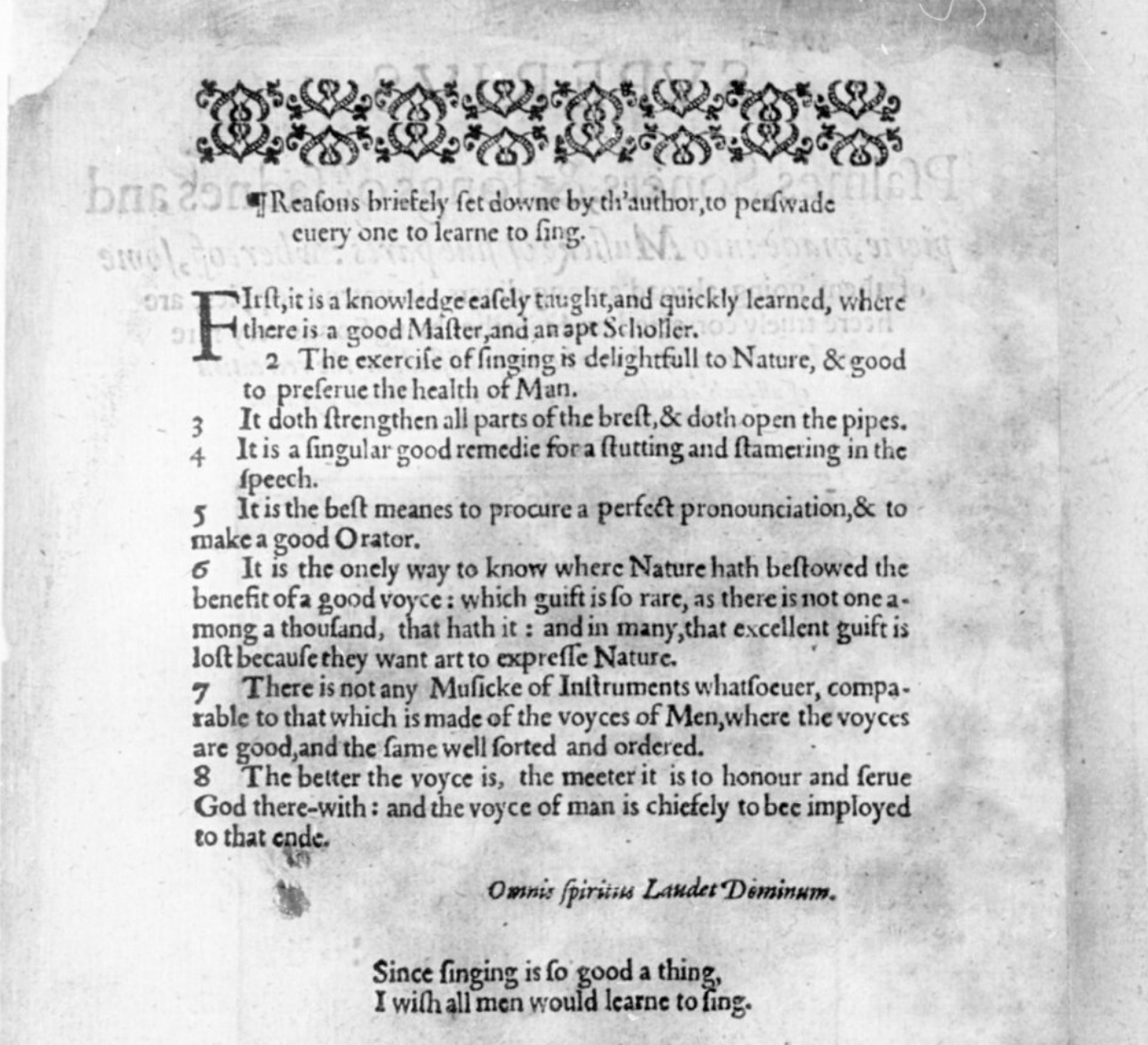
William Byrd’s Preface to Psalmes, Sonet, & songs of sadness and pietie (1588).

Movie stars are singing again. From across a century of sound cinema there have been many leading women and men who have been winning vocalists, from the first talkie generation of James Cagney and Claudette Colbert to the Dolby days and nights of Hugh Jackman and Anne Hathaway.

Many of these actors had significant youthful training that equipped them with the excellent skills at singing and dancing that are crucial to their personal entertainment brands.

But the stories behind the two recent blockbuster biopics devoted to music legends, one living one dead, tell different tales of musical growth and awareness that might even usher in a broader popular renaissance in singing.

Much praise has been heaped on Timothée Chalamet’s performance in James Mangold’s A Complete Unknown. Impressive indeed was the actor’s dedication to the task of learning to play the guitar and also to discovering his own singing voice in the process of doggedly modeling it on Bob Dylan’s. Both the accuracy of Chalamet’s vocal imitation of his model and his assiduity in attaining a convincing musical competency have been universally applauded. This particular set of talents had remained undeveloped by Chalamet until he undertook the project of becoming Bob on screen. The Bard himself even seems to have offered laconic, though still obscure, approval of his screen epigone’s efforts.

Those watching Chalamet do Dylan might now be encouraged to pick up a guitar on eBay or at the local Salvation Army Store, download a chord chart or the relevant apps, and get bardic themselves. It was this ethos of possibility that fueled the post-war folk revival and, thanks to Chalamet in A Complete Unknown, might just spawn a Second Great Awakening of Song.

Though some might be daunted, even discouraged by Chalamet’s apparently nonchalant ascent to the summit of songdom, anyone really can become a serviceable, guitar-wielding folksinger performing for the pleasure of self, family and friends. Learning just a couple-three chords, and with them opening up endless vistas onto myriad tunes and lyrics, is the work of hours.

To become an opera singer is, by contrast, a Herculean labor of years and even decades. In Pablo Larraín’s Callas (now streaming on Netflix), screen diva Angelina Jolie portrays the opera diva in her last week in Paris, moving through, and remaining still, in a world of aural and visual illusion, wandering through a labyrinth of memory and fantasy, ecstatic song and vocal failure.

In contrast to Chalamet’s unalloyed voice, Angelina Jolie’s ventriloquizes Callas’s with the aid of digital magic that artfully melds her singing voice with that of the exalted diva’s. The result is a pleasing mix of the two, a vocal fabrication that persuasively emerges from her speaking voice.

Where Chalamet had been at his Dylan musical studies for five years before shooting the movie, Jolie did a scant seven months of “intensive” vocal work in advance of Callas. Much of her tuition involved learning proper pronunciation and shaping the mouth properly in the various languages sung—Italian, French and German. Breath support and vocal production were also crucial to making her look believable on screen. Jolie was not an operagoer nor had ever sung in public before she embarked on the title role in Callas.

Jolie could never come as close to Callas’s sound as Chalamet gets to Dylan’s. Still, she has become an ardent convert and proselytizer. Famous arias now dominate her personal playlist and in many promotional interviews for the movie she has extolled the benefits of singing.

Last week she told ClassicFM that singing had transformed her in mind and body: “To be forced to get past that and make a full sound again was almost like shaking me out from years of holding, and having to confront and release a lot. It was really a gift. It’s very freeing. That’s why I say everybody should do it. I’m encouraging everyone [to learn to sing].”

Callas is as much about the body as the voice, which are, after all inseparable, even if the latter escapes the former in its journey to the ears of others. Callas’s extreme battles with her weight are obliquely portrayed in the movie when she hides pills in the pockets of the many sumptuous garments hanging in her vast wardrobe which are discovered, then confiscated, by her fondly severe butler, Ferruccio Mezzadri (Francesco Favino). The film depicts her fitful attempts at a comeback, following her to rehearsals in an empty theater where she is accompanied by her repetiteur (Steven Ashfield) at the piano. On the stage of the empty hall her voice has shrunk like her emaciated frame.

In a conversation with the film’s director Pablo Larraín hosted by Vogue, the Callas director begins by asking the actor if she is going “to open up a center” —Jolie responds with advice that must have echoed from the Hollywood Hills across the LA Basin and throughout the movie industry: “Skip therapy for a year and just go to opera class.”

The bodies of celebrity women have long been toned and tended to, modified and mocked, tailored for objectification on screen and red carpet, the fodder for tabloids and fanchat. But the voice has been neglected, and good on Jolie for bringing awareness to it.

But Larraín’s conjuring of a center immediately makes one wonder whether the current fitness trends, from spinning to rucking to hot Pilates, will now be complemented by vocal calisthenics. Will Muscle Beach become the site of weekly concerts with Arnold Schwarzenegger leading the well-oiled Barbell Choristers, blasting the Anvil Chorus out over the Pacific? Will home gyms from sea-to-shining-sea and across the smoldering plain be retrofitted as music rooms a la Jane Austen?

Canny capitalists must now be mobilizing in order to profit from what could be a huge new craze in self-improvement—monetizing the singing voice, that echo from our species’ distant past when melody and human language were born together—or so the likes of Jean-Jacques Rousseau imagined.

An idealist might hope that these movies and the uplifting pronouncements of their stars will lead not to exploitation but to an explosion of choral singing and of individual expression—even to political revolution.

But these movies reject community, lauding Dylan for lifting the middle finger to the people and spirt of the 1965 Newport Folk Festival and sympathizing with Callas as she collapses into herself and her own legend.

There is nothing new under the ever-hotter sun. Back in 1588, the year of the Spanish Armada, the towering Elizabethan musician William Byrd answered his own rhetorical question about the value of singing with eight airtight reasons that hit on all of Jolie’s, including pronunciation, circulation and breath, and mental health (in this case the proper worship). Let the world take this musical titan’s advice to heart, even as we await a Byrd biopic and the Psalmes, Sonet, & songs app:

Why Learne to Sing?

Reasons briefly set down by th’author, to perswade every one to learne to sing.

First, it is a knowledge safely taught and quickly learned, where
there is a good Master, and an apt Scholler.

The exercise of singing is delightfull to Nature, & good
to preserve the health of Man.

It doth strengthen all parts of the brest, & doth open the pipes.

It is a singular good remedie for a stutting and stamering in the
speech.

It is the best means to procure a perfect pronounciation, & to
make a good Orator.

It is the onely way to know where Nature hath bestowed the
benefit of a good voyce : which guift is so rare, as there is not one
among a thousand, that hath it.

There is not any Musicke of Instruments whatsoever, comparable
to that which is made of the voyces of Men, where the voyces are
good, and the same well sorted and ordered.

The better the voyce is, the meeter it is to honour and serve
God there-with : and the voyce of man is chiefely to bee imployed
to that ende.

“Omnis Spiritus Laudes Dominum”

Since Singing is so good a thing, I wish all men would learn to sing.


David Yearsley is a long-time contributor to CounterPunch and the Anderson Valley Advertiser. His latest recording is Handel’s Organ Banquet. He can be reached at dgyearsley@gmail.com

What Would Gabriel García Márquez Have Thought of the Netflix Version of His Novel?

January 17, 2025
FacebookTwitter

Cover image for the Avon Books edition of One Hundred Years of Solitude.

It was in a trattoria on the Piazza Navona in early April of 1974 that for the first but not the last time I heard Gabriel García Márquez refuse to even contemplate turning his masterpiece, Cien Aňos de Soledad, into a film.

Gabo—as his friends called him—was in Rome as one of the vice-presidents of the Second Russell Tribunal convened to denounce human rights violations in Latin America, so the conversation that evening was basically political. But towards the end, a question was broached by the illustrious Brazilian director, Glauber Rocha. Everyone else at the table went quiet—it was a star-studded gathering, the Argentine author Julio Cortázar, the legendary Chilean artist Roberto Matta, the exiled Spanish poet Rafael Alberti and his white-haired wife, María Teresa León, who had sworn at some point during the evening that she would enter Madrid on a white horse, totally naked, as soon as Franco died.

None of us expected the vehement reaction of the Colombian novelist, usually so soft-spoken. “Never!” Gabo exclaimed. “To synthesize that story of seven generations of Buendías, the whole history of my country and all of Latin America, really of humanity, impossible. Only the gringos have the resources for that sort of film. I’ve already received offers: they propose an epic, two hours, three hours long. And in English! Imagine Charlton Heston pretending he’s an unknown, mythical Colombian in a fake jungle.” And added a definitive, “Ni muerto!”

Which could be translated as “Over my dead body” but better rendered as “Not even after I’m dead!”

As we walked towards the hotel where we were lodged, I probed further. As an accomplished screenwriter himself, couldn’t he control the production, demand that the characters speak Spanish.

He shook his head. “It would be a travesty,” he said. “What is most entrancing in the book cannot be translated into another medium. People keep forgetting that it’s very…. literary.” And repeated: “Ni muerto!”

Well, my friend Gabo, alas, is quite muerto, irretrievably so, and One Hundred Years of Solitude is streaming on Netflix to glowing reviews. A number of his initial concerns have been brilliantly addressed: entirely filmed in Spanish on location in Colombia, with a majority of primarily anonymous, amateur actors and a praiseworthy to the text. Viewers are guided through a complicated genealogy, expertly unscrolling the intersections of time and history. The delirious cinematography, the superb casting, the respectful script, the fabulous locations, create some unforgettable, exquisite scenes, as if they had sprung directly from the entrails of Gabo’s wild and tender imagination.

García Márquez was an enthusiast of joyful intercourse, a way both out of loneliness and, eventually, a realization of how lonely each of us really is.

And yet, for anyone who has read the novel—as I have, some six or seven times, since I was first enchanted by it in 1967, one of its initial readers thanks to my job as literary critic for Ercilla, Chile’s premier newsmagazine, something essential is missing.

If Gabo’s novel were only his sprawling plot and fascinating incidents, the Netflix series could be hailed as a lavish triumph. But the novel is above all a feat of language. Like all truly revolutionary works of art, it contained, from its first iconic line, a singular strategy for conveying the world being deployed, one that would change the course of world literature.

It is that unique outlook which has been lost.

Only to focus on one of the most intriguing, heraldic incidents in the novel. To the remote village of Macondo, founded by the Buendías and their friends as a paradise where death holds no sway, comes the Plague of Insomnia, its ravages anticipating, one realizes later, the apocalyptic destiny of the town and its inhabitants. By keeping its victims perpetually awake it divests them of memories and individuality. Among the many descriptions of the pestilence’s symptoms, there is this jewel: “In that state of lucid hallucination, they did not only see the images of their own dreams but could see the images dreamt by others.” A fantastic vision that’s not included in the Netflix epic (indeed, how could something like that be filmed concisely, without interrupting the narrative flow?)

Instead we are afforded the plague-as-spectacle events, culminating in havoc and violence in the night, illuminated by a magnificent forest of torches burning spectrally. Everything is spooky and cryptic, from the onset of the epidemic, when adopted daughter Rebecca shows signs of having contracted the affliction. A moment discretely described in the novel: “her eyes lit up like those of a cat in the dark.” The filmmakers have transformed those feline eyes into a terrifying milky blue, an image that comes from the typical horror-film, visual shorthand for possession by demons.

I would not bring up what might be deemed a trivial matter if it were not indicative of the treatment in the adaptation of what is mysterious and often, erroneously in my view, termed “magical.” Not a secondary issue, as one of the signal aesthetic achievements of the novel is that the ordinary and the supernatural are incessantly and comfortably juxtaposed, a plague of insomnia recounted as matter-of-factly as the planting of a tree or a child sucking her thumb. The Buendías are not puzzled when ghosts visit them, when Aureliano can foretell the future, when a dying spinster takes letters from the town’s inhabitants to their deceased relatives. What is strange and unbelievable to those who dwell in Macondo, are the inventions of science that transmute the material world: ice, photography, compasses, intrusions from modernity into a world that, up till then, lived in a state of perpetual childlike innocence.

Gabo was able to convey this vision because he adopted the perspective of the community he embedded us in, told the story from their belief-system, as real to them as their own bodies. To signal, as the Netflix adaptation does, that something unnatural is afoot by strumming ominous music and consigning most of the paranormal episodes to a gloomy, darkened atmosphere, creates exactly the opposite effect that the novel accomplishes so amazingly. The adaptation turns us into voyeurs of the eccentric and the uncanny, comforted by familiar tropes, instead of challenging us to ask, as the book does: what exactly is reality?

Gabo was able to convey this vision because he adopted the perspective of the community he embedded us in, told the story from their belief-system, as real to them as their own bodies.

Something similar happens with sex. García Márquez was an enthusiast of joyful intercourse, a way both out of loneliness and, eventually, a realization of how lonely each of us really is, how even that momentary wonder of joined bodies cannot defeat the death we face, each on his, on her, own. Nothing could be farthest from that enigmatic, inward approach to sex than the proliferation on screen of steamy scenes of copulation, with standardized groans, heaving bodies and tiresome orgasms destined more to drive up ratings than to accompany the characters in their quest to defy extinction.

Nor could one glean, from the Netflix series, that One Hundred Years is, well, so … literary, indebted to Kafka and Borges, Faulkner and Rabelais, the Decameron and the Arabian Knights, how deeply it is the grandchild of Cervantes. Nor can spectators of this adaptation deduce that, despite the incest, murder, civil wars, massacres, imperialism, that beset the Buendía clan and the greater colonized continent that they allegorically represent, the original novel is relentlessly comical. Gabo’s characters are obstinately entrenched in their obsessions and folly, staggering, often laughably, towards the scaffold of themselves and history, a view that is absent from this solemn cinematic version. Perhaps, most crucially, there is no sense that what we are watching is subversive, contesting story-telling itself, what it truly means to have been born far from the centers of power.

Just recently, I defended in the New York Review of Books the decision by the sons and heirs of García Márquez to release, against his express wishes, his posthumous novel, Until August. I am less indulgent this time. Would their father find much to admire in this adaptation? Undoubtedly, yes. Certainly, not a travesty. He would be pleased that his beloved, flawed Buendías have been afforded such dignity. And additional millions will be drawn to this extraordinary gift from the troubled, defiant zones of our humanity. I just have to trust that the seminal vision contained in that book will shine through and not be trapped forever in the dazzling but limited version now pervading screens all across the globe.

This essay first appeared on LitHub.