
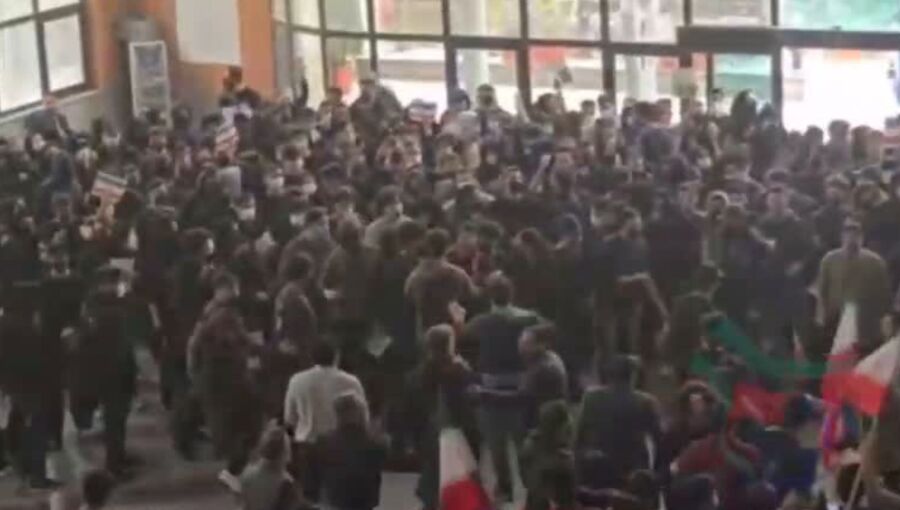
Student protests continued across Tehran's universities for a fourth consecutive day on February 24, with demonstrations reported at more than ten institutions as Basij militia members deployed on campuses to contain the unrest, according to student Telegram channels.
Al-Zahra University saw a sit-in begin on February 24, with the United Students Telegram channel reporting that "suppressors and Basijis are present to prevent the sit-in."
At Khajeh Nasir University's Vanak campus, Basij forces fired tear gas and pepper spray to disperse students, with protesters chanting slogans against the Revolutionary Guards.
Demonstrations were also reported at Sharif University, Shahid Beheshti University, Iran University of Science and Technology, Soure University, and the faculties of social sciences and arts in Tehran. Chants included "Woman, Life, Freedom," "Death to the dictator," and "Political prisoners must be freed."
Over the preceding three days, major universities in Tehran, Isfahan University of Technology, and Ferdowsi University in Mashhad had all seen large-scale protests directed against Supreme Leader Ayatollah Ali Khamenei.
Amirkabir University of Technology in Tehran has warned it will move swiftly to discipline students involved in recent campus unrest, as protests at Iranian universities entered a fourth consecutive day on February 24.
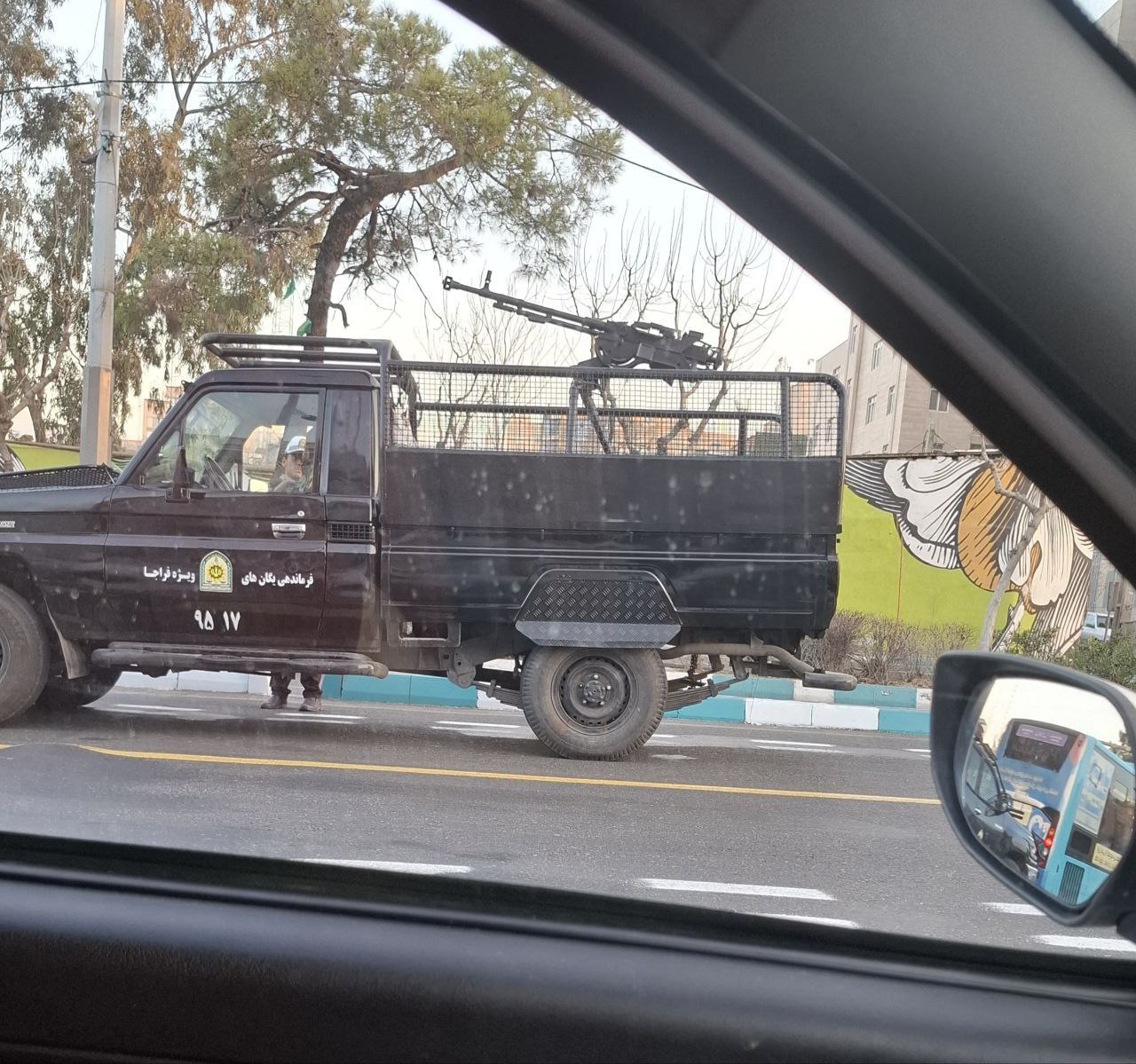
Armed police have also been recorded with machine guns outside university complexes in recent hours, according to social media posts shared with IntelliNews.
In a statement published by 19 Dey newspaper, the university said cases against students "from all factions" would be reviewed without leniency, condemning what it described as stone-throwing, property destruction, and disrespect for national symbols.
The announcement came as protests spread across at least ten Iranian universities, including the University of Tehran, Sharif University of Technology, Isfahan University of Technology and Ferdowsi University in Mashhad.
Students dressed in black gathered to mourn those killed during a government crackdown in January 2026, which Iran's authorities say left more than 3,000 dead.
Rights groups, including the US-based Human Rights Activists News Agency, put the toll at upwards of 7,000, according to its latest figures on February 24, significantly higher than the government death toll.
At Amirkabir University, clashes broke out between anti-government students and pro-regime Basij members on February 22, with verified social media footage showing scuffles between the two groups.
A student group said on Telegram that protesters had chanted "our target is the entire system," while others were insulting the yellow flags of the Basij and Hezbollah flown by those loyal to the system.
Updated 11:20 GMT/UTC
Iranian Students Face Down Security Forces On Fourth Day Of Nationwide Campus Protests – OpEd
February 25, 2026
By Mahmoud Hakamian
On February 24, 2026, the student-led uprising across Iranian universities entered its fourth consecutive day. Despite heavy militarization and violent suppression tactics by the state, major academic institutions in Tehran—including Tehran University, Beheshti (Melli), Sharif, Khajeh Nasir, Iran University of Science and Technology (IUST), and Science and Culture—remained active sites of protest. The demonstrations also expanded beyond the capital, with students at Isfahan University of Technology, as well as Sajjad and Shandiz universities in Mashhad, holding anti-regime rallies.
Direct Confrontation and Student Defiance
The regime’s response to the renewed campus unrest has been marked by physical violence and heightened surveillance, which students have met with direct resistance. At Khajeh Nasir University in Tehran, security forces assaulted students at their dormitories in an attempt to disperse their gathering, but the students fought back and maintained their rally. At Isfahan University of Technology, the state deployed drones over the campus to identify and intimidate protesters.
In Tehran, the confrontations escalated into severe physical clashes. At Beheshti University, intense altercations broke out between students and the regime’s Basij and security agents. During the rally, students torched a photograph of Supreme Leader Ali Khamenei while chanting, “This is the year of blood, Seyyed Ali will be overthrown!” and “Basij, IRGC, to us you are ISIS.” Meanwhile, at Tehran Art University, female students chanted, “Freedom, freedom, freedom!” At IUST, plainclothes campus security were seen noting the names of students wearing black mourning attire, while police forces stationed themselves outside the university gates.
The chants echoing across the campuses demonstrate a clear rejection of the theocratic state in its entirety. At Sharif University, where students successfully resisted attacks by Basij agents, the crowd chanted, “This is the last message, our target is the entire regime!” At both the University of Science and Culture in Tehran and Shandiz University in Mashhad, students repeated the slogan, “Students will die but won’t give in to disgrace!” Demonstrators at Beheshti University made their stance on the ruling establishment clear, chanting, “We will not have a country as long as the mullahs are in power!”
The State’s Panic and Threats of Escalation
The persistence of the students has prompted public alarm from the regime’s judicial authorities. On February 24, the regime’s Attorney General, Mohammad Movahedi Azad, called for a swift security and law enforcement crackdown on the universities. Blaming the unrest on “enemies” attempting to inflame the domestic atmosphere, he ordered responsible agencies to “swiftly identify the related agents and take decisive and legal action against them,” warning that the authorities “must not allow such actions to continue.”
The current campus strikes are deeply intertwined with the nationwide uprising that erupted on December 28, 2025. Sparked initially by a strike among Tehran bazaar merchants over severe economic crises, the movement quickly evolved into explicit demands for the regime’s overthrow. The state responded with a brutal crackdown, cutting off communications and killing thousands of civilians, including children.
Instead of pacifying the public, this systemic slaughter has fueled the students’ resolve. For four days, students have gathered to commemorate the martyrs of the January protests, explicitly rejecting any form of tyranny. As demonstrated during the earlier days of this campus revolt, students have forcefully expelled monarchist provocateurs from their ranks, declaring they will not accept dictatorships of either “turbans” or “boots” and demanding “Neither Shah nor Mullah.” By returning to the campuses to face down the regime’s security forces, the students are demonstrating that the blood spilled by the regime has only solidified the Iranian people’s demand for a free, democratic, and secular republic.
Mahmoud Hakamian writes for The People’s Mojahedin Organization of Iran (PMOI), also known as Mujahedin-e-Khalgh (MEK)
Iran: Tsunami Of Arbitrary Arrests, Enforced Disappearances, HRW Says
By Eurasia Review
Iran’s authorities have waged a brutal campaign to terrorize the population through mass arbitrary detentions, torture, and enforced disappearances in the aftermath countrywide massacres of protesters and bystanders by security forces on January 8 and 9, 2026, Human Rights Watch said Tuesday.
Evidence examined by Human Rights Watch shows that senior officials, Iran’s security and intelligence agencies including the police, known as FARAJA, the Islamic Revolutionary Guards Corp (IRGC) and its intelligence organization, the Ministry of Intelligence, and prosecutorial and judicial officials have orchestrated a coordinated, brutal mass clampdown to quash further dissent and conceal their atrocities. In addition to mass arrests, they have held detainees in incommunicado detention including in unofficial facilities, broadcast hundreds of coerced “confessions,” including by children, and carried out large-scale enforced disappearances while imposing severe restrictions resembling martial law in many cities.
“As a whole nation remains in shock, horror, and grief, and families still search for their loved ones in the aftermath of the massacres of January 8 and 9, authorities continue to terrorize the population. Arrests continue and detainees face torture, coerced “confessions,” and secret, summary, and arbitrary executions,” said Bahar Saba, senior Iran researcher at Human Rights Watch. “Given the immense dangers those detained and forcibly disappeared face, international monitors should immediately be given unhindered access to all detention facilities and prisons.”
A prisoner whose voice recording was received by Human Rights Watch stressed the importance of maintaining international scrutiny, saying, “Do not forget the detainees… Be our voice, if you do not raise your voice, they will eliminate us all.”
Those forcibly disappeared include individuals arrested and may include cases of people who participated in the protests but never returned home. Some families have received calls informing them that their loved ones had been killed but have not had the bodies of their loved ones returned, or received any information about them despite repeated inquiries.
A January 26 statement by the IRGC’s Intelligence Organization indicated that at least 11,000 people had been summoned by intelligence and security forces as of that date. According to judiciary’s spokesperson, 10,538 individuals had been referred for prosecution and 8,843 indictments were issued by February 17.
Human Rights Watch spoke with 23 people both inside and outside Iran, including detained protesters; relatives of people killed, detained, and/or forcibly disappeared; people participating in protests; lawyers; human rights defenders; medical professionals; and journalists. Sources provided information about the situation in areas across the country, including the provinces of Alborz, Eastern Azerbaijan, Fars, Golestan, Hormozgan, Ilam, Kermanshah, Khouzestan, Kurdistan, Lorestan, Mazandaran, Razavi Khorasan, and Tehran.
Human Rights Watch also analyzed videos of security forces violently arresting protesters and their heavy presence on the streets after the mass killings, including 139 videos of forced “confessions” broadcast by the state broadcaster—Islamic Republic of Iran Broadcasting (IRIB)—and state-affiliated media as of February 6. Human Rights Watch also reviewed official statements, reports, and publications by independent media and human rights organizations.
Authorities have repeatedly vowed “speedy trials” and a “harsh response” without “any leniency,” while labelling protesters “criminals,” “enemies of God,” and “terrorists.” On February 3, a criminal court in Qom sentenced 19-year-old wrestling champion, Saleh Mohammadi, to death for alleged involvement in the death of a member of the security forces. Mohammadi was convicted after summary proceedings that did not even last a month and relied on forced “confessions” that he said were extracted under torture. The court has ruled that Mohammadi’s execution should be carried out in public.
On February 19, Amnesty International reported that children were also among 30 people facing the death penalty whose cases were documented by the organization. In a measure reminiscent of sham trials broadcast in 2022 that resulted in arbitrary executions of several men, IRIB started broadcasting segments of trial proceedings, including against two children, for alleged offences in connection with the protests.
The exact number of those arrested since the start of the protests remains unknown, but human rights groups have reported the figures to be in the tens of thousands. As of February 13, the Volunteer Committee to Follow-Up on the Situation of Detainees, a network of activists outside Iran, had published the names and details of over 2,800 people arrested.
Those interviewed said that prosecutors and prison officials have systematically denied detainees access to their families and lawyers and refuse to provide information about detainees’ fate and whereabouts, thus subjecting them to enforced disappearance. Enforced disappearances are grave crimes under international law and are considered ongoing so long as the authorities refuse to acknowledge the fate or whereabouts of those disappeared.
A human rights defender who has spoken to several detainees’ relatives in the provinces of Ilam and Kermanshah said that officials responded to families’ requests with insults and profanities. Verified videos posted online and verified by Human Rights Watch show scores of concerned families gathering outside prisons, prosecutors’ offices, and police stations in search of their loved ones.
Human Rights Watch has also documented cases of torture and other ill-treatment, including severe beatings with batons; kicks and punches; sexual and gender-based violence; food deprivation; and psychological torture, such as threats of execution, and denial of medical care to those injured. These cases, which can also amount to serious international crimes, are believed to be a fraction of the true scale of gross detention violations given that many people remain in incommunicado detention.
Iran’s authorities have imposed and maintained a heavy military presence applying severe restrictions against the population across numerous cities in the aftermath of the massacres. Several witnesses described measures resembling curfews and martial law, including checkpoints across cities and intra-city roads and armed agents routinely stopping vehicles and searching cars and passengers’ mobile phones. These descriptions were corroborated in videos verified by Human Rights Watch.
Security and intelligence forces have continued to carry out arrests of real and perceived dissidents. Those targeted include protesters, lawyers, medical professionals, human rights defenders, students, schoolchildren, athletes, journalists, political activists, environmentalists, and members of ethnic and religious minorities including Baha’is.
Since the start of the protests, the IRIB and media outlets affiliated with the IRGC have broadcast hundreds of protesters’ coerced “confessions.” They further heighten fears that people whose forced “confessions” have been aired will face the death penalty, and arbitrary executions.
Coerced television “confessions” violate the absolute prohibition of torture and other ill-treatment, the rights to presumption of innocence, and to a fair trial. The Islamic Republic has a long history of using coerced “confessions” to quash dissent and in cases leading to death sentences and arbitrary executions after grossly unfair trials.
Fears of a wave of death sentences and arbitrary, summary, and secret executions are growing in light of official statements and the execution spreeof recent years. Since the start of the protests, officials have vilified protesters, repeatedly referring to them as “criminals”, and mohareb, an individual “waging war against God,” which is a capital offense.
UN member states should demand that Iran’s authorities immediately release all those arbitrarily detained, disclose the fate and whereabouts of people forcibly disappeared, halt any planned executions, and allow independent international bodies, such as the UN Fact-Finding Mission on Iran, unhindered country access, including to prisons and detention facilities, hospitals, morgues, and cemeteries.
Governments with embassies in Iran should send high level observers to all capital trial proceedings and urgently request to visit to all sections of detention facilities.
“Systematic impunity has enabled Iranian authorities to repeatedly commit crimes under international law,” Saba said. “Other countries’ judicial authorities should initiate criminal investigations of international crimes under the principle of universal jurisdiction and in accordance with national laws, with a view to prosecute those suspected of criminal responsibility.”
Mass Arbitrary and Violent Arrests, Unlawful Detentions
Officials and state-affiliated media in Iran have stated that authorities have arrested thousands of people across the country, but independent rights organizations have reported that there have been tens of thousands of arrests.
Several sources who had spoken to people in prisons across the country said that authorities had emptied prison wards to hold detainees together and in isolation from other prisoners, in an apparent attempt to stop the flow of information.
Protest detainees are also held in unofficial detention facilities run by security and intelligence bodies, and other unregistered and secret locations, placing them at heightened risk of torture and arbitrary, summary, and secret executions. Iranian authorities have a track record of using secret, unofficial, and makeshift detention facilities, in particular during protest crackdowns, to hold detainees without registration.
Security forces have continued to arrest protesters on the streets, at checkpoints, and in home raids. A spokesperson for the Volunteer Committee to Follow-Up on the Situation of Detainees told Human Rights Watch that many people were arrested at home, days after they had participated in protests.
In one case, based on credible information received, Revolutionary Guard forces conducted an early morning raid on the house of Milad Ebrahimi, an injured protester in Kamyaran, Kurdistan and arrested him on February 1. The source said Ebrahimi sustained a gunshot wound during the protests but did not seek medical care at a hospital fearing arrest. Security forces also arrested his brother, Hamed Ebrahimi, for objecting to the arrest.
Witness statements and state media reports indicate that security forces have used video footage from CCTV cameras, and drones to identify those participating in protests.
Relatives of detainees and lawyers interviewed said that the authorities prohibited access to lawyers during the investigation phase, consistent with authorities’ decades-long pattern of denying detainees access to legal representation, including independent lawyers of their choice.
Under Note to Article 48 of the Code of Criminal Procedure, individuals charged with certain offenses, including national security offenses, are denied the right to access an independent lawyer of their own choosing. Only lawyers approved by the head of the judiciary can be appointed to defend them. The UN Fact-Finding Mission on Iran and human rights organizations have documented a pattern of complicity by many judiciary-approved lawyers in grave human rights violations. As a result, families and detainees have said they do not trust them.
“Detainees have no access to lawyers,” a lawyer said. “Families do not want to retain Article 48 lawyers. Independent lawyers who go to officials to take on protest detainees’ cases are told by the authorities, ‘Are you an Article 48 lawyer? No? Then leave, you cannot take the case.’”
In practice, even in cases with judiciary-approved lawyers, detainees are denied access to legal counsel during the investigation phase including during interrogations.
Witnesses said that, consistent with their track record, authorities have also harassed families of detainees, warning them not to speak up or publicize the situation of their loved ones.
Incommunicado Detention; Enforced Disappearances
The authorities have held those arrested during and after the protests in incommunicado detention. In many cases those detained are forcibly disappeared, as authorities have refused to provide families with any information about their fate and whereabouts.
In one case, authorities arrested Youresh Mehrali Beiglou, an Azerbaijani Turk activist, on January 4 in or around Tabriz, East Azerbaijan province, after releasing a video in which he spoke about the protests. After the arrest and for a period of over a month, he was allowed to make only one brief phone call to his family, and they were denied information about his whereabouts.
Another Azerbaijani Turk activist, Ali Babai, was arrested on January 14. Other than one brief phone call informing his family that he was in an intelligence ministry detention facility, the authorities have denied his relatives information about his fate and whereabouts.
In Karaj, Alborz province, security forces raided Jahangir Kazemi’s home on January 14 and arrested him. His family received two brief phone calls from Kazemi, who is reportedly held in solitary confinement, but has been denied visits and information about his situation. Kazemi’s wife, Fatemeh Golmohammadi, was arrested on January 27. The couple, who have young children, have been denied access to a lawyer.
A relative of a detainee in a northern province, described the response of prosecution officials to detainees’ families:
“When we ask officials at the prosecutor’s office [about our loved one], they tell us, ‘They are criminals, if they weren’t, we would not have arrested them,’ “When we ask what their crime is, they respond, ‘You yourselves know better.’”
Families have been gathering outside prisons, police stations, and prosecutors and governors’ offices. Human Rights Watch has reviewed four videos showing such gatherings.
Researchers geolocated videos showing these scenes outside the county courthouse in Karaj, Alborz province, Qazvin Central Prison, Qazvin province, and outside the governor’s office in Yasuj, Kohgiluyeh, and Boyer-Ahmad province.
Verified videos analyzed by Human Rights Watch from the provinces of Alborz, Esfahan, Lorestan, and Razavi Khorasan corroborated these accounts. Collectively, the videos show large numbers of armed security forces patrolling cities on foot or in vehicles, including trucks mounted with heavy machine guns, discharging weapons and using megaphones to order people to stay indoors.
In one video published online on January 29, and reported to have been recorded outside a police station in Kerman, concerned families are seen speaking to an official from behind a closed door, repeatedly saying that their loved ones are missing. One man is heard saying, “Why is there no one to answer us… my child has disappeared for 24 hours, but no one answers… is there not a manager, a supervisor, someone to step outside? So many people are here worried for their children.”

No comments:
Post a Comment