
Canada Vows Aid for Cuba as Trump Oil Embargo Fuels Humanitarian Disaster
Mexico earlier this month also stepped up aid shipments to Cuba during the
Trump administration’s oil embargo.
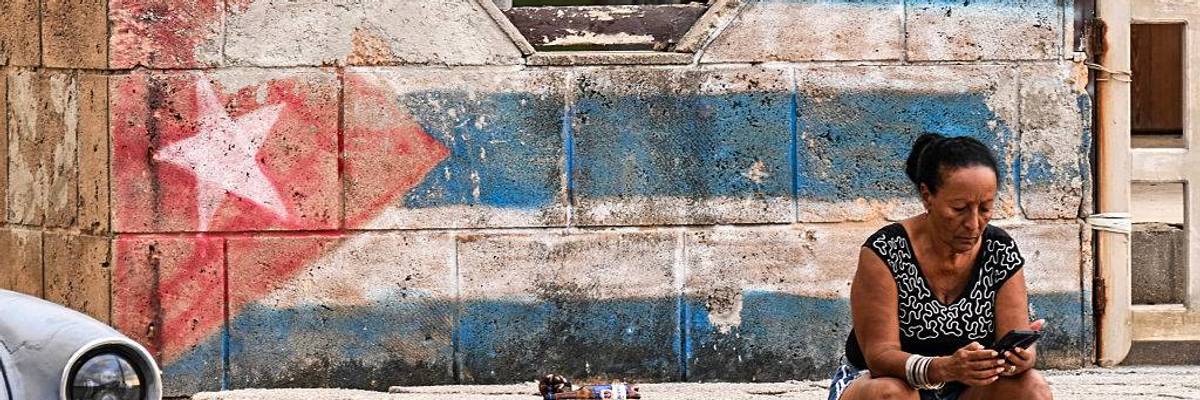
A woman looks at her cellphone on a street in Havana on February 23, 2026.
(Photo by Yamile Lage/AFP via Getty Images)
Brad Reed
Feb 24, 2026COMMON DREAMS
The Canadian government on Monday announced plans to send aid to Cuba, which is currently being squeezed economically by a US oil embargo.
As reported by the Associated Press, Canadian Foreign Minister Anita Anand revealed that the government is “preparing a plan to assist,” adding that “we are not prepared at this point to provide any details” of what it will entail.
A Canadian aid package to Cuba would be the latest rebuff to US foreign policy. The two long-time allies have been at odds since President Donald Trump took office last year and slapped hefty tariffs on Canadian products, while also vowing to make the country into the “51st state” of the US.
Canada wouldn’t be the first US ally to step up help for Cuba, as Mexico earlier this month sent two ships loaded with more than 2,000 tons of goods and food to the island nation.
The shipments to Cuba were aimed at easing the humanitarian crisis intensified by the Trump administration’s oil embargo, which began shortly after the administration invaded Venezuela and abducted President Nicolás Maduro in January.
Trump has vowed to slap tariffs on any country that sends oil to Cuba, although the US Supreme Court’s ruling last week slapping down his powers to unilaterally enact tariffs through the International Emergency Economic Powers Act has potentially neutered that threat.
Earlier this month, a group of United Nations human rights experts called the Trump blockade of Cuba “a serious violation of international law and a grave threat to a democratic and equitable international order,” and “an extreme form of unilateral economic coercion with extraterritorial effects.”
Medea Benjamin, co-founder of the anti-war group CodePink, traveled to Cuba recently and spoke to local residents who described the devastating impact of the oil blockade.
“With no gasoline, buses don’t run, so we can’t get to work,” Marta Jiménez, a hairdresser from Holguín, told Benjamin. “We have electricity only three to six hours a day. There’s no gas for cooking, so we’re burning wood and charcoal in our apartments. It’s like going back 100 years.”
As reported by the Associated Press, Canadian Foreign Minister Anita Anand revealed that the government is “preparing a plan to assist,” adding that “we are not prepared at this point to provide any details” of what it will entail.
A Canadian aid package to Cuba would be the latest rebuff to US foreign policy. The two long-time allies have been at odds since President Donald Trump took office last year and slapped hefty tariffs on Canadian products, while also vowing to make the country into the “51st state” of the US.
Canada wouldn’t be the first US ally to step up help for Cuba, as Mexico earlier this month sent two ships loaded with more than 2,000 tons of goods and food to the island nation.
The shipments to Cuba were aimed at easing the humanitarian crisis intensified by the Trump administration’s oil embargo, which began shortly after the administration invaded Venezuela and abducted President Nicolás Maduro in January.
Trump has vowed to slap tariffs on any country that sends oil to Cuba, although the US Supreme Court’s ruling last week slapping down his powers to unilaterally enact tariffs through the International Emergency Economic Powers Act has potentially neutered that threat.
Earlier this month, a group of United Nations human rights experts called the Trump blockade of Cuba “a serious violation of international law and a grave threat to a democratic and equitable international order,” and “an extreme form of unilateral economic coercion with extraterritorial effects.”
Medea Benjamin, co-founder of the anti-war group CodePink, traveled to Cuba recently and spoke to local residents who described the devastating impact of the oil blockade.
“With no gasoline, buses don’t run, so we can’t get to work,” Marta Jiménez, a hairdresser from Holguín, told Benjamin. “We have electricity only three to six hours a day. There’s no gas for cooking, so we’re burning wood and charcoal in our apartments. It’s like going back 100 years.”
Cuban fuel crisis: a Russian tanker is on route. Will Trump let it through?
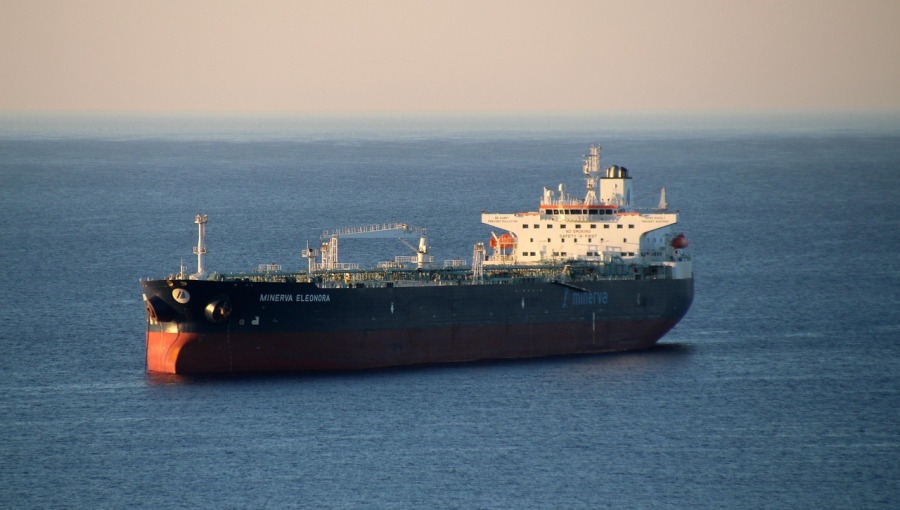
A tanker widely believed to be carrying Russian fuel is heading towards Cuba, potentially setting the stage for a fresh confrontation between Moscow and Washington as the island struggles under a de facto US fuel embargo that has crippled power generation, transport and basic services.
The situation bears distant echoes of the Cuban Missile Crisis of 1962, when Soviet vessels carrying nuclear warheads brought the two superpowers to the brink of war. The stakes this time are incomparably lower, but Cuba could once more find itself at the centre of a geopolitical standoff, this time over desperately needed oil rather than nuclear warheads. Fulton Armstrong, the former CIA lead Latin America analyst, told the New York Times: "Since the Cuban Missile Crisis, this is the biggest step. And the Cubans will have to make a decision on whether to surrender."
The tanker, identified by maritime tracking data as the Sea Horse and flagged in Hong Kong, is expected to arrive in Cuba in early March carrying nearly 200,000 barrels of fuel, most likely gasoil, according to shipping data and analysis by maritime intelligence firm Kpler cited by Bloomberg. The cargo is believed to be of Russian origin, though neither Moscow nor Havana has confirmed the shipment. Russia's embassy in Cuba has denied publishing any official communication about the vessel, dismissing circulating reports, including claims that the tanker was being escorted by a Russian destroyer, as false. What is not in dispute is the scale of US efforts to prevent any fuel from reaching the island.
While the Trump administration has stopped short of formally declaring a blockade, it is functioning as one, the NYT reported, citing a US official who spoke on condition of anonymity.
The architect of the policy is Secretary of State Marco Rubio, the first US-born Cuban to hold the post, who has made no secret of his ultimate ambition. "We would love to see the regime change," he told Congress last month.
According to people familiar with the matter cited by Axios, Rubio has been conducting backchannel discussions with Raúl Guillermo Rodríguez Castro, grandson of former leader Raúl Castro, in what officials describe as an exploratory effort to identify a negotiated pathway to political transition, following a playbook Washington has already tested in Venezuela, where it cultivated relationships within the existing power structure ahead of Nicolas Maduro's removal.
President Donald Trump signed an executive order in late January declaring a national emergency over an "unusual and extraordinary threat" from Cuba, threatening tariffs on any country supplying oil to the communist-run island, already subject to a punishing trade embargo for over 60 years. The measures have succeeded in frightening off potential suppliers, with Mexico halting shipments despite President Claudia Sheinbaum's public misgivings.
A massive US naval deployment, the largest the Caribbean has seen in decades, has been enforcing Washington's oil embargo, building on the operational experience gained during the campaign against Venezuela that culminated in Maduro's capture in January. Caracas had long been Cuba's dominant oil supplier, accounting for roughly 58% of petroleum imports as recently as 2023, but its removal from the equation left the island scrambling for alternatives.
The deterrent effect has been tangible and swift. On January 19, a petrochemical tanker, the Mia Grace, departed Lomé, Togo, carrying what analysts believe was several hundred thousand barrels of diesel or fuel oil, reportedly purchased by Cuban state company Cubametales through a European intermediary. The African token of solidarity never arrived: midway through its Atlantic crossing, the vessel quietly altered its destination to the Dominican Republic. No shots were fired, no boarding took place: the mere prospect of US reprisals was enough.
According to a NYT analysis of shipping data, a separate vessel linked to Cuba subsequently made the five-day journey to Curaçao, consuming precious fuel reserves in the process, only to leave the port empty-handed. Shortly afterwards, the US Coast Guard stopped a Colombian fuel oil tanker that had approached to within 70 miles of Cuban waters, escorting it away from the island.
The case of the Ocean Mariner illustrates Washington's reach with particular clarity. According to the NYT, the vessel loaded around 84,500 barrels of fuel oil in Colombia in late January, transmitting its destination as the Dominican Republic before altering course towards Cuba on February 10. The following day, still some distance from the Cuban coast, it abruptly reversed course as a US Coast Guard vessel pulled alongside. The tanker was escorted into Dominican waters, where it sat full of fuel for several days before being directed north towards the Bahamas – the same destination used for Venezuelan tankers seized by US forces late last year.
Cuba's Foreign Minister Bruno Rodríguez has condemned the measures as illegal under international law, asserting Havana's right to import fuel from willing suppliers and describing US actions as naked political pressure. The United Nations has echoed those concerns, warning that failure to meet Cuba's energy needs risks triggering a humanitarian crisis.
The human cost, meanwhile, is already severe. Cuba generates more than four-fifths of its electricity from ageing Soviet-era oil-fired plants, and the supply shock has rippled through nearly every sector of life on the island. Blackouts lasting up to 20 hours a day have been reported across the country. Hospitals have postponed operations, water pumping stations have been disrupted, schools have cancelled classes and trash goes uncollected on Havana's streets as fuel-dependent municipal services grind to a halt. A shortage of jet fuel has forced major airlines to suspend routes and many tourist resorts to shut down, dealing a severe blow to an industry that provides a crucial source of hard currency for the cash-strapped island.
Rohit Rathod, a senior oil analyst at Vortexa, told Bloomberg he estimates the country's reserves could be depleted by late March, a timeline that could trigger social unrest severe enough to threaten the government. Cuba recorded zero oil imports in January, the first such month since 2015, and has received just one shipment so far in 2026, as per Kpler data.
For Russia, the Sea Horse's reported journey represents an opportunity to project influence close to US shores at a moment when Western sanctions have forced Moscow to seek alternative markets for its own fuel exports. Kremlin spokesman Dmitry Peskov has described Cuba's fuel situation as critical, accusing Washington of pursuing "unilateral coercive measures" and reiterating Moscow's readiness to support its long-standing ally. Russia, already heavily sanctioned over its invasion of Ukraine, has little additional trade exposure to US reprisals, a point Peskov himself made plain: 'We don't want an escalation, but on the other hand,” he said. “Our trade with the United States is almost nonexistent.”
Yet the Kremlin's willingness to act carries its own complications. Russia has extensive experience operating a shadow fleet of tankers and alternative insurance arrangements, infrastructure developed over three years of circumventing sanctions on its own fuel exports, and could in theory sustain a modest supply line to Cuba if Washington turns a blind eye. The question is whether it will.
Should the Sea Horse be permitted to discharge its cargo without interference, it could open the door to further shipments, handing Moscow a propaganda coup and raising questions about the credibility of US sanctions enforcement. There are parallels to China's continued purchases from Russia's Arctic LNG-2 plant over the past six months, despite those trades violating US sanctions – a pattern that has demonstrably weakened the deterrent effect of Western economic pressure.
Should Washington move to intercept the vessel, however, it would risk further straining relations with Moscow at a delicate moment, with Ukraine peace talks now tentatively under way as the full-scale invasion nears its fourth anniversary. What happens to the Sea Horse will say much about how far both sides are prepared to go.
Report: Product Tanker with Russian Fuel Appears Bound for Cuba
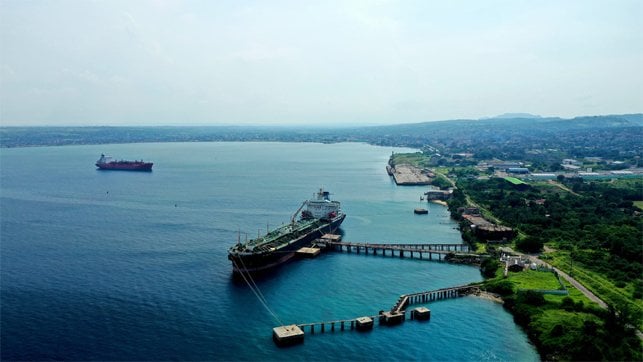
A Chinese-owned MR tanker appears to have loaded a cargo of Russian fuel and is now heading toward Cuba. Based on an analysis of data by maritime intelligence firm Windward and Marine Traffic, the ship might be set to challenge the U.S. embargo on Cuba as early as next weekend.
Russian officials have repeatedly said that they were prepared to provide aid to Cuba and the Communist government since Donald Trump announced the country a “hotbed of spies” and threatened tariffs on any country that aided Cuba with fuel deliveries. Russian Deputy Foreign Minister Sergi Ryabkov spoke of potential financial aid, while Kremlin spokesperson Dmitry Peskov said discussions were underway about how Russia could provide assistance.
The Russian Embassy in Havana told Reuters earlier in the month that a fuel delivery was expected “soon,” while Russia also called for a diplomatic approach to Cuba. It pointed out the humanitarian needs on the island, with analysts suggesting the fuel supply was as low as 20 days. The United States cut off Cuba’s fuel supplies from Venezuela, but there was a report in The Economist that the United States might permit a humanitarian fuel delivery for cooking and to run the water system.
Windward and Marine Traffic are tracking the Hong Kong-flagged MR tanker Sea Horse (27,000 dwt). Built in 2002 and managed from China, the vessel appears to have undertaken a ship-to-ship transfer near Cyprus, with Windward reporting it likely loaded Russian middle distillate originating from the Black Sea ports. Windward says the vessel’s draft increased on February 8 and reports it could reach Cuba on March 2.
The ship’s AIS signal is transmitting that it is bound for Gibraltar. However, it passed Gibraltar days ago. The last estimates place it near the middle of the Atlantic, sailing due west. The Sea Horse is not under any sanctions.
If it reaches Cuba, it would be the first delivery since January 9. The U.S. stopped a crude oil tanker from leaving Venezuelan waters, and at least two or three other tankers have turned back, intimidated by the U.S. presence.
The tanker Ocean Mariner, as previously reported, sailed from Colombia and entered the Windward Channel off Haiti. The vessel made a sudden “U” turn and headed south of the Dominican Republic. The New York Times reported a U.S. Coast Guard vessel had approached the tanker and hailed it, inquiring about its destination. It said the Dominican Republic, and it has been loitering near Santo Domingo. It later proceeded to Nassau in the Bahamas, reportedly with a USCG shadowing its movements.
Another small tanker that regularly made the runs between Curacao and Cuba, The New York Times reports, also appeared to abandon a supply run. The Gas Exelero (3,100 dwt), the paper reports, sailed to Curacao in early February but returned to Cuba apparently empty. A third tanker, the Greek-owned Nicos IV (45,364 dwt), docked in Matanzas, Cuba, last month, but it was unclear if it had a cargo aboard. The vessels each have only represented a token supply that would do little to alleviate the long-term challenge.
It is unclear currently if the U.S. Coast Guard would interdict the Sea Horse as the vessel arrives in the Caribbean. So far, the U.S. appears only to have used its presence to intimidate vessels from approaching Cuba. The U.S. did permit a humanitarian aid shipment from Mexico to reach Cuba, but it did not have fuel supplies.


No comments:
Post a Comment