Sunday, March 09, 2025

Nigeria bets on deradicalization program in North West
March 8, 2025

The Nigerian government wants to rehabilitate and reintegrate bandits who have terrorized the North West zone. But will expanding Operation Safe Corridor be enough to end the killings and instability in the region?


A military patrol on the border between Niger and Nigeria attempts to keep armed gangs at bay
Image: AFP

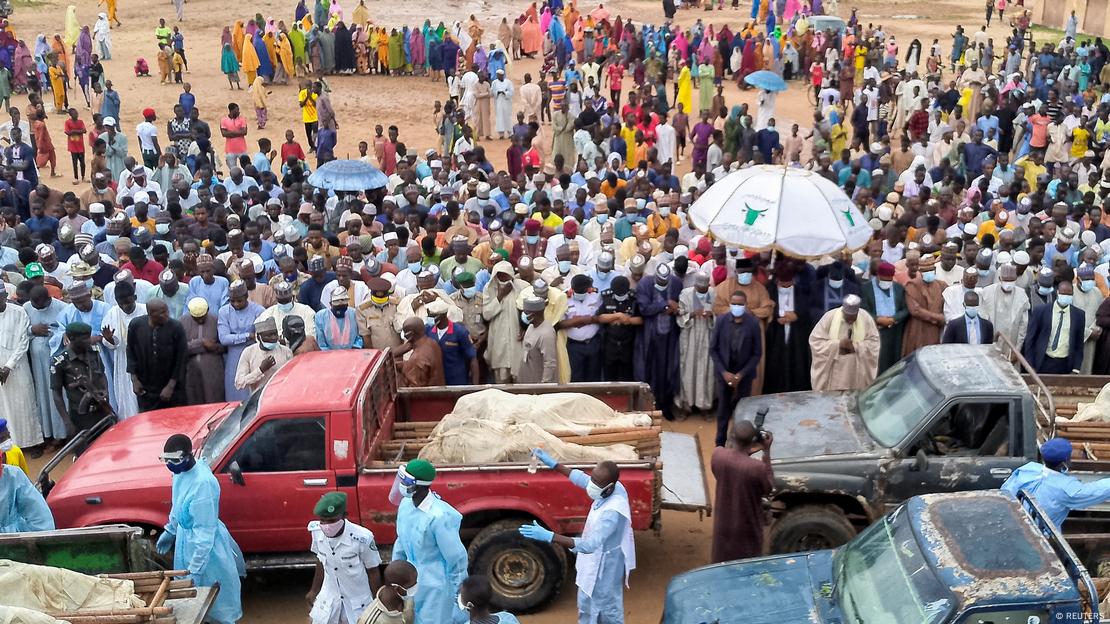
The government of Nigeria said it was expanding its deradicalization program, Operation Safe Corridor, to the country's North West region to tackle rising insecurity. The geopolitical zone comprises the states of Jigawa, Kaduna, Kano, Katsina, Kebbi, Sokoto and Zamfara.

The North West has been locked in a decade-old conflict as criminal gangs, otherwise referred to as bandits, raid villages and run a large kidnap-for-ransom industry. They are known to sexually assault women, kill citizens, and tax locals across vast swaths of northern Nigeria.

Chief of Defence Operations Emeka Onumajuru, who represented General Christopher Musa, the chief of defence staff, said the deradicalization program is "vital to breaking the cycle of terrorism and banditry through a structured pathway for rehabilitation and reintegration" of bandits. The program has also been used to deradicalize former Boko Haram fighters in the North East zone.
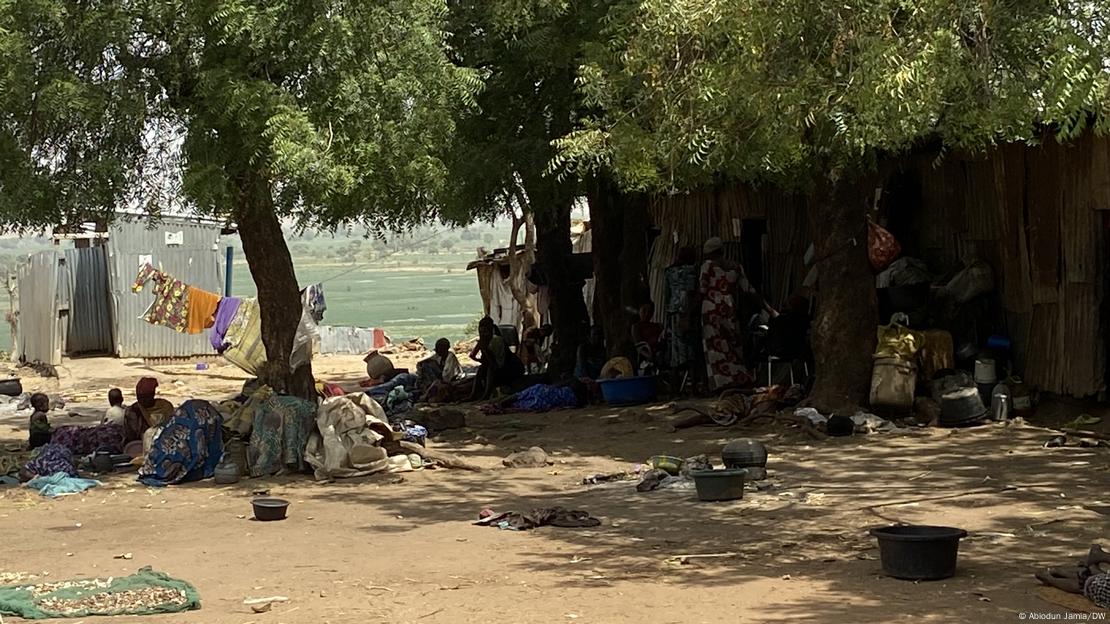
Internally displaced persons at a makeshift displacement camp near Sokoto often face poor living conditions and have no opportunities to find workImage: Abiodun Jamia/DW
Deradicalization efforts yield results in North East

So far, Nigerian officials say Operation Safe Corridor has been instrumental in the fight against insurgency in the North East. The program aimed to rehabilitate former insurgents who surrendered or defected, reintegrating about 2,190 repentant terrorists back into the society.

The initiative is built on five pillars, says Onumajuru. These are: disarmament, demobilization, deradicalization, rehabilitation, and reintegration.

While the program has been relatively successful in the North East region, concerns have been raised about recidivism, with reports of some rehabilitated individuals returning to terror groups.

Now with the intended expansion of the program to the North West, analysts have raised questions about Operation Safe Corridor's effectiveness. This is because the banditry in North West is largely driven by financial incentives like ransom payments, cattle rustling, and illegal mining, rather than ideology.


Boko Haram militants have attacked many communities and killed thousands of civilians, and displaced over a million people
Image: REUTERS


Can Operation Safe Corridor repeat successes?

Samuel Malik, a senior researcher at the pan-African think tank Good Governance Africa, believes the replicating the program is not inherently flawed. He says only "kinetic responses" that involve aggressive measures, often with military action, cannot solve Nigeria's security challenges.

But Samuel Malik adds the program can only succeed in the North West "if it is properly structured, monitored, and adapted to local realities, rather than being a rushed initiative."

"Deradicalization is effective when dealing with individuals who have been indoctrinated into violent extremist ideologies, but most bandits in the North West have explicitly rejected jihadist agendas," Samuel Malik said.

Oluwole Ojewale, an analyst with Dakar-based Institute for Security Studies, said the problem with "Safe Corridor" is that it was developed for terror groups who share extreme views.

"If what the government wants to do is demobilization, it is quite in order. But they cannot afford to copy and paste what they did in the North East and replicate the same in the North West," he told DW.


Deep-rooted problems remain

Critics of Operation Safe Corridor have said the program is perpetrator-centered and risks being seen as a reward system for terrorists.

Dengiyefa Angalapu, a counterterrorism and peacebuilding researcher, said this argument is reductionist. He told DW the initiative can be implemented in the North West as there are multiple actors in the region, including ideological terror groups, which often get generalized under the catchphrase of banditry.

Dengiyefa added that the deep-rooted grievances among herders prompt some to take up arms and make the initiative suitable for the region.

"Kinetic strategy alone cannot lead to a decline in terrorism. This is an initiative that should be expanded to other parts of the country to provide a national framework for countering terrorism," he told DW.

The analysts seem in agreement that this strategy should involve local peacebuilding mechanisms and economic empowerment to prevent relapse.

"While certain elements of the initiative such as psychological support, vocational training, and community reintegration remain crucial, the government should prioritize economic reintegration, conflict resolution, and mechanisms that prevent re-engagement in criminal activities," Samuel said.


Edited by: Cai Nebe
ASEAN summit invites China, Gulf states amid tariffs threat

Thomas Kohlmann
DW
March 9, 2025

The Southeast Asian trade bloc has invited China and several Arab states to a joint summit in Kuala Lumpur in May. Could a new trade alliances emerge in response to Donald Trump's aggressive tariff policies?


Will a new trade alliance emerge from the ASEAN summit in Kuala Lumpur?
Image: CHROMORANGE / Werner Thoma/picture alliance

Malaysia's decision to invite representatives from China and Arab Gulf states to the ASEAN summit in May has made headlines beyond the Southeast Asian nation that currently holds the chairmanship of the 10-member trade bloc.

Malaysian Prime Minister Anwar Ibrahim has insisted though, that the presence of non-members at the summit is not intended as a move against the United States, nor does it signal that the Association of Southeast Asian Nations (ASEAN) is "choosing sides." Rather, he told reporters in Kuala Lumpur, it was about "ensuring ASEAN's strategic relevance in a multipolar world."

However, Anwar's plan for a trade alliance between ASEAN, China, and the resource-rich, investment-driven Gulf states may not sit well with Washington, says Sam Baron, a researcher at the Yokosuka Council on Asia-Pacific Studies in Japan.

"ASEAN nations, several Gulf states, and China all run significant trade surpluses with the US," Baron told the South China Morning Post. "Trump isn't afraid to use trade policy as a sledgehammer. Anwar needs to be cautious."
Natural trading partners?

The combined gross domestic product (GDP) of the Arab Gulf states, comprising the so-called Gulf Cooperation Council (GCC), stood at around $2.1 trillion (€1.96 trillion) in 2023, according to the International Monetary Fund (IMF). Saudi Arabia and the United Arab Emirates (UAE) account for nearly three-quarters of the economic output of the bloc, which also includes Bahrain, Kuwait, Oman and Qatar.

ASEAN is one of the world's fastest-growing economic regions, with a combined population of approximately 690 million. In 2023, its 10 member states reached total GDP of nearly $3.8 trillion, with Indonesia alone contributing a third of that as the group's most populous nation.

For the European Union, ASEAN countries are already key trading partners, ranking third after the US and China. ASEAN's top trade partners, meanwhile, are China, the US, the EU, and Japan.

Despite its economic clout, ASEAN is far from a homogeneous bloc. It includes both low-income nations like Laos and wealthy, highly developed city states like Singapore. Malaysia's per capita GDP, for example, is nearly twice that of Thailand.

"ASEAN countries have actually been benefiting from the US-China trade tensions over the past years, gaining global export market shares and attracting foreign investment," said Francoise Huang, senior economist at Allianz Trade, in an interview with DW.

Beneficiaries of diversified global trade

Since the COVID-19 pandemic exposed vulnerabilities in global supply chains, many multinational companies have increasingly diversified their manufacturing investments away from China and into ASEAN nations.

Huang notes that foreign direct investment (FDI) in ASEAN countries from advanced economies within the OECD has now doubled compared to investments in China. Back in 2018, the situation was reversed.

"ASEAN is also attractive for Chinese companies, with Chinese automakers having invested $5.4 billion there in 2023, nearly tripling the scale from 2015," she said.

Sharon Seah, a senior fellow at the ASEAN Studies Center of Singapore's ISEAS-Yusof Ishak Institute, believes closer cooperation between ASEAN and the Gulf states specifically makes strategic sense.

"Although ASEAN-GCC trade numbers are still relatively modest, there is much room for expansion," she told DW, adding that for the Asians the key strategic imperative was a need to "diversify trade links and increase cooperation outside of the region."

"By enhancing bloc-to-bloc cooperation with partners like the EU and the GCC, ASEAN is hopeful that it can keep multilateral trade open and free," she said
Controlling the world's most important trade route

ASEAN countries Malaysia, Indonesia, and Singapore hold a key advantage in global trade as they border the Strait of Malacca, through which over a quarter of the world's total trade volume passes. Additionally, 80% of oil shipments from the Middle East to China and Japan transit through this narrow waterway.

The Strait of Malacca is one of the busiest trade routes in the world
Image: Cheng Yiheng/Xinhua/picture alliance

US President Donald Trump's trade war, unleashed for now primarily against US neighbors Canada and Mexico, as well as China, makes it difficult to predict how global trade will change, says Sharon Seah. But in light of this, Malaysia's decision to invite China is "unprecedented."

"It can be viewed as Malaysia wanting to expand ASEAN's cooperation with both China and the GCC in a tripartite partnership to leverage each party's strengths," she said.

Allianz Trade's Francoise Huang thinks that the Gulf states could bring substantial financial resources to the table, thanks to their huge oil and gas revenues. So strategic investments in technology and artificial intelligence (AI) could benefit the Asian economies.

"ASEAN could tap on some of that investment for its own growth, positioning its technological sector to attract investment from GCC sovereign wealth funds," said Huang.

ASEAN a future hub of global trade?

A recent study by Allianz Trade suggests that some ASEAN countries are well-positioned to expand their role in global trade.

Malaysia and Vietnam ranked second and third place in the analysis of what could become so-called next-generation trade hubs, exhibiting "high scores in efficiency and trade potential." Indonesia came in at fifth place.

The number one spot in the ranking was claimed by one of ASEAN's potential new Gulf partners — the United Arab Emirates.

Currently, about 20% of ASEAN exports go to the United States. Given Washington's increasingly aggressive trade policies, it is unsurprising that some ASEAN nations are "clearly going towards a diversifying foreign policy approach," says Huang. "For example, Indonesia has decided to join BRICS, while also advancing its roadmap to access the OECD."

Malaysia is also striving to become a member of the BRICS group, which is named after the initials of its founding nations, Brazil, Russia, China, and South Africa.

However, the Trump administration views BRICS as a challenge to the global dominance of the US dollar and has threatened to impose 100% tariffs if the bloc attempts to "play games with the dollar."

This article was originally written in German.
POLITICS DENMARK

Greenland elections to be closely watched by the world
March 9, 2025
DW

Foreign influencers, disinformation, geopolitical ruptures and the potential takeover of a whole region: next week's parliamentary election in Greenland will take place under unusual scrutiny.


Nuuk is the capital of Greenland, home to around 20,000 people
Image: Evgeniy Maloletka/AP Photo/picture alliance

In normal times, this election probably wouldn't be of too much interest to the rest of the world. Around 40,000 voters will choose just 31 parliamentarians, and it will all take place on an island that isn't even fully autonomous.

But these are not normal times and this election is in Greenland, which means it could prove a starting point for further geopolitical upheaval in the Northern Hemisphere.

Firstly, because supporters of independence for Greenland hope the ballot may result in a strong mandate for Greenland's complete separation from Denmark. Currently Greenland, a former Danish colony, is a self-governing territory of the latter.

And secondly, and probably most importantly, because US President Donald Trump has been talking about making Greenland part of the US ever since he was elected last November.

Greenland's mineral wealth


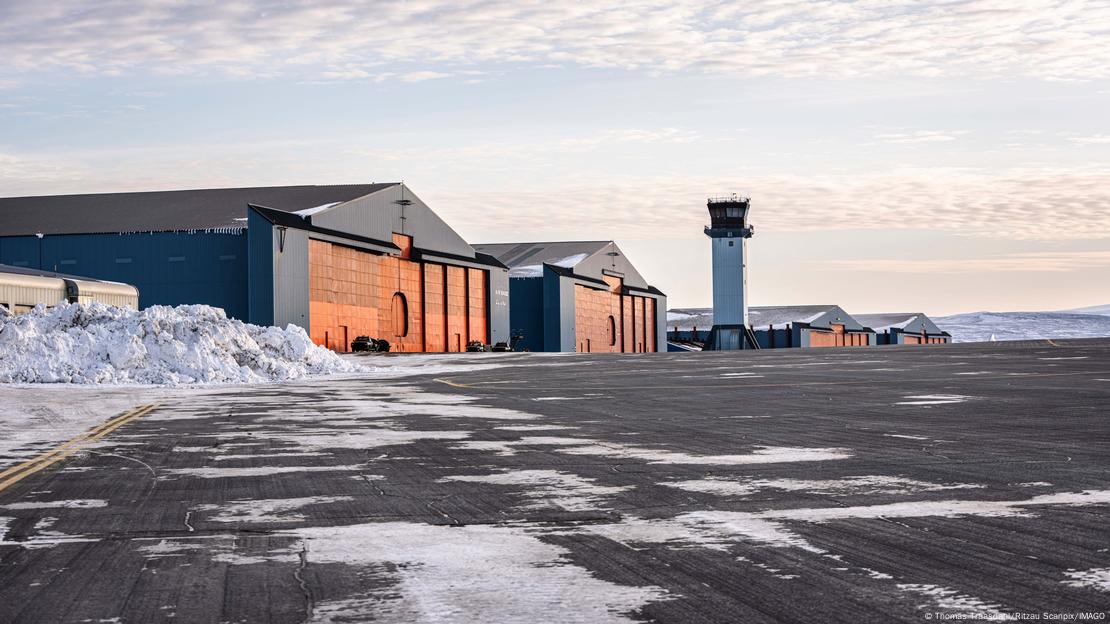
Trump has frequently spoken of how it would be in the interests of US security to control Greenland. Since the 1950s, the US has run the Pituffik Space Base, in the northwest of Greenland.

It is the Americans' northernmost post and plays a key role in missile warnings and space surveillance. Previously, during the Cold War, it was called the Thule Air Base and was there to send early warnings and initiate defense against potential Soviet attacks.

Other than security issues, economics might also play a part in Trump's claims on Greenland. In the south of Greenland, there are thought to be valuable deposits of oil, gas, gold, uranium and zinc.

Thanks to climate change, which is thawing Greenland's ground out, mining these deposits will eventually become easier.

Established in 1951, the Pituffik Space Base in Greenland is the US Air Force's northernmost outpost
Image: Thomas Traasdahl/Ritzau Scanpix/IMAGO

During his first term in office, in 2019, Trump offered to buy Greenland. The government in Denmark swiftly rejected that.

But this term, Trump has continued to express expansionist intentions, over Canada, the Panama Canal and Gaza, as well as Greenland.

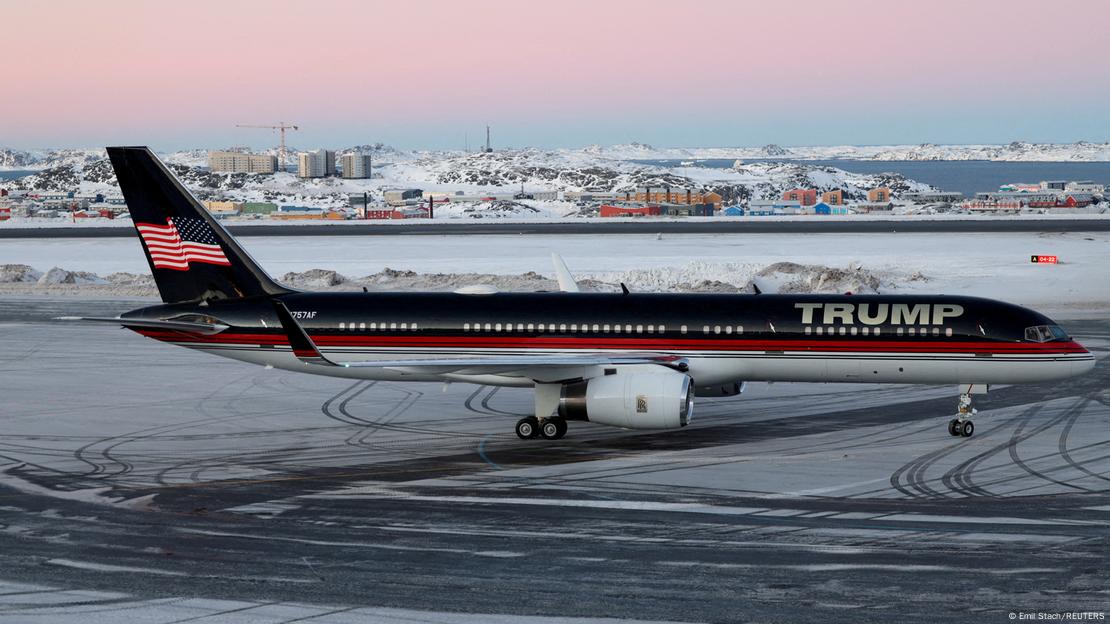
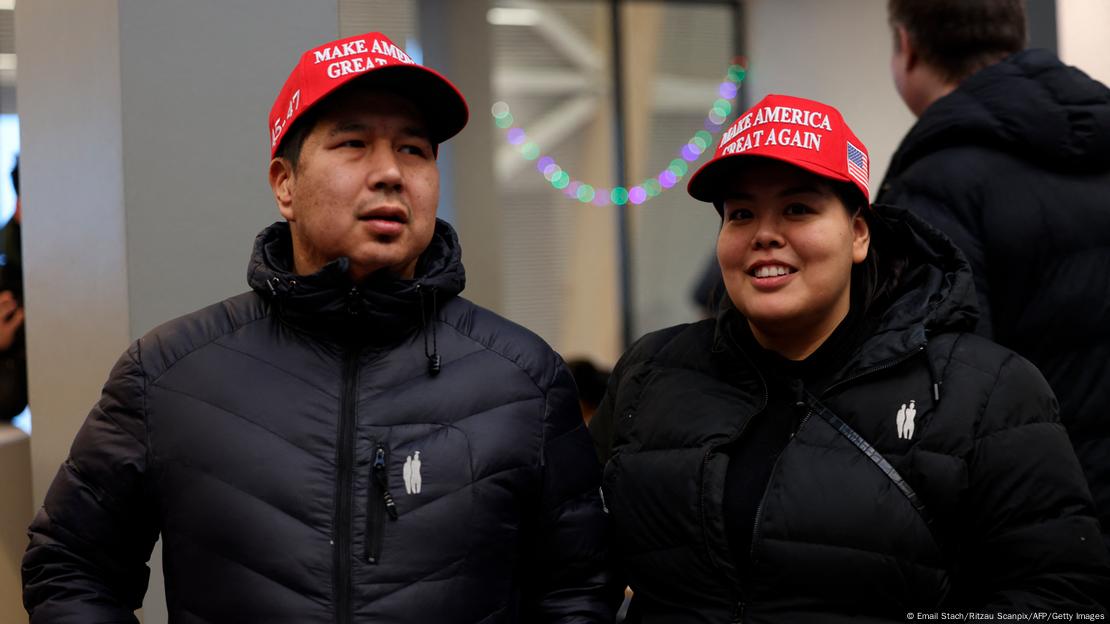
Even before he took up office in January, Trump sent his son, Donald Trump Jr., to Greenland — although officially he was there as a tourist.

A few weeks later, a poll was published showing that only 6% of Greenlanders wanted their island to become part of the US, while 85% opposed to the idea.

In his speech to Congress early in March, President Trump addressed his desire again, directing his comments to the people of Greenland.

"We strongly support your right to determine your own future," Trump said. But just two sentences later, he seemed to renege on that, stating, "I think we're going to get it [Greenland] — one way or the other, we're going to get it."

When Donald Trump Jr. visited Greenland for a day in January, Greenland's government said he was there "as a private individual" and state representatives would not be meeting with him
Image: Emil Stach/REUTERS


Foreign interference?


Given this and upcoming elections, Greenland has had to deal with the possibility that there could be external attempts to influence the country's vote — for instance, from Russia or China, both of whom are also pursuing their own security agendas in the Arctic.

Denmark's national security and intelligence service, PET, warned of Russian disinformation in particular.

"In the weeks preceding the Greenlandic elections' date announcement, several cases of fake profiles were observed on social media, including profiles masquerading as Danish and Greenlandic politicians, which contributed to a polarization of public opinion," PET stated, although it did not link those accounts to any specific country.

Johan Farkas, an assistant professor in media studies at the University of Copenhagen, is familiar with these kinds of posts as they also circulate in Russian media. But he doesn't think they'd have much impact on Greenland's elections because, besides Danish, most locals speak Greenlandic, an Inuit language.

Despite it not being an official trip, Donald Trump Jr. did manage to find some fans in Greenland 
 Image: Email Stach/Ritzau Scanpix/AFP/Getty Images

"Greenland is a very small and tight-knit community in many ways," Farkas told DW. "And so, influencing fake accounts, or these kinds of things that we have seen in the past and in other elections, my assessment is that it's not an easy thing to do."

But that doesn't mean there's nothing to worry about. "My concern as a disinformation researcher has more been around how this plays out in macro-politics. Would we suddenly see Elon Musk hosting live podcast interviews with specific candidates or Trump endorsing specific candidates? That is a very problematic and threatening thing for a free and fair election," Farkas argues, referring to the weeks before Germany's own recent federal election.

During that time, US billionaire Musk appeared on social media with the leader of Germany's far-right political party and US Vice President JD Vance called on German centrist parties to cooperate with the far right.


Political controversies

Since the beginning of the year, there have been a number of controversies around Greenland's upcoming elections. Reports suggest that influencers from Trump's "Make America Great Again" movement distributed $100 bills in Greenland's capital, Nuuk.

Local member of parliament Kuno Fencker traveled to Washington where he met a Republican politician who spoke to him about how Greenland should become an American territory.

Media studies professor Farkas doesn't think the danger has passed — the elections will be held on March 11. "But," he says, "I was more concerned about a month ago than I am right now."

In early February, Greenland's parliament, the 31-seat Inatsisartut, passed a law banning foreign and anonymous donations to local political parties. Danish donations are excluded.

And Trump's offer to buy their country is not the only thing locals will be voting on in the upcoming election.

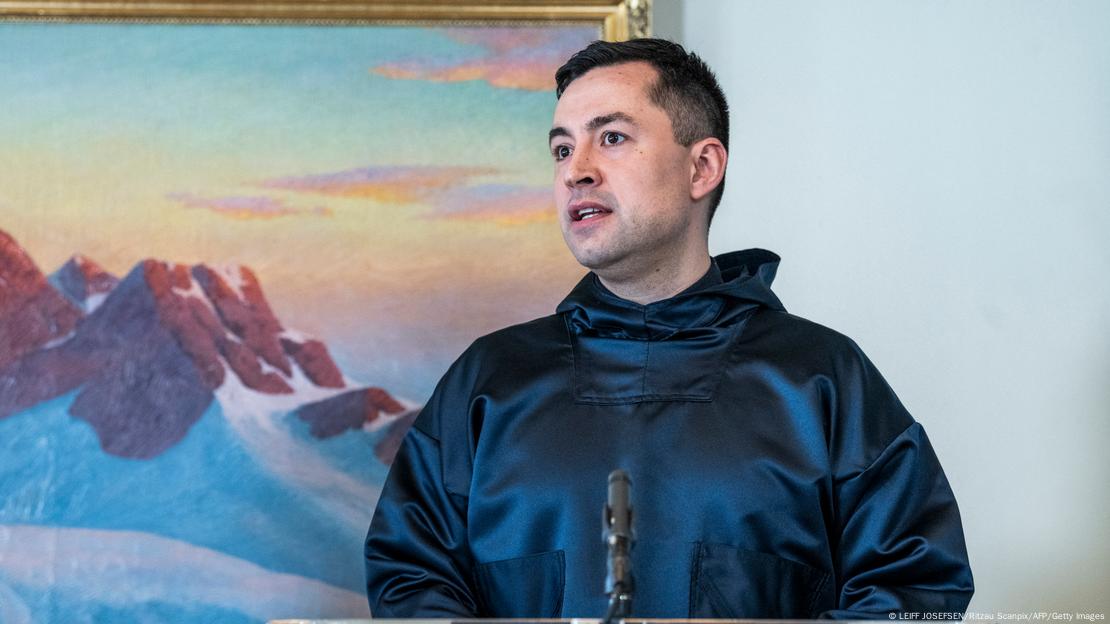
Greenland's Prime Minister Mute Egede is chairman of Inuit Ataqatigiit, a democratic socialist political party, and is hoping for reelection
Image: LEIFF JOSEFSEN/Ritzau Scanpix/AFP/Getty Images


Independence from Denmark


The approximately 57,000 Greenlanders, who call themselves Kalaallit, are also worried about other issues. For example, which mineral resources their island should be developing and whether, and which, foreign partners should get concessions to do this.

The debate around mining revenues is part of the argument some make for becoming independent from Denmark. Allowing foreign interests to mine in Greenland would make Greenland less dependent on Denmark.

This is because "Denmark contributes over half of Greenland's budget revenue to cover employment, health care, and education, with the annual cost of administrative support and direct financial transfers amounting to at least $700 million [€645.5 million] per year," researchers at the Washington-based Center for Strategic and International Studies, pointed out in January.

Independence is a long-term goal, Greenlandic Prime Minister Mute Egede said after Trump's speech to Congress. "We do not want to be Americans, nor Danes; we are Kalaallit. The Americans and their leader must understand that," Egede wrote on social media. "We are not for sale and cannot be taken. Our future is determined by us in Greenland."

Opinion polls show that the majority of Greenlanders probably do want independence from Denmark but they remain undecided as to when and how that will happen.

And that uncertainty won't change after the March 11 election either, says Farkas. "I think the most important thing is to zoom out and acknowledge that this is not a threat that goes away the moment this election is over," he concluded.

"As long as this declared US wish to take over Greenland is there, there is a risk that we suddenly see an escalation of this kind of influence campaign."

This story was originally published in German.


David Ehl Reporter and editor
Middle East: What an end of the PKK would mean for Kurds
DW
MARCH 8, 2025

Following the call by Abdullah Ocalan to disband the Kurdistan Workers' Party, PKK, and to lay down arms, Syrian affiliates and the PKK headquarters in Iraq remain ambivalent. What are their options?


Kurdish forces in Syria and Iraq are uncertain about their future after PKK leader Abdullah Ocalan called for all forces to lay down arms.
Image: DELIL SOULEIMAN/AFP/Getty Images


Kurds in the Middle East have been in a state of limbo since Abdullah Ocalan, the imprisoned leader of the Kurdistan Workers' Party, or PKK, gave his pioneering speech in late February.

In his historic address, he said, "Convene your congress and make a decision. All groups must lay down their arms and the PKK must dissolve itself."

While an official date for such a congressional meeting is yet to be announced, the PKK already stated on March 1 that they would comply. They also declared a unilateral ceasefire.

This could mark the beginning of the end of the PKK and their 40-year-old violent struggle for independence on Turkish territory.

However, until such an end of the PKK is confirmed, Ankara will continue to consider not only Turkey's PKK as a terrorist organization, but also the PKK headquarters in Iraq and affiliates in Syria.

Turkey expects all groups to dissolve, without exception.

In his speech, however, Ocalan did not specifically mention any of the Kurdish forces and administrations outside Turkey, although he did refer to ‘all groups,’ which could be interpreted as referring to Syrian affiliates also.

He also failed to offer an alternative roadmap for the around 35 million Kurds who remain the largest ethnic group without their own state.

The Kurds live in a vast territory, which is split across Turkey, Syria, Iraq, Iran, and Armenia. While they share a common ethnic identity and are predominantly Sunni Muslims, they do not have cross-border representatives, common policies or a joint military defense unit.

PKK spokespeople in Iraq and Syria had different reactions to Ocalan's call.


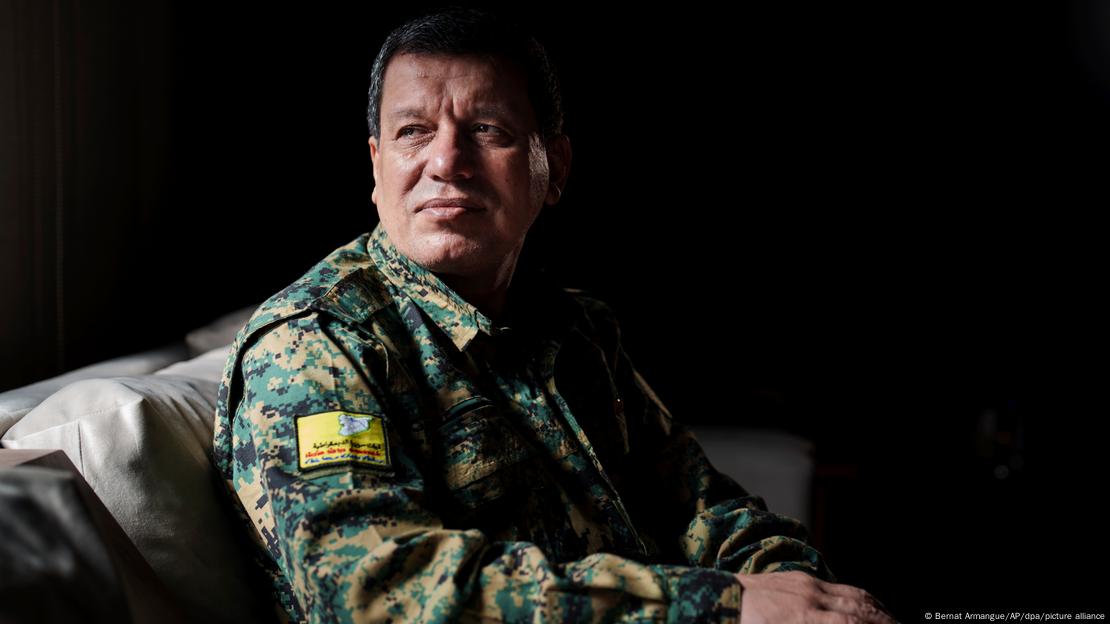
Mazloum Abdi, the commander of the SDF, says that Ocalan's call does not apply to his group.
Image: Bernat Armangue/AP/dpa/picture alliance


Kurds in Iraq

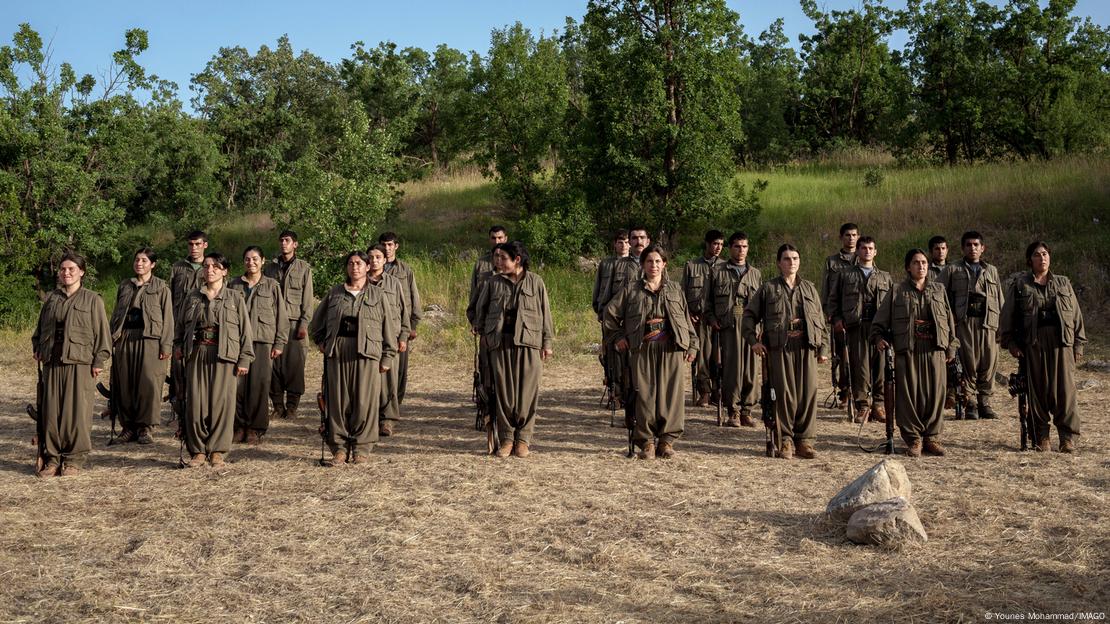
Analysts widely agree that the PKK headquarters in northern Iraq will most likely follow Ocalan's call.

"Once the PKK's congress formally declares it's dissolution and renounces armed struggle, this decision would cover both southeast Anatolia in Turkey [where the Kurdish majority in Turkey live] and militants directly operating under the PKK leadership structure in north Iraq," Nigar Goksel, Turkey and Cyprus project director at the conflict-prevention organization International Crisis Group, told DW.

The president of the semi-autonomous Iraqi Kurdistan region in Iraq's north, Nechirvan Barzani, has already urged the PKK to "commit to and implement this [Ocalan's] message."

Hopes are that an end of the armed fight between Turkey and the PKK in Iraq will not only end ongoing strikes by the Turkish military in the area, but eventually improve political and economic ties between Iraqi Kurdistan and Turkey.


Furthermore, the PKK's dissolution would most likely also improve the political situation in Syria's northeast where Turkey and Kurdish forces have been fighting for years.

"If these groups [in Turkey and Iraq] fully disband and undergo a DDR process [disarmament, demobilization and reintegration], this will unlock unprecedented opportunities for good governance and stability in northern Syria as well as alter the balance of power across the country," Burcu Ozcelik, senior research fellow for Middle East Security at the London-based think tank Royal United Services Institute (RUSI), told DW.

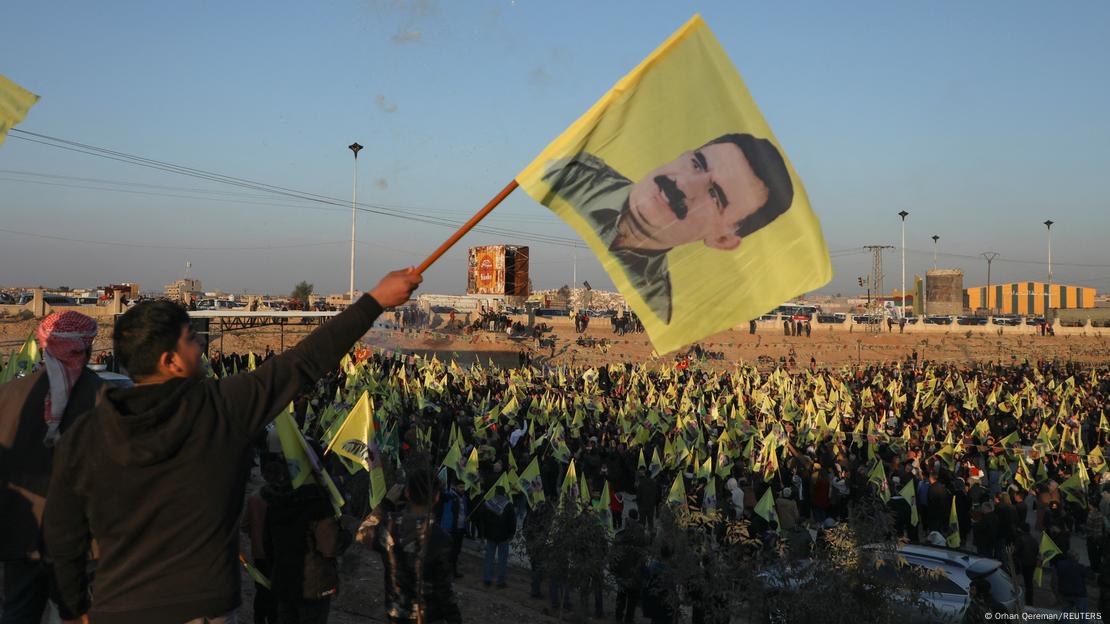
It remains to be seen if or to what extent Syria's PKK-affiliates will continue their political roadmap.Image: Orhan Qereman/REUTERS


Kurds in Syria


Yet, both analysts highlight that the Kurdish forces in Syria don't see Ocalan's call as ultimately binding for themselves.

Kurdish forces consist of the Kurdish Syrian People's Protection Unit (YPG), who are at the core of the Kurdish-led Syrian Democratic Forces, or SDF.

According to Ozcelik, the YPG is organically and institutionally linked to the PKK, and it is unimaginable that Turkey would agree to the YPG’s survival as it currently stands.

However, Mazloum Abdi, the commander of the SDF, already said that the call to dissolve did not apply to his group.

"It is not related to us in Syria," he stated.

He still welcomed Ocalan's call.


"If there is peace in Turkey, that means there is no excuse to keep attacking us here in Syria," Abdi said.

"If the PKK genuinely and demonstrably lays down arms and disbands, meaning that the armed cadres physically hand over their weapons to state authorities as the process would demand, it will be the dawn of a new era," Ozcelik stated.

She also said, however, that this "will not mean that PKK-affiliates operating in northeastern Syria will now have free rein."

I
raq's PKK headquarters are most likely to follow Abdullah Ocalan's call to dissolve.Image: Younes Mohammad/IMAGO


Is an end of the PKK a path to unity?


Ocalan's call for an end of the PKK coincides with an unprecedented situation in Damascus that arose after the fall of Syria's longtime dictator Bashar Assad in December.

Syria's new interim government under President Ahmed al-Sharaa has called on the Kurdish forces to integrate into the national army.

However, the Kurdish forces insist to operate as an individual unit within the army.

So far, the Syrian government has rejected this and also didn't invite the SDF to the country's first national dialogue conference in late February.

While it remains to be seen if, or to what extend the SDF might integrate, the focus of the Kurdish forces is "not on disarmament," Nigar Goksel told DW.

And yet, once the PKK dissolves, the links between the Kurdish forces in Syria and the PKK would effectively be severed, she added.

In turn, Burcu Ozcelik sees that Ocalan's call for an end of the PKK could actually help the Kurds in Syria to gain a political foothold.

"If the Syrian Democratic Forces is able to credibly distance itself from the PKK and its affiliates, and contest in the political space of the new Syria as a pro-democracy party through legal guarantees, it will open the path for political mobilization," Ozcelik said.

Jailed Kurdish PKK leader urges group to disarm and dissolve  02:07


DW's Aref Gabeau contributed to this article.

Edited by: Carla Bleiker


Jennifer Holleis Editor and political analyst specializing in the Middle East and North Africa.

WILDCAT!

Germany: Hamburg airport cancels flights over sudden strike


Nik Martin with AP, DPA
1 hour ago
March 9, 2025

Ground staff walked out "without prior notice," hours before a 24-hour strike was due to begin at a dozen German airports.

Passengers were reportedly given no warning that flights had been canceled


Almost all flights to and from Germany's Hamburg Airport were canceled on Sunday due to a strike by airport workers "without prior notice," the airport operator said.


What do we know?


A spokesperson for Hamburg Airport told DPA news agency that out of 144 arrivals and 139 departures scheduled for Sunday, only 10 early morning flights had run to schedule.

DPA reported the remaining flights have been canceled.

"For this reason, the airport is closed with immediate effect," the spokesperson told DPA.

Public broadcaster NDR reported that many passengers were left stranded by the sudden walkout, with many having already checked in their luggage and having difficulty getting it returned.

Strike had been due to start Monday

The union Verdi has called so-called warning strikes at around a dozen German airports on Monday in a dispute over wages.

Verdi said Munich, Stuttgart, Frankfurt (Main), Cologne-Bonn, Düsseldorf, Dortmund, Hanover, Bremen, Hamburg, Berlin-Brandenburg and Leipzig-Halle airports will be affected.

More than 510,000 travelers could see delays or cancelations of their flights, according to airport association ADV.

An estimated 3,400 flights are expected to be canceled on Monday.

At Hamburg, the walkout had originally been due to start late Sunday evening and continue until late Monday.

A Verdi spokesman told DW: "The walkout was necessary so that the impact of the strike could really be felt."

Edited by: Kieran Burke
Nik Martin is one of DW's team of business reporters based in Bonn.
CRIMINAL CAPITALI$M

France's former spy chief found guilty of using public funds to aid LVMH

A Paris court has found the former head of France's domestic security services, Bernard Squarcini, guilty of influence-peddling and using public resources to benefit LVMH. The trial shed light on efforts by LVMH – the world's biggest luxury group – to protect its reputation.


Bernard Squarcini, former head of France’s internal intelligence agency, has been jailed and fined for misusing public funds. AP - Michel Euler


By:RFI
08/03/2025 -

Squarcini, 69, headed France's domestic security services from 2008 to 2012 and was later hired by luxury giant LVMH as a security consultant.

The court on Friday handed him a four-year prison sentence, two of them suspended, on charges of using his security contacts for personal gain, including by obtaining confidential information for LVMH.

Squarcini, whose professional nickname was "le Squale" (the shark), can serve his sentence at home with an electronic bracelet. He was also fined €200,000 and given a ban on professional activities relating to intelligence or advisory services for five years.

His lawyers said he would appeal the verdict.

Links to Europe's richest man

Part of the verdict was related to the use of public funds to locate blackmailers targeting LVMH chairman and CEO Bernard Arnault in 2008, while Squarcini was still head of DCRI French security services (since renamed the DGSI).

That year, security agents staked out a cyber cafe in Aix-en-Provence to identify a suspect sending emails seeking to extort Arnault as part of a mission Squarcini defended as protecting French economic interests.

Arnault, Europe's richest man, testified during the trial in November as a witness but was never charged and denied all knowledge of a scheme to protect the luxury group.

French luxury mogul Arnault defiant at ex-spy chief trial
'A call to order'

Squarcini was also found to be complicit in spying on François Ruffin, a former journalist and founder of leftist magazine Fakir who is now a leading lawmaker with hard-left France Unbowed.

Ruffin filed a lawsuit in 2019 accusing LVMH of contracting Squarcini to spy on him for nearly three years while filming a satirical documentary "Merci Patron" (Thanks boss) for which the Fakir team planned to disrupt an LVMH shareholder meeting in 2013.

The film won a Cesar – France's equivalent of the Oscars – for best documentary in 2017.

Ruffin's lawyer, Benjamin Sarfati, welcomed Friday's verdict. "We are satisfied with this decision that serves as a call to order, though we regret the absence of Mr Bernard Arnault among the defendants," he said.

Proceedings against LVMH were dropped in 2021 after the company paid a €10 million settlement to close the criminal probe.

Squarcini, a close ally of former president Nicolas Sarkozy, was sacked as head of intelligence in 2012 after Sarkozy lost his re-election bid to François Hollande. Hollande, a Socialist, considered Squarcini was too close to the former right-wing president.

(with Reuters)


Windfall for European arms makers as Brussels ramps up defence spending

Weapons manufacturers across Europe are rushing to secure contracts after EU countries announced plans to dramatically increase defence spending. Share prices of European arms companies had already risen sharply following the US decision to suspend military aid to Ukraine.


Ukrainian servicemen fire with a French self-propelled 155 mm/52-calibre gun Caesar towards Russian positions at a front line in the eastern Ukrainian region of Donbas on June 15, 2022. © Aris Messinis / AFP
07/03/2025 

Under the "Rearm Europe" plan announced by EU Commission President Ursula von der Leyen on 6 March, EU member states can boost defence spending even if it means breaking the bloc’s budget deficit rule of 3 percent of GDP.

Von der Leyen suggests the EU could raise "close to" €650 billion over four years, which would be added to a €150 billion loan to member states for defence investment, totalling €800 billion.

European arms manufacturers view this as a golden opportunity to compete against their US rivals.EU leaders vow to boost defence as US announces new talks with Kyiv

Some deals are already in motion. During a meeting in London on 2 March, UK Prime Minister Keir Starmer announced a €1.9 billion agreement to supply 5,000 Lightweight Multi-role Missiles (LMMs) for use against drones and helicopters.

Thales Belfast, a UK-based subsidiary of French defence giant Thales Group, which produces NLAW (Next-generation Light Anti-tank Weapon) missiles for Swedish defence manufacturer Saab, is expected to benefit from the surge in demand. Saab specialises in aerospace, missile systems and military technology.

This is likely just one of many contracts that will be offered to European arms contractors, shifting the burden of providing Ukraine with weapons from the US to Europe's "coalition of the willing" – EU countries together with the UK and Norway.Europe's defence vulnerabilities exposed as US shifts on Ukraine

Arms manufacturers have profited substantially from the Ukraine conflict.

The share value of French company Thales increased by about 50 percent between the beginning of the Russian invasion on 24 February 2022 and the end of 2024.

Shares development of French weapons manufacturer Thales. The first red bar indicates the start of Russia's invasion of Ukraine, the second the inauguration of Donald J. Trump as President of the US. © Screenshot Google Finance

Until now, according to the Ukraine support tracker of the Kiel Institute for the World Economy (IFW), EU countries plus the UK and Norway provided €61.94 billion in military aid to Ukraine, compared to €64.1 billion from the US between the start of Russia's invasion and the end of 2024.

Weapons supplied to Ukraine since the invasion began include US F-16 and French Mirage-5000 fighter jets, US Abrams tanks, French Caesar howitzers, various missile systems, Patriot air defence systems, armoured vehicles, light weapons, millions of rounds of ammunition and US-made Javelin anti-tank systems that became a symbol of Ukraine's resistance.

A US soldier fires a Javelin anti-tank missile. US ARMY/AFP/File

Following Trump's apparent reluctance to continue military aid to Ukraine and Europe's reaction, the effect on local weapons producers was immediate.

Market statistics show that performance of US defence companies had already fallen behind European arms companies before Trump's election as US president on 5 November 2024. After his victory, the gap widened.

After Trump's inauguration on 20 January and particularly following his announcement of plans to suspend military aid to Ukraine after a difficult meeting with President Volodymyr Zelensky at the White House on 28 February, Thales shares soared – as did those of other European arms manufacturers.

Stockmarket development of Rheinmetall, the german weapons manufacturer. Shares jumped from just over €1,000 to €1,150 on 28 February 2025 after a spat between US President Donald J. Trump and Ukranian President Volodymyr Zelensky. 
© Screenshot Google Finance

Starlink dependency


US policy changes could also impact Ukraine’s battlefield communications. The Ukrainian military has relied on Elon Musk’s Starlink satellite network since Russian strikes wiped out other communications systems.

But SpaceX, the company behind Starlink, has raised concerns about the network being used for military purposes.

Last month, SpaceX President Gwynne Shotwell said Starlink was "never, never meant to be weaponized," adding that the company never intended for it to be used offensively.

US Treasury Secretary Scott Bessent has reportedly floated the idea of cutting Ukraine’s access to Starlink unless Kyiv agrees to grant the US access to critical materials such as rare earth elements, lithium, and other essential resources.

Eutelsat

Now, Europe is looking at alternatives. Paris-based Eutelsat, the world’s third-largest satellite operator by revenue, is in talks to replace Starlink in Ukraine.

CEO Eva Berneke told Bloomberg that after "discussions about the Starlink potential pull-out of Ukraine," Eutelsat shares more than tripled in value over two days, adding over €1 billion to its market capitalisation.

"It is a key element of modern warfare to have strong communications capabilities," Berneke said. She added that discussions to replace Starlink with Eutelsat’s OneWeb satellite network "have intensified".

The logo of the European satellite operator Eutelsat is seen at the company's headquarters in Issy-les-Moulineaux near Paris, France, October 11, 2021. 
© GONZALO FUENTES/REUTERS

Currently, Ukraine has around 40,000 Starlink terminals, nearly 10 times the number provided by Eutelsat. Berneke said the company could supply "a couple of thousand" terminals immediately but would need "a couple of months" to replace all 40,000.

Eutelsat’s system would eventually be part of the EU’s "Secure Satellite System" IRIS², a flagship project launched on 17 December. The hardware is supplied by Italian aerospace company Telespazio, a joint venture between Italy’s Leonardo (67 percent) and France’s Thales Group (33 percent).EU launches flagship satellite project to rival US networks by 2030

Drones

On 6 March, Italian company Leonardo signed a deal with Turkey's Baykar for a joint venture to produce drones as defence companies rush to respond to the surge in European military spending.

Increased demand may revive the EU's Eurodrone project, a four-nation development programme involving Germany, France, Italy and Spain.

Meanwhile, the Czech Republic announced it will extend its Czech ammunitions initiative with Denmark, Canada, Portugal and Latvia, which already supplied Kyiv with 1.6 million rounds of large-calibre ammunition last year.

Overall, the biggest winners from the increase in EU defence spending are likely to be Germany's Rheinmetall, France's Thales and Saab of Sweden, while BAE systems of the UK is well-positioned to benefit from increased military budgets across EU nations.
  
A view of a Leopard 2 tank at a production line at the future site of an arms factory where weapons maker Rheinmetall plans to produce artilleries from 2025, in Unterluess, Germany, Monday Feb. 12, 2024. AP - Fabian Bimmer


Sir Basil Zaharoff, the infamous sales agent for Vickers, was probably the world's best-known. Page 6. arms dealer through World War I. Zaharoff once boasted to ...

The major arms companies in Britain before the war were Vickers Sons & Maxim Ltd, Armstrong and Whitworth, and Coventry Ordnance Works.


LA REVUE GAUCHE - Left Comment: Search results for PERMANENT ARMS ECONOMY


Ukraine war   SILVER LININGS

How the Russian invasion has sparked a renaissance of Ukrainian culture

As the war in Ukraine enters its fourth year, going to the theatre or visiting one of the city's newest bookshops provides a moment of refuge for the people of Kyiv. But culture has also become a powerful means of resistance and a way to assert Ukrainian identity.


Sens is a bookshop and café on three levels which opened a year ago in the centre of Kyiv. © Aurore Lartigue/RFI


By:RFI
04/03/2025 - 

As the war in Ukraine rages on and air raid alerts in Kyiv remain a daily occurrence, a somewhat surprising new trend has flourished on TikTok – young people are posting about the race to get hold of theatre tickets.

"Before, we used to announce new seasons a month in advance. Now we open ticket sales three months in advance and within two hours, everything's gone," said Victoria Bourkovska, the administrator of the Ivan Franko National Theatre – currently celebrating its 105th anniversary – who can hardly believe this turn of events.

In 2024, the hot ticket was for The Witch of Konotop, an adaptation of a 19th-century satirical novel about a Cossack chieftain battling witches. On TikTok, videos of the play have been viewed millions of times.

EU leaders in Ukraine to mark third anniversary of Russia’s invasion

In front of the pastel blue facade of the theatre, Veronika and her group of friends are delighted to be among the lucky few who have seen the play. Yet Grehori, 32, confesses that before the war, he had never set foot in a theatre. One day he went along, and loved it. Tonight, the group don't know what they're going to see: "We just took whatever tickets they had."

Evgeny Nuschuk, director of the Franko Theatre since April 2024, said: "There is a theatre craze at the moment. And it's not just in Kyiv. With theatre, there's this here and now aspect." A living art form, a format that chimes with current events, it is also a source of inspiration for the future, as reflected in the theatre's slogan for the new season: "Today's theatre must reflect tomorrow's society."

There have been adjustments since the invasion. Big Russian names such as Pushkin and Chekhov have been eliminated from the repertoire – but a new generation of directors has seized upon Ukraine's literary and theatrical heritage.

Actor, former Minister of Culture and involved in the Ukrainian armed forces, Evgeny Nuschuk is now director of the Ivan Franco theatre in Kyiv, Ukraine, February 2025. © Aurore Lartigue/RFI
Fundraising for armed forces

In the event of an air raid alert, the play is stopped. And familiar faces have disappeared from audiences. "We have lost some regulars," says Nuschuk. "They had bought tickets for the evening of 1 January, intending to start the year with us. Some other spectators brought flowers to lay on their seats."

Before taking over the reins of the establishment, the director twice served as the country's minister of culture. In the early days of the war he volunteered, and the theatre is engaged with the war effort. "In six months, we have collected more than 55 million hryvnias [almost €1.3 million] for our armed forces. Our troops perform in military hospitals and we lend our spaces to displaced troops from Sumy, Kherson or Mariupol every Monday," said Nuschuk.

Zelensky hails Ukraine's 'heroism' on third anniversary of Russia's invasion

"There has always been a renaissance of Ukrainian culture in difficult times," Tetiana and Olha told RFI. These two students have also become regular theatre-goers since the start of the war.

"Remember the proliferation of poetry and theatre in the 1920s, for example [at the time of the occupation by the Soviet Union]. But I also think that one of the reasons for the craze we are experiencing is that today's directors are reviving a certain authenticity in Ukrainian culture, breaking away from the rigid and overwhelming Russian culture embodied by the great authors and the great ballets."
Language as resistance

In this cultural war, language is another battlefield. In a country where most people have historically mastered both Russian and Ukrainian, the former is being rejected while use of the latter has become a symbol of resistance.

On Khreshchatyk Avenue – Kyiv's Champs-Élysées – where Vladimir Putin was planning a victory parade in 2022, the Sens bookshop opened its doors a year ago. On this Saturday afternoon, its two floors are bustling with people, particularly young people. With its café and stylish interior, it's eminently Instagrammable. The store's motto? "You can do what you like here, but not in Russian." You won't find any books in the language of Tolstoy for sale in this shop.

When the first Ukrainian language only bookshop opened, just before the full-scale invasion of February 2022, many people were sceptical, says Oleksii Erinchak, one of the owners and founders of Sens. "We would always hear that books in Ukrainian were more expensive, that there were few translations and therefore little choice... We wanted to promote books in Ukrainian. And we've shown that there is a demand for them."


The Sens bookstore, in the center of Kyiv, Ukraine, opened in February 2024. 
© Aurore Lartigue/RFI

He added: "Of course, it's an act of resistance. For centuries, Russia stifled our culture. This is like putting a protective dome over it." He believes culture is a weapon, one Russia had tried to deploy in Ukraine long before the invasion: "Putin thought that the Ukrainians would welcome the Russians with open arms because culture had already prepared the ground."

Before the war, around 75 percent of the book market in Ukraine was made up of books imported from Russia, illustrating Russian influence. Since 2022, these have been banned.

Today, eight of the shop's top ten bestsellers are written in Ukrainian. They include a collection of love poetry, an anthology on Ukrainian nationalism, and a thrilling detective novel by Illarion Pavliuk, a Ukrainian writer and journalist turned soldier.

The bookshop also organises the collection of Russian-language books for recycling, with the money raised going to anti-aircraft defence.

Macron warns Trump: ‘No weakness’ with Putin as France enters ‘new era’

Maria Smirova, who is browsing for books to give as gifts with her husband Dimitrov, said: "Before the war I only bought books online, and most of them in Russian. Now everything has changed. We only speak to each other in Ukrainian and we've got rid of all our books in Russian." For her, shopping here also means supporting Ukraine.

Over the last two years, some 50 new bookshops have opened across the country. According to Rostyslav Semkiv, a professor of literature at the University of Kyivand a literary critic, this "cultural blossoming" can be explained by "a reformatting of our identity".

"Before 2014, the cultural landscape was dominated by a post-Soviet identity. The large-scale invasion shattered this identity. This Ukrainian ethnic identity has become political. Many people are starting to take an interest in Ukrainian history, art and literature. What makes up Ukrainian culture? There is a search for ‘Ukrainianness’," he explained.

Somoloskyp (meaning "torch"), the small Ukrainian-language publishing house run by Semkiv, is a testament to this movement. "Ten years ago, for us, printing 1,000 or 2,000 copies of a book was huge. Today, we have average print runs of 4,000 to 5,000 copies, and we can go up to 30,000. And every book that comes out goes very quickly," he says. Production is in fact struggling to keep up with demand, with the printing works slowing down as a result of the war.
Renaissance and resilience

In a basement in the centre of Kyiv, around 30 people have taken their seats. "Glory to Ukraine! Putin, you dickhead!" shouts stand-up comedian Arthur Petrov as he takes to the stage.

Nadiya and Stanislas, who discovered Petrov on YouTube, are here hoping to escape for an hour "from our difficult daily lives, and hear a few good jokes about Russkies, fighting and body bags," says Stanislas, with a heavy does of irony.

"Laugh and keep your head up" is the name of the programme offered by this venue, the Underground Standup Club, which was founded in 2016 and sends 20 percent of its takings to the armed forces.
Stand-up comedian Anton Zhytlov in a room in a new district of Irpin, near Kyiv, Ukraine on 26 January, 2025. © Aurore Lartigue/RFI

When the hour is up, Petrov has another engagement – a charity show with two other comedians in the town of Irpin, near the capital, which has been hit hard by the war. The money raised will go to a charity that buys drones.

The show is taking place in the brand new community hall of a newly built neighbourhood, on a street formerly known as Dostoevsky Street and now renamed for Olha Kobylianska, a Ukrainian feminist writer. The atmosphere is warm among this young, hip audience.

Russians who refuse to fight in Ukraine see hope of sanctuary in France

Taxi drivers, the Montessori education method, talking in Ukrainian during sex, air raid alerts... war is not the only ground covered by the comedians, and laughter is clearly an outlet. Far from silencing it, the war has seen a huge increase in the number of comedians performing in Ukraine.

"Before the war started, most of the big stand-up shows in Ukraine were in Russian," says Anton Zhytlov as he leaves the stage. "With the start of the war, we stopped using Russian and this has led to a sort of renaissance in Ukrainian humour."

In the audience, Rima is happy to be able to relax a little. Her husband is at the front, but she doesn't know where exactly. "It's invaluable for our mental health," she says.

For Zhytlov, the fact that Ukrainians still go to stand-up shows and comedians continue to perform, despite the war, is indicative of the national mentality: "We are courageous and we look fear in the eye. We're not afraid of anything."

This article has been adapted from the original in French, by our correspondent in Kyiv.
DRC mineral contract with China slammed by NGOs citing 'major losses'

A controversial mining deal between the DRC and China has come under the spotlight, as NGOs and civil society groups warn of financial losses and lack of transparency, one year after the 'contract of the century' was updated.


Workers walk in the copper-cobalt Mutanda Mine in southeastern Democratic Republic of Congo, on 19 June 2023. AFP - EMMET LIVINGSTONE

By: RFI
07/03/2025 -

A major mining agreement between the Democratic Republic of Congo and a Chinese consortium is facing renewed scrutiny, as civil society organisations allege that a recently renegotiated deal continues to put the Congolese state at a disadvantage.

The CNPAV coalition – "Le Congo n'est pas à vendre" or "Congo is not for sale" – comprises of anti-corruption NGOs who claim the new terms are still heavily skewed in favour of Chinese companies, resulting in a $132 million (€124 million) loss for the DRC in 2024 alone.

The group is urging the government to reopen negotiations to secure a fairer agreement.

The so-called "contract of the century" was originally signed in 2008 under then-president Joseph Kabila, granting Chinese companies access to extensive copper and cobalt mines in exchange for infrastructure development.

Renegotiated in early 2024, the agreement was meant to yield nearly $4 billion (€3.8 billion) in additional benefits for the Congolese.

However, watchdogs argue that the new terms fail to rectify previous imbalances.

Long road for DRC as it renegotiates minerals deal with China


Fluctuating markets


One of the primary concerns raised by CNPAV is the dependence of infrastructure funding on the fluctuating price of copper.

Under the revised terms, the DRC is supposed to receive $324 million (€312 million) annually for road infrastructure over a 20-year period.

However, these payments are only guaranteed if copper prices remain above $8,000 (€7,700) per tonne.

If prices fall below this threshold, "the state will receive less, or even nothing at all," warns the coalition.

Additionally, even if copper prices soar to $12,000 per tonne, the Congolese side will still receive the same $324 million, preventing the country from fully benefiting from market upswings.

Eastern DR Congo grapples with Chinese gold mining firms


Skewed payment structure

A further criticism of the deal lies in its fixed payment structure, regardless of the volume of minerals extracted.

Baby Matabishi, coordinator at the Carter Center-DRC and a member of CNPAV, highlighted the issue in an interview with RFI’s Kinshasa correspondent Pascal Mulegwa.

"Everything depends on the price of copper. There is this volatility and uncertainty of price, which doesn't necessarily guarantee that the $324 million is secured," Matabishi explained to RFI.

The NGO also raises a key inconsistency: "How can it be understood that a company that produces 100,000 tonnes of copper pays $324 million – and on the day it produces 200,000 tonnes or 400,000 tonnes – and then pays the same amount?" Matabishi emphasised.

Hence, the lack of a production-based scaling mechanism means the DRC does not proportionally benefit from increased mining output.

CNPAV has also condemned ongoing tax exemptions granted to Chinese companies, which cost the DRC at least $100 million annually.

While the Kinshasa government argues that infrastructure development will offset any losses, civil society organisations claim that many promised projects remain incomplete or substandard.
Archaeological findings on France's Ile de Ré reveal North Sea trade links

Archaeological excavations on the Ile de Ré, an island off France's Atlantic coast, have unearthed graves and artefacts dating back to the 8th century – findings that confirm trading ties with Northern European and Celtic peoples.


\Archaeologists have uncovered 50 graves on the on Ile de Ré, including that of this individual, who was buried with a pearl necklace and an iron basin. 
© INRAP/Yohan Manthey
RFI
02/03/2025 - 

"What is exciting and quite unique is to find various objects from as far as Ireland, England, the Netherlands and Germany buried with the corpses in this part of western France, in the late 8th century," archaeologist Annie Bolle, of France's National Institute of Preventive Archaeological Research (INRAP), told RFI.

Bolle is the scientific project manager for excavations taking place at La Flotte, a village on the Ile de Ré, off the French Atlantic coast.

INRAP was called in to look at a plot of land ahead of the construction of a house – because in 1985 a Gallo-Roman villa dating back to the 4th century was unearthed next door.
This 9th century map shows the position of Ile de Ré, on France's Atlantic coast. © INRAP

Between October and December 2024, the INRAP team uncovered around 50 graves in and outside a chapel. Having belonged to the priory of Saint Eulalie, according to texts from 1156, it was later destroyed during the French Wars of Religion, between Catholics and Protestants, in the 16th century.

"The findings provide rare tangible evidence of close ties between the Carolingian Empire [a Frankish empire in Western and Central Europe during the early Middle Ages] and a population from the North and Celtic Seas," said Bolle.
Unusual burials

Five of these graves stood out. The position of the bodies and the artefacts they were buried with "are quite rare to find on Ile de Ré or even in western France," explained Bolle.

Two of the bodies were not positioned in the customary Christian fashion, with the heads facing east towards Jerusalem, but were orientated towards the south.

The lower limbs of some were bent rather than extended, as would be expected. Furthermore, two others were laid on their sides and one female was found lying face down.

Millennial surprise as Gallo-Roman graveyard unearthed in Paris

"The bodies in the five graves were buried with various objects and ornaments. This practice, common during the 6th and 7th centuries, disappeared later in the 8th and 9th centuries, around the time we think the five were buried," said Bolle.

Among graves unearthed on Ile de Ré, 13th century bell ovens can be seen in the centre. © INRAP/Clémence Pilorge

The archaeologists found two combs and necklaces made of amber, glass, bone and copper beads.

The findings from the La Flotte excavations have been preserved and will undergo analysis to gather information about their composition and provenance.

"By finding out what technique was used to make the combs, we will be able to tell when and where they were made. DNA testing of the material used – bones or antlers – will help us to more accurately determine where they came from," Bolle explained.

Other artefacts unearthed include a metal belt with an intricate design, and a knife similar to one previously found in the south-east of England.
Excavation of a burial site at La Flotte on Ile de Ré, on France's Atlantic coast. © INRAP/Clémence Pilorge
Social status

"Stable isotopes analysis of the human bones will help us to reconstruct the diet of the individuals," Bolle said, explaining that what they ate will give an indication of where they came from – as well as their social status, given usually only people with means could afford meat.

Notre-Dame: archaeological discoveries reveal centuries of history beneath cathedral

"Paleogenetic analysis of the skeletons’ DNA should help us determine the sex of the individuals and whether they were related or not," she added.

The findings have been sent to various laboratories around France, with some at the Arc’Antique Laboratory in Nantes, while some of the DNA testing – of the combs, for example – will be done at the Natural History Museum in Paris.
Trade links

Most of the artefacts unearthed from the graves appear to originate from northern Germany, the Netherlands, south-east England and the area around Dublin in Ireland. The beads are Irish, the knife or the belt could come from England and the combs may come from the Frisian region in north-western Europe – in modern times, parts of the north of the Netherlands and north-west Germany.

Examination under a binocular magnifier of a copper alloy belt at the Arc’Antique laboratory in Nantes. © INRAP/Patrick Ernaux

"What is fascinating is trying to uncover how the various objects from so many different places found their way in this small plot of land on Ile de Ré," Bolle said.

"The La Flotte excavations [have uncovered] rare archaeological evidence of the active trade relations we’ve read about between the Carolingian Empire and the population around the North Sea."

Danish and German archaeologists have already shown an interest in the La Flotte findings. Now follows at least two years of investigation to uncover the story behind them.

France returns ancient artefacts to Ethiopia

"What we don’t know yet is whether the individuals were locals buried with their own objects or whether they were foreigners buried on this land," said Bolle. "It says a lot if the foreigners were buried amongst the locals. It means that they were well accepted. And, resonates with what is happening nowadays in terms of tolerance towards migrants."