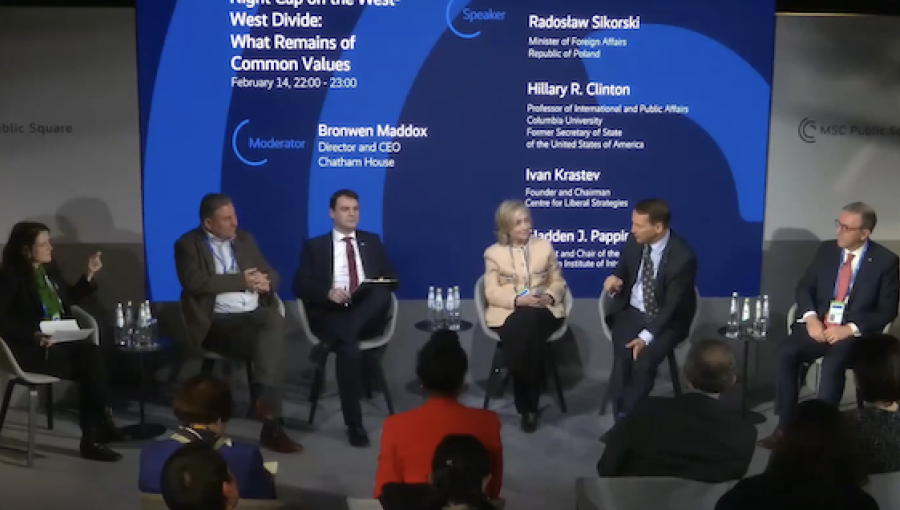
US President Donald Trump praised the Czech Minister of Foreign Affairs and the leader of the anti-green and Eurosceptic Motorists for Themselves party Petr Macinka following Macinka’s participation at a debate at the Munich Security Conference where he provoked clashes with Hillary Clinton and his Polish counterpart Radek Sikorksi.
“Great job in your Debate against Hillary Clinton on various subjects, including her ridiculous views on Gender. Say hello to everybody in your wonderful Country! President DJT,” Trump wrote on his Truth Social online platform.
At the debate on February 14, Macinka defended Trump policies in the US, saying that “I think what Trump is doing in America is a reaction that in some political areas it went too far, too far from regular people, too far from reality,” as reported by the Czech Press Agency (CTK) and other media.
“I disagree with gender revolution, with climate alarmism,” Macinka stated, pushing the gender issues on the agenda of the security conference, to which Clinton replied “what gender, that women have their rights?”
During the debate at a panel, which also included Bulgarian political scientist Ivan Krastev and Hungarian political scientist Gladden Pappin, Clinton slammed the Trump administration for “pushing Ukraine into a capitulation to Putin,” which she described as “shameful”.
“I think that the efforts of Trump and Putin to benefit from the suffering and death of Ukrainians is a historical mistake,” Clinton also stated.
Macinka also criticised the European Parliament at the debate suggesting that national parliaments are supposed to have more democratic legitimacy, which prompted Macinka’s Polish counterpart Radek Sikorski to point out that both EU and national parliaments emerge from democratic elections held in the EU member states.
Macinka also travelled as a Czech observer to the first meeting of Trump’s Board of Peace in Washington D.C. where he said he had met with leaders of US administration and Trump had asked him whether he saw his Truth Social post.
“Surprisingly everyone, the American President, as well as the American Vice President and the Minister of Foreign Affairs, saw a record of my debate with Hillary Clinton at the Munich conference,” Macinka was quoted as saying by online news outlet Seznam Zprávy.
AU CONTRAIRE
RAGOZIN: Rubio in Budapest, pulling Orban's puppet strings
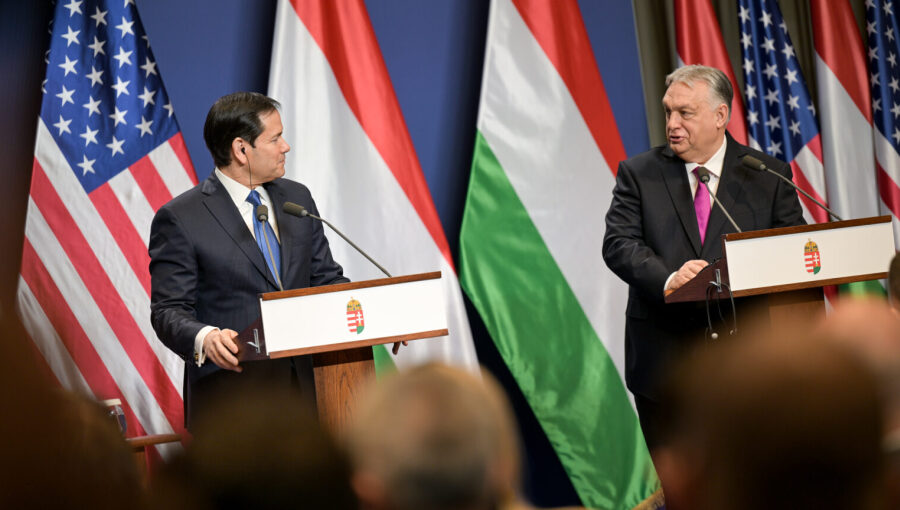
When US state secretary Marco Rubio toured Hungary and Slovakia last weekend, American liberals were aghast. They were specifically flared up by Rubio openly endorsing the incumbent Hungarian prime minister, Viktor Orbán, in the upcoming elections scheduled in April.
Some claimed Rubio had no right to interfere in the democratic process in a European country, others made it clear that they simply wanted Orbán, who defies EU leadership and Western liberal mainstream on Ukraine, to be defeated. “If I were just an average Hungarian, my attitude would be: I want to be electing somebody who’s for Hungary, not somebody who is a puppet of Donald Trump”, Rubio’s predecessor Hillary Clinton said in an interview.
Interfering in other country’s political process is of course a staple of standard America foreign policy, which Clinton embodies. She was instrumental in overthrowing Muammar Gaddafi’s regime in 2011 - a move which instead of helping to democratise Libya, plunged it into a civil war that kept raging for many years. Her husband, Bill Clinton, intervened in Yugoslavia, taking the anti-Serbian side instead of trying to act as an arbiter and genuinely trying to prevent ethnic cleansing, on all sides. By doing so, he triggered Russian prime minister’s Yevgeny Primakov famous U-turn over the Atlantic and with it - a new historical cycle of superpower confrontation in Europe that would eventually lead to the war in Ukraine.
One larger than life feature of American interference in Eastern Europe, by both Democratic and Republican administrations has always been their flirtation with local nationalism, no matter how rabid - as long as it is anti-Russian. This pattern reached grotesque proportions in Ukraine, starting with US undersecretary of state Victoria Nuland touring Maidan barricades and posing for photos with revolutionary leaders, including the anti-Semitic far-right leader Oleh Tiahnibok, and going all the way to the US funding of corps-sized ideologically far-right military formations controlled by people with clear neo-Nazi roots, such as Andriy Biletsky.
But - thanks to globalism and American leadership - local politics in Europe has to a large extent become an extension of domestic American politics, which in its turn has grown critically polarised during the last decade. These days, the American political barricade - between far-right populists and self-proclaimed “liberals” (their liberal credentials warrant much scrutiny, especially in foreign policy matters) - extends into countries like Hungary and Poland. This is the context behind Rubio’s visit to Hungary with a clear aim of endorsing the Trump administration’s ideological ally in Europe on the eve of Hungarian elections - in defiance of the EU leadership which sides with Trump’s liberal rivals in America.
Rubio’s political intervention in Hungary triggers the liberals, but what they will never admit is the causality between their own endorsement and nurturing of rabid East European nationalism over past decades and Eastern Europe turning against them now, as manifested by Orbán and many others today.
Liberal poster child
Orbán might be currently trailing behind his chief rival Peter Magyar of the Tisza party, but he represents a larger-than-life trend - that which spreads all across the former Eastern Bloc, especially across the Visegrad Group (Poland, Czechia, Slovakia and Hungary), once a prime showcase of the radical Westernisation former Soviet satellites underwent in the 1990s. To a varying extent, these countries have all fallen under the spell of modern far-right politics, which - as its inner logic dictates - brings them to questioning their geopolitical choices, either cautiously or brazenly, as Orbán has been doing over the last decade.
This trend is not going away even if Orbán loses the election in April. His rival Magyar, to begin with, is a former functionary of Orbán’s own party who treads carefully in order not to antagonise the undecided electorate by saying things that veer too far away from Orbán’s nationalist paradigm, especially on Ukraine.
With Orbán serving as the region’s most prominent political role model, two neighbouring countries - Slovakia and Czechia - have been overtaken in recent years by politicians of the same political streak. Even the main bulwark of hardcore Atlanticist supremacism in Eastern Europe, Poland, elected a far-right Ukraine sceptic, Karol Nawrocki, as it president. Meanwhile in Romania, it took a brazen interference of the secret services in democratic process to prevent Russia-friendly far-right candidates from seizing the presidential office.
While liberal commentators favour conspiracy theories about the European far-right being Russian assets, alongside Donald Trump, this trend truly stems from the inherent bug of velvet revolutions that swept away Europe’s communist regimes back in 1989-91. It was the liberals who sowed what they are reaping today.
These revolutions liberated a few dozen countries from a totalitarian regime, but they truly weren’t genuinely liberal. They were engineered by an alliance of liberals and nationalists in which the former were - a) often phoney, b) a minority.
Nationalism and Western supremacism, not liberalism, were the main components of velvet revolutions. The instincts of East European politicians were far closer to their right-wing authoritarian and, at times, quasi-fascist predecessors from the 1930s, an epoch celebrated as a golden age across the region, then to the slogans of multiculturalism and tolerance championed by Bill Clinton or later by Barack Obama.
They played along with what they thought was the decadent West’s childish games of fancy until the West itself began embracing far-right politics, whereupon they began showing their true colours. Orbán embodies this evolution. Back in the 1990s he was a poster child of East European liberalisation, becoming the vice-chairman of the global Liberal International in 1992. But mindless and cynical geopolitics trumped liberalism from the outset. Like Lech Wałęsa of Poland and Václav Havel of Czech Republic, he championed the policy of extending NATO to the Russian borders while explicitly keeping Russia out of the Euro-Atlantic integration - a policy that lies at the heart of the current conflict in Ukraine.
Orbán’s later evolution into a conservative and nationalist politician first, and into Putin’s ally in the EU later, was only natural and logical, dictated by the original algorithm of an East European politician from his generation. Russian President Vladimir Putin himself underwent the same evolution since being elected in 1999. But his or Orbán’s trajectory reflect the political and cultural evolution of the entire Global North, of which Russia remains a prominent part, even as a temporary outcast. The trend of far-right radicalisation doesn’t originate in Moscow or Budapest, on the West’s cultural and political periphery. It comes from its very heart - Washington DC.
The inherently illiberal and xenophobic component of velvet revolutions affected the political thinking in the 1990s. In her famous book Not One Inch, US historian of international diplomacy Mary Sarotte describes how the constant pressure from Eastern European leaders Wałęsa and Havel, aided by personal ambitions of middle-ranking Clinton administration staffers, resulted in the US-led West losing a historical chance to integrate Russia and forget about conflicts in Europe for at least another century. Their argument boiled down to a vague future Russian threat, which was non-existent at the time, but it turned into a self-fulfilling prophecy as Moscow began to feel more and more ignored, alienated and excluded from European integration in the late 1990s.
Orbán model in Ukraine?
Fast-forward to the conflict in Ukraine and Western liberals find themselves irreversibly stuck in an unholy alliance with far-right extremists, far worse than Orbán, which they’ve now spent decades whitewashing and nurturing, while simultaneously denying its very existence.
People like the leader of Azov Movement (a vast network of huge army units, paramilitary youth and veteran organisations) Andriy Biletsky, has long become one of the liberal Western media’s darlings in Ukraine, while Yevhen Karas of the neo-Nazi group C14 gets invited to lecture British highbrow society at Chatham House.
What completely escapes the liberal mainstream is that people like Biletsky and Karas are ideologically infinitely closer to more obscurantist elements inside Putin’s regime than to liberal values. The Azov Movement’s ideas of Reconquista, a white supremacist revolution in Europe, are a version of Russia’s Duginism, the only true difference being over the choice of capital for the new Reich - Kyiv or Moscow.
Just like their like-minded comrades and old friends in Russia, the Ukrainian far-right is a largely inorganic political force that derives from an unholy alliance of secret services and organised crime groups, both adopting neofascism as their corporate ideology. The Azov Movement in particular was strongly influenced by Russian neo-Nazis with clear FSB links from its inception as “Little Black Men” in the Kharkiv region in the spring of 2014.
These elements are traditionally easier for the Kremlin to negotiate with than with the more mainstream politicians in Ukraine. Just look at Georgia, if you wonder how far-right ideology, along with the West's bizarrely counter-productive foreign policy, helped to sway this country, once a showcase of post-Soviet Westernisation, to Moscow’s side.
Look at the oscillations of major Ukrainian far-right leaders, Illia Kyva and Oleh Shiryayev, in recent years for a foretaste of things to come, if the war ends on the terms largely dictated by Moscow, which it most likely will.
A prominent Right Sector personality who once called for executing pro-Russian Ukrainians in Donbas, Kyva, broke up with Ukrainian ultra-nationalism and united forces with Putin’s main ally in Ukraine, Viktor Medvedchuk, helping to set up a paramilitary wing of the latter’s parliamentary party in 2019. He managed to recruit Oleh Shiriayev, an influential Azov Movement figure who controlled a large chunk of the movement’s paramilitary force in Kharkiv.
When Russia launched an all-out invasion of Ukraine in 2022, their paths parted. Kyva escaped to Russia where he was assassinated by Ukraine’s secret services a year later. Shiryayev, on the other hand, chose the Ukrainian side and eventually became the commander of the 225th regiment, which played a prominent role in Ukraine’s failed Kursk operation. Ukrainian President Volodymyr Zelenskiy awarded him with the Hero of Ukraine title.
Today, Shiryayev appears on major English-language TV networks, such as CNN and Sky News, being presented as a brave hero, his past digressions never pointed out or even remembered. But what further career twists we might expect from him is the million dollar question. His current glorification by Western media highlights modern Western liberals’ trademark unscrupulousness coupled with extreme arrogance when it comes to anything related to the former Soviet Union. What will they say if, disillusioned with the lack of sufficient Western aid, the Ukrainian far-right will start turning to Putin, like Chechen President Ramzan Kadyrov’s clan did in Chechnya in the early 2000s? Perhaps nothing - today’s liberal milieu is hardly known for deep strategic thinking, more about immediate gain at the expense of their own future.
But is it even fair to call them liberals these days when what they represent is just another streak of Western supremacist populism, simply with another set of bogeymen and conspiracy theories than Trump? That’s a bigger question, which warrants another investigation.

No comments:
Post a Comment